
How to Set Up Wholesale Pricing on Shopify: Sign-Up, Approval and Price Lists (2026)
 Jignesh Vagadiya
22/10/2026
9 min read
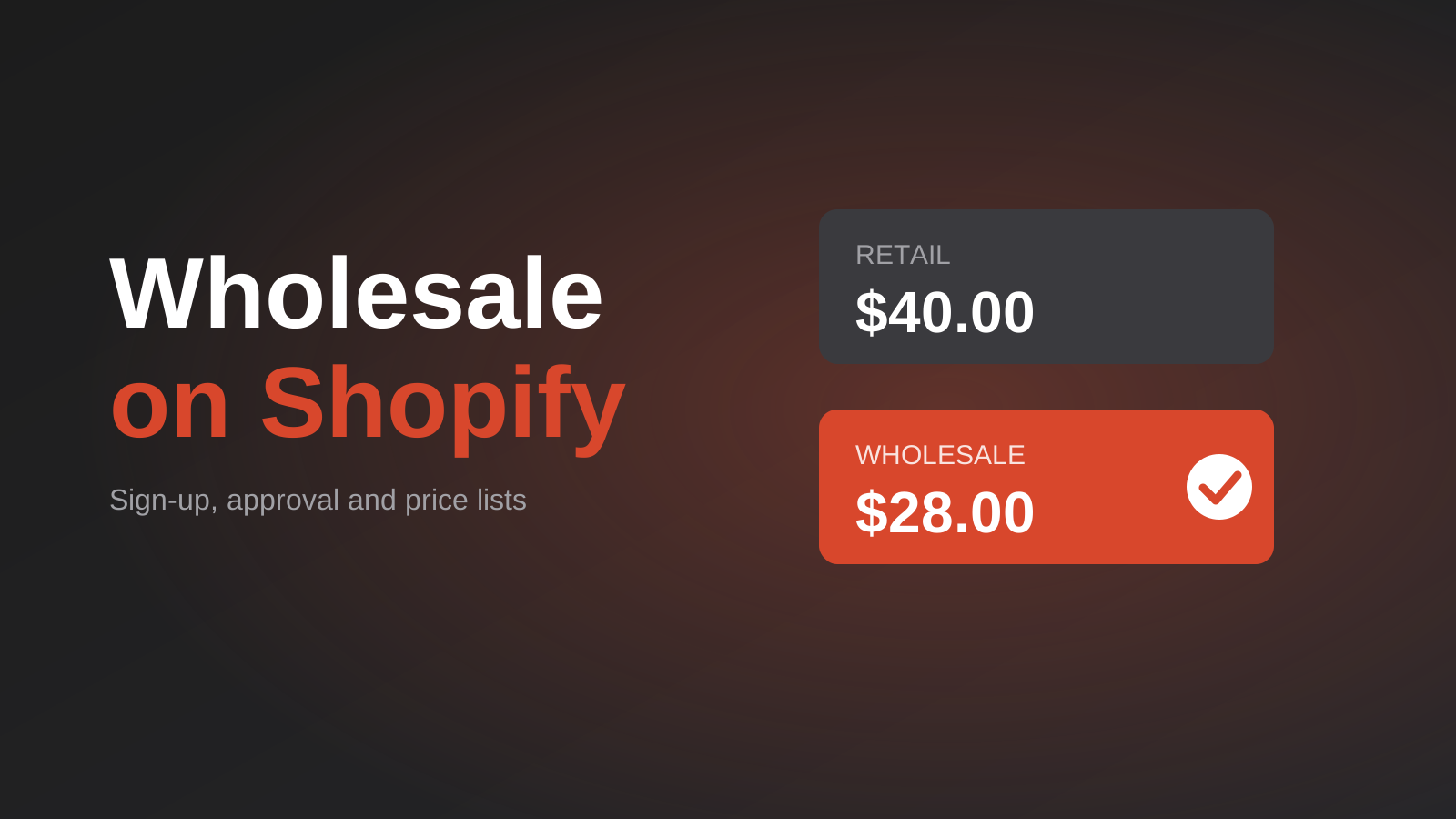
Sooner or later most successful Shopify stores get the same email: “Do you do trade pricing?” A cafe wants to stock your product. A reseller wants a better rate on volume. A small business wants to buy twenty at a time and would like to know what that looks like. At that point you have a decision to make about how wholesale is going to work, and the temptation is to answer with a discount code and hope for the best.
Discount codes work for about a fortnight. Then someone shares the code, a retail customer finds it, and you’re discounting for everyone. A proper wholesale setup does three things: it decides who qualifies, it shows those customers the right prices (and nobody else), and it makes the rates easy to keep up to date. This guide walks through each, including the options for doing it on Shopify, the decisions worth making before you build anything, and the mistakes we see most often. If you’d like to see how our own app handles it, there’s a section on GD: Wholesale Pro near the end.
Three Ways to Sell Wholesale on Shopify
1. Shopify’s built-in B2B features. Shopify has been building native wholesale tools, including company accounts, catalogs and payment terms. Which of them you can use depends on your Shopify plan, and the details have been changing, so check Shopify’s current documentation for what your plan includes before you decide. If your plan covers what you need, it’s the most integrated route. If it doesn’t, or you only need a simple trade tier, it can be more than you need.
2. An app on your existing store. Wholesale apps add registration forms, approval, and customer-specific pricing to the store you already run. This is the usual choice for small and mid-sized merchants: quick to set up, no second site to maintain, and the cost scales with how much you use it. The trade-off is that you’re relying on the app’s capabilities and its support. We compare general-purpose apps in our guide to Shopify apps worth paying for.
3. A separate wholesale store or portal. A dedicated store, or a custom-built B2B portal, gives you complete control over catalogue, pricing rules and ordering experience. It also means double the admin and, for a custom portal, a real development budget. This makes sense for larger trade operations with account-specific catalogues, ERP-driven pricing or approval chains. It’s probably overkill for your first twenty trade customers.
Decide the Rules Before You Build Anything
The tools are the easy part. The decisions are what make a wholesale channel profitable or a headache, and it’s much cheaper to make them on paper first.
Who qualifies
Write down what makes someone a wholesale customer. For most Australian businesses that’s a registered business with an ABN who is buying to resell or to use in their own business. You can check an ABN on the Australian Business Register’s public lookup, abr.business.gov.au. Decide whether there’s a minimum first order, whether you need a trade reference, and whether you want to approve everyone manually. Manual approval is more work, and for a new channel it’s worth it: it keeps a lid on bargain hunters and gives you the chance to say hello.
How the pricing is structured
There are three common patterns, and you can combine them:
- One flat percentage off retail. Simple to explain and to maintain, but blunt. It treats a $5 item and a $500 item the same way, even though your margin on each is different.
- Price lists with set wholesale prices. A specific price per product or variant. More work to set up, much more control, and the right choice when your margins vary across the range.
- Tiers by customer group or volume. Standard trade, preferred, distributor. Reward buyers for commitment rather than just for asking.
Whichever you choose, work out your actual margin at the wholesale price for your most popular products, including shipping and payment fees, before you publish. A wholesale rate that feels generous at a glance can wipe out the profit on a slow-moving line.
GST and how prices are displayed
Retail customers in Australia generally see GST-inclusive prices. Trade buyers who are registered for GST typically think in ex-GST terms, because they can claim it back. Decide how wholesale prices will be shown and make sure your tax settings and invoices match, so a customer expecting to pay $28 plus GST doesn’t see $28 including GST and feel misled, or the other way around. Your accountant can confirm the right treatment for your business; we cover the accounting side in our Xero integration guide.
Build the Registration Form and Approval Flow
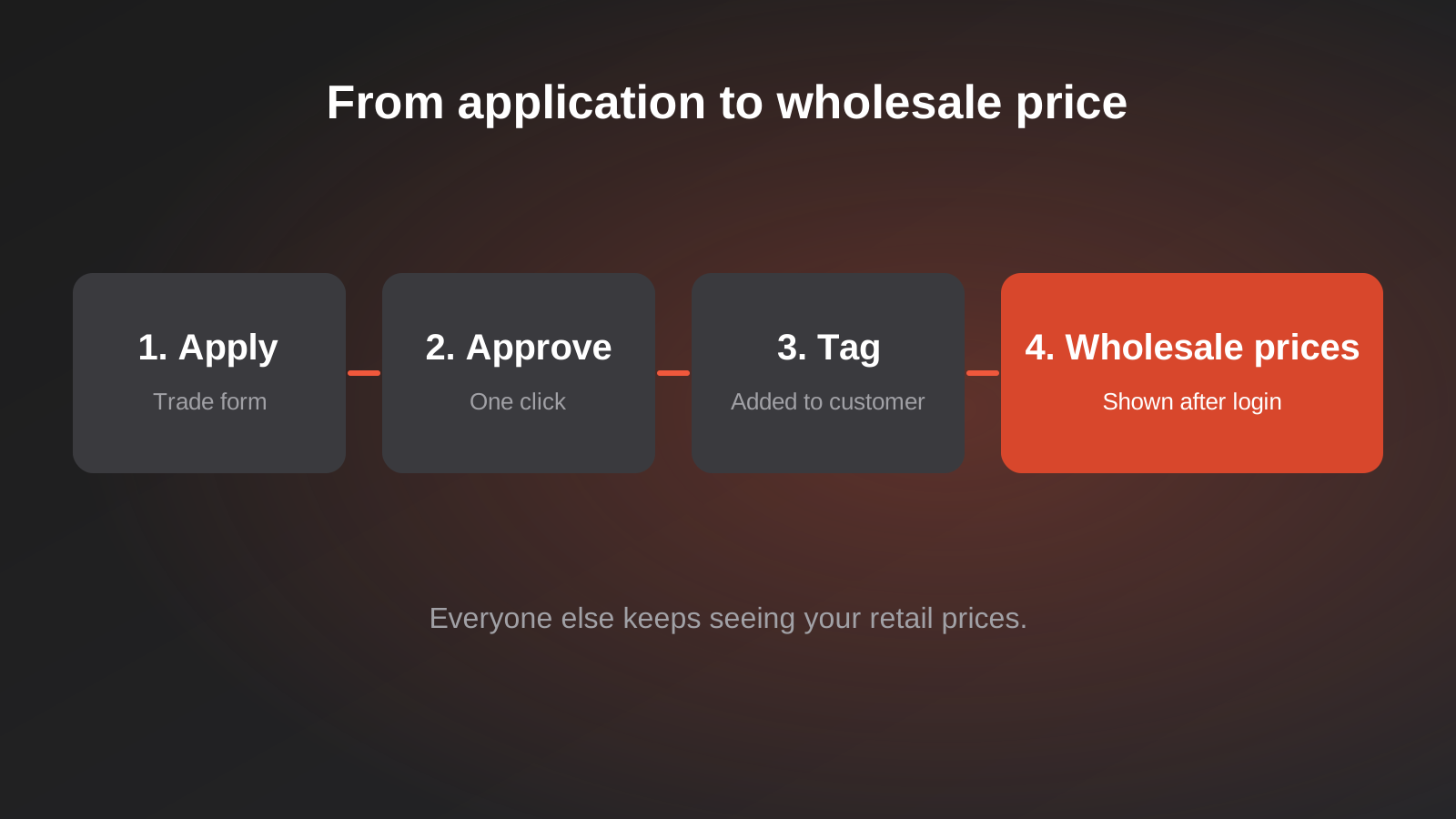
A good application form asks for enough to make a decision and no more. A sensible starting set:
- Business name and ABN
- Contact name, email and phone
- Type of business (retailer, cafe, reseller, trade, other)
- Website or social profile, if they have one
- Expected monthly or annual spend, roughly
- Delivery address
Behind the form, you need a flow that works without you becoming a bottleneck. Applications arrive somewhere you will actually see them, you can approve or decline quickly, and approval does something automatically, usually adding a tag or customer group that triggers the wholesale pricing. If approval means manually editing each customer record, the channel won’t scale past the first handful.
Keep Wholesale Prices Away From Retail Shoppers
This is the part to test, not assume. Once the setup is done:
- Browse the store logged out and confirm you see retail prices only, including in search, collections and any product feeds.
- Log in as an approved wholesale customer and confirm the wholesale prices appear on product pages, in the cart and at checkout.
- Log in as a registered but not-yet-approved customer and confirm they see retail.
- Check emails and invoices show the right amounts.
If you run Google Shopping or other feeds from your store, confirm they use retail prices. Wholesale rates leaking into a public feed is an awkward way to find out your setup has a gap.
Keeping Rates Up to Date
A wholesale price list isn’t something you set once. Supplier costs change, you run seasonal promotions, you add products. If your catalogue is more than a few dozen items, editing wholesale rates one variant at a time becomes a recurring chore that quietly stops happening. A spreadsheet workflow, where you export the current rates, edit them in bulk and import them back, is the practical answer. Whatever tool you use, make sure it can show you what will change before it changes it. We go deeper on that process for retail prices in our guide to bulk updating Shopify prices from a supplier price list.
Where GD: Wholesale Pro Fits
We published GD: Wholesale Pro for the middle option above: wholesale on the store you already run. It provides custom B2B registration forms with an approval workflow and automatic customer tagging, wholesale price lists with tiers and discounts, and Excel import and export so large catalogues can be updated in one go. Approved accounts see wholesale rates and everyone else sees retail.
There’s a free plan covering ten active B2B pricing variants, which is enough to test the idea on a handful of products, and paid plans that raise the limit. Current prices and compatibility are on the Shopify App Store listing, which is the place to check before installing. If your needs go beyond what an app does, such as account-specific catalogues or approvals tied to your ERP or CRM, that’s the point at which a custom build is worth discussing. See our Shopify development and custom software pages.
Common Mistakes
- Starting with a discount code. It spreads, it can’t distinguish customers, and it’s hard to take back.
- Not checking the margin. A flat percentage can make your best-selling cheap items unprofitable at wholesale.
- Approving everyone automatically. Fine once the channel is established, risky on day one.
- Forgetting GST presentation. Trade customers want to see ex-GST pricing clearly.
- Never testing as a logged-out shopper. That is the test that catches leaks.
- Letting the price list go stale. Build the update workflow before you need it.
- Ignoring fulfilment differences. Trade orders are bigger, and often need different shipping, packing or payment terms. Decide how you’ll handle them before the first order arrives.
Frequently Asked Questions
How do I offer wholesale pricing on Shopify?
Either use Shopify’s own B2B features if your plan includes what you need, add a wholesale app to your existing store, or build a separate wholesale store or portal. Most small and mid-sized merchants start with an app, because it adds registration, approval and customer-specific pricing without a second site. Whichever route you take, decide who qualifies and how prices are structured first.
How do I stop retail customers seeing wholesale prices?
Use a setup where wholesale prices only appear to approved, logged-in trade customers, and test it as a logged-out visitor and as a registered but unapproved customer. Check that product feeds and emails use the correct prices. A shared discount code can’t give you this protection, which is why it isn’t a good long-term approach.
Should wholesale prices include GST?
Trade customers registered for GST usually expect to see prices excluding GST and can claim it back, while retail prices in Australia are normally shown including GST. Decide how wholesale prices will be displayed and make sure your tax settings and invoices match. Your accountant can confirm the right treatment for your business.
Should I approve wholesale applications manually?
When you’re launching a trade channel, yes. Manual approval keeps out bargain hunters, gives you a chance to check the ABN and the type of business, and lets you start the relationship. Once you understand who applies, you can consider relaxing the rules for applicants who meet clear criteria.
How do I update wholesale prices across hundreds of products?
Use a spreadsheet workflow: export the current wholesale rates, edit them in bulk, and import them back, previewing the changes before they apply. Editing variant by variant doesn’t scale past a few dozen products. Apps like GD: Wholesale Pro include Excel import and export for exactly this reason.
Where to Start
Before touching any settings, write one page: who qualifies, what the first order minimum is, how prices are structured, and how GST will be shown. Then pick the option that fits. If you want to try wholesale on your existing store, the GD: Wholesale Pro page explains what the app does and how it’s priced, and if you’re weighing a bigger build, see our wider Shopify guide for Australian ecommerce brands.
Keep reading
Related posts
Best Ecommerce Platforms for Australian Retailers in 2026: Six Options Compared
Six ecommerce platforms for Australian retailers compared honestly: real fees, GST and payments, drawbacks and who each one actually suits.
How to Bulk Update Shopify Prices From a Supplier Price List (Without Breaking Your Catalogue) (2026)
How to update Shopify prices in bulk from a supplier spreadsheet: SKU matching, cost vs sell price, GST, compare-at prices, and a…
How to Update Shopify Inventory in Bulk by SKU: A Spreadsheet Workflow for Multiple Locations (2026)
A practical spreadsheet workflow for updating Shopify stock in bulk by SKU across multiple locations, with the traps that corrupt inventory and…
Got a project you'd like to talk through?
Tell us what you're working on — we'll come back with a plan.
