
Black Friday & Cyber Monday Marketing for Australian Ecommerce Stores (2026)
 Jignesh Vagadiya
14/11/2026
22 min read
Black Friday is two weeks away. If your Klaviyo flows aren’t built, your checkout hasn’t been stress-tested and nobody’s actually confirmed what “30% off sitewide” means once the exclusions are applied, this is the moment that matters more than any other on the calendar. Not because Black Friday and Cyber Monday are new — they’ve been running in Australia for close to a decade now — but because the businesses that treat it as a proper campaign, planned months out, consistently outperform the ones that bolt a discount banner onto the homepage in the last week of November.
We work with Australian ecommerce stores on exactly this kind of peak-season planning, and the pattern repeats every year: the stores that win Black Friday and Cyber Monday aren’t necessarily discounting harder than their competitors. They’re the ones whose email flows were sequenced weeks in advance, whose site didn’t fall over under the traffic spike, and whose “was” price on the strikethrough banner was actually a was price. The ones that lose aren’t losing on discount depth either — they’re losing to a checkout that chokes at 2pm, an abandoned-cart flow that was never updated for the sale, or an ACCC-flagged pricing claim that turns a good campaign into a bad headline.
This guide walks through how to actually plan Black Friday and Cyber Monday for an Australian store: the shape of the local peak season (which is not a copy of the US calendar), the email and SMS sequencing that does most of the heavy lifting, the technical readiness that stops a good campaign from crashing at the worst possible moment, and the Australian Consumer Law questions around countdown timers and discount claims that more businesses are getting wrong than you’d expect.
How the Australian peak season actually works
Most Black Friday advice online is written for the US market, where the calendar is simple: Thanksgiving, then Black Friday, then Cyber Monday, done. Australia’s peak season is messier than that, and treating it like a single day costs businesses real revenue on either side of it.
The 2026 dates, and what sits either side of them
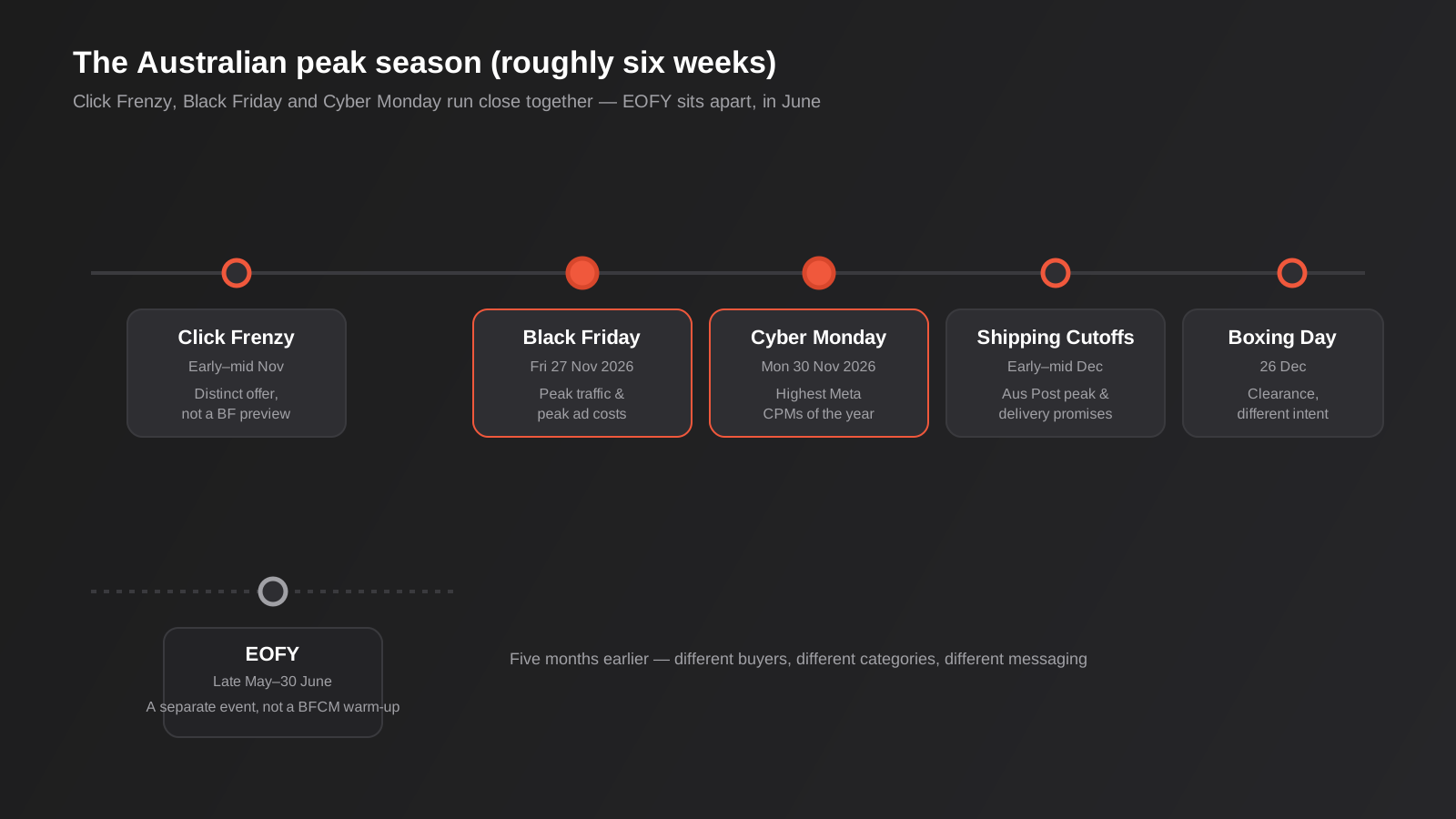
Black Friday 2026 falls on Friday 27 November, with Cyber Monday following on Monday 30 November. Those dates are fixed by the US retail calendar (the Friday after Thanksgiving, the Monday after that), and Australian retailers have simply adopted them as the anchor for the local sales period.
What most generic BFCM content misses is Click Frenzy, the homegrown Australian sales event that typically runs in the first half of November, ahead of Black Friday rather than on top of it. In 2025, Click Frenzy’s Main Event ran from the Tuesday evening to the Friday of the second week of November, finishing roughly two weeks before Black Friday itself. At the time of writing, Click Frenzy hadn’t locked in its exact 2026 dates, so check clickfrenzy.com.au directly rather than assuming it lines up with the same week this year — but the pattern of “early November, ahead of Black Friday” is a safe planning assumption.
Put together, the realistic Australian peak season is closer to a six-week run than a single weekend: Click Frenzy in early-to-mid November, Black Friday and Cyber Monday at the end of the month, continued Cyber Week offers through the first days of December, Australia Post’s Christmas shipping cutoffs in the first half of December, then Boxing Day sales straight after Christmas. If your campaign plan has one email and one ad set covering all of that, it’s doing a lot less than it could.
Why EOFY isn’t a Black Friday warm-up
Australian retailers have a second major sale period that doesn’t exist anywhere in the US calendar: End of Financial Year, running through late May and June, with the deepest activity in the final two weeks of June. It’s genuinely useful to understand EOFY and BFCM as two separate, differently-shaped events rather than one long “sale season” mentality, because the customer psychology is different in each.
EOFY skews toward work-deductible categories — electronics, office equipment, tools, software — and a meaningful share of EOFY buyers are small business owners bringing forward a deductible purchase before 30 June, not bargain-hunting in the way a Black Friday shopper is. Black Friday and Cyber Monday, by contrast, skew heavily toward fashion, apparel and the international brands that treat it as their single biggest trading event of the year worldwide. If your store runs the same messaging and the same offer structure for both periods, you’re very likely leaving conversion on the table in at least one of them.
What this means for your planning calendar
Practically, this gives you three checkpoints rather than one: a Click Frenzy decision (participate or sit it out, and if you participate, keep the offer distinct from what’s coming two weeks later), the Black Friday/Cyber Monday event itself, and the shipping-cutoff period immediately after it where “order by this date for Christmas delivery” messaging does real work. Each of those needs its own content, its own flow triggers and, ideally, its own creative — reusing the same banner for six weeks straight is one of the more common ways Australian stores quietly fatigue their list before the biggest sales day of the year even arrives.
Building the email and SMS flow calendar
For most Australian ecommerce stores, email and SMS do more of the actual revenue-generating work over Black Friday and Cyber Monday than any single piece of paid media. That’s partly because flows are already running in the background and partly because BFCM is often the one week of the year a brand emails its entire list, including people who’ve gone quiet for months. Getting the sequencing right matters more here than almost anywhere else on the marketing calendar.
Sequencing before, during and after the sale
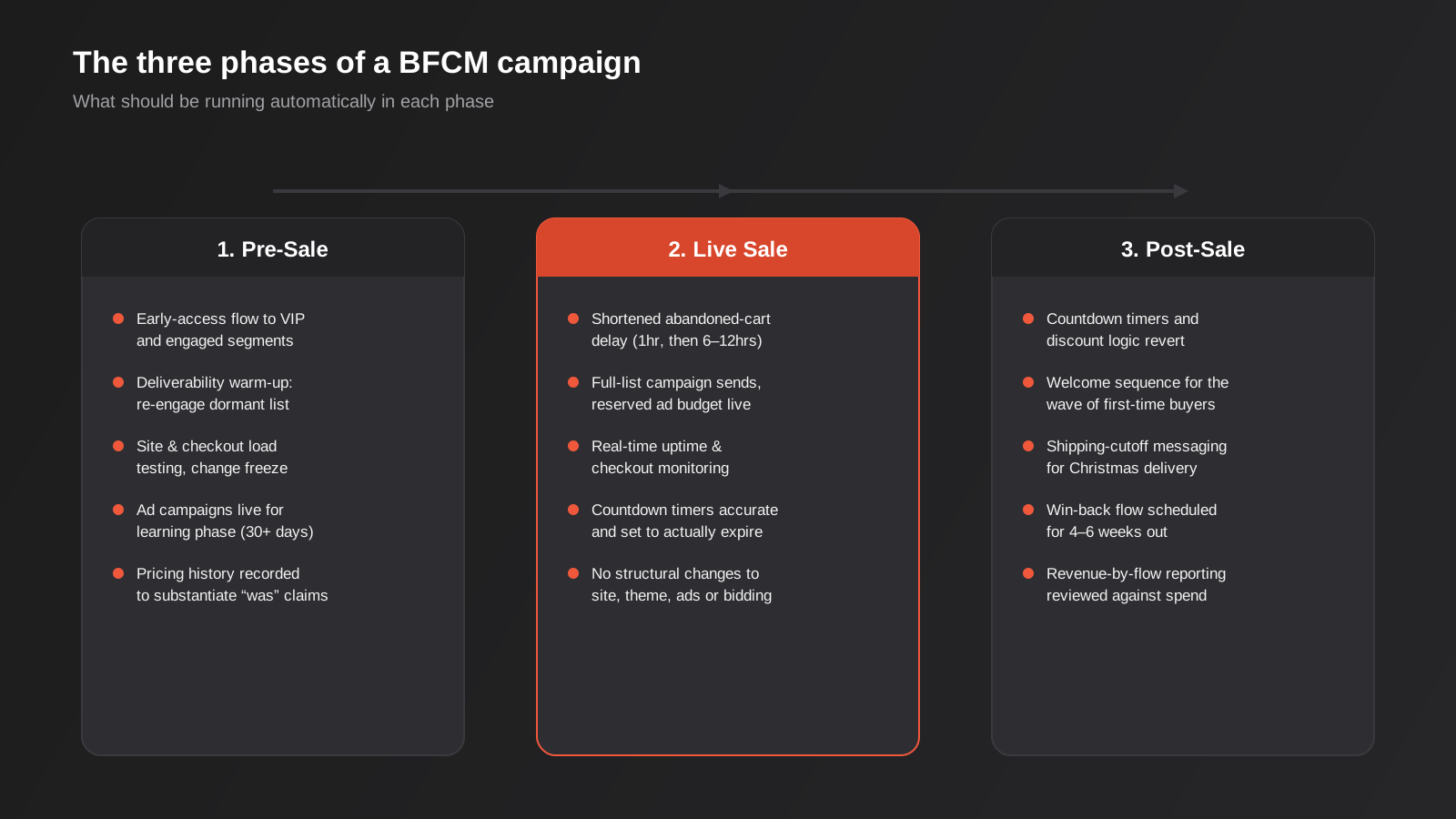
The flows that do the heaviest lifting generally split into three phases. Before the sale, a teaser or early-access sequence to your most engaged segment (and, if you run one, your VIP or loyalty tier) builds anticipation and lets your best customers buy before the general list even sees the offer. During the sale, your abandoned cart and browse abandonment flows need shorter delays than usual — a cart sitting for six hours during a 72-hour sale window is a lost sale, not a slow-burn opportunity, so tightening the first touch to within an hour and the follow-up to six to twelve hours is standard practice rather than aggressive. After the sale, a short post-purchase and win-back sequence matters more than most stores give it credit for: Mailchimp’s own Australian data shows first-time buyers made up roughly 69% of email-driven orders and over 73% of SMS-driven orders across a recent BFCM weekend, meaning the bulk of your BFCM database is new to you and needs a proper welcome into the relationship, not silence until next November.
One detail worth building in deliberately: any flow with a countdown timer or a discount that’s only valid “today” needs to actually stop or revert once the window closes. We cover why that’s not just good practice but a genuine compliance point later in this guide.
Deliverability prep matters more at BFCM than any other time of year
If BFCM is the one week you’ll email your entire list — including the subscribers who haven’t opened anything since last Christmas — your sending reputation needs to be ready for that before the week arrives, not during it. A sudden full-list send after months of only emailing engaged segments is exactly the kind of pattern that can trip spam filters and tank inbox placement at the worst possible moment. Warming up by re-engaging dormant segments earlier in November, cleaning obviously dead addresses out of the list, and confirming SPF, DKIM and DMARC are all correctly configured are worth doing in the first half of the month, not the week of the sale. We go deeper on the full build (flows, segmentation, campaign design and deliverability as one connected system) on our email marketing page, and if you want the mechanics of welcome, abandoned cart and segmentation flows outside the BFCM context specifically, our email marketing automation guide covers the fundamentals in more depth.
Where SMS fits, and what it needs to stay compliant
SMS earns its place in a BFCM calendar because open rates are near-immediate and it cuts through an inbox that’s already flooded with competing sale emails — but it comes with stricter compliance obligations than email under the Spam Act and ACMA’s Sender ID Register, and those obligations don’t pause for peak season. Consent still has to be genuine and opt-in, unsubscribe still has to work instantly, and a last-minute SMS blast to a list that never actually consented to SMS specifically is a real enforcement risk, not a theoretical one. If you’re choosing or evaluating an SMS platform for the first time ahead of BFCM, our comparison of SMS marketing platforms for Australian businesses covers sender ID registration, GST and per-message costs across the main options.
Getting your site and checkout ready for the traffic spike
A campaign that drives a 400% traffic spike to a site that can only comfortably handle 150% of normal load isn’t a marketing win, it’s a support ticket queue. Australian examples of this going wrong in public are easy to find: Chemist Warehouse’s site has crashed on a past Black Friday badly enough that customers were placed into a holding queue, and Click Frenzy’s own platform famously buckled under demand in one of its earlier years. Neither of those businesses lacked the budget to prevent it — the failure was in not testing the specific thing that was about to happen to their infrastructure.
The important nuance here is that stress-testing your homepage tells you almost nothing about whether your checkout will survive. Checkout concurrency — many shoppers completing payment within the same few minutes — behaves differently to simple page-load traffic, and it’s the part of the funnel where a failure costs you a completed sale rather than just a slow page view. If you’re on Shopify, the platform’s core infrastructure scales automatically, but that doesn’t cover a slow theme, a heavy app stack, or custom checkout extensions you’ve added yourself — Shopify’s own guidance is to performance-test your specific store, not assume the platform’s scale makes you immune. If you’re on WooCommerce or another self-hosted setup, PHP memory and thread limits under a traffic spike are the classic failure point, and a CDN plus full-page caching in front of the store buys you real headroom.
A few things worth doing in the two weeks before the sale rather than the two days before it: load-test the actual checkout flow, not just the homepage; put a change freeze on theme, app and plugin updates once testing is done, since an unrelated update breaking something on Black Friday morning is a genuinely common failure pattern; confirm with your host or platform whether temporary scaling is available and how to request it; and set up real-time uptime and response-time monitoring so you find out about a problem from an alert, not from a flood of complaints on social media. One further detail Australian stores specifically need to watch: your own marketing email or SMS send is often the single biggest self-inflicted traffic spike of the day, landing all at once the moment the campaign goes out — which is exactly why flow and send-time coordination between marketing and whoever manages the site matters more during BFCM than at any other point in the year.
Paid media budgeting and bid strategy for BFCM
Cyber Monday has been reported as Meta’s single most expensive advertising day of the year by CPM, with one industry estimate putting it well above Meta’s annual average cost per thousand impressions. Whether or not the exact figure holds for Australia specifically, the underlying pattern is real and consistent every year: every other advertiser in your category is bidding for the same audience in the same 72-hour window, and costs rise accordingly. Spending the way you spend in a normal week, at the same daily budget, generally means your ads simply get outbid at the moments that matter most.
The practical fix is to stop thinking in daily budgets for the BFCM window and set a reserved Q4 pool specifically for the peak days, so a strong Thursday doesn’t exhaust the budget before Black Friday even starts. On Google Ads, that’s worth pairing with Auction Insights to see which competitors increased their impression share during last year’s equivalent period, and with promotional assets, sitelinks and callout extensions that state the actual offer in the ad itself rather than leaving the discount as a surprise on the landing page. Campaigns generally need to go live at least a month out to build the performance history platforms use for optimisation, and most agencies recommend a structural change freeze — no new campaigns, no bid strategy changes, no attribution changes — in the final two weeks before the sale, for exactly the same reason you’d freeze a website theme: the time to test is before the traffic arrives, not during it.
Whichever platform is carrying the spend, the landing page it points to matters as much as the campaign itself. A $40 cost-per-click to a slow-loading, generic category page is a worse outcome than a cheaper click to a dedicated sale page that loads fast and states the offer clearly — which is exactly why a purpose-built BFCM landing page, separate from your everyday site navigation, consistently earns its build cost back during peak season.
Conversion-focused design for sale pages
Discount depth gets most of the attention in BFCM planning, but the page the discount lands on does a surprising amount of the actual converting. A sale banner that links through to your normal homepage, where the shopper then has to go hunting for what’s actually on sale, loses people in the first five seconds — and five seconds is roughly what you get before someone bounces to a competitor’s sale instead.
The fundamentals that matter most for a BFCM sale page are the same ones that matter for conversion generally, just under more time pressure: a clear statement of the actual offer above the fold, filtering or categorisation so a shopper can get straight to the relevant discounted range, genuine (not fabricated) stock or demand signals where they exist, and a checkout path with as few extra clicks as you can strip out. We go deeper on the underlying psychology and structure in our ecommerce CRO guide, and if your current site doesn’t have a dedicated framework for building high-converting pages under this kind of time pressure, our conversion-focused design service is specifically built around exactly this problem — pages designed to convert attention into a completed order, not just look good in a screenshot.
One genuine trade-off worth naming honestly: a custom-built sale page takes longer to produce than duplicating last year’s template, but a templated page that still references last year’s offer structure, last year’s stock levels or a countdown timer nobody reset is a worse outcome than starting from a clean page, even under time pressure.
Pricing claims and the ACCC: what you can and can’t say
This is the section most Black Friday guides skip, and it’s the one most likely to turn a good campaign into a genuine legal problem. The ACCC treats Black Friday sales advertising as an annual enforcement priority, and the headline cases from the last couple of years are worth knowing before you write a single sale banner.
The core rule sits in sections 18 and 29 of the Australian Consumer Law, which prohibit misleading or deceptive conduct and false representations about price. In practice, that means a “was $199, now $99” claim is only lawful if $199 was a genuine price the product was actually sold at for a reasonable period beforehand — not a price invented or briefly applied purely to make the discount look bigger. The Federal Court found exactly this pattern in Coles’ “Down Down” promotions, where the majority of reviewed tickets involved prices being raised shortly before being “dropped” and marketed as a saving. Mattress retailer Emma Sleep admitted to misleading conduct after the ACCC found dozens of products had never actually been sold at the higher strikethrough price being advertised against, and as part of the outcome was barred from running countdown-timer campaigns on sales that weren’t genuinely time-limited — directly relevant if your BFCM page uses a countdown timer anywhere.
Beyond individual pricing claims, the ACCC has also pursued retailers over “sitewide” discount claims that excluded a meaningful share of products, and over sales that kept running (with the same discount messaging) past their advertised end date. The practical guidance that falls out of all of this is straightforward even if the enforcement history sounds alarming: don’t inflate the “was” price, don’t let a countdown timer run past the date it claims to expire, make sure “sitewide” or “up to X% off” claims are actually accurate once exclusions are applied, and keep a dated record of your pricing history so you can substantiate a claim if asked. None of this requires discounting less aggressively — it just means the discount you advertise has to be the discount that’s real.
One nuance worth getting right rather than overstating: Australia’s new, broader unfair trading practices law — which explicitly targets dark patterns, drip pricing and manipulative design more generally — passed Parliament in 2026 but doesn’t formally commence until 1 July 2027, so it isn’t yet the law that applies to this year’s Black Friday. What that commencement date doesn’t mean is that the underlying conduct is currently fine; the ACCC is already pursuing the same substance (misleading urgency claims, inflated comparison pricing) under the existing misleading conduct provisions, as the cases above show. The honest way to read it is that scrutiny is already real for BFCM 2026, and it tightens further from mid-2027. We cover the design side of this — how urgency tactics and pricing presentation cross from legitimate into legally risky — in more detail in our guide to dark patterns and Australia’s unfair trading practices law.
The genuinely Australian complications
A lot of Black Friday advice is written for the US market and ported over with an AUD sign swapped in, which misses a handful of problems that are specific to running an Australian store during this exact period.
Currency confusion and the $75,000 GST trigger
If your store displays prices in AUD, Australian shoppers reasonably expect the transaction to be treated as domestic — but some are still hit with an international transaction fee from their own bank if the underlying payment is actually processed overseas, which is a genuine source of post-sale complaints even when your pricing display was technically correct. It’s worth disclosing plainly at checkout if this applies to your store. Less obviously, a BFCM revenue spike can be the thing that tips a growing store over the $75,000 AUD rolling 12-month threshold that triggers mandatory Australian GST registration for an overseas-based seller — worth checking where you actually sit on that threshold before the sale, not after it.
Shipping capacity across a genuinely large country
Australia Post handled close to 111 million parcels across the 2025 November–December peak period, up 7.6% year on year, with its single busiest day processing over 5.8 million parcels. That volume comes with real transit time blowouts, particularly for interstate and regional deliveries — the two-day shipping promise that works in a normal week can genuinely stretch during peak, and promising it anyway in your BFCM messaging sets up a wave of support tickets you could have avoided by being upfront about realistic delivery windows instead. Booking carrier capacity early, rather than assuming your usual pickup arrangement scales automatically, is the difference between stores that hit their delivery promises during peak and the ones that don’t.
Small business participation is rising, not falling
Xero’s Australian research found 53% of local small businesses planned to definitely take part in Black Friday in 2026, up from 43% the year before — alongside a separate finding that many small businesses fund their BFCM stock and staffing costs through credit or delayed payment. If you’re a smaller store feeling like you can’t compete with a major retailer’s discount depth, the data suggests most of your actual competitors are smaller businesses feeling exactly the same pressure, not the big names setting the pace.
Common mistakes
- Running one generic sale banner across Click Frenzy, Black Friday, Cyber Monday and the shipping-cutoff period instead of distinct messaging for each, which fatigues your list well before the biggest sales day arrives.
- Leaving abandoned cart and browse abandonment flows on their normal multi-day delay during a 72-hour sale window, when a six-hour delay already means the discount may have changed by the time the email lands.
- Stress-testing the homepage and assuming checkout will hold up the same way, when checkout concurrency fails differently to general page traffic.
- Setting a countdown timer that doesn’t actually stop when the advertised sale ends, or that resets for a “new” sale carrying the same discount.
- Advertising a “was” price that was raised shortly before the sale specifically to make the discount look bigger, rather than a price genuinely charged for a reasonable period beforehand.
- Promising standard delivery timeframes in BFCM marketing without accounting for interstate and regional transit blowouts during Australia Post’s peak period.
- Making structural changes to ad accounts, bidding, or site theme and plugins in the final days before the sale, when any resulting bug or performance regression has no time left to be caught and fixed.
- Treating EOFY and Black Friday as the same kind of event and reusing EOFY messaging and offer structure for a BFCM audience that’s shopping for entirely different reasons.
Frequently Asked Questions
When exactly are Black Friday and Cyber Monday in 2026?
Black Friday 2026 falls on Friday 27 November, with Cyber Monday on Monday 30 November. Click Frenzy’s Main Event typically runs earlier in November, ahead of both — check clickfrenzy.com.au for its confirmed 2026 dates rather than assuming they repeat exactly from the year before.
Is it illegal to use a countdown timer on a sale page in Australia?
Not inherently — a genuine, accurate countdown to a real end date is fine. The ACCC’s enforcement action has targeted timers that don’t match the real sale duration, that keep running past the advertised end date, or that reset to disguise an extended sale at the same discount. The timer itself isn’t the problem; a timer that misrepresents reality is.
How far in advance should we start preparing?
Most of the genuinely useful preparation — email flow building, deliverability warm-up, site load testing, ad campaign setup for Google’s learning phase — needs around four to six weeks of lead time to be done properly rather than rushed. Starting in early October for a late-November event isn’t excessive; it’s roughly the minimum for everything to be tested rather than assumed.
Should a small business even bother competing with major retailers on Black Friday?
Most of your actual competition on Black Friday is other small and mid-sized businesses, not the major chains — Xero’s research shows well over half of Australian small businesses now participate. The businesses that do best generally aren’t discounting the deepest; they’re the ones whose flows, site and offer are properly prepared rather than assembled in the final week.
What’s the single highest-impact thing to fix if we’re starting late?
If time is genuinely short, prioritise the abandoned cart and browse abandonment flow timing (shortening delays for the sale window) and a basic checkout load test over almost anything else — both directly affect whether traffic you’ve already paid to acquire actually converts, which matters more at the last minute than adding another channel.
Does the new unfair trading practices law apply to this year’s Black Friday?
Not yet in its new, broader form — that law commences 1 July 2027. The existing misleading conduct provisions of the Australian Consumer Law already cover inflated “was” prices and misleading urgency claims, and the ACCC is actively enforcing against exactly that conduct right now, so treating this year’s campaign as unregulated would be a mistake either way.
Where to start
If Black Friday is two weeks out and your flows, site and ad accounts aren’t ready yet, the most useful thing to do first is an honest audit of what’s actually built versus what you’re assuming is built — most Klaviyo accounts we’re brought in to review have a welcome flow and little else, with abandoned cart, browse abandonment and win-back sequences either missing entirely or untouched since they were first set up. Our email marketing team can tell you honestly what’s missing from your current setup and what’s realistic to build in the time remaining before the sale.
On price: because we run lean as a specialist agency rather than carrying a large account-management layer, our fixed quotes typically come in below the Australian averages covered in this guide. If you’ve already got a written quote from another agency for comparable scope, send it through and we’ll do our best to beat it.
Whether you need the flows built from scratch, a dedicated sale landing page, or just a second set of eyes on whether your pricing claims and countdown timers are actually defensible before you publish them, get in touch and we’ll talk through what’s realistic for the time you’ve got left.
Keep reading
Related posts
Best Payment Gateways for Australian Businesses (2026): 6 Compared
Six payment gateways compared for Australian businesses after the surcharge ban: Stripe, PayPal, Square, Tyro, Airwallex and eWAY, with fees and drawbacks.
Best Ecommerce Platforms for Australian Retailers in 2026: Six Options Compared
Six ecommerce platforms for Australian retailers compared honestly: real fees, GST and payments, drawbacks and who each one actually suits.
How to Bulk Update Shopify Prices From a Supplier Price List (Without Breaking Your Catalogue) (2026)
How to update Shopify prices in bulk from a supplier spreadsheet: SKU matching, cost vs sell price, GST, compare-at prices, and a…
Got a project you'd like to talk through?
Tell us what you're working on — we'll come back with a plan.
