
Best SMS Marketing Platforms for Australian Businesses (2026): 6 Compared
 Jignesh Vagadiya
03/11/2026
22 min read
Most Australian SMS platform comparisons are written for someone sending a million messages a month from a US data centre. If you run a clinic, a Shopify store or a trades business, you are sending a few thousand texts a month, you care about whether your customers see your business name instead of a random number, and you would like the thing to keep working after you stop thinking about it. That is a different shopping list, and most “best SMS platform” pages ignore it.
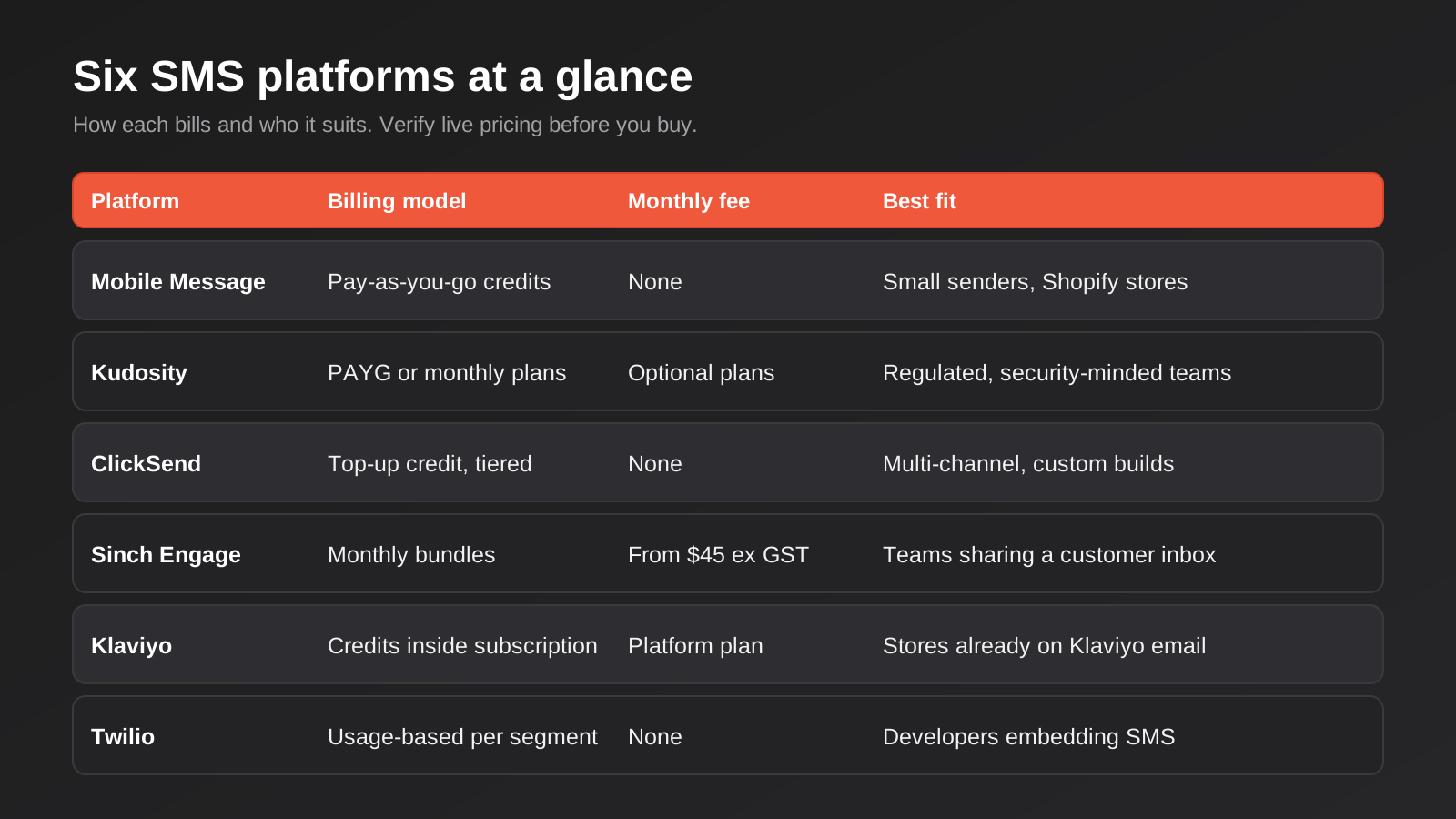
This round-up covers six platforms we would genuinely put in front of an Australian business: Mobile Message, Kudosity, ClickSend, Sinch Engage (the platform that used to be MessageMedia), Klaviyo and Twilio. They are not six versions of the same product. Two are Australian-built bulk senders aimed at small and mid-sized teams, one is a long-running local platform now under a global owner, one is an ecommerce marketing tool with SMS bolted into the same profile as your email, one is a messaging toolkit, and one is a developer API. Which one is right depends far more on what you are connecting it to than on the per-message price.
Here is how we judged them. We looked at how the platform bills (per message, monthly bundle or credits inside another subscription), whether Australian sender ID registration is handled for you, where the data sits, how well it connects to the tools Australian businesses actually run (Shopify, WooCommerce, Xero, a CRM), and what is awkward about it once you are living with it. Every tool below gets a real drawback. SMS pricing in particular is messy: vendors publish different headline rates on different pages, comparison sites that sell their own SMS service rank themselves first, and some rates are volume floors that a small sender will never see. Where we could not pin a number down, we say so and tell you what to ask instead. Check the live pricing page before you buy anything, because every figure here will date.
What to Look For Before You Compare Prices
Per-message price is the number everyone leads with and the one that matters least for a small sender. At 2,000 texts a month, the difference between three cents and five cents a message is forty dollars. The difference between a platform that handles sender ID registration for you and one that leaves you to work it out is a week of lost sends. So before you open any pricing page, get clear on these.
Sender ID. Australia now runs an ACMA Sender ID Register for alphanumeric sender names, the “YourBrand” text that shows instead of a phone number. Unregistered names can be labelled or blocked by carriers, so the platform needs to either help you register or tell you plainly how. We cover the rules in our guide to SMS compliance in Australia, including the Spam Act obligations that sit on you whichever platform you choose.
How you are billed. There are three models. Pay-as-you-go credits (you top up, messages draw down), monthly bundles (a fixed fee including a set number of messages) and credits inside a bigger subscription (Klaviyo is the example here). Credits that expire and bundles that do not roll over are the two things that quietly raise your real cost per message.
Segments, not messages. A standard text holds 160 characters. Go over, and it splits into segments of 153 characters each, and each segment is billed. Include an emoji or certain special characters and the encoding changes, dropping you to 70 characters a segment. A “one cent cheaper” platform stops looking cheap when your template quietly bills as three segments.
What it plugs into. An SMS tool that cannot see your orders, bookings or CRM records is a manual job waiting to happen. If you are weighing connections between SMS and the rest of your stack, our work on marketing automation is where that usually ends up.
1. Mobile Message
What it is. An Australian bulk SMS service built for small and medium businesses, with a web dashboard, an API, a range of third-party integrations and, since April 2026, a listing on the Shopify App Store.
What it does well. Simplicity and pricing structure. It is pay-as-you-go with no monthly platform fee, and its documentation states that purchased credits do not expire, which removes one of the quiet costs of SMS (the “use it or lose it” bundle). For Shopify stores, the app covers order and shipping notifications, abandoned cart messages and bulk campaigns to customers filtered by Shopify tag, and it works across Basic through Plus plans. Sender options include a custom business name of up to 11 characters, a dedicated Australian number or a shared pool, which gives a small team a sensible choice rather than one path.
Where it falls short. It is a sending service, not a marketing platform. You get messaging and basic list tools, not the customer profile, segmentation and revenue reporting a Klaviyo-style tool gives you. It is also a smaller operation than the global names, so if procurement at your business asks for formal uptime commitments or enterprise security paperwork, ask early. A few practical flags from our research: the Shopify app listing had no reviews yet when we looked, the first-purchase headline rate appears in different forms on different pages (older pages show a higher introductory figure), and a pricing table we found shows an alphanumeric sender ID charge in some places and calls it free in others. Confirm before you load credit.
What it costs. Its help centre lists standard rates around 4 cents per SMS for 500 to 999 credits and 3.5 cents for 1,000 to 9,999, excluding GST, with an introductory rate on a first purchase that the site advertises at 1.6 cents. Treat the 3.5 to 4 cent range as your realistic small-sender figure, and the introductory price as a bonus.
Who it suits. Small Australian businesses and Shopify stores that want transactional and occasional promotional texts at a low, predictable cost, and who do their customer segmentation somewhere else.
2. Kudosity
What it is. The platform formerly known as Burst SMS and Transmitsms, now trading as Kudosity. It offers a web app, an API and a managed approach to Australian compliance, and positions itself around security and onshore data.
What it does well. Compliance and data handling. Kudosity states that its data is hosted in Australia and that the platform holds ISO 27001 and SOC 2 Type 2 certification, which matters if you are a healthcare, finance or legal business answering security questionnaires. It acts as a certified telecommunications provider for the Sender ID Register and has a managed “Trusted Sender” service, so registration is something it does for you rather than a form you fight with. You can run it on pay-as-you-go or on monthly plans, and a REST API makes it a reasonable engine for custom builds. A dedicated virtual number for two-way conversations is available from around $25 a month.
Where it falls short. Price transparency. Kudosity’s own pricing page leads with a rate from 2.9 cents per SMS excluding GST, but that is a volume-dependent floor, and its Enterprise tier is described at higher figures. A Sinch-published comparison puts the pay-as-you-go rate at 7.9 cents, dropping with larger plans, and Kudosity’s own help material mentions a per-message overage rate of 5.6 cents on one plan. Those do not reconcile neatly, and a small sender should assume the middle of that spread, not the floor. Its help material also notes that free assistance with sender ID registration has a cut-off date, after which standard pricing applies, so ask what registration will cost you.
What it costs. Pay-as-you-go or monthly plans, quoted ex GST. For a business sending a few thousand messages a month, plan on a rate between the headline floor and the pay-as-you-go figure, and get the plan tiers in writing.
Who it suits. Regulated or security-conscious businesses, and teams that want someone else to carry the sender ID paperwork.
3. ClickSend
What it is. An Australian-founded messaging platform that does a lot more than SMS: MMS, voice, email, fax and even physical post, all through one dashboard and one API.
What it does well. Breadth and developer friendliness. If the job is “send an SMS, and if they do not respond, email, and if it is a legal notice, post a letter,” ClickSend does that from one account. It has no monthly platform fees; you top up credit and your per-message rate falls as top-ups get larger, with one comparison describing discounts of up to about 21% at the high end. It has published help documentation for the Australian sender ID registration process, which is more than some platforms bother with, and its API is well documented, which is why you will find it behind a lot of custom integrations.
Where it falls short. It is a toolkit, not a campaign manager. Compared with Klaviyo or a dedicated marketing platform, building audiences and measuring revenue takes more effort or another tool. The bigger practical issue is price clarity: we found Australian per-SMS rates hard to confirm from public pages, and third-party summaries conflict, from promotional rates under two cents for new customers to noticeably higher rates for small top-ups. The cheapest rate generally needs a large single top-up, which is fine if you send a lot and awkward if you do not.
What it costs. No monthly fee, tiered by top-up size. Run its own pricing calculator with your expected monthly volume and your realistic top-up amount, not the biggest tier on the page.
Who it suits. Businesses that need multi-channel messaging from a single provider, and developers or agencies wiring messaging into a custom system.
4. Sinch Engage (formerly MessageMedia)
What it is. MessageMedia was one of the original Australian business SMS platforms and now sits under Sinch, a global communications company, trading as Sinch Engage. It is sold as a monthly plan with a web app, shared inboxes, MMS and an API.
What it does well. Team features and staying power. Plans include multiple users and sub-accounts, so a business where several people send and reply to messages gets a proper shared setup instead of one login passed around. Inbound messages are free in Australia on Sinch’s own pricing page, which matters if you run two-way conversations such as appointment confirmations. It is also the option most likely to survive an IT or procurement review at a larger organisation, because it is a known vendor with enterprise support.
Where it falls short. The plan model. Sinch’s Australian plans start at $45 a month for a few hundred included messages and step up through to around $789 a month for roughly 13,500, with custom pricing beyond that, all excluding GST. Reviews note that unused included messages do not roll over, and overage on the entry plan was reported at 7.9 cents a message. In a quiet month you pay for capacity you did not use, and in a busy month you pay the overage rate. Competitor sites also claim a 12-month minimum term on monthly plans. We could not verify that from Sinch directly, so make it a question for the sales call. Some integrations (Salesforce is one example) cost extra per seat.
What it costs. Monthly plans from $45 ex GST, with included volume rising by tier. Divide the plan price by the messages you will truly send to see your effective rate, and compare it to the per-message platforms.
Who it suits. Teams of several people managing customer conversations by SMS, and organisations that want a large vendor behind the service.
5. Klaviyo
What it is. An ecommerce-focused email and SMS marketing platform. SMS is not a separate product here; it shares the customer profile, segments and flows with your email, and it connects tightly to Shopify and WooCommerce.
What it does well. Segmentation and automation. Because SMS and email sit on one profile, you can build a flow that sends an email first and only texts the people who did not open it, or text only customers who have bought twice and not in 60 days. Revenue attribution runs through the same reports as your email, so you can see which texts made money rather than counting sends. For an online store already on Klaviyo email, adding SMS is a toggle and a consent strategy rather than a new tool to integrate. We cover the email side in our round-up of email marketing platforms for Australian businesses.
Where it falls short. The cost model is the awkward part. SMS is bought as credits on top of your subscription, and Klaviyo’s own help material gives a worked example in which 10 Australian recipients use 40 credits, which is four credits per message. Third-party breakdowns put the cost of a credit at under a US cent, working out to around 3 to 4 US cents per Australian SMS, but we could not find an official Australian-dollar rate, so check what your billing currency and credit price actually are. Your subscription also scales with the number of profiles you hold, so SMS is cheapest when you already pay for Klaviyo and dearest when you would be buying the platform just to send texts. Quiet-hours defaults are documented around North American conventions, so set your own sending windows for Australian time zones rather than trusting the defaults. Sources also disagree on MMS in Australia, and Klaviyo’s help article indicates it is not available here, so plan around plain SMS.
What it costs. A platform subscription that scales with your contact count, plus SMS credits. The only honest way to price this is to model it with your own list size and send volume in Klaviyo’s calculator.
Who it suits. Shopify and WooCommerce stores that want SMS driven by customer behaviour and measured against revenue, and that already use or plan to use Klaviyo for email.
6. Twilio
What it is. A developer messaging platform. There is no campaign builder to speak of; you send messages through an API, usually from software that somebody has built or configured.
What it does well. Flexibility and reach. If your business needs SMS inside a custom web app, a booking engine or an internal system, Twilio is the most documented and most widely integrated option, and it is built for sending in many countries from one account. Its Australian pricing page lists usage-based rates with no monthly platform charge, free alphanumeric sender IDs, and it will submit the Australian sender ID registration as a certified provider on your behalf or let you register independently. Many no-code and automation tools (Zapier, Make, n8n) have native Twilio connections, so it is easy to plug into a workflow.
Where it falls short. It is not a marketing product. There is no audience manager, no consent tracking for your customer list, and no unsubscribe handling unless you build or buy it. Under the Spam Act that is your responsibility, so a Twilio build needs a proper consent record and opt-out handling designed in from day one. Pricing is per segment, so long or emoji-heavy messages cost multiples. Failed messages also carry a small processing fee. And as with other global platforms, check which currency the prices on the Australian page are quoted in and what support hours you actually get.
What it costs. Its Australian page lists outbound SMS at roughly five cents per segment, with tiers beneath that for large volume, plus the small failed-message fee. That makes it middling on price for a small sender; you are paying for flexibility, not savings.
Who it suits. Businesses with developers or an automation partner who want SMS embedded in their own systems rather than a standalone marketing tool.
What a Month of Texts Actually Costs
Headline rates are easier to judge once you run your own numbers through them. Take a business sending 2,000 messages a month, a realistic figure for a clinic with appointment reminders or a small store with order updates. On a pay-as-you-go platform at 3.5 to 4 cents a message, that is $70 to $80 before GST. It is simple arithmetic, and it is also the best case, because it assumes every message fits in one segment.
Now add segments. If your reminder template runs to 200 characters, it bills as two segments, and your 2,000 messages become 4,000 billable units. The same template with a single emoji in it can bill as three. This is why we tell clients to paste their real templates into each platform’s character counter before comparing a single price. A platform that is a cent dearer but shows you the segment count clearly can beat a cheaper one that surprises you on the invoice.
Monthly bundles need a different calculation. Divide the plan price by the messages it includes, and you get the effective rate if you use every message. Sinch’s entry plan at $45 for roughly 570 messages works out to about 7.9 cents a message when fully used, and its top published plan at around $789 for 13,500 works out to about 5.8 cents. If you use half the bundle, double those figures. Bundles earn their keep when you send steadily and need the extras (shared inbox, multiple users, support), not when you are chasing the lowest per-message rate.
Then add the costs that never appear on the pricing page: a dedicated number if you want customers to reply to a consistent line, any sender ID registration charge, GST on everything, and a card surcharge on some accounts. None of these are large on their own. Together they make a small sender’s real cost noticeably higher than the rate card suggests, so ask for a full first-month estimate rather than a rate card.
Consent, Opt-Outs and the Boring Bits That Decide Whether It Works
Whichever platform you pick, three operational details decide whether your SMS programme runs smoothly or becomes a headache. The first is consent capture. Where do people opt in: a checkbox at checkout, a booking form, a sign-up page? Whatever the answer, record the timestamp and the wording they agreed to, in a place you control. If the platform is the only record, you lose it when you switch platforms.
The second is opt-out handling. Marketing messages need a clear way to stop receiving them, and the platform should process replies and unsubscribe links without you touching anything. Test it. Sign up a spare number, send yourself a campaign, opt out, and check that the next campaign skips you. This sounds trivial, and it is the step most often skipped.
The third is timing. Sending a promotional text at 8:30 on a Sunday morning, or in the wrong time zone for a national list, produces complaints that no feature can fix. Set sending windows that suit the customers you actually have, and remember Australia has multiple time zones and daylight saving that does not apply everywhere. This is another reason to be wary of defaults designed around North American conventions.
Finally, run a trial before committing. Most of these platforms offer free test credits or a low first top-up. Use it to send to a handful of real handsets on different carriers, with your registered sender name, and see exactly what arrives. That 20-minute test catches more problems than any amount of reading.
How to Choose
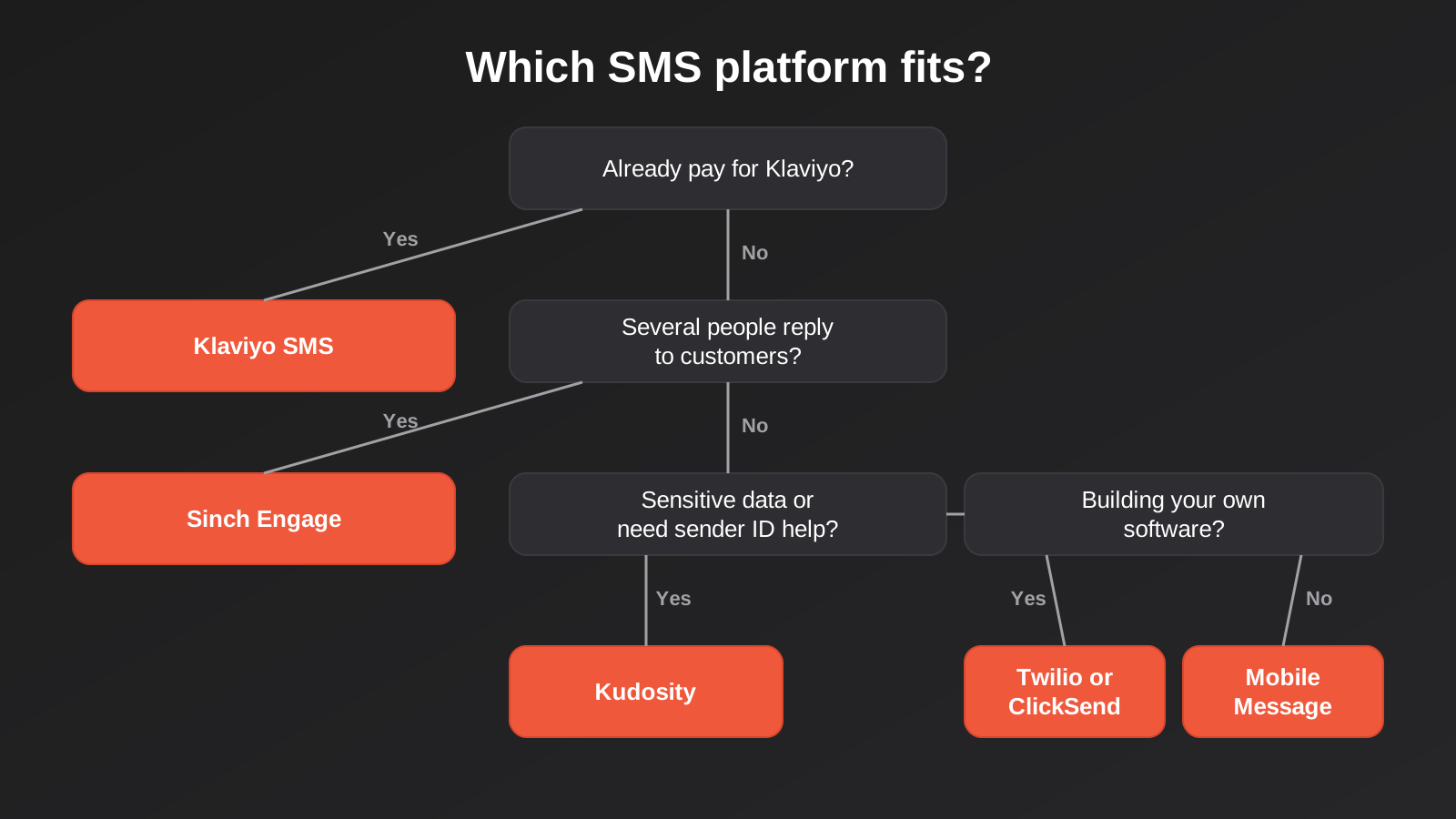
Start with the job, not the price list. We find that nearly every Australian business falls into one of four situations, and each points to a different tool.
If you run an online store and already use Klaviyo for email, use Klaviyo for SMS. The segmentation and revenue reporting are worth more than a cent or two a message, and a second tool just means a second list to keep consent-clean. If you do not use Klaviyo and have no plans to, do not adopt it for SMS alone. Look at Mobile Message’s Shopify app or a similar sender, and keep your segmentation where it already lives.
If you are a service business sending appointment reminders, confirmations and the occasional promotion, the question is whether several people need to reply to customers. If yes, Sinch Engage’s shared inbox and user model earn their monthly fee. If it is mostly one-way reminders from a booking system, a pay-as-you-go sender like Mobile Message, Kudosity or ClickSend is cheaper and simpler. Many booking tools have SMS built in, and our comparison of email and SMS marketing covers when text is worth the extra cost over email at all.
If you handle sensitive customer data, the decision leans toward Kudosity or Sinch, where onshore data handling and certifications are documented and someone else carries the sender ID registration. Put the security questions in writing and keep the answers.
If you are building software that sends texts, such as a portal, a quoting flow or a notification layer, pick between Twilio and ClickSend on API experience and which integrations you need, and expect to build the consent and opt-out handling yourself.
Common Mistakes When Choosing an SMS Platform
- Comparing the cheapest tier. Headline rates are often volume floors. Work out your realistic monthly volume and price that tier.
- Ignoring segments. Write your actual templates, paste them into the platform’s counter, and price them as billed. Emoji turn a one-segment message into three.
- Buying a monthly plan you will not use. Bundles that do not roll over mean a quiet month still costs the full fee. If your sending is seasonal, favour credits that do not expire.
- Leaving sender ID until launch week. Registration takes time. Start it before you build the campaign, not after.
- Treating consent as the platform’s job. Your tool might include an unsubscribe link, but the record of who agreed to what, and when, is yours to keep.
- Running SMS in a silo. A list that lives only in the SMS tool will drift away from your CRM, your store and your email list. Decide where the master record lives first.
- Trusting a comparison written by a vendor. Several of the popular “best bulk SMS” pages are published by SMS companies that rank themselves first. Read them for facts, not rankings.
Frequently Asked Questions
What is the cheapest SMS platform in Australia?
It depends on volume, and the rankings change as vendors adjust rates. At small volumes the pay-as-you-go senders such as Mobile Message and ClickSend generally come out cheaper per message than monthly plans, while the global and developer platforms land in the middle. Don’t go by the headline rate. Price your real monthly volume, in segments, including GST and any sender ID charges.
Do I need to register my sender name in Australia?
If you send with an alphanumeric sender name (your brand name rather than a mobile number), yes. It has to be registered on the ACMA Sender ID Register, and unregistered names can be labelled as unverified or blocked. Most platforms either register on your behalf or walk you through it, so ask what the process and cost are before you sign up.
Can I send marketing SMS to my existing customers?
Only if you have their consent, which can be express or, in limited circumstances, inferred from an existing relationship. Every marketing message also needs to identify your business and include a working way to opt out. This is a legal obligation on you as the sender, not a feature of the platform, so keep records of how and when each person opted in.
Is Klaviyo worth it for SMS if I only send a few hundred texts a month?
Only if you are paying for Klaviyo anyway. The value is in the behavioural flows and revenue reporting, not the sending. If you would be adopting Klaviyo just to text a few hundred customers, a dedicated SMS sender is almost always cheaper and simpler.
What counts as one SMS for billing?
One segment, not one message. A plain text segment holds up to 160 characters, and longer texts are split into 153-character segments that are each billed. Emoji and some special characters switch the encoding and cut a segment to 70 characters, so a short, friendly message with an emoji can bill as several.
Can SMS be connected to my CRM, store or booking system?
Usually, yes. Most of these platforms offer an API, and tools like Zapier, Make and n8n have native connections to the major ones. What differs is how much of the work you do yourself. Shopify stores have app-based options, while a custom CRM or booking system normally needs a small integration to trigger messages and write replies back.
Where to Start
Write down three numbers before you look at any vendor: how many texts you will really send in a typical month, how many of those are automated (reminders, order updates) versus manual campaigns, and where your customer records live. Those three answers narrow six options down to two in about ten minutes, and the final choice usually comes down to a trial account and a close look at the Sender ID process.
If the interesting part for you is connecting SMS to a CRM, store or booking system so messages fire without anyone touching them, that is the kind of build we scope individually. Our automation pricing page explains what moves the cost of that work, and why we quote each project as a single fixed figure.
Because we run lean as a specialist agency rather than carrying a large account-management layer, our fixed quotes typically come in below the Australian averages covered in this guide. If you’ve already got a written quote from another agency for comparable scope, send it through and we’ll do our best to beat it.
Keep reading
Related posts
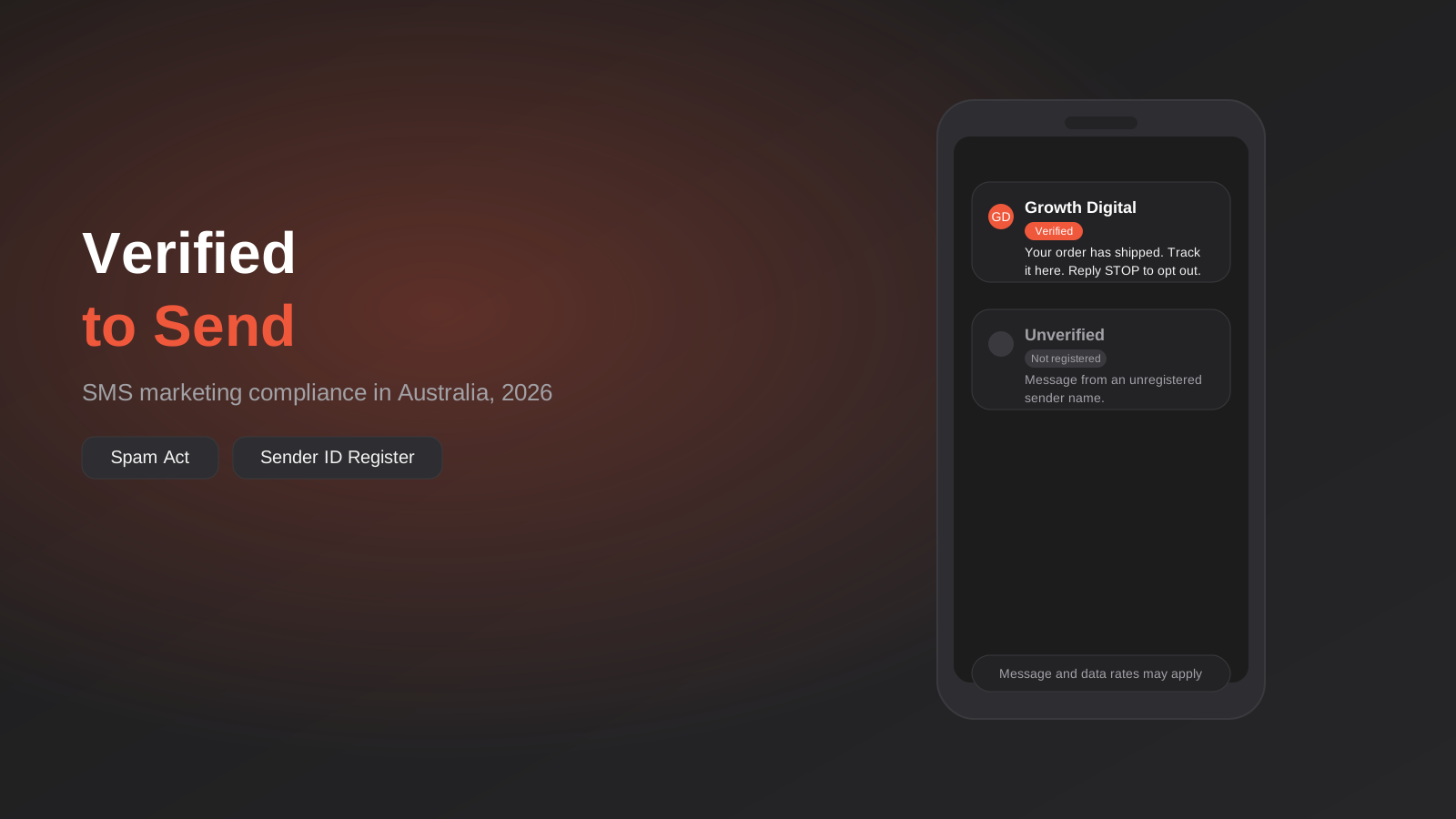
SMS Marketing Compliance in Australia: The Spam Act, the ACMA Sender ID Register and the Fines That Prove It’s Enforced (2026)
What the Spam Act and ACMA's new Sender ID Register require for SMS marketing in Australia, plus real penalties and a compliance…
Best Email Marketing Platforms for Australian Businesses (2026): 6 Compared
Six email marketing platforms compared for Australian businesses — real pricing, ecommerce depth and AU data hosting, from Mailchimp to Vision6.
Email Deliverability in Australia: The SPF, DKIM, DMARC and Spam Act Guide for 2026
A practical 2026 guide to SPF, DKIM and DMARC, Gmail and Yahoo's bulk sender rules, and the Spam Act 2003 obligations Australian…
Got a project you'd like to talk through?
Tell us what you're working on — we'll come back with a plan.
