
International SEO for Australian Businesses: Expanding Into NZ, UK and US Markets Without Starting From Zero (2026)
 Jignesh Vagadiya
18/11/2026
21 min read
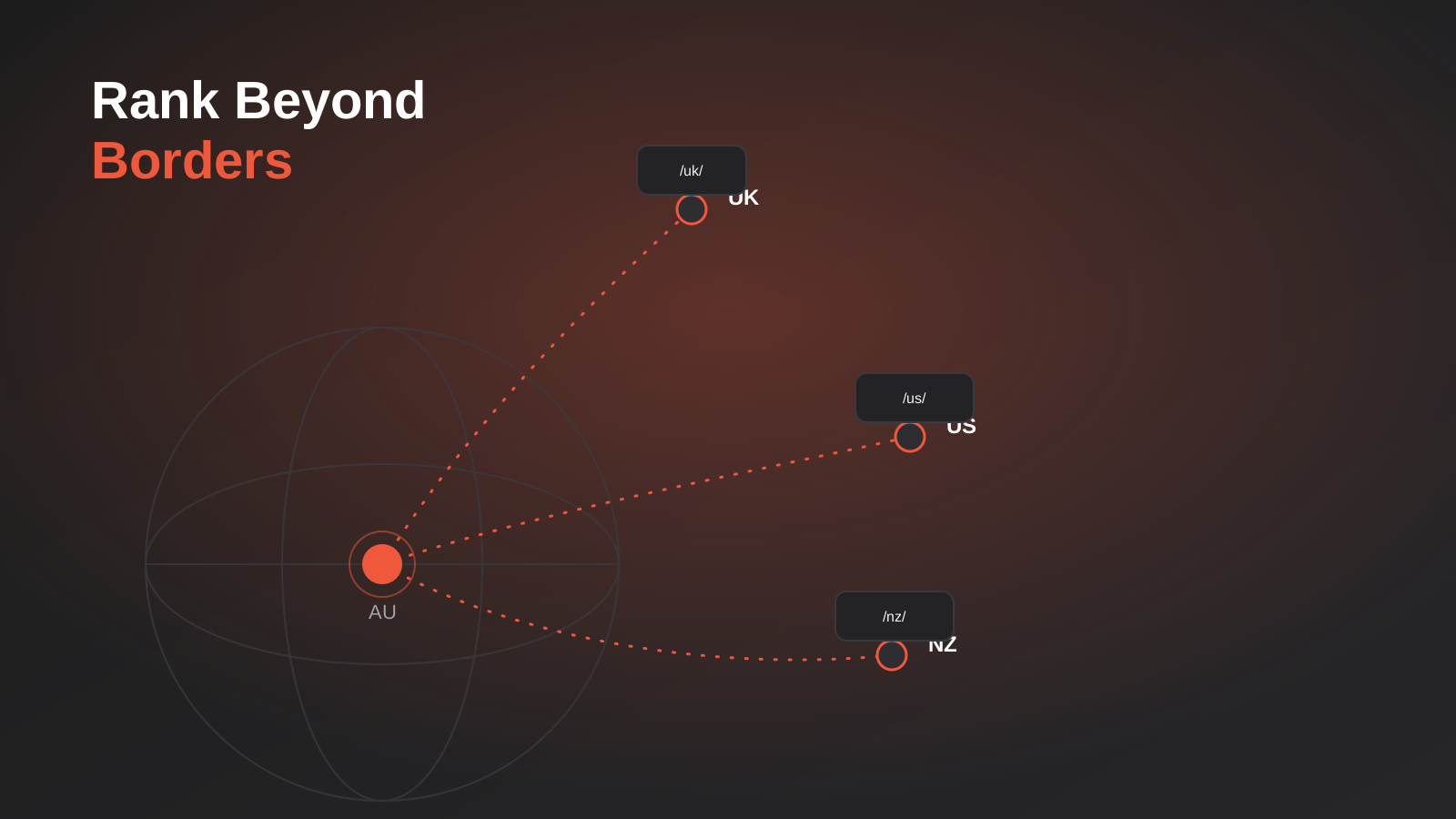
A Melbourne-based SaaS client once asked us why their US sign-ups had stalled at almost exactly the same number for three months, despite a healthy flow of American traffic landing on their Australian site. The answer wasn’t their product. It was their URLs. Every American visitor was seeing a page written for an Australian buyer, priced in a currency they’d have to convert in their head, linking to a support form that asked for a “mobile” number instead of a “cell” number, and ranking for approximately nothing on Google.com because Google had no signal that this content was meant for them at all.
That’s the part of international SEO nobody mentions when they talk about “going global.” Most Australian businesses that expand into New Zealand, the UK or the US aren’t dealing with a different language. They’re dealing with the same language doing a worse job than it thinks it is, on a site structure that was never built to tell Google “this page is for someone else, somewhere else.” That’s a genuinely different problem from multilingual SEO, and it gets solved with a different toolkit — site structure, hreflang, and a set of localisation decisions that have nothing to do with translation.
This guide walks through the international SEO toolkit properly: how to choose between a ccTLD, a subdirectory and a subdomain, what hreflang actually does (and the part Google quietly retired in 2022), what changes in your content beyond the spelling, and a realistic rollout plan for launching your first international market without torching the rankings you’ve already built in Australia.
Why “International SEO” Means Something Different When You’re Not Translating Anything
Most international SEO content online is written for a business moving from one language into several — a German retailer adding French and Spanish, say. If you’re an Australian business adding the UK, the US, Canada or New Zealand, you’re doing international SEO without doing multilingual SEO. The content is already in English. Nothing needs translating. That sounds like it should make the job easier, and in one sense it does — there’s no translation budget, no risk of a bad machine translation embarrassing you in market. But it also removes the one signal that normally forces a business to take market separation seriously. When the words are identical, it’s tempting to just… not bother. Point the same pages at every market and assume it’s fine because everyone reads English.
It isn’t fine, for three reasons that have nothing to do with vocabulary. First, Google still needs a signal to know which version of a page to show an American searcher versus an Australian one, even when both pages say almost the same thing — and without that signal, it guesses, and it guesses using geography, server location proxies and whichever page has more authority in that market, which is usually none of them yet. Second, a page that reads as unmistakably Australian — in spelling, in cultural reference, in the examples it uses — reads as foreign to the market you’re trying to enter, and foreign reads as untrustworthy to a buyer comparing you against three local competitors. Third, the compliance, pricing and currency layer sitting underneath the words is genuinely different by market, and that layer affects conversion rate far more than most businesses expect going in.
None of that is solved by a better headline. It’s solved by structure, which is where most international SEO projects actually go wrong before a single word of content gets written.
Choosing Your Site Structure: ccTLD vs Subdirectory vs Subdomain
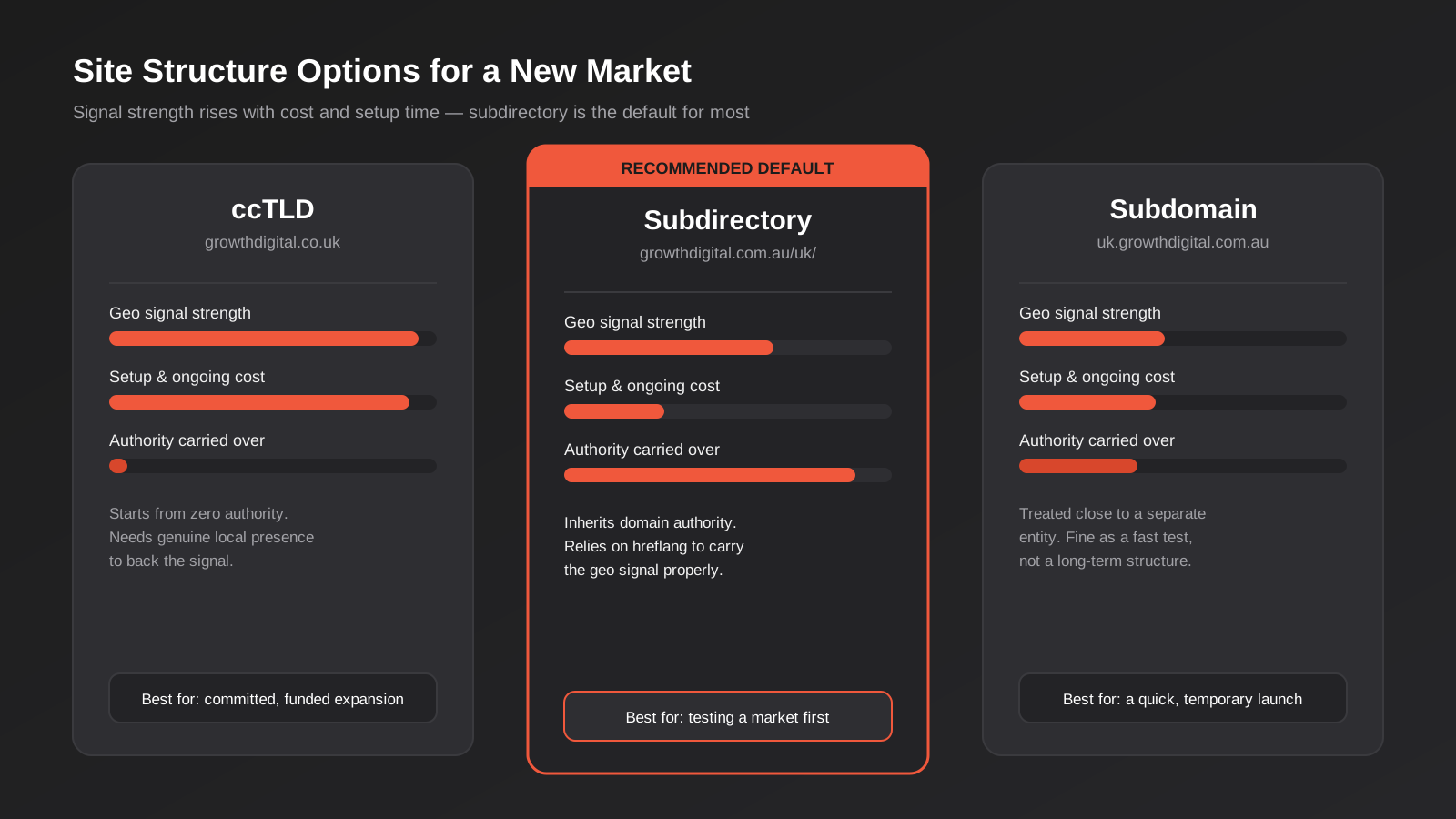
This is the decision that gets made once and is expensive to unwind, so it’s worth slowing down on. You have three real options for serving a UK or US version of your site, and each sends Google a different strength of signal about who the page is for, at a different cost and a different speed to results.
ccTLDs: the strongest signal, and the steepest price
A country-code top-level domain — growthdigital.co.uk sitting alongside growthdigital.com.au — is the clearest geographic signal you can send. Google doesn’t need to infer anything; the domain itself says “this is the UK site.” That clarity comes at a real cost. Each ccTLD is a separate domain with its own authority, which means it starts from zero in Google’s eyes. None of the backlinks, trust or ranking history you’ve built on your .com.au transfers across. You’re not expanding your existing site into a new market; you’re launching a new site that happens to share a brand and a codebase. For a business with the budget and the long-term commitment to build that authority market by market — and a genuine local presence to back it up, since a ccTLD with no local address, local phone number or local business registration looks thin fast — it’s the strongest option. For most Australian SMEs testing whether a market is even worth the investment, it’s usually the wrong first move.
Subdirectories: the default that actually fits most Australian businesses
A subdirectory — growthdigital.com.au/uk/ or /us/ — keeps everything on the one domain and lets the new market section inherit the authority of the whole site. This is the approach we recommend for the large majority of Australian businesses testing a new English-speaking market, and it’s not a close call. You get a geographic signal (reinforced properly with hreflang, which we’ll get to), you don’t start from zero, and the ongoing cost is a fraction of running and promoting a second domain. The honest trade-off: the signal is weaker than a ccTLD on its own, so you’re relying on hreflang and on-page targeting to do more of the work. For most businesses that’s a trade worth making, because the alternative — a second domain with no authority, no backlink profile and a multi-year runway to build one — is a much bigger bet to place on a market you haven’t proven out yet.
Subdomains: rarely the right call, more often an accident
A subdomain — uk.growthdigital.com.au — sits in the middle structurally, and Google has gone back and forth over the years on how much authority actually passes between a subdomain and its root domain. In practice, most SEOs now treat subdomains as close enough to a separate entity that you lose a meaningful chunk of the authority benefit a subdirectory gives you, without gaining the clean geographic signal a ccTLD gives you. The one scenario where a subdomain earns its place is a fast, low-commitment test — you need something live in a new market this month, on limited dev resources, and you’re willing to migrate to a proper subdirectory structure once the market proves itself. Treat it as temporary, because migrating a subdomain’s content and link equity into a subdirectory later is its own project, not a flag flip.
Whichever structure you land on, the next layer is the one that actually tells Google and your visitors which version of the page they’re looking at — and it’s the layer most businesses get wrong even when the structure itself is right.
Hreflang: What It Actually Does (and the Part Google Quietly Retired)
Hreflang is an HTML attribute that tells search engines “this page and that page are equivalent versions aimed at different audiences — show whichever one matches the searcher.” It’s not a ranking signal in the sense that having it doesn’t help any individual page rank higher. It’s a routing signal: it determines which of your equivalent pages shows up for a given searcher, so that an Australian buyer sees your /au/ pricing and an American buyer sees your /us/ pricing, instead of Google picking whichever one it decided was more authoritative and showing that to everyone.
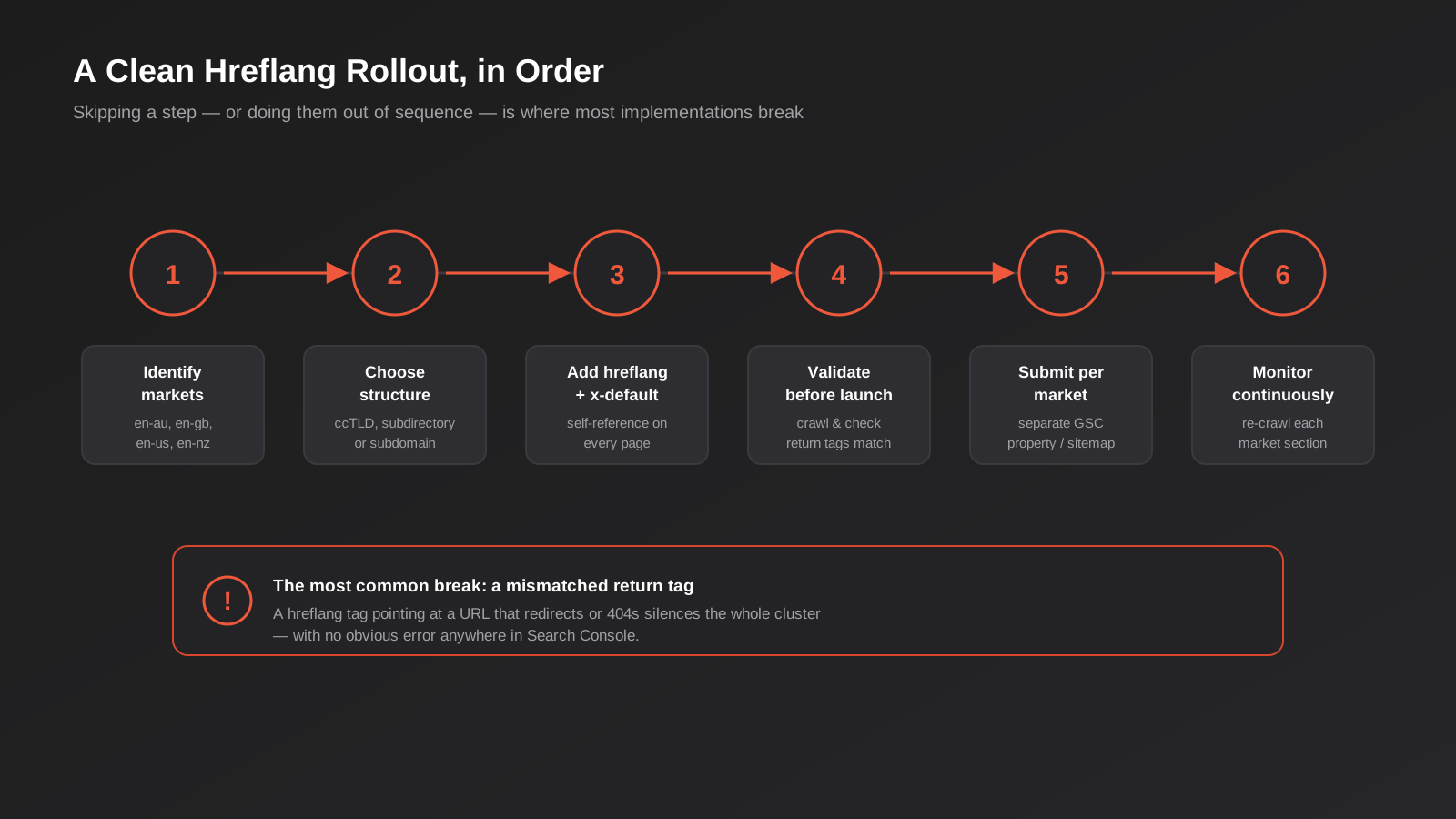
Every page needs a self-referencing hreflang tag pointing to itself, plus one tag for every other market version, plus an x-default tag that tells Google which version to fall back to for a searcher who doesn’t match any of your targeted markets. Miss the self-reference or the x-default and the whole set can be ignored. This is also where Google made a change in 2022 that a surprising number of agency guides still haven’t caught up on: Search Console’s International Targeting report, which used to let you set a target country for the whole property and check hreflang errors in one place, was deprecated. Google was explicit that it still supports and uses hreflang tags on pages — nothing changed there — but the standalone country-targeting setting and its dedicated error report are gone. If your current SEO provider is still talking about “setting your target country in Search Console,” that conversation is a few years out of date.
What replaced it, practically
With no dedicated geotargeting setting, the signals that determine which market a page serves now sit entirely in the URL structure and the hreflang tags themselves, plus a handful of supporting signals: the language declared in the page’s HTML, the currency and address details on the page, and — much more weakly than it used to be, now that CDNs put servers everywhere — where the site is hosted. In Search Console, you’ll want a separate property (or at minimum a separate sitemap) per market section, so you can see indexing and query data by market rather than it all blending into one property-wide view. Hreflang errors that used to show in the dedicated report generally now surface in the Enhancements or Page Indexing sections instead, which is a less convenient place to find them, so we check them manually with a crawler rather than relying on Search Console to flag every break.
The mistakes that actually waste months
The failure pattern we see most often isn’t a missing tag — it’s a mismatched one. A /uk/ page pointing its hreflang=”en-gb” tag at a URL that 301-redirects somewhere else, or that returns a 404 after a content update, silences the whole cluster without an obvious error anywhere. The second most common mistake is IP-based content swapping — detecting an American visitor and silently serving them different content at the same URL the Australian version uses. That actively works against hreflang, because Googlebot usually crawls from a US IP range regardless of which market version it’s trying to index, so IP-based swapping shows Googlebot the wrong content for whichever URL it’s currently crawling and corrupts your indexing for every market at once.
What Changes Beyond the URL: the Localisation That Actually Moves Conversion
Structure and hreflang get a page in front of the right searcher. What happens next — whether that searcher trusts what they’re reading enough to buy — comes down to a layer of localisation that has nothing to do with translation and everything to do with the small details that tell a reader “this business understands people like me.”
Spelling, currency and the tells searchers notice in about two seconds
Australian English and American English diverge in spelling — optimise versus optimize, colour versus color — and British English sits closer to Australian but not identically. Get the market’s spelling convention wrong on a page clearly aimed at that market and you’ve told a careful reader, in the first paragraph, that this content wasn’t actually made for them. Pricing shown in AUD on a page aimed at a US buyer forces a currency conversion in their head before they can even evaluate whether you’re good value, which is a small piece of friction that quietly costs conversions at scale. Dates are the quiet one: 03/04/2026 means the 3rd of April to an Australian reader and the 4th of March to an American one, and getting that wrong on a booking or deadline page causes real confusion, not just a minor localisation nitpick.
Legal and regulatory differences that affect what you can actually say
Terms of service, privacy disclosures and advertising claims that are compliant in Australia aren’t automatically compliant in the UK or the US. Consumer guarantee language, cooling-off periods, and what you’re allowed to claim about a product’s performance can all differ by jurisdiction, and this matters well beyond the legal department — a page making a claim that would draw regulatory attention in the target market is a liability you’re creating specifically by expanding, not one you already had. If your expansion involves anything regulated — financial services, health claims, anything consumer-credit adjacent — get local legal advice on the content before it goes live in that market, not after.
Why your Australian authority doesn’t travel with you
This is the expectation we spend the most time resetting with clients starting an international push. Ranking position one in Australia for your category doesn’t transfer to the UK or the US, even on a subdirectory structure that technically inherits domain-level authority. Google still evaluates each market’s search results independently, weighing local backlinks, local engagement signals and local competition that you haven’t built yet. A subdirectory gives you a real head start over a brand-new ccTLD starting at zero, but “head start” is the right framing, not “automatic ranking.” Competitive English-speaking markets like the US and the UK realistically take six to twelve months to show meaningful movement on commercial terms, and that timeline assumes the structural and hreflang work is correct from day one — get those wrong and you’re not slower, you’re often invisible in that market regardless of how long you wait.
Building Local Authority in a New Market: Backlinks and Trust Signals
Structure and hreflang get Google to consider showing the right page to the right searcher. Whether it actually ranks against the businesses already entrenched in that market is a separate contest in international SEO, and it’s one your Australian backlink profile doesn’t help you win. A hundred strong links pointing at your .com.au domain say almost nothing to Google about whether a UK searcher should trust your /uk/ pages, because the sites linking to you are overwhelmingly Australian, and Google reads that pattern as exactly what it is.
Local backlinks compound faster than generic ones
The fastest way to build market-specific trust is the same mechanism that works domestically — it just needs to happen in the new market’s own ecosystem. A mention from a UK industry publication, a listing in a genuinely relevant UK directory, or a guest contribution to a site that a UK audience already reads all carry more weight for your /uk/ pages than another Australian link ever would, no matter how strong that Australian link is. This is the same groundwork covered in our guide to link building that actually earns backlinks, just aimed at a different market’s publications, associations and directories instead of Australian ones. It’s slower than buying placements, and it should be — the slow version is the one that still counts in twelve months.
Smaller trust signals that add up
Beyond backlinks, a handful of smaller signals tell both Google and a human visitor that you’re not just an Australian business dabbling overseas. A local phone number (even a forwarding one), a registered local business address if you have one, local payment methods on your checkout, and testimonials or case studies from customers in that market all contribute. None of these move rankings on their own the way a strong backlink does, but they compound with everything else in this guide, and skipping all of them is usually visible to a sceptical buyer within the first few seconds on the page, long before Google’s ranking algorithm gets a say in the outcome.
A Practical International SEO Rollout Plan for Your First Market
The order matters here more than the detail of any individual step. Businesses that get into trouble almost always did these out of sequence — writing localised content before deciding on structure, or launching before hreflang was tested, or promoting a market before checking whether the product actually has demand there.
1. Validate demand before you build anything
Pull search volume and competitor visibility for your core terms in the target market specifically — volume in the US for a term can be ten times Australia’s and still represent a thinner opportunity once you account for the competitors already entrenched there. This is the same keyword research discipline you’d apply locally, just run against a different market’s search data rather than assumed from your Australian numbers.
2. Decide structure once, properly, before you build a single page
Use the ccTLD/subdirectory/subdomain decision above and commit. Changing structure after launch means 301-redirecting every page, rebuilding your hreflang map and re-verifying each affected property in Search Console — a non-trivial project in its own right, and one that temporarily suppresses rankings while Google re-crawls and re-evaluates the new URLs.
3. Localise the content layer, not just the spelling
Currency, dates, measurement units, compliance language, local case studies or social proof where you have them, and any references that assume an Australian reader’s context — all of it, before launch, not retrofitted after you notice the bounce rate.
4. Implement and test hreflang before indexing, not after
Crawl the live staging structure with a tool that validates hreflang pairs (missing return tags, redirect chains, mismatched language codes) before you let Google anywhere near it. A clean hreflang set from day one avoids months of Google having already formed an opinion about which page serves which market, which is slow and sometimes stubborn to unwind.
5. Set realistic reporting by market, from week one
Separate Search Console properties or sitemaps per market, separate landing page tracking, and separate conversion goals. Blending a new market’s early, small numbers into your existing Australian reporting hides exactly the signal you need to see — whether the new market is moving at all.
6. Budget for six to twelve months before judging the result
This is the step businesses skip emotionally even when they’ve read the timeline. A competitive market with correct technical foundations still needs real time for Google to build confidence in your pages against entrenched local competitors. If the budget or patience for that runway doesn’t exist, a paid search channel targeted specifically at the new market, structured the same way you’d structure any new-market campaign, buys visibility while the organic foundation builds underneath it.
7. Keep the technical health of each market visible on its own
Once a market is live, the easiest way to lose track of a slow-building problem is to let its numbers blend into a single global view. Set up GA4 reporting with a view or comparison filtered to each market’s subdirectory path, separate from the aggregate, so a stall in the UK doesn’t get masked by growth in your existing Australian traffic. The same applies to crawl health — run a recrawl of each market section on a schedule rather than only when something looks wrong, since a broken hreflang return tag or a market section that’s quietly been excluded from the sitemap can sit unnoticed for months if nothing is watching for it specifically. Treat each market as its own small site with its own health checks, even though it lives inside one larger site.
Common Mistakes
- Launching a new market on a subdirectory with no hreflang at all, assuming the URL path alone tells Google enough.
- Serving different content to the same URL based on visitor IP address, which breaks hreflang’s ability to match the right version to the right searcher and confuses what Googlebot indexes.
- Translating nothing but the currency symbol and calling a page “localised” for the UK or US market.
- Treating your Australian keyword research as directly transferable, instead of re-running it against the target market’s own search data and competitor set.
- Choosing a ccTLD for budget or branding reasons without the ongoing resource to build that domain’s authority from zero.
- Expecting Search Console’s old International Targeting report or country-targeting setting to still exist — it was deprecated in 2022, and rebuilding a strategy around it wastes real setup time.
- Judging a new market’s SEO performance at the three-month mark, when six to twelve months is the realistic runway for competitive English-speaking markets.
- Publishing legal, compliance or advertising claims copied from the Australian site without checking they’re valid in the target jurisdiction.
Frequently Asked Questions
Is expanding from Australia into the UK or US considered international SEO or multilingual SEO?
International SEO. Multilingual SEO specifically deals with content in different languages — English and French for a Canadian market, for example. Australia, the UK, the US and New Zealand are all English-speaking, so the work is entirely about audience and market targeting — structure, hreflang, currency, compliance and cultural localisation — without a translation layer involved.
Do I need a different Google Search Console property for each market?
It’s strongly recommended, even on a subdirectory structure. A separate property per market section (or at minimum a separate sitemap submission) lets you see indexing status and query data broken out by market, rather than blended into one property-wide view where a struggling new market can hide behind a healthy established one.
Can I just use Google Translate or an AI tool to localise content for the UK and US instead of rewriting it?
Since there’s no language to translate between Australian, UK and US English, that’s not really the task. What’s needed is editing for spelling convention, currency, units, compliance language and cultural references — a copyediting and localisation pass, not a translation one. Running it through a translation tool adds no value and can introduce odd phrasing where there wasn’t a language barrier to begin with.
Will adding international pages hurt my existing Australian rankings?
Not if the structure and hreflang are implemented correctly. The risk sits in execution, not in the concept — a subdirectory structure with broken or missing hreflang can confuse Google about which page to show which searcher, including Australian ones, so get the implementation right before launch rather than treating it as something to fix after you notice a drop.
How long before an international market starts generating organic traffic and leads?
For competitive English-speaking markets like the UK and US, six to twelve months is the realistic range for meaningful commercial movement, assuming the technical foundation is correct from launch. Less competitive markets, or categories with less entrenched local competition, can move faster. Judging results before that window closes usually leads to pulling the plug just as momentum would have started building.
Should I start with a ccTLD if I eventually want a strong local presence in the UK or US?
Only if you have the budget and commitment to build that domain’s authority from scratch, and a genuine local presence — a real local address, local phone number, local business registration — to back the geographic signal a ccTLD sends. For most businesses still validating whether a market is worth the long-term investment, a subdirectory that inherits your existing domain authority is the lower-risk way to test before committing to a second domain.
Where to Start
If you’re weighing up a UK, US or NZ expansion, start with international SEO keyword and competitor research for that specific market before any structural decision gets made — it’s the cheapest step and it tells you whether the opportunity justifies the build. From there, the structure decision (ccTLD, subdirectory or subdomain) and the hreflang implementation are the two things worth getting external advice on if you haven’t done it before, since they’re expensive to unwind once live. Our SEO service covers international structure and hreflang work as part of ongoing retainers, and our SEO pricing page has the current packages if you want to see where a multi-market scope would sit. It’s also worth a look if you’re a growing business weighing up international expansion against other growth levers, since the sequencing matters as much as the tactics.
Worth putting a number on it: our own SEO starts from $550 a month — below the $1,500–$4,000 a month most Australian businesses report paying for the kind of multi-market scope international SEO actually needs, once you factor in the broader keyword tracking, hreflang work and localisation that a second market adds on top of a standard package.
If you’ve already got a written quote from another agency for comparable scope, send it through and we’ll do our best to beat it.
Keep reading
Related posts
Local SEO for Tradies: Plumbers, Electricians and Builders in Australia (2026)
Local SEO for plumbers, electricians and builders in Australia: GBP setup, reviews, service-area pages, citations and trust signals that win the map…
Online Review Management for Australian Businesses: A Practical 2026 Guide
A practical guide to getting more reviews, responding well, and staying ACCC-compliant — the legal line, automation, and where reviews actually convert.
SEO for Real Estate Agents in Australia: Winning the Searches the Portals Don’t Own (2026)
SEO for Australian real estate agents: why beating realestate.com.au isn't the goal, and what actually wins vendor and local search.
Got a project you'd like to talk through?
Tell us what you're working on — we'll come back with a plan.
