
Online Review Management for Australian Businesses: A Practical 2026 Guide
 Jignesh Vagadiya
08/11/2026
23 min read
A tradie we spoke to recently had a Google Business Profile sitting at 4.9 stars from eleven reviews. Great number, until you noticed it hadn’t moved in fourteen months. Meanwhile his biggest competitor, two suburbs over, was sitting at 4.6 stars from just over three hundred reviews, with a fresh one landing every few days and a short, specific reply from the owner under almost every negative one. Guess which listing wins the click when someone’s standing in their kitchen with a burst pipe and thirty seconds to decide who to call.
Most Australian businesses treat reviews as something that happens to them — a thing customers do, sometimes, if they remember and feel strongly enough. The businesses actually winning on this have flipped that around. They run review management as a system: a predictable way to ask, a consistent way to respond, and a clear line they won’t cross when a review is unfair, fake, or outright defamatory. None of that is complicated once it’s set up. Almost none of it is being done properly by the businesses losing jobs to the competitor with three hundred reviews.
This guide covers online review management for Australian businesses specifically — the operational and legal side of building a system that generates reviews without breaching Australian Consumer Law, writing responses that actually move a prospective customer’s decision, knowing when you can legitimately get a review taken down versus when you’re stuck with it, and where to put reviews on your own site once you’ve earned them. If you want the mechanics of how reviews function as a Google Business Profile ranking signal specifically — categories, suspension triggers, the profile-level detail — our Google Business Profile guide covers that ground. This one is broader: it’s about the review itself, wherever it lives, and the process around getting, keeping and using it.
What “Review Management” Actually Covers
The term gets used loosely enough that it’s worth pinning down what it actually involves, because most businesses are only doing one piece of it — usually the easiest piece — and assuming that counts as the whole job.
It’s broader than your Google Business Profile
Google is the platform that matters most for the overwhelming majority of Australian businesses, and we’ll come back to why. But a proper review management process has to account for wherever customers are already leaving feedback, not just the platform you’ve decided to pay attention to. ProductReview.com.au carries real weight for anything consumer-facing in Australia. Trustpilot shows up heavily for ecommerce and SaaS. Facebook reviews still matter for hospitality and local retail even as Meta has deprioritised the feature in places. Industry-specific platforms — HealthEngine-style booking platforms for allied health, Houzz for trades and renovation, Tripadvisor for hospitality and tourism — can carry more weight with your specific customer base than Google does, even though Google usually wins on raw search volume. A business that’s meticulous about Google and has never once looked at what’s sitting on ProductReview or Trustpilot is managing half the problem.
The four jobs inside the discipline
Strip it back and review management is really four separate, ongoing jobs that happen to get lumped under one label:
- Generation — building a repeatable, compliant process that asks real customers for a review at the right moment, rather than hoping it happens organically.
- Response — replying to what comes in, positive and negative, in a way that reads well to the next hundred people who find the review rather than just the one customer who wrote it.
- Moderation — knowing when a review is fake, defamatory or in breach of a platform’s own content policy, and understanding the (narrower than most people assume) legal basis for doing something about it.
- Deployment — actually using the reviews you’ve earned on your own website and in your own marketing, rather than letting them sit stranded on a third-party platform doing nothing for your conversion rate.
Most businesses we talk to are doing generation badly (an occasional ask, no system), response inconsistently (replying to the five-star reviews because it feels nice, ignoring the one-star ones because it feels unpleasant), moderation not at all, and deployment never. The rest of this guide works through each one.
The Legal Line: What the ACCC Actually Allows
This is the section that generic, usually US-written review management advice skips entirely, and it’s the section that actually matters most if you’re running this for an Australian business. Get it wrong and you’re not just risking a platform policy breach — you’re risking genuine Australian Consumer Law exposure, with penalties that have run into the millions for businesses that treated reviews casually.
Section 18 and section 34: the two provisions doing the work
Section 18 of the Australian Consumer Law is the general prohibition on misleading or deceptive conduct in trade or commerce, and it’s broad enough to catch almost any review-related conduct that creates a false impression — publishing fake reviews, cherry-picking which genuine reviews to display, or quietly suppressing legitimate negative ones. Section 34 deals specifically with false or misleading representations about the existence, exclusion or effect of consumer guarantees and related claims, which comes into play when a business uses manipulated reviews to imply a level of quality or satisfaction that isn’t real. The ACCC’s own published guidance is built around a simple principle: omitting or editing genuine negative reviews can be just as misleading as inventing fake positive ones. It’s not only about what you add. What you selectively hide counts too.
What enforcement has actually looked like
This isn’t a hypothetical risk sitting in a regulator’s guidance document that never gets tested. The Federal Court ordered HealthEngine to pay $2.9 million in penalties for conduct that included publishing misleading patient reviews on its platform, among other breaches. Service Seeking was separately ordered to pay $600,000 in penalties for making false or misleading representations tied to the reviews it published. Both cases involved platforms rather than individual local businesses, but the underlying conduct — manipulating what reviews a customer sees, in a way that creates a misleading impression of genuine satisfaction — is exactly the conduct a smaller business can fall into without ever intending to mislead anyone. Nobody sets out to breach the ACL. They set out to “clean up” their review profile a bit, and the line between tidying and misleading is thinner than it looks from the inside.
When you can legitimately remove a review — and when you can’t
The ACCC’s position draws a real distinction here, and it’s worth holding onto because it’s more permissive than a lot of businesses assume, in one specific direction, and much less permissive in the other. You’re entitled to remove or report a review you have an adequate basis to believe is actually fake — not just unflattering, but fabricated. The ACCC’s own guidance points to practical signs: a spike of unusually positive or unusually negative reviews landing in a short window, several reviews using near-identical language or arriving from the same email address or IP, or a review describing a transaction, product or interaction you have no record of ever happening. Where that evidence exists, removing or reporting the review is defensible.
What you can’t legitimately do is remove or edit a review simply because it’s genuine and unflattering. A real customer who had a real bad experience and wrote an accurate, if harsh, account of it is not a candidate for removal just because it’s hurting your average. Doing that — and then displaying only the curated, more flattering remainder as if it represented your full review history — is close to the exact conduct the ACCC’s guidance singles out as misleading. The test isn’t “is this review damaging.” It’s “is this review genuine.” Damaging and genuine reviews you have to sit with, respond to, and let inform how you actually run the business.
Incentivising reviews without breaking the rules
There’s a genuine gap between what Australian Consumer Law permits and what individual platforms allow, and it catches out careful business owners more often than outright fraud does. Broadly, the ACL’s disclosure-based test would tolerate an incentive offered for a review regardless of whether it ends up positive or negative, provided the incentive is clearly disclosed. Google’s own review policy is stricter and bans incentivised reviews outright — any discount, prize draw entry or free product offered in exchange for a review, good or bad, breaches Google’s terms and risks the review being removed or the whole profile being flagged, even though the same offer might satisfy a regulator reading it under the ACL. We cover that specific mismatch in more depth in our Google Business Profile guide, because it’s primarily a Google policy issue. The practical rule that holds up everywhere: never tie any reward, discount or entry to leaving a review, on any platform, regardless of outcome. Ask for the review. Make it effortless to leave. Leave the reward out of it entirely.
Building a System That Actually Generates Reviews
Once the legal boundary is clear, generation is mostly a logistics problem — getting the ask in front of the right customer at the right moment, through a channel they’ll actually act on, without it feeling like nagging.
Timing the ask matters more than the wording
The single biggest lever in review generation isn’t a clever message template. It’s timing. Ask too early — immediately after a sale, before the customer has actually used the product or experienced the service — and you get a shallow, generic review, or no review at all because there’s nothing to say yet. Ask too late and the moment has passed; the emotional peak of satisfaction (or frustration) has faded into background noise and the ask feels like an unrelated interruption. The right moment is almost always immediately after the point where the customer has experienced the actual value — the job’s finished and the tradie’s packing up the van, the package has arrived and been opened, the appointment just wrapped up and the patient’s walking out the door. That’s when gratitude or relief is at its highest and the effort of writing three sentences feels proportionate to how they’re feeling.
Picking the right channel
SMS consistently outperforms email for response rate in Australia, largely because open rates for text messages are dramatically higher than email open rates and the action — tapping a link, typing a star rating — is lower friction on a phone than opening a laptop. Email still has a role, particularly for ecommerce where the customer’s already expecting a post-purchase email sequence and a review request slots naturally into it. For in-person or on-site service businesses, a physical QR code on an invoice, a receipt, or a van decal gives a customer who’s standing right there a frictionless way to leave feedback before the moment passes, without needing a phone number on file at all.
Where automation actually earns its cost
Manually remembering to ask every single customer, at the right moment, across however many jobs or orders a business runs in a week, simply doesn’t survive contact with a busy trading week. This is squarely where workflow automation pays for itself: a trigger fires when a job is marked complete in a booking or field-service tool, an order status flips to delivered in an ecommerce platform, or an invoice is marked paid in accounting software, and that trigger fires off the review request automatically, through whichever channel suits the business, with a follow-up nudge a few days later if there’s been no response. Zapier, Make and n8n all handle this comfortably once the trigger event is identified, and it’s one of the more straightforward automations a business can stand up without custom development — our SEO team regularly builds this exact trigger into the local search work we do for clients, because a steady review cadence is as much an operational process as it is a marketing one.

Keeping velocity steady rather than chasing spikes
A profile that picks up two or three reviews a week, every week, reads to both customers and to Google as an actively trading, currently-relevant business. A profile that sits dormant for months and then gets a rush of twenty reviews after someone remembers to run a campaign does the opposite — it looks engineered, and on Google specifically an unnatural spike concentrated in a short window can trigger a suspicious-activity review of the whole profile. The automated, event-triggered approach above solves this automatically, because reviews arrive at roughly the same rate your business is actually trading, rather than in bursts tied to whenever someone in the office remembers the task exists.
Responding to Reviews: What Actually Works
A review sitting unanswered, good or bad, is a wasted opportunity. The response is where most of the actual persuasion happens, because the person reading it later isn’t the customer who wrote it — it’s the next fifty people deciding whether to trust your business with their money.
Positive reviews deserve a reply too
It’s tempting to let five-star reviews sit there unanswered because there’s nothing to fix, but a business that replies to its good reviews — specifically, not with a generic “thanks for your feedback!” — reads as more attentive and more real than one with a long column of five stars and silence underneath every one. Reference something specific from the review itself. If a customer mentions a staff member by name, thank that staff member by name in the reply. It takes thirty seconds and it’s the difference between a review section that looks curated and one that looks like an actual relationship with actual customers.
Negative reviews: the template that doesn’t make it worse
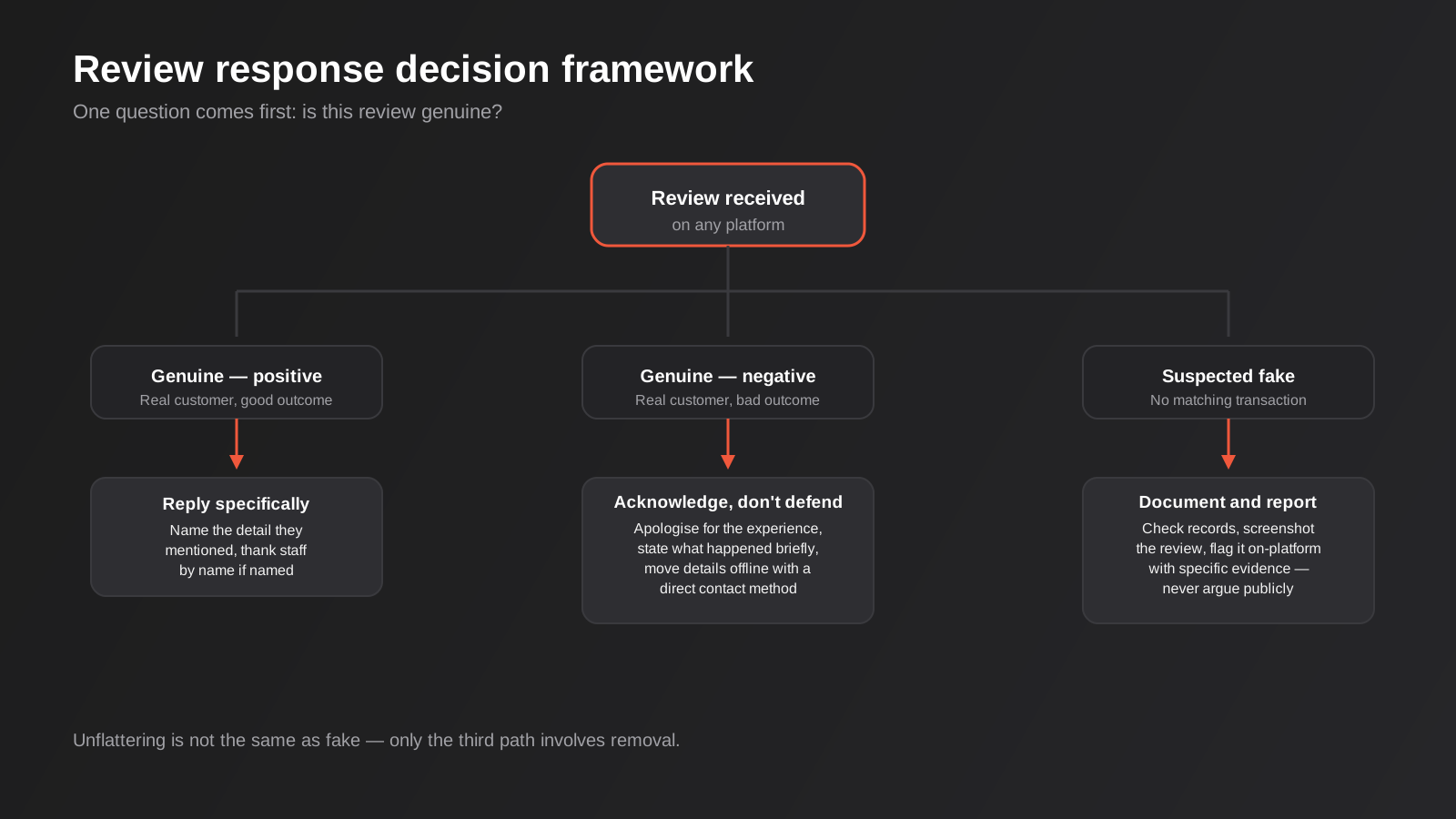
The instinct with a negative review is almost always wrong. Defending the business, disputing the customer’s account publicly, or going into forensic detail about why they’re mistaken reads badly to everyone watching, regardless of whether the business is technically in the right. A response that works, consistently, follows roughly the same shape: acknowledge the specific issue without being defensive, apologise for the experience even if you disagree with aspects of their account, state briefly and factually what happened or what you’re doing about it, and move the detailed back-and-forth offline with a direct contact method. Something close to: “Thanks for the feedback, [name] — sorry to hear the install took longer than quoted. We flag unexpected wiring issues as soon as we find them, which is what added the extra time here, but we should have communicated that better on the day. Give us a call on [number] and we’ll make it right.” That response does more work for the next reader than a five-star review does, because it shows exactly how the business behaves when something goes sideways — which is the actual information a cautious prospective customer is looking for.
When a review crosses into fake or defamatory territory
Genuine criticism, however harsh, isn’t something you get to make disappear. A different category of review — one from someone who was never actually a customer, one describing an interaction that demonstrably never happened, or one containing content that’s factually false and damaging rather than simply a harsh opinion — is a different problem, and most review platforms have a reporting mechanism built specifically for this. Document your evidence before reporting: your booking or sales records showing no transaction with that name on that date, screenshots of the review before it potentially gets edited, and a clear, specific explanation of why you believe it’s fabricated rather than just unflattering. Google, ProductReview and Trustpilot all have review flagging processes, and all of them move faster when the report includes specific, verifiable evidence rather than a general “this isn’t true” assertion. For content that’s genuinely defamatory rather than simply fake, a letter from a solicitor requesting removal under defamation law is a separate and sometimes faster path than a platform’s own reporting queue, particularly for a review that’s doing active, ongoing commercial damage.
Which Platforms Actually Matter for an Australian Business
Not every review platform deserves equal attention, and spreading limited time evenly across all of them is a worse strategy than concentrating effort where your actual customers are looking.
Google, by a wide margin
For almost every Australian business with a physical location or a local service area, Google Business Profile reviews carry more weight than every other platform combined, simply because of where they appear — directly in the local pack and Maps results, which is where the overwhelming majority of local searches actually resolve. We cover the mechanics of how Google weighs review volume, recency and response as ranking and click-through signals in detail in our local SEO click-through rate guide, because reviews do double duty there — they influence whether you show up and whether people click once you do.
ProductReview.com.au, Trustpilot and the platforms that fit your specific customers
ProductReview.com.au has built real, independent trust with Australian consumers over nearly two decades, and for retail, services and anything consumer-facing, a healthy presence there sits alongside Google rather than replacing it — some customers specifically seek out a second, independent source before trusting a purchase decision. Trustpilot carries more weight for ecommerce and SaaS businesses, partly because it’s embedded into checkout widgets and comparison tools that a Google listing never touches. Beyond the generalist platforms, industry-specific ones can matter more to your actual buyer than either: Tripadvisor for hospitality and tourism, Houzz for renovation and trades, booking-platform reviews for allied health and clinics. The right approach is identifying the two or three platforms your specific customers actually check before buying, rather than trying to maintain an active presence everywhere a review could theoretically be left.
Facebook and social reviews
Facebook’s review feature (recommendations, in its current form) still carries weight for hospitality, local retail and community-facing businesses where customers are already spending time on the platform socially, even as its prominence in Meta’s own interface has shifted over the years. It’s worth claiming and monitoring if your audience skews toward an older, more Facebook-native demographic, but it shouldn’t be the first platform you invest generation effort into if Google and your one or two industry-relevant platforms aren’t already in good shape.
Putting Reviews to Work on Your Own Website
Reviews sitting on a third-party platform are doing a job — influencing search visibility and third-party trust — but they’re not doing the job of converting a visitor who’s already on your own site, unless you actively bring them across.
Review widgets and structured data
A widget pulling your genuine Google or Trustpilot reviews directly onto your homepage, service pages or checkout flow does real conversion work, provided it’s showing real, current reviews rather than a handful of cherry-picked testimonials from three years ago. Where you have real, verifiable review data, aggregateRating schema markup can also surface star ratings directly in your organic search snippet — distinct from every plain listing around it on the results page — which is one of the more reliable ways to make an organic result visually outcompete the ones either side of it. It has to be built on genuine, disclosed review data; fabricated or unverifiable review markup breaches Google’s structured data guidelines and risks a manual action, which is a considerably worse outcome than a middling click-through rate.
Placement that actually lifts conversion
Where you put reviews on the page matters almost as much as having them. Directly beside a call-to-action, a price, or a form — the exact moment someone’s weighing whether to commit — does far more work than a generic testimonials page buried in the main navigation that almost nobody clicks through to. This is squarely a conversion design decision rather than a content one, and it’s worth treating it that way: our conversion-focused design work looks specifically at where social proof needs to sit on a page to actually move a hesitant visitor, rather than treating reviews as decoration dropped in wherever there’s empty space.
Measuring Whether It’s Actually Working
Review count and star rating are the two numbers everyone watches, and they’re genuinely useful, but on their own they miss the parts of the system that actually predict whether the whole thing is working or quietly drifting.
Response rate — what share of actual customers asked for a review actually leave one — tells you whether your generation process is working at all, separate from whether the reviews coming in are good. A response rate under ten percent usually means the timing or channel is wrong, not that customers are unhappy. Response time — how long a negative review sits unanswered before someone replies — matters because a prospective customer reading a one-star review from three weeks ago with no reply draws a worse conclusion than the same review answered within a day. And review recency, tracked over a rolling ninety days rather than as a lifetime total, is the number that actually reflects whether the system is still running or whether it quietly stopped working six months ago while the lifetime star rating kept looking fine.
Common Mistakes We See
- Asking for a review at the point of sale instead of after the value has actually been delivered, which produces thin, generic reviews or no response at all.
- Offering a discount, prize draw or freebie in exchange for a review, which breaches Google’s policy outright even where the ACL’s disclosure-based test might tolerate it.
- Replying only to the five-star reviews and leaving every negative one unanswered, which reads as a business that can’t handle criticism rather than one that’s simply had a bad week.
- Removing or editing genuine negative reviews because they’re unflattering rather than because there’s an actual basis to believe they’re fake — the exact conduct the ACCC’s guidance treats as misleading.
- Running review requests as an occasional campaign rather than an automated, event-triggered process, which produces the unnatural spikes that can trigger a platform’s suspicious-activity review.
- Letting genuine reviews sit stranded on a third-party platform instead of surfacing them on-site where they can actually influence a visitor who’s already deciding.
- Treating every review platform as equally important instead of concentrating effort on the two or three your actual customers check before buying.
- Fabricating or inflating review schema markup on-site, which risks a manual action from Google that’s far more damaging than a mediocre click-through rate.
Frequently Asked Questions
Can I legally remove a negative Google review in Australia?
Only in limited circumstances. You can request removal through Google’s reporting process if a review breaches its content policies — it’s fake, from someone who was never a customer, or contains content the platform itself prohibits. You can’t have a review removed simply because it’s genuine and unflattering; the ACCC’s guidance treats selectively removing real negative reviews as potentially misleading in its own right. If a review is genuinely defamatory rather than just critical, a solicitor’s letter requesting removal under defamation law is a separate path worth exploring.
Is it illegal to offer a discount for a Google review in Australia?
It sits in a genuine grey area. Australian Consumer Law’s disclosure-based test would likely tolerate a disclosed incentive offered regardless of whether the review is positive or negative. Google’s own policy is stricter and bans incentivised reviews outright, regardless of disclosure, and breaching it risks the review being removed or the whole profile being flagged. The safest approach, and the one we recommend, is to never tie a reward to a review on any platform.
How do I respond to a negative review that I think is fake?
Don’t argue with it publicly in the reply, even if you’re confident it’s fabricated — a public dispute reads badly regardless of who’s right. Check your own records for any transaction matching the name or date described, take a screenshot of the review as it currently stands, and report it through the platform’s own flagging process with that specific evidence attached. Reports with concrete, verifiable evidence move faster than a general “this isn’t true” claim.
Which review platform matters most for an Australian small business?
Google Business Profile, for almost every business with a physical location or a local service area, because its reviews sit directly inside the local pack and Maps results where most local search intent actually resolves. Beyond Google, the right second and third platforms depend on your industry — ProductReview.com.au or Trustpilot for general retail and ecommerce, Tripadvisor for hospitality, Houzz for trades and renovation — rather than trying to maintain a presence everywhere a review could theoretically appear.
How often should I be asking customers for reviews?
As close as possible to every single transaction, triggered automatically off an event that’s already happening — a job marked complete, an order marked delivered, an invoice marked paid — rather than as an occasional manual campaign. A steady trickle of two or three reviews a week reads as a genuinely active business and avoids the unnatural spikes that can trigger a platform’s own suspicious-activity checks.
Should I display reviews on my own website, or is the Google listing enough?
Display them on your own site as well. A review sitting only on a third-party platform does nothing for a visitor who’s already on your website deciding whether to buy, book or enquire. Genuine reviews placed near a call-to-action, a price or a form do real conversion work, and where the data is genuine, review schema markup can also help your organic listing stand out in search results.
Where to Start
If you’re starting from close to zero, don’t try to build all four pieces — generation, response, moderation, deployment — at once. Get the automated ask running first, since it’s the piece that compounds fastest: every week you delay is a week of customers who were never asked and never will be retroactively. Response templates and a basic moderation process come next, and deployment on your own site is the piece that turns reviews you’ve already earned into conversions you’re currently leaving on the table.
We fold review and reputation work into the local search layer of our SEO service rather than selling it as a separate add-on, because it performs best managed alongside the rest of a site’s local search strategy instead of as an isolated task nobody owns. Our SEO pricing page outlines how that work is scoped, with fixed monthly packages and no lock-in contract.
Worth putting a number on it: agency-run review and reputation management in Australia commonly runs from around $300 a month for a single-location program up into the $1,000–$3,000-a-month range once you’re paying a dedicated reputation specialist, before software or SMS costs on top. Our SEO packages, which fold this work in alongside the rest of your local search strategy rather than billing it separately, start from $550 a month and sit toward the affordable end of that range for comparable scope. If you’ve already got a written quote from another agency for comparable scope, send it through and we’ll do our best to beat it.
Keep reading
Related posts
International SEO for Australian Businesses: Expanding Into NZ, UK and US Markets Without Starting From Zero (2026)
A practical guide to international SEO for Australian businesses expanding into the UK, US and NZ — site structure, hreflang and real…

Local SEO for Tradies: Plumbers, Electricians and Builders in Australia (2026)
Local SEO for plumbers, electricians and builders in Australia: GBP setup, reviews, service-area pages, citations and trust signals that win the map…

SEO for Real Estate Agents in Australia: Winning the Searches the Portals Don’t Own (2026)
SEO for Australian real estate agents: why beating realestate.com.au isn't the goal, and what actually wins vendor and local search.
Got a project you'd like to talk through?
Tell us what you're working on — we'll come back with a plan.
