
Local SEO for Tradies: Plumbers, Electricians and Builders in Australia (2026)
 Jignesh Vagadiya
10/11/2026
21 min read
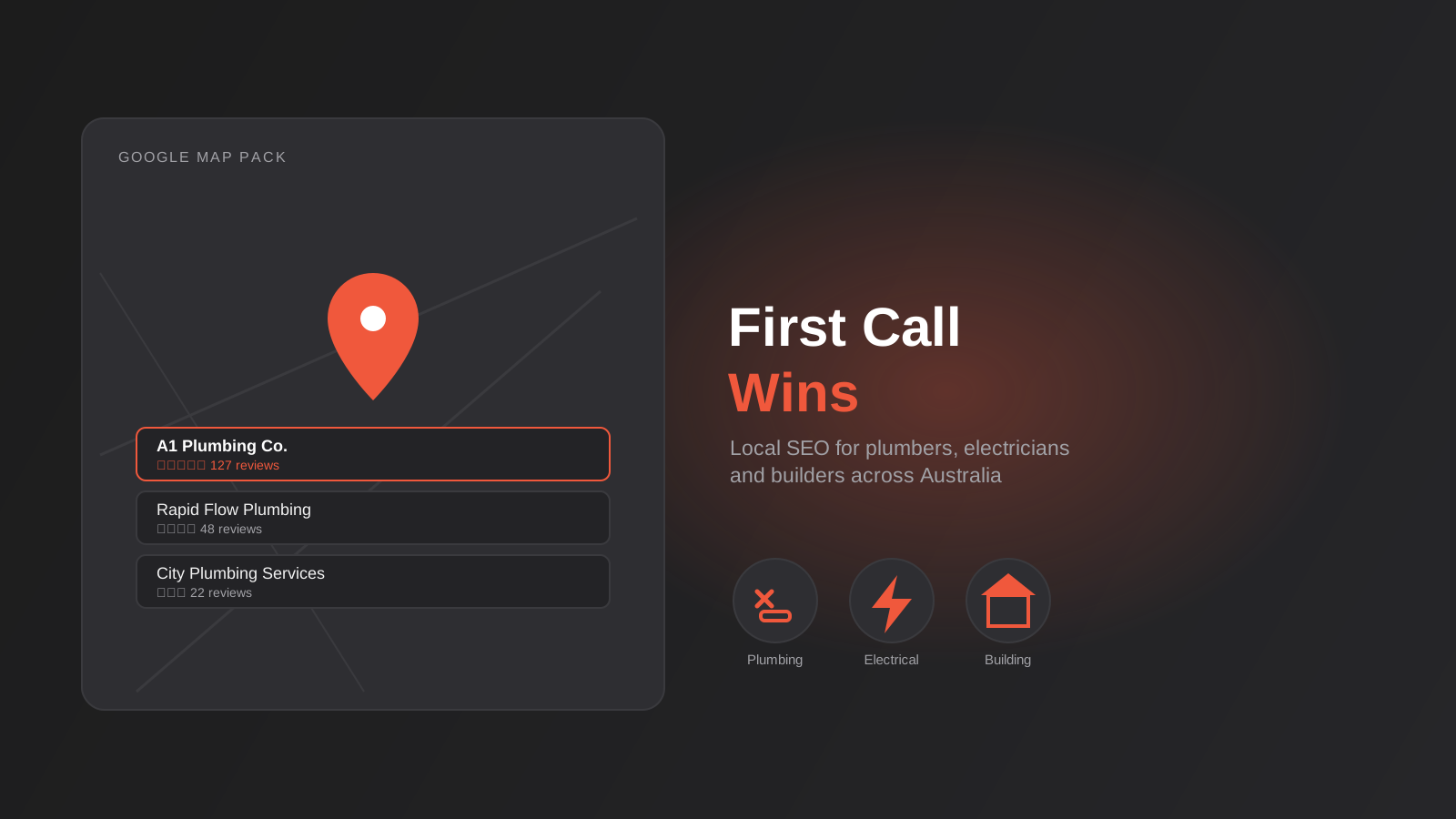
It’s 9pm on a Tuesday and someone’s hot water system has just died. They don’t open a browser tab and start comparing five plumbers on price, reading testimonials and checking which one has the nicest logo. They pull out their phone, type “plumber near me open now,” and call whoever shows up first in the map results with decent reviews. That’s the entire decision process. No consideration phase, no retargeting funnel, no second visit next week to compare quotes — one search, one call, job done.
This is why local SEO for tradies works differently to local SEO for almost anything else we handle. A cafe or a boutique can afford to be discovered gradually, through content, through social, through word of mouth building over months. A plumber, electrician, builder or HVAC technician is competing in a market where a huge share of demand is urgent, mobile and decided within seconds of a search. If you’re not visible in that moment — in the map pack, with the trust signals to get picked over the business next to you — the job goes to someone else, and it doesn’t come back.
We’ve covered broader digital marketing for trades and construction businesses before, including paid channels and website strategy — see our guide to digital marketing for trades and construction businesses if you want the wider picture. This guide goes narrower and deeper: specifically local SEO, specifically for tradies, and specifically the parts of it — Google Business Profile setup, review generation, service-area pages, citations and trust signals — that decide whether you show up in that 9pm search at all.
Local SEO for Tradies: Why Trade Search Behaviour Is Different
Most local SEO advice is written for a generic “local business” — a cafe, a gym, a retail shop. Trades sit in a genuinely different category of search behaviour, and treating them the same as a yoga studio’s SEO is how a lot of trade businesses end up with a technically fine website that still doesn’t generate calls.
The “near me, right now” pattern
A meaningful share of trade searches carry real urgency — a burst pipe, no power, a blocked drain, an air conditioner dying in a heatwave. These searchers aren’t researching; they’re triaging. They want the fastest credible option, not the best-researched one. That changes what actually matters in your SEO: proximity and immediate availability signals (hours, “open now,” response time) carry more weight than they would for a business people are happy to shortlist and call back tomorrow.
Not every trade search is an emergency, of course — a kitchen renovation or a full rewire is planned well in advance, and that planned-work searcher behaves more like a typical considered buyer, comparing a few options over days. The practical implication is that your Google Business Profile and site need to serve both kinds of searcher at once: fast, reassuring signals for the urgent caller, and enough genuine detail (past work, licensing, service range) for the planner doing their homework.
Trust substitutes for price comparison
Because the urgent segment of the market isn’t price-shopping in any real sense, the thing that wins the click isn’t the lowest number — it’s whichever business looks the least risky to let into someone’s house or business right now. Reviews, licensing, insurance, and a business that looks established rather than a one-man operation working out of a ute with no online footprint are doing most of the persuasive work. This is the opposite of ecommerce SEO, where price and product detail dominate; for trades, trust signals are the actual conversion lever, which is why we’ll spend real time on them below rather than treating them as a footnote.
Google Business Profile for Trade Businesses
Your Google Business Profile is the single highest-leverage asset in local SEO for a trade business — more than your website, in most cases, because it’s what actually appears in the map pack and the local results that urgent searchers click. Getting it set up properly is worth more than almost any other item on this list.
Service-area business vs a storefront listing
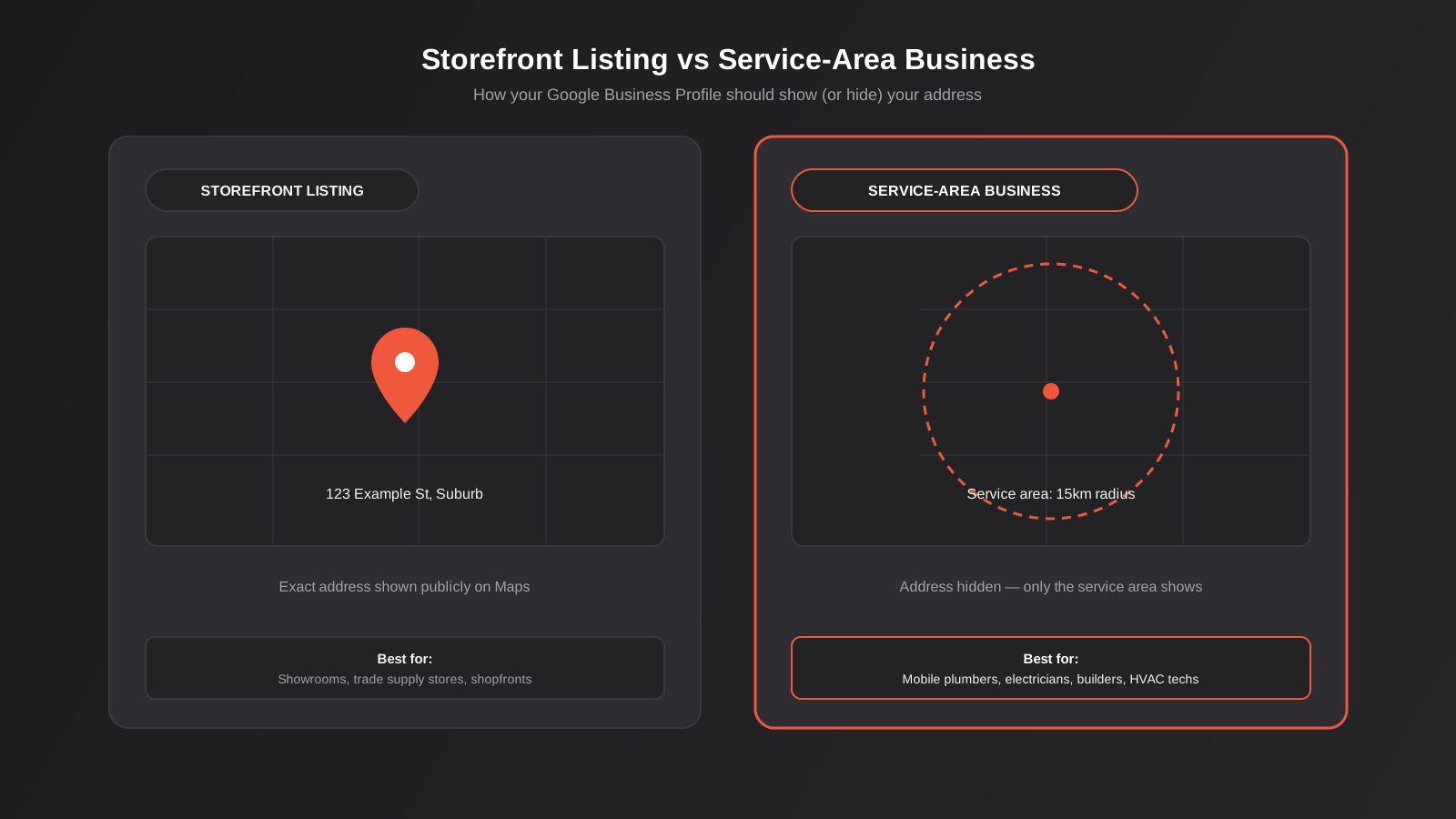
This is the single most common setup mistake we see, and it’s worth getting right from day one. Google Business Profile supports two fundamentally different configurations, and most tradies should be using the one they’re not using.
A storefront listing shows your exact street address publicly on Maps and is meant for a business customers physically visit — a trade supply store, a showroom, a shopfront. A service-area business (SAB) listing, by contrast, hides your exact address and instead shows the geographic area you service, defined as a radius or a set of suburbs/postcodes. If you’re a plumber, electrician or builder who works out of a van and goes to the customer rather than the other way around, the service-area setting is the correct one — and using the wrong configuration isn’t a cosmetic issue, it actively works against you. A home-based or van-based tradie listed as a storefront publishes a residential address that offers no benefit and can look unprofessional, while also failing to clearly define the service area that Google uses to decide who to show for a given suburb search.
Categories and services tradies get wrong
Your primary category should be the single most accurate description of your core business — “Plumber,” not “Contractor,” not “Home improvement” as a catch-all. Google lets you add multiple secondary categories, and it’s worth using them properly: a plumber who also does gas fitting and hot water system installation should add those as secondary categories rather than hoping the primary category alone covers everyone searching for a specific job.
The Services section inside your profile is under-used by most trade businesses and deserves real attention. List out specific services — “blocked drain clearing,” “hot water system replacement,” “emergency burst pipe repair” — rather than leaving it at a generic description. Each service entry is effectively a mini landing page Google can match against specific, high-intent searches, and a profile that only lists “plumbing services” is leaving genuine ranking opportunity on the table for free.
Photos, Q&A and Business Profile posts
Profiles with recent, genuine photos of actual completed work consistently outperform profiles using stock imagery or a handful of old photos from setup day. Before-and-after shots of real jobs do double duty: they’re a trust signal for the person deciding whether to call you, and Google’s own data shows profiles with more photos get more direction requests and website clicks than those without.
The Questions & Answers section is worth seeding yourself with the genuine questions customers actually ask — “do you charge a call-out fee,” “are you available on weekends,” “do you service [suburb]” — answered clearly and kept current. Left empty, this section often gets filled by randoms asking irrelevant questions, or stays blank and answers nothing. Posting updates through the profile’s Posts feature (seasonal reminders, a note about extended hours over a public holiday, a completed project) also keeps the profile looking active, which matters more than it might seem — an abandoned-looking profile with no recent activity reads as a less trustworthy business to both searchers and, to some extent, to Google’s own ranking signals.
Reviews: The Signal That Actually Moves the Needle
If you can only improve one thing this quarter, make it reviews. Review count and review recency are among the strongest local ranking signals available to a trade business, and they’re also the single biggest factor in whether a searcher actually picks up the phone once they’ve found you. A profile with four reviews sitting next to one with eighty loses the click almost every time, rankings aside.
Getting reviews without breaking Google’s rules
The highest-converting moment to ask for a review is immediately after the job is done and the customer is relieved and happy — not a generic email blast sent weeks later that gets ignored. A simple text message with a direct review link, sent from the field right after the invoice is settled, outperforms almost any other method we’ve seen trade businesses use. Make the link as short and frictionless as possible; every extra tap between “yes I’ll leave a review” and the review actually posting loses you a meaningful share of people who genuinely meant to do it.
What you can’t do, under Google’s policies, is offer an incentive for a review, review on a customer’s behalf, or set up a filtering system that only sends happy customers to the public review link while diverting unhappy ones elsewhere (commonly called review gating). These aren’t just against Google’s terms — incentivised or gated reviews also tend to produce a suspiciously lopsided review profile that’s easy for both customers and Google’s spam systems to spot, and a profile suspension over review manipulation is a genuinely painful thing to recover from for a business that depends on the map pack for leads.
Responding to negative reviews properly
A trade business will eventually get an unfair or angry review — a customer upset about a quote, a miscommunication, a job that genuinely didn’t go to plan. How you respond is public and read by every future customer deciding whether to trust you. A calm, specific, non-defensive response that acknowledges the issue and offers to resolve it directly (without relitigating the dispute in public) generally does more for your credibility than the negative review does damage, provided you don’t ignore it or respond emotionally. Unresponded negative reviews, left sitting at the top of your profile for months, read as a business that doesn’t care — which is usually a worse signal than the review itself.
Service-Area Pages Without the Duplicate Content Trap
Once the profile is sorted, the next lever is your website’s own structure — specifically, whether you have individual pages targeting the suburbs and service areas you actually work in, and whether those pages are genuinely useful or just templated duplicates with the suburb name swapped out.
How many suburbs is actually worth targeting
The instinct to build a page for every suburb within your service radius is understandable but usually wrong. A realistic starting point is the suburbs where you already do meaningful volumes of work, plus a handful of adjacent high-population areas you’d genuinely like more of — typically somewhere between six and fifteen pages for most single-trade, single-van operations, not sixty. Each page needs enough genuinely distinct content to justify existing on its own; if you can’t write something real and specific about why that page matters (common jobs in that area, a note about typical house styles or issues you see there, a couple of completed projects), it’s a candidate for consolidation rather than a new page.
What makes a service-area page genuinely different
The failure pattern we see most often is a template with “[Suburb]” swapped into an otherwise identical page across dozens of locations — same copy, same structure, same generic claims. Google has become considerably better at detecting this pattern, and it tends to suppress the whole set rather than just penalising the worst offenders. A genuinely useful service-area page includes specifics: which services you actually run in that suburb, any local considerations (older housing stock with different plumbing standards, a particular council’s permit requirements for a builder), a couple of real reviews or completed jobs from customers in or near that suburb, and a direct, prominent call-to-action rather than a wall of filler text padded out to hit a word count. If you’re building these as dedicated landing pages rather than blog-style content, our landing page development team builds exactly this kind of page — fast-loading, conversion-focused, and genuinely differentiated rather than templated.
This is also where trade businesses commonly get confused with multi-location franchise SEO, which is a related but distinct problem — see our guide to multi-location SEO for Australian franchises if you’re managing several branded locations rather than one van-based operation covering a service radius. The two situations look similar on the surface but need different site architecture.
Citations and Directories That Actually Matter for Trades
Citations — mentions of your business name, address and phone number on other sites — still matter for local SEO, but not all of them matter equally, and chasing every directory on the internet wastes time better spent elsewhere.
For Australian trade businesses specifically, a short list of citations genuinely moves the needle: the major lead-gen marketplaces (hipages, Oneflare, ServiceSeeking) because they’re both a citation source and a direct enquiry channel in their own right; general local directories (True Local, Yellow Pages, Localsearch) that carry real domain authority; and, often overlooked, your relevant trade association — Master Plumbers, Master Electricians Australia, NECA, the HIA or Master Builders Association depending on your trade. Association listings carry a specific kind of trust signal that a generic directory can’t replicate, because they imply licensing and compliance scrutiny beyond what Google itself can verify.
The thing that actually matters across all of them is consistency — your business name, address (or service area, for an SAB listing), and phone number need to match exactly across every citation. Inconsistent NAP data (a different phone number on one directory, an old address lingering on another from before you went mobile-only) genuinely confuses Google’s confidence in which business entity it’s dealing with, and it’s one of the more common, fixable issues we find auditing trade business sites that have been running for years without anyone checking this.
Trust Signals: Licensing, Insurance and Schema Markup
We flagged trust as the real conversion lever earlier, and it’s worth being concrete about what that actually looks like on a site rather than leaving it abstract.
What to actually show, and where
Licence numbers, insurance coverage (particularly public liability, which matters to anyone letting a tradesperson into their home), association memberships and years in business should be visible without a visitor having to dig — ideally near the top of your homepage and on every service page, not buried on an about page nobody reads. This is fundamentally a design and conversion problem as much as an SEO one: where you place trust signals, how prominent they are against the call-to-action, and whether they’re genuinely legible on a phone screen (where most urgent trade searches happen) all affect whether the signal actually does its job. If your current site buries this information or wasn’t designed with mobile-first urgent searchers in mind, it’s worth a proper look at conversion-focused design rather than just adding more SEO content to a layout that’s quietly working against you.
Schema markup for trade businesses specifically
Structured data (schema) won’t win you a ranking on its own, but LocalBusiness schema — or the more specific subtypes schema.org provides, such as Plumber, Electrician, HVACBusiness or GeneralContractor — gives Google explicit, machine-readable confirmation of what you do, where you operate, your hours, and your review data, rather than leaving it to infer that from unstructured page text. For a service-area business, schema should reflect the areaServed property rather than a single fixed address, matching how your Google Business Profile is actually configured. Getting this technically correct is a genuinely worthwhile, one-time piece of setup work that supports everything else in this guide rather than replacing it.

Planning Content Around Real Seasonal and Emergency Demand
Trade demand isn’t flat across the year, and search volume follows it closely — which is a genuine opportunity most trade businesses don’t plan content around. Air conditioner repair and installation searches spike hard in the lead-up to and during summer heatwaves. Roof and gutter repair searches spike after storm events. Heating system searches spike through winter cold snaps. Blocked drains and burst pipes are less seasonal but spike around specific weather events (heavy rain, a cold snap causing pipes to freeze and crack in southern states).
The practical move is having the relevant service pages genuinely ready, fast-loading and well-optimised before the seasonal spike hits, not scrambling to write content once demand has already arrived and competitors are already capturing it. A short seasonal checklist or “what to do if” guide (what to do when your hot water system fails, how to tell if storm damage needs urgent attention) published ahead of the relevant season also tends to earn genuine, non-commercial search traffic that a pure service page won’t, while still reinforcing your expertise and local relevance.
AI Overviews and Trade Searches
AI-generated answer summaries are appearing across a growing share of Google results, including local and commercial searches, and trade queries aren’t exempt. For a genuinely local, urgent query like “emergency electrician [suburb],” the map pack itself still tends to dominate the result, because Google recognises local intent and serves local pack results prominently regardless of whether an AI summary also appears above or alongside it. Where AI summaries have more influence is on the more informational end of trade searches — “how much does it cost to rewire a house,” “signs you need a new hot water system” — where a summary can answer the question directly and reduce the click-through a blog post would otherwise have earned.
The sensible response isn’t panic, it’s making sure your content actually answers the specific question clearly enough to be a source an AI summary might cite, while keeping your core local-intent pages (service and suburb pages, your Google Business Profile) focused on winning the map pack, which remains the dominant result for the searches that actually turn into booked jobs.
Measuring Whether Any of This Is Actually Working
A trade business that only measures website form submissions is almost always undercounting its real results, because most urgent searchers skip the form entirely and call. If your reporting stops at “how many enquiries came through the contact page,” you’re genuinely blind to the biggest channel local SEO is supposed to be feeding.
Call tracking is non-negotiable for trades
A dedicated tracking number — shown only on your Google Business Profile, separate from the number on your van or printed materials — lets you see exactly how many calls the profile itself is generating, distinct from calls from people who already knew you. Most call tracking providers let you route that number through to your normal mobile seamlessly, so nothing changes operationally; the only difference is you now have a real number to put against “is this working.” Pairing that with call duration is worth doing too — a flood of calls lasting eight seconds usually means a mismatched expectation somewhere (wrong service area showing, a category attracting the wrong kind of enquiry) rather than genuine demand.
Matching Search Console data to the pages you’ve actually built
Google Search Console will show you the actual queries bringing people to each service and suburb page, which is the most direct feedback loop available for deciding what to build next. If a suburb page is getting impressions for “emergency plumber [suburb]” but barely any clicks, that’s a strong signal the page title or snippet isn’t matching the urgency of the search — a fix that takes minutes once you’ve seen the data. If a service you don’t explicitly list is showing up in the queries anyway, that’s a genuine signal to add it properly as its own service entry and, if volume supports it, its own page, rather than leaving it to be caught incidentally by a broader page.
None of this needs to be complicated or expensive to set up properly — a tracking number, Search Console access, and a monthly habit of actually looking at both is more than most trade businesses have in place, and more than enough to tell genuine progress from a vanity ranking that never turns into a booked job.
Common Mistakes Trade Businesses Make With Local SEO
- Running a storefront-style Google Business Profile for a van-based business. Publishing a home address with no benefit, while giving Google a weaker signal of the actual service area.
- Building dozens of near-identical suburb pages. A templated page with the suburb name swapped is more likely to get the whole set suppressed than to rank any of them.
- Letting the profile go quiet. No new photos, no recent reviews, no posts for months — an abandoned-looking profile reads as a less trustworthy business.
- Creating a second Google Business Profile instead of fixing the first. Duplicate listings for the same business are against Google’s guidelines and risk both profiles being suspended.
- Burying licensing and insurance information. The exact details that turn an urgent searcher’s hesitation into a phone call, hidden on a page nobody visits.
- Chasing every directory instead of the handful that matter. Time spent submitting to thirty low-value directories that could have gone into reviews, photos or genuine service-area content.
- Not tracking phone calls as conversions. Measuring website form fills alone wildly understates a trade business’s actual lead volume, when most urgent searchers simply call.
Frequently Asked Questions
Do I need a physical shopfront to rank well locally as a tradie?
No. Most plumbers, electricians, builders and HVAC technicians should be set up as a service-area business on Google Business Profile, which hides your exact address and shows your service area instead. A shopfront is only relevant if customers physically visit your premises, such as a trade supply store or showroom.
How many suburbs should a trade business actually target?
Most single-trade, single-van businesses get genuine value from somewhere between six and fifteen well-built service-area pages, covering the suburbs they already work in plus a few adjacent high-population areas. More than that usually tips into templated, near-duplicate pages that can hurt rather than help your visibility.
Can I run separate Google Business Profiles for each suburb I service?
No — this breaches Google’s guidelines on representing a single business with a single profile, and it’s one of the more common reasons trade business profiles get suspended. One profile, with a correctly configured service area, is the right structure; individual suburbs are better served by dedicated pages on your website, not separate profiles.
How do I get more Google reviews without breaking the rules?
Ask every customer, right after the job is finished, with a direct and frictionless link — a text message sent from the field converts far better than an email sent days later. What you can’t do is offer an incentive, review on someone else’s behalf, or selectively route only happy customers to the review link while diverting unhappy ones elsewhere, all of which risk a profile suspension.
Is paid Google Ads better than SEO for urgent trade searches?
They’re complementary rather than competing, particularly for a new or recently relocated trade business that doesn’t yet have the review volume or map pack history to win organically. Ads can fill that gap immediately while local SEO work compounds in the background; most established trade businesses that run both end up relying on organic local SEO for the bulk of steady volume over time, with ads topping up demand or covering gaps in coverage.
How long does local SEO take to show results for a trade business?
Google Business Profile changes (categories, services, photos) can influence visibility within weeks, while review volume and service-area page authority typically take a few months of consistent work to meaningfully shift map pack rankings. Businesses starting from an under-optimised or inconsistent profile usually see the fastest early gains, simply because there’s more low-hanging fruit to fix.
Where to Start
If you’re a plumber, electrician, builder or HVAC business and you’re not confident your Google Business Profile is configured correctly, your reviews are being actively generated rather than trickling in by accident, or your website is doing anything useful with the suburbs you actually service, that’s the practical starting point — not a full site rebuild, not a generic SEO package bolted on afterward. A proper audit of your current profile and site against what’s covered here will usually tell you, concretely, what’s actually costing you calls. Our SEO team runs exactly this kind of audit for trade businesses, and our SEO pricing page sets out current packages and what’s included at each tier.
Worth putting a number on it: our own SEO packages start from $550 a month — below the roughly $700–$1,500 a month most Australian small local businesses pay for comparable entry-level local SEO scope, with no lock-in contract either way.
If you’ve already got a written quote from another agency for comparable scope, send it through and we’ll do our best to beat it.
Keep reading
Related posts
Programmatic SEO in 2026: How to Scale Pages Without Triggering Google’s Scaled Content Abuse Policy
Programmatic SEO done right: how to scale location, comparison and integration pages in 2026 without tripping Google's scaled content abuse policy.
International SEO for Australian Businesses: Expanding Into NZ, UK and US Markets Without Starting From Zero (2026)
A practical guide to international SEO for Australian businesses expanding into the UK, US and NZ — site structure, hreflang and real…
Online Review Management for Australian Businesses: A Practical 2026 Guide
A practical guide to getting more reviews, responding well, and staying ACCC-compliant — the legal line, automation, and where reviews actually convert.
Got a project you'd like to talk through?
Tell us what you're working on — we'll come back with a plan.
