
Digital Marketing for Trades and Construction Businesses in Australia (2026)
 Jignesh Vagadiya
06/09/2026
21 min read
A plumber and a residential builder both get called “tradies” by their customers, but they are selling completely different things. One gets a call because someone’s hot water system died an hour ago and every minute matters. The other gets shortlisted alongside two or three competitors, gets asked for references, and might not sign a contract for another six weeks. Most digital marketing advice online treats these as the same problem — get more traffic, get more leads, spend less per click — and that’s exactly why so much of it falls flat for trades and construction businesses.
We’ve built websites, run SEO and managed Google Ads for businesses on both sides of this divide — electricians, plumbers, roofers, and mid-size residential and commercial builders. The channels overlap (Google, your website, reviews, a bit of social proof) but what “working” looks like is different for each, and the mistakes that waste budget are different too. This guide covers digital marketing for tradies and construction businesses in Australia specifically: how the buyer’s journey splits into two very different shapes, what local SEO needs to look like without turning into duplicate-content spam, realistic Google Ads costs, and the parts of the website and quote process that quietly cost people jobs.
If you’re running a general digital marketing budget across SEO, ads and email without an industry lens, our guide to digital marketing expectations vs reality is a good companion piece. This one goes narrower — it’s specifically for people who quote jobs, run crews, and compete on trust as much as price.
Why Digital Marketing for Tradies and Construction Needs a Different Playbook
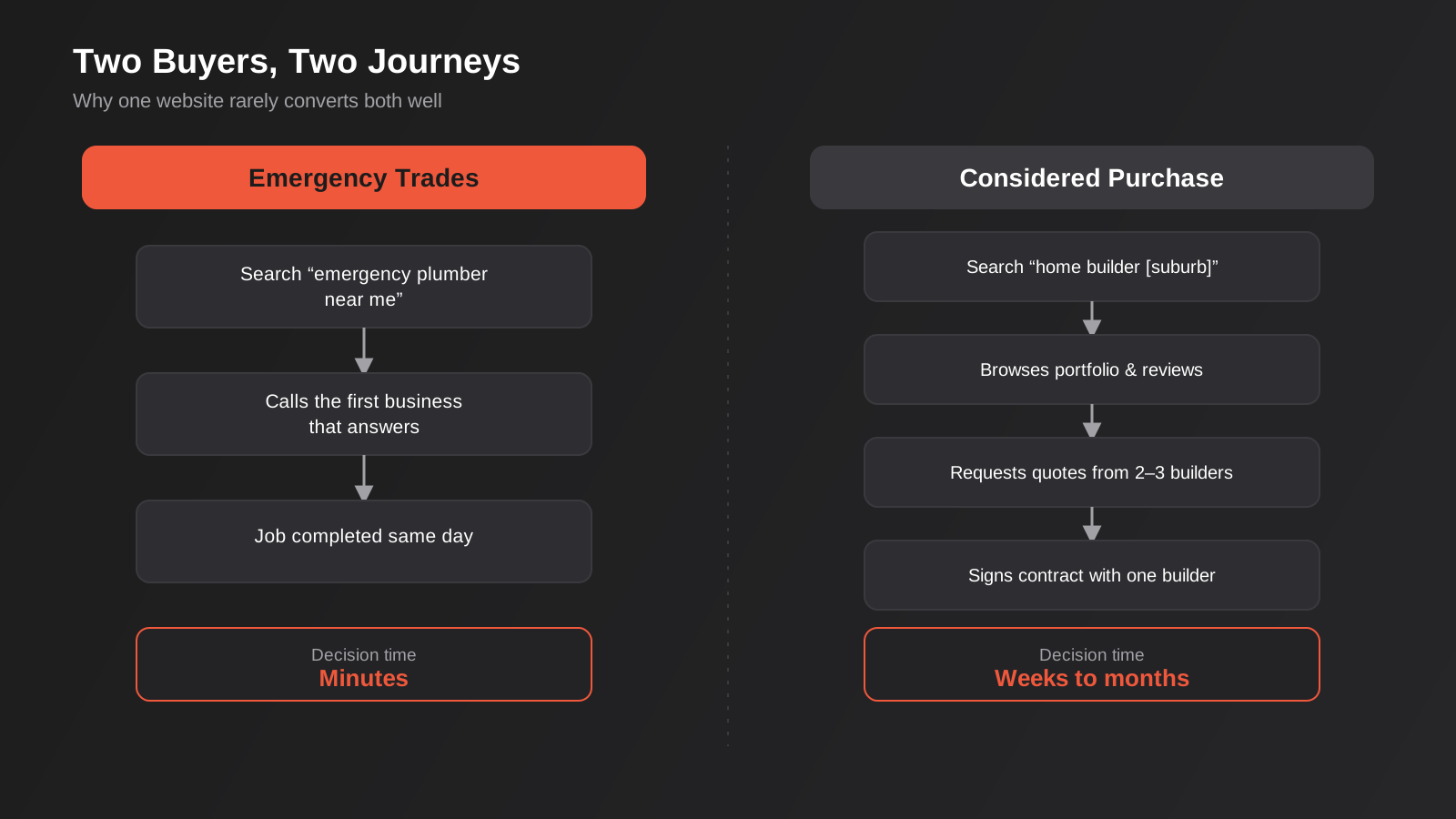
The core issue is that “trades and construction” actually covers two distinct buying behaviours, and a lot of businesses sit somewhere in between. Getting clear on which one you are — or which one a given service line is — changes almost every marketing decision that follows.
Emergency and Urgent-Intent Trades
A blocked drain, a tripped switchboard, a broken garage door spring — these searches happen because something is actively wrong right now. The person searching isn’t comparing five websites and reading case studies. They’re looking at the first three to five results, checking who has a phone number visible above the fold, glancing at the star rating, and calling. Decision time is measured in minutes.
For this kind of demand, being fast to answer matters more than almost anything else in your marketing. A beautifully designed website that takes eight seconds to load and buries the phone number in a hamburger menu will lose to a plainer site with a clickable phone number in the header, because the customer isn’t reading — they’re tapping.
Project-Based and Considered-Purchase Construction
A new kitchen extension, a duplex build, a commercial fit-out — these are considered purchases with a much longer runway. The person searching today might not make a decision for weeks or months. They’ll look at a portfolio, read reviews, check how long the business has been operating, ask for quotes from two or three builders, and compare not just price but communication style and how the first conversation went.
Here, speed to first contact still matters (slow responders get quietly dropped from shortlists) but the website’s job is different. It needs to build enough confidence that someone picks up the phone or fills in a quote form in the first place, and it needs a portfolio that actually shows relevant work — not stock photography, not three projects from 2019.
Businesses That Straddle Both
Plenty of trades do both: an electrician doing emergency callouts and also quoting full home rewires or new-build wiring. If that’s you, don’t run one undifferentiated marketing plan. Treat emergency and project work as two separate offers with two separate landing experiences, even if the same team does both. In practice that can be as simple as a dedicated “24-hour emergency electrician” page that leads with a phone number and response time, sitting alongside a separate “home rewiring and new build wiring” page built around a portfolio and a quote form. Trying to serve both intents from one generic services page usually means the page does a mediocre job of converting either one. We cover how that split plays out in ad structure further down.
Local SEO Foundations That Actually Hold Up
Local SEO for trades and construction rests on three things: a well-maintained Google Business Profile, service-area content that isn’t thin duplicate spam, and a review engine that doesn’t rely on you remembering to ask. Get these right and paid channels become a lot more efficient, because you’re not paying to compensate for a weak organic and map presence.
Google Business Profile as Your Core Asset
For local intent searches — “electrician Parramatta”, “plumber near me” — the map pack sits above the organic results on mobile, which is where most of this traffic happens. A Google Business Profile that gets set up once and never touched again signals exactly that to Google: an inactive business. The listings that hold map pack positions tend to have recent photos (not just a logo from setup day), a steady trickle of new reviews, correct and current service categories, and Q&A sections that have actually been answered rather than left blank.
A practical cadence that works: photos added monthly (finished jobs, the van, the team on site — anything genuine beats a stock image; Google’s own guidance on managing Business Profile photos is worth a quick read if you’re unsure what qualifies), review requests sent within a day or two of job completion while the experience is fresh, and service areas and categories checked quarterly as your business actually changes.
Service-Area Pages Without the Duplicate-Content Trap
The instinct to create a page for every suburb you service is understandable — more location pages, more chances to rank locally — but templated pages that swap out a suburb name and change nothing else are exactly the kind of thin, duplicate content Google’s helpful content systems are built to suppress. If you’ve got twenty near-identical “[Service] in [Suburb]” pages differing only by find-and-replace, you’re more likely to hurt your domain’s overall credibility than help it.
The pages that actually rank and convert have something genuinely specific to that area: a landmark or council area reference that shows local knowledge, a note about the kind of housing stock common there (older Federation homes with older wiring, new-build estates with strata rules), maybe a review or two from a job in that suburb. If you can’t write five unique, useful sentences about a suburb beyond “we service this area”, you probably don’t need a standalone page for it — a well-structured service-area list on your main service page, with those suburbs indexed for map and local relevance, does the job without diluting the site with weak pages.
This is the same principle behind conversion from ranking to actual clicks — ranking in position three means nothing if the listing and landing experience don’t earn the click and then the call. We go deeper on the click-through side specifically in our guide to increasing local SEO click-through rate, which covers title tags, review schema and GBP photo strategy in more detail than fits here.
Reviews as a Ranking and Conversion Signal
Review volume and recency feed directly into local ranking factors, and review content feeds directly into conversion — a five-star average with three reviews from 2023 reads as less trustworthy than a 4.8 average with sixty reviews, several from the last month. The businesses that keep review flow steady almost always have a simple, repeatable ask built into the job-completion process: a text message with a direct review link sent from the office admin system, not a verbal “leave us a review if you get a chance” that nobody follows up.
Matching Content and Keywords to Real Search Intent
Keyword strategy in this industry fails most often because businesses target volume instead of intent. “Electrician Sydney” has bigger search volume than “switchboard upgrade cost Sydney”, but the second phrase tells you exactly what the person wants and roughly where they are in the decision. Someone researching “bathroom renovation timeline” isn’t ready to book yet; someone searching “licensed electrician reviews [suburb]” is close to calling.
A workable way to structure content across the funnel:
- High-intent transactional pages for the services you actually quote and complete — these should be your best, most detailed pages, built for conversion, not just ranking.
- Educational content answering the real questions customers ask before they commit — typical costs, how long a job takes, what a permit process involves, what to check before hiring.
- Trust and credibility content — licensing, insurance, workmanship guarantees, and genuine before/after project write-ups.
The educational tier does double duty: it captures earlier-stage search traffic, and it’s exactly the kind of content that gets cited or paraphrased in AI answer summaries and Google’s AI Overviews, which increasingly intercept the “how much does X cost” and “how long does X take” queries before a click ever happens. Being the clearly-cited source on those questions still drives brand recognition even without the click, and it keeps you in the running when the same person searches something more transactional later. If you want a deeper technical grounding in how content strategy and keyword research fit together, our SEO service page covers the mechanics in full.
Google Ads for Trades and Construction: Real Costs and Structure
Google Ads is usually the fastest channel to generate leads for both emergency trades and project-based construction, because it captures people who are already searching with clear intent — you’re not creating demand, you’re catching it. But it’s also the easiest channel to burn budget on if the account structure doesn’t match how the industry actually buys.
What Realistic Cost Ranges Look Like
Costs vary a lot by trade, location and how competitive the local market is, but the ranges that come up consistently across industry benchmarking and our own account management sit in familiar territory: cost per click for competitive trade and building terms commonly runs somewhere in the mid-single-digit to high-teens dollar range, and cost per lead for builders and larger trade jobs often lands between roughly $70 and $200, with high-value residential building terms sometimes higher again in capital cities. Smaller, lower-value trade callouts (a tap washer, a light fitting) generally cost less per lead but also convert to smaller jobs, so the comparison that matters isn’t cost per lead in isolation — it’s cost per lead against the average value of the job that lead turns into.
If your cost per lead looks high compared to those ranges, the account structure or landing experience is usually the first place to look before assuming the channel itself is too expensive — poorly segmented campaigns and generic landing pages are the most common reason budgets get burned without proportional leads.
Campaign Structure That Matches the Buyer Split
Given the emergency-versus-considered split covered earlier, lumping every service into one campaign wastes budget on mismatched bidding and messaging. A structure that holds up in practice usually separates spend into distinct groups, each with its own bidding strategy and landing page:
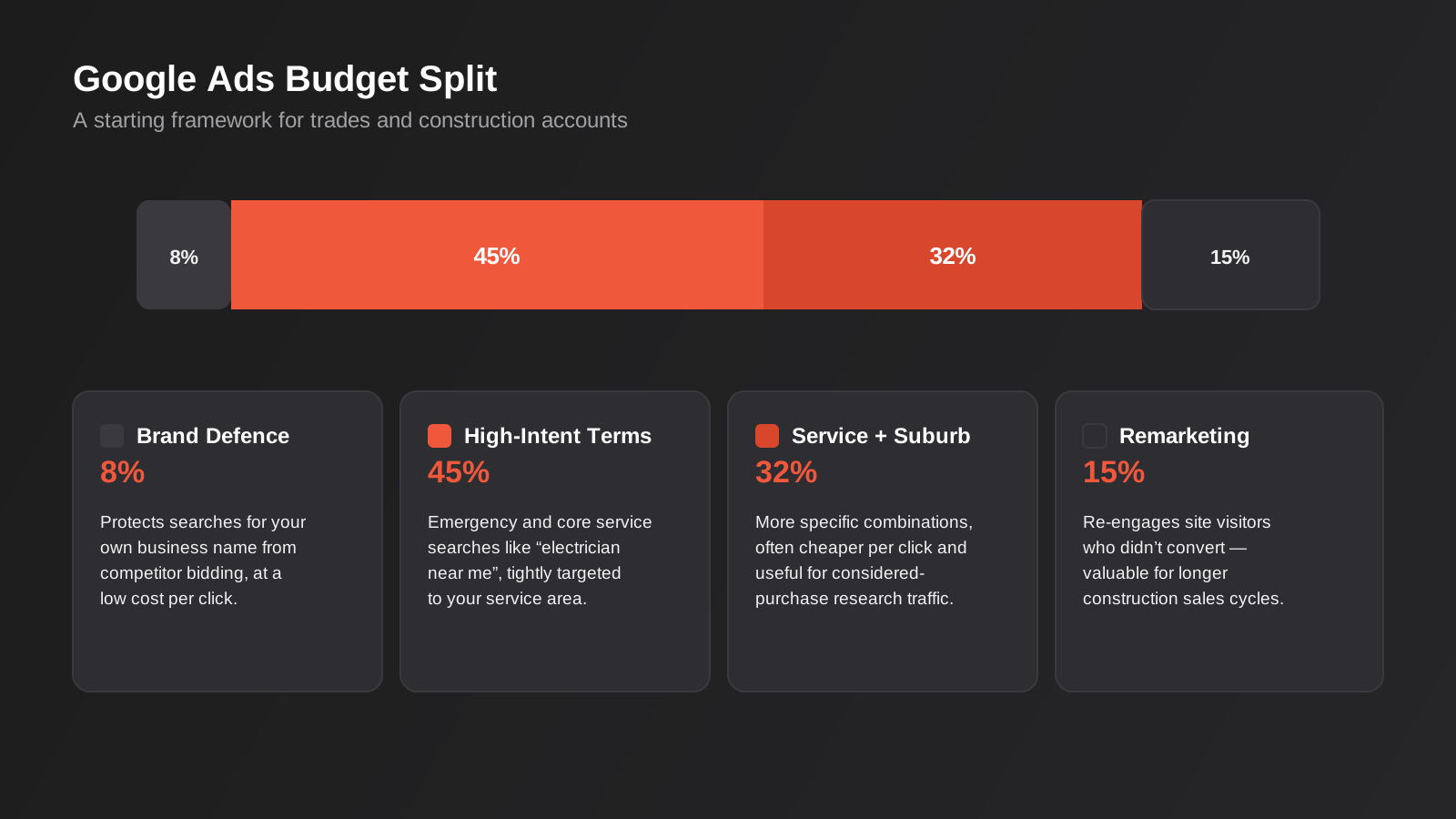
- Brand defence (roughly 5–10% of budget): protecting searches for your own business name from competitors bidding on it, at low cost per click.
- High-intent service or emergency terms (40–50%): the “electrician near me”, “burst pipe plumber now” style searches, on manual or conversion-focused automated bidding with tight geographic targeting.
- Service + suburb combinations (25–35%): more specific, often cheaper per click, and useful for capturing considered-purchase research traffic in your actual service area.
- Remarketing (10–15%): display or search remarketing to people who visited your site but didn’t convert — particularly valuable for the longer construction sales cycle, where someone might visit three times before requesting a quote.
This isn’t a fixed formula — it’s a starting point that performance data should reshape within the first couple of months. What matters more than the exact percentages is keeping emergency and considered-purchase spend in genuinely separate campaigns so bidding, ad copy and landing pages can be tuned independently. For the broader mechanics of account structure, tracking and Smart Bidding that apply across industries, our guide to maximising Google Ads ROI covers the detail this section deliberately keeps brief.
Call Tracking Is Not Optional
A huge share of trades leads come in as phone calls, not form fills, and without call tracking connected to your ads platform, you’re optimising blind — Google Ads will happily keep spending on keywords that generate cheap clicks and zero real calls, because it has no way of knowing the difference without that data feeding back in. Dynamic number insertion tied to a call-tracking platform, with call recording for quality review, should be considered baseline infrastructure, not a nice-to-have add-on. It’s also the single fastest way to catch a receptionist or office team not answering fast enough — a problem no amount of ad spend will fix.
The Website and Quote Funnel
Traffic and leads are wasted if the website and the process behind it can’t convert or handle them properly. This is where a lot of trades and construction marketing spend quietly leaks out, because the website gets treated as a one-off project rather than part of the conversion system.
What an Emergency-Intent Page Needs
Speed, clarity, and a phone number that’s tappable within one thumb-reach on mobile. Above the fold: what you do, where you service, and how to contact you right now — not a hero video, not an animated statistics counter. Trust signals (licence number, insurance, years operating, a handful of recent reviews) should sit close to the call to action, not buried in an “About” page three clicks away.
What a Considered-Purchase Page Needs
Here the job is building enough confidence to get a quote request, which means the portfolio needs to look like real, recent, locally-relevant work — ideally with enough project detail (scope, rough timeline, what made it tricky) that a prospective client can picture their own job going the same way. Client testimonials that mention specifics beat generic five-star blurbs. A clear explanation of the quoting and project process removes a lot of the uncertainty that makes people hesitate to reach out at all — how many quotes you’ll provide, roughly how long the process takes from first call to signed contract, and what happens after the contract is signed. People considering a project that could run into the tens or hundreds of thousands of dollars are, understandably, nervous about the unknowns, and a page that answers those questions before being asked tends to convert better than one that just lists services and waits for a phone call.
This is also where the difference between landing page design and landing page development matters in practice — a page can look right and still convert poorly if the underlying build is slow or the form has too much friction.
Quote Forms, Booking and the Follow-Up Gap
A form that asks for twelve fields before someone can request a callback will lose people who would have converted on a three-field version. Name, phone, suburb, and a one-line job description is usually enough to get a genuine enquiry moving — you can qualify further on the call. The bigger leak, though, is usually what happens after the enquiry lands: leads that sit in an inbox for six hours convert at a fraction of the rate of leads called back within ten minutes, and this is a process problem, not a marketing problem, no matter how good the campaign that generated the lead was.
Social Media and Reviews as Proof of Work
Trades and construction businesses are one of the few categories where organic social media genuinely works without much of an advertising budget behind it, because the content is free to produce (you’re already doing the job) and visually compelling in a way that plenty of other industries have to manufacture. Before-and-after transformation content, job-in-progress reels, and short explainer clips (“why this switchboard needed upgrading”) consistently outperform generic branded posts, because they double as proof of competence rather than just marketing.
The practical version of this doesn’t need a dedicated content team — it needs someone on-site taking thirty seconds of phone footage at the start and end of a job, and a simple weekly habit of turning that footage into two or three posts. Consistency matters more than production quality here; a rough, real video of an actual job outperforms a polished stock-feeling ad for this audience almost every time, because the whole point is proving the work is real.
Reviews deserve a mention here too, because they cross over between SEO, paid ads (Google shows review ratings in ad extensions) and social proof on the website itself. Treating review generation as a single, ongoing operational habit — not a marketing campaign you run once a quarter — is the difference between a review profile that compounds and one that plateaus.
Building a Realistic Marketing Budget
Budget allocation for trades and construction businesses should follow the shape of the sales cycle, not a generic percentage-of-revenue rule copied from another industry. Emergency-heavy trades businesses tend to get faster payback from paid search because the buying window is so short — spend today, get calls today. Construction and larger residential building businesses need to budget for a longer runway on both SEO and content, because organic visibility takes months to build and the sales cycle itself takes months to close, so the return shows up later but tends to be more durable once it’s established.
A sensible starting split for a business getting serious about digital marketing for the first time: enough Google Ads budget to generate a steady, trackable stream of leads within the first month, paired with SEO and content investment sized for a six-to-twelve month payback rather than a thirty-day one, plus whatever modest ongoing cost review generation and basic social content require (often more time than money). Businesses that already know their service area well — check our construction industry page for how this plays out specifically for builders and construction companies — can usually skip a lot of the early positioning work and go straight to execution.
Planning Around Seasonal Demand
Trades and construction demand isn’t flat across the year, and pretending it is wastes budget in both directions. Storm and roofing work spikes hard after severe weather events and is close to unpredictable by nature, which is a case for keeping some flexible ad budget in reserve rather than locking every dollar into a fixed monthly spend. Renovation and building enquiries in most parts of Australia pick up heading into spring and early summer as people plan work around warmer weather and school holidays, and tend to soften over the Christmas and January period when tradespeople and clients alike are harder to pin down for site visits. Commercial fit-out and construction work often has its own rhythm tied to financial year budgets, with a push to get projects committed before June.
The practical takeaway is to treat your slower period as the time to invest in the things that pay off later rather than pulling back entirely — content, review generation, and site improvements are far cheaper to do when the phones are quieter, and they’re exactly what makes the next busy period more profitable rather than just busier.
Common Mistakes We See Constantly
- Running one undifferentiated campaign for both emergency and project work, which means bidding, messaging and landing pages are compromised for both.
- Setting up Google Business Profile once and never touching it again, then wondering why map pack rankings slip over a year.
- Building dozens of thin, templated suburb pages instead of a smaller number of genuinely useful ones, and inadvertently damaging overall site credibility.
- No call tracking, so ad spend keeps flowing to keywords that generate clicks but not real enquiries.
- Relying on shared lead-generation directories that sell the same enquiry to three or four competing businesses, turning every lead into a race on price and speed rather than a genuine opportunity to win on trust.
- Treating reviews as a quarterly task instead of a habit built into job completion, which stalls the compounding effect reviews have on local rankings.
- Pausing marketing spend the moment work picks up, then scrambling to restart visibility from zero during the next quiet patch.
- Slow lead follow-up that quietly wastes a large share of the leads the marketing spend generated in the first place.
Frequently Asked Questions
Is SEO or Google Ads better for a trades or construction business?
They solve different problems and generally work best together. Google Ads gets you visible immediately for the searches that matter most, which is useful for a new business or a slow patch, but you pay for every click. SEO takes longer to build (typically three to six months before you see meaningful movement) but keeps generating enquiries without an ongoing cost per click once it’s established. Most established trades and construction businesses run both, with ads carrying more of the load early and SEO taking over a larger share of leads as rankings build.
How much should a trades or construction business budget for digital marketing?
It depends heavily on average job value and how competitive your market is, but the more useful question is whether the budget matches your sales cycle. Emergency-heavy trades can often see return within the same month from Google Ads alone. Construction and larger residential builders should budget for SEO and content over a six-to-twelve month horizon, since the sales cycle itself takes that long to close.
Do I need a separate website page for every suburb I service?
No, and building dozens of near-identical pages can actively hurt you if they read as thin, duplicate content. A smaller number of genuinely detailed service-area pages, backed by a well-structured service area list and a properly maintained Google Business Profile, generally outperforms mass-produced suburb pages that all say the same thing with the location swapped.
Why is my cost per lead from Google Ads so much higher than the industry ranges I’ve read?
Before assuming the channel is too expensive for your industry, check the account structure and the landing experience first. A single undifferentiated campaign covering both emergency and considered-purchase searches, a slow-loading landing page, or a quote form with too much friction will all inflate cost per lead well above what the channel is genuinely capable of. Call tracking data usually reveals the actual leak within the first review.
What’s the biggest difference between marketing a trade business and a construction or building company?
The length and shape of the buying decision. Trades work is frequently urgent, with a decision made in minutes based on availability, reviews and a visible phone number. Construction and building work is a considered purchase that can take weeks or months, involves comparing multiple providers, and depends heavily on portfolio quality and communication during the first few interactions. Marketing built for one rarely performs well for the other without adjustment.
Do lead-generation directories work for trades businesses?
They can generate volume quickly, which makes them tempting when a business needs work fast, but the same enquiry is often sold to several competing businesses at once, turning the follow-up into a race on speed and price rather than a genuine opportunity to win on trust or quality. They’re rarely a bad short-term filler, but building your own SEO, Google Ads and review presence tends to produce better-margin, more exclusive leads over time.
Where to Start
If you’re trying to work out where your own marketing sits against everything above, start by being honest about which buyer you’re actually serving on a given service line — emergency or considered purchase — because that single decision shapes almost everything else: campaign structure, website priorities, and where content effort should go first. From there, an audit of what’s already in place (Google Business Profile health, current ad structure, call tracking, and how service-area content is built) usually surfaces two or three fixes that matter more than anything new you could add.
We work with trades and construction businesses across Australia on exactly this mix of SEO, Google Ads and website work, and we’re always happy to look at what you’ve currently got running and talk through where the gaps actually are before recommending anything. If that sounds useful, get in touch and we’ll have a look — no pressure, just a genuine conversation about what would move the needle for your business specifically.
Keep reading
Related posts

Digital Marketing for Car Dealerships and Workshops in Australia (2026)
Digital marketing for Australian car dealerships and workshops: local SEO, Google Ads, booking flows, and the price-advertising rule every dealer must follow.
Digital Marketing for Australian Manufacturers: Turning Visitors Into RFQs (2026)
How Australian manufacturers turn website visits into RFQs: capability pages, product SEO, LinkedIn Ads for procurement buyers, and quote automation.
Marketing for Recruitment Agencies in Australia: Winning Both Clients and Candidates
Recruitment agencies sell to two audiences at once. How SEO, LinkedIn Ads, job board strategy and compliance need to split between employers…
Got a project you'd like to talk through?
Tell us what you're working on — we'll come back with a plan.
