
Digital Marketing for Transport & Logistics Companies in Australia: Winning Freight and Fleet Accounts (2026)
 Jignesh Vagadiya
12/11/2026
21 min read

A shipper comparing freight providers rarely cares how clever your homepage animation is. They want to know three things fast: do you cover their route, can you handle their volume, and will you actually turn up. Every transport and logistics website in Australia says “reliable” and “on time.” Almost none of them prove it. That gap — between what logistics buyers are trying to verify and what most freight, courier and 3PL websites actually show them — is where the marketing opportunity sits.
We work with transport and logistics businesses on exactly this problem, and the pattern repeats across owner-operator couriers, multi-depot freight forwarders and regional trucking fleets alike: the marketing spend goes toward getting found, and almost none of it goes toward what happens once a shipper actually lands on the site. SEO brings someone in who typed “refrigerated transport Sydney to Brisbane.” Google Ads brings someone in who’s comparing three quotes right now. Then the site shows them a stock photo of a truck on a highway and a contact form that goes to an inbox nobody checks until tomorrow. The enquiry dies there, and the business never knows it happened.
This guide covers digital marketing for logistics companies in Australia end to end — not just ranking higher, but converting the specific, risk-averse way logistics buyers actually evaluate a provider, and making sure a genuine quote request doesn’t sit in a queue while a competitor calls back first.
Why logistics marketing doesn’t work like consumer marketing
Most digital marketing advice is written for consumer purchases: emotional triggers, urgency, a nice-looking checkout. Freight and logistics buying decisions are the opposite. A procurement or logistics manager choosing a transport provider is making a risk decision on behalf of their employer — if the freight doesn’t arrive, that’s their name on the mistake. That changes almost everything about how the marketing needs to work.
First, the sales cycle is longer and more deliberate than almost any other local service category. A shipper rarely books the first provider they find. They shortlist two or three, check whether each one actually services the route or region, compare capacity and pricing, and often ask for references or a trial shipment before committing to anything ongoing. Marketing that’s built for a single transactional click — “book now,” one-and-done — misses most of that evaluation window entirely.
Second, winning the account matters more than winning the enquiry. A consumer business can treat every sale as independent. Logistics doesn’t work that way: a single freight account, once won, can run for years and be worth vastly more than the cost of acquiring it. That means the marketing and reporting should be built around account value and retention, not just counting form fills. A campaign that generates fifty cheap leads that never convert to an ongoing account is worse than one that generates five expensive leads that become five-year contracts.
Third, the buyer is almost always B2B, and often a specific job function — a logistics coordinator, procurement officer or operations manager — rather than a business owner making an instinctive decision. That changes which channels are worth the spend. Platforms built for reaching specific job titles and industries, like LinkedIn Ads, tend to outperform broad consumer-social platforms for this audience, even though the cost per click is usually higher. You’re not trying to reach everyone who might ship something eventually; you’re trying to reach the specific person at a specific company who handles freight decisions this quarter.
What a shipper is actually evaluating before they request a quote
Before any marketing channel gets chosen, it’s worth being precise about what’s actually being evaluated, because almost every transport and logistics website gets this wrong in the same way — it talks about the business (who we are, our values, our fleet) instead of answering the four questions a shipper is actually trying to answer.
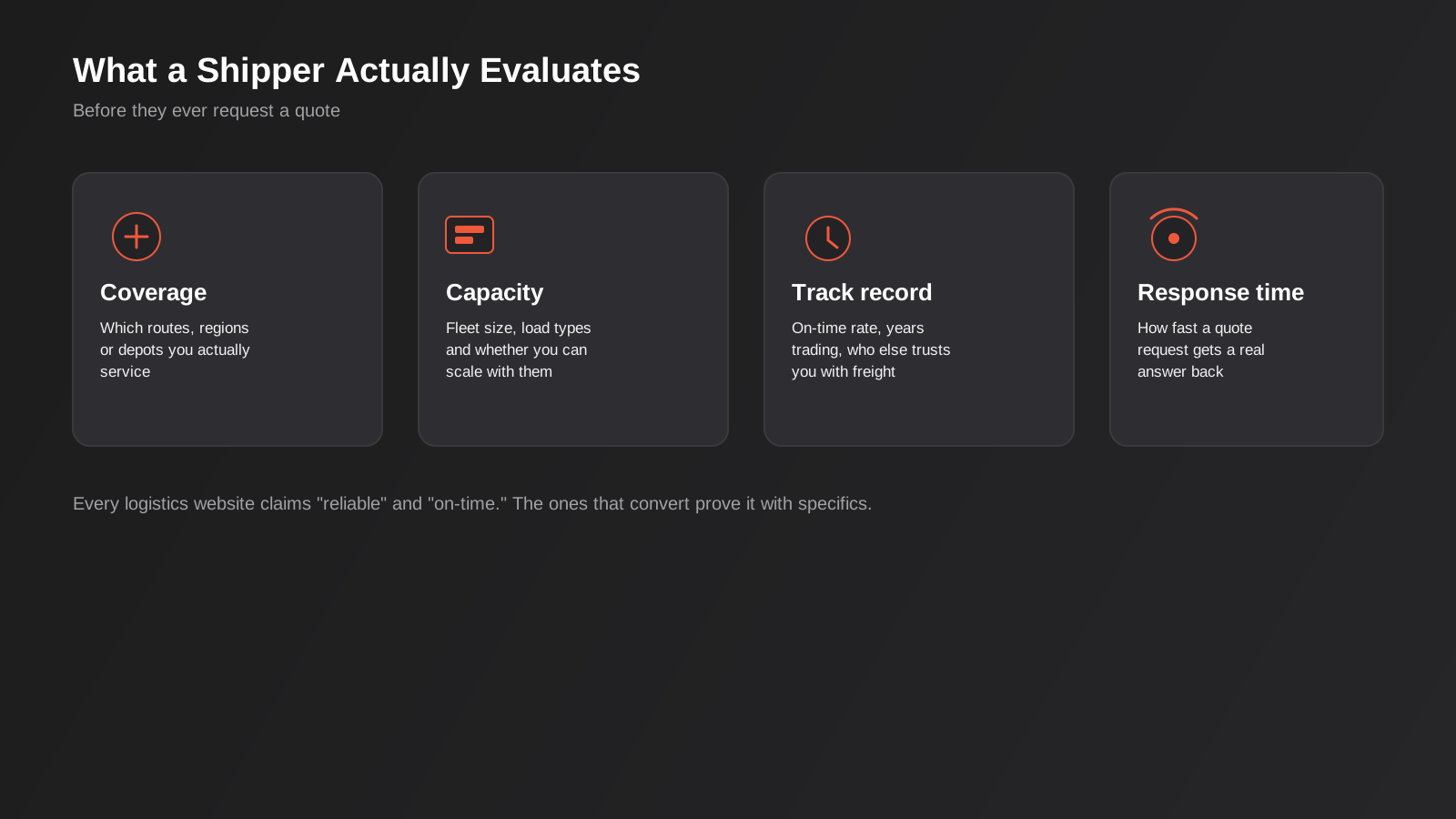
Coverage
Does this provider actually service my route, my region, or my specific lane? This sounds obvious, but a huge number of transport websites bury or omit this entirely, forcing a shipper to either guess or pick up the phone to ask — and a meaningful share of them will simply move to the next provider on the list instead. A clear coverage map, or a plainly stated list of serviced regions and corridors, lets a shipper self-qualify in seconds. That self-qualification cuts both ways: it reduces wasted enquiries from people you can’t service, and it speeds up genuine ones because the shipper already knows the answer to their first question before they fill in a form.
Capacity
Can this provider actually handle my volume, my load type, and scale with me if my shipping needs grow? A single owner-operator courier and a 40-truck regional fleet are solving completely different buyer anxieties. The courier needs to prove personal reliability and responsiveness. The fleet needs to prove it has genuine spare capacity and won’t bottleneck during a busy season. Neither gets solved by a generic “fast, reliable, affordable” headline.
Track record
How long has this business been operating, what’s their on-time performance, and who else has trusted them with freight. Years trading, a straightforward on-time percentage if you track and can stand behind one, and even a handful of named industries or client types you’ve served (without breaching any confidentiality agreements) all do real work here. This is also where testimonials and case studies earn their place — not as decoration, but as third-party evidence for a buyer who’s inherently sceptical of a provider’s own claims about itself.
Response time
When I ask for a quote, how fast do I get a real answer back? This is the one most businesses can control immediately and most completely ignore. If a shipper has shortlisted three providers and the first one to come back with a proper quote wins a meaningful share of those comparisons by default, how a quote request is handled after it’s submitted is, in a very real sense, a marketing lever — even though it looks like an operations problem. We come back to this later, because it’s one of the highest-leverage, most commonly skipped parts of the whole funnel.
SEO for transport and logistics businesses
Search is usually the strongest long-term channel for logistics marketing, because the buyer intent is unusually specific. Someone searching “interstate removalist Melbourne to Brisbane” or “refrigerated transport Adelaide” has already decided they need a provider and is actively comparing options — that’s about as close to bottom-of-funnel intent as search gets.
Target the corridor and service type, not just the industry term
A huge share of logistics search volume isn’t generic (“freight company Australia”) but specific to a corridor, region or load type: “Sydney to Perth freight,” “bulk grain transport Riverina,” “last-mile courier Parramatta,” “temperature-controlled transport Queensland.” These searches convert far better than the generic industry term, for a simple reason — the person typing them has already defined their requirement and is looking for someone who matches it. Generic terms, by contrast, pull in a mix of job seekers, researchers and competitors alongside genuine buyers.
Building this out properly usually means dedicated pages per major corridor or service line rather than trying to cram every route into one page. A freight business running Sydney–Melbourne, Sydney–Brisbane and Melbourne–Adelaide lanes gets more from three focused pages, each answering the specific questions a shipper on that corridor has, than from one page that mentions all three in passing.
Multi-depot and multi-region SEO without the pages competing against each other
Operators with more than one depot or service region face a structural problem: if every location page is a thin copy of the same template with the suburb name swapped, Google increasingly treats that as low-value duplicate content and may not rank any of them well. The fix is giving each location or region page something genuinely distinct — the specific depot address and operating hours, the actual lanes serviced from that depot, any local accreditations, and ideally some region-specific detail that a national template can’t fake. This is the same core problem retail and franchise businesses run into with local SEO, and it’s worth treating with the same discipline rather than relying on a thin location-page generator.
Technical groundwork that matters more for logistics sites than most
Transport and logistics sites often carry tracking widgets, live quote calculators or integrations with a transport management system (TMS), and these can quietly wreck page speed if they’re not implemented carefully — which matters both for ranking and for the shipper actually waiting on a quote calculation to load on a mobile connection from a warehouse loading dock. Schema markup for the business as a LocalBusiness or Organization entity, with service area and contact details marked up properly, also tends to be under-used in this industry relative to how much it can help with local and “near me” style queries.
Case studies and testimonials as trust signals, not decoration
Most transport websites treat testimonials as an afterthought — a scrolling carousel of unattributed quotes near the footer. For a buyer who’s inherently sceptical of a provider’s claims about itself, a short written case study naming the industry (even if not the specific client, where confidentiality requires it), the problem they had, and what changed once you took over their freight does far more work than a generic five-star quote. One paragraph describing how you solved a real capacity or timing problem for a business in a specific industry is worth more, credibility-wise, than ten generic “great service, highly recommend” lines. If you’ve genuinely got the data — an on-time percentage you can stand behind, a number of years servicing a particular corridor — put it next to the testimonial rather than leaving the reader to take your word for it.
Paid search and LinkedIn Ads for logistics lead generation
SEO is the compounding asset, but it takes months to build. Paid channels fill the gap while that’s happening, and for logistics specifically, two channels do most of the useful work: Google Ads for people actively searching, and LinkedIn Ads for reaching the specific buyer by job function before they’ve started searching at all.
Google Ads for freight and courier searches
Search campaigns for logistics work best when they mirror the SEO structure — corridor and service-specific ad groups rather than one broad “freight services” campaign. A shipper searching a specific lane is close to ready to request a quote, and a landing page that matches that specific search (rather than dropping everyone onto the generic homepage) converts noticeably better. This is also a category where negative keywords deserve real attention early, since terms like “freight” and “courier” pull in a lot of job-seeker and general-research traffic that will quietly burn budget without producing a single quote request.
LinkedIn Ads for account-based targeting of procurement and logistics managers
This is where logistics marketing diverges most from most other local service categories. LinkedIn lets you target by job title, seniority, company size and industry — so a provider can run campaigns aimed specifically at logistics coordinators, supply chain managers or procurement officers at companies of a particular size in a particular industry, rather than hoping the right person happens to see a generic ad. For account-based logistics marketing — where the goal is winning a handful of specific larger accounts rather than volume quote requests — this kind of precision targeting is usually worth the higher cost per click, because the audience waste that drags down cost-efficiency on broader platforms largely disappears. It’s a genuinely different approach from running the same display or social ad you’d run for a consumer business, and it’s one of the more under-used levers in this industry specifically because most transport operators have never run a B2B-targeted campaign before and default to whatever they’ve seen other local businesses do.
In practice this usually means building a small audience list around company size, industry and seniority rather than one broad logistics-industry audience, then testing sponsored content — a short post with a specific, credible claim about coverage or capacity — before layering in any direct outreach. The targeting precision is the whole point: a campaign aimed at supply chain managers at manufacturing companies with 50 to 500 staff in a specific state will almost always out-convert a campaign aimed at “logistics” broadly, even though the audience is smaller and the cost per click is higher. For account-based efforts specifically, it’s worth pairing the ad spend with a short, named target list — the twenty or thirty companies you’d most like as accounts — so the campaign and reporting can be judged against whether it actually reached and moved those specific companies, not just against generic click and impression numbers.
Website and landing page design that actually builds trust with shippers
Once the traffic arrives — organic or paid — the website has to do the trust-building work the sales conversation used to do. For a category where the buyer is assessing risk rather than reacting to a feeling, that means specific, verifiable detail wins over polish every time.
Replace generic claims with specific detail
“Reliable,” “on-time” and “quality service” appear on almost every transport website in the country, which means they’ve become background noise a shipper skips straight past. What actually moves the needle: an explicit coverage map or list of serviced regions, fleet size and vehicle types stated plainly, years in operation, any relevant accreditations (NHVR compliance, COR, chain of responsibility certifications, specific handling licences), and genuine client testimonials rather than a vague “trusted by businesses across Australia” line. None of this requires clever copywriting — it requires being willing to put real numbers and real detail on the page instead of hiding behind adjectives.
Purpose-built landing pages for high-intent traffic
A paid search click on “Sydney to Perth freight quote” shouldn’t land on the homepage. It should land on a page built around that exact search — confirming the lane, showing relevant capacity and transit-time detail, and getting straight to a quote form without making the visitor dig through a full site to find it. Dedicated landing pages built this way consistently convert better than sending paid traffic to a general site, and they’re also easier to test and improve in isolation, since you can change one page’s layout or copy without touching the rest of the site. For a business running multiple corridors or service lines, a small library of these focused pages — one per major route or service type — tends to outperform a single do-everything page by a wide margin.
Make the quote form match the decision, not a generic contact form
A generic “name, email, message” contact form forces a shipper to type out everything in free text, which is friction they didn’t come for. A quote form built for the industry — origin, destination, load type, weight or volume, timing — takes barely longer to fill in and gives whoever receives it everything they need to respond with an actual number on the first reply, instead of a back-and-forth email just to gather basic details. That difference alone often determines who replies first, and replying first is frequently the deciding factor in whether an account is won at all.
Automating quote handling so a genuine enquiry never sits unanswered
This is the part most transport businesses skip entirely, and it’s arguably the highest-leverage fix available, because it costs nothing in media spend and directly affects win rate on traffic you’ve already paid to attract.

When a quote request lands in a shared inbox, it waits for whoever next checks that inbox — which might be in ten minutes or might be tomorrow morning if it arrives on a Friday evening. A simple automated flow fixes most of this: the form submission gets acknowledged instantly so the shipper knows it was received, it’s routed automatically to whoever handles that region or lane (rather than sitting in a general queue), and if there’s no response logged within a set window, a follow-up reminder fires to make sure it doesn’t get missed. None of this requires custom software — it’s the kind of workflow a transport and logistics business can set up with existing CRM and automation tools, often in a matter of days rather than months.
The same logic extends to account communication once a relationship is won. Shippers on an ongoing account expect consistent updates, not silence punctuated by invoices. Automated status notifications, scheduled check-ins, and simple reporting on how the account is tracking all reduce the admin load on dispatch staff while making the relationship feel more professional — which matters directly for retention, since the real financial value in logistics marketing sits in keeping accounts, not just winning the first shipment.
Measuring what actually matters: accounts won, not just form fills
Website traffic and form submissions are the easiest things to report on, which is exactly why so many logistics marketing reports stop there. They’re also close to meaningless on their own, because a quote request that never becomes an account is worth nothing, and a hundred visits from the wrong audience tell you nothing about whether the right shippers are finding you.
What’s worth tracking instead: qualified quote requests (filtered for the lanes and load types you can actually service), quote-to-account conversion rate, average account value, and time-to-first-response on new enquiries. Tracking that last figure tends to be uncomfortable the first time a business measures it honestly — it’s common to discover that “we respond quickly” actually means anywhere from twenty minutes to two days depending on who happens to see the enquiry first. Once that’s visible, it becomes an obvious thing to fix, and fixing it is usually cheaper than any amount of additional ad spend aimed at generating more enquiries that will suffer the same fate.
For multi-depot operators, it’s also worth reporting by region or corridor rather than only in aggregate, since a campaign that looks healthy overall can be masking a specific lane or depot that’s quietly underperforming and losing accounts to a local competitor.
Common mistakes we see in transport and logistics marketing
- Leading with generic claims — “reliable,” “on-time,” “quality service” — instead of specific, verifiable detail about coverage, capacity and track record that actually differentiates the business from every competitor using the same three words.
- Sending all paid traffic to the homepage instead of a landing page built around the specific route, lane or service that was searched, which quietly tanks conversion rate on every paid click.
- Treating the contact form as good enough, when a purpose-built quote form that captures origin, destination, load type and timing gets a usable answer back to the shipper far faster.
- Letting quote requests sit in a shared inbox with no routing or follow-up, so the fastest competitor wins the comparison by default regardless of who had the better offer.
- Thin, duplicated location pages for multi-depot operations that compete against each other in search instead of each ranking for their own region.
- Reporting only on traffic and leads, never on quote-to-account conversion or account value, which hides whether the marketing spend is actually producing profitable accounts.
- Ignoring LinkedIn Ads entirely because it looks expensive per click, without comparing that cost against the value of the specific accounts it can target that broader platforms can’t reach precisely.
- Running one generic recruitment-style ad campaign that tries to attract both new freight accounts and new drivers at once, which dilutes the message for both audiences and performs worse for either.
Frequently Asked Questions
How much should a transport or logistics business budget for digital marketing in Australia?
It depends heavily on fleet size, number of depots and how competitive your specific corridors are, but as a general guide, SEO in Australia across industries typically runs from around $1,500 to $10,000 a month, and logistics-specific campaigns for multi-location freight brokers or mid-size 3PLs often land in the $3,000 to $15,000 a month range once link building, content and technical work are properly scoped. A single-depot regional operator targeting a handful of corridors can usually start at the lower end of that and scale up as the account base grows. Paid search and LinkedIn Ads budgets sit on top of that and vary with how competitive your routes are and how precisely you can target the buyers you want.
Is LinkedIn Ads worth it for a smaller transport business, or is it only for big 3PLs?
It depends on who you’re trying to reach. If your growth comes from winning specific larger accounts — manufacturers, wholesalers, retailers with recurring freight needs — LinkedIn’s ability to target by job title and company size can be worth the higher cost per click even at a smaller scale, because you’re not wasting spend on an irrelevant audience. If most of your business comes from smaller, more transactional bookings, Google Ads and local SEO are usually the better first investment, with LinkedIn added once you’ve got a specific account-based target list worth pursuing.
Should every depot or service region have its own page on our website?
Generally yes, provided each page has genuinely distinct content — the actual depot address and hours, the specific lanes or regions serviced from it, and any local detail that isn’t just a copy-pasted template with the suburb swapped. A thin, duplicated location page usually does more harm than good, because search engines can treat near-identical pages as low-value and may not rank any of them well. Fewer, better-built pages consistently outperform a large number of thin ones.
What’s the fastest way to improve quote conversion without spending more on ads?
Measure and fix your time-to-first-response on quote requests. It’s free to fix, it directly affects win rate on traffic you’ve already paid to attract, and most businesses are slower than they assume once they actually track it. Simple automated acknowledgement and routing — so a request goes straight to the right person instead of sitting in a shared inbox — is usually the single highest-leverage change available before touching the marketing spend at all.
Can we integrate marketing and quote automation with our existing transport management system (TMS)?
In many cases, yes, though it depends on which TMS you’re running and what it exposes through an API or webhook. Some systems make this straightforward; others need custom integration work to connect quote requests, tracking data or account status through to your CRM and marketing tools. It’s worth having this assessed properly before assuming either that it’s simple or that it’s not possible — both assumptions are common and both are often wrong for a given system.
Should driver recruitment marketing be run alongside customer-acquisition marketing?
Not as the same campaign. Driver recruitment and customer acquisition target completely different audiences with different motivations and different messages, and combining them into one generic campaign tends to dilute both. It’s better to scope and run them as separate efforts, even if the same business and the same marketing partner is handling both.
Where to start
If you’re running a transport, freight or logistics business in Australia, the highest-leverage place to start is usually the two things covered above that cost the least to fix: putting specific, verifiable coverage and capacity detail on your site instead of generic claims, and tightening up how quote requests get routed and followed up once they land. Both of those improve conversion on the traffic you’re already getting, before you spend another dollar on SEO or ads. From there, SEO built around your actual corridors and service types compounds over time, and LinkedIn Ads or Google Ads can fill the gap while that’s building, depending on whether you’re chasing specific accounts or general enquiry volume.
Our own SEO packages run from $550 to $950 a month excluding GST with no lock-in contract, scoped around how many keywords and pages need work, and we always start by scoping the actual routes, regions and account types you’re trying to win before recommending a package. If logistics marketing, quote automation or a transport-specific website rebuild is something you’re weighing up, our transport and logistics page has more detail on how we approach it, or you can reach out directly and tell us about your operation.
Worth putting a number on it: our own SEO starts from $550 a month — below the $1,500–$10,000 a month most Australian businesses pay for comparable monthly SEO, and well under the $3,000–$15,000 a month that logistics-specific campaigns often run to for multi-location freight brokers and mid-size 3PLs. If you’ve already got a written quote from another agency for comparable scope, send it through and we’ll do our best to beat it.
For a related look at how other B2B, quote-driven industries approach the same problem, see our guides on digital marketing for Australian manufacturers and digital marketing for trades and construction businesses — both cover the same RFQ-driven, risk-averse buying pattern in adjacent industries.
Keep reading
Related posts
Best Social Media Scheduling Tools for Australian Businesses (2026): 6 Compared
Six social media scheduling tools compared for Australian businesses: real USD pricing, honest drawbacks, time zones, support hours and which one suits…

Short-Form Video Marketing for Australian Businesses: A Reels, TikTok and Shorts Playbook (2026)
A practical, no-fluff guide to short-form video for Australian businesses: why videos actually spread, Reels vs TikTok vs Shorts, and what converts.

Affiliate Marketing for Australian Businesses: How to Build a Program That Actually Drives Sales (2026)
How to build an affiliate program in Australia: commission structures, platforms, AANA/ACCC disclosure rules and the mistakes that kill programs.
Got a project you'd like to talk through?
Tell us what you're working on — we'll come back with a plan.
