
Digital Marketing for Australian Manufacturers: Turning Visitors Into RFQs (2026)
 Jignesh Vagadiya
23/10/2026
21 min read
An engineer with a drawing to price doesn’t ring around. They search for the part, the material, the process — “316 stainless laser cutting Melbourne,” “CNC machining tolerance 0.05mm,” “food-grade conveyor fabrication Australia” — open four or five supplier sites in separate tabs, and quietly cross off the ones that can’t answer the question in front of them. By the time anyone from your sales team hears about the job, the shortlist is usually already half-built.
That’s the part most manufacturers get wrong about their own marketing. They treat the website like a digital version of the company brochure — an “About Us,” a product list with no detail, a contact form that asks for a name and a message. Meanwhile the buyer on the other end is an engineer or a procurement manager who already knows exactly what they need and is simply trying to work out, as fast as possible, who can actually make it. Win that moment and you get a proper request for quote with drawings attached. Lose it and you never hear from them at all — no bounce, no complaint, just a tab closed.
We’ve built and marketed enough manufacturer and industrial supplier websites to know this isn’t really a web design problem or a marketing problem on its own. It’s both, plus a request-for-quote process that either respects an engineer’s time or wastes it. Done properly, digital marketing for manufacturers covers the pages that actually earn a shortlist spot, the search and advertising that reach procurement and engineering buyers instead of a generic professional audience, and the quote-handling that turns an enquiry into a job instead of a missed opportunity.
Why Manufacturing Marketing Doesn’t Look Like Other B2B Marketing
Most “B2B marketing” advice is written for software companies selling subscriptions to marketing managers. Manufacturing is a different animal. The buyer is technical, the purchase is physical, and the sales cycle can run from a same-day quote on a standard part to eighteen months of specification, sampling and approval for a custom tooling job. None of the generic playbooks quite fit, which is exactly why so many manufacturer websites end up looking like every other small business site with a factory photo swapped in.
Technical buyers search for the part, not the company
An engineer rarely searches for “manufacturer near me.” They search for what they need: a material grade, a process, a tolerance, a certification, sometimes a part number from an existing supplier they’re trying to replace. That’s good news for a manufacturer willing to be specific, because it means the competition for “custom sheet metal fabrication Melbourne” is nothing like the competition for “digital marketing agency,” and a well-built page on a genuinely narrow topic can rank without years of link building behind it. It’s bad news for a manufacturer whose site only talks in general terms about “quality,” “reliability” and “decades of experience,” because none of that matches what anyone is actually typing into a search bar.
Long cycles, multiple stakeholders, real stakes
A marketing manager choosing a new email platform can decide alone in an afternoon. A procurement manager replacing a supplier for a safety-critical part usually can’t, and often shouldn’t. Engineering has to sign off on the specification, quality has to sign off on certifications, finance has to sign off on payment terms, and if it’s a large enough contract, someone several levels up has to sign off on the whole relationship. That means your website and your follow-up often need to equip more than one person at the buying company with what they need to make their own case internally — a spec sheet an engineer can forward, a certifications page a quality manager can point to, a clear quote a procurement lead can put in front of finance.
Small search volume, very high value per enquiry
A keyword like “custom injection moulding tooling Australia” might get a few dozen searches a month nationally. That number looks tiny next to consumer search volumes, and it scares off a lot of marketers who are used to judging a keyword by its traffic potential. For a manufacturer, it’s close to irrelevant. If even a handful of those searchers are a genuine fit and one of them turns into a long-running account, the lifetime value can outweigh what most ecommerce stores make from thousands of visits. Precision beats reach here. A page that nails one specific capability for the handful of people searching for it will usually outperform a broad page trying to cover everything you do.
The Manufacturer Website: What Actually Needs to Be There
If you strip away the templates and the stock photography, a manufacturer’s website has one job: let a technical buyer confirm, in a couple of minutes, that you can actually do the thing they need done — and then make it easy for them to ask for a price. Most manufacturer sites fail at both, usually in the same handful of ways.
Capability and process pages, not a product list
“We manufacture custom metal components” tells a buyer nothing they can act on. What materials? What tolerances? What volumes, from prototype runs to full production? What finishing options? A capability page that answers those questions specifically does two jobs at once: it gives a human buyer the information they need to shortlist you, and it gives search engines something concrete to match against a real query. If you cut, bend, weld and finish sheet metal in aluminium, mild steel and stainless up to a certain thickness, say exactly that, with the numbers, rather than leaving it to a phone call to find out.
Specifications belong on the page, not buried in a PDF
A huge amount of manufacturing content still lives in PDF data sheets that search engines barely index and mobile visitors struggle to read. Data sheets have their place — some buyers genuinely want a downloadable spec to file or forward — but the core specification should also live as real, readable text on the page itself: tolerances, standards met, material options, lead times. Buyers increasingly research suppliers through AI tools and chat-based search as well as traditional search engines, and those tools can only work with content they can actually read and extract, not a flattened image inside a PDF.
The request-for-quote form is your most important conversion point
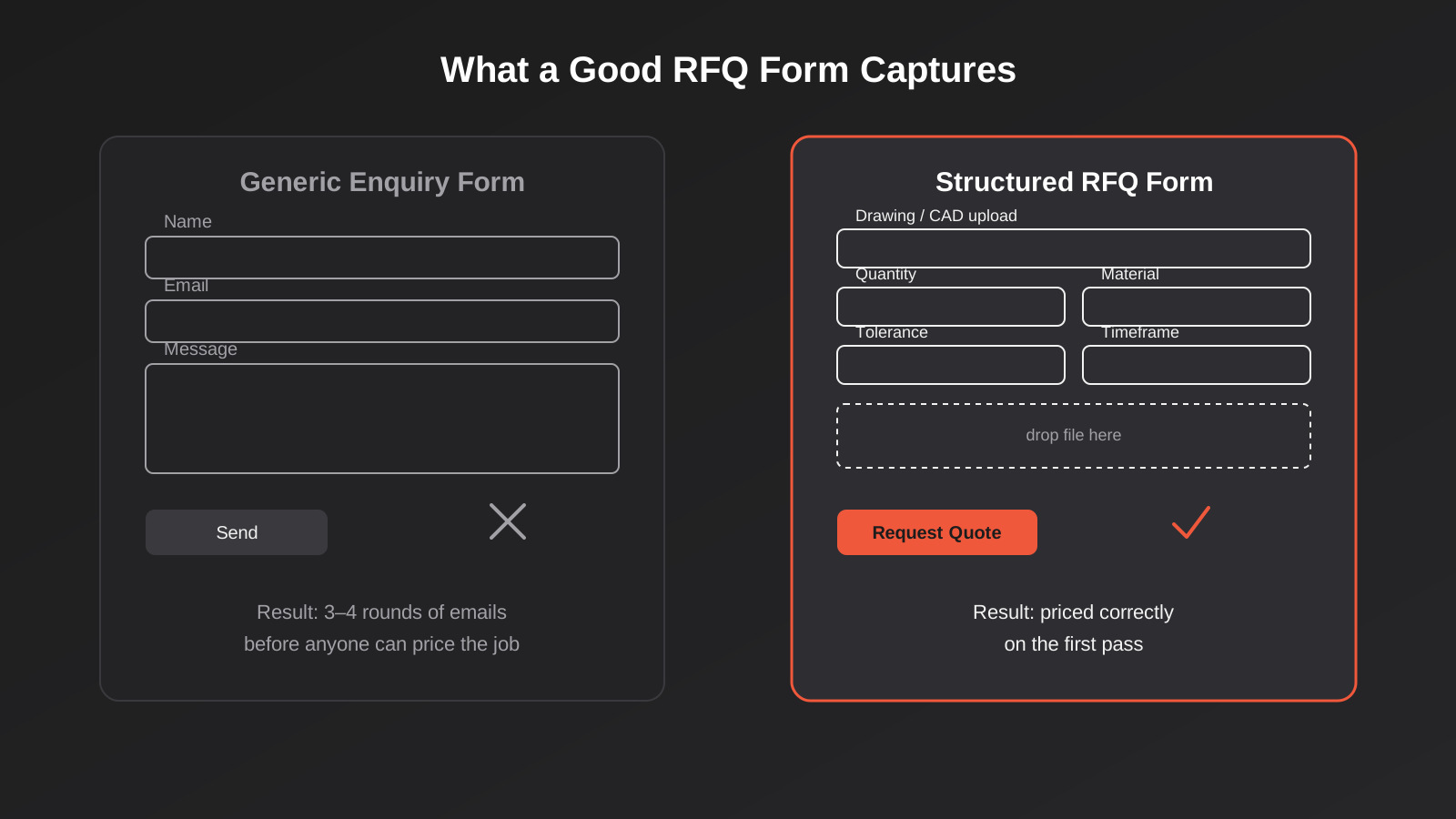
Most manufacturer enquiry forms ask for a name, an email and a short message. That’s not a quote request, it’s the start of three or four rounds of back-and-forth before anyone can price the job. A properly built RFQ form asks for what an estimator actually needs on the first attempt: drawing or CAD file upload, quantity, material or finish, required tolerance, and timeframe. It takes a little longer to fill out, which sounds like it should hurt conversion — in practice it rarely does, because the buyers filling in a form with that much detail are already serious, and the ones who weren’t going to convert anyway drop off at the same rate regardless of form length.
Proof that doesn’t rely on a site visit
A buyer who can’t walk your floor needs other ways to trust you. Quality certifications (ISO 9001 and any industry-specific standards you hold), industry memberships, a real equipment list, and genuine photography of your facility and machinery all do work that a stock photo of a generic factory never will. Case studies and capability statements that describe a specific job you’ve completed, without breaching any confidentiality, tend to convert better than a general “about our company” page because they show the kind of problem you solve rather than just claiming you solve problems. If you’re promoting local manufacture, “Australian made” and similar origin claims sit inside consumer law and need to be accurate and able to be substantiated, not just a line that sounds good on a hero banner.
Getting Found: SEO for Manufacturers
Search is where most manufacturer enquiries should originate, because it catches buyers at the exact moment they’re looking, rather than interrupting them. The approach is different from consumer SEO in a few important ways.
Target the product, material and process, not the company
Start from the searches an engineer or buyer would actually type, not the language your business uses internally. That usually means a page per capability or product line rather than one page trying to cover everything. A fabricator that does laser cutting, folding, welding and powder coating is better served by separate, specific pages for each than by one page that mentions all four in passing. Each page becomes something concrete to rank for, and together they build a site that reads as genuinely capable rather than vague.
Write content that answers an engineer’s actual question
Technical buyers are a demanding audience for content. A generic “benefits of custom manufacturing” blog post won’t earn their trust the way a page explaining tolerance ranges by process, or when to specify 304 versus 316 stainless for a particular environment, will. This kind of content takes real subject-matter input — from an estimator, an engineer, a production manager — rather than being something a content writer can produce from a keyword list alone. It’s also exactly the kind of specific, well-sourced content that AI Overviews and chat-based search tools favour when they’re compiling an answer, because it’s genuinely useful rather than generic.
Local and regional visibility, where it actually matters
Freight cost and lead time mean some manufacturing searches do carry real local intent — a buyer wanting a supplier within a reasonable radius to control freight, or wanting to see a facility before committing to a large order. Google Business Profile, location pages for genuine facility locations, and local citations matter here the same way they do for any physical business, though the keyword intent behind them is still product- and capability-specific rather than generic “near me” language.
Don’t neglect distributor and dealer-facing pages
If you sell through distributors as well as direct, a dealer or distributor locator and dedicated trade pages are often under-built. These pages serve a different search intent again — “become a [product] distributor” or “find a [product] stockist near me” — and they’re frequently left off the site entirely because they don’t fit neatly into either the “customer” or “about us” sections most templates assume.
Schema markup gives search engines (and AI tools) something structured to work with
Product and capability pages benefit from structured data the same way any other product does — marking up materials, specifications, availability and pricing where it’s public, using Product or Service schema depending on how your offering is structured. For a manufacturer this is particularly useful because so much of the differentiating detail is numeric and specific (tolerance in millimetres, maximum sheet thickness, certification codes), and structured data gives search engines and AI answer tools a clean, unambiguous way to pull exactly that detail into a result rather than guessing from unstructured paragraph text. It’s a smaller lift than most of the content work on this list, and one of the few technical fixes that benefits both traditional rankings and how often you get cited in an AI-generated answer.
Paid Channels That Actually Reach Procurement and Engineering Buyers
SEO captures people who are already looking. Paid channels can put you in front of the right person earlier, before they’ve started searching in earnest, and can accelerate pipeline when a new product line or expanded capacity needs demand quickly.
Google Ads for bottom-of-funnel, high-intent searches
Because manufacturing search volume is low but valuable, Google Ads can work well for defending or capturing specific high-intent terms — particularly ones where you’re competing against distributors, marketplaces or overseas suppliers for the same search. The campaign structure matters more than the budget here: tightly themed ad groups built around specific products or capabilities, rather than one broad “manufacturing services” campaign, keep cost per click reasonable and send traffic to a page that actually matches what was searched.
LinkedIn Ads for reaching the right job titles before they start searching
LinkedIn is one of the few platforms built on genuine professional data rather than inferred interests, which makes it unusually well suited to industrial B2B. You can target by job title, seniority, industry and company size, which means reaching engineering managers, procurement leads and operations directors directly instead of hoping a broad professional audience happens to include them. It tends to work best as a complement to search rather than a replacement for it: LinkedIn reaches people who aren’t actively looking yet and builds awareness for when they are, while search captures the ones who already are. Sponsored Content with a lead gen form is usually the strongest starting format, since LinkedIn pre-fills a decision-maker’s profile data and removes most of the friction of filling out yet another form. Our LinkedIn Ads management page covers the formats and targeting in more depth, with real Australian benchmarks to model a budget before committing to one.
Account-based targeting for a defined buyer list
If you’re selling into a known, finite list of target accounts — a specific set of OEMs, a defined panel of builders, a handful of large retailers you want as direct customers — account-based targeting on LinkedIn lets you build campaigns around those exact companies rather than a lookalike audience guessing at who they are. It’s a much better fit for industrial sales than broad awareness advertising, because the universe of real buyers is often small enough to name individually.
Trust, Proof and Design for a Technical Buyer
Design for a manufacturer isn’t about looking trendy. It’s about looking credible to someone whose job depends on picking the right supplier. That means clean, scannable layouts that get specification data in front of a reader fast, certifications and standards displayed prominently rather than buried in a footer, and photography that shows real equipment and real facilities rather than generic stock imagery that could belong to any company in any country. A site that’s visually polished but vague on substance will lose to a plainer site that answers the actual question — though the two aren’t mutually exclusive, and getting both right is where conversion-focused design earns its keep. Building that proof into the structure of the page, not just bolting a testimonials slider onto a template, is the difference between a site that reassures a sceptical buyer and one that reads as marketing fluff. Our conversion-focused design page goes into how we approach that balance for technical and trust-sensitive audiences.
Certifications and standards deserve their own page, not a footer logo strip
A row of small certification badges at the bottom of the homepage is easy to miss and gives a quality manager nothing to forward internally. A dedicated certifications and standards page, listing what you hold, what it covers, and linking to or displaying the actual certificate where appropriate, does real work during the approval stage of a deal. It’s also one of the easier pages to keep current, since certifications tend to change on a known renewal cycle rather than needing constant rewriting.
Automating the Quote Process So You Don’t Lose the Race
Industrial buyers very often send the same request to several suppliers at once and award the job to whoever responds first with a credible, accurate quote. That means the window between “enquiry submitted” and “someone capable looks at it” matters almost as much as the quality of the quote itself.
A few automations consistently pay for themselves here. Routing rules that send an RFQ straight to the right estimator based on product type or material, rather than into a shared inbox someone checks twice a day. An instant acknowledgement email that confirms the request was received and sets a realistic expectation for turnaround, so the buyer isn’t left wondering if the form actually worked. Follow-up sequences for quotes that haven’t been actioned after a few days, since long sales cycles mean a quote can quietly go cold without anyone meaning to drop it. And where it’s genuinely useful, a connection between the RFQ form and your CRM or ERP system, so a request doesn’t have to be manually re-typed into the system your sales team actually works from.
Landing pages built for a specific campaign or trade show follow-up deserve the same attention. A generic contact page asks a trade show lead to do all the work of finding the right form; a dedicated landing page built for that specific audience, with tracking wired up so you know which campaign actually produced the enquiry, does the opposite. Our landing page development service covers exactly this kind of build — fast-loading, properly tracked, and connected to your CRM so a lead from a trade show or a LinkedIn campaign doesn’t disappear into a generic inbox.
Keeping a long sales cycle warm without becoming spam
A quote that isn’t actioned in a week isn’t necessarily a lost deal — industrial buyers often collect several quotes before a budget is approved internally, and months can pass between a quote going out and a purchase order coming back. A short, genuinely useful email sequence tied to the quote (confirming lead time still holds, flagging a relevant capability they didn’t ask about, checking in before the quote’s validity period expires) keeps you front of mind without looking like you’re chasing. This is a good use for basic email marketing automation rather than a full marketing campaign tool, since the sequence is short, triggered by the quote itself, and aimed at exactly one recipient rather than a list.
How Much Does Manufacturer Website Design and Marketing Cost in Australia?
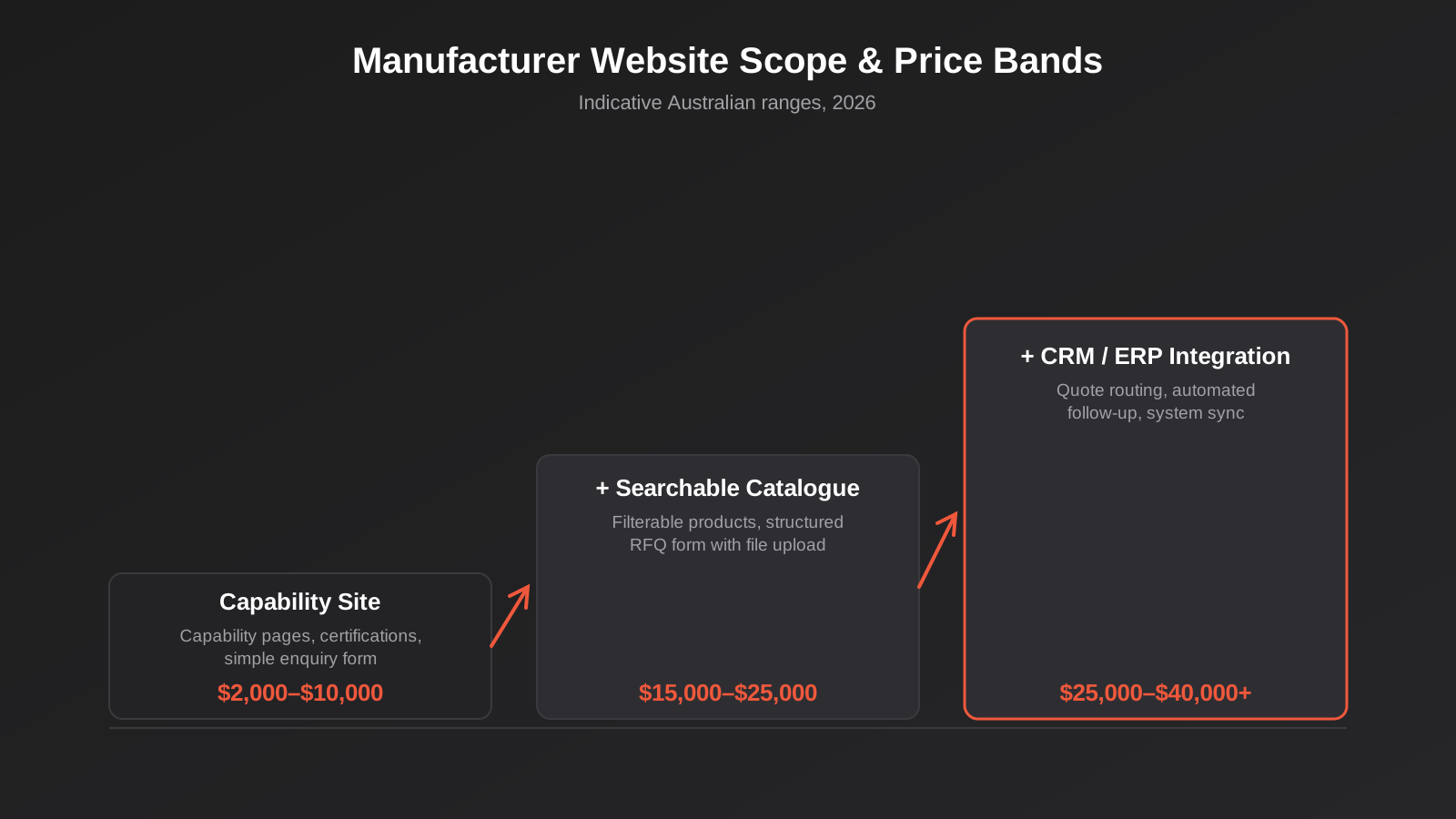
Scope drives cost more than almost anything else here, and manufacturer sites genuinely vary more in scope than most other industries. A focused capability-led brochure site — the kind that clearly explains what you make, for whom, with what certifications, and collects a well-structured enquiry — sits at the lighter end of the market. Industry-wide, a professionally designed small business website in Australia in 2026 typically runs somewhere between $2,000 and $10,000 depending on page count and complexity, before any ecommerce or custom functionality is added.
Once you add a searchable product catalogue with filtering by material, size or application, a structured RFQ workflow with file uploads, or a genuine connection into your CRM or ERP, the scope — and the price — grows accordingly. Builds with that level of integration and custom functionality commonly run from $15,000 up to $40,000 or more in the Australian market, largely driven by how much of your existing systems the site needs to talk to and how large the product range is.
Marketing spend follows a similar logic to lead cost rather than traffic volume. Because manufacturing search terms carry low volume and high intent, a modest monthly SEO or Google Ads budget can be enough to meaningfully move the needle, provided it’s aimed at specific capability and product terms rather than spread thin across broad industry keywords. LinkedIn Ads budgets tend to need to be a little more generous per click than Google or Meta, given the platform’s higher cost-per-click, but the targeting precision usually justifies it for a business with a meaningful average deal size.
Common Mistakes Manufacturers Make With Their Website and Marketing
- Describing capability in vague, general terms (“quality,” “reliability,” “decades of experience”) instead of specifics an engineer can actually act on — materials, tolerances, volumes, lead times.
- Burying specifications inside PDF data sheets that search engines and AI tools can barely read, instead of also putting the core detail on the page itself.
- Running an enquiry form with three vague fields instead of a structured RFQ form that captures drawings, quantity, material and timeframe up front.
- Letting RFQs sit in a shared inbox instead of routing them straight to the right estimator, and losing the job to whichever competitor responded first.
- Spending the whole marketing budget on broad brand awareness instead of specific, high-intent product and capability searches.
- Targeting LinkedIn campaigns at a generic “manufacturing professionals” audience instead of the actual job titles and seniority levels that sign off on a purchase.
- Making “Australian made” or similar origin claims without being able to substantiate them accurately under consumer law.
- Treating the website as a one-off project instead of adding new capability and product pages as the business actually grows and changes.
Frequently Asked Questions
How is marketing for a manufacturer different from marketing for a typical trade or construction business?
Trade and construction marketing is usually local, service-based lead generation — a homeowner or builder searching for someone to do a job in their area, with a shorter decision and often one decision-maker. Manufacturing marketing is national or even international, product- and capability-led, with longer sales cycles and several stakeholders signing off on a purchase. Our guide to digital marketing for trades and construction businesses covers that local, service-led side if that’s closer to your situation.
What should a manufacturer’s homepage actually say?
It should make it obvious within a few seconds what you make, who you make it for, and what makes you capable of doing it — specific materials, processes, certifications or volumes, not general claims about quality. Clear paths to your capability pages and to a request-for-quote form matter more than a polished hero statement.
Is SEO worth it for a manufacturer with low search volume?
Usually yes, because the searches that do exist carry unusually high intent and value. A handful of well-matched enquiries a month from specific product and capability pages can be worth more than a large volume of unqualified traffic elsewhere. The key is targeting the exact products, materials and processes buyers search for rather than broad industry terms.
Should we be on LinkedIn, Google Ads, or both?
Most manufacturers get the best result from both, used for different jobs. Google Ads and SEO catch buyers who are already searching; LinkedIn Ads reach the right job titles before they’ve started looking, which matters for a long sales cycle where awareness now becomes a shortlist spot later. If budget is tight, start with search, since it captures existing demand at a generally lower cost per click.
Do we need a searchable product catalogue, or is a simpler site enough?
It depends on how many distinct products or materials you offer and how much buyers need to filter and compare them. A manufacturer with a handful of core capabilities is usually well served by clear capability pages. A manufacturer with hundreds of SKUs, variants or material options benefits from a searchable, filterable catalogue, both for usability and because each filtered result gives search engines something specific to index.
Can our website connect to our existing ERP or CRM?
Often, yes, though it depends on what your specific systems expose and how your business actually uses them. The honest answer only comes from checking your actual setup rather than promising an integration before anyone’s looked at it — which is also why a proper quote for this kind of build usually starts with a short discovery conversation rather than a fixed package price.
Where to Start
If you’re not sure where to begin, start with the website. Audit your current capability pages against what an engineer would actually need to know to shortlist you, check whether your enquiry form is a genuine RFQ form or just a contact box, and look honestly at whether your specifications are readable on the page or trapped in a PDF nobody can search. Those fixes alone often lift enquiry quality before a single dollar goes into paid advertising.
From there, SEO targeted at your specific products and capabilities is usually the next move, since it compounds over time and catches buyers who are already looking. LinkedIn Ads are worth testing once you have a clear picture of who actually signs off on your product, particularly if your sales cycle is long enough that building awareness now pays off later. If you want a second opinion on your current site or a straightforward look at what a proper RFQ-focused rebuild would involve, our website pricing page sets out how we scope and quote that kind of project.
Worth putting a number on it: our own website design starts from $1,500 — below the $2,000–$10,000 most Australian small businesses pay for a professionally designed site of comparable scope. A fuller build with a searchable catalogue, RFQ workflows and ERP integration is scoped to what you actually need rather than forced into a fixed package, but the entry point for a focused capability site undercuts the general market baseline.
If you’ve already got a written quote from another agency for comparable scope, send it through and we’ll do our best to beat it.
Tell us what you manufacture, who buys it, and how requests for quote reach you today, and we’ll tell you honestly what’s worth fixing first.
Keep reading
Related posts
Digital Marketing for Car Dealerships and Workshops in Australia (2026)
Digital marketing for Australian car dealerships and workshops: local SEO, Google Ads, booking flows, and the price-advertising rule every dealer must follow.
Marketing for Recruitment Agencies in Australia: Winning Both Clients and Candidates
Recruitment agencies sell to two audiences at once. How SEO, LinkedIn Ads, job board strategy and compliance need to split between employers…
Cosmetic Clinic Advertising Rules in Australia: AHPRA, TGA and What You Can Legally Say (2026)
What AHPRA's 2025 guidelines and TGA rules actually restrict for cosmetic clinic marketing in Australia, and the compliant way to market injectables.
Got a project you'd like to talk through?
Tell us what you're working on — we'll come back with a plan.
