
Short-Form Video Marketing for Australian Businesses: A Reels, TikTok and Shorts Playbook (2026)
 Jignesh Vagadiya
13/11/2026
21 min read
Open the Insights tab on almost any Australian business Instagram account right now and you’ll usually find the same pattern: a grid of tidy static posts getting polite, predictable reach, and one video sitting well ahead of everything else — often the one nobody on the team expected to do anything. It wasn’t boosted. Nobody paid for it. It just moved, because enough people watched it to the end, and the platform noticed.
That’s the part most businesses miss about short-form video marketing. Everyone’s chasing paid attention right now — Meta Ads, TikTok Ads, Google campaigns — and for good reason, since paid buys reach on demand. But organic short-form video is still one of the few ways left on the internet to get genuinely free distribution to people who’ve never heard of you, and most Australian businesses either ignore it completely or do it badly: posting sporadically, treating a 20-second clip like a billboard, and wondering why nothing happens.
We’ve written before about social media strategy more broadly — platform choice, content pillars, the workflow behind posting consistently without burning out. This guide goes narrower and deeper into one piece of that: short-form video marketing specifically. Why certain clips spread and others sit at nine views, how Reels, TikTok and YouTube Shorts actually differ despite looking the same, which formats genuinely convert for different kinds of businesses, how to build a production workflow you can sustain without hiring a videographer, and when it’s worth putting paid dollars behind something that’s already working organically.
Why short-form video marketing earns a different kind of attention
Paid social buys you a guaranteed audience size for a guaranteed price. Organic video buys you something paid can’t: the sense that you found this, rather than someone paid to put it in front of you. People scroll past ads with their guard up. They don’t scroll past a video with the same scepticism, because as far as the feed is concerned, it’s just content — recommended because it earned the spot, not because a budget bought it.
That trust gap matters more for some businesses than others. A tradie showing an actual job, a clinic explaining a procedure in plain language, a retailer showing how a product is actually used — these build credibility that a polished ad often can’t, precisely because they don’t look like advertising. Static image posts and carousels still have a place, but video consistently gets more algorithmic favour across Instagram, TikTok and YouTube right now, because platforms are optimising for watch time, and nothing holds attention the way moving footage does.
None of this makes organic video free in the way “free” usually gets used. It costs time, and time is the real currency here — filming, editing, writing hooks that actually work, posting consistently enough that the algorithm has a pattern to reward. Businesses that treat it as a side project squeezed in when there’s a spare ten minutes almost always get side-project results.
How the algorithm actually decides what gets shown
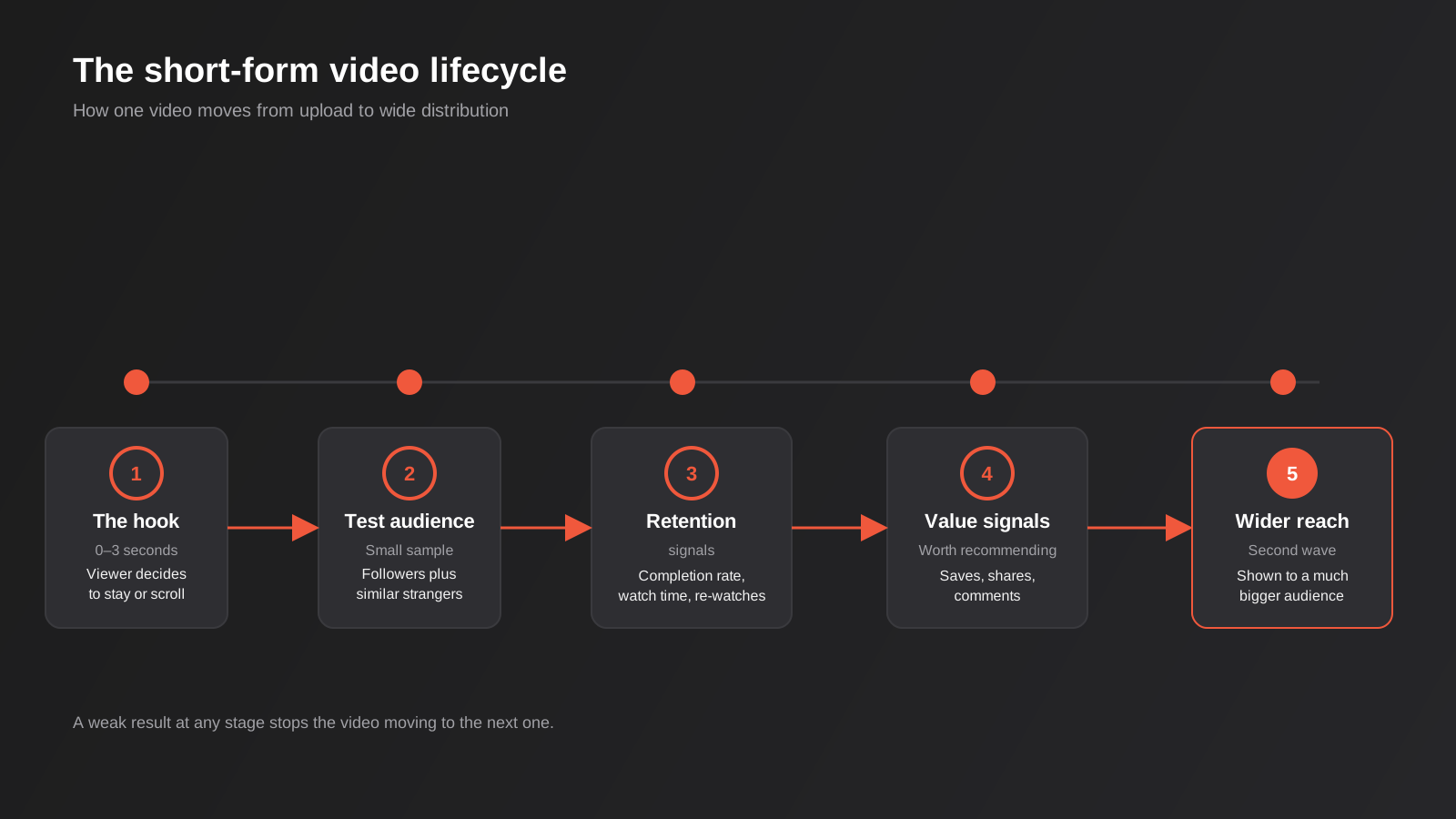
Every short-form platform runs a recommendation system rather than a strict chronological feed, and while the exact weighting is never published and changes constantly, the underlying mechanics are consistent enough across Instagram, TikTok and YouTube to plan around. The system tests a video on a small slice of your followers and a small slice of strangers who fit a similar interest profile. If that initial audience watches, re-watches, saves or shares it, the system shows it to a slightly bigger pool. If they scroll past in the first few seconds, it stops there. That’s it — there’s no secret trick beyond consistently clearing that first gate.
The first three seconds decide almost everything
The single biggest lever in short-form video is the opening. Viewers decide whether to keep watching almost instantly, long before they’ve consciously registered what the video is about. A hook that states the payoff immediately — “here’s why your invoices keep bouncing back,” not a slow pan across a logo and a “hey guys” — is what gets someone to stay for the next ten seconds. Businesses that script the first line of every video and skip scripting the rest almost always outperform the ones that write a full plan and rush the opening.
This is also where most business video content fails before it starts. A video that opens with a company name, a logo animation or “thanks for watching” is asking for patience the algorithm has already decided the viewer doesn’t have. Save the branding for the end card, where it costs nothing, and spend the opening on the reason to keep watching.
Watch time and completion rate matter more than view count
A video that gets ten thousand views but loses most of its audience in the first five seconds performs worse, long term, than one that gets five hundred views with most of them watched to the end. Completion rate and average watch time are the clearest signal a platform has that the content is actually good, not just that the thumbnail or the first frame was clickable. This is why shorter, tighter videos frequently outperform longer ones for business accounts — not because short is inherently better, but because it’s far easier to hold full attention for fifteen seconds than for ninety.
Re-watches count too, and they’re one of the easier signals to design for deliberately. A video that only makes sense on a second viewing, or that reveals something on a loop — a punchline, a reveal, a list that times out right as it restarts — picks up replays that read to the algorithm as a strong engagement signal, even without a single comment.
Saves and shares signal “worth recommending again”
A comment is a weak signal on its own. A save or a share is a much stronger one, because it means someone valued the content enough to want it again later or to hand it to somebody else — and both actions tend to get weighted more heavily in distribution than likes do. Content that’s genuinely useful enough to bookmark — a checklist, a comparison, a “save this for later” tip — tends to outperform content that’s only entertaining, because it earns saves on top of whatever engagement the entertainment value brings in.
Choosing your platforms without spreading yourself thin
Reels, TikTok and YouTube Shorts look almost identical on the surface — vertical video, a similar length, a similar scroll — but they reward different things, and treating them as one upload target rather than three distinct audiences is one of the quickest ways to underperform on all three.
Instagram Reels
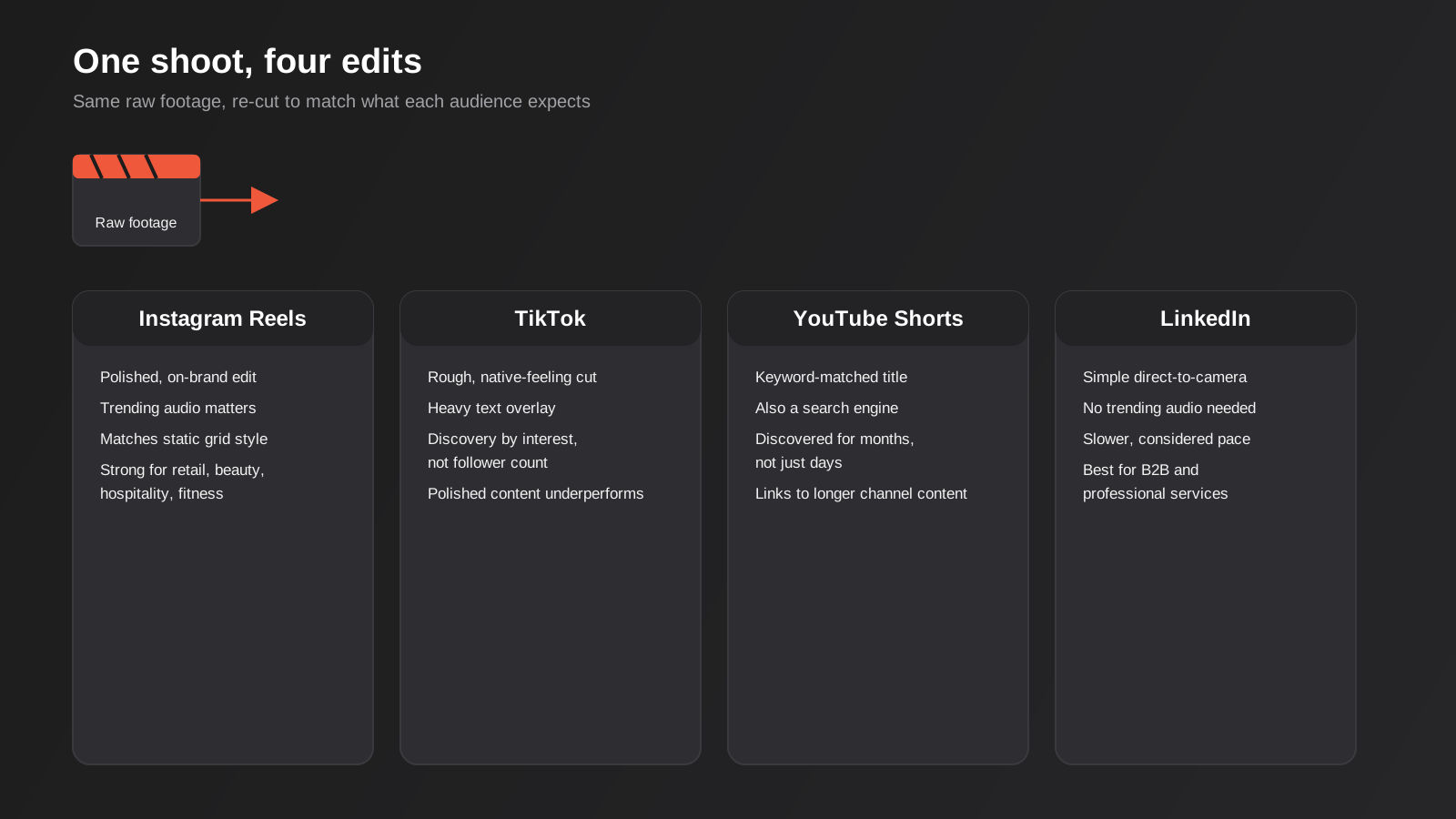
Reels sits inside an app people already use to follow businesses they know, so it rewards polish and brand consistency more than the other two. It also benefits from a visual feed around it — a Reel that looks wildly different from the static grid it sits next to can actually hurt profile conversion, even if the Reel itself performs well. Reels is generally the strongest platform for retail, hospitality, beauty, fitness and anything visually led, and it’s the one where trending audio still moves the needle noticeably, since Instagram’s discovery still leans on audio trends more than TikTok’s does now.
TikTok
TikTok’s audience expects native, unpolished content and treats anything that looks like a repurposed ad with visible suspicion. Text-heavy overlays, a direct-to-camera delivery and a rougher, faster edit consistently outperform the glossier style that works on Reels. TikTok’s discovery also runs more on interest-matching than on your existing follower base, which is genuinely useful for a new account with zero following — a business with twelve followers can still reach thousands of strangers if the content earns it, in a way that’s harder to replicate on Instagram or YouTube.
YouTube Shorts
Shorts is the one platform in this group that’s also a search engine, which changes the calculus. A Short with a clear, keyword-matched title and description can keep getting discovered months after posting, long after a Reel or TikTok has stopped circulating. Shorts also benefits from linking into a channel’s longer content — a Short that teases a full tutorial or case study, with the channel’s other videos sitting right there, converts viewers into subscribers more readily than a standalone clip does on the other two platforms.
LinkedIn video, briefly
LinkedIn’s short-form video is smaller scale but worth a mention for B2B and professional services. It doesn’t reward trending audio or fast cuts the way the consumer platforms do — a founder explaining a decision direct to camera, filmed on a phone with no editing at all, regularly outperforms a produced piece here. If the audience is corporate or government-adjacent, this is usually a better use of video effort than chasing TikTok trends that audience will never see.
One shoot, several cuts
The workflow that actually scales isn’t filming three separate videos for three platforms. It’s filming one piece of raw footage long enough to extract several angles from, then editing it differently for each destination: a punchier, text-heavy cut for TikTok, a cleaner on-brand cut with trending audio for Reels, and a searchable, title-optimised cut for Shorts. The content is the same; the edit, the pacing and the on-screen treatment change to match what each audience actually expects.
Formats that actually convert, not just entertain
Trend participation gets a lot of attention, but trend audio bolted onto unrelated business content is usually the weakest-performing format on this list — it reaches people who came for the trend, not for the business, and converts almost nobody. The formats below consistently do better, because they give someone a reason to care about the specific business behind the account.
For service and trade businesses
- Real jobs filmed as they happen — a before-and-after, a tricky fix explained in plain language, the part of the job customers never usually see.
- Myth-busting content that corrects a common misunderstanding in the trade, which tends to get saved and shared because it’s genuinely useful on its own.
- Quick answers to the questions that come up in every quote conversation — “how long does this actually take,” “why does this cost more than the last guy,” answered once on video instead of a hundred times in person.
For healthcare, allied health and professional services
Regulated industries need to be more careful here — a dental practice, a physiotherapy clinic or a law firm can’t make the same claims a retailer can. Within those limits, educational content performs reliably well: explaining what actually happens during a procedure or a first consultation, correcting a common misconception patients bring in, or walking through what a client should expect before they book. This content builds trust precisely because it isn’t selling anything directly in the video itself.
For ecommerce and retail
- Unboxing and first-use content shot the way a customer would actually film it, not a studio production.
- Side-by-side comparisons against the obvious alternative, which perform well because they answer the exact question a buyer has at the point of deciding.
- Behind-the-scenes of how a product is made or packed, which consistently earns saves and shares even when it isn’t trying to sell anything.
- Genuine customer reaction content, which reads as far more credible than a scripted testimonial.
Building a production workflow you can actually sustain
The research on cadence is consistent on one point even where the specific numbers vary: a handful of genuinely good videos a week beats daily posting of anything that gets thrown together. Three well-made videos a week, posted reliably, will outperform seven rushed ones almost every time, and it’s far easier to sustain for more than a month.
Batch your filming
Filming one video at a time, whenever there’s a spare moment, is how most businesses’ video efforts quietly die within six weeks. Setting aside a half-day once every week or two to film enough raw footage for the next ten to fifteen videos turns video into a scheduled task instead of something that competes with everything else for attention every single day. Keep a running list of ideas between shoots — questions customers actually asked that week, a job worth filming, a comparison someone raised — so the batch day starts with a list, not a blank page.
Equipment that’s actually necessary
A recent phone, decent natural light and a cheap lavalier microphone cover almost every format that performs well on these platforms — audiences on TikTok and Reels in particular tend to trust phone-shot footage more than anything that looks studio-produced, since over-polished content reads as an ad. The one upgrade worth making early is audio. Viewers tolerate average video quality far more readily than they tolerate audio they have to strain to hear, and bad audio is the fastest way to lose someone in the first three seconds that matter most.
Editing, captions and accessibility
Burned-in captions aren’t optional anymore — a large share of short-form video gets watched with the sound off, in an office, on public transport, in a waiting room, and a video with no captions loses that entire audience in the first second. Most editing apps on the market now auto-generate captions reasonably accurately; the only extra step worth taking is proofreading them before posting, since a wrong word in a caption looks careless in a way a shaky camera angle doesn’t. Keep text on screen large enough to read at a glance and change up visuals every few seconds rather than holding one static shot — both genuinely help retention, which is the metric that actually drives distribution.
A script template that doesn’t sound scripted
Fully scripted video tends to sound stiff on camera, but no script at all usually means rambling, dead air and a weak opening. The middle ground that works for most businesses is a four-line skeleton rather than a word-for-word script: write the hook exactly, word for word, since that’s the line that has to land perfectly; note the two or three points that need covering in whatever order feels natural when speaking; write the call to action exactly, since a vague trailing-off ending wastes everything the video just earned; and leave everything in between unscripted, delivered in the person’s own words. This keeps the delivery sounding like a real person talking rather than reading, while protecting the two moments — the open and the close — that actually determine how the video performs.
A posting cadence that doesn’t burn you out
Consistency compounds in a way a single viral video doesn’t. An account that posts three solid videos a week for six months builds an audience that trusts hearing from it regularly; an account that posts fifteen videos in a burst and then goes quiet for a month loses most of what it built in that gap. Pick a cadence that’s genuinely sustainable with the time available — even two a week done properly, for a year, will outperform an ambitious daily schedule that collapses after three weeks.
Measuring what actually matters
Vanity metrics versus business metrics
View count is the easiest number to check and the least useful one to act on. A video with a hundred thousand views and no saves, shares or profile visits usually did one thing well — the hook — and nothing else. The metrics worth tracking, in rough order of what they tell you, are completion rate, saves, shares, profile visits from the video, and then whatever happens after someone lands on the profile or the website — link clicks, enquiries, bookings, sales. A monthly review that only reports follower count and views is reporting activity, not results.
You don’t need specialist software to track any of this properly in the early months. Each platform’s native analytics already show completion rate, average watch time and where traffic went after someone tapped through, and a simple spreadsheet logging those numbers against each video, updated weekly, is usually enough to spot which formats and hooks are actually working before you’ve posted enough to justify anything more elaborate. The point isn’t the tool; it’s reviewing the numbers often enough to notice a pattern and act on it, rather than posting on instinct indefinitely.
Where the traffic should actually land
Short-form video is almost always a top-of-funnel play — it builds awareness and trust, it rarely closes a sale inside the video itself. What happens after someone taps the link in a bio matters just as much as the video that got them there. A link that dumps traffic onto a generic homepage loses most of that momentum; a link to a page built specifically around what the video promised — the offer, the service, the product shown — converts a noticeably higher share of that traffic. If video is regularly sending people somewhere specific, it’s worth having a proper landing page built for that destination rather than relying on a bio link to a page that was never designed to receive that kind of attention.
When to put paid spend behind your best organic videos
Once a video is clearly outperforming everything else an account has posted, organically, that’s useful information worth acting on — it’s already proven it holds attention with a real, unpaid audience before a single dollar goes behind it. Putting ad spend behind a video that’s already working, rather than guessing at creative from scratch, is one of the more reliable ways to get more out of a paid budget. This works particularly well on TikTok specifically, where the line between organic and paid content is thinner than on most platforms and ads that don’t look like ads consistently perform better — we’ve gone deeper on costs and targeting in our TikTok Ads guide. If that’s a direction worth exploring properly — turning a winning organic clip into a funded campaign rather than hoping it keeps circulating for free — our TikTok Ads service covers exactly that handover from organic proof to paid scale.
The reverse is also worth knowing: a video that flopped organically rarely performs better once money is behind it. Paid spend amplifies what’s already working; it doesn’t fix a hook that didn’t land or a video nobody wanted to finish.
Common mistakes businesses make with short-form video
- Treating every platform the same. Re-posting one cut identically to Reels, TikTok and Shorts ignores the different expectations each audience has, and it shows — a TikTok audience in particular tends to scroll straight past content that looks lifted from somewhere else.
- Opening with the logo, not the hook. The first line needs to earn attention, not announce the brand. Save the branding for the end card, where it costs nothing.
- Chasing trends with no relevance to the business. Trend audio bolted onto unrelated content reaches the wrong audience and converts almost nobody, even when the view count looks healthy.
- Posting in bursts and then going quiet. Consistency builds trust with an audience far more reliably than occasional spikes of activity, and a long gap after a burst tends to cost more momentum than it gained.
- Skipping captions. A large share of viewing happens with the sound off, and a video with no captions loses that audience in the first second, before the hook even has a chance to work.
- Only tracking views. Views without saves, shares or follow-through traffic is a vanity number that doesn’t tell anyone whether the content actually worked, let alone whether it’s worth repeating.
- Sending video traffic to a generic homepage. Momentum built by a video gets lost fast if the landing experience doesn’t match what the video promised the viewer.
- Over-producing everything. Studio-polished content frequently underperforms rougher, native-feeling footage on TikTok and Reels specifically, because it reads as an ad the moment it looks too clean.
- Giving up after a handful of videos. Most accounts don’t find a format that works until well into the first few dozen posts — the data from the first week rarely tells you much either way.
Frequently Asked Questions
How often should a business actually post short-form video?
There’s no single number that fits every business, but the research and our own experience both point the same way: a handful of properly made videos a week, posted consistently, beats a daily schedule that collapses within a month. Three a week is a reasonable starting point for most businesses, with quality taking priority over hitting an exact count every single week.
Do I need expensive equipment to get started?
No. A recent phone, good natural light and a cheap clip-on microphone cover the vast majority of what performs well on Reels, TikTok and Shorts. Audiences on these platforms tend to trust phone-shot footage more than anything that looks heavily produced, since over-polished video often reads as an ad. The one upgrade worth prioritising early is audio quality, not camera quality.
Should I post the exact same video to Reels, TikTok and Shorts?
You can, and it’s better than not posting at all, but it usually underperforms editing each platform’s version slightly differently. TikTok audiences respond better to rougher, text-heavy, native-feeling cuts, Reels rewards more polish and trending audio, and Shorts benefits from a searchable, keyword-matched title since it also functions as a search engine. One shoot, several edits, is the workflow that scales best.
How long does it take before short-form video actually produces results?
Engagement can start moving within the first few weeks of consistent posting, but an audience that genuinely converts into enquiries or sales usually takes a few months of compounding, consistent effort to build. It’s slower to get going than paid advertising, but the trust it builds with an audience tends to last considerably longer.
Is short-form video worth it for a B2B or professional services business?
Yes, though the format usually needs to shift. Trend-driven, fast-cut content built for TikTok rarely lands with a B2B or corporate audience. A founder or specialist explaining a decision direct to camera, filmed simply and without heavy editing, tends to perform far better for this audience — particularly on LinkedIn, where a more considered, slower-paced style is generally rewarded over trend participation.
Should organic short-form video replace paid social advertising?
They solve different problems rather than competing with each other. Organic video builds trust and awareness over time without an ongoing media spend; paid advertising buys guaranteed reach and conversions right now. Most businesses that can manage both run them together — and one of the more effective paid moves is putting budget behind an organic video that’s already proven it works, rather than building paid creative from a blank page.
What’s the single biggest reason a short-form video underperforms?
Almost always, it’s the opening. A weak or slow first line gets scrolled past before the rest of the video — however good it is — ever gets seen. Before changing the format, the editing or the topic, it’s worth rewatching the first three seconds on their own and asking honestly whether they’d stop a stranger mid-scroll. That one fix tends to move the needle more than any other single change.
Where to start
If none of this exists yet for your business, don’t try to build all of it at once. Pick one platform that genuinely matches where your actual customers spend time, commit to a realistic posting cadence you can sustain past the first month, and judge the first batch of videos on completion rate and saves rather than view count. Once something is clearly working, that’s the point to think about repurposing it across platforms, building a landing page that matches what it promises, or putting paid spend behind it.
Short-form video marketing is the kind of work we run as part of our social media marketing service — content strategy, filming and editing, community management and reporting that ties back to enquiries and sales rather than vanity numbers. Social media management is quoted as an ongoing monthly retainer rather than a fixed, published price, since the right scope depends on how many platforms you need covered and how much original content that calls for each month. Because we run lean as a specialist agency rather than carrying a large account-management layer, our fixed quotes typically come in below the Australian averages covered in this guide. If you’ve already got a written quote from another agency for comparable scope, send it through and we’ll do our best to beat it.
If you’re not sure whether video is the right place to start at all, or how it fits against the rest of your social strategy, that’s worth a conversation before you spend a weekend filming anything.
Keep reading
Related posts
Digital Marketing for Transport & Logistics Companies in Australia: Winning Freight and Fleet Accounts (2026)
How Australian freight, courier and logistics businesses win more accounts with SEO, LinkedIn Ads and quote automation that proves reliability online.

Affiliate Marketing for Australian Businesses: How to Build a Program That Actually Drives Sales (2026)
How to build an affiliate program in Australia: commission structures, platforms, AANA/ACCC disclosure rules and the mistakes that kill programs.

Digital Marketing for B2B Software & SaaS Companies in Australia (2026)
How Australian B2B software and SaaS companies build demand gen, pricing pages and trial-to-paid automation that actually converts technical buyers.
Got a project you'd like to talk through?
Tell us what you're working on — we'll come back with a plan.
