
TikTok Ads for Australian Businesses: Costs, Targeting and What Actually Works (2026)
 Jignesh Vagadiya
29/08/2026
21 min read
Jignesh Vagadiya
29/08/2026
21 min read
Most of the TikTok briefs that land in our inbox start the same way. A business owner has watched a competitor’s video pick up two hundred thousand views, or their teenager has shown them a TikTok ad for a brand they’ve never heard of doing suspiciously well, and they want to know why they aren’t on the platform yet. That’s a fair question. What’s less fair is the assumption — and we see it constantly — that TikTok ads work the same way as the Google Ads or Meta Ads account they already run, just with a younger audience and vertical video.
They don’t. The bidding mechanics are different, the creative that performs is almost the opposite of what wins on Meta, the targeting behaves differently once a campaign is live, and the audience is a lot broader than “teenagers dancing” suggests. We’ve run TikTok campaigns for ecommerce brands, service businesses and a handful of B2B accounts that had no business being on the platform (and knew it within three weeks), so this guide is built from what actually happens once you turn a campaign on, not from TikTok’s own marketing material.
If you’re trying to work out whether TikTok deserves a slice of your paid media budget in 2026, what it’ll actually cost, how targeting and campaign structure work, and where most businesses waste money in their first ninety days, this is the guide. We’ll flag upfront where TikTok is a poor fit — it isn’t right for every business, and we’d rather tell you that now than three months into a campaign.
Who’s actually on TikTok in Australia
The “it’s just teenagers” objection was accurate around 2019. It isn’t any more. TikTok’s own ad platform now estimates a potential reach of just over 10 million Australians aged 18 and over, which puts it in the same order of magnitude as LinkedIn and not far behind Meta’s local reach. The audience has aged up with the platform: the single largest demographic segment is men aged 25–34, followed by women 25–34 and women 18–24. Roughly three-quarters of the Australian user base is under 34, so it’s still a younger-skewing platform than Facebook, but it is not exclusively Gen Z, and the 25–34 cohort with actual disposable income is where most of the volume sits.
The more interesting number for anyone weighing up ad spend is behavioural, not demographic: a large share of Australians aged 15–29 now use TikTok as a search engine at least weekly, checking it before or alongside Google for recommendations, reviews and how-to content. That shift matters because it means TikTok isn’t purely a top-of-funnel awareness play any more. People are already using it to make decisions, which is part of why TikTok Shop and Collection ads have grown into a genuine ecommerce channel rather than a novelty.
None of that means every business should be there. If your customer is a 55-year-old facilities manager signing off a six-figure procurement decision, TikTok is very unlikely to be where you find them — a platform like LinkedIn Ads is doing a completely different job, built around job title and seniority targeting that TikTok simply doesn’t offer. But if you sell to consumers, or to small-business owners and tradies who are on their phones constantly, the audience is there in numbers that justify a proper test.
What TikTok ads actually cost in Australia right now
Costs move around by vertical, season and how aggressively you’ve set your targeting, but the ranges we see consistently across Australian accounts sit at roughly $4 to $10 CPM (cost per thousand impressions) and $0.50 to $1.50 CPC (cost per click). Retail and ecommerce tend to sit toward the lower end of that CPM range because the volume of advertisers bidding into broad consumer audiences keeps prices competitive; finance, education and anything targeting a narrow professional segment sits higher, sometimes considerably so. Expect a 20 to 50 percent premium during peak retail periods — End of Financial Year, Click Frenzy, the run-up to Christmas — when every other advertiser in your category is bidding into the same inventory at the same time.
Minimum budgets and campaign structure
TikTok’s platform minimums are low: $30 a day at campaign level, $15 a day per ad group. That number is almost meaningless in practice. TikTok’s delivery algorithm needs to gather enough signal to move an ad group out of the learning phase and into stable, optimised delivery, and at $15 a day that process either never finishes or finishes on statistically useless data. We tell clients to budget for a genuine 30-day test of at least $1,500 per campaign if they want a result they can actually act on. Below roughly $500 a month in total spend, the learning phase eats most of the budget before the algorithm has enough conversions to optimise around, and you’re left unable to tell whether TikTok doesn’t work for your business or whether you simply never gave it enough data to work with.
That budget threshold is the single biggest reason TikTok campaigns get written off prematurely. A business spends $20 a day for three weeks, sees a handful of clicks and no conversions, and concludes the platform “doesn’t work for us.” In most cases what actually happened is the campaign never left the learning phase, so nothing about that result reflects how the account would perform once TikTok’s algorithm had something to optimise against.
What pushes your CPM up or down
Four things move your cost more than anything else. Audience size and specificity is the biggest lever — the narrower you go, the more you pay per impression, for reasons we cover in the targeting section below. Competition within your vertical and time of year is the second, and it’s largely out of your control; if you can shift budget away from the two or three weeks a year everyone else is bidding hardest, you’ll see meaningfully lower costs. Creative quality and relevance score is the third, and it’s the one most businesses underinvest in — TikTok rewards ads that keep people watching with cheaper delivery, so a genuinely engaging piece of creative can cut your CPM by a large margin compared with a mediocre one targeting the exact same audience. And bid strategy is the fourth: cost-cap and bid-cap strategies give you more control but slower delivery and learning, while lowest-cost bidding spends faster but with less predictability on unit economics.
If you want a fuller picture of what digital channels cost across the board, not just TikTok, our 2026 pricing guide breaks down real fixed prices for SEO, Google Ads, Meta Ads and web development, which is useful context when you’re deciding how much of a total paid media budget TikTok should reasonably take.
Campaign objectives and ad formats, explained plainly
TikTok separates the objective you choose at campaign level (Traffic, Conversions, Reach, App Promotion and so on) from the ad format your creative actually takes. That distinction trips a lot of people up when they’re used to Meta’s simpler mental model, so it’s worth being clear about the formats before you touch objectives.
In-Feed, Spark, TopView and Collection ads
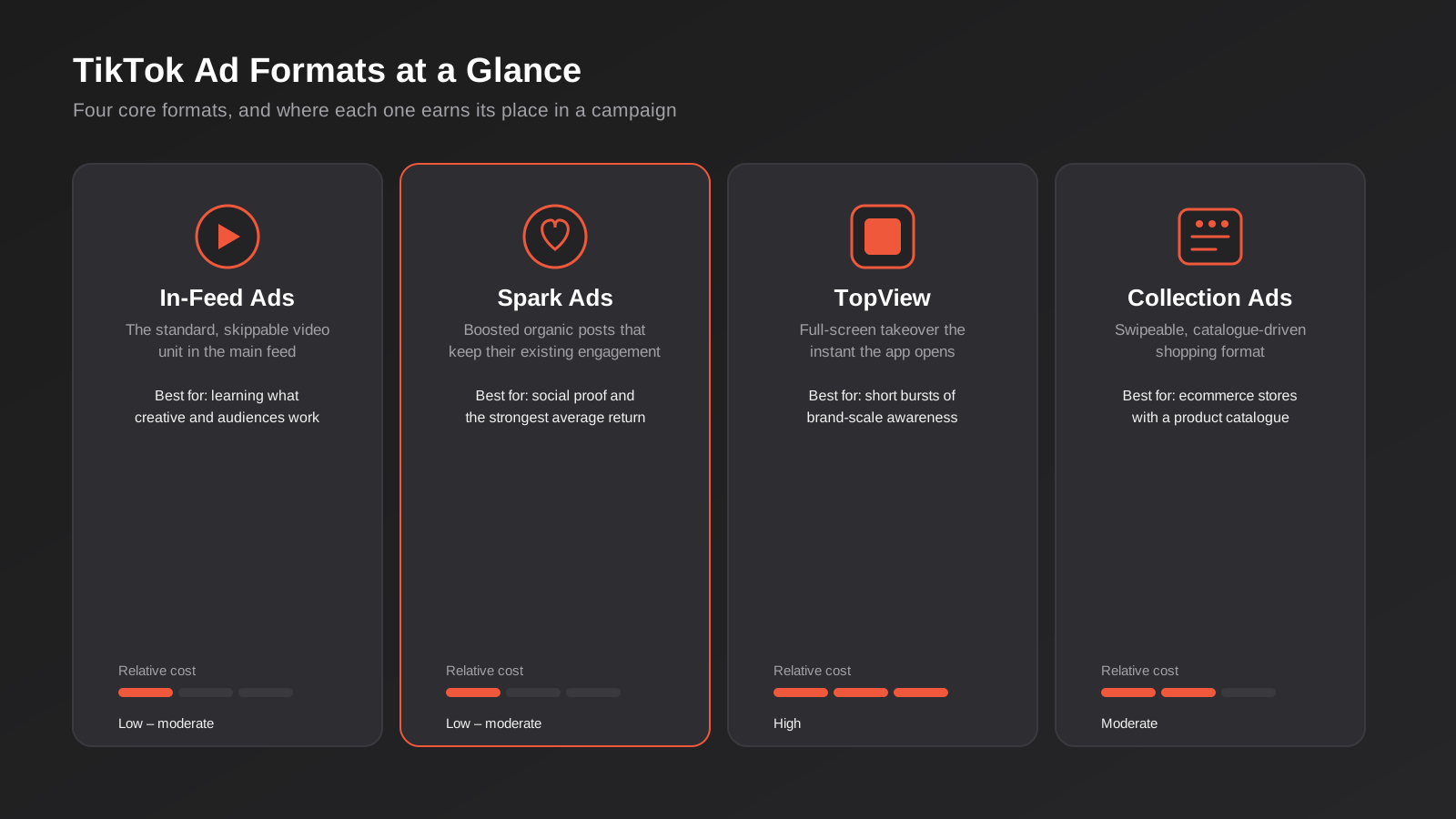
In-Feed ads are the standard unit: a video that appears in the main For You feed between organic content, skippable, and the format most businesses should default to while they’re learning what works. Spark Ads are the format that consistently outperforms for us, and they work differently to a standard ad — rather than uploading a fresh creative asset, you boost an existing organic TikTok post (your own, or a creator’s with their authorisation), and every view, comment, share, like and follow that the boosted post earns gets attributed straight back to the original organic post. That matters for two reasons: the ad carries the organic engagement and comments it already had, which reads as social proof rather than an obvious advertisement, and any performance you build stays attached to your account after the campaign ends rather than disappearing. A single TikTok Ads Manager account can run up to 10,000 Spark Ads, so there’s no real ceiling on scaling the format once it’s working.
TopView is the full-screen takeover format that appears the moment someone opens the app — high impact, high cost, and really only justified for brand campaigns with the budget to treat it as a one-day or one-week domination play rather than always-on spend. Collection and Video Shopping ads are built for ecommerce, pulling a product catalogue into an interactive, swipeable format that sits closer to a mini storefront than a single ad; if you run a Shopify or WooCommerce store, these are worth testing alongside your core In-Feed and Spark activity. It’s a similar logic to how Facebook ad campaigns pair prospecting formats with catalogue-driven retargeting — the platforms differ, but the principle of matching format to funnel stage is the same.
Smart+ campaigns: TikTok’s automated option
Smart+ is TikTok’s AI-driven campaign type, and it’s worth understanding even if you don’t use it immediately. Rather than the older all-or-nothing automation, TikTok’s 2026 update lets you choose how much control to hand over module by module: you can let the platform run creative testing while locking your own audience segments, keep budgets managed centrally while requiring specific placements, or hand over targeting entirely while you retain approval on creative. Reported performance is genuinely strong — roughly 10 to 15 percent lower cost per acquisition than equivalent manual campaigns in TikTok’s own benchmarking — but it comes with real prerequisites. Smart+ needs volume to work with: TikTok recommends at least 50 weekly conversions and a budget around 20 times your target cost-per-acquisition before results become reliable, plus a genuinely diverse pool of creative for the system to test against. For a business just starting out on the platform with a handful of conversions a week, manual campaigns with tight creative control will usually get you a cleaner read faster. Smart+ becomes the better option once you have enough historical data and conversion volume for the automation to have something to learn from.
Targeting on TikTok: what works, and what quietly backfires
TikTok gives you four real targeting layers to work with: interest targeting based on content people engage with, behavioural targeting based on actions taken in-app, lookalike audiences built from an existing customer list or pixel data, and custom audiences built from your own uploaded data or website visitors. On paper that looks similar to Meta. In practice, the way TikTok’s delivery algorithm responds to narrow targeting is different enough that copying a Meta targeting strategy straight across is one of the most common ways businesses waste their first month of budget.
Interest, behaviour, lookalike and custom audiences
Interest and behavioural targeting are best used as a rough steer rather than a precise filter — think broad categories (fitness, home renovation, small business ownership) rather than stacking five or six niche interests together, which is a habit a lot of advertisers bring over from Meta and which works against you here. Lookalike audiences built from a customer list or a well-populated pixel are usually the strongest performer once you have enough source data, typically a minimum of a few hundred converters to build from. Custom audiences — retargeting site visitors, cart abandoners, existing customers for repeat purchase or upsell campaigns — are where a lot of the actual return on a TikTok budget lives, in the same way retargeting carries a disproportionate share of ROAS on Meta.
Why narrow targeting kills performance on this platform specifically
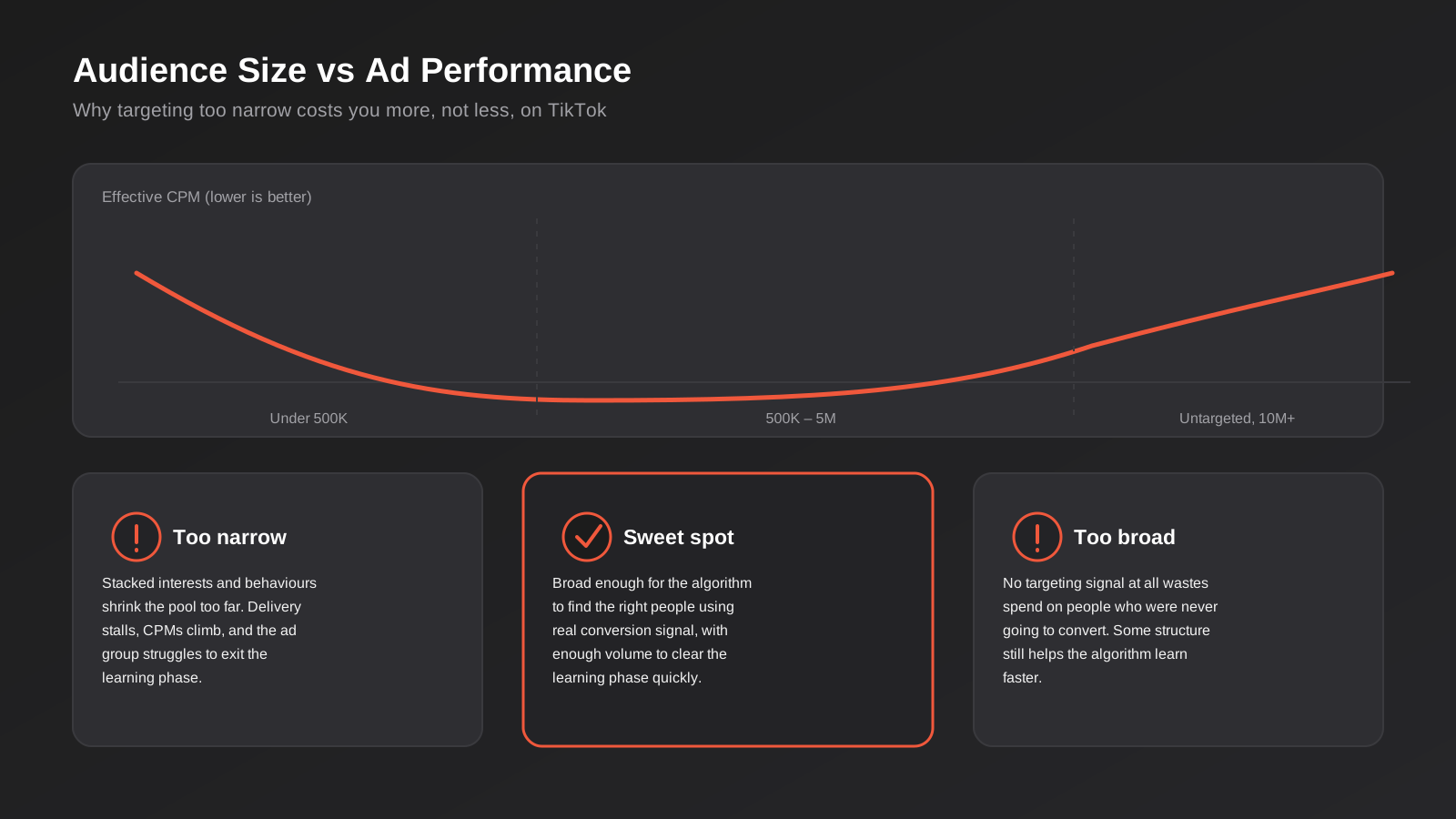
This is the part that catches experienced paid media managers off guard when they first move onto TikTok. Stack enough interests, age brackets and behaviours together and you’ll end up with an audience TikTok simply can’t find enough people within, and delivery either stalls completely or spends erratically against a diluted version of who you actually wanted to reach. As a rough rule, an addressable audience below around 500,000 people is too narrow to give TikTok’s algorithm room to work, and you’ll see it show up as high CPMs and inconsistent daily spend. Go broader than that and let the algorithm do more of the targeting work itself — TikTok’s system is genuinely good at finding the right person within a broad audience when it has enough conversion signal to learn from, which is a different philosophy to the tightly hand-built audiences that used to be best practice on Meta before that platform went through the same shift.
There’s a second, faster-moving version of the same problem: creative fatigue. Because the For You feed moves so quickly, an audience — especially a narrow one — will exhaust a single piece of creative far sooner on TikTok than on Meta or Google. If you’re only running two or three ad variations, you’ll typically see performance decay within one to two weeks. Meaningful creative testing on this platform means five to eight variants per concept as a starting point, varying the hook, the format and the call to action independently so you can actually tell which lever is doing the work.
Creative that actually performs on TikTok
This is where the platform diverges most sharply from everything else in a typical media plan, and it’s the single biggest reason a campaign that’s technically well-built on the backend still underperforms. A polished, brand-safe asset — square crop, logo lockup in the corner, professional voiceover — reads as an advertisement within about half a second on TikTok, and gets scrolled past before the message lands. Content that looks native to the platform, shot vertically, informal, presenter-to-camera or UGC-style, consistently outperforms studio-produced creative, sometimes by a very wide margin on cost per result.
A few things we’ve found matter more than almost anything else in the account: the first one to two seconds have to earn the next five, because that’s the window before someone decides to keep watching or swipe past, so lead with the hook and not the branding. Sound-on design is close to mandatory — the vast majority of TikTok is consumed with audio on, unlike Meta’s feed, which changes how you write and pace a script. And native formats — talking head, screen-recorded demo, a customer or creator genuinely using the product — consistently beat anything that looks like it was made for television and repurposed. This is exactly why Spark Ads tend to be the strongest format in most accounts: they start from content that was already built to work as organic TikTok content, rather than creative built for a different platform and dropped in.
If your team isn’t set up to produce that kind of native content in-house, it’s worth talking to your broader social media marketing partner about a creative pipeline that feeds both organic posting and paid Spark Ads from the same shoots, rather than treating TikTok ad creative as a separate, one-off production line.
A useful way to brief creative for this platform is to separate the hook from the body from the offer, and test each independently rather than changing everything at once between variants. The hook is the first one to two seconds and its only job is to stop the scroll — a question, a bold claim, an unexpected visual, someone mid-action. The body is where you actually make the case, and it works better shown than told: a demonstration, a before-and-after, a real customer reaction, rather than a list of features read out over stock footage. The offer or call to action comes last and should be a single, clear next step, not three options competing for attention in the final two seconds. Running five to eight variants that each isolate one of those three elements — same body, different hooks, for example — tells you far more about what’s actually driving performance than five completely different ads that each change everything at once.
Tracking and measuring what actually matters
Views and likes are the easiest numbers to report and the least useful ones to manage a budget against. The metric that matters is whatever ties back to the business outcome you actually care about — leads, purchases, bookings, app installs — and getting that connected properly starts with the TikTok Pixel and, increasingly, server-side tracking via the Events API. Just like Meta, TikTok’s browser-based pixel alone is losing accuracy as iOS privacy settings and browser-level tracking protections tighten, so a server-side connection through your CRM, ecommerce platform or booking system gives you a materially more reliable read on what a campaign is actually delivering, particularly for anything with a purchase cycle longer than a single session.
Set your attribution window deliberately rather than leaving the default in place, and be realistic about what “good” looks like for your specific business rather than benchmarking against a case study from a completely different vertical. A $40 impulse-purchase product and a $4,000 considered B2C service will have wildly different acceptable cost-per-result numbers, and the useful comparison is always against your own margin and customer lifetime value, not an industry-wide average pulled from a blog post.
For ecommerce accounts specifically, set up separate event tracking for add-to-cart, checkout initiated and purchase completed, rather than relying on purchase volume alone. That funnel breakdown is usually what tells you whether a weak result is a targeting problem (traffic isn’t the right audience), a creative problem (people click but don’t engage with the product page) or a site problem (they add to cart but abandon at checkout). Collapsing all of that into a single ROAS number makes it almost impossible to diagnose what to fix first.
Where TikTok fits in your broader marketing mix
One of the more useful questions to ask before allocating budget isn’t “does TikTok work” in isolation, it’s what job you actually need it to do next to the channels you’re already running. Google Ads and organic search capture demand that already exists — someone typing a query because they’ve already decided they want something similar to what you sell. TikTok, like most of paid social, is better understood as a demand-generation channel: it puts your product or service in front of someone who wasn’t looking for it yet, and on a good campaign, plants the seed that gets them searching for your brand by name a few days later. If you look at TikTok in isolation and judge it purely on last-click conversions inside the TikTok Pixel, you’ll usually undervalue it, because a meaningful share of its actual contribution shows up as branded search volume and direct traffic elsewhere in your funnel rather than as a same-session purchase.
That doesn’t mean treating it as unmeasurable — it means checking whether branded search and direct traffic move when you switch TikTok spend on and off, in addition to watching the platform’s own reported conversions. For businesses running SEO or Google Ads already, TikTok tends to work best as a layer on top rather than a replacement for either, feeding awareness into a funnel that search then captures. Businesses with no existing search presence to catch that demand usually see a weaker return from TikTok specifically, because the interest it generates has nowhere efficient to land.
Common mistakes we see Australian businesses make on TikTok
Most of these come back to treating TikTok as a smaller, cheaper version of a Meta or Google account rather than a platform with its own rules. The businesses that get the best results tend to be the ones willing to unlearn a few habits that worked perfectly well elsewhere.
- Reusing a Meta or TV ad as-is instead of building creative that looks native to the platform — polished, obviously-branded assets get scrolled past almost instantly.
- Setting targeting too narrow out of an instinct toward caution, which stalls delivery and pushes CPMs up rather than making the campaign more efficient.
- Under-funding the test, then judging the platform on data collected before the campaign ever left the learning phase.
- Managing the account against views and likes instead of the metric that actually ties to revenue.
- Ignoring Spark Ads in favour of standard uploaded creative, and missing out on the social proof and lower relative cost that boosted organic content tends to carry.
- Killing an ad group in week one because early numbers look soft, before the algorithm has had a fair run at exiting the learning phase.
- Running two or three creative variants and calling it a test, when TikTok’s feed speed means that’s barely enough to avoid fatigue inside the first fortnight.
- Skipping server-side tracking, then wondering why reported conversions don’t reconcile with actual sales or leads.
Frequently Asked Questions
Is TikTok worth it for a B2B business?
Sometimes, but it’s the exception rather than the rule. TikTok doesn’t offer job-title, seniority or company-size targeting the way LinkedIn Ads does, so it’s a poor fit for reaching a specific buyer at a specific type of company. Where it can work is B2B brands with a genuinely broad addressable market — software aimed at small business owners, for example — where the buyer is also a consumer who spends time on the platform outside work hours. If your buyer is a niche enterprise role, put the budget into LinkedIn instead.
How much should a small business budget to properly test TikTok ads?
Plan for at least $1,500 across a 30-day test if you want a result you can actually make a decision from. Below roughly $500 a month, most of the spend gets consumed by the learning phase before the algorithm has enough data to optimise, so the test tells you very little either way.
Do I need TikTok-specific content, or can I reuse Instagram Reels?
You can reuse Reels as a starting point, but content built purely for Instagram often carries polish and pacing that reads as an obvious ad on TikTok. The safest approach is to shoot with both platforms in mind from the start, or run your best-performing Reels through a TikTok-native edit — rougher cut, sound-on hook in the first second or two — before spending media budget behind it.
How long before I know if TikTok ads are working for my business?
Give a campaign a genuine 30-day window at a budget large enough to exit the learning phase before judging it. Shorter than that, and especially at low daily spend, you’re usually looking at noise rather than a real signal.
What’s the actual difference between TikTok ads and just boosting an organic post?
A Spark Ad is TikTok’s formal version of boosting, but it’s built through Ads Manager with full campaign controls — proper targeting, bidding, budget management and reporting — rather than the blunt, limited boost button available from a creator’s own account. It keeps the organic engagement and comments attached to the original post while giving you the same level of control you’d expect from any other paid campaign.
Does TikTok only work for younger audiences?
No, though it still skews younger than Facebook. The largest single demographic segment on the platform in Australia is now adults aged 25–34, and usage among older millennials and Gen X continues to grow. If your customer is under 45 and spends meaningful time on their phone, they’re very likely reachable on TikTok — it’s really only the older, more traditional end of the market where the platform stops making sense.
Where to start
If you’ve read this far and TikTok sounds like a genuine fit rather than a channel you feel obligated to be on, the honest next step is a proper test: enough budget to clear the learning phase, creative built for the platform rather than repurposed from somewhere else, and tracking set up before the campaign launches rather than bolted on afterwards. If it sounds like a poor fit for your business right now, that’s a useful outcome too — better to know before the budget is spent than after.
We run TikTok Ads campaigns alongside Google, Meta and LinkedIn for Australian businesses, and we’d rather have an honest conversation about whether it belongs in your marketing mix than sell you a campaign it doesn’t suit. Have a look at how we approach TikTok Ads as a service, or get in touch and we’ll talk through whether it’s worth testing for your business specifically.
Keep reading
Related posts
Reddit Ads for Australian Businesses: Costs, Targeting and Whether It’s Worth Testing (2026)
What Reddit Ads actually cost in Australia, how subreddit and keyword targeting work, and a straight framework for deciding if it's worth…
LinkedIn Ads Cost and Targeting in Australia: A 2026 Deep Dive for B2B
Real LinkedIn Ads cost benchmarks for Australia plus the targeting, bidding and Matched Audiences setup that actually cuts cost per lead.
How to Choose the Right LinkedIn Ads Service for Your Business (2026 Guide)
What makes LinkedIn Ads different from every other paid channel, and what that means for choosing the right service to run it…
Got a project you'd like to talk through?
Tell us what you're working on — we'll come back with a plan.
