
How to Run a High-Performing Facebook Ad Campaign: A Complete Guide (2026)
 Jignesh Vagadiya
19/08/2026
21 min read
Jignesh Vagadiya
19/08/2026
21 min read
Most Australian businesses running Facebook ads are still fighting the platform instead of working with it. They’re building ten narrow ad sets when Meta’s algorithm wants three broad ones. They’re checking the Ads Manager ROAS number and treating it as gospel, when half their conversions never made it back to Meta in the first place. And they’re still writing ad copy like it’s 2019, when the accounts actually winning right now are the ones feeding Meta’s AI enough signal, enough creative, and enough room to do its job. This guide covers how we build and manage Facebook ad campaigns for clients today — campaign structure, creative strategy, audience targeting in a privacy-first world, budgeting, measurement, and where Meta ads sit next to Google Ads in a broader media mix. If you’re running Facebook ads Australia-wide or just for your local market, the fundamentals below apply either way.
Start With a Campaign Structure That Matches How Meta Actually Optimises
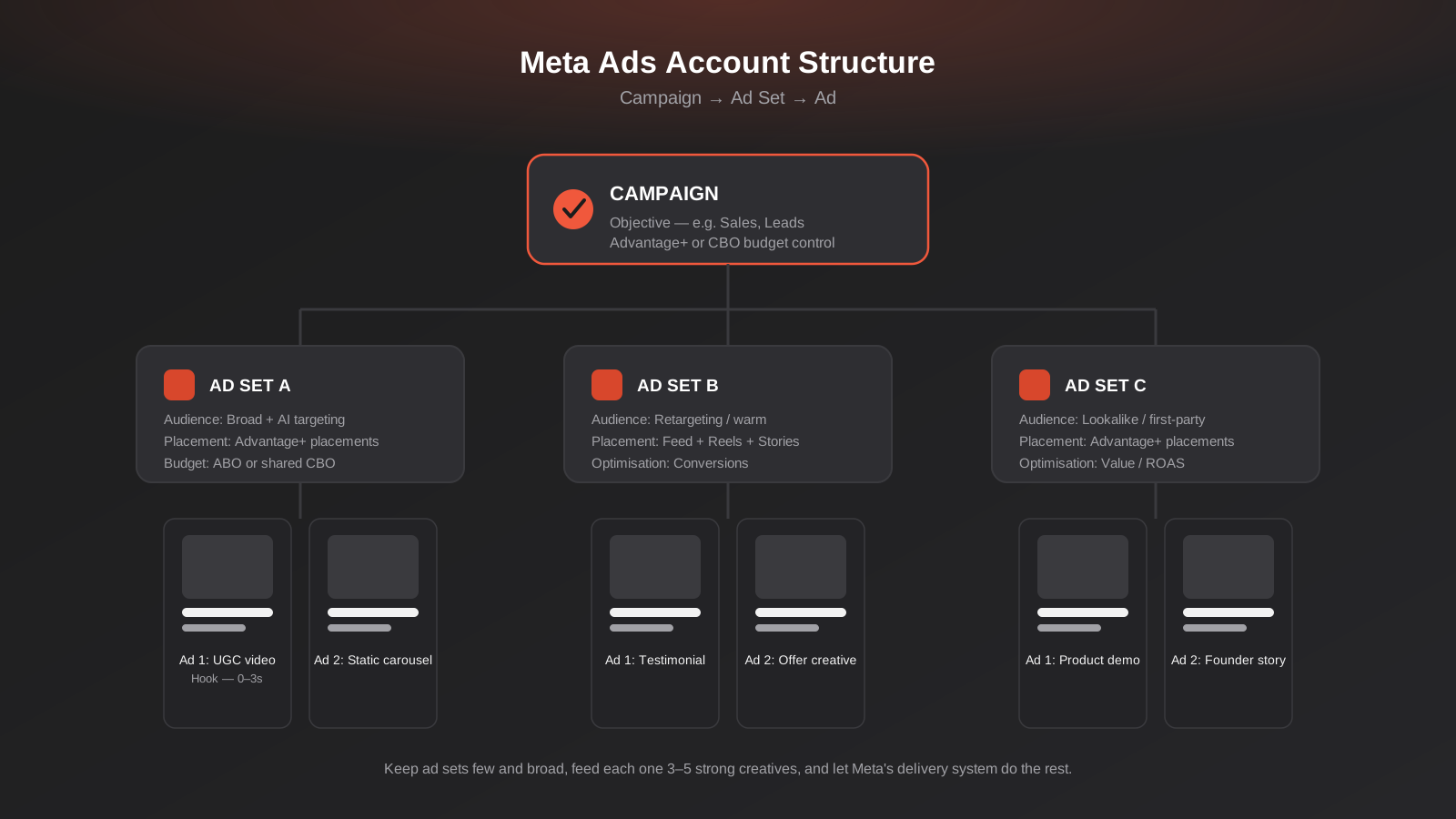
The biggest shift in Meta advertising over the last few years isn’t a new placement or a new ad format — it’s how much control Meta has quietly taken away from advertisers, and how much better results get when you stop fighting that. Every Facebook ad campaign is still built from the same three layers — campaign, ad set, ad — but the way you should use those layers in 2026 looks very different to how agencies taught it five years ago.
Advantage+ Campaigns vs Manual Structure
Advantage+ shopping campaigns (and the broader rollout of Advantage+ audience and placement controls across other objectives) automate most of the decisions that used to sit with the advertiser — audience selection, placement mix, and creative rotation are all handed to Meta’s machine learning. For businesses with a solid pixel or Conversions API setup and at least some purchase history, Advantage+ campaigns routinely outperform manually built ones, particularly on cost per acquisition. The trade-off is control: you lose the ability to see exactly which audience segment is driving results, and early performance can be noisy while the system learns.
Our general approach is to run Advantage+ as the primary engine for prospecting once an account has enough conversion volume to support it (roughly 30–50 optimisation events a week is a reasonable floor), while keeping a smaller, manually structured campaign running in parallel for retargeting and any audience segments — VIP customers, high-intent leads, past purchasers — that genuinely benefit from separate budget and messaging. Businesses that are newer, with limited historical data, often still need a more manual build for the first few months simply because Advantage+ needs signal to learn from, and a brand-new account doesn’t have any yet.
CBO vs ABO — Which Budget Strategy to Use
Campaign Budget Optimisation (CBO) lets Meta shift spend automatically between ad sets within a campaign, favouring whichever is performing best at any given moment. Ad Set Budget Optimisation (ABO), by contrast, locks a fixed budget to each ad set regardless of performance. For most standard Facebook ad campaigns we run today, CBO is the default — it removes the guesswork of manually reallocating spend and generally finds efficiency faster, especially when ad sets are testing different audiences with a similar creative set.
ABO still earns its place in specific situations: when you deliberately want to guarantee spend against a smaller, high-value audience (a warm retargeting pool, for example) regardless of how it’s pacing against a much larger prospecting audience, or when you’re running a genuine creative test and need every variant to get a fair, even amount of spend rather than have the algorithm starve the slower starters early. As a rule, we use CBO for scale and ABO for control.
Placements: Let Meta Choose
Manual placement selection — picking Feed only, or excluding Audience Network, or running Stories separately from Reels — used to be a legitimate lever for controlling cost and quality. It’s largely counterproductive now. Advantage+ placements (Meta’s automatic placement setting) let the delivery system shift budget in real time toward whichever placement is currently returning the cheapest results for a given ad set, and in the large majority of accounts we manage, automatic placements outperform any manually restricted placement set on cost per result. The one genuine exception is when a specific creative asset has been built for a single format — a vertical, full-screen Reels-native video, for example — and running it into a square Feed placement would visibly crop or distort it. In that case we’ll either build placement-specific creative variants and let Meta serve each to its matching placement, or accept the trade-off of automatic placements with slightly imperfect cropping in exchange for better delivery efficiency.
Creative Strategy Is the Real Lever in 2026
Targeting used to be where the competitive advantage lived in Facebook advertising. That’s largely gone now — Meta’s delivery system does most of the audience-finding itself, provided you give it broad enough parameters. What’s left as the genuine differentiator between accounts that perform and accounts that don’t is creative. We’d estimate creative accounts for the majority of the variance in cost per result between two campaigns targeting the same audience with the same budget.
Video-First, UGC-Style Creative
Polished, studio-shot brand video still has a place, but it is no longer the format that wins the feed. User-generated-content-style video — filmed on a phone, delivered by a real person, framed like organic content rather than an ad — consistently outperforms high-production creative on cost per click and cost per acquisition across most verticals we manage. It reads as native to the placement, particularly on Reels and Stories, and it doesn’t trigger the same instinctive scroll-past that a glossy ad does.
This doesn’t mean production value doesn’t matter at all — audio quality, lighting, and a clear subject still matter enormously. It means the aesthetic should mimic what someone would see from a friend or a creator they follow, not what they’d expect from a television commercial. For most Australian small and mid-sized businesses, this is genuinely good news: UGC-style creative is cheaper to produce than a full studio shoot, and it can be turned around far faster, which matters given how quickly creative fatigues.
The Hook and Retention Game
Meta’s own delivery system rewards creative that holds attention, because watch time is a strong signal it uses to judge relevance. The first one to three seconds of any video ad now determine most of its fate — if the hook doesn’t stop the scroll, the rest of the ad is irrelevant, no matter how strong the offer or the copy underneath it. Effective hooks tend to do one of a few things: open mid-action rather than with a logo or intro, ask a question the viewer’s audience will recognise themselves in, or make a bold, specific claim in the first frame of on-screen text.
Beyond the hook, retention through the middle of the video matters more than most advertisers assume — a video that loses 80% of viewers by the five-second mark but recovers well after that is telling Meta something different to one that bleeds viewers steadily throughout. We look at the retention graph in Ads Manager for every new creative, not just the headline click-through rate, because it tells us where to cut or restructure the next version.
Creative Volume and Testing Cadence
Because creative fatigues — frequency climbs, cost per result rises, and the same audience simply gets tired of seeing the same ad — a single winning creative is never a long-term solution. We aim to have three to five active, meaningfully different creative concepts in market at any time per ad set, with new concepts (not just new edits of the same idea) entering rotation every one to two weeks for active campaigns. This is less about volume for its own sake and more about giving Meta’s system enough raw material to find a new angle before the old one wears out.
Ad Copy That Doesn’t Read Like Ad Copy
Primary text and headlines matter less than they once did relative to the video or image itself, but they’re still doing real work — particularly in Feed placements where text sits directly alongside the creative. The copy patterns that perform best mirror the same shift we’ve seen in creative more broadly: conversational, specific, and written the way a person would actually talk about the product, not the way a brochure would describe it. Leading with a specific number, a direct question, or a plainly stated problem tends to outperform generic benefit statements (“Fast, reliable, affordable”) that could apply to almost any business in the category. We also see consistent gains from testing copy length against itself — a short, punchy primary text against a longer, more detailed one for the same creative — because different audiences within a broad targeting pool respond to different amounts of information before they’re ready to click.
Audience Strategy in a Post-iOS 14, Privacy-First World
Apple’s App Tracking Transparency framework, browser-level cookie restrictions, and Meta’s own response to a more privacy-conscious regulatory environment have permanently changed how audience targeting and measurement work on the platform. The old playbook of building dozens of narrow interest-based audiences and letting them compete against each other largely stopped working once Meta’s signal quality took a hit — the algorithm simply didn’t have enough clean data to optimise narrow segments effectively.
Why Broad Targeting Now Outperforms Narrow Targeting
Counterintuitively, the answer to reduced signal quality has been to target more broadly, not less. When you give Meta’s algorithm a wide audience — sometimes as broad as an entire country, age-gated only — and pair it with strong creative and solid conversion signal, the system generally finds better performing sub-segments on its own than a human manually assembling interest stacks ever could. This is the logic behind Advantage+ audience expansion and why so many high-performing accounts today run with minimal manual targeting layered on top. That’s a sharp contrast to a platform like LinkedIn Ads, where narrow, precise targeting is still the whole point — see our LinkedIn Ads guide for how differently that platform behaves.
This shift is genuinely uncomfortable for advertisers used to feeling in control of exactly who sees their ads. But the accounts we’ve moved from heavily segmented, narrow targeting to broader, AI-optimised targeting have, in the majority of cases, seen cost per result improve within two to three weeks, once the algorithm had enough runway to learn.
First-Party Data and the Conversions API
With third-party signal degraded, first-party data — information you collect directly from your own customers, with their consent — has become the highest-value asset in a Meta ads account. Email lists, phone numbers, and site visitor data can be hashed and matched against Meta’s user base to build custom audiences and lookalikes, and critically, that same first-party data underpins the Conversions API, which sends conversion events to Meta directly from your server rather than relying solely on a browser-based pixel that ad blockers and privacy settings can quietly break.
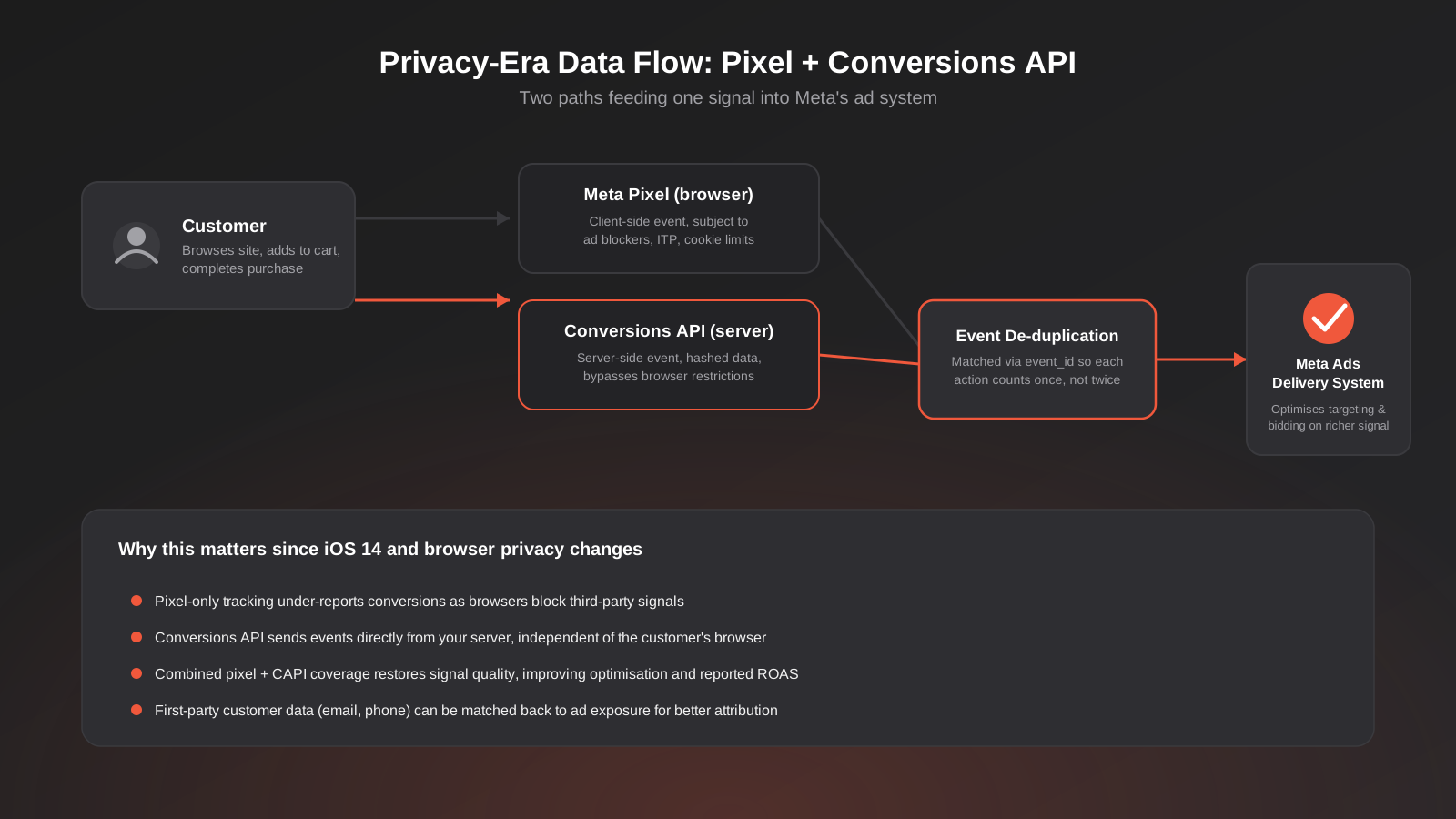
A properly configured Conversions API implementation, running alongside (not instead of) the browser pixel, with events deduplicated using a shared event ID, is one of the highest-leverage technical changes we make on a new account. It’s not glamorous work, but the effect on reported conversion volume and downstream optimisation quality is often larger than any single change to targeting or bidding.
Budget and Bidding: Giving Meta’s Algorithm What It Needs
Meta’s delivery system needs a minimum volume of conversion events to properly exit the learning phase and optimise efficiently — generally cited as around 50 optimisation events per ad set per week, though in practice we see stable performance with slightly fewer if the account has strong historical signal. Under-budgeted campaigns that can’t hit this threshold tend to stay stuck in a permanent, expensive learning phase, restarting every time an edit is made.
How Much Budget Do You Need for the Algorithm to Learn
As a starting point, we calculate minimum viable daily budget by working backwards from target cost per result: if a client’s target cost per purchase is $40 and they need roughly 50 purchases a week to give the algorithm enough signal, that’s a minimum spend of around $285 a day before you’d expect stable, efficient delivery. Businesses that try to run effective Facebook ad campaigns on budgets well below this threshold usually end up paying a premium per result simply because the account never leaves the learning phase. Our Meta Ads pricing page breaks down what a properly resourced monthly budget and management fee typically looks like.
This is one of the more difficult conversations we have with prospective clients — a media budget that looks reasonable on paper can genuinely be too small to let the platform do its job. In those cases, the right move is often to narrow the objective (optimise for a cheaper, higher-volume event like add-to-cart rather than purchase, at least initially) rather than to spread an inadequate budget across too many campaigns.
Bid Strategies — Cost Cap, Bid Cap, and Highest Volume
Meta offers a handful of bid strategies, and the right one depends on how much budget stability you need versus how aggressively you want to chase volume. Highest Volume (Meta’s default) spends the full budget and lets the system chase as many results as it can, which is appropriate for most standard prospecting campaigns. Cost Cap sets a target average cost per result and asks the algorithm to hold to it, which suits accounts with tight, non-negotiable margin requirements. Bid Cap gives the most manual control but requires real expertise to set correctly — set it too low and delivery stalls, too high and you lose the point of using it.
For most Facebook ad campaign builds we run for Australian clients, we start on Highest Volume with no cap while the campaign is establishing performance data, then layer in a Cost Cap once we have two to three weeks of stable results to set a realistic target from — setting a cost cap on day one, based on a guess, is one of the more common ways we see campaigns unnecessarily strangled before they’ve had a chance to find their footing.
Scaling Budget Without Breaking Delivery
Once a campaign is performing, the instinct is to increase budget quickly to capture more of what’s working — but a large, sudden budget jump resets the learning phase in much the same way a major creative or targeting change does, because it materially shifts the auction the algorithm is bidding into. As a general rule, we increase budget in increments of no more than 15–20% every three to four days when scaling a working campaign, giving the algorithm time to re-stabilise at each new spend level rather than lurching from one learning phase straight into another. For businesses that need to scale faster than that — a seasonal promotion or a limited-time launch, for example — duplicating the campaign at a higher budget rather than editing the original in place can sometimes get to volume faster, at the cost of starting that new campaign’s learning phase from scratch.
Measuring ROAS Properly
Return on ad spend is the metric every business ultimately cares about, and it’s also the metric most commonly misread. The number sitting in Ads Manager is Meta’s own attributed ROAS, calculated using its own attribution window and its own view of which conversions the ad was responsible for. That number is useful for optimisation, but it should never be the only number a business uses to judge whether Meta ads are actually working.
Blended ROAS vs Platform-Reported ROAS
Blended ROAS — total revenue across the whole business divided by total ad spend across all channels, in a given period — is a far more honest number, because it’s immune to any single platform’s attribution model and immune to the cross-channel double-counting that happens when Google Ads and Meta both claim credit for the same sale. We always ask new clients for their blended revenue and total marketing spend before we ever look at Ads Manager, because a Facebook ads Australia campaign showing a strong 6x platform ROAS means very little if blended ROAS across the business hasn’t moved.
The gap between platform-reported ROAS and blended ROAS has widened since iOS 14, simply because more conversions happen outside the attribution window Meta can see or measure. This doesn’t mean platform ROAS is useless — it’s still the fastest signal for comparing one campaign or ad set against another within the same account — but it should be treated as a relative, internal measure rather than an absolute statement of business impact.
Setting Up Conversions API and Server-Side Tracking Properly
Beyond blended ROAS as a sanity check, the single biggest lever for closing the gap between what Meta reports and what actually happened is a correctly implemented Conversions API, ideally paired with Meta’s Aggregated Event Measurement configuration for any domain affected by App Tracking Transparency. Getting this right means defining a clear event priority order for the eight events Aggregated Event Measurement allows per domain, testing deduplication with Meta’s own Events Manager diagnostics rather than assuming it’s working, and revisiting the setup whenever a new checkout platform, CRM, or tracking tool is introduced. It is unglamorous, technical work, and it is consistently underinvested in relative to how much it affects reported performance.
How Meta Ads Compares to and Complements Google Ads
We’re regularly asked by clients whether they should run Facebook ads or Google Ads, as though it has to be one or the other. In practice, the two platforms are strongest at different points in the customer journey and work best run together rather than as competing budgets. Google Ads — particularly Search — captures demand that already exists: someone typing a query has already decided they want a solution and is choosing between providers. Meta ads, by contrast, are fundamentally an interruption format; they create demand or surface a business to someone who wasn’t actively looking, which is a harder job but one with a much larger addressable audience.
The businesses that get the most out of their combined budget tend to use Meta for top-of-funnel awareness and mid-funnel consideration — building a pool of people who’ve engaged with the brand, watched a video, or visited the site — and use Google Search to capture the resulting demand once it turns into an active search. Meta retargeting campaigns and Google remarketing lists can also be built from the same first-party data sources, meaning the customer data work done for one platform typically benefits the other directly. For most of our clients, we don’t recommend choosing between Meta ads and Google Ads at all — we recommend a split that reflects where their specific customer journey actually starts and ends.
There’s also a measurement argument for running both. Because Meta’s attribution has become less complete since iOS 14, businesses that rely on Meta ads alone can end up with a distorted view of which parts of their funnel are actually working. Layering in Google’s Search and remarketing data, alongside a proper blended-ROAS view across the whole business, generally gives a far more reliable picture than trusting either platform’s self-reported numbers in isolation. In our experience, clients who run a deliberate two-platform strategy — rather than treating Meta and Google as separate, unrelated budgets managed by different teams with different goals — consistently get more total revenue out of the same combined spend.
Common Mistakes We See in Facebook Ad Campaigns
Most underperforming Meta ads accounts we take over aren’t failing because of one dramatic error — they’re failing because of two or three small, compounding habits that quietly stop the algorithm from ever getting a fair run. Individually, each of the items below might only cost a business a modest amount of efficiency. Stacked together across an account, they’re usually the entire gap between a campaign that struggles and one that scales comfortably.
- Building too many ad sets and splitting an already-modest budget across all of them, which starves every ad set of the conversion volume it needs to exit the learning phase.
- Editing live campaigns too frequently — changing budgets, creative, or targeting more than once every few days resets the learning phase and destroys accumulated optimisation data.
- Relying on a single hero creative for months at a time, then wondering why cost per result has crept up as frequency climbed and the audience fatigued on the ad.
- Running the pixel alone with no Conversions API, then being surprised that reported conversions sit well below what the business’s own sales data shows.
- Judging campaign success purely on platform-reported ROAS instead of checking it against blended revenue across the whole business.
- Setting an aggressive Cost Cap on day one before the algorithm has any real performance data to base delivery on.
- Writing ad copy and creative that looks and sounds like traditional advertising rather than content native to the placement it’s running in.
- Ignoring frequency and audience saturation in an already-small addressable market, which is a particularly common problem for local and regional Australian businesses with limited audience size.
- Treating Meta ads as a “set and forget” channel rather than reviewing creative performance, retention data, and audience overlap on a weekly cadence.
Frequently Asked Questions
How much should a small business budget for a Facebook ad campaign in Australia?
There’s no single figure that applies to every business, because it depends heavily on your target cost per result and how many conversion events Meta’s algorithm needs each week to optimise properly. As a rough guide, we’d suggest a minimum of $1,500–$2,500 a month for a single-objective campaign to have a genuine chance of exiting the learning phase and finding stable, efficient delivery. Below that, it’s usually better to narrow the campaign objective to a lower-cost event rather than spread an inadequate budget too thin.
Is Meta Ads Australia targeting still accurate after the iOS 14 privacy changes?
It’s different rather than simply worse. Individual-level tracking is less precise than it used to be, but Meta’s aggregated, machine-learning-driven targeting — especially through Advantage+ — has become genuinely strong at finding relevant audiences from broad targeting inputs, provided the account is feeding it clean conversion signal via both the pixel and the Conversions API. Accuracy has shifted from being a targeting-input problem to being a data-quality problem.
Should I use Advantage+ campaigns or build my own manual campaign structure?
If your account has consistent conversion volume and a reasonably mature pixel and Conversions API setup, Advantage+ is usually the stronger starting point for prospecting, because it removes a lot of manual guesswork and tends to find efficiency faster. Newer accounts with little historical data, or businesses that need to protect budget for a specific, high-value segment like past purchasers, often still benefit from a smaller manual campaign running alongside it.
How long does it take for a new Facebook ad campaign to start performing well?
Expect a genuine learning period of roughly one to two weeks before judging performance, and closer to three to four weeks before drawing firm conclusions about creative winners or audience performance. Meta’s algorithm needs enough accumulated conversion data to optimise properly, and campaigns that are judged or changed too early rarely get a fair test.
What’s the difference between the Meta Pixel and the Conversions API?
The Meta Pixel is a piece of code that runs in a customer’s browser and reports events like page views, add-to-carts, and purchases back to Meta. The Conversions API sends that same type of event data directly from your server, which means it isn’t affected by ad blockers, browser privacy settings, or Apple’s App Tracking Transparency framework. Running both together, with events deduplicated by a shared event ID, gives Meta the most complete and accurate picture of what’s actually happening on your site.
Should I run Facebook ads or Google Ads first?
It depends on where your customers currently sit in their buying journey. If people are already actively searching for what you offer, Google Search is usually the faster win because it captures existing demand. If awareness is the bigger gap — people don’t yet know your business exists — Meta ads are typically more effective at building that initial awareness and consideration. Most established businesses eventually run both, using Meta to build audience pools that Google remarketing and search can then capture.
Where to Start
If there’s one takeaway from everything above, it’s that a high-performing Facebook ad campaign in 2026 depends far less on clever manual targeting than it used to, and far more on the fundamentals underneath it: clean conversion tracking through both the pixel and Conversions API, a lean campaign structure that gives Meta’s algorithm room to work, a steady pipeline of native, video-first creative, and a budget that’s actually large enough to let the system learn. Get those right and the platform does most of the heavy lifting.
If you’re not sure where your account currently stands against any of this — whether it’s a tracking gap, a structure that’s spreading budget too thin, or creative that’s simply run its course — we’re happy to have a look and tell you plainly what we’d change. Get in touch with the Growth Digital team for a straightforward, no-pressure review of your Meta ads account.
Keep reading
Related posts
Meta Ads Cost and Targeting in Australia: A 2026 Deep Dive
Real 2026 Meta Ads cost benchmarks for Australia, plus how Advantage+, detailed targeting and placement strategy actually work now.
Facebook Ads for Ecommerce Stores: Catalog Ads, Retargeting and ROAS That Works (2026)
How ecommerce stores use Facebook catalog ads, product feeds and cart retargeting to hit real ROAS — on Shopify and WooCommerce.
Got a project you'd like to talk through?
Tell us what you're working on — we'll come back with a plan.
