
How to Maximise Google Ads ROI: A Complete Guide for Australian Businesses (2026)
 Jignesh Vagadiya
19/08/2026
22 min read
Jignesh Vagadiya
19/08/2026
22 min read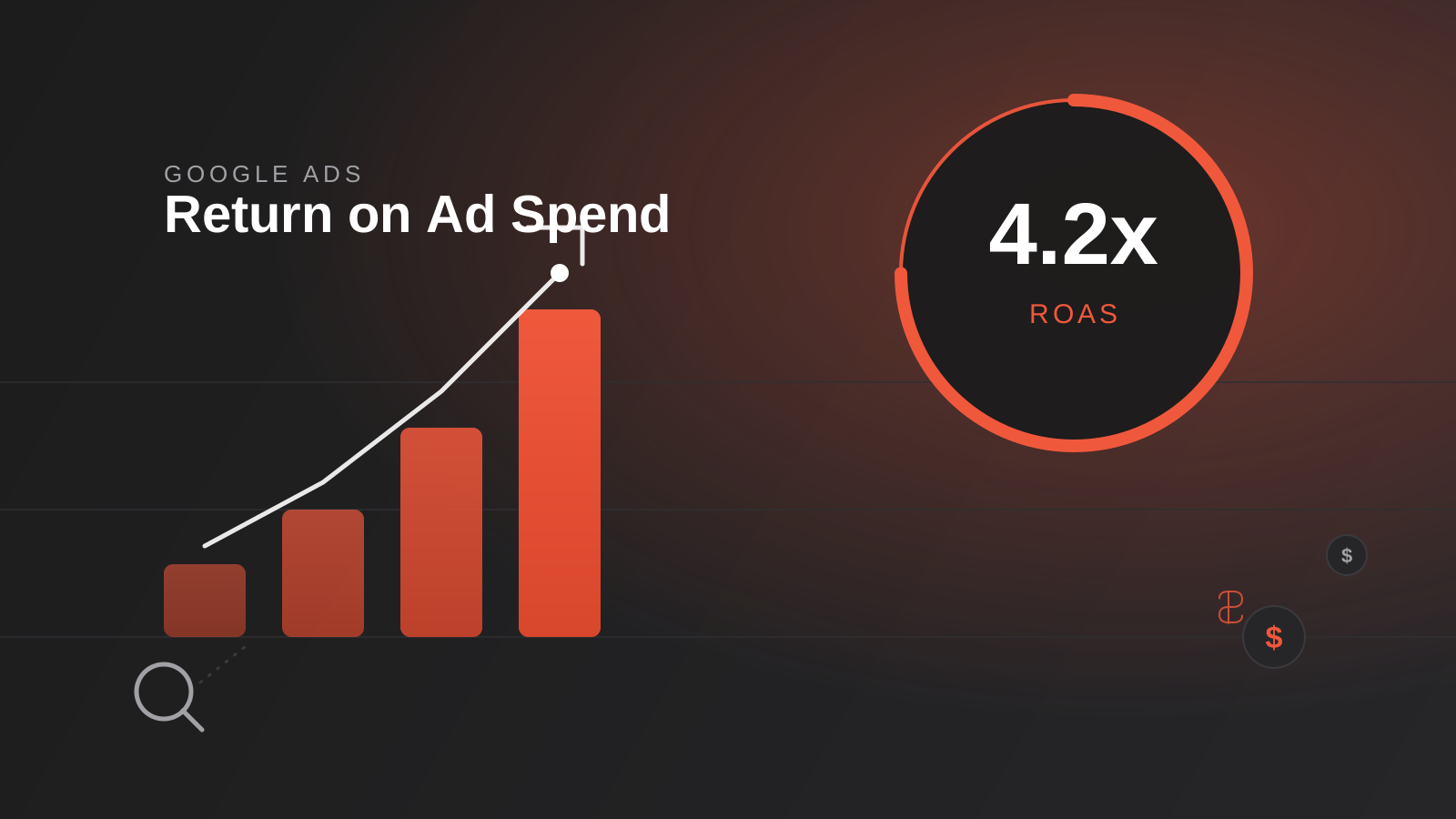
Most guides to Google Ads ROI open with a formula and a pep talk. That’s not where the real problem usually is. In our experience running paid search accounts for Australian businesses, the accounts that struggle with ROI rarely have a bidding problem — they have a measurement problem, a structure problem, or a landing page problem, and the bidding is quietly doing exactly what it’s told with bad information.
That distinction matters more than any single “10 tips” list, because it changes where you actually start. Tweaking ad copy on an account with broken conversion tracking is rearranging furniture in a room that’s on fire. This guide works through Google Ads ROI in the order that actually moves the needle: what ROI means and how to measure it honestly, the account foundations that determine whether Smart Bidding can do its job, the levers that genuinely affect return once those foundations are solid, and the mistakes we see most often when a business inherits an account that “isn’t performing.”
It’s long, deliberately. Google Ads ROI isn’t a single lever you pull — it’s the compound result of tracking, structure, bidding, creative, and landing pages all working together. Skip one and the rest can only compensate so far.
What “Google Ads ROI” Actually Means
Before anything else, it’s worth separating two numbers that get used interchangeably and shouldn’t be: ROAS and ROI.
ROAS (Return on Ad Spend) is revenue divided by ad spend, expressed as a ratio or percentage — spend $1,000, generate $4,000 in tracked conversion value, and your ROAS is 4:1 or 400%. It’s the number Google Ads itself optimises toward when you set a Target ROAS bidding strategy, and it’s the number most dashboards default to showing.
ROI (Return on Investment) is a more honest number because it accounts for cost of goods, margin, and (arguably) the cost of running the campaigns in the first place: (revenue — total cost) ÷ total cost. A campaign can show a beautiful 5:1 ROAS and still be marginally profitable or even lose money once you factor in a 70% cost of goods sold and a 15% agency or team management cost. This is the single most common reason a business owner feels like Google Ads “isn’t working” while the Google Ads dashboard shows green numbers — they’re reading ROAS as if it were ROI. For the exact formulas behind ROAS, true ROI and break-even ROAS — with worked examples — see our PPC formulas and metrics guide.
For a services business, the equivalent trap is treating a cheap cost-per-lead as the win condition. A $40 lead that never closes is more expensive than a $150 lead that converts one in three times, but the $40-lead campaign looks like the star performer in a report that stops at lead volume. Real Google Ads ROI, for any business model, has to be traced at least one step past the click — ideally all the way to revenue or a closed deal, not just the first conversion event.
The Foundation: Conversion Tracking That’s Actually Trustworthy
Every optimisation decision in this guide assumes Google Ads knows, accurately, what a conversion is worth. If that assumption is wrong, everything built on top of it — Smart Bidding, budget allocation, campaign-level ROI reporting — is wrong in the same direction, just less visibly. This is why conversion tracking gets its own section before bidding strategy, ad copy, or anything else: it’s not a “nice to have,” it’s the input every other lever depends on.
Primary vs secondary conversions
A common and quietly damaging setup mistake is letting every trackable action — button clicks, PDF downloads, newsletter sign-ups, and actual purchases or qualified leads — count as an equal “primary” conversion. Smart Bidding strategies optimise toward whatever’s marked primary, so if a low-intent newsletter sign-up is weighted the same as a completed purchase, the algorithm will happily chase cheap newsletter sign-ups and call it a win. Getting this right means being deliberate: mark the actions that actually indicate revenue (purchases, qualified lead form submissions, phone calls that convert) as primary, and demote micro-conversions to secondary or observation-only status.
Value-based tracking, not just conversion counts
Counting conversions tells you volume. Passing conversion value back into Google Ads — actual order value for ecommerce, or an assigned value per lead type for services (a booked consultation might be worth $200 in expected pipeline value, a simple enquiry $40) — is what lets Target ROAS and Maximise Conversion Value bidding do their job properly. Without value data, Google Ads is optimising for the number of conversions, which will happily trade five high-value conversions for eight low-value ones if the algorithm can’t tell the difference.
Enhanced conversions and offline conversion import
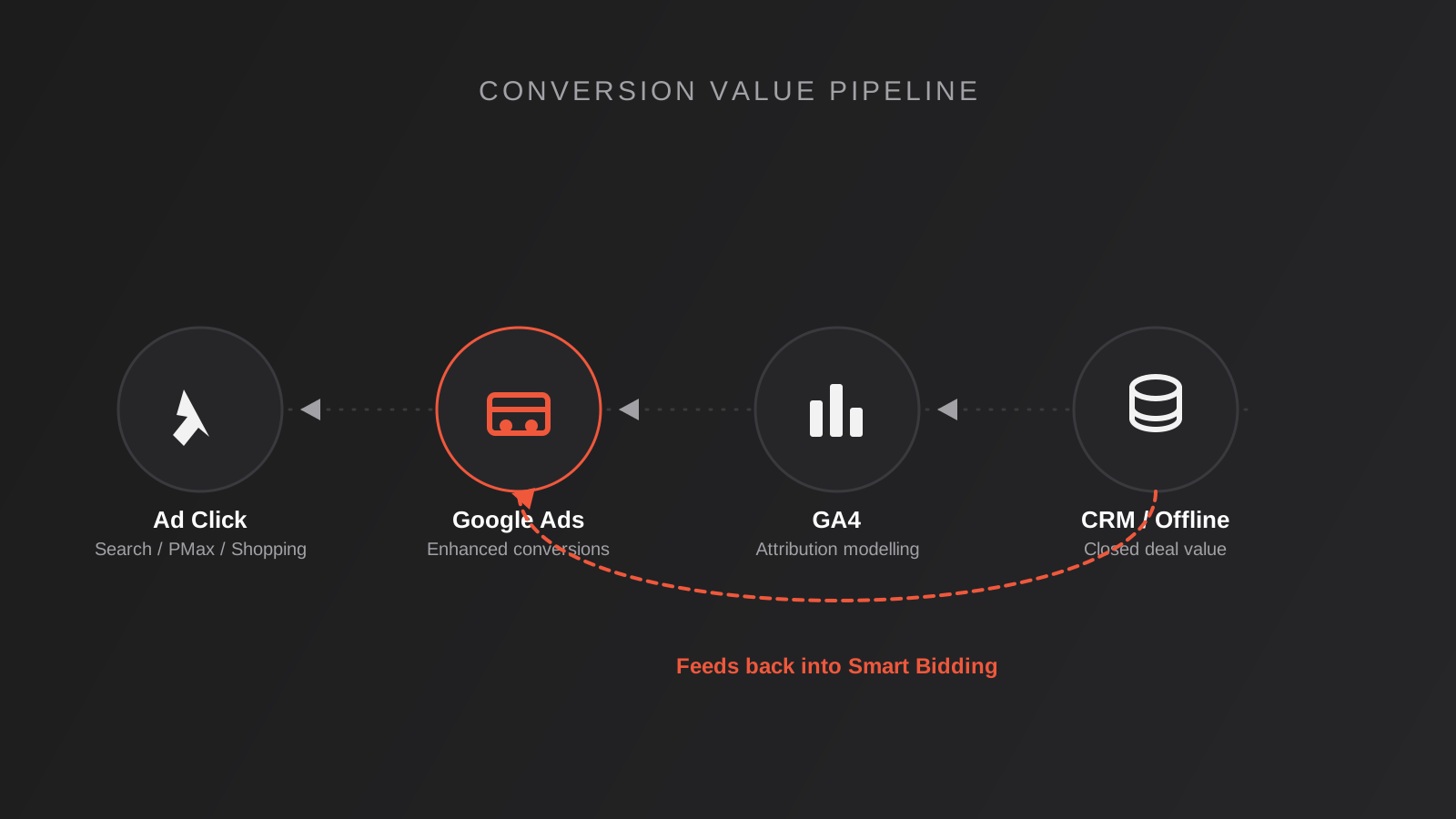
Browser privacy changes and ad blockers have made last-click, cookie-based tracking progressively leakier over the past few years, which is part of why Google pushes Enhanced Conversions — hashed first-party data (email, phone) sent server-side to fill in gaps that browser-based tracking misses. For businesses where the actual sale happens offline or well after the click — a quote that’s accepted two weeks later, a car sold after a test drive, a service contract signed after a sales call — offline conversion import closes an even bigger gap, feeding real closed-deal data back into Google Ads days or weeks after the original click. Without it, Google Ads is optimising against an incomplete picture of what’s actually generating revenue, no matter how well everything else is configured.
Account Structure: Setting Up Bidding to Succeed
Account structure doesn’t get the attention bidding strategy does, but it directly determines how much data each campaign has to learn from — and Smart Bidding is, fundamentally, a machine learning system that needs enough conversion volume per campaign to find a reliable pattern.
Structuring around intent, not internal org charts
A common mistake is structuring campaigns the way the business is internally organised — one campaign per product category, one per state, one per sales rep — rather than around search intent. A search for “emergency plumber Parramatta” and a search for “bathroom renovation cost Sydney” both might fall under “plumbing services” internally, but they represent wildly different intent, timeframes, and value, and lumping them into one campaign with one budget and one target ROAS blurs signal the algorithm needs to bid well.
Campaign type mix: Search, Performance Max, Shopping
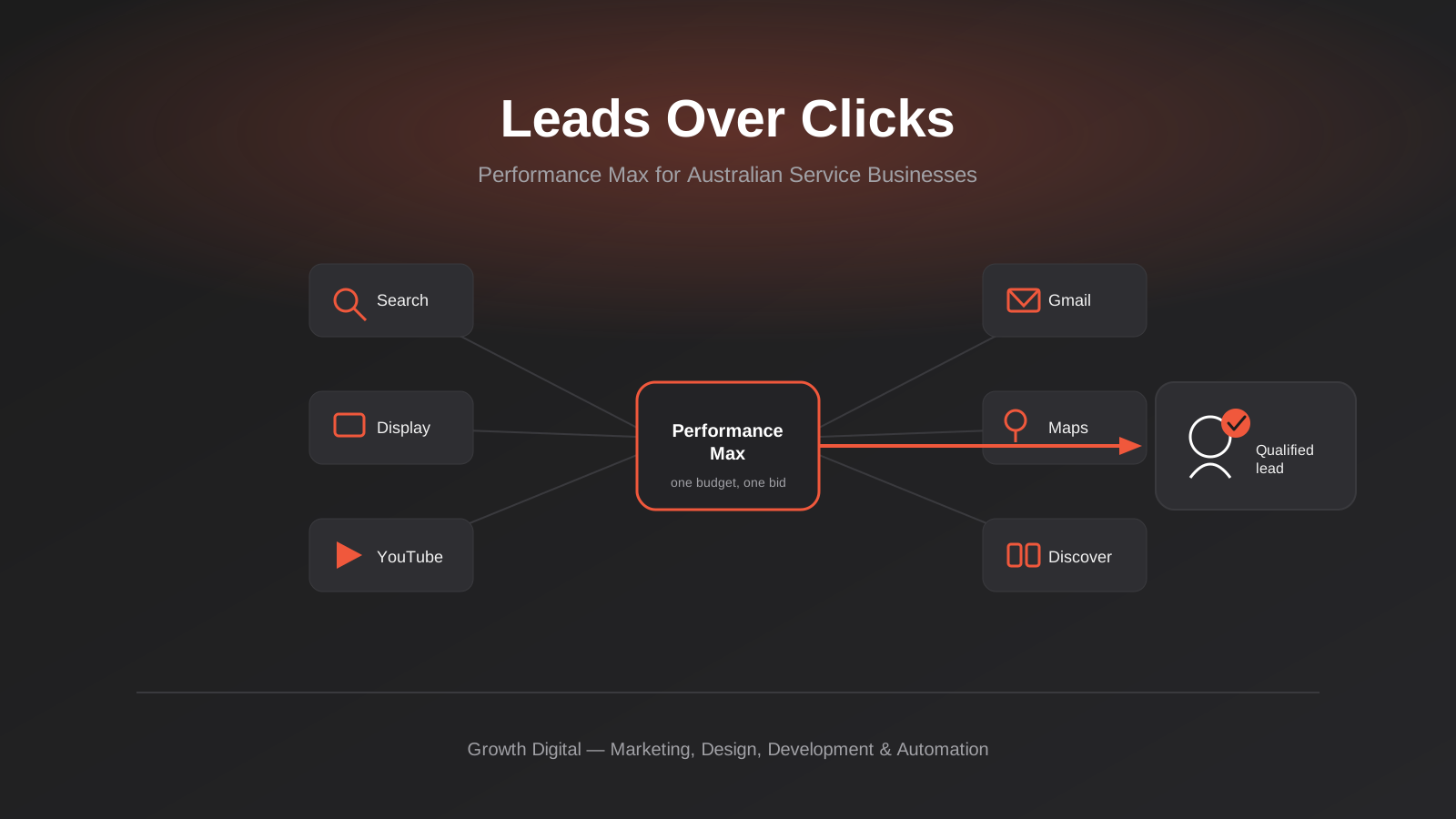
Standard Search campaigns still give you the most granular control — specific keywords, specific ad copy, specific landing pages — and remain the right starting point for testing messaging and understanding what search terms actually drive value. Performance Max campaigns, which Google has pushed heavily since 2023, bid across Search, Display, YouTube, Gmail, and Maps from a single campaign using asset groups instead of keywords, trading control for reach and automation. For ecommerce accounts with solid product feed data and enough conversion volume, PMax genuinely can outperform manually managed Shopping campaigns. For newer accounts, service businesses with less conversion volume, or anyone who needs to understand why something is or isn’t working, PMax’s black-box reporting can make diagnosis frustrating — which is why we typically recommend proving the offer and message with a well-structured Search campaign first, then layering PMax on top once there’s a baseline of what “good” looks like.
Enough conversion volume per campaign
Google’s own guidance suggests a Smart Bidding strategy needs roughly 30 conversions in a 30-day window per campaign to exit the learning phase reliably — fewer than that and bids can swing unpredictably as the algorithm works with too little data. A common fix for accounts split across too many thin campaigns is consolidation: merging campaigns targeting genuinely similar intent so each one accumulates enough signal, rather than spreading the same budget across a dozen campaigns that individually never leave the learning phase.
Keyword Strategy and Negative Keywords
Keyword match types have shifted meaningfully over the past few years. Broad match, once treated as the option for beginners who didn’t understand match types, is now Google’s recommended default when paired with Smart Bidding and solid conversion tracking — the algorithm uses signals well beyond the literal keyword (landing page content, other keywords in the account, searcher behaviour) to decide relevance. Used badly — without tight conversion tracking, or on an account with no negative keyword discipline — broad match can burn budget fast on loosely related searches. Used well, it can surface converting search terms a narrower match type would never have found.
Negative keywords as ongoing maintenance, not a one-off task
The search terms report — the actual queries that triggered your ads — is one of the most underused tools in a Google Ads account. Reviewing it weekly, or at minimum fortnightly, and adding clearly irrelevant terms as negatives is unglamorous but directly protects ROI, especially on broad match campaigns. A landscaping business running broad match on “garden design” might find its ads triggering for “garden design video game” or “garden design course” — harmless-looking clicks that add up to real wasted spend across a month if nobody’s watching.
Building a shared negative keyword list
For accounts with multiple campaigns, a shared negative keyword list applied account-wide — excluding terms like “free,” “jobs,” “DIY,” or competitor brand names, depending on the business — saves having to catch the same irrelevant terms individually in every campaign, and it’s one of the simplest structural changes that compounds in effect the longer an account runs.
Smart Bidding and Budget Allocation
With tracking and structure solid, bidding strategy is where most of the visible ROI conversation happens — and where the most common misunderstanding is treating it as “set and forget” rather than a strategy that needs the right conditions to work.
Choosing between Target ROAS, Maximise Conversion Value, and Target CPA
Target ROAS tells Google Ads to hit a specific return ratio and lets spend fluctuate to get there — useful once you know roughly what ratio is genuinely profitable for the business. Maximise Conversion Value (with an optional ROAS target) is generally better for accounts still establishing what a realistic target looks like, since it prioritises growing conversion value first. Target CPA, optimising toward a specific cost per conversion rather than value, still suits businesses where every conversion is worth roughly the same — a single-service business with one offer and one price point, for instance — but it’s the wrong choice once conversion values genuinely vary, because it has no way to tell a high-value conversion from a low-value one.
Respecting the learning phase
Every time a bid strategy or target is changed significantly, Google Ads re-enters a learning phase — typically one to two weeks — where performance can be noisier and less predictable while the algorithm recalibrates. The single most common self-inflicted ROI problem we see in accounts previously managed in-house is a target ROAS getting adjusted every few days in response to short-term fluctuations, which keeps the account permanently in a learning phase and never lets it stabilise. Give a change genuinely enough time — usually two to three weeks minimum, more for lower-volume accounts — before judging whether it worked.
Seasonality adjustments
For predictable short-term demand spikes — a 48-hour sale, EOFY promotions, a product launch — seasonality adjustments tell Smart Bidding to expect a temporary change in conversion rate, rather than letting the algorithm slowly and reactively catch up after the spike has already started (or, worse, treating an EOFY conversion rate as the new baseline and overbidding for weeks afterward).
Ad Copy and Creative That Actually Moves ROI
Creative gets treated as the “fun part” and, not coincidentally, is often the part done with the least rigour. Responsive Search Ads now dominate the Search Ads format, assembling headlines and descriptions dynamically from a pool of assets you provide — which shifts the skill required from writing one perfect ad to writing enough genuinely distinct, high-quality headline and description variations for the system to test combinations against each other.
Specificity beats cleverness
The ad copy that reliably outperforms in our own testing isn’t the cleverest — it’s the most specific. “Same-Day Quotes, Sydney-Wide” outperforms “Quality Service You Can Trust” because it tells the searcher something concrete and differentiating in the two seconds they spend scanning results, rather than a generic trust claim every competitor’s ad also makes. Pricing, timeframes, guarantees, and genuinely differentiating details (licensed, insured, a specific certification, a real turnaround time) consistently beat vague value propositions.
Ad strength is a floor, not a target
Google Ads’ “Ad Strength” indicator (Poor through Excellent) measures asset diversity and relevance, not actual performance — an “Excellent” ad can still underperform, and a “Good” ad with sharper, more specific copy can outperform an “Excellent” one padded with generic filler headlines added purely to satisfy the meter. Treat it as a minimum bar to clear on the way to a genuinely differentiated ad, not the finish line.
Assets: the extensions most accounts under-use
Sitelinks, callouts, structured snippets, price assets, and promotion assets increase an ad’s real estate on the results page and give Google more surface area to match against a searcher’s intent — and they’re free to add. An account running only the bare minimum of assets is leaving both visibility and Ad Strength on the table for no real cost.
Landing Pages and Quality Score: The Part Most “Google Ads Audits” Skip
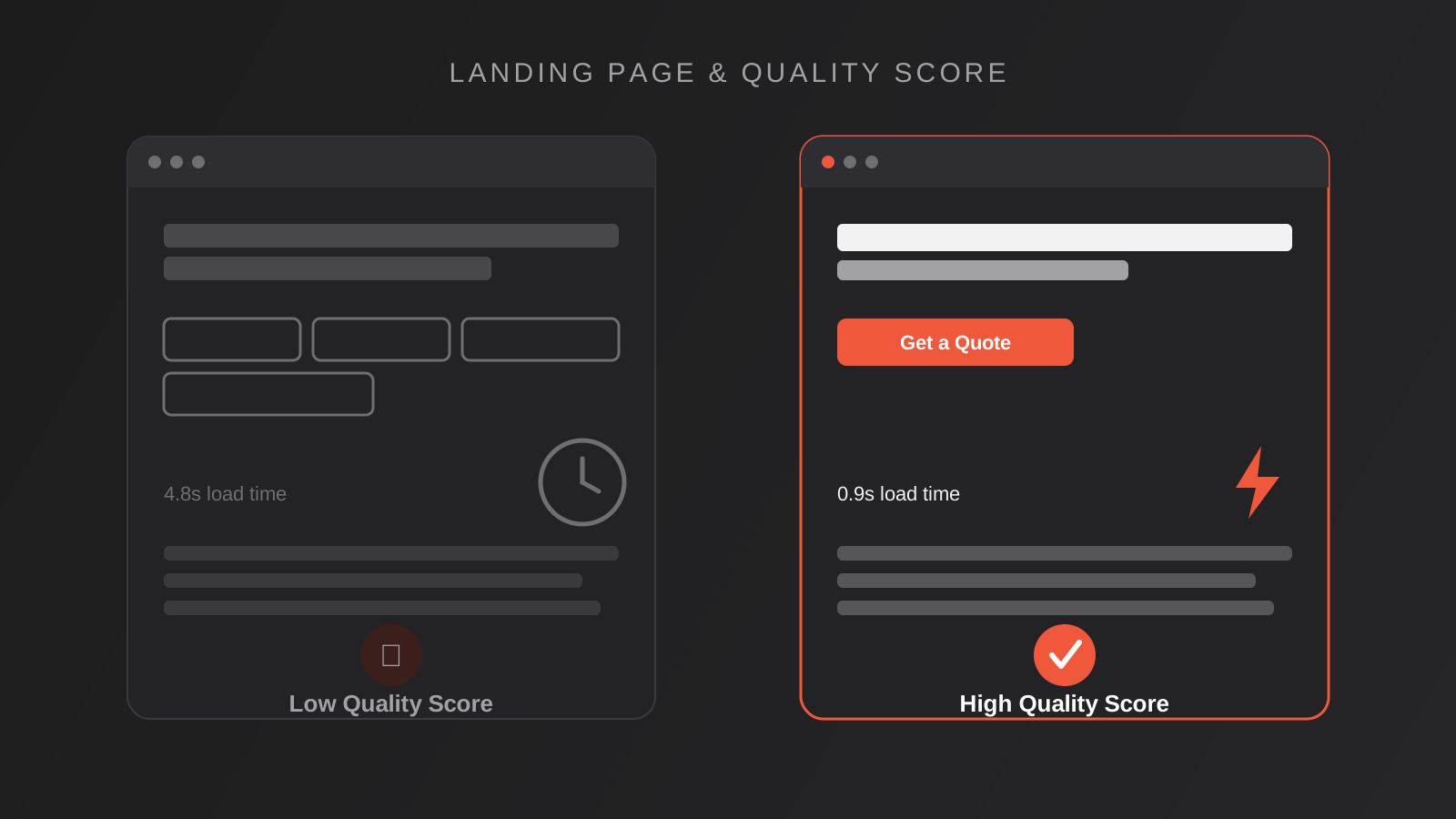
A perfectly optimised campaign sending traffic to a slow, unclear, or mismatched landing page is capping its own ROI before the visitor even has a chance to convert. This is also the part of a Google Ads audit that gets skipped most often, because it isn’t technically inside Google Ads — but Google’s own Quality Score, which directly affects both cost-per-click and ad rank, is built partly from expected landing page experience.
Message match
The single highest-leverage landing page fix is usually the simplest: does the headline on the landing page match the promise in the ad the visitor just clicked? A click on “Same-Day Hot Water Repairs” that lands on a generic homepage, rather than a page that immediately confirms same-day hot water repairs, loses a meaningful share of visitors in the first three seconds — not because the offer was wrong, but because the page didn’t confirm they’d landed in the right place.
Page speed and mobile experience
With the majority of Google Ads clicks in Australia now happening on mobile, a landing page that loads slowly or requires pinch-zooming to read is losing conversions Google Ads itself can see in the engagement data feeding Quality Score — and it’s compounding cost, not just conversion rate, because Quality Score directly discounts the cost-per-click needed to win an auction.
One clear conversion action per page
Landing pages with five competing calls to action — call us, book online, download a brochure, chat now, subscribe to a newsletter — dilute the one action that actually matters for that specific campaign. The highest-converting landing pages we build for paid campaigns typically have one primary action, repeated at logical points down the page, with everything else demoted or removed entirely.
Audience Signals and First-Party Data
Privacy changes across the ad ecosystem — the gradual phase-out of third-party cookies, tighter platform tracking limits — have made first-party data (the business’s own customer and lead data) more valuable to feed into Google Ads, not less.
Customer Match
Uploading a hashed list of existing customers or past leads lets Google Ads both exclude them from acquisition campaigns (no point paying to “acquire” someone who’s already a customer, unless the goal is genuinely a repeat-purchase campaign) and build lookalike-style audience signals from who those customers actually are, rather than relying purely on keyword-level targeting.
Remarketing lists, segmented by intent
A visitor who reached the pricing page and left behaves very differently from one who bounced off the homepage in four seconds — and a single, undifferentiated “all website visitors” remarketing list treats them identically. Segmenting remarketing lists by depth of engagement (viewed pricing, added to cart, started a form and abandoned it) allows meaningfully different messaging and bid adjustments for each group, rather than one generic “come back” ad shown to everyone regardless of how close they actually got.
Measuring ROI Properly: Beyond Last-Click
Google Ads defaults to data-driven attribution now for most accounts, which is a genuine improvement over the old last-click model — but it’s still worth understanding what it changes and where a business needs to look beyond Google Ads’ own dashboard entirely.
Why last-click undercounts upper-funnel activity
A search campaign is frequently the channel that gets credit for a conversion simply because it was the last touchpoint before purchase — even when a Display or YouTube campaign earlier in the journey is what actually built the awareness that led to the eventual search. Last-click attribution systematically starves upper-funnel channels of credit and budget, which is part of why data-driven attribution (which distributes credit across the actual touchpoints based on real conversion path data) tends to paint a more honest picture, particularly for businesses with longer consideration cycles.
Blended CAC and the channels-working-together reality
The most useful ROI number for a business running Google Ads alongside SEO, social, and other channels usually isn’t any single platform’s self-reported ROAS — it’s blended customer acquisition cost across all marketing spend, measured against actual revenue from finance data. Individual platforms have a structural incentive to over-credit themselves (every ad platform’s own attribution tends to flatter its own contribution), which is exactly why cross-referencing platform-reported conversions against GA4 and, ideally, actual CRM or sales data matters before making a big budget call based on one platform’s dashboard alone. We go deeper on how to build that kind of cross-platform reporting in our Google Ads reporting guide.
Customer lifetime value changes the whole equation
A campaign that looks marginal on a first-purchase or first-booking basis can be genuinely excellent once repeat purchase rate or contract renewal value is factored in — and the reverse is also true, where a campaign with an impressive first-conversion ROAS turns out to be acquiring low-retention, one-off customers that never justify the acquisition cost long-term. Businesses with meaningful repeat revenue should be evaluating Google Ads ROI against lifetime value, not first-transaction value, even though first-transaction value is the easier number to pull.
Common Google Ads ROI Mistakes We See in Australian Accounts
A handful of patterns show up repeatedly in accounts that come to us after being run in-house or by a previous agency, worth naming directly because every one of them is fixable:
- Optimising toward conversion count instead of conversion value. An account chasing the cheapest conversions will find them — usually at the expense of the conversions that actually generate meaningful revenue.
- Changing bid targets too frequently. Adjusting a Target ROAS every few days in response to short-term noise keeps Smart Bidding permanently re-learning and never lets it stabilise into its actual performance ceiling.
- No negative keyword routine. Especially on broad match campaigns, letting the search terms report go unreviewed for months quietly leaks budget to irrelevant queries.
- Treating Performance Max as a black box to leave alone. PMax still benefits from clean asset groups, exclusion lists, and genuinely good creative — it’s automated, not unmanaged.
- Sending every campaign to the same generic landing page. Message mismatch between ad and landing page is one of the single biggest silent conversion-rate killers we find in an audit.
- No offline or value-based conversion data. For any business where the real sale happens after the first tracked conversion, Google Ads is optimising against an incomplete picture without it.
Where AI and Automation Fit in 2026
Google has pushed automation hard across Google Ads — Smart Bidding, Performance Max, AI-generated ad assets, automatically applied recommendations. The honest take, after running accounts through this shift, is that automation has genuinely raised the floor: a reasonably well-set-up account with Smart Bidding will usually outperform manual bidding run by someone without deep expertise. What it hasn’t done is remove the need for judgement.
The recommendations tab inside Google Ads, for instance, is worth treating with real scepticism — it’s built to improve Google’s own metrics (Ad Strength, “Optimisation Score”) as much as the advertiser’s actual ROI, and blindly applying every suggestion (broader match types, higher budgets, more automated bidding) without judgement is a common way accounts quietly bleed efficiency. The role of a person managing the account shifts from manually setting individual bids — genuinely a solved problem now — to setting the right guardrails, feeding the system clean data, catching what the algorithm gets wrong, and making the judgement calls a machine learning system structurally can’t: is this segment worth pursuing at all, does this creative direction fit the brand, is this the right moment to expand budget or pull back.
How Long Until Google Ads Actually Pays Off
Unlike SEO, Google Ads can generate traffic and conversions from day one — but genuinely optimised ROI is a different timeline. The first two to four weeks are largely about the account gathering enough data for Smart Bidding to exit its initial learning phase and for early creative and landing page testing to surface a clear winner. Meaningful, stable ROI improvement typically shows in the eight-to-twelve-week range, once there’s enough conversion volume for confident bidding decisions and enough testing cycles to have found what actually converts for that specific business. Accounts we’ve managed for six months or more consistently outperform their own first-month numbers by a wide margin — not because anything dramatic changed, but because the compounding effect of clean data, refined negatives, tested creative, and a bidding algorithm with a genuinely deep history to learn from all stack on top of each other.
Frequently Asked Questions
What’s a good ROAS for Google Ads?
There’s no universal number — it depends entirely on margin. A business with 70% gross margin can be genuinely profitable at a 2:1 ROAS, while a business with 20% margin might need 6:1 or higher just to break even once cost of goods and operating costs are factored in. The right approach is calculating your own break-even ROAS from actual margin data first, then treating that as the floor rather than benchmarking against a generic “good ROAS” figure quoted for a different industry entirely.
Should I use Target ROAS or Maximise Conversion Value?
Maximise Conversion Value (with or without a target) tends to suit accounts still establishing a reliable performance baseline, since it prioritises growing conversion value without constraining spend to hit a specific ratio immediately. Target ROAS suits accounts that already know, from real margin data, roughly what return is genuinely profitable, and want spend to fluctuate to protect that number. Many accounts start with Maximise Conversion Value, gather a few months of data, then move to a Target ROAS once there’s a reliable number to target.
Why did my Google Ads ROI drop after I changed the bid strategy?
This is almost always the learning phase — every significant bid strategy or target change resets Smart Bidding’s calibration, typically for one to two weeks, sometimes longer on lower-volume accounts. Performance dips during this window are expected, not necessarily a sign the change was wrong. The mistake we see most often is reversing a change after three or four days because performance looks worse, which restarts the learning phase all over again without ever finding out whether the original change would have worked.
Is Performance Max better than Search campaigns?
Neither is universally better — they serve different purposes. Search campaigns give granular control over keywords, copy, and landing pages, and are the better starting point for understanding what message and offer actually converts. Performance Max trades that control for reach across Google’s full inventory and can outperform once there’s a proven offer, solid conversion data, and (for ecommerce) a clean product feed behind it. Most accounts we manage run both together rather than choosing one over the other.
How much should an Australian business budget for Google Ads?
Budget should be set from the demand side, not a rule of thumb — specifically, from search volume for your genuinely relevant keywords, realistic conversion rate, and what you can afford to pay per conversion while staying profitable. A useful sanity check: if your budget is too low to generate at least the roughly 30 conversions per 30 days that Smart Bidding needs to learn reliably, either the budget needs to increase, the campaign scope needs to narrow to concentrate that budget, or expectations for how quickly the account will stabilise need to shift accordingly.
Where to Start
If your account has a genuine ROI problem, the fix is rarely a single dramatic change — it’s usually two or three foundational issues (tracking, structure, or landing pages) quietly capping everything built on top of them. The order that actually works is the same one we use with every account we take on: audit conversion tracking first, because every other decision depends on it being accurate; fix account structure so Smart Bidding has enough clean data to learn from; then move to bidding strategy, creative, and landing page testing once the foundation is solid enough for those changes to actually be measurable.
That’s also usually the fastest way to find out whether an account’s real problem is Google Ads itself, or something upstream of it that no amount of bid tweaking was ever going to fix. If you want a second set of eyes on where your own account currently stands, that’s exactly the conversation worth having before another dollar goes into a campaign a tracking or landing page issue is quietly undermining. For what ongoing management typically costs, see our Google Ads pricing page.
Keep reading
Related posts
Performance Max for Lead Generation: A 2026 Guide for Australian Service Businesses
Performance Max for lead gen needs different conversion tracking and asset groups than ecommerce PMax. How Australian service businesses should set it…
Microsoft Advertising (Bing Ads) for Australian Businesses: Cost, LinkedIn Profile Targeting and the Google Ads Import Trap (2026)
What Microsoft Advertising actually costs in Australia, how LinkedIn profile targeting works for B2B, and what breaks when you import from Google…
Google Ad Grants for Australian Non-Profits: Eligibility, Application and the Rules That Keep It Alive (2026)
A practical guide to Google Ad Grants for Australian non-profits: who qualifies, how to apply, and the compliance rules that keep the…
Got a project you'd like to talk through?
Tell us what you're working on — we'll come back with a plan.
