
How Much Does a Website Redesign Cost in Australia? A 2026 Price Guide
 Jignesh Vagadiya
18/11/2026
22 min read
The most common redesign quote we see forwarded to us looks something like this: a business has an existing website that is three or four years old, a bit slow, not quite on brand any more, and three agencies have priced the job at $4,500, $13,000 and $38,000. Nobody has told them why. All three agencies called it a “redesign”, and all three were being honest about the number they quoted. They were pricing three different jobs.
That is the core problem with redesign pricing in Australia. “Redesign” can mean a fresh coat of paint on the pages you already have, a ground-up rebuild on a new platform with every old URL redirected, or something in between. If you don’t know which one you are buying, you can’t compare quotes, and you can’t tell whether the cheap one is a bargain or a stripped-down version of what you needed.
This guide covers what a website redesign costs in Australia in 2026, using ranges drawn from published Australian agency and studio guides (which disagree with each other more than you’d expect, so we have leaned toward the middle). It also covers what pushes a quote up or down, the pricing models you will be offered, what a proper quote should list, and the mistakes that blow budgets. For Growth Digital’s own current figures, our website pricing page is the single source of truth; everything below is about the wider market so you can sanity-check any quote you are holding, ours included.
What a Website Redesign Actually Costs in Australia
Published Australian estimates for redesigns range from under $2,000 for a template refresh to $60,000 or more for a custom rebuild with a platform change. Most of the figures come from studios and agencies selling the work, so read them as benchmarks rather than gospel. Here are the bands that hold up when you line the sources up against each other, ex GST:
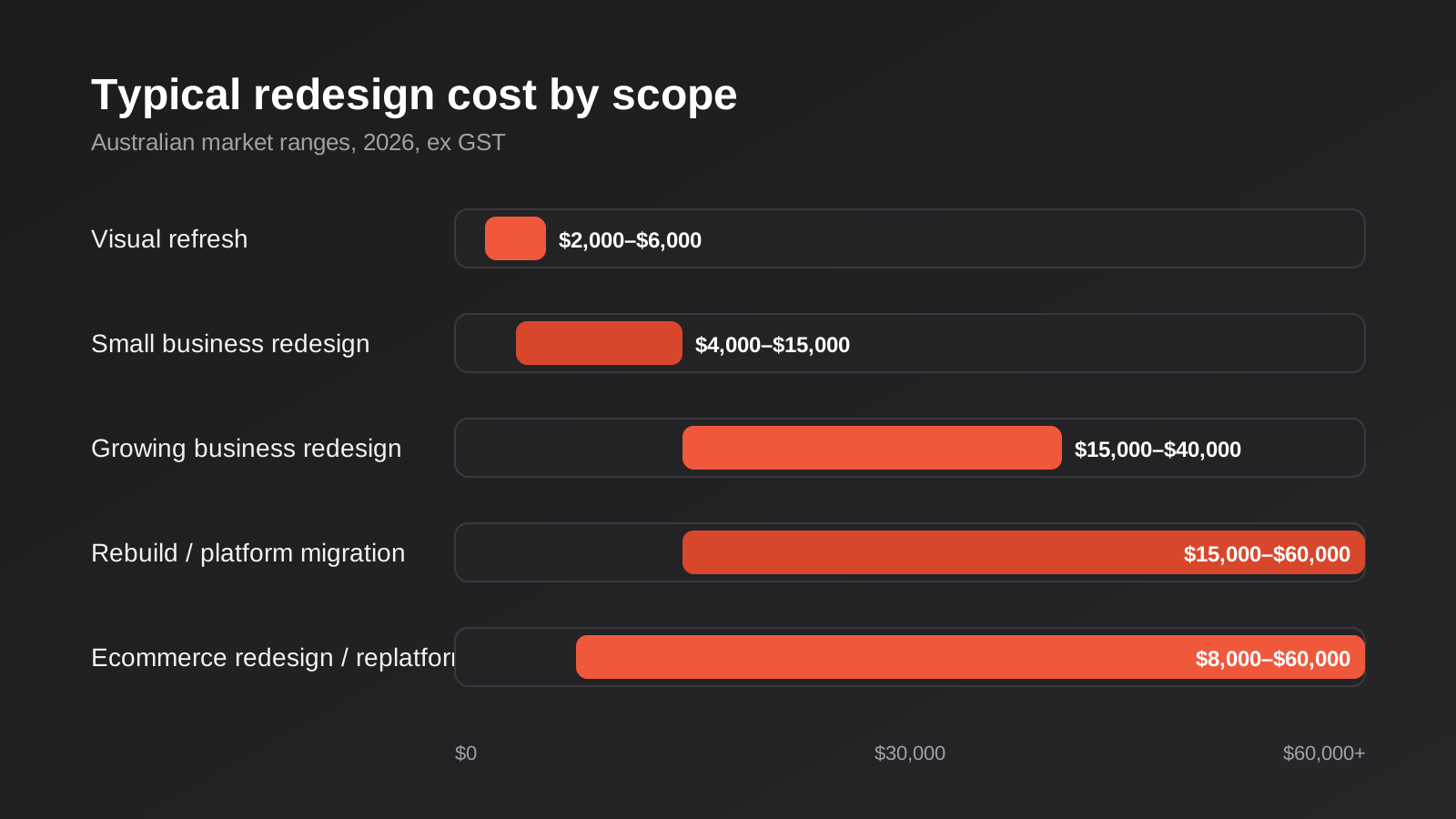
- Visual refresh (same pages, same platform, new look): roughly $2,000–$6,000. New layout, colours and typography applied to what you already have, with the content and structure largely untouched.
- Small business redesign (5–15 pages, new design, content reworked): roughly $4,000–$15,000. This is where most Australian small businesses land, and where freelancers and small studios sit at the lower half and agencies at the upper half.
- Growing business redesign (20+ pages, new structure, integrations, multiple page templates): roughly $15,000–$40,000.
- Rebuild or platform migration (replacing ageing custom code or moving to a new CMS): roughly $15,000–$60,000, depending on how much has to be rebuilt rather than carried across.
- Ecommerce redesign or replatform: roughly $8,000–$60,000 or more. The spread is huge because the same words cover a theme change on a 40-product store and a full rebuild of a catalogue with wholesale pricing and ERP syncing.
You will see lower numbers advertised. Some small studios list entry redesign packages under $2,000, and some freelancers quote anywhere from $800 up. Those can be genuine for a very small site with supplied content, and we are not going to pretend nobody delivers good work at that level. What you should do is find out exactly what they include before you compare them with a $9,000 quote.
None of these figures include what happens afterwards. Hosting, maintenance, new content and the ongoing SEO work that keeps a redesigned site performing all sit outside the build price. Our guide on what a website costs in Australia covers the from-scratch end of the market and the running costs in more detail.
Refresh, Redesign or Rebuild: Which One Are You Buying?
Before you ask anyone for a price, decide which of three jobs you actually need. Most of the spread between quotes comes from agencies assuming a different one.
A refresh
A refresh changes how the site looks without changing how it is organised. The URLs stay the same, the content is carried across (perhaps lightly edited), and the platform is untouched. Because nothing moves, the SEO risk is low and the cost is modest. A refresh suits a site whose structure still works and whose problem is mostly visual: dated typography, a template that no longer matches the brand, poor mobile layout. If your pages are ranking and converting but the site looks tired, this is usually the right size of job.
A redesign
A redesign changes the design and the information architecture. Pages are merged, split or removed, navigation is rethought, and the copy is rewritten to match. Some URLs change, which means redirects, and that is where the hidden work lives. A redesign suits a site that is not performing: visitors can’t find things, the service pages are thin, or the structure grew by accident over five years of additions. It costs more than a refresh because someone has to make decisions about content and structure, not just apply a new skin.
A rebuild
A rebuild replaces the underlying platform or code. Moving from an old custom CMS to WordPress, from WooCommerce to Shopify, or from a heavily customised theme with years of plugin debt to a clean build all count. This is the most expensive and the most technical option because data has to be migrated, functionality re-created, and every old URL mapped to its new home. If you are moving a store between platforms, our WooCommerce to Shopify migration page shows what that kind of project involves in practice.
A useful test: if you can describe the job as “same site, new look”, it is a refresh. If you would say “same business, new site”, it is a redesign. If the honest answer is “the thing it is built on is the problem”, it is a rebuild. Tell every agency which of the three you think you need, and ask them to tell you if they disagree. That one conversation filters out a surprising number of mismatched quotes.
What Drives the Price Up
Redesign quotes are built from a handful of cost drivers. Knowing them lets you work out why a number looks the way it does, and where scope could be trimmed if it is bigger than your budget.
Page templates, not page count
A twenty-page site where most pages share two layouts is cheaper than a twelve-page site where every page needs bespoke design. What agencies actually price is the number of distinct templates: home page, service page, location page, blog post, contact page and so on. When you hear “it depends on the number of pages”, what it really depends on is how many different kinds of page there are.
Content: who writes it, who moves it
Content is the line item most often left out of a cheap quote. If the quote assumes you will supply finished copy and images in the right format, and you won’t, someone will have to produce it. Professional copywriting for even a small site runs to thousands of dollars on its own. Even when the existing content is staying, moving it across, reformatting it and re-linking it is real labour, particularly on large sites or blogs with hundreds of posts.
Redirects and SEO protection
This is the cost driver people discover too late. If URLs change, every old address needs a 301 redirect to the right new page, otherwise the rankings and inbound links those pages earned simply disappear. On a small site this is an afternoon. On a site with hundreds of pages, years of blog content and links from other websites, it is a project in its own right, and it should appear as its own line in the quote. We go through the full process in our guide to redesigning a website without losing rankings or revenue.
Platform change
Keeping the same platform keeps the cost down because the data structure carries across. Switching platforms means exporting products, customers, orders and content, mapping fields between two systems that don’t model things identically, and testing that nothing was lost. For ecommerce in particular, order history, customer accounts, product variants and redirects for every product URL all have to survive the move.
Integrations
A redesign that has to preserve connections to a CRM, booking system, accounting platform or inventory tool is more expensive than one that does not, because each connection has to be rebuilt or at least retested against the new site. If you already have working integrations, say so up front. Agencies that don’t ask about them in the first call are likely to find them in week five.
Depth of design work
A template with your brand applied is a different amount of work to a custom design system with bespoke illustration, motion and a component library. Both can look good. Only one produces a site that looks like nobody else’s in your category. If differentiation is part of how you win business, it is worth paying for. If you are a single-location trade business that wins on reviews and local search, probably not.
Accessibility and compliance
Meeting WCAG standards properly, rather than nominally, takes design and testing time: colour contrast, keyboard navigation, screen reader behaviour, accessible forms. Some organisations have no choice, and none of them get it for free.
Stakeholders and revision rounds
A redesign approved by one person moves quickly. A redesign approved by a committee of six, each of whom has opinions about the footer, does not. Most quotes include a fixed number of revision rounds, and the project that blows its budget is usually the one where those rounds were consumed by internal disagreement rather than by genuine design refinement. Decide who signs off before you start.
Timeline
If you need the new site live before a campaign, a trade show or a seasonal peak, expect agencies to price in the disruption of reshuffling their schedule. Rush loadings of somewhere between 15% and 30% are common. If the deadline is real, say so early, because it changes how the project is staffed, not just what it costs.
What Brings the Price Down
If the number is bigger than your budget, these are the honest ways to bring it down, roughly in order of impact:
- Keep your URLs where you can. The fewer pages that move, the fewer redirects, the lower the SEO risk and the shorter the project. Resist the urge to rename everything just because the new navigation looks tidier.
- Start from a good template or theme rather than a fully custom design. You trade some differentiation for a professional result at a fraction of the cost.
- Reduce the number of distinct page templates. A flexible layout reused across many pages is cheaper than several unique ones.
- Supply finished content. This only saves money if the copy and images are genuinely ready, not “mostly there”.
- Prune before you migrate. Old posts nobody reads, duplicate service pages and abandoned landing pages cost money to move and add nothing. Auditing first and migrating only what earns its place often cuts a meaningful amount from the scope.
- Phase it. Launch the core site, then add the booking system, member area or second language later, once there is evidence you need it.
- Fix the scope in writing before you ask for quotes. Nothing keeps a budget intact like a brief that does not change halfway through.
None of these are tricks. They are real trade-offs between cost and capability, and a decent agency will tell you which ones suit your situation instead of selling you past what the business needs this year.
The Cost Most Quotes Don’t Mention: Protecting What You Already Have
A new site is not a blank slate. If your current one has been live for years, it has accumulated search rankings, inbound links and customers who know where to find things. A redesign can erase all of that or protect it, and the difference sits in work that a lot of quotes skip.
Before the build starts, someone should crawl the existing site and record every URL, its traffic, its rankings and the links pointing at it. That inventory is what the redirect map is built from, and it is also how you spot the pages that are quietly earning most of your enquiries and need to be handled with care. After launch, someone should check that the redirects work, that the new site is being crawled properly, that analytics tracking is intact, and that nothing important has dropped out of search. A redesign with no budget for either end of that process is a redesign gambling with your existing traffic.
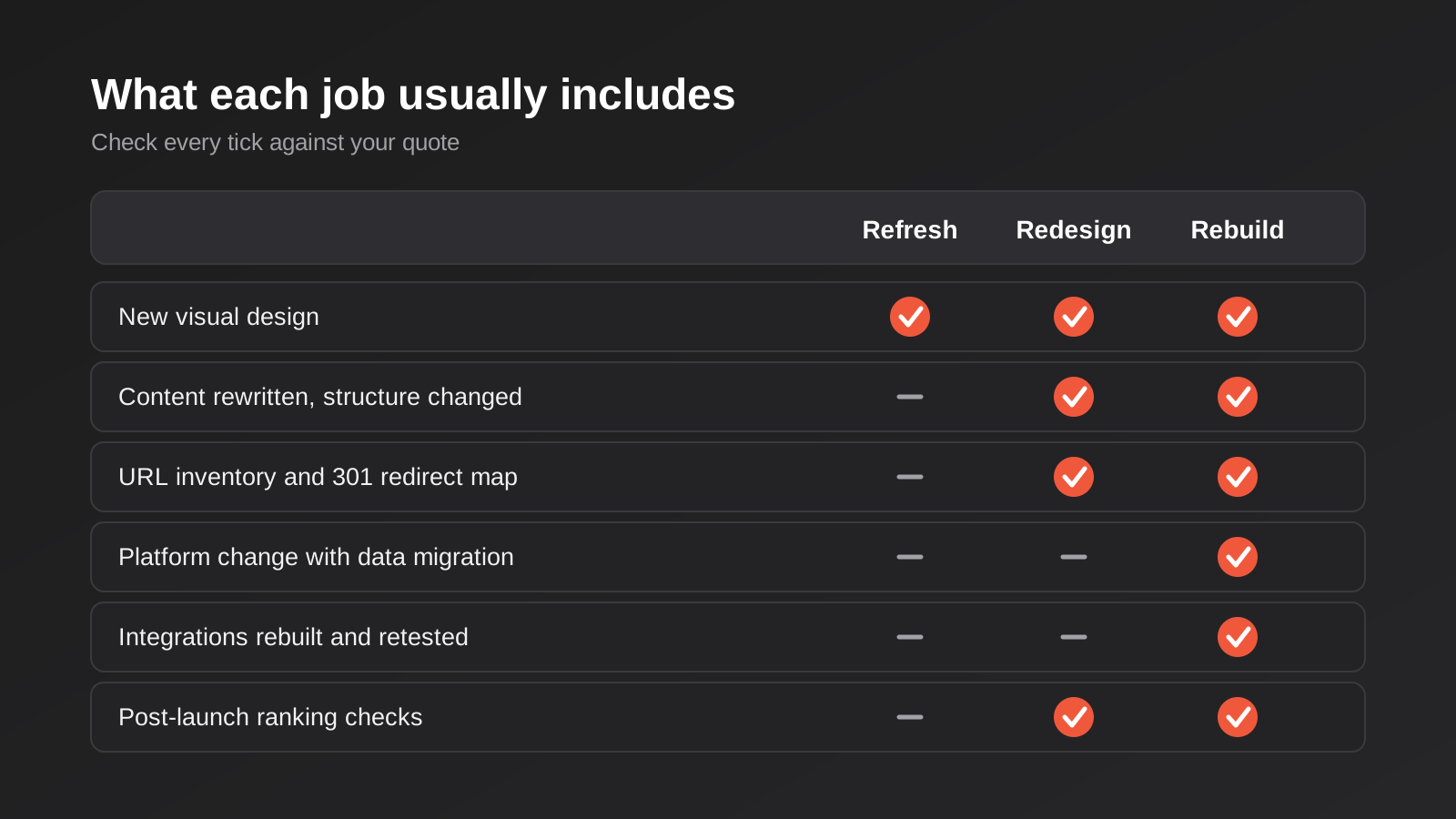
If you rely on organic traffic for leads, ask each agency a blunt question: what is your process for making sure we don’t lose rankings? A good answer mentions a pre-launch URL inventory, a redirect map, staging environment checks and post-launch monitoring. A vague answer, or a cheerful “Google will sort it out”, is a signal to keep looking. The cheapest redesign quote can become the most expensive decision you make if it costs you six months of search traffic.
Freelancer, Small Studio or Agency?
Who does the work moves the price almost as much as what the work is. Published Australian guides generally put freelancers at the bottom of the range, small studios in the middle and larger agencies at the top, and the pattern is believable, because overheads, project management and the number of people reviewing the work all differ.
A good freelancer can be the right answer for a refresh or a small redesign where one person can hold the whole job in their head. The risk is capacity and continuity: if they get sick, get busy or disappear, the project and your logins go with them. A small studio typically adds a designer and a developer who check each other’s work, along with someone managing the timeline. A larger agency adds strategy, SEO, content and project management as separate roles, which earns its cost on a complex site and is wasted on a simple one.
Whatever you choose, ask who will actually do the work, whether any of it is offshored or subcontracted, and who you contact when something breaks six months after launch. The price difference between two providers is easier to understand once you know which of those roles each quote is paying for.
What Happens to Your Budget After Launch
A redesign budget that stops at launch day is incomplete. Several costs start the moment the site goes live, and they belong in the plan from the beginning.
- Hosting and domain: usually modest, but the quality of hosting affects speed, security and uptime, so don’t treat it as an afterthought.
- Maintenance: updates, backups, security monitoring and a small allowance of changes. Budget for it as a monthly line, not a surprise.
- Post-launch fixes: every new site has small issues that only show under real traffic. Check whether the quote includes a support window and what it covers.
- Content and SEO: a site that is live isn’t automatically a site that generates enquiries. New pages, updated copy and ongoing optimisation are a separate line of spend.
- Paid plugins and tool subscriptions: forms, booking, analytics and security tools often carry annual licences that are not part of the build price.
A sensible way to frame it is the total cost over the first two years rather than the build price alone. A $6,000 build with a $150 monthly care plan and a modest content budget is a different commitment to a $6,000 quote with nothing behind it. Asking each agency to show you year-one running costs alongside the project fee is a quick way to expose quotes that look cheap only because the ongoing costs were left off the page.
Reading Three Quotes Side by Side
Here is how we would approach three quotes that look wildly different. This is an illustrative example, not a case study: imagine a business with a 12-page WordPress site that gets steady enquiries from search, and three quotes of roughly $4,500, $12,000 and $30,000.
Start by asking each provider the same three questions: which of the three jobs (refresh, redesign, rebuild) have you priced, what happens to our existing URLs, and who writes the content? The lowest quote might turn out to be a refresh priced on the assumption that nothing moves and you supply the copy. The middle one could be a redesign with new page structure, rewritten service pages and a redirect plan. The top one might include a platform change, custom design system and integrations you never asked for.
Now the numbers can be compared properly. If your site is ranking well and the problem is visual, the lowest quote may be the right one even though it is “cheapest”. If the structure is the problem, the refresh won’t fix it no matter how good the design looks. If you did not ask for a platform change, the top quote is pricing something you don’t need. The point is not that the middle quote always wins. It is that you can only know which one is right after you’ve put them on the same footing.
Pricing Models Explained
How an agency charges matters almost as much as what they charge. Three models dominate Australian redesign work.
Fixed quote
One number for a defined scope: these templates, this many pages migrated, this many revision rounds, this launch date. It is the most common model for refreshes and small business redesigns because the scope can be known in advance. The risk of overrunning sits with the agency, which is why a fixed quote usually comes with a scope document and a change-request process for anything outside it. If you have ever been told “that wasn’t included” after signing, the scope document is almost always where the gap was.
Hourly or day rate
You pay for time. Australian web development rates commonly sit somewhere between $90 and $180 an hour depending on seniority and location. This suits work where the scope really can’t be pinned down: a rebuild where the real complexity of the old system only shows once someone is inside it. The risk sits with you, so ask for a not-to-exceed estimate and regular time reporting. An open-ended hourly engagement with no estimate for what sounds like a simple refresh deserves more questions.
Retainer or website-as-a-service
The build cost is spread across a monthly fee that also covers hosting, maintenance and some ongoing changes. It smooths cash flow and avoids a large upfront payment. Read the contract term carefully, and find out who owns the site, the code and the design files if you cancel part-way through. Some of these arrangements mean you never own the result outright while payments continue. That is not automatically bad, but it is a different deal to a fixed quote.
Whichever model you choose, ask how payment is staged. A deposit to start, a milestone at design approval and a final payment at launch gives both sides protection. Full payment upfront on a large project removes the agency’s financial incentive to finish on the timeline they promised.
What a Redesign Quote Should Include
A quote that is only a dollar figure and a page count tells you almost nothing. Before you compare two of them, make sure both answer the same questions. For a deeper walk-through, our guide to comparing agency quotes in Australia covers the side-by-side method in full.
- Which type of job it is: refresh, redesign or rebuild, stated plainly.
- A page and template list with what counts as a page and what happens if you need another.
- Content scope: who writes it, who migrates it, what happens to pages being retired.
- The redirect and SEO plan: a URL inventory, a redirect map, and post-launch checks, either included or priced separately.
- Integrations being preserved or rebuilt, named individually.
- Design revision rounds included before extras are billed.
- Ownership: the domain, hosting account, code and design files, and who holds the logins.
- Exclusions: photography, stock licences, paid plugin subscriptions, ongoing SEO.
- Post-launch support: how long, and what counts as a free bug fix versus billable new work.
- A realistic timeline with your own dependencies named. If the quote assumes feedback within 48 hours and you know that won’t happen, say so now.
A dramatically cheaper quote than the rest deserves a specific kind of scrutiny. Occasionally it is a lean operator with low overheads. More often it is a template build being sold at custom-build prices, a junior freelancer learning on your project, offshore production with no local project management, or a scope that quietly leaves out the redirects, the content migration or the testing. None of those is necessarily disqualifying. You just need to know which one you are getting.
Common Mistakes When Budgeting for a Redesign
- Comparing headline prices without comparing scope. A $5,000 refresh and a $15,000 redesign aren’t competing quotes. They are different products.
- Not deciding which of the three jobs you need. If you ask for “a redesign” and let each agency interpret it, you will get three interpretations back.
- Ignoring the SEO risk. Redirects, URL inventories and post-launch monitoring cost money. Skipping them costs more.
- Migrating everything. Moving years of unread blog posts and dead pages inflates the scope and carries clutter into the new site.
- Assuming the content will sort itself out. Content is where most redesigns stall. Plan who writes it, by when.
- Treating launch as the finish line. New sites need monitoring, fixes and iteration in the first weeks, and ongoing maintenance after that.
- Letting scope creep without re-quoting. “Can we also add…” requests feel small one at a time and add up to a different project.
- Redesigning for taste rather than for a problem. If the current site converts and ranks, a refresh may beat a redesign. Know what you are trying to fix before you spend the money.
- Not knowing who owns the result. Cheap builds are sometimes cheap because the agency keeps control of hosting or the CMS login, which becomes leverage later.
Most of these share a root cause: treating the quote as the end of the conversation instead of the start of one. The businesses that end up happy with what they paid are almost always the ones that asked more questions before signing, not the ones that found the lowest number.
Frequently Asked Questions
How much does a website redesign cost in Australia?
For most small businesses, roughly $4,000–$15,000 for a full redesign of a 5–15 page site, with a visual refresh costing less (around $2,000–$6,000) and a larger site with integrations or a platform change costing $15,000–$60,000 or more. The spread is wide because “redesign” covers jobs of very different size, so the useful question is which type of job you need, not what the average is.
Is a redesign cheaper than building a new website?
Sometimes, but not reliably. A refresh that keeps your structure and content is cheaper than a new build. A full redesign with new structure, rewritten content, redirects and migration can cost as much as starting fresh, because the migration and SEO protection work is extra rather than instead of the design work.
Will a redesign hurt my Google rankings?
It can, and the usual cause is not the new design but lost URLs, missing redirects, dropped content or broken tracking. A properly managed redesign with a URL inventory, a full redirect map and post-launch monitoring protects most of what you have. Expect some movement in the weeks after launch even when it is done well, and check that nothing important has dropped out.
How long does a website redesign take?
A small business redesign typically takes four to eight weeks from kickoff to launch, and most of that time is spent on content, feedback and approvals rather than raw development. Larger sites, platform migrations and ecommerce rebuilds take longer, often eight to sixteen weeks or more. The biggest variable is usually how fast your side can turn around content and decisions.
How often should a business redesign its website?
There is no fixed cycle that suits everyone. A common rule of thumb is a significant refresh every three to five years, but the better trigger is a problem: the site is slow, hard to use on a phone, can’t be updated easily, or no longer reflects the business. Continuous small improvements usually beat a big-bang redesign every few years.
Should I redesign my site or move to a new platform?
If the platform is not the problem, stay on it. Changing platforms adds migration cost and risk, and it is only worth paying for when the current one limits what the business can do: it can’t support the features you need, it is expensive to maintain, or it is built on code nobody wants to touch. Ask any agency recommending a move to explain what specifically the new platform fixes.
Where to Start
Start by deciding which job you are buying. Write down whether your site needs a refresh, a redesign or a rebuild, list the pages and integrations that matter, and note which URLs earn you traffic and enquiries today. A one-page brief with that information makes every quote you receive comparable, and it stops agencies filling gaps with their own assumptions.
If you would like to see how we quote, our website pricing page sets out what is included at each level, and if your redesign is as much about protecting traffic as improving looks, read our guide to redesigning without losing rankings or revenue before you collect quotes. A vague brief gets a vague quote, and a vague quote is the biggest single reason redesign projects go over budget.
Worth putting a number on it: our own website packages start from $1,500 one-time — below the $4,000–$15,000 most Australian businesses pay for a comparable small business website. If you’ve already got a written quote from another agency for comparable scope, send it through and we’ll do our best to beat it.
Keep reading
Related posts
How Much Does SEO Cost in Adelaide? A 2026 Price Guide
What SEO costs in Adelaide in 2026: real monthly ranges by scope, what drives quotes up or down, and how to compare…
How Much Does SEO Cost for a Small Business in Australia? A 2026 Guide
What SEO costs a small business in Australia in 2026: real monthly ranges by budget, what each level buys, and how to…
How to Compare Agency Quotes in Australia: Why Prices Differ So Much (2026)
Why three agency quotes for the same job differ so much in Australia, what a good quote includes, and a step-by-step way…
Got a project you'd like to talk through?
Tell us what you're working on — we'll come back with a plan.
