
How Much Does a Website Cost in Australia? A 2026 Price Guide
 Jignesh Vagadiya
10/10/2026
21 min read
Ask five Australian web agencies to quote the same brief and you will get five different numbers, sometimes with a factor of ten between the lowest and the highest. We see this from the other side constantly — a prospective client forwards us a quote they received elsewhere, confused about why one agency said $3,000 and another said $35,000 for what reads, on paper, like the same website. Neither quote is necessarily wrong. They are usually pricing different things while using the same word.
So how much does a website cost in Australia in 2026? This guide sets out the real answer, broken down by the type of build, the specific things that push a quote up or down, and the pricing models you will be offered. We are not going to give you one number, because one number would be a lie. What we can give you is the real range for each tier, the cost drivers that explain why you land where you land within that range, and the questions to ask so a $4,000 quote and a $14,000 quote both make sense to you before you sign anything.
If you want our own current figures rather than market averages, our website pricing page has them. Everything below is about the broader Australian market so you can sanity-check any quote you’re holding, including ours.
A quick note on how we’ve put this together: these are market ranges drawn from current Australian pricing data across independent cost guides, agency rate cards and published Shopify and WordPress build quotes, not a single agency’s rate card dressed up as “the market.” Where sources disagreed, we’ve leaned toward the middle rather than the most flattering number, because a website guide that only ever quotes the cheap end is no more useful than one that only quotes the expensive end.
How Much Does a Website Cost in Australia?
Website cost scales with scope, not with how impressive the site looks to you in a mockup. Below are the bands we see hold up across the market in 2026, from DIY builders through to custom ecommerce and web app builds. Treat the top of each range as “fully featured” and the bottom as “lean but professional.”
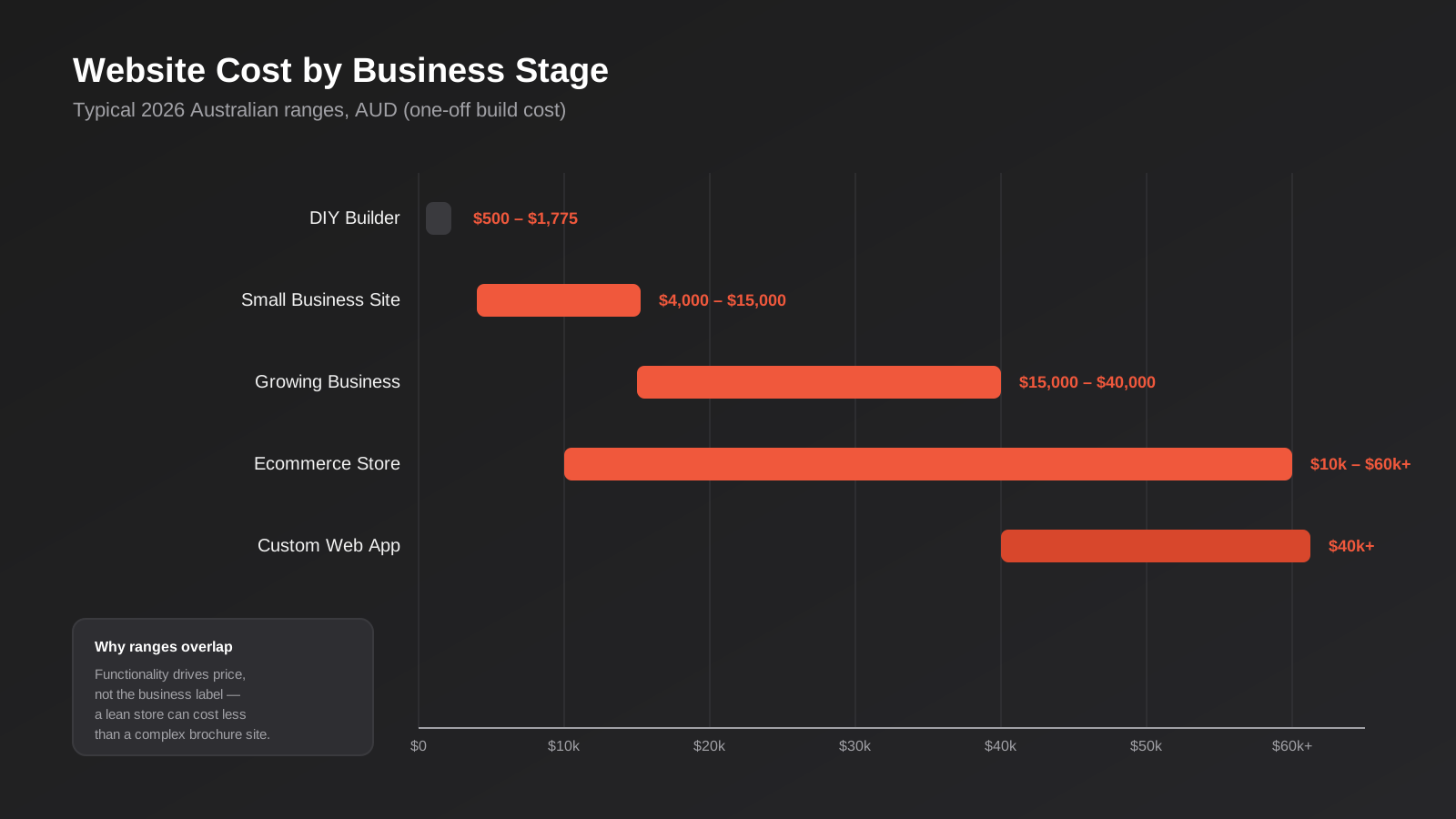
- DIY builder (Wix, Squarespace, basic Shopify theme): roughly $500–$1,775 as a one-off build, or $500–$1,500 a year if you count the subscription as the “build” cost. You’re doing the work yourself with a template; this is the only tier where labour isn’t really being priced at all.
- Small business brochure site (5–10 pages, WordPress or similar, professionally designed): roughly $4,000–$15,000, with most Australian small businesses landing in the $6,000–$10,000 band for a custom-designed site with original copywriting, basic SEO setup and a contact or booking form.
- Growing business site with custom features and integrations (CRM connections, member areas, booking systems, multi-location pages, more complex content structures): roughly $15,000–$40,000.
- Ecommerce store: roughly $10,000–$60,000+. A template-based Shopify build with standard apps sits at the low end ($2,000–$8,000 for the storefront alone); a custom-themed store with product configurators, wholesale pricing tiers or ERP integration pushes well past $30,000.
- Custom web application or highly bespoke build (portals, booking engines, anything closer to software than a marketing site): $40,000 and up, scoped on functionality rather than page count.
Two things to notice. First, the brackets overlap — a very well-specified small business site and a lean ecommerce store can land at a similar number, because it’s the functionality that drives price, not the label “ecommerce” or “brochure.” Second, nobody in this list is lying when they quote $4,000 or $40,000 for “a website.” They’re pricing different products that happen to share a name.
None of this includes what it costs to run afterwards. Hosting alone is cheap — shared hosting runs $10–$50 a month, and even managed WordPress hosting tops out around $150–$170 a month. Maintenance and support plans, which bundle updates, backups, security monitoring and a bucket of changes each month, typically run $100–$600 a month depending on how much is included. We’ve written a separate guide to what website maintenance plans actually cover if that’s the number you’re trying to pin down next.
Which tier is right for you usually comes down to what the site actually has to do commercially, not how big the business feels. A sole trader with a strong referral network and a handful of services genuinely doesn’t need more than the small business brochure tier — spending $30,000 there is money that would do more for the business sitting in a Google Ads budget instead. On the other hand, a growing business juggling multiple locations, a booking system and a CRM that all need to talk to each other is going to find the brochure-tier price simply can’t buy what’s required, no matter how good the agency is. The honest exercise is to work backwards from what the site needs to do in the next twelve months, not from a number you’ve seen a competitor mention at a networking event.
What Drives the Price Up
Every quote is built from the same handful of cost drivers. Understanding them is the fastest way to work out why your quote looks the way it does, and where you could trim scope if the number is bigger than your budget. None of these drivers are hidden on purpose — they’re just rarely explained in plain language before the number lands in your inbox, which is why the number itself feels arbitrary even when the pricing behind it isn’t.
Page count and content structure
A ten-page site with a flat structure costs less to design and build than a ten-page site with nested service categories, filterable location pages or a resource library that needs its own taxonomy. It’s not really the page count that matters — it’s how many distinct templates those pages need. Five pages that all use the same layout are cheap. Five pages that each need a different layout are not.
Custom design versus a template
A premium theme with your logo and colours swapped in is a job measured in days. A visual identity designed specifically for your brand, laid out as custom Figma designs and then built pixel-for-pixel, is a job measured in weeks. Both produce “a website.” Only one of them produces something that looks like nobody else’s site in your industry. If differentiation matters to you commercially, budget for custom design; if it doesn’t, a well-chosen template is a legitimate way to save several thousand dollars.
Ecommerce and payment complexity
A standard Shopify store with a handful of products and Shopify Payments is close to the template end of the ecommerce range. Wholesale pricing tiers, custom product configurators, multi-currency, subscriptions, freight calculators tied to Australia Post or a 3PL, and inventory synced to an ERP or accounting platform each add real development time, because each one is effectively a small custom feature sitting inside the storefront.
Integrations
Connecting your website to a CRM, booking system, accounting platform or marketing automation tool sounds like “just a plugin” until you’re the one who has to handle what happens when that third-party API is slow, rate-limited or returns an error mid-checkout. A single clean integration might add $500–$2,000. Several integrations that all need to stay in sync — CRM, calendar, invoicing — start to look like a small project of their own. If this is a significant part of your brief, it’s worth reading how we think about ERP and systems integration separately from the website build, because the two are often scoped and priced as distinct pieces of work.
Copywriting, photography and video
Design and development costs get most of the attention, but a website with no real content strategy behind it is a shell. Professional copywriting for a small site runs into the thousands on its own; a proper brand photography or video shoot can match or exceed the cost of the build itself. Many quotes assume you’re supplying your own content. If you’re not, ask whether content is in scope or an add-on — this is one of the most common gaps between a cheap quote and an expensive one for what looks like the same brief.
Accessibility and compliance requirements
If you’re in a regulated sector, or you simply want to meet WCAG accessibility standards properly rather than nominally, that’s additional design and QA time — correct contrast ratios, keyboard navigation, screen reader testing, accessible forms. It’s not optional for some organisations and it’s not free for any of them.
Animation, interactivity and custom development
Scroll-triggered animations, interactive calculators, custom filtering logic and anything that behaves more like an app than a page are built, not configured. These are usually where a “simple” brief quietly turns into a development-heavy one, because the client sees the finished effect on a reference site and doesn’t see the custom code behind it.
Timeline pressure
A compressed deadline doesn’t change how much work a website needs, only how quickly it has to be done, and that usually means a team working outside normal capacity or in parallel rather than in sequence. Expect a rush fee, typically somewhere between 15% and 30% on top of the base price, if you need a build turned around in a fraction of its normal timeline. If the date is driven by something real — a product launch, a trade show, a seasonal peak — say so upfront, because it changes how the project gets staffed, not just what it costs.
Where the business is based
Sydney and Melbourne agency rates tend to sit slightly above Perth, Adelaide and Brisbane rates for comparable work, partly reflecting local overheads and partly reflecting demand. It’s a smaller factor than scope, but it explains part of why two agencies with near-identical capability can land a few thousand dollars apart on the same brief, and it’s worth knowing before you assume a cheaper interstate quote means a lesser result.
What Brings the Price Down
The inverse list matters just as much if budget is the constraint. The honest ways to bring a website quote down, roughly in order of impact:
- Start from a proven template or theme rather than a fully custom design. You lose some differentiation; you keep a professional result at a fraction of the cost.
- Reduce the number of distinct page templates, even if the total page count stays similar. Reusing one flexible layout across many pages is cheaper than designing several unique ones.
- Supply your own copy and images, properly organised, rather than asking the agency to produce them. This only saves money if the content is genuinely ready, not “mostly there.”
- Launch in phases. Build the core site now, add the booking system, member portal or second language in a later phase once the business case for it is proven. This also avoids paying twice if the phase-two feature turns out not to be needed at all.
- Use established apps and plugins instead of custom builds for common functionality — forms, basic booking, review widgets, simple calculators. Custom development is only worth paying for when nothing off-the-shelf does the job.
- Fix the scope before you ask for quotes. The single biggest cause of a blown budget isn’t a dishonest agency, it’s scope that grows after the quote is accepted. A clear, written brief keeps every quote comparable and keeps your own requests from inflating the price as you go.
None of these are tricks. They’re genuine trade-offs between cost and capability, and a competent agency will tell you which ones make sense for your situation rather than upselling you past what the business actually needs this year.
Pricing Models Explained
How an agency charges matters almost as much as what they charge. Three models dominate the Australian market, and each suits a different kind of project.
Fixed-quote pricing
You get one number for a defined scope: these pages, this functionality, this many rounds of revisions, delivered by this date. It’s the most common model for brochure sites and small ecommerce builds because the scope is knowable in advance. The risk sits with the agency if the job runs long, which is exactly why a fixed quote usually comes with a tightly defined scope document and a change-request process for anything outside it. If you’ve ever been hit with “that wasn’t included” after signing a fixed quote, the scope document is almost always where the gap was.
Hourly or day-rate pricing
You pay for time rather than outcome, typically somewhere between $90 and $180 an hour for Australian web development depending on seniority and location. This suits projects where the scope genuinely can’t be nailed down up front — an evolving custom build, ongoing feature work, or ERP integration where the real complexity only shows up once someone is inside the existing systems. The risk sits with you as the client; a good agency manages that with regular time reporting and a not-to-exceed estimate, but an open-ended hourly engagement with no estimate at all is a legitimate reason to ask more questions before signing.
Retainer or subscription pricing
Sometimes sold as “website as a service,” this spreads the build cost over a monthly fee that also covers hosting, maintenance and a set amount of ongoing change work, often with no large upfront payment. It suits businesses that want predictable cash flow rather than a big initial outlay, and it works well as long as you read the contract term and understand what happens to the site — and who owns it — if you cancel partway through. Some of these arrangements mean you never actually own the code outright while payments continue; that’s not automatically a bad deal, but it’s a different deal to a fixed quote, and you should know which one you’re signing.
None of these models is inherently better. A fixed quote on a project with genuinely unstable scope just produces change-order fatigue. An hourly engagement on a well-defined brochure site just produces budget anxiety. Match the model to how well-defined your brief actually is, not to which one sounds safest on paper.
It’s also worth asking how payment is staged within whichever model you choose. A common structure is a deposit to start, a milestone payment at design sign-off, and a final payment at launch, which gives both sides some protection — you’re not paying the full amount before you’ve seen anything, and the agency isn’t carrying the entire cost of the project until the end. Be cautious of a request for full payment upfront on a large fixed-quote project; it removes any financial incentive for the agency to finish what they started on the timeline they promised.
What a Proper Quote Should Include
A quote that’s just a dollar figure and a page count tells you almost nothing. Before you compare two quotes, make sure both actually answer the same questions. This is where most of the “why is one quote triple the other” confusion resolves once you line them up properly.
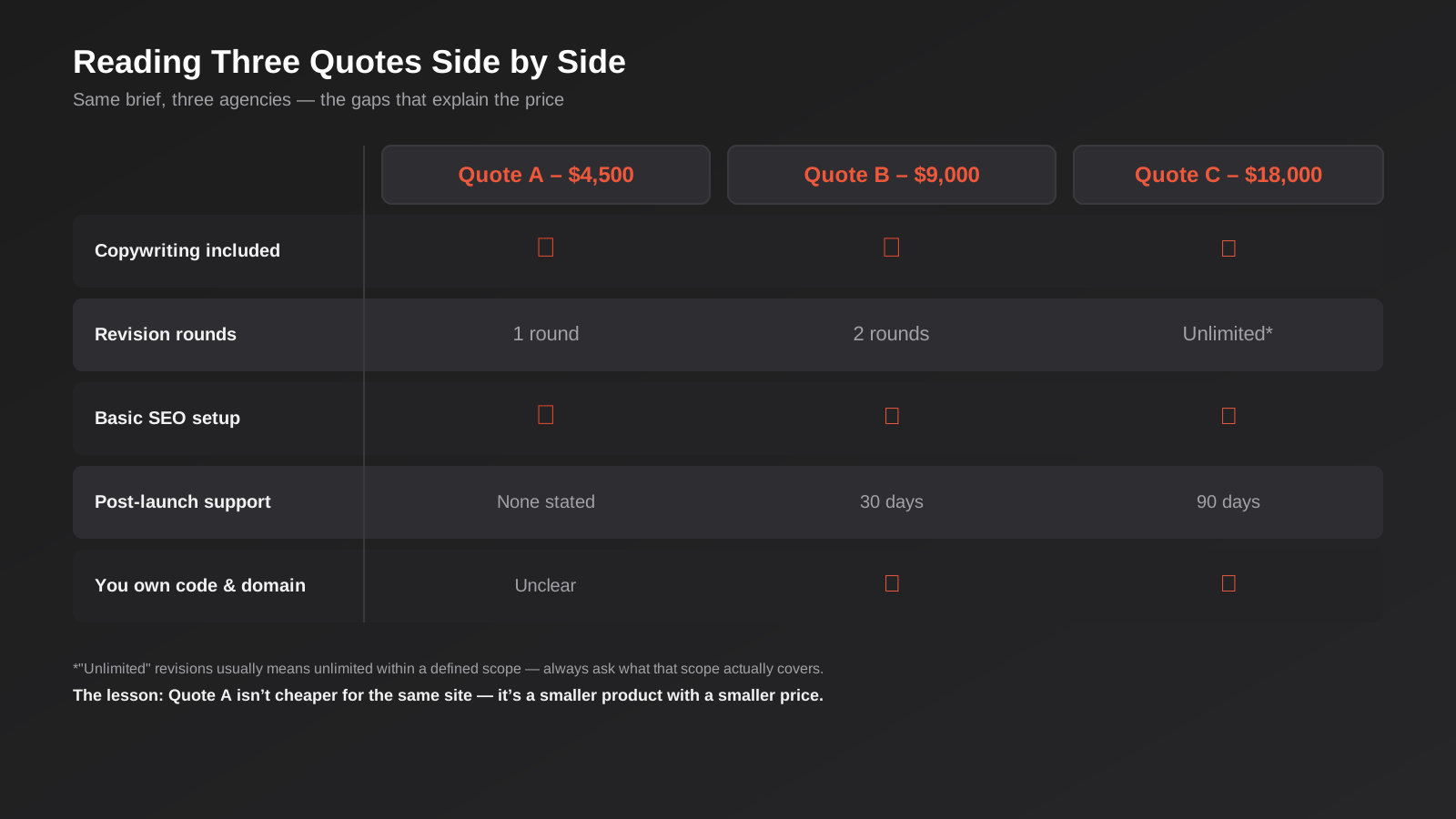
- A defined page and feature list, not just a headline number. “Up to 10 pages” means something different to every agency; ask what counts as a page and what happens if you need an 11th.
- Who owns what afterwards. Do you own the domain, the hosting account, the code and the design files, or does the agency retain control of some of them? This matters most with retainer models.
- The number of design revision rounds included before extra rounds are billed separately.
- What’s explicitly excluded — copywriting, photography, stock image licensing, ongoing SEO, third-party app or plugin subscription costs, migration of existing content.
- The post-launch support window and what counts as a “bug” covered for free versus a “change” that’s billed as new work.
- Hosting and maintenance costs after launch, spelled out as an ongoing monthly or annual figure, not left as “we’ll sort that out later.”
- A realistic timeline with the client-side dependencies named — if the quote assumes you’ll turn around content feedback in 48 hours and you know that’s not realistic, say so now, not in week six.
If a quote is missing several of these, that’s not automatically a red flag — some agencies genuinely scope a shorter document and fill in details in a kickoff call. But it means you can’t yet compare it fairly against a more detailed quote from someone else, and you should ask for the gaps to be filled in before you decide based on the headline number alone.
There’s one specific pattern worth naming on its own: the quote that’s dramatically cheaper than every other one you’ve received for the same brief. Occasionally that’s a genuinely efficient operator with lower overheads. More often it’s one of a few things — a template build being sold at custom-build prices without saying so, a junior freelancer learning on your project, offshore production with no local project management layer, or a scope that quietly excludes half of what you asked for and relies on you not reading closely enough to notice before you sign. None of those are necessarily disqualifying, but you should know which one you’re getting before you compare the number to anyone else’s.
Common Mistakes When Budgeting for a Website
- Comparing headline numbers without comparing scope. A $5,000 quote and a $15,000 quote are not comparable until you know what’s inside each one.
- Treating the build cost as the total cost. Hosting, maintenance, content updates and the inevitable “we need to add a page” six months in are real, ongoing costs that a one-off build price never covers.
- Choosing the cheapest quote without asking what it leaves out. The gap is almost always in copywriting, revision rounds, SEO setup, mobile testing depth, or post-launch support — not in visible design quality, which is why it’s easy to miss until after you’ve signed.
- Not knowing who owns the site. Some cheap builds are cheap because the agency retains control of hosting, the CMS login or the domain, which becomes expensive leverage later if you want to switch providers.
- Letting scope grow without re-quoting. “Can we also add…” requests feel small individually and add up to a materially different project than the one that was quoted.
- Skipping a written brief. Verbal alignment feels efficient early on and causes almost every costly dispute later, because nobody’s memory of “what we agreed” matches once money is involved.
- Assuming a higher price always means a better result. It usually means more scope, not more skill. A well-scoped $8,000 site built by people who know what they’re doing beats a poorly-managed $25,000 project every time.
- Forgetting that content and SEO take time too. A build can be finished and live without the business actually being ready to generate leads from it, because the copy, the calls to action and the basic on-page SEO were never budgeted as real work in their own right.
Most of these come back to the same root cause: treating the quote as the end of the conversation rather than the start of one. The businesses that end up happy with what they paid are almost always the ones that asked more questions before signing, not the ones that happened to find the lowest number.
Frequently Asked Questions
How much does a basic website cost in Australia?
A basic, professionally built small business website with 5–10 pages typically costs $4,000–$15,000 in Australia in 2026, with most businesses landing between $6,000 and $10,000 for a custom-designed site with original content and a simple contact or booking form. DIY builder sites can be done for $500–$1,775, but you’re doing the design and content work yourself.
Why do website quotes vary so much for the same brief?
Because “a website” isn’t a standard product. One agency’s quote might include custom design, copywriting and SEO setup; another’s might cover only the build, assuming you supply everything else. Page count, custom features, integrations and who owns the result afterwards all move the number independently of each other, which is why two quotes for the same stated brief can differ by a factor of five or more without either being dishonest.
Is it worth paying more for a custom-designed website instead of a template?
It depends on whether differentiation matters commercially. A template site, built well, is a legitimate, professional choice for many small businesses and saves real money. Custom design earns its cost when your visual identity is part of how you compete — agencies, professional services and ecommerce brands in crowded categories tend to get more return from it than, say, a single-location trade business relying mainly on local search and reviews.
How much should I budget for website maintenance after launch?
Expect $100–$600 a month in Australia for an ongoing maintenance and support plan covering updates, backups, security monitoring and a defined amount of change work, on top of hosting, which is usually $10–$170 a month depending on whether it’s shared or managed. Our website maintenance plans guide breaks down what should actually be included in that monthly fee.
How much does an ecommerce website cost in Australia?
Ecommerce builds in Australia typically run $10,000–$60,000 or more. A template-based Shopify store with standard apps sits at the lower end, around $2,000–$8,000 for the storefront build alone, while a custom-themed store with wholesale pricing, product configurators or ERP integration can push well past $30,000. Platform fees, apps and payment processing run separately on top of the build cost.
Should I pay a fixed price or an hourly rate for my website?
Fixed pricing suits a well-defined brief — a known page count, known features, a clear deadline — because it transfers the risk of scope overruns to the agency. Hourly or day-rate pricing suits work where the scope genuinely can’t be pinned down upfront, such as an evolving custom build or systems integration work. If an agency insists on hourly billing for what sounds like a simple, well-defined brochure site, ask why; it’s often a sign the scope hasn’t actually been nailed down yet.
How long does it take to build a website in Australia?
A small business brochure site typically takes four to eight weeks from kickoff to launch, most of which is spent on content, design feedback rounds and client-side approvals rather than raw development time. Ecommerce builds and custom web applications run longer, often eight to sixteen weeks or more, depending on how many integrations and custom features are involved. The biggest variable in practice isn’t the agency’s capacity, it’s how quickly the client side can turn around content and feedback — a project with a slow approval cycle will blow out well past a well-run project of the same scope.
Where to Start
If you’ve read this far wondering how much does a website cost in Australia for your specific situation, the honest answer is still “it depends” — but you now know what it depends on. The number that matters isn’t the figure you see in someone’s blog post, including this one — it’s the number that comes back once your actual pages, features, content situation and integrations have been scoped properly. That’s the only way to compare quotes honestly, and it’s the only way to know whether a $6,000 quote is a bargain or a stripped-down version of what you actually need.
If you’d like to see where you’d land with a real scope rather than a market average, our website pricing page walks through how we quote, and our main pricing page covers the rest of what we do if a website is only part of what you’re planning. If you’re rebuilding an existing site rather than starting fresh, it’s also worth reading our guide to redesigning a website without losing rankings or revenue before you start collecting quotes, since a redesign brief needs a different scope document to a from-scratch build.
Whichever way you go, the same principle holds across every tier in this guide: a vague brief gets a vague quote, and a vague quote is the single biggest reason website projects go over budget. Spend the time getting the brief right before you send it to anyone, and the pricing conversation that follows gets a lot shorter.
Worth putting a number on it: our own website packages start from $1,500 one-time — below the $4,000–$15,000 most Australian businesses pay for a small business brochure site. We keep our overheads lean as a specialist agency and pass that saving on. If you’ve already got a written quote from another agency for a comparable brief, send it through and we’ll do our best to beat it.
Keep reading
Related posts
How Much Does a WooCommerce to Shopify Migration Cost in Australia? A 2026 Price Guide
What a WooCommerce to Shopify migration costs in Australia in 2026: real price ranges by store complexity, hidden costs and how to…
How Much Does an AI Chatbot Cost in Australia? A 2026 Pricing Guide
What an AI chatbot costs in Australia in 2026: three pricing tiers, the running costs people miss, and how to compare quotes…
How Much Does Custom Software Development Cost in Australia? Build Cost vs Five Years of Licences (2026)
What custom software development costs in Australia in 2026: ranges by project type, integration costs, running costs, and how the build compares…
Got a project you'd like to talk through?
Tell us what you're working on — we'll come back with a plan.
