
How Much Does SEO Cost in Adelaide? A 2026 Price Guide
 Jignesh Vagadiya
16/11/2026
23 min read
Ask four Adelaide agencies what SEO costs and you’ll hear $600, $1,800, $3,500 and “it depends”. The last one is the most honest, and also the least useful when you’re trying to set a budget on a Tuesday afternoon. The spread is real, though. SEO is a label stuck on everything from fixing a Google Business Profile to running a content and outreach programme across a hundred pages, and the price follows the work, not the label.
This guide puts real Adelaide numbers on it. The ranges come from what Adelaide and wider Australian agencies publish on their own sites in 2026, and we’ve been plain about how far that data can be trusted. You’ll also get the Adelaide-specific bits that change which package makes sense, a clear view of what pushes a quote up or down, and a method for reading three proposals side by side so you can tell a fair price from one that’s been made cheap by leaving things out.
If you’re in another city, we’ve done what SEO costs in Perth as well, and the numbers differ less than you might expect. What differs is the shape of the market. Adelaide is a smaller city with tighter local competition, and that matters for how much you need to spend and where.
How Much Does SEO Cost in Adelaide in 2026?
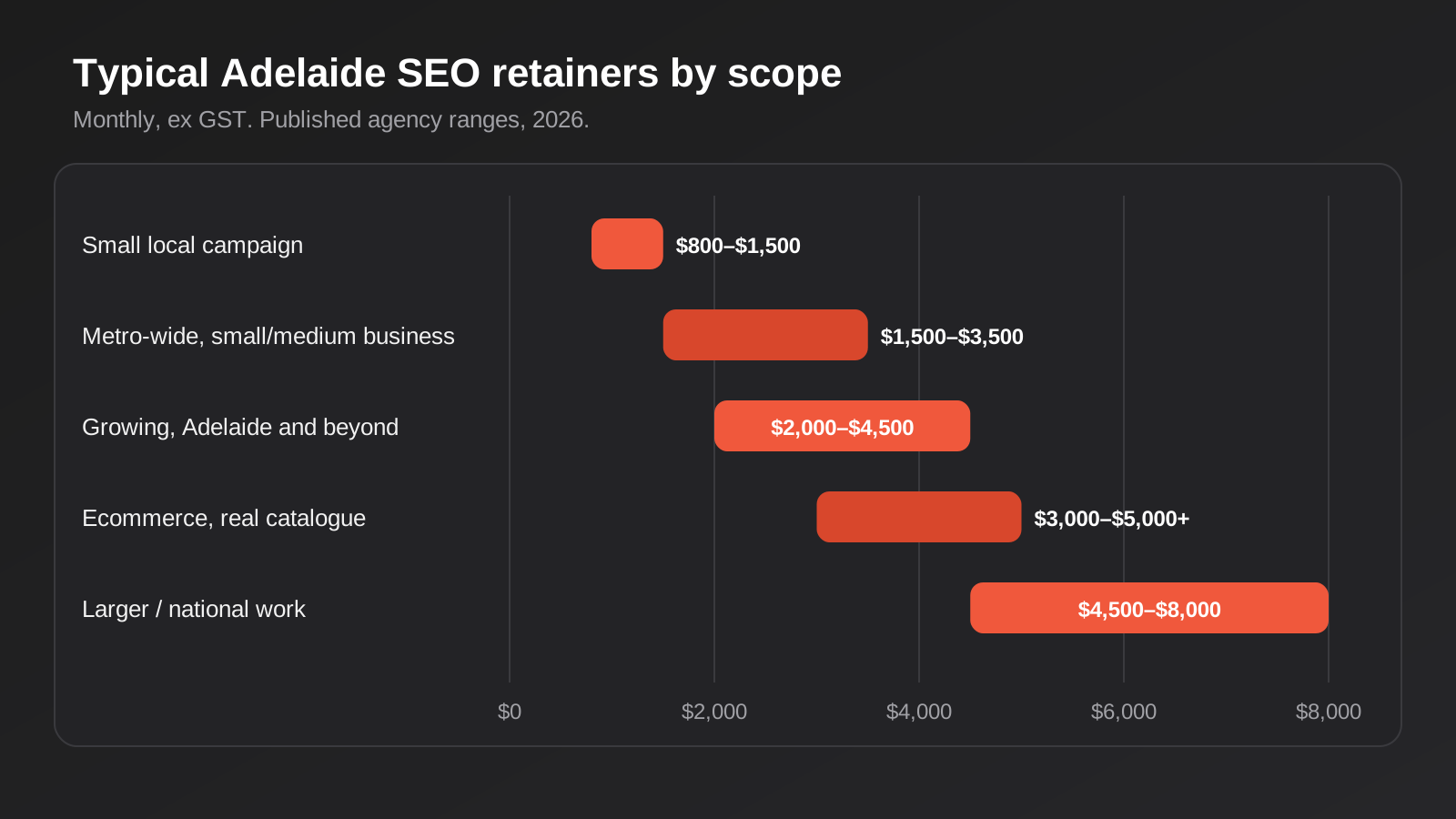
Start with the headline figures. These are monthly retainer ranges, mostly quoted excluding GST, gathered from Adelaide agency pricing pages and Australian cost guides published in 2026.
- Small local campaign, one catchment: roughly $800 to $1,500 a month. The plumber in Salisbury, the physio in Glenelg, the accountant in Norwood. One location, a defined list of services, and a Google Business Profile that does a lot of the heavy lifting.
- Metro-wide campaign for a small or medium business: roughly $1,500 to $3,500 a month. More service pages, more suburbs, more competitors to beat, more links to earn. One Adelaide agency reports an average of about $2,420 plus GST, within a published range of roughly $880 to $3,960 plus GST.
- Growing businesses competing across Adelaide and beyond: roughly $2,000 to $4,500 a month.
- Larger or national work: roughly $4,500 to $8,000 a month, and more for big catalogues.
- Ecommerce: commonly $3,000 to $5,000 or more a month once a store has a real catalogue, because the number of pages to fix and maintain is the main cost.
- Entry packages: some agencies advertise from $500 to $800 a month. They exist, and some are legitimate for a small site in a quiet niche. Many are thin, which we’ll come back to.
One caution before you plan a budget around any of this. Almost every public source for SEO pricing is an agency or a lead-generation site with something to sell, so the numbers describe what the market will bear more than what the work strictly costs. Treat them as a map, not a price list. The gaps inside each band are the interesting part, and most of this guide explains what sits in them.
One-off audits and hourly rates
Not all SEO is a monthly commitment. Published figures for a one-off audit of a typical small business site sit around $2,000 to $4,000, with larger or more complex sites costing a good deal more and some agencies quoting up to the low five figures for a comprehensive technical and content review. Hourly consulting in Australia is commonly quoted between about $75 and $250 an hour, depending on seniority and whether you’re hiring a freelancer or an agency.
An audit is worth buying when you have a developer or an in-house person who can act on it. If nobody is going to implement the findings, you’ve bought a document. Most small Adelaide businesses are better served by a retainer where the person who finds the problems also fixes them.
Ex GST, and why it matters when you compare
Most agencies quote SEO excluding GST. A “$1,200 a month” package is $1,320 on the invoice. If you’re comparing three quotes, check that each one is stated on the same basis before you compare anything else. It’s the most common reason two quotes look further apart than they are, and the most common reason a budget turns out to be 10 per cent short.
What Makes Adelaide a Different Pricing Question
The underlying work isn’t different from Melbourne or Brisbane. Google ranks pages on relevance, quality and trust wherever you are. But a few things about how Adelaide businesses operate change what you should buy.
It’s a smaller, denser market. Adelaide is considerably smaller than Sydney or Melbourne, which means fewer competitors chasing the same local searches in most categories. For a lot of trades, health and professional services, that makes a modest local campaign more winnable than the same budget would be in a bigger city. It also means that when you do have a serious competitor, they tend to be well known and well reviewed, and you’ll know who they are before an agency tells you.
The map results carry a lot of weight. For searches with local intent, Google shows a map block above the standard listings. Winning there depends on your Google Business Profile, your reviews and how consistently your details appear across the web, and it’s a different mix of work from ranking a service page. If your customers are in your suburb and the surrounding ones, a campaign weighted towards the profile can deliver quickly at a lower monthly figure. We’ve written about how to set that up properly in our Google Business Profile guide.
Service areas are spread out. Greater Adelaide runs a long way from north to south, and plenty of businesses serve the Adelaide Hills, the Fleurieu, the Barossa or the Limestone Coast as well. Ranking for “electrician Adelaide” is a very different job from ranking for “electrician Mawson Lakes” and the suburbs around it. The first is a contest against established businesses with bigger sites. The second is often winnable inside a small-campaign budget. A good agency will ask which suburbs produce profitable work before it quotes anything.
A lot of local industries sell well beyond Adelaide. South Australia has strong wine, food, defence, manufacturing and health sectors, and many of those businesses sell interstate or overseas. A winery selling online, an engineering firm supplying other companies or a specialist clinic drawing patients from across the state isn’t playing the local pack game. Their SEO looks more like a national campaign, with deeper content, technical pages for specific products or services, and links from industry sites. Budget for that work separately, because it doesn’t fit inside a suburb-level package.
If you sell online, Adelaide rates don’t set your price. The competitors on the first page for most product searches are interstate. The cost of competing with them is set by their spend and their catalogue size, not by your postcode. That’s why ecommerce SEO is quoted by site complexity and not by city.
None of this makes Adelaide cheaper or dearer in itself. It means the first question is where your customers come from, because that decides which row of the chart above you’re actually in.
What Drives the Price Up or Down
When two Adelaide agencies quote $900 and $2,800 for the same brief, the gap is almost always explained by some combination of the factors below. This is what to ask about.
1. Competition for your searches
This is the biggest single driver and the one you can least control. If the businesses ranking for your terms have been publishing, earning links and refining their sites for years, catching them takes more work for longer. If the first page is full of weak directory listings and outdated sites, a modest programme can move you up within a few months.
A decent agency checks this before quoting. Ask them to show you who currently ranks for your three most valuable searches and why. If a proposal arrives without any competitor analysis, the price is a guess.
2. How many suburbs and services you want to cover
Each service, and each suburb or region you want to rank for, typically needs its own genuinely useful page. Not a copy of another page with a place name swapped. Covering one service in one suburb is a small job. Covering eight services across twenty suburbs is a content and quality-control project. Google has been clear for years that thin, near-duplicate location pages don’t help, so doing it properly scales with the number of pages.
3. The condition of your website
A site that loads slowly, has broken pages, duplicates its own content or can’t be crawled properly needs repair before new content will perform. Some of that is a one-off cost at the start, which is why many agencies charge a setup fee or front-load the first month. A clean, fast, well-structured site costs less to rank than a neglected one. If you’re planning a rebuild, do the SEO planning before it rather than after, because fixing structure later is more expensive.
4. Content volume and who writes it
Content is where much of the real labour sits. A package that includes four properly researched and written pages a month costs far more to deliver than one that includes a monthly report and a few tweaks to existing pages. If a quote doesn’t state how many pieces are included, how long they are and who writes them, you can’t compare it with anything.
5. Link building, and what the word actually covers
Earning links from credible sites is slow and often the most expensive part of a campaign. The cheap version is submitting your business to dozens of directories, which does little beyond basic citation consistency. The real version involves outreach, relationships, original data or content that other sites want to reference. If two quotes differ by $1,000 a month and one mentions link building in a single line, ask exactly what that line means in a typical month.
6. Reporting and account management
Some agencies keep prices low by sending an automated report and little else. Others include a monthly call with someone who understands your business and will tell you what’s working. Neither is wrong, but they’re different products and the hours show up in the price. The most useful reports connect rankings to things you care about, such as phone calls and enquiries, rather than listing keyword positions alone.
7. Whether the agency or a subcontractor does the work
Plenty of low-priced packages are resold. The agency you meet sells the package, and an offshore team or a template does the work. That can be fine if it’s disclosed and the output is good. It’s a problem when it isn’t disclosed, because you’re paying for a relationship and a strategy that isn’t actually coming from the person you spoke to. Ask directly who writes the content and who touches the site.
The Pricing Models, Explained
SEO is sold in four common ways in Adelaide. Knowing which one a quote uses tells you a lot before you read the detail.
Monthly retainer
By far the most common. You pay a fixed amount each month for a defined set of activities, and the work continues until you stop. It suits SEO because results compound over months, and a retainer funds the steady, repeated effort that builds them. The risk is paying for activity rather than progress, so ask what’s delivered each month and what you should expect to see after three, six and twelve months.
Fixed-scope project
A set price for a defined piece of work: an audit, a site restructure, a batch of landing pages. Good when the job has a clear end. Poor as a substitute for ongoing work, because a project doesn’t maintain rankings once it’s delivered.
Hourly or day rate
Charged by time, usually for consulting, audits or specialist technical work. Useful for a second opinion or a short engagement. A weak fit for a full programme, because the incentive is to spend hours rather than finish the job, and you can’t forecast the bill.
Performance-based pricing
Pay only if you rank, or pay per lead. It sounds attractive and it’s rarer than the pitch suggests. Keywords chosen to guarantee a result are often so easy that ranking for them produces no customers, and per-lead models can end in arguments about what counts as a lead. If someone guarantees a first-page ranking or position one, treat it as a warning sign, because nobody outside Google controls rankings.
Contract length
Separate from the pricing model is the term. Adelaide retainers are commonly sold on initial terms of three to six months, and some agencies ask for twelve. A minimum term is understandable given SEO’s slow start, but it gives you little leverage if the work disappoints. Others run month to month. Neither is automatically better, but know which you’re signing and what notice you need to give to leave.
What a Good Quote Should Include
A quote that’s easy to compare is one that tells you what you’re paying for. Before you accept anything, check that it covers each of these.
- A starting audit or review. Technical health, current rankings, a look at your Google Business Profile and a competitor comparison. Without it, the agency is working blind.
- The searches being targeted. Named, not “up to 20 keywords”. You should be able to judge whether they’re searches that bring customers.
- Specific monthly deliverables. Pages optimised or written, hours of technical work, link activity described in plain terms.
- Who does the work. In-house team, a freelancer or an offshore subcontractor. Any can be fine, but you should know.
- How results are measured. Rankings, organic traffic, calls and form enquiries. Ask whether call and form tracking is set up, because without it nobody can tell you what SEO is worth to you.
- Reporting frequency and format. Monthly at minimum, with a human explanation of what changed.
- Contract terms. Length, notice period, and what happens to your content and accounts if you leave. You should own your website, your Google Business Profile and your analytics. Always.
- GST stated clearly. Ex or inc.
Reading three quotes side by side
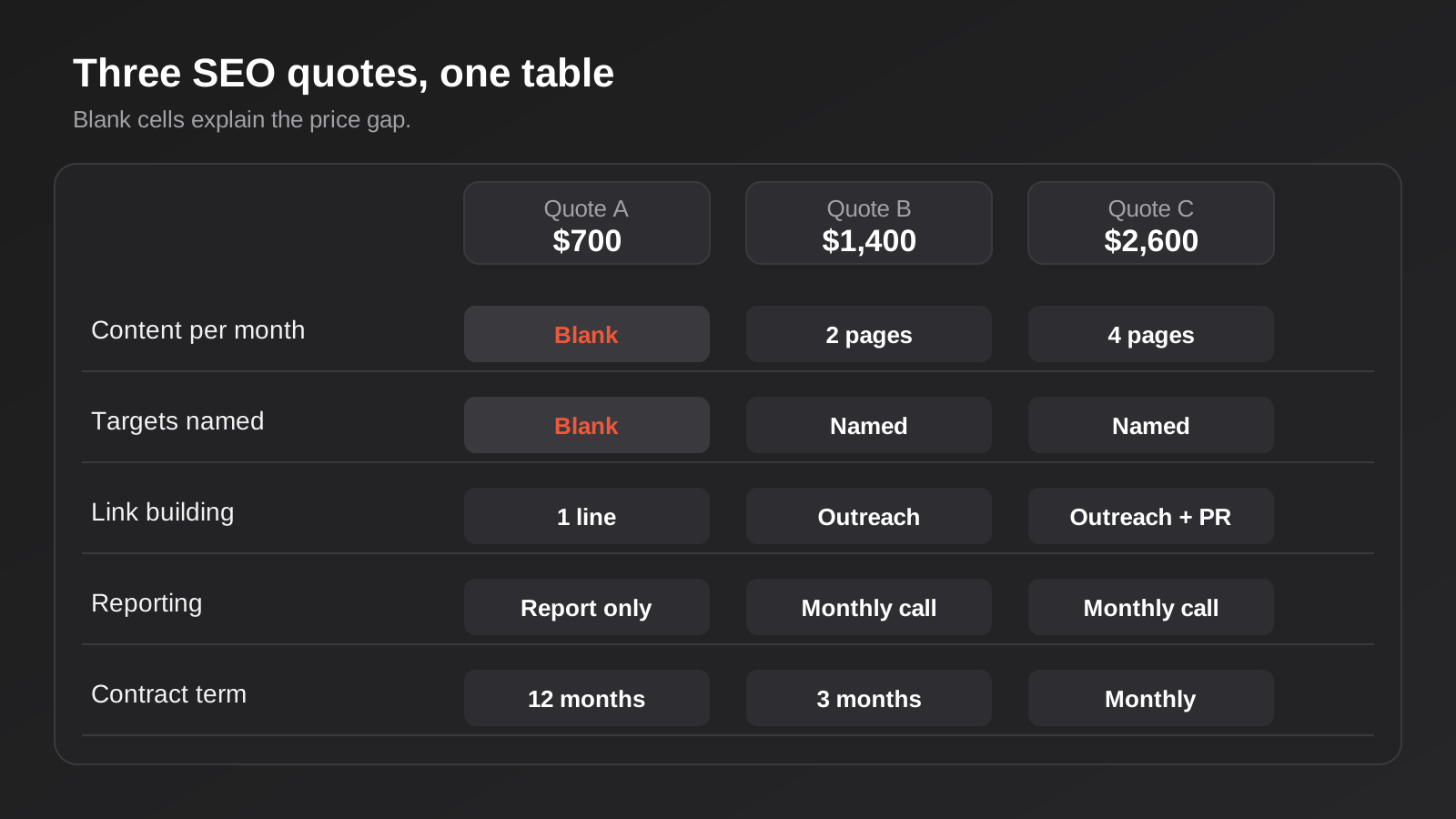
When you have three, put them in a simple table with identical rows: monthly price ex GST, content pieces per month, link-building activity, technical work, reporting, contract length. Blank cells are the most useful finding. If one quote is $700 cheaper and has four blanks, you now know why. If two quotes are within $150 of each other and one has far more detail, favour the detailed one, because vague proposals tend to produce vague delivery.
We’ve written a fuller walkthrough in our guide to how to compare agency quotes, including why the same brief can produce prices that look nothing alike.
Why Cheap SEO Often Costs More in the End
There are good low-cost options, especially for a small site with little competition. But when a quote comes in well under the bands above, it usually means one of a few things.
The scope is thinner than it looks. A $499 package may deliver a basic on-page tidy-up and an automated report. That’s a fair thing to sell if it’s honestly described. It isn’t going to compete for a contested search.
The work is templated. The same suburb page generated forty times with different place names, the same blog post lightly rewritten for every client. Google is increasingly good at ignoring this, and sometimes at demoting it.
The links are the risky kind. Bulk-bought links and private blog networks can produce a short-term bump followed by a penalty or a slow slide. Cleaning that up later is slow and often costs more than the original saving.
The account is under-resourced. One person managing too many clients can’t give your site much attention in a month. You may not find out for six months.
The reverse also applies. The most expensive quote isn’t automatically the best, because large agencies carry overheads, account layers and sales teams, and some of what you pay for is structure rather than results. The right price is the one where you can see what each dollar buys.
How Long Before You See Results
SEO doesn’t return value in the first month, and any agency implying it does is overselling. Technical fixes and Google Business Profile improvements can show movement within weeks, particularly for local searches with little competition. Content and authority take longer, and competitive terms take longer again. Plan for several months before the picture is clear and treat the first quarter as groundwork.
This is why the cheapest option can be the most expensive in practice. Pay $600 a month for a year, rank for nothing that matters, and you’ve spent $7,200 and still need to start properly. Pay more for a programme aimed at the right searches from day one and the arithmetic changes. The useful question isn’t how little you can spend. It’s what a realistic budget looks like for the position you want, and whether you can sustain it long enough to see it work.
It’s also worth remembering that SEO is one channel. If you need leads within weeks, paid search fills the gap while organic builds.
Working Out Whether the Spend Makes Sense
A simple break-even calculation beats any benchmark. Take your average profit on a new customer, not revenue, and divide your monthly SEO cost by it. That’s how many extra customers a month you need for the retainer to pay for itself.
Say a $1,500 monthly retainer and a typical job that leaves you $600 in profit. You need roughly two and a half extra customers a month from organic search to break even. For a trade or clinic with a healthy enquiry rate, that’s plausible within a year. For a business that earns $60 a sale, it’s a much harder case, and a smaller scope or a different channel might fit better. Do the sum before you ask for quotes, and ask any agency how many enquiries they’d expect to need.
Also count the cost you don’t see on the invoice: your time. Good SEO needs input from you, such as photos, reviews, details about services and quick approvals. If you can’t spare a few hours a month, tell the agency up front, because it changes what they can deliver.
What About AI Search?
Over the past year, a growing number of Adelaide agencies have added “AI SEO” or “generative engine optimisation” to their menus, aimed at appearing in answers from ChatGPT, Google’s AI Overviews and similar tools. Published pricing ranges from a few hundred dollars a month as an add-on to a few thousand for a standalone programme.
Our honest read is that the foundation is the same as for traditional SEO: clear, accurate, well-structured content, topical authority and credible mentions elsewhere. Good SEO gets you most of the way there. What’s extra is work on structured data, direct answers to common questions and brand mentions in the places AI systems draw from. That’s real work and worth paying for if your customers research with AI tools, but it extends the foundation rather than replacing it. If you’re weighing it up, our AI SEO pricing page shows how we scope it. Treat anyone promising guaranteed citations in AI answers with the same scepticism you’d give a guaranteed ranking.
Common Mistakes When Buying SEO in Adelaide
- Choosing on price alone. The cheapest quote and the best-value quote are rarely the same one. Compare scope first, then price.
- Targeting too wide too early. Trying to rank across all of Adelaide on day one spreads effort thin. Win the suburbs and services that make you the most money first, then widen.
- Skipping call and enquiry tracking. If nobody can say how many calls and form submissions came from organic search, you can’t judge whether the retainer is working.
- Ignoring the Google Business Profile. For many local Adelaide businesses, the profile brings in more enquiries than the website does. A campaign that doesn’t touch it is missing the main event.
- Accepting a lock-in without an exit. Twelve months is a long time to be tied to work you can’t evaluate. At minimum, know what happens to your accounts and content if you leave.
- Believing guarantees. Anyone promising a specific ranking by a specific date is either gaming easy keywords or being optimistic on your behalf.
- Expecting SEO to fix a weak offer. SEO brings people to your website. If your pages don’t explain what you do, where, and how to get in touch, the traffic won’t convert, whatever you pay.
- Stopping too soon. Cancelling after three months because results are modest ends the investment just before it compounds. If the work is sound and the reporting is honest, give it a fair run and judge on leads, not rankings alone.
- Hiring a cheap agency for a rebuild-sized problem. If the site itself is the issue, a monthly retainer won’t fix it. A rebuild with SEO planned in is a separate project with a separate price.
A Rough Budget Guide by Business Stage
Putting the above together, here’s how we’d think about a starting budget. These aren’t Growth Digital prices, just a way to translate the market ranges into a decision.
A new or very small local business with one location. Start with the Google Business Profile, a clean website with a page for each core service, and basic tracking. A campaign in the lower part of the small-campaign band is reasonable, provided the quote is specific about what’s included. Don’t pay for a large programme before the website has the basics.
An established local business that wants more enquiries. This sits between the small-campaign and metro bands. You need a proper audit, service and location pages that read well, reviews, and steady content. Expect the middle of the published ranges and review progress at six months.
A business competing across Adelaide or South Australia. The metro band and above. Competition matters more here, so insist on competitor analysis in the proposal and on named priority searches.
An ecommerce store or a business in a crowded sector. Treat this as a larger investment. Catalogue size, category structure and technical complexity drive the price, and the upper bands are realistic. Budget for technical work and ongoing content, and expect a longer timeline.
A business selling to other businesses. Price it as a content and authority project rather than a local campaign. Depth of content and quality of links matter more than the number of suburb pages.
Frequently Asked Questions
How much does SEO cost in Adelaide per month?
Published 2026 figures put a small local campaign at about $800 to $1,500 a month, a metro-wide campaign for a small or medium business at about $1,500 to $3,500, and larger or national work at $4,500 to $8,000, mostly quoted ex GST. Entry packages from around $500 to $800 exist but usually carry a thin scope. Your figure depends on competition, the area you cover and how much content and link work is included.
Is SEO cheaper in Adelaide than in Sydney or Melbourne?
Slightly, in some categories, mainly because fewer competitors are chasing the same local searches. The work itself costs about the same wherever it’s done. If you sell online or to customers outside South Australia, you’re competing with interstate businesses and the city of your agency makes little difference to the price.
Is SEO worth it for a small Adelaide business?
It can be, if people search for what you sell and you can turn a visit into an enquiry. It suits businesses with a reasonable profit per customer and enough runway to wait several months. Do the break-even sum first: monthly cost divided by profit per customer tells you how many extra customers you need. If you need leads in weeks, run paid search alongside it.
Do I have to sign a long contract?
No. Some Adelaide agencies ask for three to twelve months, while others work month to month. Longer terms are justified by SEO’s slow start, but they reduce your leverage if the work disappoints. Whatever you choose, make sure you own your website, analytics and Google Business Profile, and know the notice period for leaving.
How long does SEO take to work?
Google Business Profile work and technical fixes can show movement within weeks in low-competition niches. Content-driven gains and competitive searches take several months, often longer. Plan for at least a quarter of groundwork before judging results, and measure against leads rather than ranking positions alone.
Why do Adelaide agencies quote such different prices for the same job?
Mostly scope. One quote may include several new pages a month, real outreach for links and a monthly call, while another includes an automated report and some on-page changes. Who does the work, and how much competitor analysis and account management is included, also matter. Put the quotes in the same table and the gaps usually explain themselves.
Should I pay extra for AI search optimisation?
Only after the foundations are sound. AI visibility builds on the same things as traditional SEO: clear content, credible mentions and good structure. If your site already has those, an add-on may help you appear in AI answers. If it doesn’t, you’ll get more from fixing the basics first. Be wary of anyone guaranteeing citations.
Where to Start
A practical way to begin is a short, honest brief you can send to every agency you talk to. Write down your business type, the suburbs you serve, the services that make you the most money, your current website address and your rough monthly budget. Ask each agency to respond with the same things: what they would fix first, which searches they would target, what they’ll deliver each month and how they’ll report on calls and enquiries. Identical briefs produce comparable answers, and the agencies that engage with your specifics tend to be the ones worth talking to.
Then run a small test of your own before you sign. Search for your three most valuable services the way a customer would, from a phone, and note who appears in the map block and on the first page. Ten minutes of that tells you more about the competition, and about whether a quote is realistic, than most proposals will.
If you’d like to see how we structure and price this, our SEO pricing page lays out what’s included at each level, so you can use it as a reference point when you assess other proposals.
Worth putting a number on it: our own SEO packages start from $550 a month (ex GST), below the $800–$1,500 a month that published Adelaide pricing suggests for a small local campaign. Packages scale with the number of keywords and pages covered, so a broader or more competitive scope costs more than that starting figure. If you’ve already got a written quote from another agency for comparable scope, send it through and we’ll do our best to beat it.
Keep reading
Related posts
How Much Does SEO Cost for a Small Business in Australia? A 2026 Guide
What SEO costs a small business in Australia in 2026: real monthly ranges by budget, what each level buys, and how to…
How to Compare Agency Quotes in Australia: Why Prices Differ So Much (2026)
Why three agency quotes for the same job differ so much in Australia, what a good quote includes, and a step-by-step way…
How Much Does AI SEO Cost in Australia? A 2026 Price Guide
What AI SEO (GEO/AEO) costs in Australia in 2026: real monthly ranges by tier, what drives quotes up or down, and how…
Got a project you'd like to talk through?
Tell us what you're working on — we'll come back with a plan.
