
How Much Does AI SEO Cost in Australia? A 2026 Price Guide
 Jignesh Vagadiya
09/11/2026
22 min read
Ask five Australian agencies what AI SEO costs and you will get five numbers that do not overlap. One says $900 a month. Another says $4,500. A third wants $8,000 and a six-month minimum. All three call it the same thing, and none of them is necessarily lying. The label “AI SEO” (or GEO, or AEO, depending on who is selling it) covers everything from a relabelled standard SEO package to a full programme of content, digital PR and weekly citation tracking.
This guide is our attempt to put some structure around those numbers. We are an agency that sells this service, so we have an obvious interest, and we will say where that bears on what follows. The market ranges below come from published pricing guides by Australian agencies and vendors that we read this month. They are benchmarks rather than a standard: no industry body publishes an official rate card for AI search work, and most of the sources are agencies describing their own pricing. Where we could not find a defensible figure, we give you the cost drivers and the questions to ask instead.
By the end you should be able to read a quote, work out which tier of work it actually describes, and spot the ones that are standard SEO with a new coat of paint. If you want a figure for our own packages, the live numbers sit on our AI SEO pricing page, which is the one place we keep them current.
What AI SEO Actually Costs in Australia in 2026
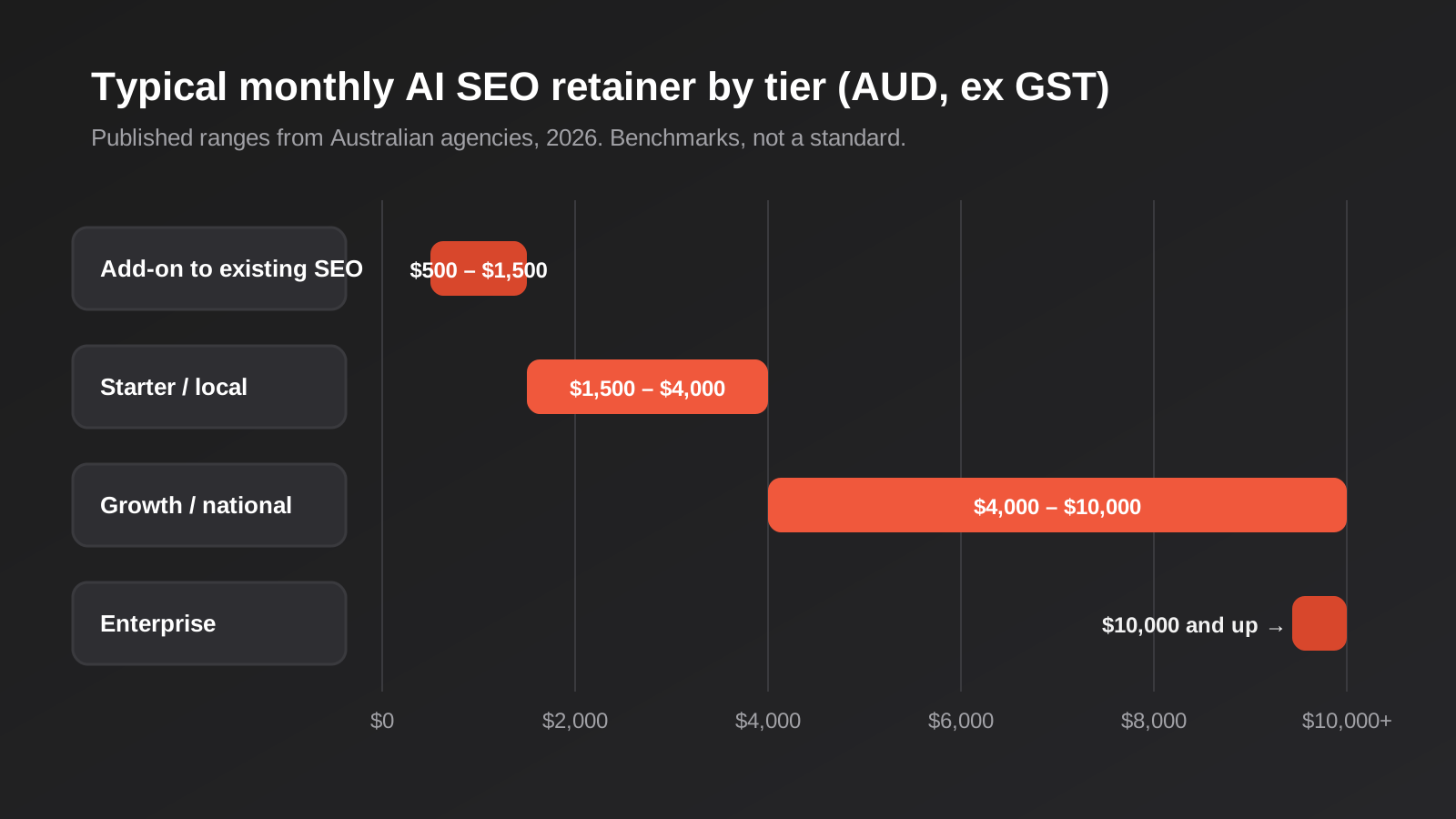
The short version: most Australian agencies we found publishing figures put a proper AI search (GEO/AEO) retainer somewhere between $1,500 and $10,000 a month, ex GST. The spread is wide because the scope is wide. A few providers advertise plans well under that, and a small number of full-stack programmes run far higher.
The four tiers you will see in quotes
- Add-on to an existing SEO retainer: roughly $500–$1,500 a month. If you already pay for SEO, several agencies price AI visibility work as an extra layer on top: structured data, answer-first content edits, and some tracking. This is usually the cheapest sensible way in.
- Starter or local: roughly $1,500–$4,000 a month. The range for a standalone programme aimed at one location or a narrow set of services. Expect a baseline audit, a defined set of pages optimised each month, some new content, and basic tracking of whether you are cited.
- Growth or national: roughly $4,000–$10,000 a month. More content, more pages, off-site work to build the mentions AI systems lean on, and weekly or monthly tracking across several AI platforms.
- Enterprise: $10,000 a month and up. Multiple markets or brands, large catalogues, heavy digital PR, and reporting wired into your internal dashboards. Some published programmes sit well above this.
You will also see one-off audits. Published guides put an SME-level AI visibility audit at roughly $1,500–$3,500, which is a reasonable way to find out whether you have a problem before signing a retainer.
The cheap end, and why it deserves suspicion
Some Australian providers list AI SEO from around $400–$900 a month. Several of the guides we read warn that plans at that level are often standard SEO relabelled, and that is a fair warning. Skilled SEO and content time in Australia is commonly priced somewhere around $140–$200 an hour in agency guides, so a few hundred dollars a month buys very few hours. That does not mean a low price is always bad. It means you should ask exactly what the hours are spent on, which we cover in the quote-checking section.
What this does not tell you
These ranges are about agency retainers. They exclude your own costs: content approval time, developer time if your site needs technical fixes, and any tool subscriptions you decide to run yourself. They also say nothing about results. Nobody can sell you a guaranteed citation in ChatGPT, Gemini or Google AI Overviews, because those answers are decided by the platforms. A price tells you what work is being bought, not what outcome you will get.
What Is Actually Inside an AI SEO Retainer
Before comparing prices it helps to know what the work is. Strip away the branding and AI search optimisation is mostly the following, in roughly this order of importance.
- A technical baseline. Crawlability, clean rendering, sensible headings, fast pages and structured data that matches what is on the page. If AI crawlers or search crawlers cannot read your content properly, nothing downstream works.
- Content that answers questions directly. Pages that state the answer early, back it with specifics, and cover the follow-up questions a buyer would ask. This is where most of the monthly hours go.
- Entity and brand consistency. Making sure your business name, services, locations and claims are described the same way on your site, your Google Business Profile, directories and anywhere else you are mentioned.
- Off-site mentions. AI systems tend to lean on sources they consider credible. Earning mentions on industry sites, publications and respected directories is slow, human work, and it is often the most expensive line in a serious programme.
- Measurement. Tracking whether and where you are cited, which pages get AI-referred visits, and how that compares to ordinary organic traffic.
If you want to see what measurement looks like in practice, we wrote a separate guide to tracking AI search visibility in GA4. It is worth reading before you agree to any reporting clause, because it shows what can and cannot be measured with free tools.
One thing worth being blunt about: most of this is good SEO with different emphasis. The overlap is large enough that an agency doing strong traditional SEO is already doing perhaps two-thirds of what AI search work needs. The genuinely new parts are the tracking, the answer-first content structure, and the deliberate pursuit of third-party mentions. That is why add-on pricing exists, and why a retainer priced as though everything is new work deserves a closer look.
What Drives the Price Up or Down
Two agencies can quote the same business $2,000 and $6,000 a month and both be reasonable, because the quotes describe different amounts of work. These are the levers that actually move a price.
Scope: pages, keywords and prompts
The biggest driver is how many things the agency is committing to touch each month. Pages optimised, articles written, topics researched and prompts tracked all translate directly into hours. A quote that lists these numbers is easy to compare. A quote that says “comprehensive AI optimisation” is not, and you should ask for the numbers.
Content production
Whether the agency writes the content or just briefs it changes the price a lot. Writing a properly researched 1,500-word page with real expertise in it takes several hours, and that is before editing, formatting and publishing. If your quote is low and includes eight articles a month, something has been squeezed. Usually it is the research, and the result reads like every other page on the topic, which is exactly what AI systems have no reason to cite.
Off-site and digital PR work
Earning mentions on other credible sites is the most variable cost. A programme that includes outreach, guest contributions or genuine PR will cost considerably more than one that stays on your own domain. It is also the part you cannot easily fake, so if a cheap quote claims to deliver “authority building” every month, ask what a typical placement looks like and who writes it.
Your site’s starting condition
A clean, fast site with tidy structure needs less work than a site with duplicated pages, broken rendering or years of inconsistent markup. Technical clean-up is usually front-loaded: a heavier first one to three months, then a lighter maintenance rhythm. Some agencies charge a separate setup fee for this. Others fold it into a higher early retainer. Neither is wrong, but you should know which you are getting.
Competition and market size
A plumber competing in one suburb faces a different problem from a software company competing nationally. National or international markets need more content, more mentions and more tracking, and the price follows. Highly competitive categories such as finance, legal and health also need more careful, accurate content because the standard for being cited is higher.
Reporting depth and account management
A monthly PDF with three charts is cheap to produce. A live dashboard, weekly citation checks and a monthly call with a senior strategist is not. Reporting is a legitimate cost, but make sure you are paying for reporting you will actually read. The agencies that charge the most are often selling this layer more than the underlying work.
Agency size and overheads
Large agencies carry account managers, project managers and offices. Boutique and specialist agencies usually have fewer layers. That can mean lower prices for equivalent work, or it can mean less capacity when something goes wrong. Ask who will actually do the work, and whether they are the same person you are speaking to now.
Pricing Models Explained
Most AI SEO work is sold as a monthly retainer, and for good reason: visibility in AI answers depends on steady content, mentions and measurement rather than a single project. But retainers are not the only option, and each model suits a different situation.
Monthly retainer
A fixed monthly fee for a defined set of deliverables. This is the standard model and the best fit for ongoing work. The risks are vague scopes and long minimum terms. A good retainer lists what is delivered each month, and lets you leave with reasonable notice. Month-to-month terms are increasingly common, and agencies that rely on six- or twelve-month lock-ins are often compensating for something.
Fixed-price project
A set fee for a defined piece of work: an audit, a content restructure, or a site-wide schema implementation. This works well when the task has a clear end. It suits businesses that want to test the water or have in-house staff to carry on after the handover. The audit range quoted earlier is the usual entry point.
Hourly or time-and-materials
Agency guides put hourly rates for senior SEO and content strategists commonly at $140–$200. Hourly billing makes sense for advisory work and for one-off fixes where scope is genuinely unknown. It is a poor fit for ongoing optimisation unless you set a monthly cap, because open-ended hours make budgets unpredictable. Our guide to fixed price versus time and materials covers the trade-offs in the software context, and the same logic applies here.
Performance-based pricing
A small number of agencies tie fees to AI citation metrics or leads. It sounds attractive, but AI citations are hard to measure reliably, platforms change their behaviour without notice, and a metric the agency controls the definition of is easy to flatter. If you are offered this model, ask exactly how a citation is counted, from which prompts, tracked by what tool, and what happens when the platform changes its output format.
Add-on to existing SEO
If you already have an SEO provider, ask them first. Many will fold AI visibility work into the existing retainer for an extra few hundred to a couple of thousand dollars a month. The advantage is that one team owns the whole picture. The disadvantage is that not every SEO provider is actually good at it yet, so ask for examples of what they have changed for other clients and what happened.
What to Expect to Pay at Each Business Stage
Budget advice that ignores the size of the business is not much use. Here is how we would think about it, using the market ranges above as the yardstick rather than a rule.
A sole trader or very small local business
If you serve one suburb or city and have a modest site, the realistic options are a one-off audit in the $1,500–$3,500 range, an add-on to whatever SEO you already have, or doing the tracking yourself with a cheap tool while a freelancer or agency fixes the content. A full standalone retainer at the top of the starter range is rarely justified yet. The bigger gains at this stage usually come from a well-kept Google Business Profile, clear service pages and a handful of genuine reviews.
A growing small or medium business
This is where a starter retainer in the $1,500–$4,000 range starts to make sense: you have several services, some real competition, and enough content to optimise. The test is whether you can name at least ten pages or topics that would meaningfully change your enquiries if they performed better. If you can, a fixed monthly scope tied to those pages is a sensible spend. If you cannot, start with strategy before production.
An established business competing nationally
Here the growth tier of $4,000–$10,000 is the realistic territory, because the work includes substantial content, off-site mentions and proper measurement. Businesses at this level should insist on a visible prompt list, a documented reporting method and a clear contract exit. They should also expect the agency to work with their internal team, since the best source material for credible content usually sits with their own subject experts.
Multi-brand, multi-market or enterprise
Above $10,000 a month the scope is large enough that every quote is custom. The useful question is not the price but the operating model: who owns strategy, who produces, how work is approved, and how the programme is measured against revenue rather than citations. At this scale, ask to speak to the people who will actually run the account.
What the First Six Months Usually Look Like
Understanding the timeline helps you judge whether a price is fair, because the work is not evenly spread. Most programmes we would consider credible follow roughly this shape, though the details vary by site.
- Month one: audit and baseline. Technical review, a list of the questions your customers really ask, and a record of where you appear today. This is front-loaded work and is sometimes billed separately.
- Months two and three: foundations. Fixing crawl and rendering issues, adding structured data that matches the page content, and rewriting your highest-value pages so they answer questions directly.
- Months three to six: content and mentions. New pages and articles that fill gaps found in the audit, and the first outreach for third-party mentions. Early signs of change often show up as improved rankings and occasional citations rather than anything dramatic.
- Ongoing: refresh and measure. Updating pages as facts change, repeating the baseline checks and adjusting the plan based on what is being cited.
Be sceptical of anyone promising visible results in the first few weeks. AI answers draw on content that has been crawled, indexed and judged credible over time, and new mentions take a while to be picked up. A fair agency will tell you what it expects to see at three and six months, and what it would do if that does not happen.
It also helps to remember the cost of waiting. AI-referred traffic is still a small share of most sites’ visits, and Google remains the main source for the majority of Australian businesses. For many, the practical case for AI search work is that it makes your existing SEO stronger and positions you for a shift that is gradual rather than sudden. That is a perfectly good reason to invest modestly now. It is not a reason to pay enterprise rates for a speculative upside.
Why Quotes for the Same Brief Differ So Much
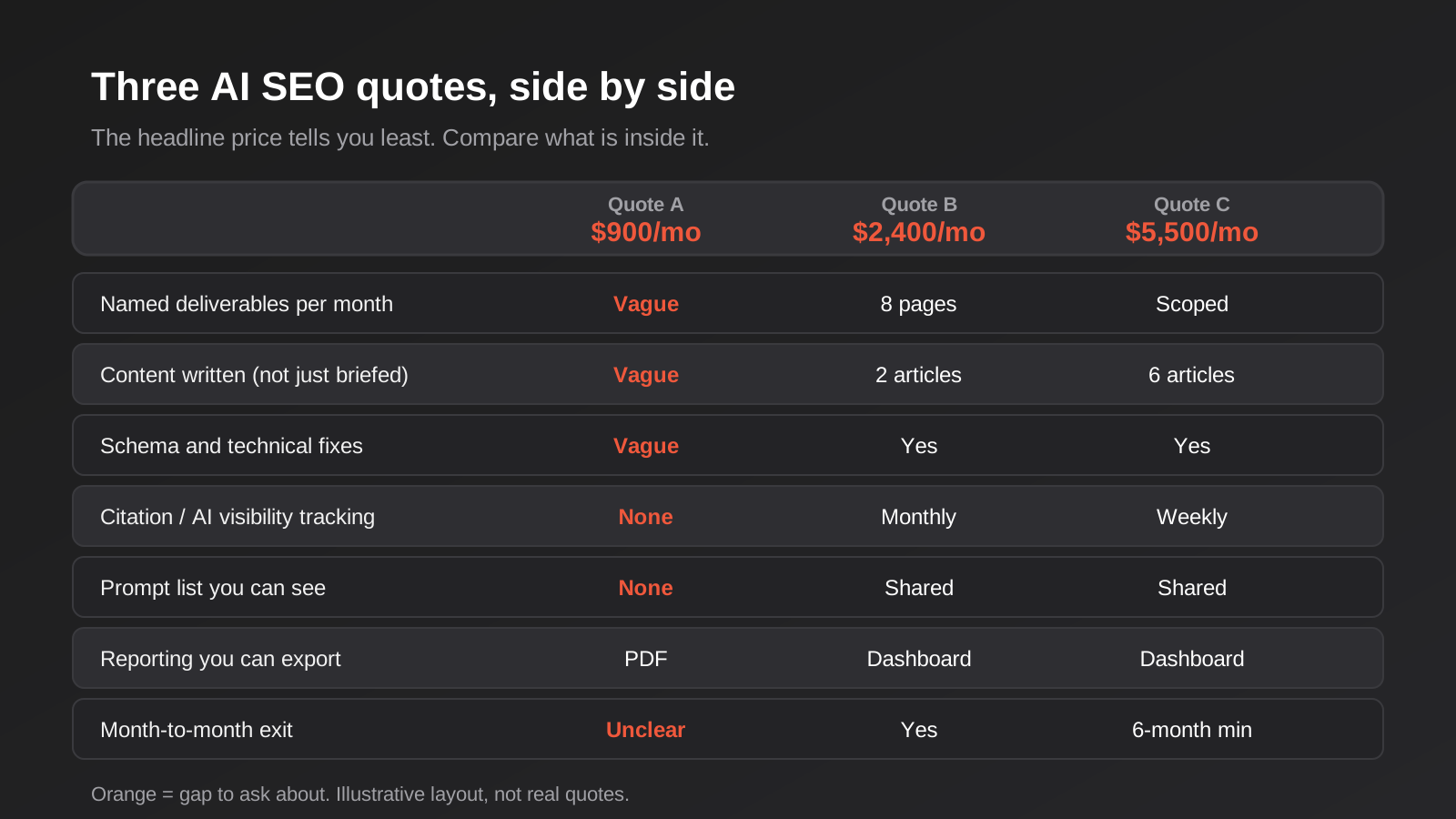
If three agencies quote $900, $2,400 and $5,500 for the same brief, it is rarely because two of them are overcharging. It is usually one of these.
- They are quoting different amounts of work. One includes writing, another includes briefing only, and the third includes digital PR.
- They are using different people. A senior strategist and a junior with a template do not cost the same, and the output differs.
- They are pricing risk differently. A longer minimum term lets an agency charge less per month, because it carries less churn risk, and shorter terms often cost slightly more.
- They are pricing for different outcomes. One is building a long-term asset, another is ticking boxes for a monthly report.
- They are absorbing different overheads. Office, account management and tooling are all built into the monthly fee somewhere.
None of that tells you which is best. It tells you what to ask. A quote that cannot explain why it is cheaper or more expensive than the others is a quote you should push on.
What the Tools Cost, If You Track It Yourself
Part of what you pay an agency for is tracking. You can also run basic tracking yourself, and the tool market is cheap enough that it is worth knowing the numbers. These are reported entry prices from vendor and comparison pages in 2026. They change often and the sources disagree in places, so confirm on each vendor’s own pricing page before budgeting.
- Otterly.AI: commonly reported from about US$29 a month, making it the usual cheapest entry point.
- Peec AI: reported from roughly €85 to €95 a month at the starter level, depending on billing.
- Semrush AI Visibility Toolkit: reported at about US$99 a month as an add-on to a Semrush plan, with the unit (per domain or per user) varying between sources.
- Enterprise platforms such as Profound: generally sales-led, with reported starting points that differ widely between sources. Ask for a quote.
A free option also exists. GA4 can show referral traffic from AI assistants, and Search Console shows how you appear in Google. Neither shows how often you are mentioned inside an answer that does not produce a click. That is the gap paid tools fill. For a small business, a cheap monitoring tool plus a monthly manual check of ten to twenty real customer questions is a perfectly sensible start.
What a Good AI SEO Quote Should Include
A quote is a document, not a number. Before you compare prices, check that each quote answers the following. If it does not, ask. An agency that cannot answer these questions clearly is telling you something.
- Named deliverables, with numbers. How many pages optimised, articles written, topics researched and prompts tracked each month.
- Who writes the content. A named writer with subject knowledge, an AI draft with a human edit, or a fully automated pipeline? All three exist, and they are not the same product.
- The prompt or query list. You should be able to see exactly which questions are being tracked and approve them. They should reflect what your customers actually ask, not what is easy to win.
- How citations are measured. Which platforms, how often, with which tool, and how results are recorded. Be wary of reporting that cannot be reproduced.
- The technical scope. Whether schema, rendering fixes and crawl issues are included, or billed separately when found.
- Setup fees and one-off costs. Whether the first month is heavier, and whether any tools or subscriptions are billed on top.
- Contract term and exit. Minimum term, notice period, and what you own at the end: content, reports, accounts and access.
- What they will not promise. A credible agency will tell you plainly that it cannot guarantee placement in a specific AI answer. If a quote guarantees it, treat that as a red flag.
How to compare three quotes side by side
Put the quotes into a simple table like the one above, with a row for each deliverable and a column per agency. Leave blank any cell the quote does not answer. The blanks are the story. A cheaper quote with five blanks is not cheaper, it is unfinished. A more expensive quote with every row filled in and a clear exit is often better value than it looks.
Then divide. Take the monthly fee and divide it by the number of real, named deliverables. This is crude, but it forces a comparison of cost per unit of work instead of cost per month. It will often show that the middle quote is the cheapest per page or article, and the lowest quote is the most expensive per hour of real work.
If you are also comparing against traditional search work, the SEO pricing page shows what a fixed monthly package looks like when the scope is written down.
Common Mistakes When Buying AI SEO
- Paying for a new label. Accepting a standard SEO package with “AI” in the name, with no changes to deliverables. Ask what is different from the same agency’s regular SEO plan.
- Buying on price alone. The lowest quote is often the one with the fewest named deliverables. Compare scope first and price second.
- Expecting guaranteed citations. Platforms decide what appears in answers. No agency controls that, and a promise of guaranteed placement is a sales line, not a service level.
- Ignoring the site’s condition. Spending on content while the site has rendering or crawl problems. Fix the foundation first, or make sure the quote does.
- Skipping the prompt list. Letting the agency choose what to track without your input. A tracking list full of easy, branded queries produces flattering reports and little else.
- Signing a long minimum term up front. Especially with a provider you have not worked with. Start month-to-month if you can, or begin with a one-off audit.
- Treating AI search as separate from the rest of marketing. The pages that get cited are usually the ones that already rank, convert and earn links. AI work should build on that, not sit beside it.
- Measuring only clicks. AI answers often influence a decision without sending a visit. Track branded search growth and direct enquiries as well as referral traffic.
Frequently Asked Questions
How much does AI SEO cost per month in Australia?
Published Australian agency guides put most standalone AI search (GEO/AEO) retainers between about $1,500 and $10,000 a month ex GST, with starter programmes around $1,500–$4,000 and growth programmes around $4,000–$10,000. Adding AI work to an existing SEO retainer is typically quoted at roughly $500–$1,500 extra. These are benchmarks drawn from agencies’ own pricing pages, not an official rate card.
Is AI SEO different from normal SEO?
They overlap heavily. Good traditional SEO covers technical health, content quality and authority, and all three matter for AI answers too. The extra work is mostly answer-first content structure, entity consistency, deliberate third-party mentions and tracking of AI citations. That is why some agencies price it as an add-on rather than a separate service.
Is a $500 or $900 a month AI SEO package worth it?
It can be, for a small site with modest needs, but only if the scope is spelled out. At that price the hours are limited, so ask exactly what is delivered each month and whether it differs from the agency’s standard SEO. Several Australian guides warn that very low-priced plans are often standard SEO relabelled.
Can anyone guarantee my business will appear in ChatGPT or Google AI Overviews?
No. The platforms decide what appears in their answers, and their behaviour changes without notice. What an agency can do is improve the conditions: clear content, consistent information about your business, credible mentions elsewhere and honest tracking. Treat any guarantee of placement as a warning sign.
Should I use my existing SEO agency or hire a specialist?
Ask your current provider first. If they can show specific changes they have made for other clients and what happened, adding AI work to the existing retainer is usually cheaper and simpler. If they cannot, a specialist or a one-off audit gives you an outside view without committing to a long contract.
Can I track AI visibility myself instead of paying for it?
Partly. GA4 shows referral traffic from AI assistants, Search Console shows Google performance, and entry-level AI monitoring tools reportedly start from around US$29 a month. A monthly manual check of real customer questions fills most of the remaining gap. What you cannot easily replicate is the content and mention-building work, which is where most retainer cost sits.
Where to Start
If you are shopping for AI search help, start with the quote rather than the price. Write down what you need, collect two or three quotes, and put them in a table with a row per deliverable. Eliminate anything that will not tell you who writes the content, what is tracked and how you can leave. Then compare what is left. If the foundations are not in place yet, a one-off audit is a lower-risk first step than a retainer.
You can see how we scope and price this work on our AI SEO pricing page, and the full service description is on the AI SEO page. If your needs sit outside the packages, a short conversation about your site and market is the fastest way to get a straight answer.
Worth putting a number on it: our own AI SEO packages start from $800 a month, which is below the $1,500–$4,000 many Australian agencies publish for a starter AI search programme. The scope scales with the tier, so compare the inclusions line by line rather than the headline fee. If you’ve already got a written quote from another agency for comparable scope, send it through and we’ll do our best to beat it.
Keep reading
Related posts
How Much Does a Website Redesign Cost in Australia? A 2026 Price Guide
What a website redesign costs in Australia in 2026: real price ranges by scope, what drives quotes up or down, and how…
How Much Does SEO Cost in Adelaide? A 2026 Price Guide
What SEO costs in Adelaide in 2026: real monthly ranges by scope, what drives quotes up or down, and how to compare…
How Much Does SEO Cost for a Small Business in Australia? A 2026 Guide
What SEO costs a small business in Australia in 2026: real monthly ranges by budget, what each level buys, and how to…
Got a project you'd like to talk through?
Tell us what you're working on — we'll come back with a plan.
