
Ask five Perth agencies what SEO costs and you’ll get five numbers that don’t look like they describe the same service. One quotes $500 a month. Another says $4,000. A third won’t give a figure until you’ve sat through a discovery call. It’s not that anyone is lying (usually). It’s that “SEO” covers everything from tidying up a Google Business Profile to running a content and outreach programme across a hundred pages, and the price follows the work.
So, how much does SEO cost in Perth in 2026? This guide puts real Perth numbers on it. The ranges below come from what Perth and Australian agencies publish on their own pricing pages in 2026, and we’ve been upfront about the limits of that data further down. What you’ll get is a realistic budget for a Perth business, a clear view of what pushes the price up or down, and a checklist for reading a quote so you can tell a fair one from one that’s been priced by leaving things out.
If you’re after the Melbourne version, we’ve covered it in how much SEO costs in Melbourne, and the national picture is in our SEO pricing guide for Australia. This one is written for businesses searching in and around Perth, where the service-area question changes the maths more than it does in most cities.
How Much Does SEO Cost in Perth in 2026?
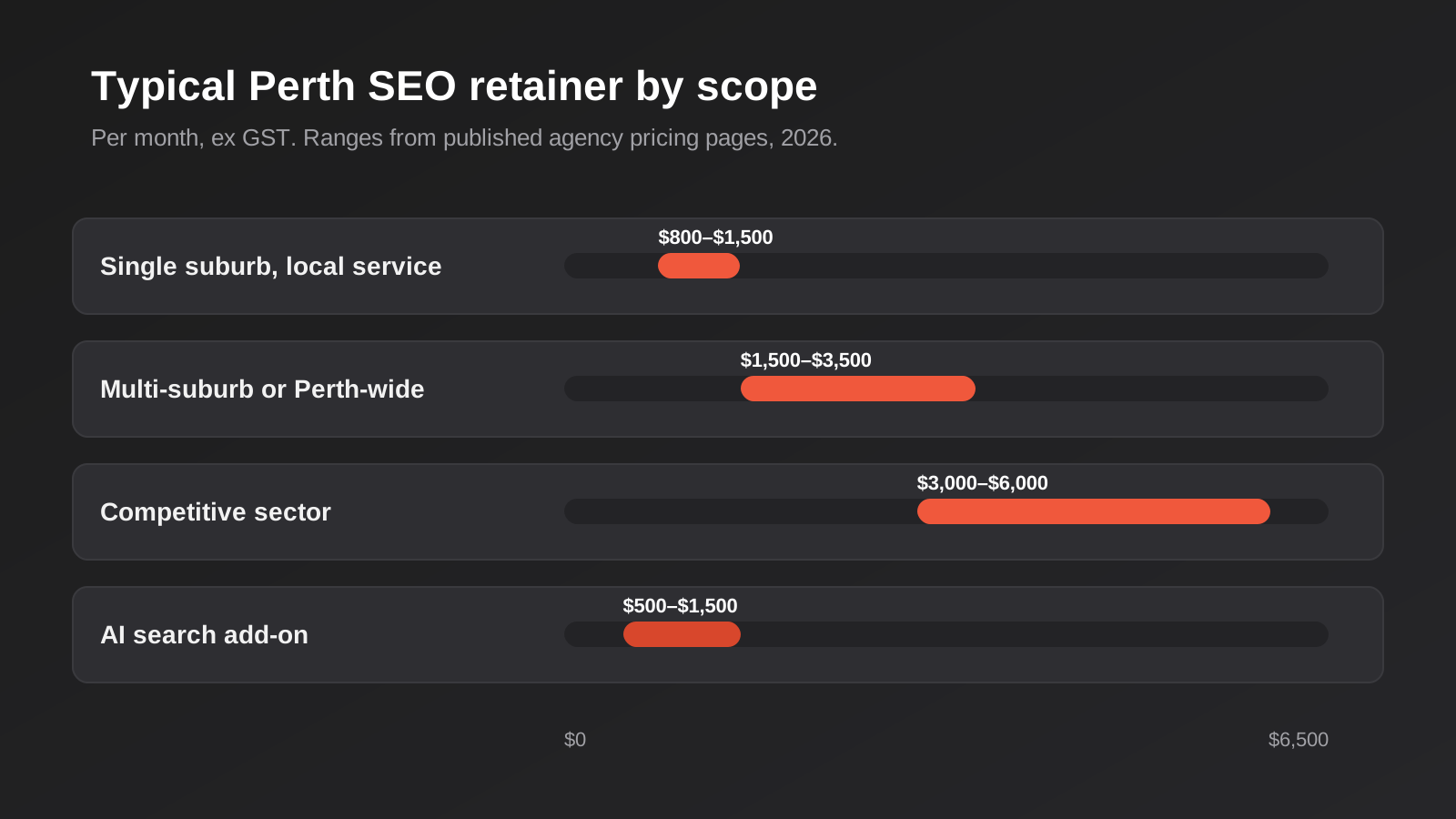
Start with the headline numbers, then we’ll unpack them. These are monthly retainer ranges, excluding GST, drawn from Perth agency pricing pages and Australian cost guides published in 2026.
- Single-suburb or single-location local campaign: roughly $800 to $1,500 a month. This is the plumber in Joondalup, the physio in Subiaco, the dentist in Cannington. One location, a defined set of services, a Google Business Profile that matters a great deal.
- Multi-suburb or Perth-wide campaign: roughly $1,500 to $3,500 a month. More service pages, more locations to cover, more competitors to beat, more links to earn.
- Competitive sectors: roughly $3,000 to $6,000 a month, and some agencies quote higher. Think legal, finance, healthcare groups, large ecommerce catalogues, anything where the first page is crowded with businesses that have been investing for years.
- Entry packages: some agencies advertise from around $500 to $1,000 a month. These exist, and some are legitimate for a small site in a quiet niche. Many are thin, which we’ll come back to.
- AI search visibility: published figures run from about $500 to $1,500 a month as an add-on to an existing SEO retainer, and $2,000 to $5,000 a month for a standalone programme.
A caution before you plan a budget around these. Nearly every public source for SEO pricing is an agency or a lead-generation site with something to sell, so the numbers skew towards what the market will bear rather than what the work strictly costs. Treat them as a map of the market, not a price list. The spread between the bottom and top of each band is the interesting part, and the next few sections explain what sits inside it.
One-off projects versus ongoing retainers
Not all SEO is a monthly commitment. Published figures for a one-off technical or SEO audit on a typical small business site sit in the low thousands, with a common range of about $1,500 to $4,000 and larger or more complex sites costing considerably more. Hourly consulting rates for SEO in Australia are quoted anywhere from around $100 to $300 an hour, depending on seniority and whether you’re hiring a freelancer or an agency.
An audit is worth buying when you have an in-house person or a developer who can act on it. If nobody is going to implement the findings, you’ve bought a document. Most small businesses are better served by a retainer where the person who finds the problems also fixes them.
Why the price is usually ex-GST
A small thing that catches people out: most agencies quote SEO excluding GST. A “$1,200 a month” package is $1,320 on the invoice. If you’re comparing three quotes, check that every one of them is stated on the same basis before you compare anything else. It’s the single most common reason two quotes look further apart than they are.
Why Perth Is a Different Pricing Question
The honest answer is that the underlying work isn’t much different from Melbourne or Brisbane. Google ranks pages by relevance, quality and trust whichever city you’re in. But a few things about how Perth businesses operate change which package makes sense.
Service area is the biggest lever. Perth is a long, narrow metro area. A tradie based in Rockingham may genuinely service Mandurah and Kwinana; a business in Joondalup may cover a corridor that runs a long way north. Ranking for “electrician Perth” is a very different job from ranking for “electrician Joondalup” and the three suburbs around it. The first is a bigger contest against more established businesses. The second is often winnable inside a single-suburb budget. A good agency will ask which suburbs actually produce profitable work before it quotes a thing.
The local pack matters more than the organic results for many Perth businesses. For service searches with local intent, Google shows a map block above the standard results. Winning there depends heavily on your Google Business Profile, your reviews and how consistently your details appear across the web, which is a different mix of work from ranking a service page. If your customers are local, a campaign weighted towards the profile can deliver quickly at a lower monthly figure.
Some Perth industries are genuinely B2B and national. A business supplying equipment, engineering services or professional services to companies across Western Australia, or beyond it, isn’t competing in the local pack at all. Their SEO looks more like a national campaign: deeper content, technical pages for specific products or services, and links from industry sites. Budget accordingly, because that work doesn’t fit in a suburb-level package.
You may not be competing only against Perth. If you sell online, the competitors on the first page are likely to be eastern-states businesses, and the price of competing with them is set by their spend, not by Perth rates. Ecommerce SEO is quoted by catalogue size and competitiveness, not by postcode.
None of this makes Perth more or less expensive in itself. It means the first question to answer is “where do my customers come from”, because it decides which row of the chart above you’re actually in.
What Drives the Price Up or Down
When two Perth agencies quote $900 and $2,800 for the same brief, the gap is almost always explained by some combination of the six factors below. This is what to ask about.
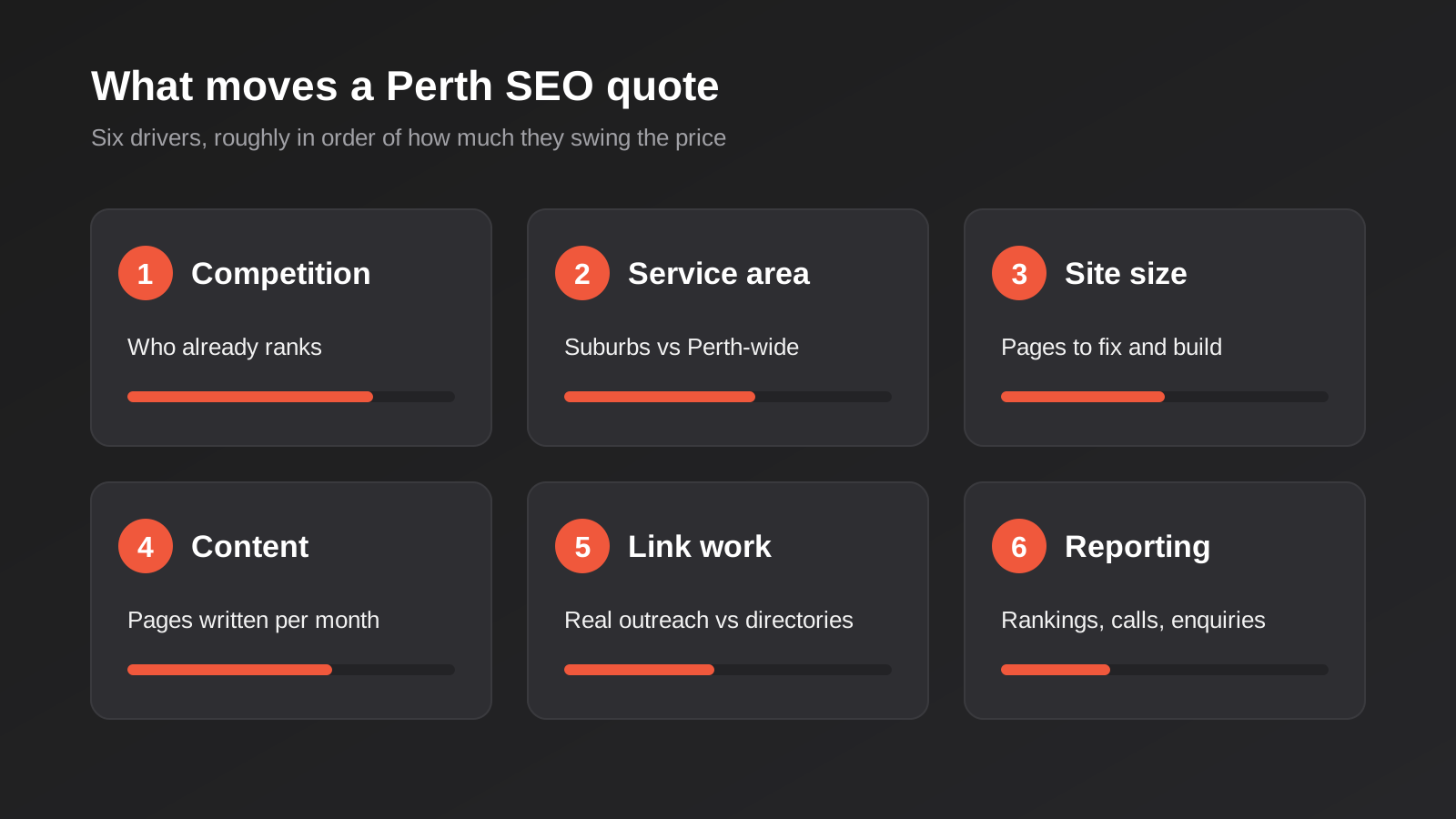
1. Competition for your keywords
This is the biggest single driver and the one you can least control. If the businesses ranking for your terms have been publishing, earning links and refining their sites for years, catching them takes more work per month for longer. If the first page is full of weak directory listings and outdated sites, a modest programme can move you up in a few months.
A decent agency will check this before quoting. Ask them to show you who currently ranks for your three most valuable searches and why. If a proposal arrives without any competitor analysis, the price is a guess.
2. The size of the area you want to cover
Each suburb or region you want to rank for typically needs its own genuinely useful page, not a copy of another page with the place name swapped. Covering one suburb is a small job. Covering twenty is a content and quality-control project. Google has been clear for years that thin, near-duplicate location pages don’t help, so the cost of doing it properly scales with the number of places.
3. Your website’s current condition
A site that loads slowly, has broken pages, duplicates its own content or can’t be crawled properly needs repair before any content will perform. Some of that work is a one-off cost at the start (which is why many agencies charge a setup fee or front-load the first month), and some is ongoing. A clean, fast, well-structured site costs less to rank than a neglected one. If your site is going to be rebuilt anyway, do the SEO planning before the rebuild rather than after, because fixing structure later costs more.
4. How much content is produced each month
Content is where a lot of the real labour sits. A package that includes four properly researched and written pages a month costs far more to deliver than one that includes a monthly report and some adjustments to existing pages. When a quote doesn’t state how many pieces of content are included, how long they are and who writes them, you can’t compare it with anything.
5. Link building and what it really means
Earning links from other credible sites is hard, slow and often the most expensive part of a campaign. The cheap version is submitting your business to dozens of directories, which does little beyond some basic citation consistency. The real version involves outreach, relationships, original research or content that other sites want to reference. If two quotes differ by $1,000 a month and one mentions link building in a single line, ask exactly what that line means in practice and what a typical month’s output looks like.
6. Reporting and account management
Some agencies keep margins low by sending an automated report and nothing else. Others include a monthly call with someone who understands your business and will tell you what’s working. Neither is wrong, but they’re different products, and the person-hours involved show up in the price. The most useful reports connect rankings to the things you care about, such as phone calls and enquiries, rather than listing keyword positions alone.
The Pricing Models, Explained
SEO is sold in four common ways in Perth. Knowing which one a quote uses tells you a lot before you read the detail.
Monthly retainer
By far the most common. You pay a fixed amount each month for a defined set of activities, and the work continues until you stop. It suits SEO because results compound over months, and a retainer funds the steady, repeated effort that builds them. The risk is paying for a package of activity rather than progress, so ask what’s delivered each month and what you’ll see after three, six and twelve months.
Fixed-scope project
A set price for a defined piece of work, such as an audit, a site restructure, or a batch of landing pages. Good when the job has a clear end. Poor as a replacement for ongoing work, because a project doesn’t maintain rankings once it’s delivered.
Hourly or day rate
Charged by time, usually for consulting, audits or specialist technical work. Useful for a second opinion or a short engagement. A weak fit for a full programme, because the incentive is to spend hours rather than finish the job, and you can’t forecast the bill.
Performance-based pricing
Pay only if you rank, or pay per lead. It sounds attractive and it’s rarer than the pitch suggests. Be careful here. Keywords chosen to guarantee a “result” are often so easy that ranking for them produces no customers, and per-lead models can lead to disputes about what counts as a lead. If someone guarantees a first-page ranking or position one, treat it as a warning sign, because no one outside Google controls rankings.
Contract length
Separate from the pricing model is the contract term. Some agencies lock you in for six or twelve months, which is understandable given SEO’s slow start but gives you little leverage if the work disappoints. Others run month-to-month. Neither is automatically better, but you should know which you’re signing before you sign, and what notice you need to give to leave.
What a Good Quote Should Include
A quote that’s easy to compare is one that tells you what you’re paying for. Before you accept anything, check that it covers each of these.
- A starting audit or review. Technical health, current rankings, a look at your Google Business Profile, and a competitor comparison. Without it, the agency is working blind.
- The keywords or services being targeted. Named, not “up to 20 keywords”. You should be able to see whether they are searches that bring customers.
- Specific deliverables per month. Number of pages optimised or written, hours of technical work, link-building activity described in plain terms.
- Who does the work. In-house team, a freelancer or an offshore subcontractor. Any of these can be fine, but you should know.
- How results are measured. Rankings, organic traffic, calls and form enquiries. Ask whether tracking for calls and form submissions is set up, because without it nobody can tell you what SEO is worth to you.
- Reporting frequency and format. Monthly at minimum, with a human explanation of what changed.
- Contract terms. Length, notice period, and what happens to your content and accounts if you leave. You should own your website, your Google Business Profile and your analytics accounts. Always.
- GST stated clearly. Ex or inc.
Reading three quotes side by side
When you have three, lay them out in a simple table with the same rows: monthly price (ex GST), content pieces per month, link-building activity, technical work, reporting, contract length. Blank cells are the most useful finding. If one quote is $700 cheaper than the others and has four blank cells, you now know why. If two quotes are within $150 of each other but one has far more detail, favour the detailed one, because vague proposals tend to lead to vague delivery.
We’ve written a longer breakdown of how to vet agencies in our guide to choosing an SEO agency in Australia, including the red flags in proposals and contracts.
Why Cheap SEO Often Costs More in the End
There are good low-cost options, particularly for a small site with little competition. But when a quote comes in well below the bands above, it usually means one of a few things.
The scope is thinner than it looks. A “$499 package” may deliver a basic on-page tidy-up and a monthly automated report, which is a fair thing to sell if it’s honestly described. It isn’t going to compete for a contested search.
The work is templated. The same suburb page generated forty times with different place names, the same blog post lightly rewritten for every client. This is the kind of content that Google is increasingly good at ignoring, and sometimes at demoting.
The links are the risky kind. Bulk-bought links and private blog networks can produce a short-term bump followed by a penalty or a slow loss of rankings. Cleaning that up later is expensive and slow, often more than the original saving.
The account is under-resourced. One person managing too many clients can’t give your site much attention in a month. You may not find out until six months pass with little to show.
The reverse also applies: the most expensive quote isn’t automatically the best. Large agencies carry overheads, account layers and sales teams, and some of what you pay for is their structure rather than your results. The right price is the one where you can see what each dollar is buying.
How Long Before You See Results
SEO doesn’t return value in the first month, and any agency that implies it does is overselling. Technical fixes and Google Business Profile improvements can show movement within weeks, particularly for local searches with little competition. Content and authority take longer, and competitive terms take longer again. Plan for several months before the picture is clear, and treat the first quarter as setup and groundwork rather than payoff.
This is why the cheapest option can be the most expensive one in practice. If you pay $600 a month for a year and rank for nothing that matters, you’ve spent $7,200 and still need to start properly. If you pay more for a programme that is aimed at the right searches from the start, the arithmetic changes. The question isn’t “how little can I spend” but “what’s a realistic budget for the position I’m trying to reach, and can I sustain it long enough to see it work?”
It’s also worth being clear that SEO is only one channel. If you need leads in the next few weeks, paid search fills that gap while organic builds.
What About AI Search?
Over the past year, a growing number of Perth agencies have added “AI SEO” or “generative engine optimisation” to their menus, aimed at appearing in answers from ChatGPT, Google’s AI Overviews and similar tools. Published pricing ranges from a few hundred dollars a month as an add-on to a few thousand for a standalone programme.
Here’s our honest read. The foundation of AI visibility is the same as for traditional SEO: clear, accurate, well-structured content, strong topical authority and credible mentions elsewhere. Good traditional SEO gets you most of the way there. What’s different is the extra effort on things like structured data, answering questions directly and building brand mentions in places AI systems draw from. That’s real work, and worth paying for if your customers research with AI tools, but it’s an extension of the foundation, not a replacement for it. If you’re considering it, see how we scope it on our AI SEO pricing page, and treat any agency promising guaranteed citations in AI answers with the same scepticism you’d apply to guaranteed rankings.
Common Mistakes When Buying SEO in Perth
- Choosing on price alone. The cheapest quote and the best-value quote are rarely the same one. Compare scope first, then price.
- Targeting too wide too early. Trying to rank across all of Perth on day one spreads effort thin. Win the suburbs and services that make you the most money first, then widen.
- Not setting up call and enquiry tracking. If nobody can say how many phone calls and form submissions came from organic search, you can’t judge whether the retainer is working.
- Ignoring the Google Business Profile. For many local Perth businesses, the profile drives more enquiries than the website does. A campaign that doesn’t touch it is missing the main event.
- Accepting a lock-in without an exit. Twelve months is a long time to be tied to work you can’t evaluate. At minimum, find out what you get if you leave, including ownership of your accounts and content.
- Believing guarantees. Anyone promising a specific ranking by a specific date is either gaming easy keywords or being optimistic on your behalf.
- Expecting the agency to fix a broken offer. SEO brings people to your website. If your service pages don’t explain what you do, where, and how to get in touch, the traffic won’t convert, whatever you pay.
- Stopping too soon. Cancelling after three months because results are modest ends the investment just before it starts to compound. If the work is sound and the reporting is honest, give it a fair run, and judge on leads rather than on rankings alone.
A Rough Budget Guide by Business Stage
Putting the above together, here’s how we’d think about a starting budget. These are not Growth Digital prices, just a way to translate the market ranges into a decision.
A new or very small local business with one location. Start with the Google Business Profile, a clean website with a page for each core service, and basic tracking. A campaign in the lower part of the single-suburb band is reasonable, provided the quote is specific about what’s included. Beware paying for a large programme before your website has the basics.
An established local business that wants more enquiries. This is the single-suburb to multi-suburb band. You need a proper audit, service and location pages that read well, reviews, and steady content. Expect the middle of the published ranges, and expect to review progress at six months.
A business competing across Perth or across Western Australia. The multi-suburb band and above. Competition matters more here, so insist on competitor analysis in the proposal and on named priority searches.
An ecommerce store or a business in a crowded sector. Treat this as a larger investment. The catalogue size, category structure and technical complexity drive the price, and the upper bands are realistic. Budget for technical work and ongoing content, and set expectations for a longer timeline.
A business selling to other businesses. Price it like a content and authority project rather than a local campaign. Depth of content and quality of links matter more than the number of suburb pages.
Frequently Asked Questions
How much does SEO cost in Perth per month?
Published 2026 figures put a single-suburb local campaign at about $800 to $1,500 a month, a multi-suburb or Perth-wide campaign at about $1,500 to $3,500, and competitive sectors at $3,000 to $6,000 or more, mostly quoted ex GST. Entry packages from around $500 exist but usually carry a thin scope. The right figure depends on your competition, the area you cover and how much content and link work is included.
Is SEO worth it for a small Perth business?
It can be, if your customers search for what you sell and you can turn a visit into an enquiry. It suits businesses with a reasonable value per customer and a long enough horizon to wait several months. If you need leads within weeks, pair it with paid search while organic builds. Ask any agency how they’ll measure calls and enquiries, not just rankings.
Do I have to sign a long contract?
No. Some agencies require six or twelve months, others work month-to-month. Longer terms are justified by SEO’s slow start, but they reduce your leverage if the work disappoints. Whatever you choose, make sure you own your website, analytics and Google Business Profile, and know the notice period for leaving.
How long does SEO take to work in Perth?
Local improvements such as Google Business Profile work and technical fixes can show movement within weeks in low-competition niches. Content-driven gains and competitive searches take several months, and often longer. Plan for at least a quarter of groundwork before judging results, and review against leads rather than ranking positions alone.
Why do Perth agencies quote such different prices for the same job?
Mostly scope. One quote may include several pages of new content, real outreach for links and a monthly call, while another includes an automated report and some on-page changes. Differences in competitor analysis, who does the work and how much account management is included also matter. Put the quotes side by side in the same table and the gaps usually explain themselves.
Should I pay extra for AI search optimisation?
Only after the foundations are sound. AI visibility builds on the same things as traditional SEO: clear content, credible mentions and good structure. If your site already has those, an add-on may help you appear in AI answers. If it doesn’t, you’ll get more from fixing the basics first. Be wary of anyone guaranteeing citations.
Where to Start
A practical way to begin is a short, honest brief you can send to every agency you talk to. Write down your business type, the suburbs you serve, the services that make you the most money, your current website address and your rough monthly budget. Ask each agency to respond with the same things: what they would fix first, which searches they would target, what they will deliver each month and how they will report on calls and enquiries. Identical briefs produce comparable answers, and the agencies that engage with your specifics tend to be the ones worth talking to.
Then run a small test of your own before you sign. Search for your three most valuable services the way a customer would, from a phone, and note who appears in the map block and the first page of results. That ten-minute exercise tells you more about the competition, and about whether a quote is realistic, than most proposals will.
Before you request a single quote, decide three things: which suburbs or regions actually produce your best customers, which three or four searches matter most, and how you’ll measure success. With those answered, quotes become far easier to compare, and a decent agency will respond with specifics instead of a generic package.
If you’d like to see how we structure and price this, our SEO pricing page lays out what’s included at each level, so you can use it as a reference point when you assess other proposals.
Worth putting a number on it: our own SEO packages start from $550 a month (ex GST), below the $800–$1,500 a month that published Perth pricing suggests for a single-suburb local campaign. Packages scale with the number of keywords and pages covered, so a broader or more competitive scope costs more than that starting figure. If you’ve already got a written quote from another agency for comparable scope, send it through and we’ll do our best to beat it.

Keep reading
Related posts
How Much Does a WooCommerce to Shopify Migration Cost in Australia? A 2026 Price Guide
What a WooCommerce to Shopify migration costs in Australia in 2026: real price ranges by store complexity, hidden costs and how to…
How Much Does an AI Chatbot Cost in Australia? A 2026 Pricing Guide
What an AI chatbot costs in Australia in 2026: three pricing tiers, the running costs people miss, and how to compare quotes…
How Much Does Custom Software Development Cost in Australia? Build Cost vs Five Years of Licences (2026)
What custom software development costs in Australia in 2026: ranges by project type, integration costs, running costs, and how the build compares…
Got a project you'd like to talk through?
Tell us what you're working on — we'll come back with a plan.
