
How Much Does SEO Cost in Melbourne? A 2026 Price Guide
 Jignesh Vagadiya
08/10/2026
21 min read
Someone in your business has almost certainly already been quoted on SEO this year, and the two numbers didn’t look like they were for the same service. One agency came back at $900 a month. Another wanted $4,500. Both called it “Melbourne SEO.” Neither explained what was actually different between the two, and the business owner was left guessing whether the cheap one was a bargain or the expensive one was a rip-off.
We get asked some version of “how much does SEO cost in Melbourne” most weeks, usually from someone who’s already collected two or three proposals and can’t make sense of why they don’t line up. It’s a fair question, and it doesn’t have a single honest answer — but it does have a defensible range, a clear set of reasons that range is so wide, and a way to tell whether a given quote sits inside it for a good reason or a bad one.
This guide sets out what SEO actually costs for a Melbourne business in 2026, what genuinely moves that number up or down, and the questions worth asking before you sign anything. We’ve deliberately left Growth Digital’s own pricing out of the figures below — you’ll find that on our SEO pricing page — because the goal here is to give you the market context to judge any quote, including ours.
None of this is about shaming agencies that charge more, or assuming the cheapest option is automatically a trap. Both of those instincts lead business owners astray just as often as they lead them right. What actually matters is whether the number in front of you matches the scope behind it, and whether that scope matches what your specific competitive situation in Melbourne actually requires. Get that match right and the price, whatever it is, starts to make sense.
What SEO Actually Costs in Melbourne Right Now
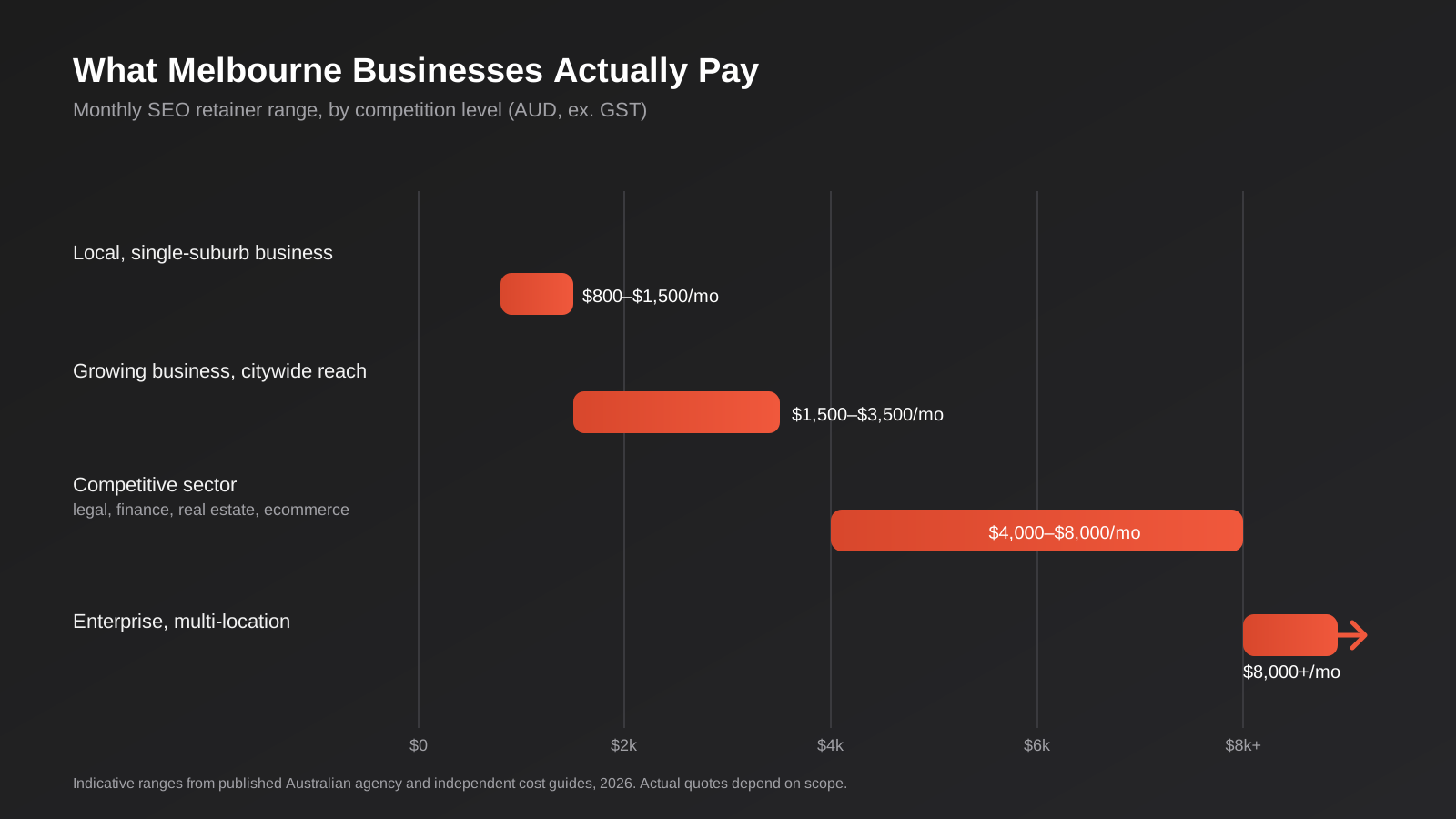
Most Melbourne businesses running SEO as an ongoing monthly retainer land somewhere between $1,500 and $3,500 a month. That’s the band that covers the bulk of small-to-mid-sized local and citywide businesses — a suburban trades business, a boutique retailer with one physical location, a professional services firm competing within Melbourne rather than nationally. It buys a reasonable amount of technical work, a steady content cadence and some ongoing link building, run by a real team rather than a single freelancer juggling twenty clients.
Below that, there’s a genuine entry tier around $800 to $1,500 a month for businesses targeting a single suburb or a narrow service area with a short keyword list — a single-location cafe chasing “best coffee [suburb],” a local plumber covering three or four nearby postcodes. The scope is small on purpose, and the price reflects that.
Above the mid-tier, competitive sectors push well past it. Legal, finance, cosmetic and aesthetic clinics, real estate agencies and ecommerce brands chasing high-volume, high-intent keywords commonly see quotes from $4,000 to $8,000 a month, and genuinely competitive national plays can go higher again. Melbourne’s retail and professional-services categories in particular are some of the most contested organic search markets in the country, so the technical depth and content volume needed to actually move rankings here is a step up from a quieter regional market.
Outside the retainer model, a one-off technical audit or a migration-related SEO project typically runs from $1,500 up to $10,000 or more depending on site size and how messy the underlying platform is, and hourly consulting sits roughly between $140 and $250 an hour at city agencies. None of these numbers are fixed prices you should expect to pay — they’re a sense check, so a quote that’s wildly outside them is worth a second look, in either direction.
One honest caveat: most of the figures agencies publish, including the ranges above, come from agencies with an obvious incentive to position their own pricing favourably. Independent cost guides tend to sit a little lower and are a more neutral starting point, but they still vary from source to source. Treat any published range, ours included, as a sanity check rather than a quote. The only number that matters is the one in a proposal scoped specifically to your site, your market and your competitors.
It’s also worth thinking about these numbers against what a lead or a sale is actually worth to your business, rather than in isolation. A $2,000 monthly retainer that generates a handful of genuinely qualified enquiries a month for a trades business with a high average job value pays for itself in a way the raw figure doesn’t show. The same $2,000 spent chasing broad, low-intent keywords for a low-margin product can lose money even if rankings technically improve. Cost per lead, not cost per month, is the number that should ultimately decide whether a given SEO spend makes sense for your business — and a competent agency should be able to talk you through that math before you commit, not just after three months of invoices.
What Actually Drives the Price Up or Down
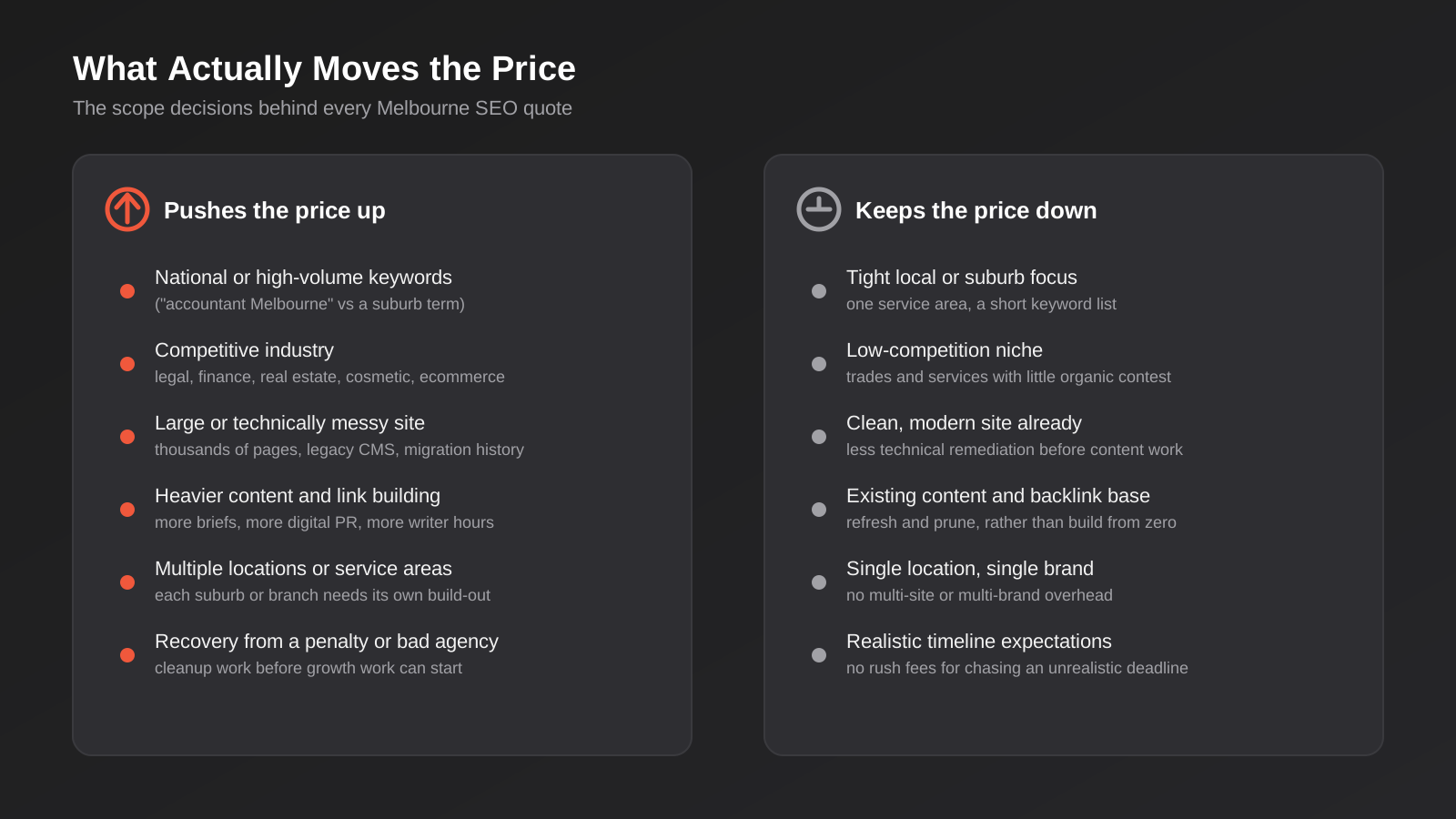
The single biggest lever is competition, not effort. Two businesses can want an identical-looking package — technical audit, monthly content, ongoing links — and pay very different amounts because one is trying to rank for “accountant” in a city of five million people and the other is trying to rank for “accountant Brunswick.” The keyword difficulty, not the work plan, is usually what the quote is really pricing.
Industry is the next biggest factor. Legal, finance, cosmetic medicine, real estate and ecommerce all carry a reputation for expensive SEO, and it’s deserved — these are categories where every competitor is already investing heavily, so matching them takes more content, more digital PR and more sustained link building than a less contested trade or service category.
Site condition matters more than most business owners expect going in. A large, ageing site on a legacy CMS with years of accumulated technical debt — broken redirects, duplicate content, a migration history nobody fully documented — needs real remediation work before any content or link building can take effect. That cleanup is often invisible to the client but accounts for a meaningful share of the first few months of a retainer, and it’s one reason a “cheap” quote that skips a proper technical audit tends to stall later rather than save money.
Scope of service area adds up quickly too. A single-location business needs one strong local presence. A business with branches across Melbourne’s suburbs, or operating in several of the capital cities we work across — Sydney, Brisbane, Perth, Adelaide and beyond — needs a coordinated structure so each location page can rank for its own area without competing against its sibling pages for the same terms. That’s materially more work than it looks like from the outside, and multi-location SEO done properly is its own specialist discipline.
Finally, recovery work costs more than growth work, at least at first. A business switching agencies after a penalty, a bad link-building campaign, or a few years of thin AI-generated content sitting on the site often needs a cleanup phase — disavowing toxic links, pruning or rewriting weak pages, fixing indexing issues — before new work can safely build on top. It’s not wasted spend, but it is spend that doesn’t show up as “new content” or “new links” on an invoice, which can make an honest quote look worse value than a dishonest one that skips the cleanup and chases visible wins instead.
Melbourne-Specific Factors Worth Weighing
Melbourne isn’t one search market, and that’s worth factoring into any quote you’re comparing. A business competing for CBD-adjacent, citywide or ecommerce traffic is fighting for the same keywords as some of the most established brands in the country, where Sydney and Melbourne consistently carry the heaviest organic competition nationally in finance, legal, retail and professional services. A business targeting a specific suburb — Brunswick, Camberwell, Frankston — is fighting a much smaller, more winnable battle, and a fair quote should reflect that difference in degree of difficulty, not just a flat “Melbourne loading” on the price.
It’s also worth checking whether a quote has actually priced your specific competitive set or just applied a generic “metro” rate. Two Melbourne businesses in the same postcode but different categories — say, a cafe and a cosmetic clinic — should not be quoted the same number, because the competitive intensity of their keyword sets is nowhere close to equivalent. If an agency hasn’t looked at who you’re actually competing against in the results before quoting, that’s a sign the number is a rate card figure rather than a scoped one.
Distance from the CBD matters too, though not always in the direction people expect. A business in an inner-north suburb competing against dozens of similar businesses within a five-kilometre radius can face more concentrated local competition than a business operating further out where there are simply fewer direct competitors running any SEO at all. We see this regularly when comparing a Brunswick or Richmond brief against an outer-suburban equivalent — the inner suburb isn’t automatically more expensive to rank in, it depends entirely on how many competitors are actively investing in the same keywords, which is exactly the kind of detail a properly scoped quote should reflect and a generic one won’t.
Why Agency Quotes Differ So Wildly for the Same Brief
Send the same brief to five Melbourne agencies and you’ll often get back five genuinely different numbers, and it’s rarely because four of them are wrong. A few structural reasons explain most of the spread. The first is overhead. A boutique agency with low fixed costs and senior staff doing the work directly can charge less for the same output than a larger agency with account managers, a sales team and premium office space layered on top of the delivery cost — neither is necessarily better or worse, but the price difference reflects business structure as much as service quality.
The second is how thoroughly the agency actually scoped your brief before quoting. A number produced from a fifteen-minute call and a glance at your homepage is a guess dressed up as a quote. A number produced after a real look at your current rankings, your competitors’ content and backlink profiles, and your site’s technical condition is an estimate grounded in your actual starting position. The second kind of quote takes longer to receive and is usually worth the wait, because it’s pricing your specific problem rather than a generic one.
The third is simply what’s included. “SEO” can mean a technical audit plus four long-form content pieces plus consistent outreach link building every month, or it can mean a monthly check-in and some meta description tweaks. Both get called SEO. Only one of them is likely to move competitive Melbourne rankings in a meaningful timeframe. When two quotes for the same brief are five times apart, the honest explanation is almost always a scope difference this large hiding behind near-identical language, not one agency being five times more skilled than the other.
The fourth, less flattering reason is that some quotes are priced to win the deal rather than to deliver the brief. An unsustainably low monthly fee for a genuinely competitive keyword set usually means one of three things is happening behind the scenes: the account will get far less senior attention than the proposal implies, corners will get cut on content quality or link quality in ways that create risk later, or the relationship is designed to be upsold heavily once you’re locked in. None of these show up in the number itself — they show up a few months in, which is exactly why the deliverable detail behind the price matters more than the headline figure.
Pricing Models Explained
Most Melbourne SEO is sold as a monthly retainer, and for good reason — SEO is ongoing work, not a one-off deliverable. Rankings aren’t “finished” the way a website build is finished; content ages, competitors react, and algorithm updates reshuffle results. A retainer buys sustained attention: a set number of hours or deliverables each month, applied consistently, with reporting that tracks progress against the previous month rather than a single finish line.
Hourly or project-based pricing shows up for narrower, bounded work — a technical audit, a platform migration’s SEO component, a one-off content push. It suits work with a clear start and end point, but it’s a poor fit for the ongoing content and link-building work that actually compounds rankings over time, since there’s no natural “done” point to bill against.
Performance or results-based pricing gets pitched occasionally — pay only for rankings achieved, or a fee tied to traffic or lead volume. Treat these carefully. Legitimate performance pricing is rare in SEO because rankings depend on factors outside any agency’s control, including Google’s own algorithm changes and what competitors do. An agency willing to tie its fee to outcomes it can’t fully control either has an unusually generous margin built into the base rate to absorb the risk, or it’s planning to hit the metric through shortcuts — thin content, manipulative link schemes — that put your site at risk of a penalty once the contract ends and the incentive to stay clean goes with it.
Fixed-scope packages — “$1,800 a month, this exact deliverable list” — sit in between. They’re easier to budget against than an open hourly arrangement and easier to compare between agencies than a vague retainer, provided the deliverable list is specific enough to mean something. “Ongoing SEO optimisation” is not a deliverable list. “Four content pieces, one technical audit per quarter, eight outreach links per month, monthly reporting call” is.
What a Proper Melbourne SEO Quote Should Include
A quote worth signing should name its deliverables, not just its price. At minimum, expect it to set out: the specific keywords or keyword clusters being targeted and why those were chosen over alternatives; the technical scope, including what gets audited and fixed in the first month versus ongoing maintenance; the content volume per month, in actual page or word counts rather than a vague “regular content”; the link-building approach and roughly how many links per month, including what counts as a link in their reporting; and the reporting cadence and the specific metrics you’ll see — rankings, organic traffic, and ideally leads or conversions, not just a keyword position screenshot.
It should also be clear about contract terms. Ask whether there’s a lock-in period, what happens to the content and any work product if you leave, and whether you retain full ownership of your site and everything built on it. A month-to-month arrangement where you keep everything you’ve paid for is the fairer default in this industry; a long lock-in with unclear ownership terms is a flag worth raising before you sign, not after.
Finally, a good quote sets expectations on timeline. Anyone promising first-page rankings on a fixed date is telling you something they can’t actually control, since no one outside Google can guarantee a specific position. What a credible agency commits to instead is the work — and a realistic timeline, which for most competitive Melbourne categories is three to six months before you see meaningful movement, with gains compounding from there rather than plateauing.
How to Compare Three Quotes Side by Side
The fastest way to make sense of three different numbers is to put them in a simple table before you talk to any of the agencies again. Down the left, list: monthly fee; contract length and lock-in terms; content volume per month (pages or word count, not “regular content”); number of links per month and the type of links being built; technical audit scope, and whether it’s a one-off or repeated; reporting cadence and what’s actually measured; and who does the work — an in-house team, a mix of in-house and contractors, or fully outsourced.
Fill that table in using each proposal’s actual wording, not your assumption of what they probably mean. It’s common to find that the $900 quote and the $2,800 quote differ mainly in content volume and link-building intensity — in which case the gap is explainable and you’re choosing based on budget and ambition, not being misled. It’s just as common to find that the cheap quote simply leaves out a technical audit, link building, or measurable reporting altogether, in which case it isn’t really the same service at a lower price — it’s a narrower service, and the comparison was never fair to begin with.
What a Cheap Quote Usually Leaves Out
A genuinely low SEO price for a genuinely narrow scope is honest and can be the right call for a small local business. The problem is the quotes that are cheap but pitched as if they cover a full competitive programme. In our experience taking over accounts from other agencies, the gap almost always shows up in the same handful of places.
Technical SEO is the first casualty, because it’s invisible to a client who isn’t looking at crawl reports and Core Web Vitals scores. A cheap retainer often skips the technical audit entirely, or does a surface-level pass that catches nothing structural, which means any content or link-building effort on top is working against a site that search engines can’t fully read in the first place.
Content depth is the second. “Regular blog content” at a low price point usually means short, generic articles produced quickly with minimal keyword research or genuine subject expertise behind them — enough to say content is being published, not enough to realistically outrank a competitor who’s invested properly in the same topic.
Link building is the third, and arguably the most consequential to skip or fake. Earning genuine backlinks through digital PR, guest content or outreach takes real time and real relationships, which costs money. A cheap retainer that claims to include link building but can’t tell you what links were actually earned, or where, is either doing none of it or doing it through low-quality, potentially risky tactics that can attract a penalty down the line.
Reporting is the fourth, and it’s the easiest to check for yourself before you’ve paid a cent. Ask to see a sample report. If it’s a keyword ranking screenshot and nothing else, you’re not getting a clear picture of whether the work is actually producing traffic or leads — you’re getting the one metric that’s easiest to present favourably regardless of real-world impact.
Common Mistakes When Buying SEO in Melbourne
- Comparing the monthly number without comparing the scope behind it, so a $900 quote and a $3,000 quote get treated as the same decision when they’re actually different products.
- Choosing the cheapest quote for a genuinely competitive keyword set, then being disappointed six months later that a $700-a-month retainer hasn’t moved a term that realistically needs a $4,000 level of investment.
- Signing a long lock-in contract before seeing a single month of reporting, which removes your ability to leave if the work turns out to be thin.
- Accepting “rankings improved” as a report without seeing the actual keyword positions, organic traffic trend and, ideally, leads — vanity movement on low-value keywords is easy to produce and easy to hide behind.
- Switching agencies every few months chasing faster results, which resets the technical and content groundwork each time and usually costs more over a year than staying with one competent agency through the slower early months.
- Assuming a higher price automatically means better work. It often correlates with more scope, but a scoped, honestly priced $1,800 retainer from a competent small team can outperform an unscoped $4,000 retainer from an agency spreading the same senior staff across too many accounts.
Frequently Asked Questions
How much does SEO cost in Melbourne?
Most Melbourne small and mid-sized businesses pay between $1,500 and $3,500 a month for an ongoing SEO retainer. Single-suburb businesses with a narrow keyword list can see entry-level pricing from around $800 to $1,500 a month, while competitive sectors like legal, finance, real estate and ecommerce commonly run from $4,000 to $8,000 a month or more. The actual figure depends far more on keyword competition and site condition than on the agency’s address.
Why do SEO quotes for the same business vary so much between agencies?
Because “SEO” isn’t a standard product with a fixed scope — it’s a label applied to very different combinations of technical work, content volume, link building and reporting depth. Two agencies quoting the same business can arrive at different numbers because one is pricing a genuinely broader scope, one has done proper keyword and competitor research and the other hasn’t, or one is simply priced for a different margin. The number alone tells you very little; the deliverable list behind it tells you almost everything.
Is cheap SEO ever worth it for a Melbourne small business?
It can be, for a genuinely narrow, low-competition local scope — a single-location trade business targeting a handful of suburb terms doesn’t need the same investment as a citywide ecommerce brand. The risk isn’t the price itself, it’s a cheap quote sold as if it covers a much bigger job than it actually does. A $700-a-month retainer that’s honest about only covering light local optimisation is reasonable. The same price pitched as a full competitive SEO programme for a contested industry usually means something — a technical audit, real content, or link building — has been quietly left out.
What should a cheap SEO quote make me check before signing?
Ask specifically whether a technical audit is included, how many pieces of content are produced per month and at what length, whether any link building is happening and what kind, and what you’ll actually see in reporting beyond a ranking screenshot. A quote that can’t answer those four questions specifically is most likely priced for a narrower service than you’re assuming, or for volume the agency can’t realistically sustain at that price without cutting corners elsewhere.
Should I pay for SEO by the hour, by retainer, or by project?
A monthly retainer suits ongoing work — content, link building, continuous technical maintenance — because SEO compounds over sustained effort rather than finishing at a point. Hourly or project pricing fits bounded, one-off jobs like a technical audit or the SEO component of a platform migration. Be cautious of performance-based pricing tied purely to rankings or traffic; it’s uncommon for good reason, since results depend on factors no agency fully controls, and the incentive structure can push toward risky shortcuts.
How long before Melbourne SEO pricing pays for itself?
Most businesses see meaningful ranking movement in three to six months, with traffic and lead gains compounding after that rather than appearing all at once. Technical fixes and quick-win content can show early signs sooner, but durable results in a competitive Melbourne category build over a longer runway than paid channels. Judging a retainer’s value inside the first two or three months, before the technical and content groundwork has had time to take effect, is one of the most common reasons businesses switch agencies prematurely and end up paying for the same groundwork twice.
Does a more expensive SEO agency guarantee better results in Melbourne?
No, though it correlates loosely with scope. A higher price usually buys more content volume, more link building and more senior staff time, which genuinely matters for a competitive keyword set. But price is set by the agency’s cost structure and sales process as much as by skill, so a well-scoped mid-range retainer from a focused team can outperform an expensive one spread too thin across too many accounts. The deliverable detail and the team’s actual track record on comparable briefs tell you far more than the number on the invoice.
Where to Start
If you’ve got quotes sitting in your inbox right now, the fastest next step isn’t to pick the cheapest or the most expensive — it’s to put them side by side against the deliverable list above and see which one is actually scoped to your competitive reality. If none of them feel like they’ve looked closely at your specific market, that’s worth raising before you sign anything.
We work with Melbourne businesses across exactly the range described in this guide, from single-suburb local SEO through to the more contested citywide and ecommerce categories, and our own SEO pricing is scoped the same way — against your actual keyword competition and site condition, not a flat rate card. You can see the full scope of what we cover on our SEO services page, read our broader national breakdown in SEO Pricing in Australia: What SEO Packages Actually Cost in 2026, or get a sense of what to vet in any proposal in How to Choose the Right SEO Agency in Australia. If you’d rather just send us a quote you’ve already received and get a second opinion on what it actually covers, that’s a conversation we’re happy to have — whether or not it ends with us.
Worth putting a number on it: our own SEO retainers start from $550 a month — below even the $800–$1,500 entry tier covered above, let alone the $1,500–$3,500 most Melbourne businesses pay. We keep our overheads lean as a specialist agency and pass that saving on. If you’ve already got a written quote from another agency for comparable scope, send it through and we’ll do our best to beat it.
Keep reading
Related posts
How Much Does a WooCommerce to Shopify Migration Cost in Australia? A 2026 Price Guide
What a WooCommerce to Shopify migration costs in Australia in 2026: real price ranges by store complexity, hidden costs and how to…
How Much Does an AI Chatbot Cost in Australia? A 2026 Pricing Guide
What an AI chatbot costs in Australia in 2026: three pricing tiers, the running costs people miss, and how to compare quotes…
How Much Does Custom Software Development Cost in Australia? Build Cost vs Five Years of Licences (2026)
What custom software development costs in Australia in 2026: ranges by project type, integration costs, running costs, and how the build compares…
Got a project you'd like to talk through?
Tell us what you're working on — we'll come back with a plan.
