
SEO Pricing in Australia: What SEO Packages Actually Cost in 2026
 Jignesh Vagadiya
19/08/2026
21 min read
Jignesh Vagadiya
19/08/2026
21 min read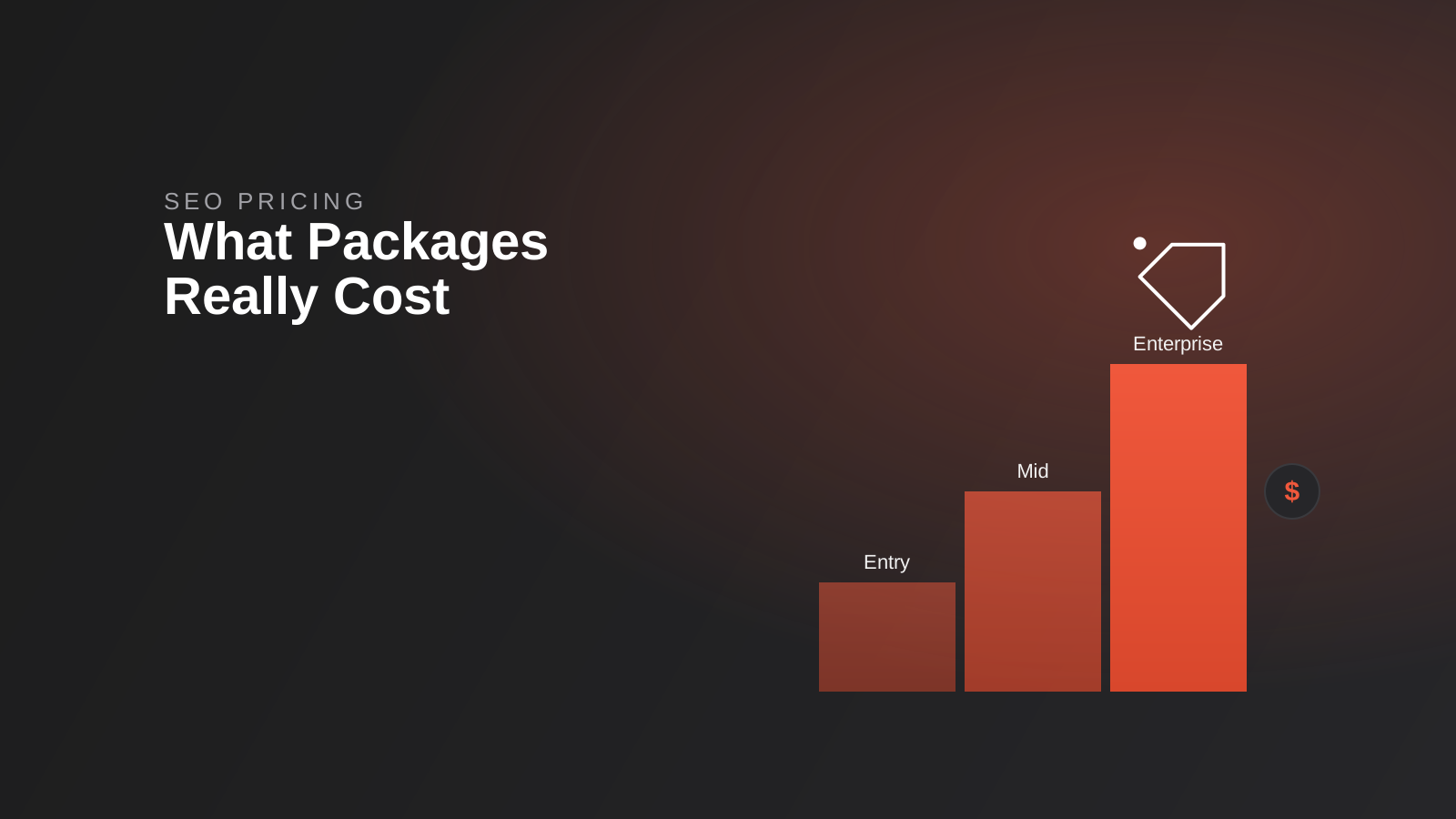
Ask five SEO agencies what their services cost and you’ll get five different numbers, often with no obvious relationship to each other. That’s not because SEO pricing is arbitrary or because agencies are making numbers up — it’s because “SEO” isn’t one service. It’s a bundle of very different work — technical fixes, content production, link building, local optimisation, ongoing strategy — and the mix of that work a specific business actually needs varies enormously depending on where their site currently stands and how competitive their market is.
This guide breaks down what genuinely drives SEO pricing in Australia, what the different pricing models mean for you as a buyer, realistic price ranges by business stage, and — probably more useful than any number — how to tell whether a quote reflects real, sufficient work or is priced to win the sale and cut corners afterward. By the end, the goal isn’t to hand you a single “correct” price to expect, since no such number honestly exists across every business and market — it’s to give you the framework to evaluate any quote you’re given on its actual merits.
What Actually Drives the Price of SEO
Four variables do most of the work in explaining why one business pays $600 a month for SEO and another pays $6,000.
Competitiveness of the market
Ranking a local trades business for a suburb-specific term is a fundamentally different task from ranking a national ecommerce brand for a head term that a dozen well-funded competitors are also chasing. Competitive markets need more content, a stronger backlink profile, and considerably more ongoing effort just to hold position, let alone gain it — which is reflected directly in price.
The website’s starting technical condition
A site with a clean technical foundation, decent existing content, and no history of penalties starts an SEO engagement from a very different place than a slow, poorly structured site with years of neglected technical debt. The second business is paying, in effect, for two things at once in the early months — fixing what’s broken and building what’s missing — which is why a technical audit at the start of an engagement often reveals a wider scope (and a different price) than the business expected going in.
Geographic and service scope
A single-location local business targeting a handful of service-area keywords needs meaningfully less ongoing work than a multi-location franchise or a business competing nationally across dozens of service and product pages. Scope, more than almost anything else, is what separates a genuinely affordable SEO package from one that looks affordable but is quietly too thin for what the business is trying to achieve.
Content and link-building intensity required
Some industries can rank with modest content investment and a handful of genuinely earned links. Others — particularly competitive B2C categories like finance, legal, or ecommerce — require a sustained content and digital PR programme just to stay competitive, which is inherently more labour-intensive and therefore more expensive to deliver properly.
How SEO Is Actually Priced
Understanding the pricing model on offer matters as much as the number itself, because different models create different incentives.
Monthly retainer
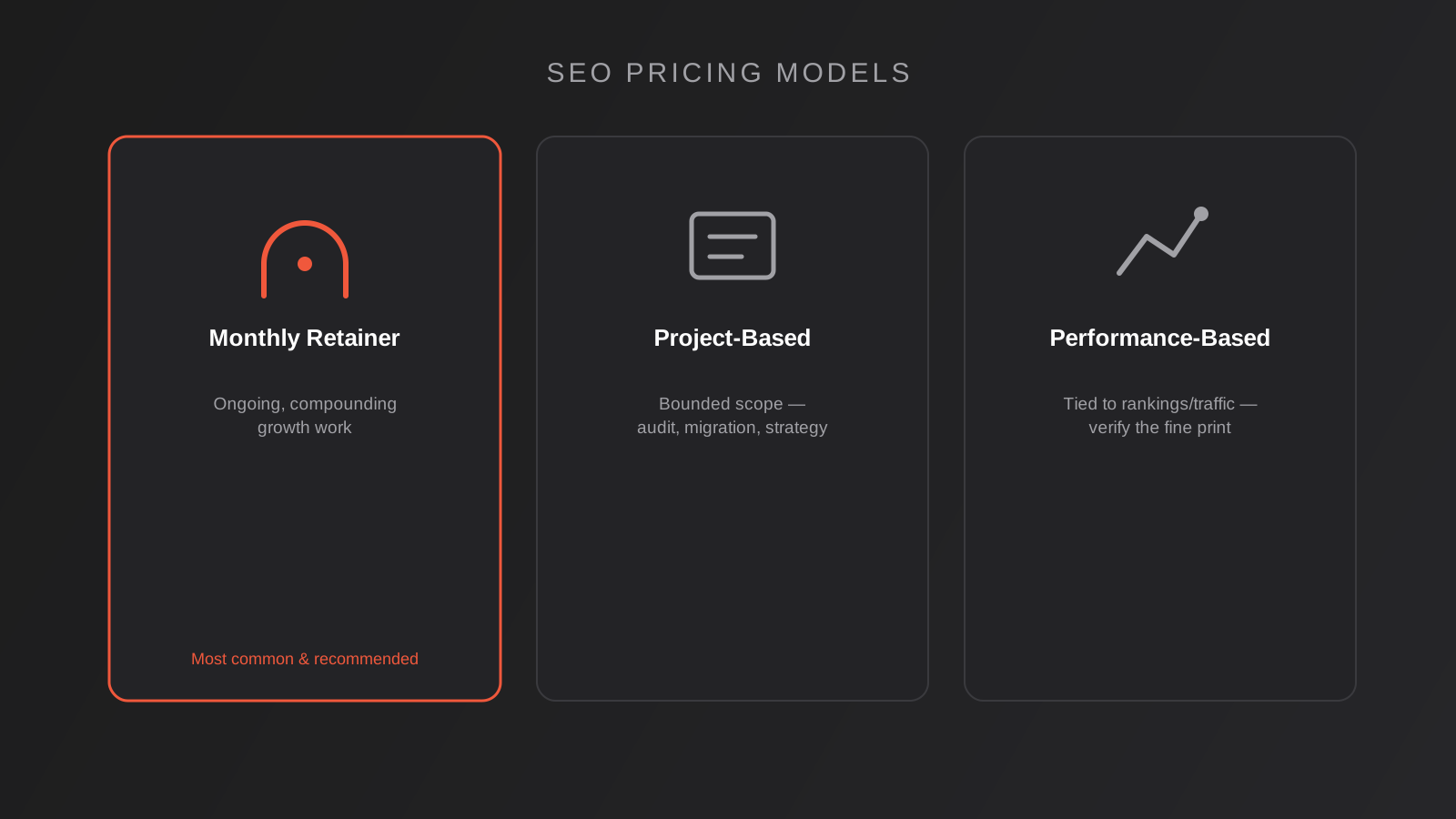
The most common model for ongoing SEO, and generally the right one — SEO is a compounding, long-term discipline rather than a project with a defined end date, and a retainer reflects that reality. The risk with retainers is scope drift: without a clear statement of what’s actually being delivered each month (how many pieces of content, how many technical fixes, what reporting), a retainer can quietly become “we’ll do whatever seems useful” with no real accountability for what that adds up to.
Project-based / one-off
Suits a defined, bounded piece of work — a technical audit and fix, a site migration handled carefully to preserve rankings, a content strategy document — but doesn’t suit ongoing ranking improvement, which by nature requires sustained work as competitors keep publishing and algorithms keep changing. A one-off project is a reasonable way to fix a specific problem; it’s not a substitute for an ongoing SEO programme if genuine growth is the goal.
Hourly
Less common for full-service SEO, more common for specialist consulting — a technical SEO specialist brought in for a specific diagnostic problem, for instance. Works well for narrow, expert-level tasks; awkward for anything requiring sustained, coordinated effort across content, technical, and link-building work.
Performance-based
Pricing tied to rankings achieved or traffic generated sounds appealing on paper but is worth real scepticism. Rankings can be gamed or targeted at low-value, low-competition terms that technically satisfy a contract without moving the business forward, and a genuine performance guarantee ignores how much of ranking success depends on factors outside any agency’s control — a site’s existing authority, the client’s own content and technical decisions, algorithm changes. Ask precisely what’s being guaranteed and for which specific terms before treating a performance-based pitch as a lower-risk option than it might actually be.
Realistic SEO Price Ranges in Australia
Treat any price range, including this one, as a starting orientation rather than a quote — the variables above shift these numbers meaningfully in either direction. As a general guide for the Australian market in 2026:
- Entry-level / small local business: roughly $700–$1,500 per month. Suits a single-location business in a low-to-moderate competition market, typically covering foundational technical fixes, Google Business Profile optimisation, and a modest, steady content cadence.
- Mid-tier / growing business: roughly $1,500–$4,000 per month. Suits a business competing across a wider service or product range, or in a moderately competitive market, with more substantial content production, a genuine link-building component, and more detailed reporting and strategy involvement.
- Enterprise / highly competitive markets: $4,000 per month and upward, sometimes well upward. Suits national or multi-location businesses in genuinely competitive categories, where the volume of content, technical complexity, and digital PR/link-building effort required to move the needle is substantially higher.
Within any of these tiers, the honest answer to “how much should I pay” is: enough to cover the specific scope of work your competitive position actually requires, delivered by people with genuine expertise — not a number chosen because it sounds reasonable in isolation.
For our current SEO pricing tiers and what’s included at each, see our SEO pricing page.
Local SEO Pricing vs National SEO Pricing
Local and national SEO are priced differently because they’re solving structurally different problems. Local SEO — ranking a business for searches tied to a specific suburb, city, or service area — leans heavily on Google Business Profile optimisation, consistent local citations, review generation, and a tighter, more geographically specific content set. Because the competitive pool is smaller (competing against other local businesses in the same area, rather than every business nationally offering a similar service), local SEO can often show meaningful results on a leaner budget than a national campaign chasing the same category.
National SEO, by contrast, is competing against every credible business in the category regardless of location, which generally means a larger content footprint, a more substantial backlink and digital PR programme, and considerably more ongoing investment to both gain and hold position. A multi-location business sits in between the two, often needing a hybrid approach — a strong national or category-level presence alongside genuinely distinct (not templated) local pages for each service area, which is one of the more common places we see budgets under-scoped, because it looks like “just add more location pages” but actually requires real content investment per location to avoid the thin, near-duplicate pages Google increasingly discounts.
In-House SEO vs Agency: A Genuine Cost Comparison
It’s worth running the numbers on hiring in-house before assuming an agency retainer is automatically the more expensive option. A single in-house SEO hire in Australia, at a level capable of running a full strategy independently, typically costs upward of $80,000–$110,000 a year in salary alone, before factoring in the tools (rank tracking, technical auditing, content research platforms), ongoing training to stay current, and the reality that one person can rarely cover technical SEO, content strategy, and link building/digital PR to an equally high standard across all three.
An agency retainer spreads access to a broader team — a technical specialist, a content lead, a link-building/digital PR function — across multiple client accounts, which is part of why a mid-tier agency retainer can deliver genuinely broader capability than a single in-house hire at a comparable or lower annual cost. The trade-off is depth of product knowledge and availability — an in-house hire is embedded in the business full-time, while an agency is managing your account alongside others. Larger, more mature businesses often land on a hybrid: an in-house SEO lead who owns strategy and product knowledge, working alongside an agency or specialist contractors for execution depth in technical SEO, content production, or link building.
How a Proper Audit Shapes the Final Quote
Any agency quoting a specific, confident price before running a real technical and competitive audit is, in effect, guessing — a genuine quote should follow, not precede, an audit that actually looks at the site’s current technical health, existing content quality and gaps, backlink profile, and the realistic competitive landscape for the target keywords. This is why an initial conversation often produces a ballpark range rather than a fixed number, and why that range can move once the audit is complete.
As an illustrative example (not a specific client, simply how the scoping process tends to play out): a local trades business might come in expecting an entry-level package, and the audit reveals a site with no structured service pages, no Google Business Profile optimisation, and several years of neglected technical debt — pushing the realistic scope, and therefore the price, toward the higher end of the entry tier or into the lower end of mid-tier, simply because there’s more foundational work to clear before ongoing growth work can even begin. Conversely, a business with an already well-built, technically clean site might need a genuinely lighter, cheaper engagement focused purely on content and authority-building, because the foundation is already solid. Neither outcome reflects the agency being more or less honest — it reflects what the audit actually found.
Why “Set and Forget” SEO Packages Rarely Hold Their Price
A package priced and scoped once, at the very start of an engagement, and never revisited is a common source of client frustration down the track — either the business outgrows what a static package was built to deliver, or the market shifts (a new competitor investing heavily, an algorithm update changing what “good” looks like) in a way the original scope never accounted for. The more sustainable pricing relationships we see build in a periodic review — typically every six to twelve months — where scope and price are revisited against genuine changes in the business’s competitive position, rather than an automatic annual increase applied regardless of whether anything has actually changed. Asking a prospective agency how and when they revisit scope, rather than assuming a quoted price is fixed forever, is a reasonable and fair question to raise before signing.
What’s Actually Included at Each Tier
The number on a quote matters less than what’s actually inside it. A genuinely useful SEO package, at any tier, should make clear: how many hours or pieces of content are being produced monthly, what technical work is included versus billed separately, what the reporting cadence and content actually covers (rankings alone are a weak signal on their own — see below), and who specifically is doing the work — a named, experienced strategist is a very different proposition from an anonymous team member juggling forty other accounts.
A package that’s vague on all of these specifics, no matter how competitive the headline price looks, is the one most likely to under-deliver relative to what the business actually needs.
Why Cheap SEO Is Usually a False Economy
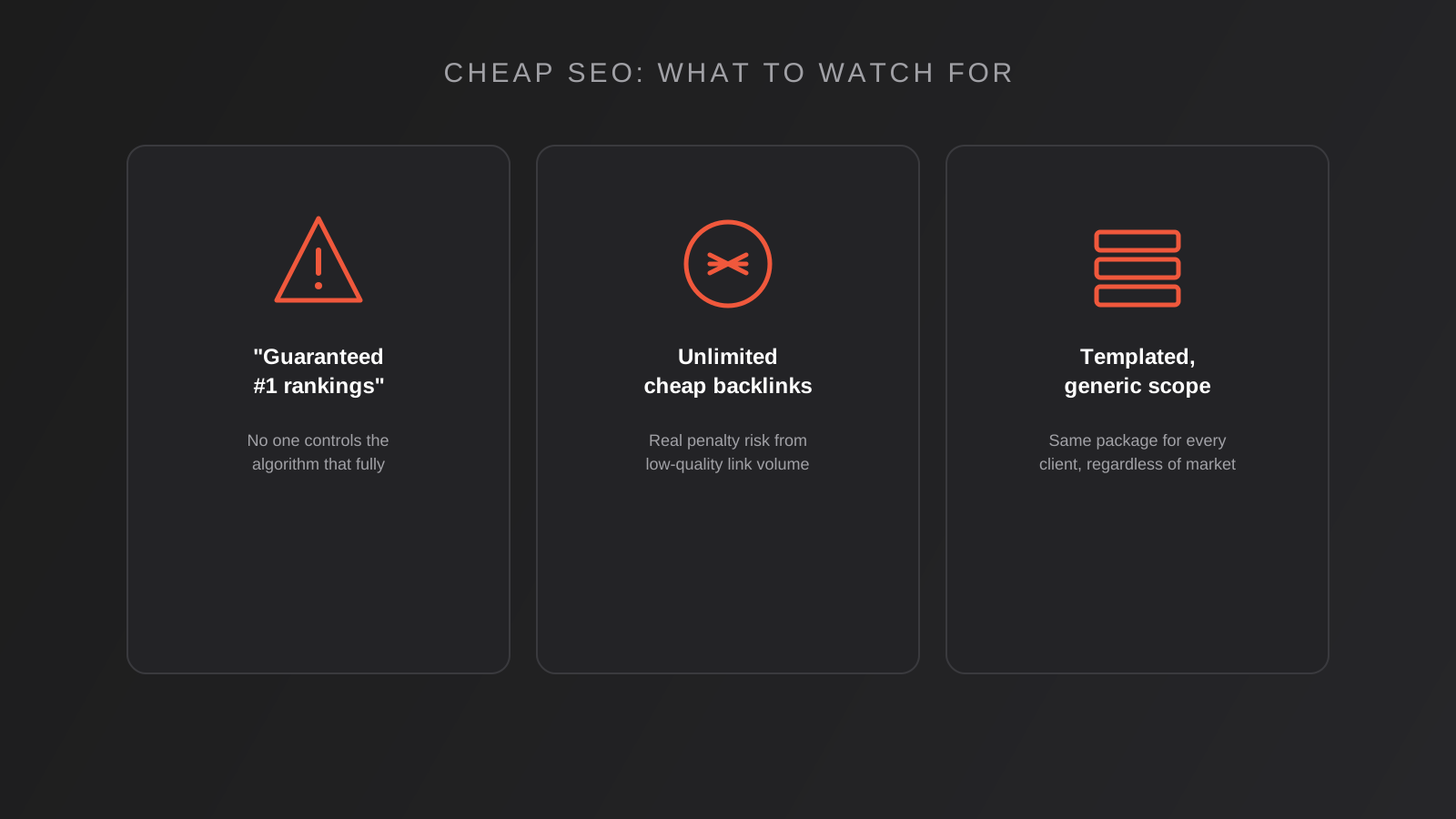
SEO priced dramatically below market rate is rarely a genuine bargain — it’s usually a sign of one of a few things: the work is templated and generic rather than tailored to the specific business and market, link building relies on low-quality, high-volume tactics that carry real penalty risk, or the account simply isn’t getting enough hours to do the job properly, however good the individual strategist’s intentions are.
The genuine cost of cheap SEO done badly isn’t just wasted spend — it’s often a Google penalty or algorithmic devaluation from a low-quality backlink profile, which can take considerably more time and money to recover from than the original engagement cost in the first place. “Guaranteed #1 rankings” and unusually cheap, unlimited link-building packages are two of the more reliable red flags worth treating with real caution.
What to Actually Look For in an SEO Package
- Transparency about deliverables. A clear, specific statement of what’s being done each month — not a vague promise to “improve rankings.”
- A strategy tailored to your specific site and market. Not a templated package identical to what every other client on the same tier receives.
- An experienced, named team. Genuine expertise, not a junior account manager relaying generic recommendations from a checklist.
- Reporting tied to business outcomes. Traffic, leads, and revenue — not rankings alone, which can move for reasons unrelated to genuine improvement and say nothing about whether the traffic they represent actually converts.
- No unreasonable lock-in. SEO takes months to show results, so some minimum commitment is reasonable — but a contract that locks a business in well beyond a fair evaluation window, with punitive exit terms, is worth questioning.
SEO Pricing vs Google Ads Pricing: A Useful Comparison
Business owners weighing up SEO spend often compare it, implicitly or explicitly, against Google Ads — and the comparison is genuinely useful, provided the fundamental difference between the two is kept in view. Google Ads is rented visibility: turn the budget off and the traffic stops immediately, with no residual value carried forward. SEO is closer to owned infrastructure: the investment compounds, and a well-built page can keep generating organic traffic for years with only ongoing maintenance, long after the active monthly spend that built it has been redirected elsewhere.
This doesn’t make SEO strictly “cheaper” — a genuinely competitive SEO programme can cost as much or more than a modest Google Ads budget in the first six to twelve months, before it’s built enough authority to compete. But it does mean the right comparison isn’t month-one cost against month-one cost; it’s the trajectory of cost-per-lead over a year or two, where SEO’s cost-per-lead typically declines as authority builds, while Google Ads’ cost-per-lead stays roughly flat (or rises with competition) for as long as the campaign runs. Most businesses that can afford both are better served running them together — Google Ads for immediate volume and control, SEO for the compounding, lower-cost-per-lead position it builds over the medium term — rather than treating the two as competing for the same budget line.
Contract Terms Worth Reading Closely
Beyond the headline price, the contract terms attached to an SEO engagement can matter as much as the number itself. A reasonable minimum term — commonly three to six months — makes sense given how long SEO genuinely takes to show results; a business that could walk away penalty-free after four weeks would make it very hard for any agency to plan and execute a real strategy. What’s worth scrutinising is what happens beyond that minimum term: is there an ongoing lock-in with a long notice period, punitive early-exit fees well beyond covering work already committed, or ownership terms over content and on-site work that make it difficult to simply continue the SEO programme with someone else if the relationship isn’t working?
A genuinely confident agency, one that expects to keep earning the business through results rather than contractual friction, tends to have reasonable, unremarkable exit terms — it’s usually the packages relying on inertia rather than performance that build in the most aggressive lock-in clauses. Reading this section of a contract before signing, not after wanting to leave, is one of the more overlooked parts of evaluating an SEO price.
Reporting: What a Genuinely Useful Report Looks Like
Monthly SEO reporting varies enormously in usefulness, and it’s worth knowing what to expect before signing. A report built purely around keyword rankings is the weakest version — rankings fluctuate for reasons unrelated to genuine progress (algorithm updates, seasonal search behaviour, a competitor’s own campaign), and a ranking improvement for a term with no commercial intent is a hollow win. A genuinely useful report ties ranking movement to actual organic traffic via Google Search Console and analytics, shows which specific pages and queries that traffic is coming through, and — where tracking allows it — connects that traffic to leads, enquiries, or sales, not just visits.
It’s reasonable to ask, before signing, for a sample of the actual monthly report a prospective agency sends existing clients. A report full of dense ranking tables and little else is a fair warning sign that the engagement will be judged, internally, on a metric that doesn’t actually reflect business value.
How AI Is Changing SEO Pricing and Delivery
AI tools have genuinely changed parts of SEO delivery — keyword research, content briefs, and some technical auditing can now happen faster than a few years ago, and agencies with efficient AI-assisted workflows can, in principle, pass some of that efficiency on as either lower prices or more output for the same price. What AI hasn’t replaced is the strategic judgement behind that output: deciding what content is actually worth creating for a specific business’s specific audience, interpreting what a technical audit’s findings actually mean for priority and sequencing, and building the kind of genuine expertise and depth that both search engines’ E-E-A-T signals and AI answer engines increasingly reward.
Be specifically wary of pricing that looks cheap because the “content” behind it is unreviewed AI output with no genuine expertise, editing, or fact-checking behind it — that kind of content is both more likely to underperform against genuinely researched, expert-reviewed content and, per Google’s own guidance, more likely to be treated as lower quality regardless of how it was produced. The efficient use of AI in a well-run SEO engagement should show up as more strategic time spent on judgement and depth, not as a shortcut around doing the work properly.
Matching a Package to Your Actual Stage of Business
A business just establishing its first real SEO presence usually gets more value from a foundational package focused on technical health, core service pages, and Google Business Profile optimisation than from an expensive, content-heavy programme it isn’t yet positioned to make the most of. Conversely, a business with a solid technical and content foundation already in place, competing in a genuinely contested market, will be under-served by an entry-level package no matter how well it’s executed — the scope simply won’t be enough to move the needle against better-resourced competitors.
The right question isn’t “what’s the cheapest package that technically includes SEO” but “what does my specific competitive position actually require, and which package genuinely covers that.” A properly scoped audit at the start of any engagement should answer this before a number gets attached to it, not after.
Questions Worth Asking Before Signing an SEO Contract
- What specifically is included in this price, month to month?
- Who is actually doing the work, and how many other accounts do they manage?
- What does your link-building process actually look like, and can you show examples?
- How do you report on results, and does that reporting go beyond rankings to traffic, leads, or revenue?
- What happens if we want to leave — what’s the notice period and exit process?
- Can you walk me through a technical audit finding and what fixing it would actually involve?
A confident, specific answer to each of these is a far better signal than any headline price on its own.
For a deeper walkthrough of vetting agencies beyond price alone — red flags, contract terms, what a good proposal looks like — see our guide to choosing the right SEO agency in Australia.
Common SEO Pricing Mistakes Businesses Make
- Choosing purely on price. The cheapest quote is rarely the cheapest outcome once a poorly executed engagement needs to be redone, or worse, recovered from a penalty.
- Expecting month-one results to justify the spend. SEO is a compounding investment; judging value after four to six weeks, before the work has had time to show in rankings and traffic, sets an unfair and inaccurate bar.
- Not asking what happens to the work if the contract ends. Content and on-site changes generally stay; some agencies’ proprietary tools, reporting dashboards, or link relationships may not transfer cleanly.
- Treating all “SEO packages” as interchangeable. A $1,000/month package from one agency and a $1,000/month package from another can represent wildly different scopes of actual work.
Frequently Asked Questions
How much does SEO cost per month in Australia?
Realistic ongoing SEO in Australia generally ranges from around $700–$1,500 a month for a small local business in a low-competition market, up to $4,000+ a month for a business competing nationally in a genuinely contested category. The right number depends far more on your specific competitive position and site condition than on a generic industry benchmark.
Is cheap SEO ever worth it?
Occasionally, for a genuinely low-competition local market with minimal existing technical debt, a lean package can be entirely appropriate. More often, SEO priced well below market rate reflects templated, generic work or corner-cutting on link quality that carries real penalty risk — the deciding factor isn’t the price itself but whether the scope genuinely matches what your specific market and site condition require.
Should I choose a monthly retainer or a one-off project?
A one-off project suits a bounded piece of work — a technical audit, a migration, a content strategy document. Ongoing ranking growth, by its nature, requires sustained work as competitors keep publishing and search algorithms keep evolving, which is why a monthly retainer is generally the right model for genuine, compounding SEO growth rather than a single fixed engagement.
Why did my SEO agency’s quote come in higher than expected after the audit?
This is common and not necessarily a sign of anything untoward — an initial ballpark quote is often given before a full technical audit, and once the audit reveals the actual condition of the site (existing technical debt, thin or outdated content, a weak backlink profile), the genuine scope of work needed can turn out to be larger than the ballpark assumed. A reputable agency should be able to walk through exactly what the audit found and why it changes the scope, rather than simply presenting a bigger number with no explanation.
How long before SEO spend starts showing a return?
Most businesses start seeing meaningful movement in rankings and organic traffic within three to six months, with results generally compounding well beyond that point as content depth, technical health, and backlink authority build on each other. Any SEO pricing conversation should be paired with a realistic timeline conversation — a package priced to deliver results in four weeks is either mis-set on expectations or not actually doing the depth of work genuine SEO requires.
Should I pay more for an agency that guarantees rankings?
Treat a ranking guarantee with real caution rather than as reassurance. No agency fully controls Google’s algorithm, a competitor’s own activity, or the countless other variables that influence where a page ranks, so a confident guarantee is either scoped narrowly enough to be nearly meaningless (a low-competition, low-value term chosen specifically because it’s easy to rank) or it’s a sales tactic rather than a genuine commitment. A far more useful question than “can you guarantee rankings” is “what’s your track record on comparable sites, and can you show me the actual results.”
Where to Start
The most useful lens for evaluating any SEO price isn’t “is this expensive or cheap” in isolation — it’s “does this scope of work genuinely match what my competitive position requires, delivered by people who can show me specifically how they’ll do it.” A properly scoped technical audit is the right starting point for that conversation in almost every case, because it turns an abstract pricing question into a concrete list of what your specific site and market actually need.
If you’re weighing up an SEO quote, wondering whether your current spend genuinely matches your competitive position, or simply want an honest second opinion on whether a package’s scope adds up to its price, that’s exactly the conversation worth having before signing anything. A quote that can’t survive being questioned in this level of detail usually isn’t one worth accepting, no matter how attractive the headline number looks on its own.
Keep reading
Related posts
Psychology Practice Marketing in Australia: Local SEO, Compliant Copy and the Waitlist Problem (2026)
How Australian psychology practices handle local SEO, AHPRA-compliant copy and waitlist triage when they're already at capacity (2026).

Physiotherapy Marketing in Australia: Local SEO, Website Design and Booking (2026)
How Australian physiotherapy clinics win new patients through Google Business Profile, local SEO, website design and real-time booking in 2026.
Local SEO for Veterinary Clinics in Australia: Google Business Profile, Reviews and the Emergency Search (2026)
Veterinary clinic SEO explained: Google Business Profile, review generation and the emergency search most vet websites get wrong.
Got a project you'd like to talk through?
Tell us what you're working on — we'll come back with a plan.
