
Physiotherapy Marketing in Australia: Local SEO, Website Design and Booking (2026)
 Jignesh Vagadiya
17/10/2026
21 min read

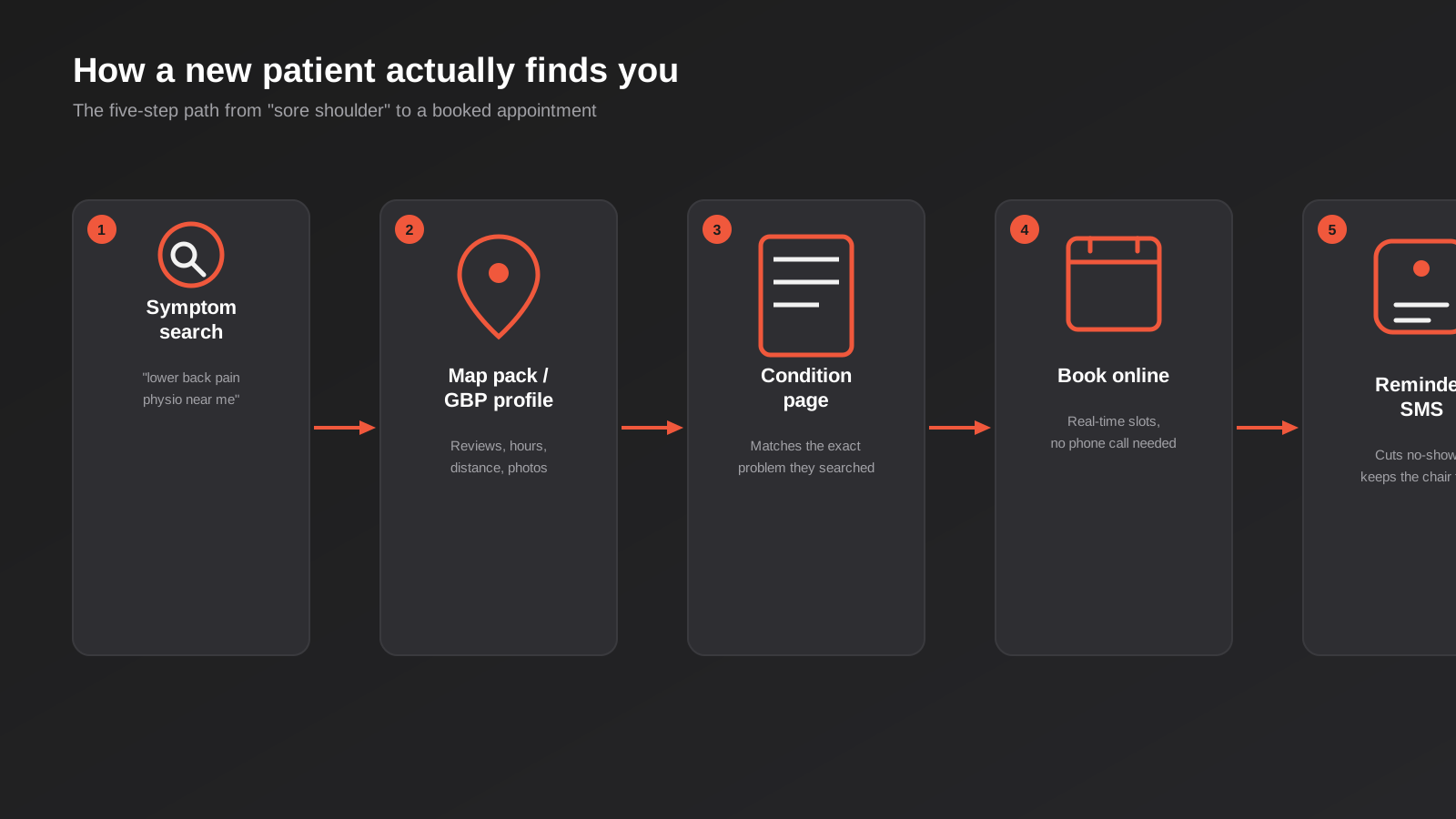
Most physiotherapy clinics still get the bulk of new patients from GP referrals, word of mouth and the physio down the road sending someone their way when they’re fully booked. That hasn’t changed. What has changed is what happens next: before that referred patient picks up the phone, they Google the clinic’s name. And a growing share of patients never get a referral at all. They wake up with a sore shoulder, type “physio near me” into their phone, and book whoever answers that search well.
We work with allied health clinics across Australia, and the pattern is consistent. Clinically excellent practices lose bookings to average ones because the average one shows up first on a map, has a real-time booking button, and a Google Business Profile with forty recent reviews. The clinical quality doesn’t even enter the decision at that point: the patient has already chosen based on who was easiest to find and easiest to book.
This guide is about physiotherapy marketing that actually closes that gap. It’s narrower than a general healthcare SEO guide, because physiotherapy has its own search behaviour, its own referral mix of GP, DVA, workers’ compensation and self-referred patients, and its own version of the AHPRA advertising rules that trip up every allied health website at some point. If you want the broader compliance picture across medical and dental practices first, we’ve covered that in our healthcare SEO and AHPRA guide. This one goes deeper into what actually works for a physio clinic specifically — from Google Business Profile structure for multi-practitioner clinics through to the booking page details that turn a Google search into a filled appointment slot. It sits alongside the dedicated work we do for physiotherapy clinic marketing and website design, if you’d rather see how we approach this end to end.
How patients actually search for a physiotherapist
Physiotherapy search traffic splits into three distinct patterns, and most clinic websites are only built for one of them.
The first is the branded search: someone searches your clinic’s name directly, usually because a GP, a friend or a specialist gave them the referral. This is the easiest traffic to win. If your Google Business Profile is accurate and your website loads properly, you’ll capture almost all of it.
The second is the local-intent search: “physio near me”, “physiotherapist [suburb]”, or just “physiotherapy clinic” with location services switched on. This is where the Google Map Pack decides the outcome before your website even gets a look. Three listings show above the fold on mobile. If you’re not one of them, you’re competing for scraps further down the page.
The third, and the one most physio websites handle worst, is the symptom or condition search — “lower back pain won’t go away”, “shoulder impingement treatment”, “physio after ACL surgery”. Patients searching this way haven’t decided they need a physiotherapist yet, let alone which one. They’re trying to understand what’s wrong with them. A website that only has a single generic “Services” page listing “Sports Injuries, Manual Therapy, Dry Needling” as three bullet points has nothing for this patient to land on. A website with a dedicated page for lower back pain, written in the language the patient actually typed, has a real shot at ranking for it and converting them.
The mix between these three varies by clinic. A sports-focused practice near a football club will see more condition-based search. A suburban general practice clinic will see more local-intent search. Multi-practitioner clinics treating everything from paediatric physio to workers’ comp rehab need to cover all three, which is exactly why a single page trying to be everything to everyone rarely ranks well for any of it.
Search volume isn’t flat across the year either, and it’s worth planning content and ad spend around it rather than treating demand as constant. Pre-season screening searches climb in the lead-up to winter and summer sporting seasons as clubs push players toward injury checks. January brings a predictable spike in new-year fitness injuries as people return to exercise they haven’t done in months. School terms shift paediatric and adolescent sports injury volume. None of this needs to be precisely forecast, but a clinic that times a “pre-season screening” landing page and a short local ad run to land a few weeks before the season starts will consistently outperform one running the exact same generic campaign year-round.
Google Business Profile for multi-practitioner clinics
For local-intent search, your Google Business Profile carries more weight than your website. It’s what shows in the Map Pack, it’s what shows in Google Maps, and for a huge share of mobile searches, it’s the only thing a patient looks at before calling or tapping “Book online”.
One profile, or one per location?
If you operate from a single physical address with multiple practitioners under one roof, you need exactly one Google Business Profile for that location — not one per physiotherapist. We still see clinics try to set up individual profiles for each practitioner at the same address, usually because a practitioner wants their own listing for personal branding. Google’s guidelines are explicit that a business profile represents a physical location a customer can visit, not an individual practitioner within it, and duplicate or near-duplicate listings at the same address get suspended or merged, often taking your review history and search visibility down with them.
If you run multiple clinics across different suburbs, each physical location gets its own profile, with its own local phone number, its own set of reviews and its own category and service list tailored to what that specific location offers. Trying to rank one “hub” profile for every suburb you service is a losing strategy: Google ties local ranking heavily to proximity, and a profile with no physical presence in a suburb will not out-rank a genuine local competitor there, no matter how well-optimised it is.
Services, categories and the booking link
Set your primary category to Physiotherapist, and add secondary categories only where they’re genuinely accurate: Physical Therapist, Sports Medicine Clinic, or Occupational Therapist if that service actually exists on-site. Padding the category list with anything remotely related dilutes relevance rather than widening your reach.
The Services section is worth more attention than most clinics give it. List out the actual conditions and treatment types you handle (sports injury rehabilitation, post-surgical rehab, dry needling, clinical Pilates, paediatric physiotherapy, vestibular rehabilitation) rather than leaving Google’s default service list untouched. Each service entry can carry a short description, and that description is indexed and can surface in search, effectively giving you extra keyword real estate inside your profile.
The booking link field should point directly to your online booking page, not your homepage. Every extra click between a mobile searcher tapping your listing and an actual time slot is a chance for them to bounce to the next clinic in the Map Pack instead.
Reviews, inside the AHPRA lines
Review volume and recency are ranking factors and trust factors at once, which makes them worth building deliberately rather than hoping they accumulate. The complication specific to physiotherapy and every other AHPRA-registered profession is that testimonials about the clinical aspects of a regulated health service (a specific diagnosis, treatment or outcome) are prohibited in advertising, and Google reviews that praise clinical results sit in a grey zone clinics need to be careful about actively soliciting or showcasing.
In practice, this means building a review request workflow that asks patients for feedback on the experience (punctuality, communication, how the front desk handled their booking, how comfortable they felt) rather than prompting for “tell us how your knee feels now”. Non-clinical service reviews are not covered by the testimonial restriction and still carry real weight with prospective patients and with Google. We go through the specific wording boundaries AHPRA draws around testimonials, before-and-after content and outcome claims in more detail in our healthcare SEO and AHPRA guide linked above, worth reading in full before you set up any automated review request sequence, since the rules apply to what the clinic solicits and displays, not only what it writes itself.
Local SEO foundations for a physiotherapy website
Writing for symptoms, not just services
Patients don’t search in clinical terminology. Nobody types “subacromial impingement syndrome” into Google on day one — they type “shoulder hurts when I lift my arm”. A page built around the condition, written in that patient language, with the clinical terms introduced alongside it rather than instead of it, captures both the early-stage symptom searcher and the patient who’s already had a diagnosis and is now shopping for treatment.
A well-structured condition page answers what the condition is, what causes it, what treatment actually looks like at your clinic, roughly how long recovery takes, and what happens in a first appointment. It ends with a clear path to book, not a generic “contact us” link. This is a genuinely different content structure from a service list page, and clinics that build five or six of these around their highest-volume conditions (lower back pain, neck pain, sports injuries, post-surgical rehab, headaches, pelvic health) consistently outperform a single catch-all services page for organic traffic.
Citations and allied health directories
Beyond Google, physiotherapy-specific directories and health-fund provider listings function as both referral sources and SEO citations. Keeping your clinic’s name, address and phone number identical across your Google Business Profile, your website, HealthEngine, Health.com.au, HotDoc and your private health fund provider directories (HICAPS, Medibank, Bupa and the rest) matters more than it sounds — inconsistent details across these sources are one of the more common, and most overlooked, reasons a clinic’s local rankings plateau despite otherwise solid content.
If you operate across several suburbs, each location needs its own genuinely distinct page with local content, not a templated page with the suburb name swapped out, or Google will treat them as duplicate content competing against each other and neither will rank well.
Schema markup and the technical basics
Structured data won’t rank a page on its own, but it gives Google a cleaner, more confident read of what your clinic is and where it operates, which helps everything else work harder. A MedicalBusiness or LocalBusiness schema block with your name, address, phone number, opening hours and geo-coordinates matching your Google Business Profile exactly is the baseline. From there, marking up individual practitioners as Person entities with their qualifications, and FAQ markup on condition pages where you genuinely answer common questions, both give search engines more to work with when deciding what to show and to whom.
Site speed matters more here than it might for a less time-pressured purchase. Someone searching “physio near me” mid-pain on their phone has close to zero patience for a slow-loading page, and will bounce back to the Map Pack and tap the next listing instead. A clinic website built on a heavy page builder with unoptimised images and five tracking scripts loading on every page is losing self-referred patients to page speed alone, often without anyone at the clinic realising it.
Content beyond condition pages: building topical authority
Condition pages do the heavy lifting for search intent, but a clinic that only ever publishes condition pages is leaving genuine ranking and trust signals on the table. Google rewards sites that demonstrate depth across a topic, not just a handful of landing pages, and patients researching an injury before booking tend to read more broadly than a single page covering “what we treat”.
A few content types consistently work well for physiotherapy clinics without requiring a full-time content team:
- Injury prevention guides for common recreational and sporting activities in your area (running, netball, cricket, weightlifting) which capture search traffic before an injury happens and build a relationship with a patient long before they need to book.
- Return-to-sport or recovery timeline content for common surgeries and injuries, which patients already under treatment search for repeatedly and share with family, generating a second wave of organic traffic and referral behaviour you don’t have to pay for.
- A genuine “what to expect at your first appointment” page, which reduces a specific, common source of pre-booking anxiety and measurably improves the rate at which an enquiry converts into a kept appointment.
- Practitioner bio pages with real qualifications, areas of interest and continuing education, not just a headshot and a job title. These feed directly into the experience, expertise, authority and trust signals Google’s own guidance has leaned on more heavily since the broader shift toward evaluating who is actually behind health content.
None of this replaces condition pages — it sits around them, and it’s the difference between a website that looks like it was built once in 2022 and one that reads like an active, trustworthy local practice today.
Website design and the booking conversion
The 30-second test
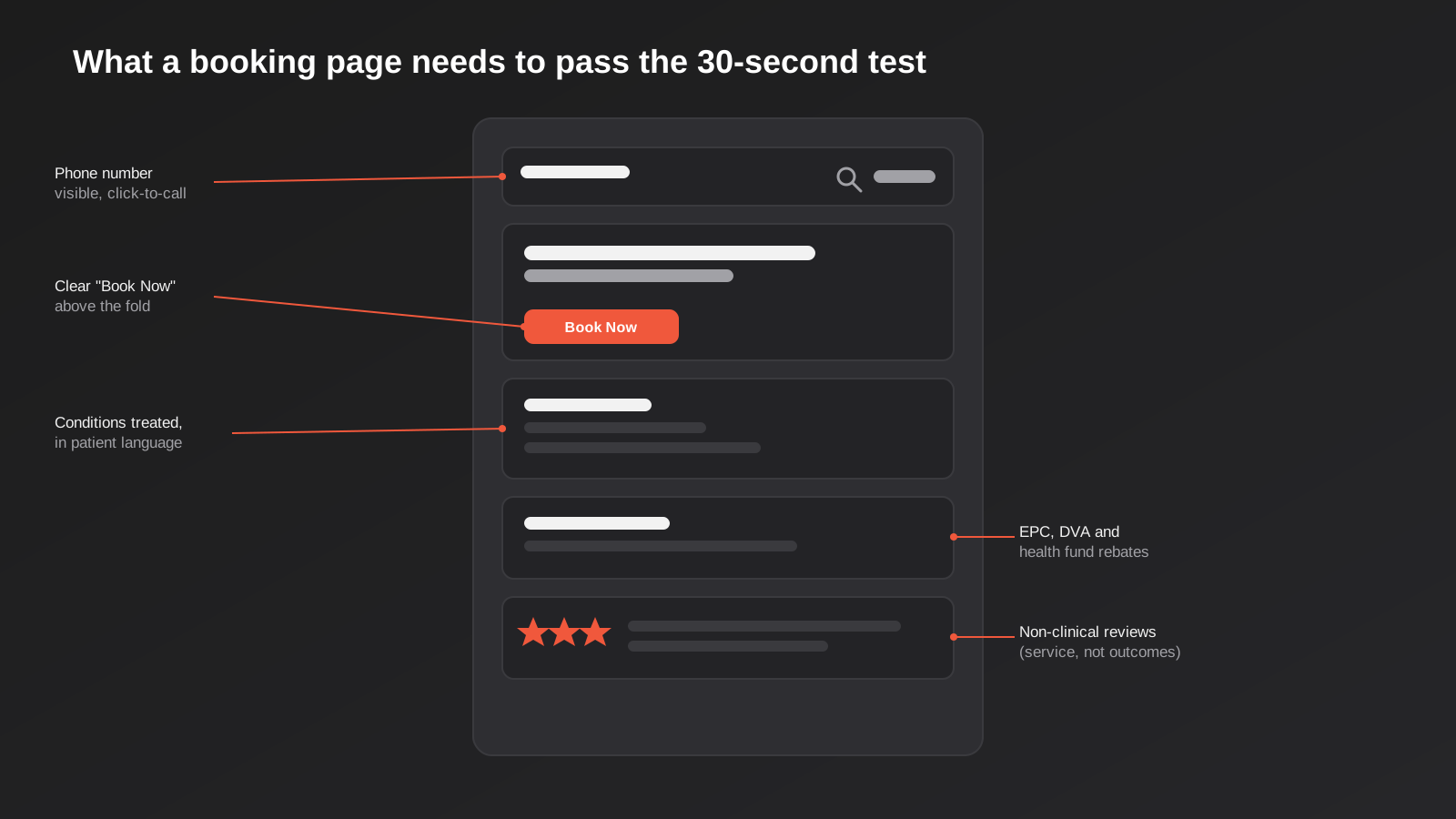
Hand your website to someone who has never seen it, on their phone, and give them 30 seconds. Can they find your phone number without scrolling? Can they tell what conditions you treat? Can they find a booking button without hunting for a “Contact” link buried in a dropdown menu? If the answer to any of those is no, you’re losing patients who would have booked with a clinic that passed the test, regardless of clinical quality on either side.
This is a design problem as much as a content problem, and it’s exactly the kind of work we do under conversion-focused design: structuring a page so the booking action is the obvious next step rather than one option among many competing for attention in the header, the hero, and three different calls to action above the fold.
Condition-specific pages that actually convert
A condition page only works if it closes with a booking path tailored to that specific visit type, not a generic enquiry form. Someone landing on a post-ACL-surgery rehab page wants to know you handle that specific recovery pathway and book in with confidence, not fill out a form and wait for a callback that may or may not confirm you even treat that condition. Where your booking software supports it, letting patients select the appointment type (initial consult, follow-up, specific program) directly from the condition page removes an entire round of back-and-forth before the first visit is even locked in.
Real-time booking, and why the phone call isn’t good enough any more
Practice management platforms common in Australian physiotherapy (Cliniko, Nookal, Front Desk and similar) all support real-time online booking widgets that can sit directly on your website. A patient who has to call during business hours to book has far more opportunities to simply not follow through: the clinic doesn’t answer, they’re put on hold, they get distracted and never call back. A patient who can see available slots and book at 9pm on a Sunday either books immediately or doesn’t, with far less drop-off in between.
This matters even more for self-referred patients researching options outside business hours, which is a meaningful share of symptom-search traffic. If your booking system requires a phone call, you’re asking a patient who found you at 9pm to remember to call back during a window when they’re probably at work.
Referrals still matter: the website carries more weight than clinics expect
Physiotherapy sits in an unusual position compared with most other local businesses, because a meaningful share of patients arrive with a referral already in hand rather than through open search. GP referrals under an Enhanced Primary Care or Chronic Disease Management plan, DVA-funded treatment for veterans, workers’ compensation cases, and NDIS-funded physiotherapy for eligible participants all bring patients to the door through a pathway that has nothing to do with Google rankings.
The mistake is assuming this reduces the importance of the website. It doesn’t. It changes what the website needs to do. A referred patient still searches your clinic name before calling, to check your hours, confirm you’re taking new patients, and see if you handle their specific referral type. A page that clearly states which funding pathways you accept (EPC, DVA, workers’ comp, NDIS, private health fund rebates) removes a genuine point of hesitation for exactly the referred patients who were always going to book anyway. We see clinics lose referred patients not because the clinical fit was wrong, but because the website gave no indication they accepted DVA clients, so the patient called a competitor who made that clear on the homepage.
Workers’ compensation referrals bring their own layer of friction worth planning for. Each state scheme (icare in New South Wales, WorkSafe in Victoria, WorkCover in Queensland, and the equivalents elsewhere) maintains its own approved provider requirements and paperwork expectations, and a clinic that makes it obvious it’s set up to handle this (claim numbers, certificates of capacity, direct liaison with case managers) removes a real barrier for both the patient and the referring GP who has to choose where to send them. A short, clearly written page explaining how your clinic handles workers’ comp claims does more for this referral stream than any amount of general SEO work.
If your clinic also treats NDIS participants, it’s worth reading our guide to marketing for NDIS providers in Australia, which covers how participants, families and support coordinators actually search for and vet providers — a meaningfully different research process from a self-referred patient Googling “physio near me”.
Keeping patients once they’ve booked
Winning the booking is only half the job. Physiotherapy treatment plans typically run across multiple sessions, and no-shows and late cancellations are a direct hit to a clinic’s revenue that has nothing to do with marketing and everything to do with basic operational follow-through.
Automated SMS and email reminders sent 24 to 48 hours ahead of an appointment reduce no-shows meaningfully, and they’re a standard feature in most practice management platforms rather than something requiring custom development. The same automation can handle the administrative load around a new booking: sending intake forms ahead of the first visit, confirming health fund or DVA details, and prompting a review request a day or two after a completed appointment, worded around the service experience rather than clinical outcomes for the reasons covered above.
The other side of retention is the patient who completes a treatment plan and simply never comes back, even when a maintenance session or a seasonal check-in would genuinely help them. Booking the next appointment before the patient leaves the clinic, rather than leaving it to them to remember and rebook later, is the single highest-leverage habit a front desk can build, and it costs nothing beyond a change in process. For patients who finish active treatment entirely, a simple automated check-in three or six months later (“how’s the shoulder holding up?”) keeps the clinic front of mind and catches a meaningful number of recurrences before they turn into a search for a different physio altogether.
None of this is a one-off setup. A website and a Google Business Profile both need ongoing attention: new condition pages as your services expand, updated hours around public holidays, fresh photos, and a Core Web Vitals check now and then as plugins and booking widgets get updated. This is the kind of ongoing maintenance we handle under website care and support, so it doesn’t end up as the thing that quietly falls off a practice manager’s already full plate.
Common mistakes we see in physiotherapy marketing
- Running one Google Business Profile per practitioner at a shared address, instead of one profile for the location, which risks suspension and splits your reviews across multiple listings.
- Asking for or displaying reviews that praise specific clinical outcomes, which sits against AHPRA’s testimonial restrictions for regulated health services.
- Building a single generic services page instead of dedicated pages for the conditions that drive the most search volume for your clinic.
- Requiring a phone call during business hours to book, which loses after-hours self-referred patients who found you through a symptom search.
- Leaving funding pathways (DVA, NDIS, EPC, workers’ comp, health fund rebates) off the website entirely, creating hesitation for referred patients who were always going to book.
- Using the exact same page template across multiple clinic locations with only the suburb name changed, which Google treats as duplicate content and ranks poorly as a result.
- Letting the Google Business Profile services list sit at its unedited default instead of filling it out with the actual conditions and treatments the clinic offers.
- Letting a patient leave without their next appointment booked, relying on them to remember to rebook rather than locking it in before they walk out the door.
- Ignoring page speed on a mobile-heavy, pain-driven search audience, where a slow-loading page loses patients to the next Map Pack listing before they’ve even seen what the clinic offers.
Frequently Asked Questions
How long does local SEO take to show results for a physiotherapy clinic?
Google Business Profile improvements — better categories, a complete services list, new photos — can shift Map Pack visibility within a few weeks. Organic website rankings for condition and symptom pages typically take three to six months to gain meaningful traction, longer in competitive metro suburbs with several established clinics already ranking. Clinics that have never had a dedicated SEO presence tend to see the steepest early gains, since there’s more low-hanging fruit to capture.
Can physiotherapists use patient testimonials in marketing at all?
AHPRA’s advertising guidelines prohibit testimonials about the clinical aspects of a regulated health service — comments on a specific diagnosis, treatment or outcome. Feedback about the non-clinical experience, such as friendliness, punctuality or how a booking was handled, isn’t covered by that restriction. The distinction matters for how you word review requests and what you choose to feature on your site. Our healthcare SEO and AHPRA guide goes through this in more depth, including what counts as a testimonial under AHPRA’s own definition.
Do I need a separate website page for each clinic location?
Yes, if each location is a genuine physical premises with its own address, practitioners and Google Business Profile. Each location page needs distinct content (the practitioners on-site there, parking and access details, and ideally a condition or service emphasis specific to that clinic) rather than a templated page with only the suburb name changed, which search engines read as duplicate content.
What should a physiotherapy clinic’s booking page actually include?
At minimum: a visible, click-to-call phone number, a prominent booking button above the fold, the conditions treated in plain language rather than only clinical terms, accepted funding pathways (DVA, NDIS, EPC, health fund rebates), and service-based (non-clinical) reviews. Real-time appointment availability, where your practice management software supports it, removes one of the biggest drop-off points between finding the page and actually booking.
Is paid advertising worth it for a physiotherapy clinic, or is SEO enough?
It depends on how saturated local SEO already is in your suburb and how quickly you need to fill new-practitioner capacity. SEO compounds over time but takes months to build; Google Ads can fill gaps immediately, particularly around a specific high-value condition page or when a new practitioner joins and needs a full book quickly. Most established clinics eventually run both, with SEO carrying the steady baseline and ads used tactically to fill short-term capacity gaps.
How much does marketing for a physiotherapy clinic typically cost in Australia?
It varies with how many locations you’re marketing and how competitive your local search landscape already is, but the underlying cost drivers (content production, technical SEO work and ongoing management) are the same ones that apply across local SEO generally, with Google Business Profile and condition-page work usually sitting at the more affordable end and multi-location campaigns scaling up from there.
Where to start
If you’re reading this because your clinic relies almost entirely on referrals and walk-ins, the fastest win is usually the Google Business Profile: it takes a few hours to properly rebuild the services list, fix the categories and tidy up photos, and the Map Pack visibility gains can show within weeks. If your website hasn’t been touched since it was built, the 30-second test is worth running honestly before anything else: hand it to someone outside the clinic and watch where they get stuck.
Good physiotherapy marketing isn’t one-size-fits-all: every clinic’s mix of referral sources, locations and growth priorities is different, and the right starting point depends on which of those is actually holding your bookings back. If you’d like a second opinion on where your clinic’s website and local presence stand right now, we’re happy to have a look and talk through what we’d prioritise first, no pressure, just a practical read on what’s working and what isn’t.
Keep reading
Related posts
Psychology Practice Marketing in Australia: Local SEO, Compliant Copy and the Waitlist Problem (2026)
How Australian psychology practices handle local SEO, AHPRA-compliant copy and waitlist triage when they're already at capacity (2026).
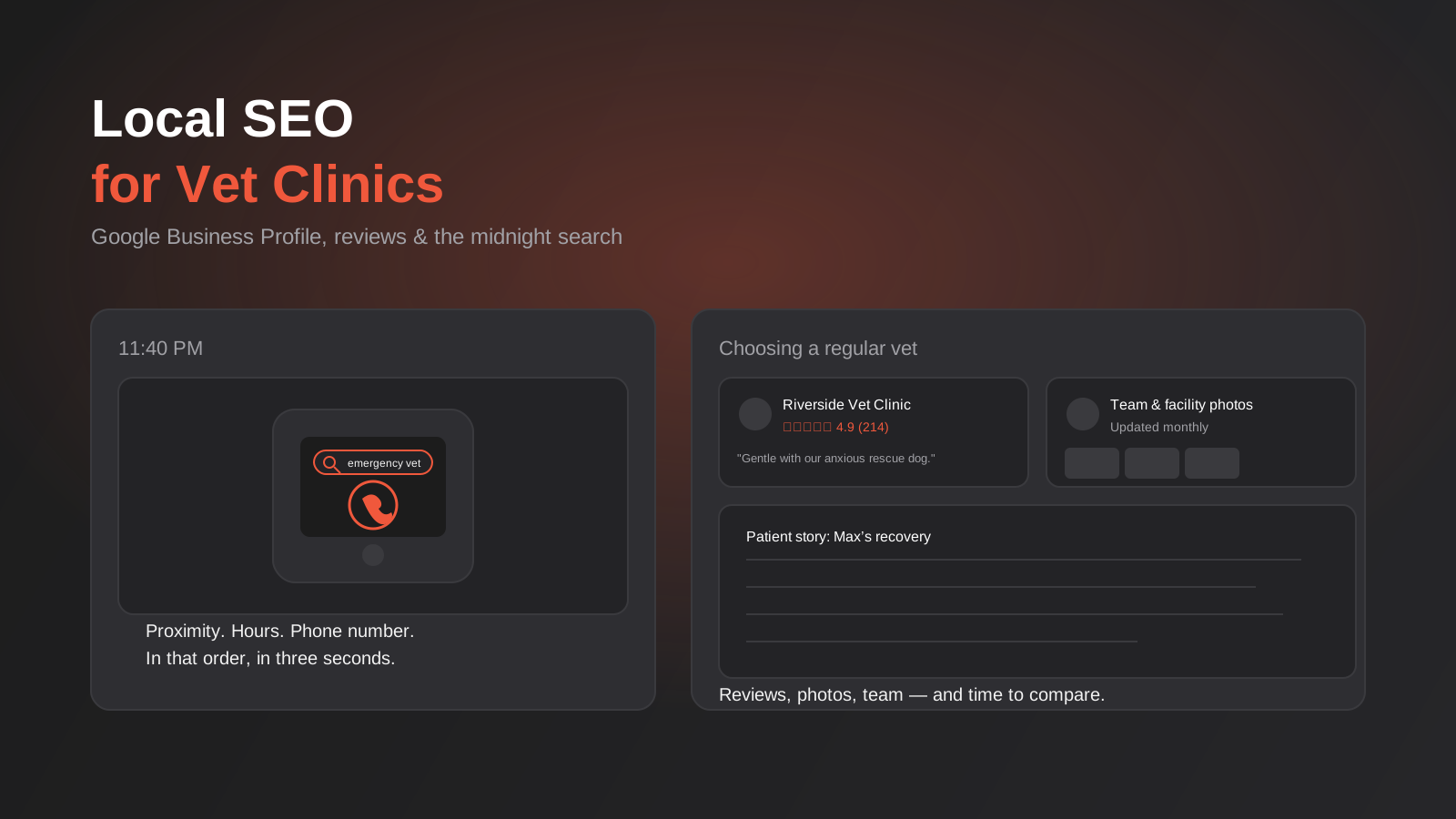
Local SEO for Veterinary Clinics in Australia: Google Business Profile, Reviews and the Emergency Search (2026)
Veterinary clinic SEO explained: Google Business Profile, review generation and the emergency search most vet websites get wrong.
Marketing for NDIS Providers in Australia: How Participants, Families and Support Coordinators Actually Find You (2026)
How NDIS providers get found by participants, families, support coordinators and plan managers — SEO, compliance and the 2026 registration shift.
Got a project you'd like to talk through?
Tell us what you're working on — we'll come back with a plan.
