
Marketing for NDIS Providers in Australia: How Participants, Families and Support Coordinators Actually Find You (2026)
 Jignesh Vagadiya
06/10/2026
23 min read
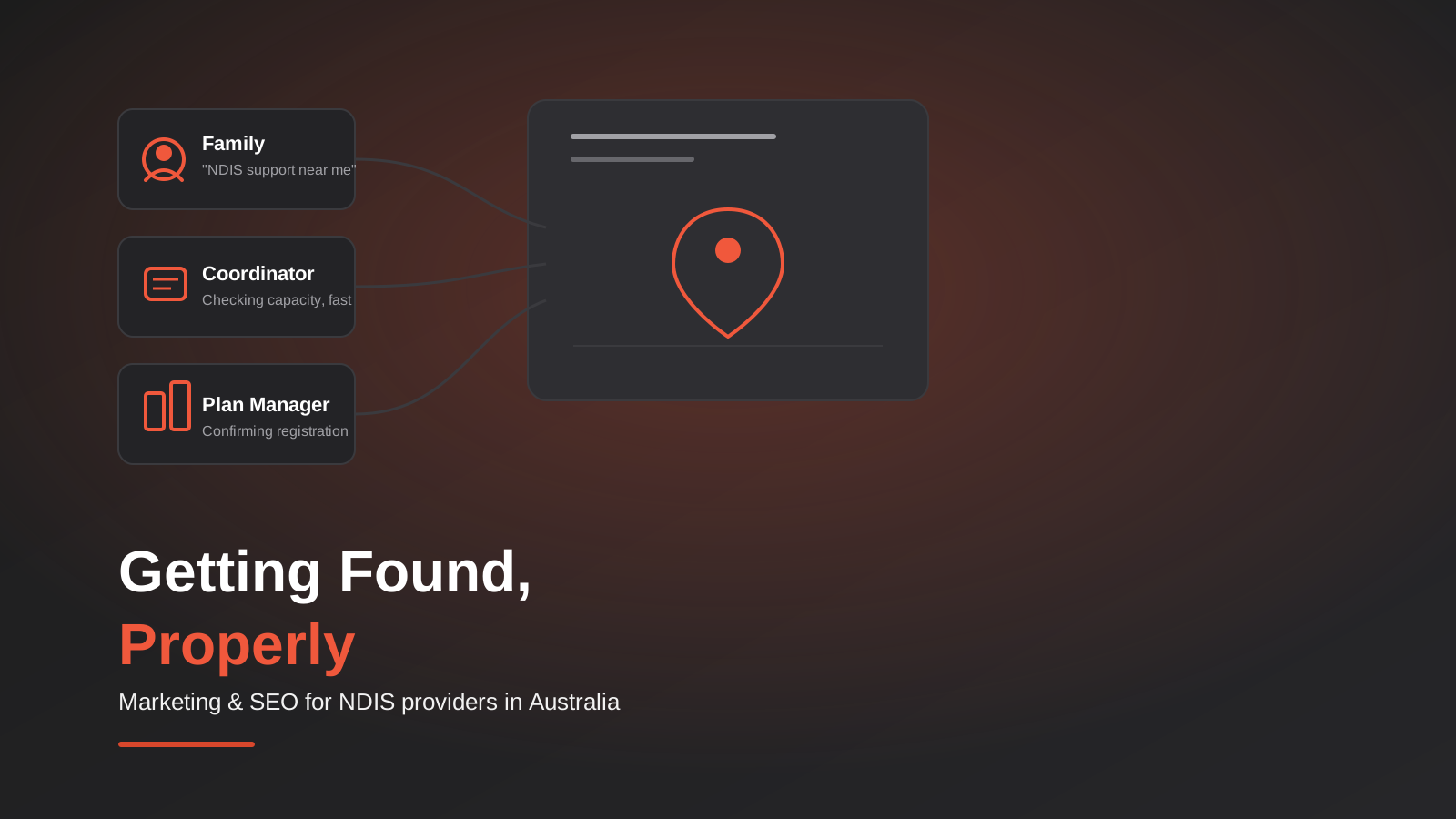
A support coordinator sitting at her desk with twelve open plan reviews doesn’t Google “best disability support provider.” She types the suburb, the service type, and maybe “SIL vacancy” or “accepting new participants,” and she picks from whoever answers the phone fastest and looks legitimate on the first click. A participant’s mother doing the same search at 9pm after a diagnosis appointment is asking something completely different, in completely different language, and she’s reading reviews nobody wrote with SEO in mind. Both of them end up on Google. Almost nothing else about how they search is the same.
That’s the problem with most marketing advice aimed at NDIS providers: it treats the sector like any other local service business with a disability label stuck on top. Set up a Google Business Profile, collect reviews, write some blog posts, run a few ads. None of that is wrong exactly, but it skips past what actually makes this category different — three distinct audiences searching for three different reasons, a regulator with its own advertising rules that aren’t the same as AHPRA’s, a registration status that’s about to become a much bigger trust signal than it currently is, and a referral economy running through support coordinators and plan managers that most generic SEO content never mentions.
We’ve built websites and SEO for providers across supported independent living, community access, allied health-adjacent supports and plan management, and the brief is rarely just “get more traffic.” It’s “get found by the right person, for the right service, in a way that doesn’t read as either generic or pushy.” This guide covers how NDIS participants, families and referral partners actually search in 2026, what the NDIS Quality and Safeguards Commission’s rules mean for what you can publish, the local SEO and content work that actually moves the needle, and why the mandatory registration changes landing this year are about to reshape how providers need to present themselves online. If your practice includes AHPRA-registered allied health professionals, our healthcare SEO guide covers that regulatory layer in more depth — this article is about the broader NDIS provider landscape, which includes a lot of services and search behaviour AHPRA never touches.
Three Searchers, Three Completely Different Journeys
Most local SEO advice assumes one kind of searcher: someone nearby, looking for a service, ready to book. NDIS marketing has to work for at least three, and conflating them is where a lot of provider websites go wrong.
Participants and families: emotional, specific, and often searching in a crisis moment
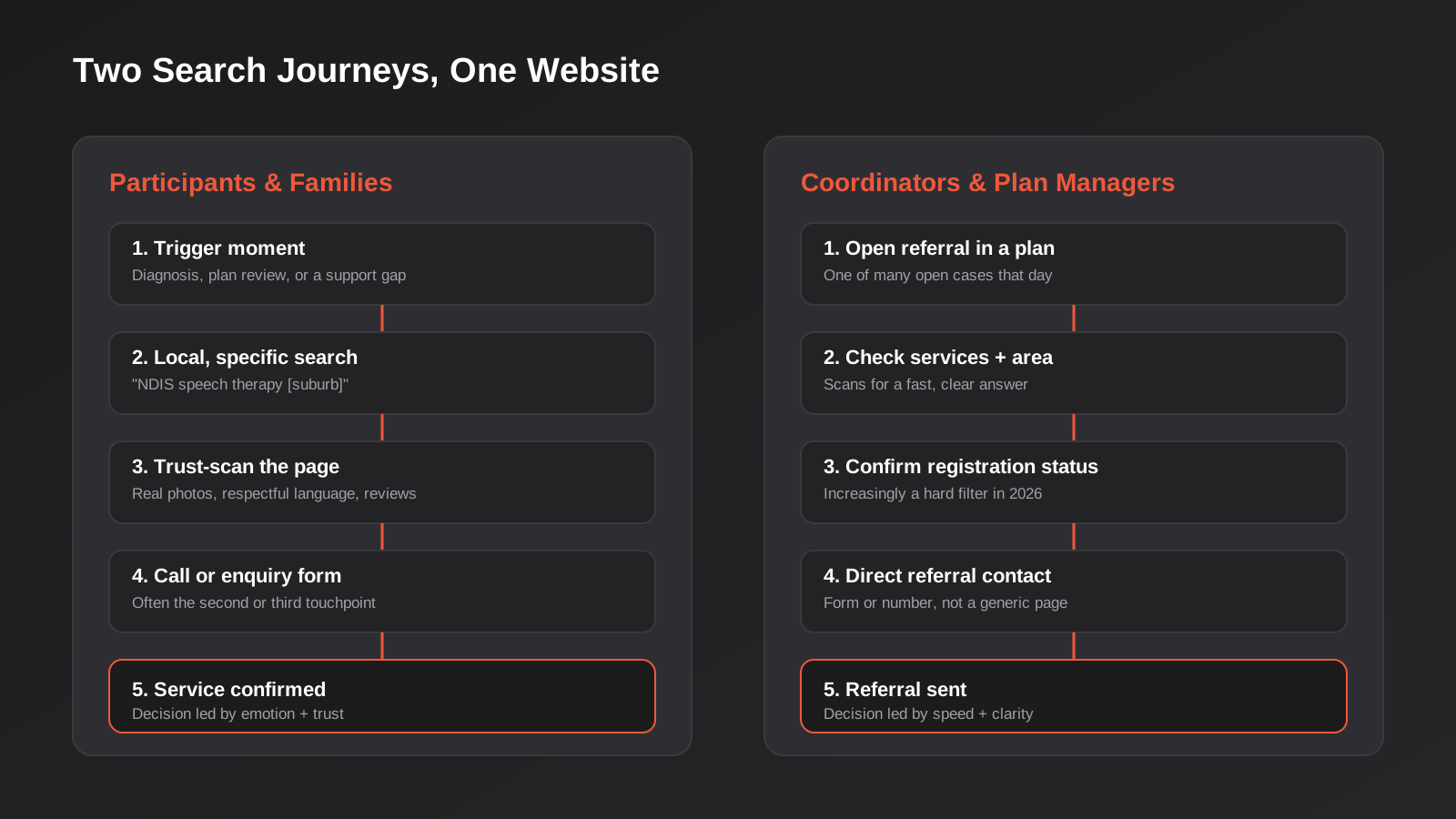
A parent searching for early childhood intervention support, or an adult newly approved for a plan searching for community access options, is rarely in a calm, comparison-shopping headspace. The search often follows a diagnosis, a planning meeting, a falling-out with a previous provider, or a sudden gap in support. Queries tend to be specific and local — “NDIS speech therapy [suburb],” “SIL vacancy near me,” “NDIS provider that works with autistic teenagers” — and the decision leans heavily on trust signals that are quick to read: does this provider look like it understands my situation, are the photos and language respectful rather than clinical or stock-photo generic, and do the reviews (where they exist) sound like real families rather than marketing copy.
This group also searches more on mobile, more outside business hours, and more often starts from a Facebook group, a parent forum or a word-of-mouth recommendation before they ever reach Google — which means your website needs to hold up as the second or third touchpoint, confirming what someone already half-decided, not just winning a cold click.
Support coordinators and plan managers: fast, transactional, and judged on responsiveness
This is the audience most NDIS marketing content ignores, and it’s often the one that actually drives volume. A support coordinator working through a participant’s plan needs to place a referral quickly, confirm a provider has capacity, and move on to the next case. They’re not reading your “About Us” story. They want to know, fast: what services do you actually deliver, in which suburbs, do you have availability, are you registered (increasingly non-negotiable, covered below), and how do we get in touch with someone who’ll actually respond. Providers who make this information genuinely easy to find — a clear services-and-areas page, a direct phone number or referral form that doesn’t require six clicks, response times that are actually fast — get referred again. Providers who bury that information under generic mission-statement copy don’t.
Case managers, LACs and NDIA planners: searching on behalf of someone else, cautiously
A third group — Local Area Coordinators, NDIA planners, hospital discharge staff — searches to build a shortlist for someone else’s decision, often under time pressure and often erring toward the safest, most obviously credible option rather than the most creative or cheapest. For this audience, clarity and compliance read as competence. A site that’s vague about registration status, light on detail about qualifications and screening, or inconsistent across its directory listings reads as a risk they’d rather not recommend, even if the actual service quality is fine.
What You Can and Can’t Say: The NDIS Commission’s Rules on Advertising
This isn’t legal advice, and any provider should check current guidance directly with the NDIS Quality and Safeguards Commission or their own compliance adviser — but these are the restrictions that come up constantly when planning NDIS marketing content.
The NDIS Code of Conduct governs how you advertise, not just how you deliver services
The NDIS Code of Conduct requires providers to act with honesty, integrity and transparency in all dealings with participants, including how services are promoted. In practice this means marketing claims need to be accurate and not create unreasonable expectations about outcomes, participants’ dignity and privacy need to be respected in any content that features them, and language needs to be respectful and avoid outdated or infantilising framing — no stock photography of a participant being “cared for” in a way that strips them of agency, no language implying a support will “fix” a disability rather than support someone to live the life they want.
Unlike AHPRA’s advertising rules, which apply specifically to registered health practitioners and are enforced with a defined penalty regime, the NDIS Commission’s advertising expectations sit inside the broader Code of Conduct and Practice Standards. That makes them somewhat less prescriptive line-by-line, but the underlying principle is the same one that should shape every piece of content: don’t promise outcomes you can’t guarantee, and don’t use someone’s story without their genuine, informed say-so.
Testimonials, case studies and informed consent
Unlike AHPRA, the NDIS Commission doesn’t broadly prohibit testimonials — but it does require genuine, informed consent before using a participant’s story, image or quote in marketing, and that consent needs to account for the fact that many NDIS participants are people with cognitive disability, guardianship arrangements, or other factors that make “informed” consent a genuinely higher bar than ticking a box on an intake form. A participant or their nominee needs to understand specifically what they’re consenting to (a quote on a website, a photo in a brochure, a video testimonial) and be able to withdraw that consent later. Providers that collect a blanket “we may use your information for marketing” signature at intake and then run with it are taking on more risk than they probably realise, particularly if a family later objects to how a child’s story was used.
The practical approach most providers land on: ask specifically and separately for marketing consent, keep records of what was agreed to and when, offer an easy way to withdraw it, and favour outcomes described in general terms (“supports people to build independent living skills”) over specific before-and-after claims that could misrepresent what’s typical.
Where AHPRA rules stack on top
A good number of NDIS providers employ or contract AHPRA-registered practitioners — physiotherapists, psychologists, occupational therapists, speech pathologists. For any content specifically about services those practitioners deliver, AHPRA’s advertising rules apply in addition to the NDIS Code of Conduct, which means the testimonial restrictions and outcome-claim limits covered in our healthcare SEO guide kick in for that specific slice of your content even if the rest of your service offering sits outside AHPRA’s scope entirely. It’s worth mapping, service by service, which parts of your site touch an AHPRA-registered profession and which don’t, rather than applying one blanket compliance standard across content that actually sits under two different frameworks.
Local SEO Foundations, Built for a Multi-Service, Multi-Region Reality
Most of the local SEO fundamentals that apply to any Australian business apply here too — we’ve covered the mechanics in general in our local SEO guide. What’s different for NDIS providers is the shape of the business: most run multiple service lines (support coordination, SIL, community access, STA, capacity building) across multiple suburbs or regions, which is exactly the setup that trips providers into either one enormous unfocused page or dozens of thin, near-duplicate ones.
Google Business Profile for a service area, not a storefront
Our Google Business Profile guide covers the general setup in depth; a few things matter specifically for NDIS providers. Most deliver support in participants’ homes or in the community rather than from a single physical shopfront, which means setting up the profile as a service-area business rather than a storefront location, with an accurate list of the suburbs or regions actually covered — not every suburb in the state on the theory that more coverage can’t hurt. An inflated service area dilutes relevance for the areas you actually operate in and can trigger quality reviews from Google if your listed reach doesn’t match your actual footprint. Category selection matters too: “Disability services and support organisation” reads differently to Google than a generic “non-profit organisation” category, and getting the specific service categories right (support coordination, community care, home health care service) shapes which searches you actually surface for.
NAP consistency across the directories that are specific to this sector
Beyond the usual local citations, NDIS providers accumulate listings on sector-specific directories that general local SEO audits routinely miss: the NDIS Provider Finder on the myplace portal, platform marketplaces like Mable and Hireup where relevant, peak body member directories, and community organisation referral lists. Name, address and phone number need to match exactly across every one of these, because support coordinators and families both use them as shortlist tools, and a mismatched number or an outdated service list on even one of these sends a real chunk of your discovery traffic to the wrong place.
Service-area pages that earn their place
A page per region only works when there’s something genuinely specific to say about that region — the actual team members who cover it, specific partner organisations or referral relationships in that area, any region-specific intake process. A templated page with a swapped suburb name and otherwise identical copy is thin content that both frustrates the families trying to get real information and gives Google nothing distinct to rank. If you cover six regions with meaningfully different teams or capacity, six real pages beat one generic page or six thin ones. If the service is genuinely identical everywhere, one strong page describing the full service area usually outperforms a set of near-duplicates.
Structuring Content Around How the NDIS Actually Categorises Supports
A website that says “we provide quality disability support services” and little else is invisible to search, because nobody searches that way. Families, coordinators and planners search and think in NDIS terms — Core Supports, Capacity Building, Capital Supports, and the specific line items underneath them. Structuring your service pages around these categories, in the language participants and coordinators actually use, is the single biggest content lever available.
Build around support categories and specific line items, not generic service names
Rather than one page titled “Our Services” listing everything in a paragraph, separate pages (or well-structured sections) for the actual categories you deliver — Supported Independent Living, Short Term Accommodation, Community Participation, Capacity Building for daily living, Support Coordination — each written around what a participant or coordinator actually needs to know: what the support involves day-to-day, who delivers it and their qualifications or screening, what a typical intake and onboarding process looks like, and which regions and participant cohorts (age groups, disability types, communication needs) it’s set up for. This does double duty: it’s the structure Google rewards because it matches real search intent, and it’s the structure a support coordinator scanning quickly can actually use to confirm fit in under a minute.
SIL, SDA and STA deserve their own depth
Supported Independent Living, Specialist Disability Accommodation and Short Term Accommodation are high-value, high-intent searches with real commercial weight behind them, and they’re also the categories most affected by the mandatory registration reforms landing in 2026 (more on that below). A generic “accommodation support” page undersells what’s often a provider’s most complex and differentiated offering. Pages here benefit from specifics most providers are hesitant to publish but that genuinely help the right person self-select: typical vacancy patterns, the kind of participant the home or program suits, how compatibility and house dynamics are managed, and current registration status stated plainly.
Write for the decision-maker, who often isn’t the participant reading the page
A meaningful share of NDIS service pages are read by a parent, guardian, support coordinator or plan manager making or heavily influencing the decision on someone else’s behalf. That doesn’t mean writing about participants in the third person as though they’re not the audience at all — respectful, person-first content matters regardless of who’s reading — but it does mean the practical details a decision-maker needs (screening checks, staff-to-participant ratios, communication protocols with families, what happens if a support worker is unavailable) need to be easy to find rather than assumed to be obvious or covered in a phone call later.
Why Registration Status Is About to Become a Much Bigger Trust Signal
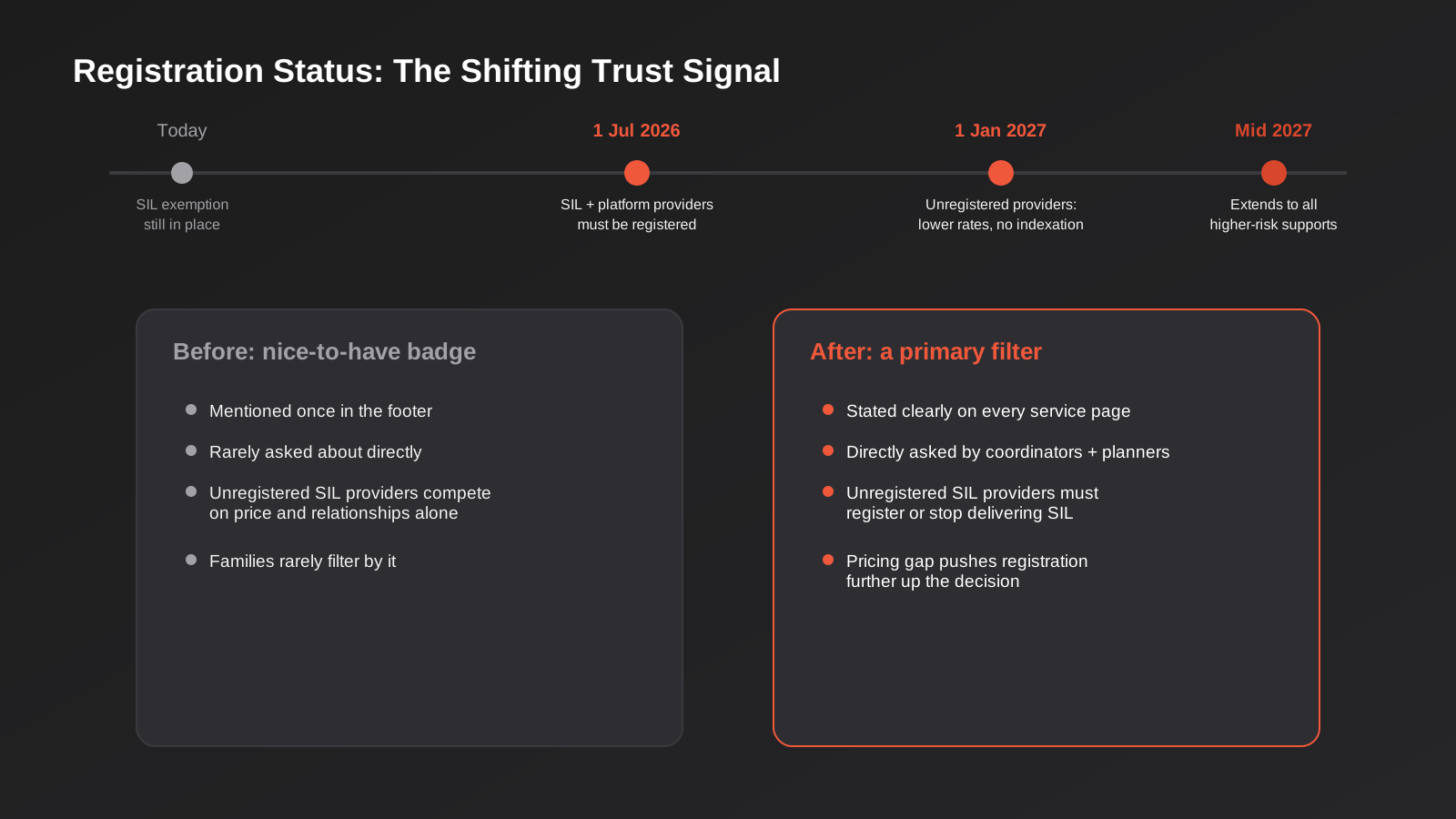
From 1 July 2026, mandatory registration with the NDIS Commission extends to providers delivering Supported Independent Living and to platform providers, closing an exemption that previously let a meaningful share of SIL providers operate unregistered. Unregistered providers currently delivering SIL need to complete registration (or cease delivering it) by the relevant deadline, and from 1 January 2027 unregistered providers of certain community-participation supports face a pricing disadvantage — paid less and without the indexation increase that registered providers keep. The reform pathway extends further from mid-2027, broadening mandatory registration to other higher-risk support categories.
The marketing implication is straightforward: “registered NDIS provider” stops being a nice-to-have badge and starts being close to table stakes for the services affected, and families, support coordinators and planners — already somewhat wary of unregistered providers after high-profile Royal Commission coverage of the sector — are increasingly likely to filter on it explicitly. That means registration status needs to be stated clearly and prominently (not just buried in a footer or a PDF), supported with the actual registration details where appropriate, and reflected in your Google Business Profile and directory listings consistently. For providers still working through registration ahead of a deadline, being transparent about where that process is up to tends to land better with a cautious decision-maker than saying nothing and hoping the question doesn’t come up.
Reaching the Real Referral Engine: Support Coordinators and Plan Managers
Most NDIS marketing effort goes toward the participant-facing side of the funnel, but for a lot of providers, the actual volume lever is the referral relationship with support coordinators, plan managers and Local Area Coordinators. This is closer to B2B marketing than consumer marketing, even though it sits on what looks like a consumer-facing website.
Make the referral-relevant information easy to find fast
Support coordinators referring on behalf of a participant want a small, specific set of facts, quickly: services offered, areas covered, current capacity or vacancy status, registration status, and the fastest way to make contact — ideally a direct referral form or email rather than a generic contact page that routes through reception. Providers who put this information on one clearly findable page, rather than scattered across service pages and a PDF brochure, get referred more often simply because they’re easier to refer to under time pressure.
Responsiveness is a marketing asset, not just an operational metric
Support coordinators consistently report choosing providers who respond within hours, keep them updated without chasing, and don’t drop the ball on a referral once it’s sent. None of that is a website feature exactly, but it’s worth building the expectation into your site copy and your actual process — a stated response-time commitment, a direct line for coordinators separate from the general enquiry form — because word travels fast in a relatively small, networked referral community, and a reputation for being easy and reliable to work with compounds over time in a way that no amount of SEO content replaces.
Content that speaks to referral partners directly
A short section or page aimed specifically at support coordinators and plan managers — covering what makes your service distinct, your intake process from a referral partner’s perspective, and any specialisation worth knowing about (experience with a particular disability type, behaviour support capability, specific age cohorts) — gives this audience something to scan and remember, and it’s content almost no competitor bothers to write because it doesn’t look like “normal” marketing. That gap is exactly why it’s worth filling.
Reviews, Trust Signals and the Parts of This That Are Genuinely Hard to Fake
Reviews matter here as much as in any local SEO category, with a wrinkle: a participant with communication difficulties, or a family navigating a difficult period, isn’t always going to leave a review unprompted, and some of the families most satisfied with a service are the least likely to have the time or inclination to write about it publicly. Making it genuinely easy — a short text link after a positive interaction, a QR code that goes straight to a review form — without pressuring anyone, respects both the reality of who’s being asked and the Code of Conduct’s expectations around dignity and consent.
Beyond reviews, the trust signals that do real work in this sector are the ones that are hard to fake convincingly: specific, named staff with real qualifications and screening credentials rather than generic “our caring team,” transparent and current registration status, clear and respectful photography that doesn’t rely on stock imagery, and plain information about costs, funding categories and what’s covered under which part of a plan. Providers who get this level of specificity right consistently outperform providers running polished but generic marketing, because the audience reading closely — coordinators, planners, cautious families — is specifically looking for the signals that separate a real, accountable service from a template.
Paid Advertising: What’s Different for This Sector
Paid search and social can work for NDIS providers, particularly for newer services or competitive categories like SIL and allied-health-adjacent supports, but a few sector-specific wrinkles are worth planning for. Both Google and Meta treat disability as a sensitive interest category under their personalised advertising policies, in the same family of restrictions that applies to health conditions — which means building granular remarketing audiences off, say, visitors to a specific disability-type service page is likely to be restricted or blocked outright, similar to the limits healthcare providers run into with condition-specific retargeting.
The practical workaround most providers use is broader targeting and optimisation — at the level of “visited the site and enquired” rather than segmented by specific disability or support type — alongside keyword and placement targeting based on the search terms and interests of support coordinators and plan managers rather than assumed participant demographics, which are harder to target reliably and more likely to trip sensitive-category restrictions in the first place. Ad copy also needs the same honesty-and-no-unreasonable-expectations standard as organic content; a time-limited “book now and save” style offer sits as awkwardly with the Code of Conduct in paid media as it would on a service page.
Measuring What Actually Matters
Standard SEO and ads reporting — rankings, traffic, form fills — only tells part of the story for an NDIS provider, because a meaningful share of genuine leads arrive by phone or through a referral from a support coordinator who found you via a directory rather than your website directly. Worth tracking specifically: call volume and source (call tracking numbers on the website versus the Google Business Profile versus printed material), referral source where it’s captured at intake (did this family find you via Google, a coordinator, a Facebook group, a directory), vacancy-to-enquiry conversion for SIL and accommodation services specifically, and — because the reform landscape is shifting under the sector in 2026 and 2027 — how often registration status comes up as a question or an objection during intake, since that’s a leading indicator of how much weight it’s carrying in the market.
It’s also worth setting realistic timeframes. Local SEO and content work for a newer provider typically shows meaningful movement in three to six months, faster for less competitive service categories or regions and slower for heavily contested urban SIL and support coordination searches. Referral relationships with support coordinators build on a longer, more relational timeline that content alone won’t shortcut — the website and SEO work make you findable and credible when a coordinator checks you out, but the relationship itself is usually built through responsiveness and consistent delivery over multiple referrals, not a single good first impression online.
Common Mistakes in NDIS Provider Marketing
- Writing one generic “Our Services” page instead of structuring content around actual NDIS support categories. Nobody searches for “quality disability support” — they search for support coordination, SIL, or a specific capacity-building category, and your content needs to meet that language.
- Treating all three searcher types the same. A site built purely for an emotional family search misses the support coordinator trying to confirm capacity and registration status in under a minute, and vice versa.
- Collecting a blanket marketing-consent signature at intake instead of specific, informed consent. This is a real risk area given how many participants have cognitive disability or guardianship arrangements that make a standard checkbox inadequate.
- Burying registration status, or treating it as a footer detail. With mandatory registration expanding through 2026 and 2027, this is heading toward a primary trust filter, not a minor credential.
- Ignoring sector-specific directories in NAP consistency checks. The myplace provider finder and platform marketplaces carry real discovery weight that a standard local SEO audit often misses entirely.
- No content or page aimed at support coordinators and plan managers specifically. For a lot of providers this is the actual referral engine, and it’s left to a generic contact page more often than not.
- Stock photography and outdated, non-person-first language. Beyond the Code of Conduct implications, it reads as generic to the exact audience — families and coordinators — who are specifically looking for signs that a provider actually understands disability support, not just sells it.
Frequently Asked Questions
Can NDIS providers use participant testimonials in marketing?
Yes, unlike AHPRA’s rules for registered health practitioners, the NDIS Commission doesn’t broadly prohibit testimonials. The requirement is genuine, informed consent — the participant or their nominee needs to clearly understand what they’re agreeing to, be able to withdraw consent later, and not be pressured into providing it. If any part of the service involves an AHPRA-registered practitioner, that specific content needs to follow AHPRA’s stricter testimonial rules as well.
Do I need to be a registered NDIS provider for SEO and marketing to work?
No, unregistered providers can still be found and chosen through search and referrals today, particularly for support categories that don’t yet require registration. That said, mandatory registration is expanding significantly from 1 July 2026 for SIL and platform providers, with pricing disadvantages for unregistered providers in other categories following from 2027, so registration status is becoming a more prominent factor in how families and coordinators filter their options regardless of what your SEO looks like.
How important are Google reviews for an NDIS provider compared to other trust signals?
Reviews matter, but they’re one signal among several, and they can be harder to collect naturally in this sector than in a typical local business given the nature of some participants’ circumstances. Specific, named staff qualifications, transparent registration status, and plain, accurate information about costs and services often carry as much or more weight with cautious decision-makers like support coordinators and planners as review volume alone.
Should our website be built more for participants and families, or for support coordinators?
Both, but they need different things from the same site. Families respond to respectful, specific, trust-building content about what a support actually involves. Support coordinators want to quickly confirm services, areas, capacity and registration status, ideally from one clearly structured page, and a fast, direct way to make contact. A site that only does one of these well is leaving real referral volume on the table.
Can we run Google Ads or Facebook Ads for NDIS services?
Yes, but both platforms treat disability as a sensitive advertising category, which restricts granular remarketing based on specific disability types or condition-related page visits. Broader targeting and optimising toward overall enquiries rather than segmented audiences generally stays within policy, and it’s worth reviewing ad copy against the same honesty and no-unreasonable-expectations standard the NDIS Code of Conduct applies to organic content.
How long does it take to see results from NDIS provider SEO?
Local SEO improvements — Google Business Profile optimisation, directory consistency, basic content structure — typically start showing movement within three to six months, similar to other local service categories. Competitive, high-value categories like SIL in metro areas take longer to move organically than less contested support categories or regional areas. Referral relationships with support coordinators build on a separate, longer timeline driven more by responsiveness and delivery than by content alone.
Where to Start
If your current website reads as one generic disability-services page with a stock photo and a contact form, the fix isn’t necessarily a full rebuild — it’s usually restructuring around the support categories you actually deliver, getting registration status and service-area details genuinely easy to find, and building the one page most providers skip entirely: a clear, fast-to-scan page for support coordinators and plan managers who are trying to decide whether to refer to you. From there, Google Business Profile accuracy and NAP consistency across the sector-specific directories tend to be the highest-leverage next steps.
This is a genuinely specialised corner of the SEO work we do, alongside healthcare and medical practices and other regulated, trust-sensitive sectors. If you’d like to talk through what this would actually look like for your services and regions — including where the 2026 registration changes might affect how you present yourself online — get in touch and we’ll have a straightforward conversation about what’s realistic.
Keep reading
Related posts
Psychology Practice Marketing in Australia: Local SEO, Compliant Copy and the Waitlist Problem (2026)
How Australian psychology practices handle local SEO, AHPRA-compliant copy and waitlist triage when they're already at capacity (2026).
Physiotherapy Marketing in Australia: Local SEO, Website Design and Booking (2026)
How Australian physiotherapy clinics win new patients through Google Business Profile, local SEO, website design and real-time booking in 2026.
Local SEO for Veterinary Clinics in Australia: Google Business Profile, Reviews and the Emergency Search (2026)
Veterinary clinic SEO explained: Google Business Profile, review generation and the emergency search most vet websites get wrong.
Got a project you'd like to talk through?
Tell us what you're working on — we'll come back with a plan.
