
Local SEO for Sydney Businesses: The Complete Guide (2026)
 Jignesh Vagadiya
19/08/2026
24 min read
Jignesh Vagadiya
19/08/2026
24 min read
Sydney is not one market. It is dozens of them stitched together — the CBD and its satellite business districts, the Inner West, the Eastern Suburbs, the Hills District, the Sutherland Shire, Greater Western Sydney — each with its own commute patterns, its own competitive set, and its own idea of what “nearby” means. That geography is exactly why generic SEO advice falls over here. A national local SEO playbook tells you to claim your Google Business Profile and collect a few reviews. That gets you in the game, but it does not explain why a plumber in Parramatta is fighting a completely different battle to a plumber in Mosman, or why a law firm on Pitt Street needs a different local search strategy to a law firm in Chatswood. We have run local SEO Sydney campaigns across trades, healthcare, professional services and retail long enough to know that the suburb-by-suburb reality of this city changes what actually works. This guide sets out how local search behaves specifically in Sydney, how to build a Google Business Profile and citation strategy that holds up here, how to handle suburb and regional targeting without falling into the thin-content trap search engines now penalise, and what a genuinely competitive local SEO Sydney strategy looks like in 2026.
Why Local SEO in Sydney Is Different From Everywhere Else
Most local SEO content is written for a generic mid-sized city where “local” means one metro area with a handful of well-defined suburbs. Sydney does not fit that mould. It is Australia’s largest and most fragmented metro market, spread across roughly 12,000 square kilometres, with more than 650 suburbs and a population that commutes, shops and searches within tightly bounded pockets rather than across the city as a whole. A resident of Cronulla is very unlikely to drive to Hornsby for a haircut, and Google’s local algorithm knows this. Distance and travel time are baked directly into how Sydney local search results are ranked, which means the “one website, one set of keywords” approach that might work in a smaller city simply does not scale here.
Sydney’s Search Behaviour Is Hyper-Local
When Sydneysiders search for a service, they are overwhelmingly searching with a suburb, a region or an implicit “near me” intent already attached. Someone searching “dentist” while standing in Newtown is not being shown the best dentist in Sydney — they are being shown the best-matching, most prominent dentist within a tight radius of their actual location. This is different to how national or even state-based searches behave, and it is the reason local search Sydney results can look completely different for the same keyword depending on which side of the Harbour Bridge the search happens on. Any business that treats Sydney as a single target market is leaving visibility on the table in every suburb outside its immediate neighbourhood.
This hyper-local behaviour is compounded by how mobile-heavy Sydney’s search traffic is. A large share of local searches here happen on a phone, mid-errand, with intent to act within the hour — find a locksmith, book a car service, get a quote on an emergency repair. Ranking well nationally, or even ranking well for “Sydney” as a broad term, does not help if you are invisible in the specific two or three suburbs where your actual customers live and search.
The Competition Problem in a City of Villages
Because Sydney behaves like a collection of villages rather than one city, competition is layered. You are not just competing against other businesses in your category city-wide — you are competing against every business in your category within your specific trading radius, many of which have been established locally for decades and have deep local review histories, long-standing citations and genuine community reputation behind them. A new business entering, say, the Sutherland Shire home services market is not just up against national franchise competitors; it is up against family-run operators who have been the default local choice for twenty years and whose Google Business Profile reflects that. This is why a Sydney SEO agency working in this market needs to think about competitive density at the suburb level, not just the category level.
How Google Actually Ranks Local Businesses in Sydney
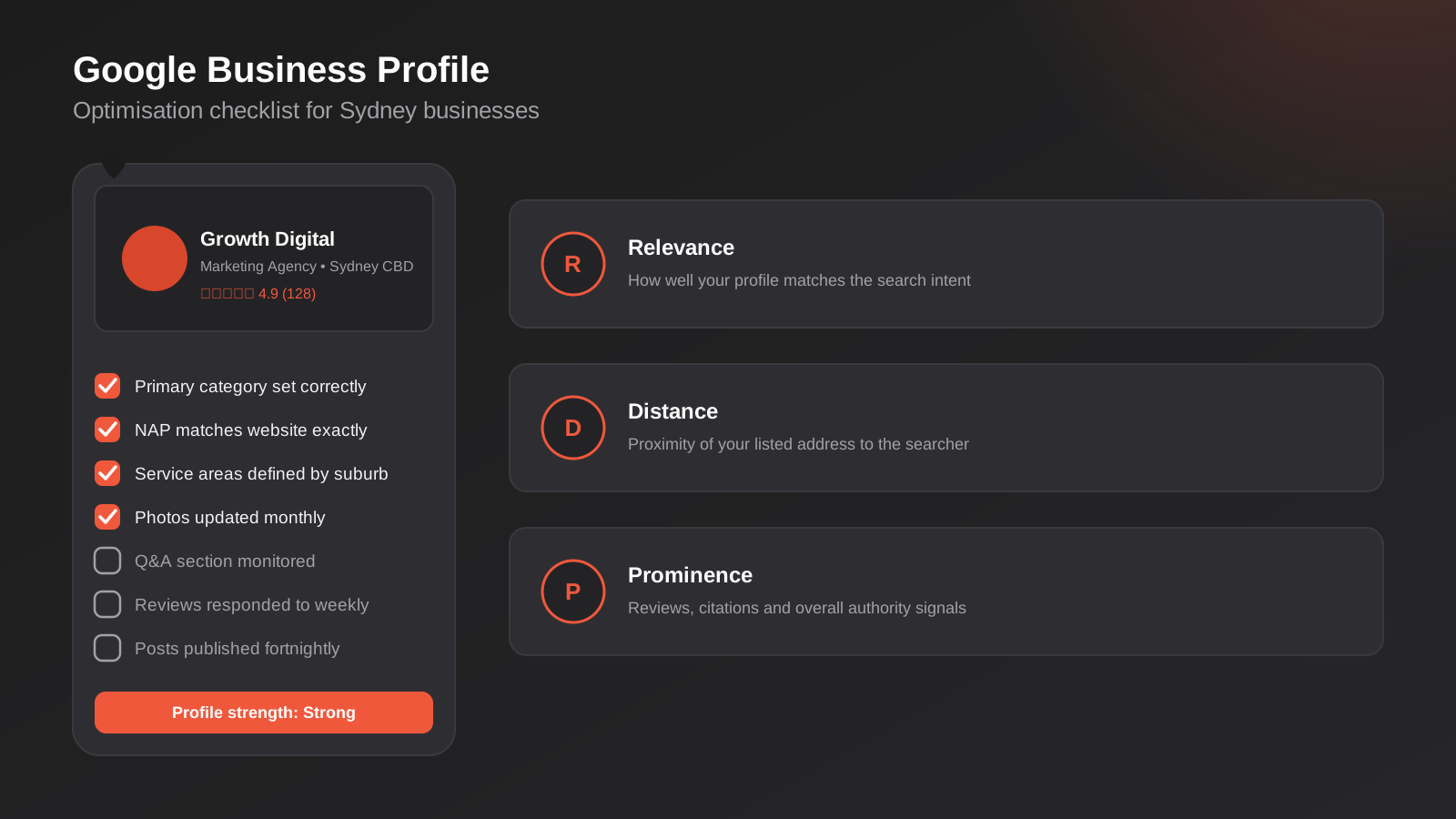
Google’s local ranking system runs on three pillars — relevance, distance and prominence — and understanding how each one plays out specifically in a Sydney context is the difference between a local SEO strategy that works and one that reads well on paper but never moves the needle.
Relevance, Distance and Prominence in a Sydney Context
Relevance is about how well your Google Business Profile and website match what the searcher is actually looking for. In Sydney, this often comes down to category precision and service-area accuracy rather than keyword volume. A business that lists itself under a broad category and hopes to rank for a dozen related searches usually underperforms a competitor with a tightly matched primary category, even if that competitor has a smaller website.
Distance is the pillar most affected by Sydney’s geography specifically. Because the city sprawls across such a wide area with genuine travel-time barriers — the Harbour, the National Park to the south, the ranges to the west — Google leans harder on physical proximity here than it might in a more compact city. This means a business’s actual registered address, and whether that address sits inside the customer’s realistic search radius, matters enormously. It also means that businesses serving a wide area (say, a mobile mechanic covering all of Western Sydney) need a fundamentally different profile and content strategy than a business anchored to one shopfront.
Prominence is built from reviews, citations, links and general authority — and in Sydney, prominence is heavily contested because so many categories are saturated with long-established local operators. A five-year-old business with 40 reviews is not automatically going to outrank a twenty-year-old business with 400, no matter how well-optimised the newer profile is. Prominence has to be built deliberately and over time; there is no shortcut for local SEO Sydney campaigns operating in dense, mature categories like trades, legal services or hospitality.
The Local Pack and Why It Matters More Here
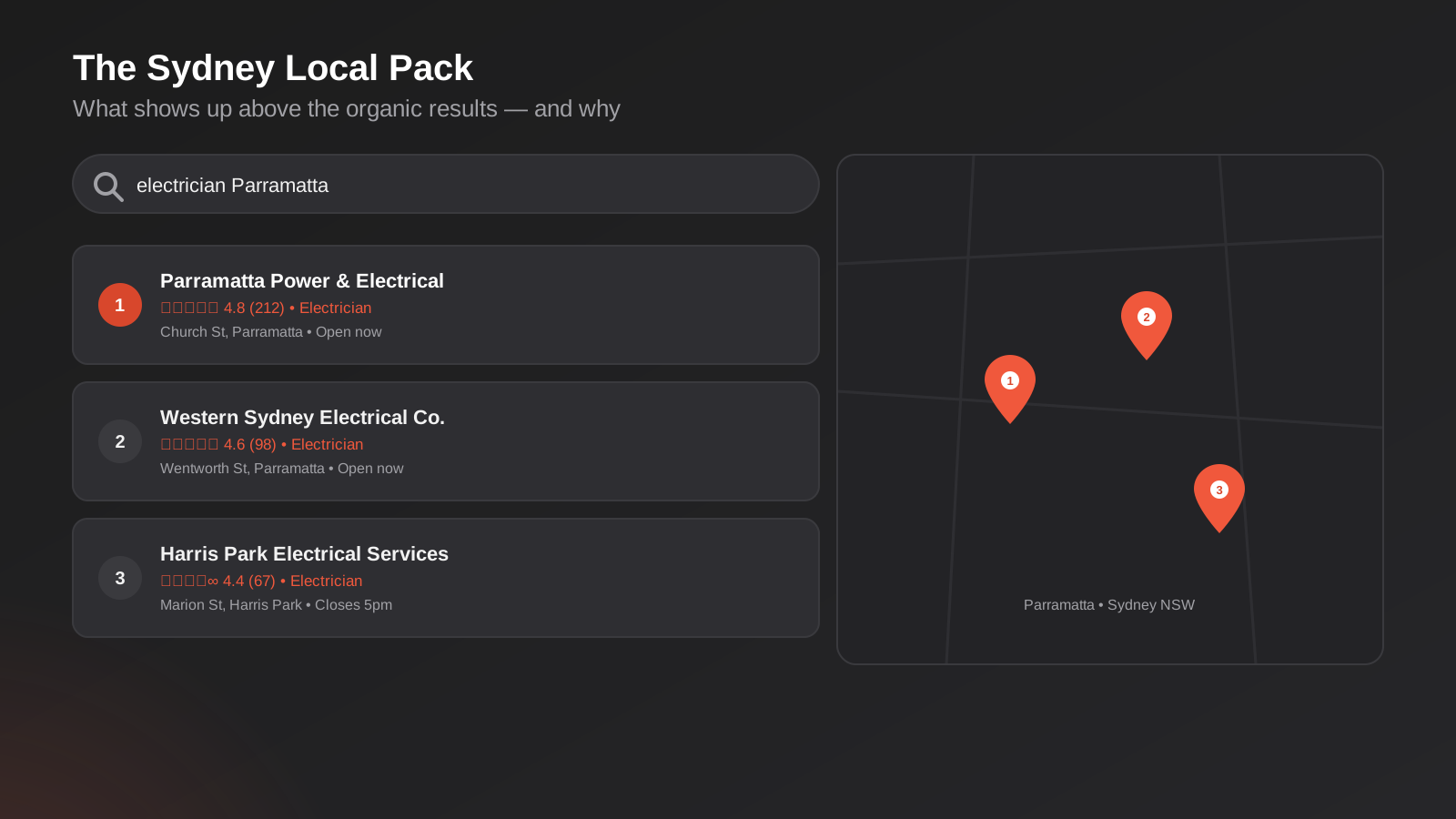
The “local pack” — the map and the three business listings that appear above the organic results for local queries — captures a disproportionate share of clicks for exactly the kind of high-intent, service-based searches that dominate Sydney’s search volume: tradespeople, healthcare providers, hospitality, professional services. Businesses that are not appearing in the local pack for their core suburb and service combination are, for practical purposes, invisible to a huge portion of ready-to-convert local search Sydney traffic, regardless of how well their website ranks organically further down the page. This is one of the most common blind spots we see: a business with a genuinely strong website and solid organic rankings that has never properly optimised its Google Business Profile, and is consequently missing out on the exact searches that convert best.
Google Business Profile Optimisation for Sydney Businesses
Your Google Business Profile is the foundation of any local SEO Sydney strategy, and in a market this competitive, the difference between a profile that is merely claimed and one that is genuinely optimised is significant. We have audited hundreds of Sydney business profiles over the years, and the pattern is consistent: most businesses do the bare minimum, which means a properly built-out profile has an outsized advantage.
Getting the Fundamentals Right
Start with the basics, but treat them as non-negotiable rather than a checkbox exercise. Your business name should match your legal trading name exactly — no keyword-stuffed variations like “Growth Digital – Best SEO Agency Sydney,” which breaches Google’s guidelines and can get a profile suspended. Your address needs to be your genuine, staffed business address; PO boxes, virtual offices and unattended registered addresses are a common cause of suspended or suppressed listings for Sydney service businesses, particularly in categories where fake or misleading addresses have historically been a problem, such as locksmiths, garage door repairs and towing.
Your phone number should be a local Sydney number where possible — a local area code still carries a small trust signal for Sydney searchers, even in a mobile-first world, and it avoids the awkwardness of a customer wondering whether they have reached a call centre interstate or overseas. Hours need to be accurate and kept current, including public holiday hours; NSW-specific public holidays that differ from other states (Bank Holiday, certain regional show days) are a small but real source of “permanently closed” mislabelling if a profile is not actively managed.
Category Selection and Service Areas
Primary category selection deserves more attention than most businesses give it. Google offers thousands of categories, and picking the closest match rather than the most accurate one is one of the most common errors we see. A business offering both plumbing and gas fitting needs to think carefully about which is genuinely the primary service and set secondary categories to capture the rest — category mismatches are a quiet but significant drag on visibility for exactly the kind of specific, high-intent searches that drive Sydney local search volume.
Service area settings matter enormously for Sydney businesses that travel to customers rather than operate from a single shopfront — mobile mechanics, electricians, cleaners, tutors, physiotherapists doing home visits. Google allows you to define a service area by suburb or by drive-time radius from your base address, and getting this right is a balancing act specific to Sydney’s geography. Set it too narrow and you miss legitimate demand from adjacent suburbs; set it too broad — claiming to service all of Greater Sydney from a single base in, say, Bondi — and you dilute your relevance and distance signals for every suburb in that list, often ranking for none of them particularly well. The businesses that get the most out of service-area settings tend to define them around genuine, realistic trading radiuses of 15 to 25 minutes’ drive time, adjusted for how Sydney traffic actually behaves at different times of day, rather than an idealised straight-line distance.
Reviews as a Sydney-Specific Ranking Signal
Review volume, recency and response rate all factor into prominence, but the more Sydney-specific point is this: because so many categories here are dominated by long-established local competitors with hundreds of reviews, review velocity — how consistently you are generating new reviews over time — often matters more than total count for a newer or growing business trying to close the gap. A steady stream of five or so new reviews a month, each responded to promptly and specifically, tends to outperform a one-off push that gets forty reviews in a week and then goes quiet for a year. Google’s systems, and prospective customers scanning a profile, both read consistency as a signal of an active, trustworthy, currently-operating business — which matters in a city where “permanently closed” and “temporarily closed” businesses clutter search results more than most people realise.
Where genuinely relevant, reviews that mention a specific suburb or landmark (“great service, came out to us in Five Dock within the hour”) provide a small but real relevance signal for that location, alongside their obvious value as social proof. We never fabricate or solicit specific wording from customers — that is both against platform guidelines and bad practice — but a simple, natural request for feedback after a job is completed, sent while the experience is fresh, tends to produce reviews with this kind of organic local specificity anyway.
Local Citations and Directories That Actually Matter in Sydney and NSW
Citations — mentions of your business name, address and phone number (NAP) on other websites — remain a meaningful trust and prominence signal for local search Sydney rankings, but not all citations carry equal weight, and a lot of the directory-submission services sold to small businesses waste effort on low-value, low-trust listings that Google barely registers.
The Core Australian Citation Set
Every Sydney business should have accurate, complete, consistent listings on the major Australian-relevant platforms: Google Business Profile itself, Bing Places, Apple Maps (via the Apple Business Connect portal), True Local, Yellow Pages Australia, Yelp Australia, Hotfrog, and Facebook. The single most important requirement across all of them is NAP consistency — the exact same business name, address format and phone number everywhere. Inconsistencies as small as “St” versus “Street,” or an old suite number carried over from a previous office, create a confusing trust signal that can genuinely suppress rankings, particularly for businesses that have moved premises within Sydney and never fully cleaned up their old citations.
Sydney and NSW-Specific Directories
Beyond the generic national directories, there is real value in citations and mentions that are genuinely regional to Sydney and NSW, because they carry more localised trust weight and often drive real referral traffic alongside the SEO benefit. Local council business directories are frequently overlooked — the City of Sydney, Parramatta, Northern Beaches, Inner West, Canterbury-Bankstown and other councils all maintain some form of local business or tourism directory, and a listing there is both a legitimate citation and a signal of genuine local presence. Industry-specific NSW bodies — Master Builders Association NSW, the NSW Business Chamber, local chambers of commerce in areas like Manly, Chatswood or Liverpool, and trade-specific NSW licensing bodies where a public register exists — are another layer worth pursuing, particularly for trades and professional services where licensing credibility matters to the customer as well as to search engines.
Local media and community sites are the third layer, and the hardest to get right at scale, which is exactly why they carry more weight. A mention or listing on a suburb-specific community Facebook group’s linked website, a local news outlet like the Inner West Courier or a Sydney-focused industry publication, or a sponsorship listing for a local sports club or school fete, all contribute genuine, hard-to-fake local relevance signals that generic directory submissions cannot replicate. These take more effort to build than a directory submission, but they are precisely the kind of signal that separates a serious local SEO Sydney strategy from a box-ticking one.
Suburb and Regional Strategy Without Falling Into the Thin-Page Trap
This is the section where most Sydney local SEO advice goes wrong, so it is worth being direct about it. The old approach to targeting multiple Sydney suburbs was to build a separate landing page for every suburb serviced — “Plumber Parramatta,” “Plumber Blacktown,” “Plumber Penrith” — each one a near-identical template with the suburb name swapped out. We do not recommend this, and we want to be clear about why, because it is still sold heavily by lower-quality SEO providers as a Sydney-specific strategy.
Why Dozens of Suburb Pages Don’t Work Anymore
Google’s algorithms, particularly since the various helpful content and spam updates rolled out over recent years, are specifically tuned to identify and suppress templated, near-duplicate location pages that exist purely to capture search volume rather than to genuinely serve a distinct audience. A business with forty suburb pages that all say some version of “we provide fast, reliable plumbing services in [suburb], call us today” is not fooling anyone — not Google, and increasingly, not the customer either, who can tell within seconds that a page has been templated rather than written. At best this approach produces pages that simply never rank. At worst, a large footprint of thin, duplicate content can drag down the authority of the entire site, including the genuinely strong pages. This is the same trap our own general SEO guide for Australian businesses warns against at a national level, and it holds just as true, if not more so, in a market as suburb-obsessed as Sydney.
What Genuine Regional Depth Looks Like Instead
The alternative is not to abandon suburb-level targeting — that would leave real visibility on the table in a city where search behaviour is this hyper-local. The alternative is to make sure any location-specific content is genuinely, substantively different, and only to build it where there is a real reason to. A handful of well-developed regional pages, each reflecting something actually true and specific about how the business operates in that area — the particular building stock and strata issues common in a suburb like Bondi versus the larger freestanding homes typical of the Hills District, a genuine project or client example from that area, specific local landmarks or transport routes relevant to a mobile service, or region-specific regulatory or council information that actually affects the service being offered — will consistently outperform dozens of thin, near-identical pages, both in rankings and in actual conversion once a visitor lands there.
If a business genuinely operates differently across regions — different call-out fees for Western Sydney versus the Eastern Suburbs due to travel time, different service offerings depending on local building types, a different team based out of a second depot — that is worth writing about properly, because it is real, specific, useful information. If a business does not operate differently by suburb, that is fine too; it usually means the effort is better spent on one strong service page, robust Google Business Profile service-area settings, and one or two genuinely distinct regional pages for the areas that matter most, rather than an army of pages saying the same thing forty different ways.
Grouping Sydney Into Real Trading Regions
A more sustainable structure for most Sydney businesses is to organise content around a small number of genuine trading regions rather than individual suburbs — Inner West, Eastern Suburbs, North Shore, Northern Beaches, Western Sydney, South West Sydney, Sutherland Shire — and build one solid, specific page per region actually served, mentioning the individual suburbs within it naturally rather than manufacturing a page for each one. This mirrors how Sydneysiders themselves think and talk about the city, gives Google enough distinct, well-supported content to work with, and avoids the duplicate-content ceiling that a suburb-by-suburb template approach inevitably hits.
Sydney-Specific Competitive Dynamics
Competition looks different depending on where in Sydney a business operates and what category it is in, and a Sydney SEO agency that treats the whole city as one competitive environment will consistently misjudge what it actually takes to rank.
The CBD vs Suburban Competition Gap
Sydney CBD and the immediately surrounding business districts — North Sydney, Chatswood, Parramatta’s own CBD — are dominated by high-value professional services categories: law firms, accountants, financial advisers, consultancies, medical specialists. Competition here is intense, budgets are larger, and prominence is genuinely hard-won; these categories often have well-resourced competitors who have been investing in SEO and content for years. Ranking in these pockets typically requires sustained investment in authority-building — genuine backlinks, thought-leadership content, PR — alongside the local fundamentals, because the local fundamentals alone will not be enough to differentiate one CBD law firm’s Google Business Profile from another’s.
Move out to the suburbs and middle-ring areas, and the picture changes. Trade and home-service categories dominate search volume, competitors are often smaller operators with less sophisticated digital marketing, and the fundamentals — a properly optimised Google Business Profile, consistent citations, a steady flow of reviews — carry disproportionately more weight because so many local competitors have never done them properly. This is genuinely good news for small and medium Sydney businesses in trade and home-service categories: the ceiling for what “properly done” local SEO can achieve here is often higher, and faster to reach, than in the CBD professional-services categories.
Trade and Service Businesses vs Professional Services
Trade and emergency service categories — plumbers, electricians, locksmiths, pest control, garage doors — see some of the highest-intent, highest-conversion local search Sydney traffic of any category, precisely because the customer usually needs someone now and is choosing almost entirely off the local pack. For these businesses, Google Business Profile optimisation, review velocity and accurate service-area settings tend to deliver the fastest, most measurable return of any local SEO investment.
Professional and healthcare services — medical practices, allied health, legal, accounting, financial planning — see a longer research and decision cycle. The local pack still matters for initial discovery, but trust signals go deeper: qualifications, specific service pages, genuine patient or client-facing content, and a website that holds up to scrutiny once the initial local search has done its job of getting the business shortlisted. Local SEO for these categories needs to work in tandem with a stronger on-site content and trust-building strategy, not as a substitute for one.
Content and On-Page Signals for Local Search in Sydney
Your website still matters for local SEO Sydney rankings — the Google Business Profile is the front door, but a thin or generic website behind it caps how far prominence and relevance signals can carry you, particularly for the more considered, higher-value service categories.
Localising Without Being Generic
The goal is specificity, not keyword density. Mentioning “Sydney” and a handful of suburb names throughout a page used to be treated as sufficient local optimisation; it is not anymore, and search engines are considerably better at distinguishing genuine local relevance from surface-level keyword insertion. Genuine specificity looks like: real project photos with context about where the work was done, accurate and current service-area information that matches your Google Business Profile exactly, staff or team information that reflects an actual local presence, and content that answers questions a Sydney customer would genuinely have — strata approval requirements for renovation trades, council permit processes that differ between local government areas, parking and access considerations for inner-city versus outer-suburban jobs. This kind of detail does double duty: it is exactly the kind of specific, useful content that supports genuine regional pages without tipping into the thin-content trap, and it reads as credible and locally knowledgeable to an actual customer deciding who to call.
Schema markup — structured data that explicitly tells search engines your business name, address, phone number, service area, opening hours and review data — is a technical layer worth getting right and then largely forgetting about. It will not overcome weak fundamentals, but it removes any ambiguity for search engines trying to match your business to a local query, and it is a one-off technical investment rather than an ongoing content commitment.
Common Mistakes Sydney Businesses Make
These are the issues we see most often when auditing local SEO for Sydney businesses, roughly in order of how frequently they show up and how much impact fixing them tends to have:
- Setting a Google Business Profile service area too broad (claiming all of Sydney from one suburb) rather than a realistic, drive-time-based radius, which dilutes relevance and distance signals everywhere instead of strengthening them anywhere.
- Inconsistent NAP details across citations, often left over from a previous office address or an old phone number, quietly undermining prominence and confusing both Google and customers.
- Building a suburb page for every service area using a templated structure, resulting in dozens of near-duplicate pages that rarely rank and can drag down the rest of the site.
- Choosing a Google Business Profile primary category based on what sounds impressive rather than what a customer would actually search for.
- Letting review responses lapse, or responding with the same copy-pasted reply regardless of what the customer actually said, which reads as inauthentic to both prospective customers and, over time, as a weaker engagement signal.
- Treating a PO box or an unattended registered address as the business address on Google Business Profile, risking suspension in categories Google scrutinises closely.
- Ignoring NSW public holidays and specific closures in Google Business Profile hours, leading to “closed” mislabelling exactly when demand (and frustration) is highest.
- Focusing exclusively on the CBD or one flagship location while ignoring genuine demand in outer suburbs and growth corridors like the North West and South West growth areas, where competition is often much lighter.
- Assuming a strong organic website ranking makes up for a neglected Google Business Profile, when in practice the local pack is where most local search Sydney clicks actually happen.
Frequently Asked Questions
How long does local SEO take to show results in Sydney?
Google Business Profile improvements — category corrections, service-area adjustments, added photos and posts — can produce visible movement within a few weeks in less competitive suburbs and categories. In saturated CBD or professional-services categories, meaningful ranking improvement typically takes three to six months of consistent work across citations, reviews and content, and ongoing effort to maintain and extend that position against equally motivated competitors.
Do I need a separate website page for every Sydney suburb I service?
No, and building one is one of the most common mistakes we see. Templated, near-duplicate suburb pages tend not to rank and can drag down the rest of the site. A better approach is a small number of genuinely distinct regional pages covering real trading areas, backed by accurate Google Business Profile service-area settings and specific, useful local content rather than a page for every postcode.
Is Google Business Profile or my website more important for local SEO Sydney rankings?
They work together, but for most local, service-based searches in Sydney, the Google Business Profile and the local pack are where the majority of clicks happen, particularly for trade and emergency services. A strong website without an optimised profile still misses a large share of high-intent local search traffic, while a strong profile backed by a thin website struggles to convert once a customer clicks through to learn more, especially in more considered categories like healthcare or professional services.
How many Google reviews does a Sydney business actually need to rank well?
There is no fixed number — it depends heavily on category and suburb, since some Sydney categories are dominated by long-established competitors with hundreds of reviews. What matters more than a raw total is consistency: a steady flow of new, responded-to reviews over time tends to outperform a one-off review push, both as a ranking signal and as a trust signal to prospective customers scanning your profile.
Which local directories and citations actually matter for a Sydney business?
Start with the core set — Google Business Profile, Bing Places, Apple Business Connect, True Local, Yellow Pages Australia and Facebook — and ensure your business name, address and phone number are identical across all of them. From there, genuinely local sources like your council’s business directory, relevant NSW industry bodies and local chambers of commerce carry more localised trust weight than generic national directory submissions.
How is local SEO different for a business in the Sydney CBD versus the suburbs?
CBD and inner-business-district categories, particularly professional services, tend to be more competitive and require sustained authority-building — genuine backlinks, content and PR — on top of local fundamentals. In middle and outer suburbs, particularly for trade and home-service categories, competitors are often less sophisticated digitally, so getting the fundamentals right — profile optimisation, citations, reviews — tends to deliver faster, more measurable results.
Where to Start
If you take one thing from this guide, make it this: local SEO in Sydney rewards precision over volume. A tightly optimised Google Business Profile, a clean and consistent set of genuinely relevant citations, and a small number of substantive regional pages will outperform a scattershot approach every time — and it will do so faster, with less ongoing maintenance, and without the risk of the thin-content penalties that catch out businesses still running the old suburb-page-for-everything playbook.
Start by auditing what you already have. Check your Google Business Profile category, service area and hours against reality. Search your business name and old addresses to find inconsistent citations. Look honestly at whether your existing location pages are genuinely useful or just templated filler. That audit alone usually surfaces the highest-impact fixes before any new content gets written. If you want a sense of what that investment typically looks like, our SEO pricing page breaks down cost by scope.
We work with Sydney businesses across trades, healthcare, professional services and retail to build local SEO strategies suited to how this specific city actually searches — not a generic national template with the word “Sydney” dropped in. If you would like a second opinion on where your local search presence stands today, get in touch with our team and we will talk you through what we would prioritise first.
Keep reading
Related posts
Psychology Practice Marketing in Australia: Local SEO, Compliant Copy and the Waitlist Problem (2026)
How Australian psychology practices handle local SEO, AHPRA-compliant copy and waitlist triage when they're already at capacity (2026).

Physiotherapy Marketing in Australia: Local SEO, Website Design and Booking (2026)
How Australian physiotherapy clinics win new patients through Google Business Profile, local SEO, website design and real-time booking in 2026.
Local SEO for Veterinary Clinics in Australia: Google Business Profile, Reviews and the Emergency Search (2026)
Veterinary clinic SEO explained: Google Business Profile, review generation and the emergency search most vet websites get wrong.
Got a project you'd like to talk through?
Tell us what you're working on — we'll come back with a plan.
