
Healthcare SEO in Australia: Ranking Medical and Dental Practices Without Breaching AHPRA (2026)
 Jignesh Vagadiya
12/09/2026
21 min read

A GP clinic in Parramatta and a personal injury lawyer’s office three suburbs over are both chasing the same local pack. But only one of them can get shut down by a regulator for the way they write a blog post. Healthcare SEO looks like ordinary local SEO from a distance — Google Business Profile, reviews, service pages, content — and then you actually try to write a page about “best treatment for lower back pain” and remember that AHPRA has opinions about that, backed by fines that start at $30,000 per offence.
That’s the gap most SEO advice falls into. Generic local SEO guides don’t mention advertising law. Healthcare marketing guides mention AHPRA in passing and then hand you a content calendar that would get a practice manager a please-explain letter. We’ve built SEO for medical, dental and allied health clients where the brief wasn’t just “rank” — it was “rank without a compliance review knocking half the content back.” That constraint changes what a healthcare SEO strategy actually looks like, and it’s worth walking through properly rather than bolting a disclaimer onto a standard SEO checklist.
This healthcare SEO Australia guide covers what’s different about SEO for GPs, dentists, specialists, allied health and other AHPRA-regulated practices in Australia: the rules that shape what you can publish, the local SEO foundations that matter most for a “near me” search category, content and E-E-A-T signals that carry real weight in a YMYL niche, and where AI search is starting to change how patients find a provider. If you’re after website design and branding specifically for a dental practice, we’ve covered that ground in more depth in our dental practice website and branding guide — this article is about the SEO and content side, and applies across GPs, specialists, allied health and dental alike.
Why Healthcare SEO Australia Isn’t Just Local SEO With a Different Logo
Two things make healthcare search different from, say, a plumber or a café chasing the local pack: it’s Your-Money-Or-Your-Life (YMYL) content, and it’s regulated advertising. Both change the calculus.
Google treats health information as high-stakes. Bad advice about a plumbing job costs someone a call-out fee. Bad advice about a symptom, a medication interaction or a treatment timeline can cost someone their health. Google’s quality rater guidelines single out YMYL topics for extra scrutiny on expertise, authoritativeness and trust — and health is the clearest example of a YMYL category there is. A thin, unsourced page about “signs of a heart attack” written to catch search volume is exactly the kind of content Google’s systems are built to push down, regardless of how well it’s optimised technically.
Then there’s AHPRA. Under Section 133 of the Health Practitioner Regulation National Law, the way a registered health practitioner advertises their services is regulated, not just suggested. This covers every channel — website copy, blog content, social media, Google Ads, even how a receptionist describes a service on the phone in some interpretations. It applies to all AHPRA-registered professions: medicine, dentistry, nursing, physiotherapy, psychology, chiropractic, optometry, podiatry and more. AHPRA processes hundreds of advertising complaints a year, and the practitioner is the one who wears the consequence, not the marketing agency that wrote the copy.
Put those two together and you get a niche where the content that would normally win — strong claims, patient testimonials, before-and-after proof, urgency-driven offers — is either penalised by Google for lacking real evidence, or is a straight-up compliance breach. The practices that do well in healthcare SEO aren’t the ones pushing hardest on either axis. They’re the ones who understand both sets of rules well enough to write content that satisfies E-E-A-T and stays inside AHPRA’s lines at the same time.
The AHPRA Rules That Shape What You Can (and Can’t) Publish
This isn’t legal advice, and any practice should check specifics with AHPRA’s own advertising guidelines or their indemnity insurer — but for planning content, these are the restrictions that come up constantly.
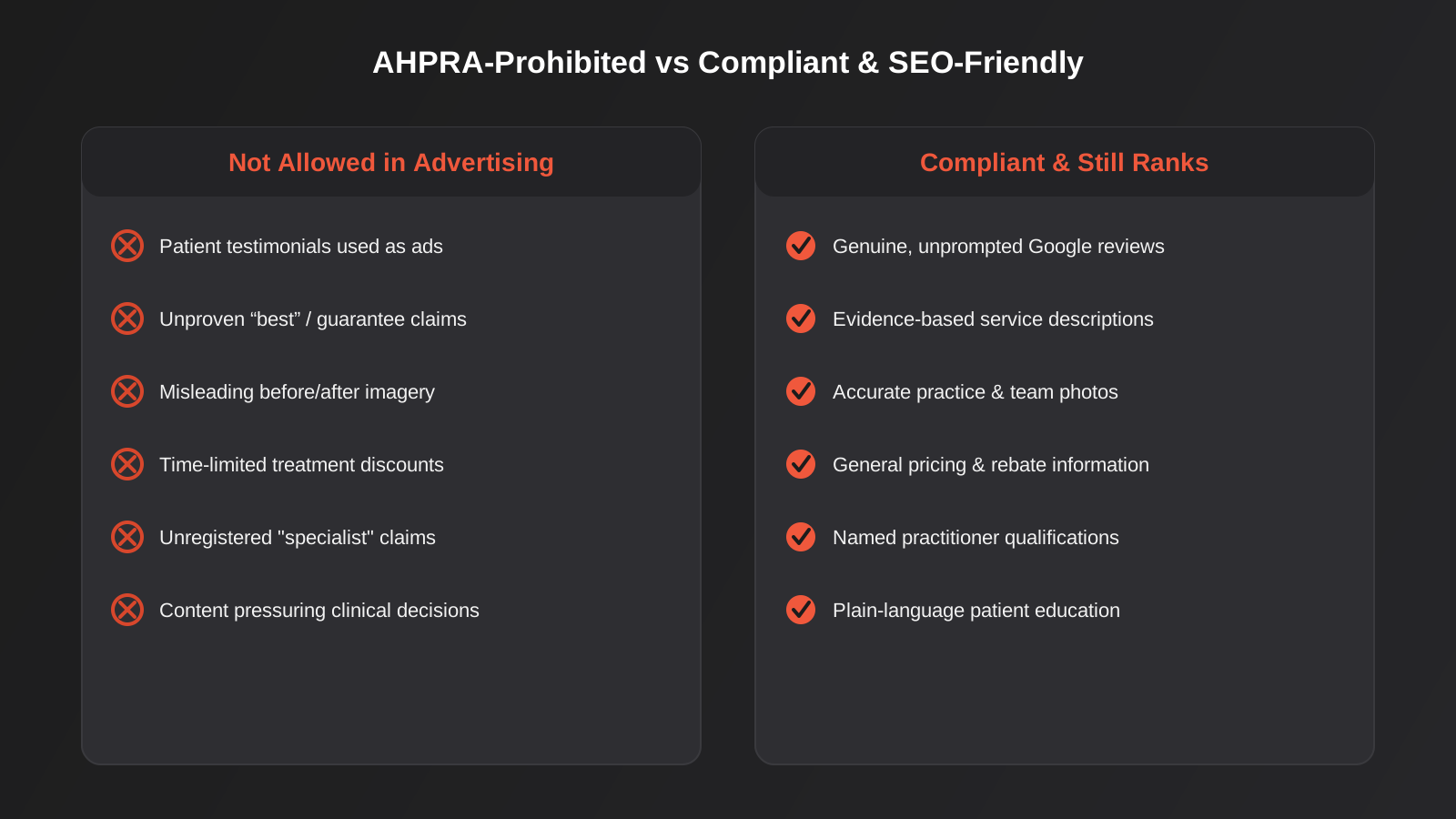
What AHPRA prohibits in advertising
- Testimonials or reviews used as advertising material for a regulated health service — this is the one that trips practices up most, because it directly conflicts with the standard “reviews are the top local SEO trust signal” advice.
- Claims that create unreasonable expectations of beneficial treatment, including vague superlatives (“the best,” “guaranteed results,” “pain-free”) without evidence to back them.
- Before-and-after imagery that could mislead about typical outcomes, particularly common in cosmetic and dental advertising.
- Time-limited offers or discounts that pressure someone into a clinical decision — “book your consult this week and save $200” territory.
- Content implying a practitioner has expertise or specialisation they aren’t actually registered to claim (using “specialist” when that’s a protected title under the National Law, for instance).
The testimonial rule deserves its own callout because it’s so widely misunderstood. AHPRA’s position has consistently been that testimonials used in advertising are prohibited — but a patient leaving an unprompted Google review isn’t the same as a practice publishing a curated testimonial on its homepage. The distinction that actually matters is between reviews existing on a third-party platform (Google, Health Engine, Whitecoat) that a patient chooses to leave, versus a practice actively soliciting, selecting and republishing testimonials as marketing collateral. Practices that quietly encourage patients to leave a genuine Google review sit in a materially different position to practices that cherry-pick five-star quotes onto a landing page.
What’s actually fine, and still ranks
- Factual, evidence-based descriptions of services, conditions treated and what a typical appointment involves.
- Practitioner qualifications, registration details, years in practice and areas of clinical focus.
- Educational content that answers real patient questions without promising outcomes (“what to expect after a wisdom tooth extraction” rather than “pain-free wisdom teeth removal”).
- Accurate photos of the practice, equipment and team.
- General information about pricing structures, item numbers and what private health cover typically applies, without positioning it as a limited-time deal.
The useful reframe here is that AHPRA-compliant content and genuinely good SEO content overlap more than people assume. Google’s E-E-A-T model rewards accurate, well-sourced, hedge-appropriate health content. AHPRA requires the same thing. The content that gets both agencies unhappy — hyped claims, unverifiable superlatives, manufactured urgency — was never going to build durable rankings anyway. The constraint pushes you toward better content, not worse.
Local SEO Foundations for Healthcare Practices
Most healthcare searches are near-me searches: “dentist open Saturday,” “bulk billing GP near me,” “physio for a sports injury Brisbane.” That means the local pack — the three-listing map result Google shows above organic results for most service queries — carries more weight than it does for a lot of other industries. We’ve covered local pack mechanics in general in our local SEO guide for Sydney businesses; the healthcare-specific layer sits on top of those same fundamentals.
Google Business Profile, done properly
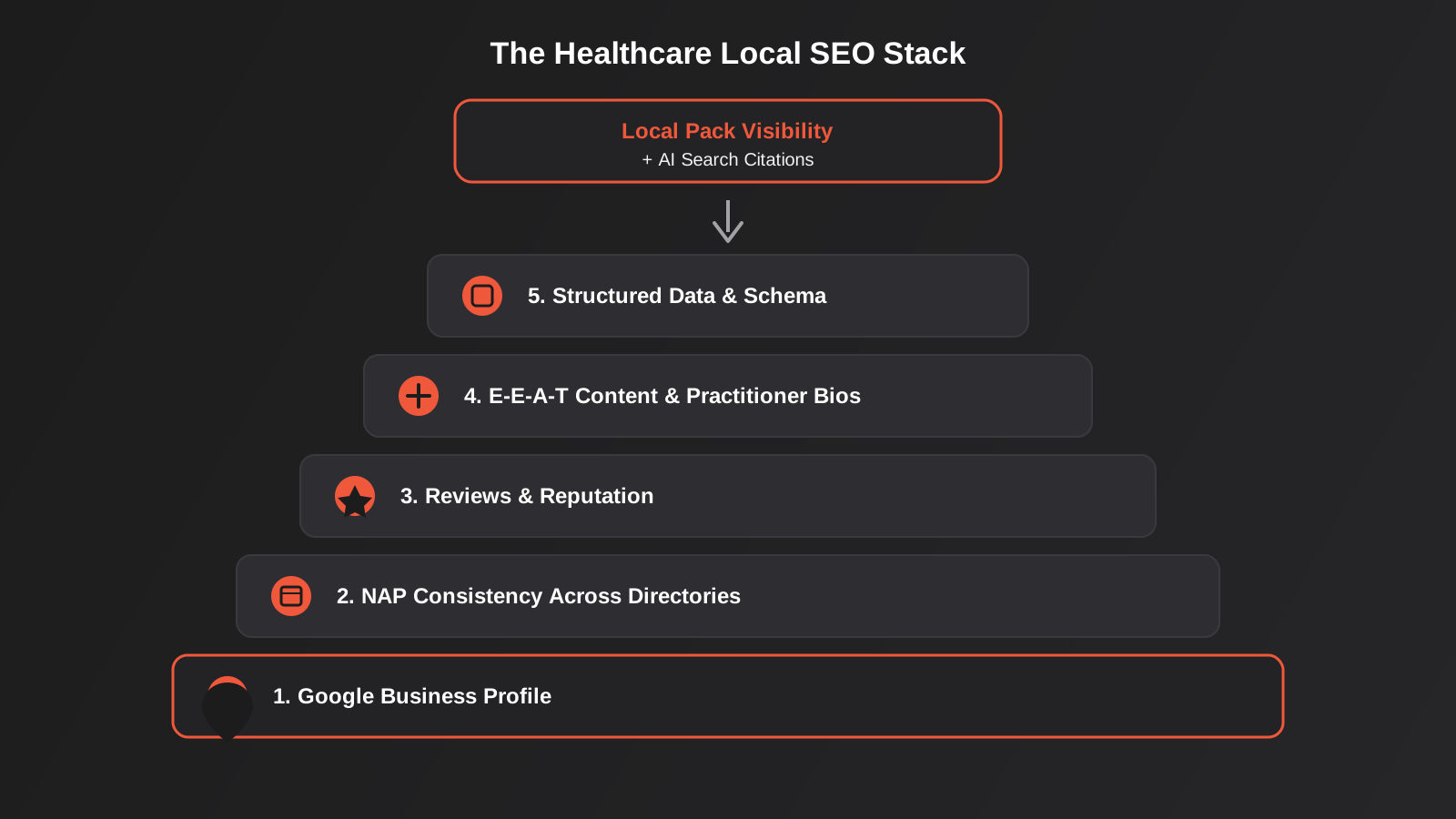
A complete, accurate Google Business Profile is the single highest-leverage thing a healthcare practice can do for local visibility. That means the correct primary category (there’s a real difference between “Dentist,” “Cosmetic Dentist” and “Emergency Dental Service” in how Google matches intent), accurate opening hours including public holidays, a full list of services with descriptions, and regular photo updates of the practice and team. Booking links matter more here than in most industries — a GBP listing that lets a patient book directly converts appointment-intent traffic that would otherwise bounce to a competitor’s listing.
NAP consistency across every listing
Name, address and phone number need to match exactly across your website, GBP, and every directory a practice appears on — Health Engine, Whitecoat, Yellow Pages, your industry association’s “find a provider” tool, and any hospital or health network listing. Healthcare practices tend to accumulate more of these third-party listings than most local businesses because so many exist specifically for the industry (practitioner directories, health fund provider lists, hospital admitting-rights pages), and each one is a chance for the address or phone number to drift out of sync after an office move or a new number. That inconsistency is a quiet but real drag on local ranking confidence.
Reviews, handled the compliant way
Reviews do double duty in local SEO: review volume and recency feed the ranking algorithm, and reviews are the single biggest factor in which of the three map pack listings a patient actually calls. The compliant approach is to make it easy for patients to leave a review where they naturally would — a follow-up text or email with a direct Google review link, a QR code at reception — without offering an incentive, without pre-screening who gets asked, and without republishing selected reviews as advertising copy on the website. Responding to reviews (positive and negative) professionally and without disclosing any clinical detail is worth doing consistently; it’s a trust signal for prospective patients reading the page, not just an SEO input.
Location pages, only when they’re real
Multi-location healthcare groups are tempted to spin up a page per suburb to catch more “near me” variants. That only works when each page represents a genuinely separate location with its own address, phone number, practitioners and photos. A templated page that swaps a suburb name into otherwise identical copy is exactly the kind of thin, duplicate content Google’s local search systems are tuned to filter out, and it wastes the effort that would have gone into one strong page per real site.
Content Strategy: Patient Questions, Condition Pages and E-E-A-T
Healthcare content works best when it starts from the questions patients are already asking, not from a generic keyword list. Front desk staff, practitioners and booking data are a better source for this than a keyword tool — the tool tells you volume, the people at reception tell you what’s actually being asked before someone books.
Building condition and service pages that hold up
A strong service or condition page for a healthcare practice typically covers: what the condition or service is in plain language, when someone should consider seeking care, what a typical appointment or treatment pathway looks like, realistic expectations around recovery or outcomes (without promising a specific result), and who on the team treats it. That last point matters more here than in most industries — tying a service page to a named, credentialed practitioner is both an E-E-A-T signal for Google and a genuine trust signal for a patient deciding whether to book.
Where this goes wrong most often is practices trying to rank for every symptom search under the sun with content written by whoever’s cheapest, then hoping “medically reviewed by [name]” at the bottom fixes it. Google’s systems and AHPRA both respond to substance, not the label. If a practitioner isn’t genuinely involved in reviewing content that discusses conditions and treatments, that gap tends to show up in vague, generic writing that doesn’t hold up next to a competitor’s page written by someone who actually treats the condition.
Practitioner bios as an SEO asset, not an afterthought
A thin “Dr Smith has been practising for 10 years” bio is a missed opportunity. A practitioner bio that lists actual qualifications, AHPRA registration details, areas of clinical interest, professional memberships and publications or presentations does two jobs: it’s a direct E-E-A-T signal Google can associate with the content that practitioner is credited on, and it’s often the page a hesitant patient reads last before deciding to book. Linking each service or condition page back to the relevant practitioner’s bio (and vice versa) reinforces both.
The FAQ trap
FAQ sections are common on healthcare sites and easy to get wrong two ways: either they’re so hedged and lawyer-reviewed that they don’t actually answer anything (“results vary and you should consult your practitioner” repeated eight times), or they drift into specific clinical claims that cross the AHPRA line. The useful middle ground is answering the logistical and general-information questions thoroughly — costs, Medicare and health fund rebates, what to bring to a first appointment, how long a procedure typically takes — while keeping condition-specific medical claims general and appropriately qualified.
Technical SEO and Structured Data for Healthcare Sites
Schema markup that actually fits
Generic LocalBusiness schema is better than nothing, but Schema.org has purpose-built types for healthcare — MedicalOrganization, MedicalClinic, Physician, Dentist, and MedicalWebPage among them — and using the correct type gives search engines (and increasingly, AI systems parsing the page) a clearer signal about what the practice is and what a given page covers. Practices that implement medical-specific schema properly tend to see richer, more accurate representations in search results compared to sites running only generic business markup. This sits alongside the FAQPage and Article schema most content-heavy sites already use; a well-built healthcare page can carry both without conflict, provided each is implemented correctly rather than layered on top of itself.
Site speed and accessibility aren’t optional here
A meaningful share of healthcare searches come from someone in discomfort, on a phone, wanting an answer fast — “emergency dentist near me now” is not a query where a five-second load time is tolerated. Core Web Vitals matter for every industry, but the bounce cost is higher in healthcare because the alternative (the next map pack listing) is one tap away. Accessibility matters for a similar reason: a meaningful proportion of the patient population searching for healthcare services has a vision, motor or cognitive impairment that makes poor colour contrast, missing alt text or unlabelled form fields a genuine barrier to booking, not just a compliance checkbox.
Booking flow as a technical SEO concern
Search engines increasingly reward pages that resolve the searcher’s actual intent, and for most healthcare queries that intent is “let me book an appointment.” A service page that ranks well but buries its booking link below three paragraphs of content, or routes to a booking widget that fails on mobile, is leaking the value the ranking created. This is less about a specific ranking factor and more about engagement signals — time on page, bounce rate, conversion — feeding back into how search engines treat the page over time.
Healthcare Search in the Age of AI Overviews
Patients are increasingly asking AI tools health-adjacent questions directly — “find a bulk-billing GP near me open Saturday,” “what does a root canal cost in Brisbane,” “physio vs chiro for lower back pain.” How AI systems like Google’s AI Overviews, ChatGPT and Perplexity decide what to cite for these queries draws on largely the same signals as traditional local and organic search: a complete, consistent Google Business Profile, structured data that clearly identifies what a practice does and treats, and content that answers the question plainly without burying it in marketing language. We go deeper on the mechanics of how these systems choose citations in our AI SEO guide.
The compliance angle matters here too, and it’s genuinely unresolved territory. If an AI system pulls a testimonial-style claim or an exaggerated outcome from a third-party page and presents it as a direct answer, the practice named didn’t publish that claim as advertising — but it’s worth practices being aware that their content, reviews and directory listings all feed into what AI tools might surface about them, and keeping that footprint accurate and conservative is the safest position regardless of who technically “said” it.
Privacy and Remarketing Restrictions You Need to Know
Healthcare marketing runs into a set of platform restrictions that don’t apply to most other industries, and they catch practices out at the paid media and analytics level rather than the content level. Google’s personalised advertising policy treats health conditions as a sensitive interest category, which means remarketing to someone based on their having visited a page about a specific condition or treatment — the kind of retargeting that’s routine for an ecommerce store — is restricted or blocked outright. A practice that tries to build a remarketing list off visitors to its “anxiety treatment” or “erectile dysfunction” service page will typically find Meta and Google either refuse to serve those audiences or flag the account for review.
This has practical implications for how a healthcare site should be structured for tracking. Broad remarketing off the whole site, or off non-condition-specific pages like the homepage or contact page, generally stays within policy. Segmenting audiences by which specific condition or procedure page someone viewed is the part that creates risk, both from a platform-policy standpoint and, depending on what’s actually being captured and stored, a patient privacy standpoint under the Australian Privacy Principles. Practices collecting any health information through website forms — even something as simple as a symptom checklist before a first appointment — need a privacy policy that specifically addresses health information handling, not a generic template pulled from a different industry.
The practical fix most practices land on is tracking and optimising at the level of “did this visitor book an appointment” rather than building granular condition-based audiences for remarketing. It’s a less precise targeting model than a lot of other industries can run, but it’s the one that stays compliant, and conversion volume for most single-location practices isn’t high enough to need the level of segmentation that would trigger these restrictions anyway.
Measuring What Actually Matters
Healthcare SEO reporting looks different from ecommerce or lead-gen reporting in one important way: the highest-value conversion event is often a phone call or a direct booking through a third-party platform (HotDoc, HealthEngine, or a practice management system’s own booking widget), not a form submission your analytics naturally captures. Getting call tracking and booking-platform conversion data actually connected to your analytics is worth doing properly before worrying about anything more advanced — a lot of healthcare SEO work looks like it’s underperforming purely because half the conversions aren’t being counted.
Beyond that baseline, the metrics worth tracking regularly are: local pack position for your core service and location terms (tracked separately per location if you have more than one), the ratio of Google Business Profile calls and direction requests to website clicks (a shift toward more GBP-direct actions usually means your profile is doing more of the work than your website), new review volume and average rating over time, and organic traffic to condition and service pages split by whether the visitor arrived via a branded or non-branded search. That last split matters because a practice can look like it’s winning on organic traffic while almost all of the growth is existing patients searching the practice’s own name, which isn’t the same as new patient acquisition.
Worth setting realistic expectations here too: healthcare is one of the more expensive and competitive verticals for paid search in Australia, particularly in dental and cosmetic categories in capital cities, and organic rankings for the most contested terms (a general term like “dentist Sydney” with no suburb qualifier) can take a long time to move for a newer or smaller practice regardless of how well the SEO is executed. Suburb-qualified and condition-specific terms are almost always a faster, more realistic path to visible results in the first six months.
Common Mistakes in Healthcare SEO
- Treating AHPRA compliance as a legal afterthought. Bringing compliance in after content is written means constant rewrites and content that reads like it was neutered by committee. Building the guardrails into the brief from the start produces better copy, faster.
- Publishing curated testimonials as marketing copy. The most common single AHPRA breach we see in the wild, usually copied straight from a template the practice bought without realising the testimonial section was a liability.
- Writing generic content instead of practitioner-grounded content. Outsourcing every condition page to a low-cost writer with no clinical input produces pages that read like every competitor’s, which is exactly what E-E-A-T is designed to push down.
- Ignoring NAP consistency across health-specific directories. General local SEO audits often miss the industry directories (Whitecoat, Health Engine, health fund provider portals) where a healthcare practice’s citations actually live.
- Chasing every symptom keyword instead of the ones patients actually search. A huge library of thin, AI-generated symptom pages performs worse than a smaller set of genuinely useful pages built around real patient questions from reception and booking data.
- Templating location pages without real differentiation. Swapping a suburb name into identical copy across multiple locations reads as duplicate content and rarely ranks any of the pages well.
- Under-investing in page speed because “patients will wait.” They won’t, particularly for urgent-care and emergency-adjacent searches where the next listing is one tap away.
Frequently Asked Questions
Can healthcare practices use Google reviews at all if AHPRA prohibits testimonials?
Yes. The distinction is between a patient leaving an unprompted review on a third-party platform like Google, and a practice actively soliciting, curating and republishing testimonials as advertising material. Encouraging patients to leave genuine reviews on Google (without incentives or cherry-picking) sits differently to pulling five-star quotes onto a homepage as marketing copy. When in doubt, check current guidance directly with AHPRA or your indemnity insurer, since interpretation has shifted over time.
How long does healthcare SEO Australia take to show results?
Similar timelines to other competitive local SEO categories — meaningful movement in the local pack often starts within two to four months of consistent Google Business Profile and citation work, while organic content and authority-building for competitive condition or specialty terms typically takes six months or longer. Multi-practitioner clinics with an established Google Business Profile history tend to move faster than a brand-new practice with no review history or citations yet.
Do allied health practices (physio, psychology, podiatry) need the same approach as medical and dental?
The AHPRA advertising rules apply to all AHPRA-registered professions, so yes, the same compliance considerations apply to physiotherapists, psychologists, podiatrists, chiropractors, osteopaths and optometrists as much as to doctors and dentists. The local SEO and content fundamentals are also largely the same. The main difference tends to be search volume and competition — some allied health categories are less contested than dental or GP terms in a given area, which can mean faster results for the same amount of work.
Is it worth running Google Ads alongside SEO for a healthcare practice?
Often yes, particularly for a new practice or a competitive category where organic and local rankings take time to build. The same AHPRA advertising rules apply to Google Ads copy as to any other channel, so ad copy needs the same compliance review as website content. Running both in parallel also gives you faster signal on which keywords and service lines actually convert, which can then inform where organic content effort goes.
Does having multiple practitioners at one clinic help or complicate SEO?
It generally helps, provided each practitioner has a genuine, detailed bio and is credited on the content and services they actually deliver. More named, credentialed practitioners gives Google more E-E-A-T signal to associate with the practice’s content overall, and gives patients more ways to find a specific fit (a practitioner who treats a particular condition, sees children, or works evenings). The complication is purely operational — keeping bios, schema and service-page attributions accurate as staff join or leave.
Should a healthcare practice manage AHPRA compliance in-house or rely on an agency?
Final compliance responsibility sits with the registered practitioner regardless of who writes the content, so it’s worth someone at the practice reviewing content before it publishes even when an agency produces it. A good agency working in this space should understand the AHPRA framework well enough to avoid the obvious breaches in the first draft, but treating that as a substitute for a practitioner’s own sign-off on clinical content is a risk most practices shouldn’t take.
Where to Start
If your practice’s marketing is built around testimonials, before-and-afters or a content calendar nobody’s checked against AHPRA guidelines, the fix isn’t necessarily starting over — it’s usually an audit first: what’s currently live, what’s actually at risk, and which pages are working hard enough to protect versus rebuild. From there, the highest-leverage first steps are almost always the same regardless of specialty: get the Google Business Profile complete and accurate, fix NAP consistency across the directories that matter for healthcare specifically, and start building a small number of genuinely useful, practitioner-grounded pages rather than a large number of thin ones.
Healthcare SEO Australia work is one of the more specialised corners of the SEO we do, alongside healthcare and medical practices more broadly and other regulated, specialist industries. If you’d rather talk through what a compliant, effective SEO strategy would look like for your specific practice type, get in touch and we’ll have an honest conversation about what’s realistic and what it would take.
Keep reading
Related posts

Psychology Practice Marketing in Australia: Local SEO, Compliant Copy and the Waitlist Problem (2026)
How Australian psychology practices handle local SEO, AHPRA-compliant copy and waitlist triage when they're already at capacity (2026).

Physiotherapy Marketing in Australia: Local SEO, Website Design and Booking (2026)
How Australian physiotherapy clinics win new patients through Google Business Profile, local SEO, website design and real-time booking in 2026.
Local SEO for Veterinary Clinics in Australia: Google Business Profile, Reviews and the Emergency Search (2026)
Veterinary clinic SEO explained: Google Business Profile, review generation and the emergency search most vet websites get wrong.
Got a project you'd like to talk through?
Tell us what you're working on — we'll come back with a plan.
