
AI SEO in Australia: How to Get Cited by ChatGPT, Google AI Overviews and Perplexity (2026)
 Jignesh Vagadiya
07/09/2026
21 min read
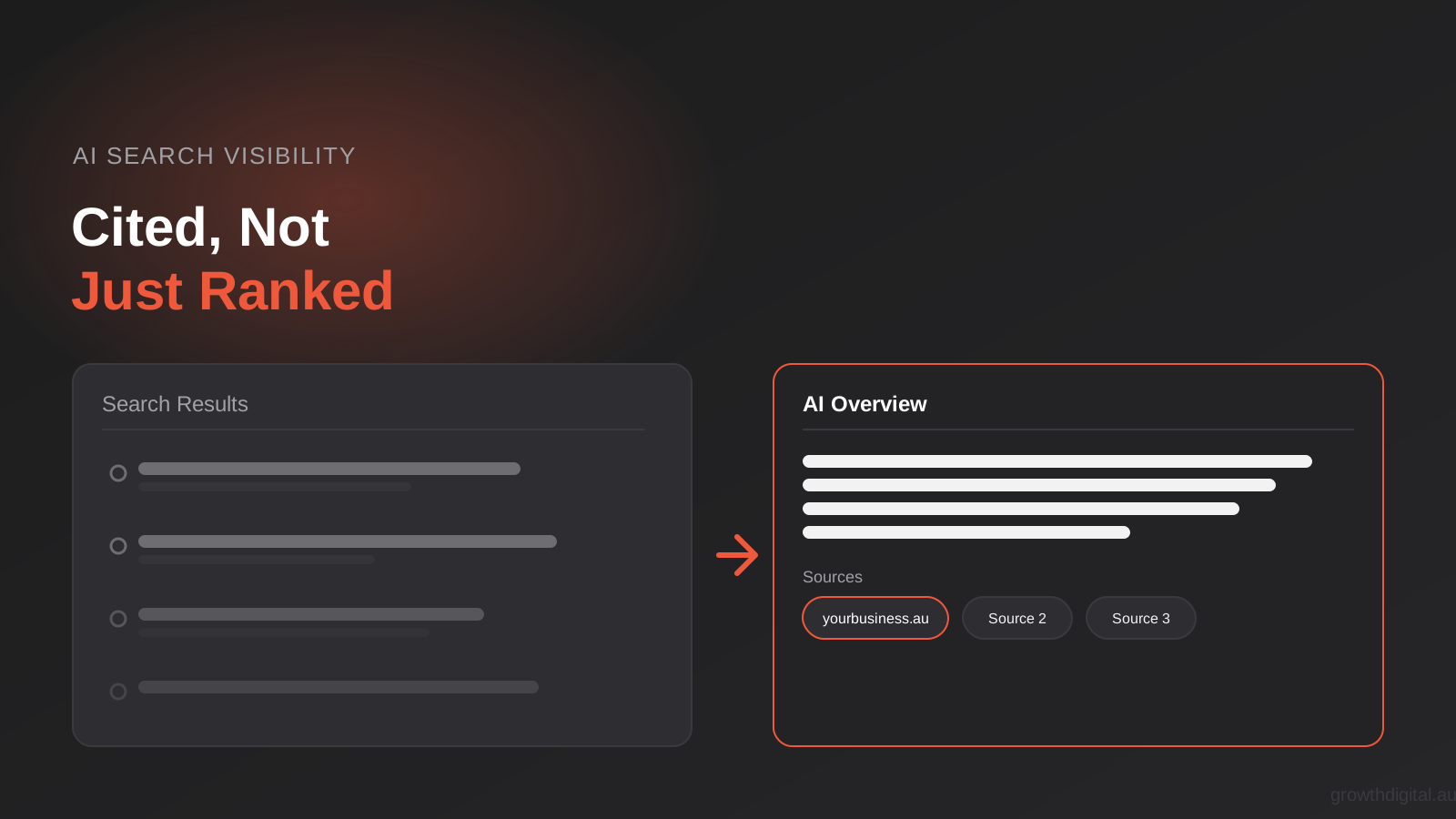
Somewhere in the last eighteen months, a chunk of your future customers stopped clicking through to websites altogether. They typed a question into ChatGPT, or Google’s AI Overview answered it before they scrolled past the fold, or they asked Perplexity to just tell them which local supplier does what they need. Nobody visited ten blue links. Nobody compared five tabs. The answer arrived, fully formed, with your competitor’s name in it instead of yours — or with nobody’s name in it at all.
This is the bit that trips people up about AI SEO Australia businesses are hearing more about every month: it sounds like a rebadge of ordinary SEO with an AI sticker on it. It isn’t. Ranking on page one of Google and being cited inside an AI-generated answer are now two different games, run by different rules, and a page can win one while losing the other completely. We’ve spent the past year rebuilding parts of our own process around that fact, and this guide is what we’ve actually learned doing it — not a theoretical explainer.
If you’ve read our general SEO guide, treat this as the deeper, narrower follow-on: that post covers technical SEO, content and links for traditional search; this one is specifically about the separate skill of getting your business named inside an AI-generated answer, and what that takes that ordinary SEO doesn’t already cover.
What’s actually changed in Australian search
Google’s AI Overviews now appear in a large share of Australian searches — general informational queries trigger one around 40% of the time, according to recent search behaviour studies. That’s not a niche feature anymore; it’s close to becoming the default way Google answers a plain question. ChatGPT has grown into a genuine search habit for a meaningful slice of the population too, and Perplexity, while smaller, punches well above its user count because the people using it are actively comparing options and ready to act.
The detail that matters more than the headline number is what happens with local intent. Add a suburb, a city name or “near me” to a query and the AI Overview trigger rate drops sharply — by some measurements the steepest drop of any query type studied. Google still leans on its local pack and map results when someone is clearly trying to find a business near them. That’s a genuine bit of protection for local SEO in the short term, and it’s part of why we’re not telling local businesses to abandon local search fundamentals in favour of chasing AI Overviews.
Consumer adoption backs this up from the other direction: recent research puts the share of Australians who’ve used a generative AI tool in the past year at close to half the population, and a meaningful chunk of that usage is explicitly research-oriented — people asking ChatGPT to shortlist local services, or using Google’s AI Mode to work through a comparison before they’ve even opened a second tab. That’s not a future trend to plan around eventually. It’s already showing up in referral data for businesses that know where to look.
But for anything that isn’t a hard local lookup — comparisons, explainers, “how does X work,” “what should I look for in Y” — the AI answer is increasingly the whole interaction. And the citations inside that answer aren’t drawn evenly from the usual top-ten results. Studies on AI Overview citations consistently find that only a small minority of cited pages — often cited around 17% — also rank in Google’s organic top ten for the same query. Ranking well is not a proxy for getting cited. They correlate, but weakly, and the gap is the whole reason this deserves its own strategy rather than being folded into “just keep doing SEO.”
Traditional SEO and AI SEO are related, not identical
We want to be straight about this because a lot of what’s being sold as “AI SEO” right now is either repackaged basic SEO advice or vague promises nobody can actually verify. Here’s the honest version of how the two overlap and where they split.
Traditional SEO optimises for ranking: getting a page to appear as high as possible in a list of ten (or four, for ads) results, competing on relevance, authority and technical quality signals that Google’s algorithm has refined over two decades. The unit of success is a position. Someone clicks, lands on your page, and the rest of the conversion is up to your site.
AI search optimisation — generative engine optimisation, or GEO, and answer engine optimisation, or AEO, are the terms you’ll see used more or less interchangeably — optimises for extraction and citation. The unit of success is a passage of your content getting lifted out, summarised or quoted inside someone else’s answer, with your business named as the source. The person may never click through at all. When they do, referral data increasingly shows they arrive further along in their decision than a typical organic click, because the AI has already done the comparison shopping for them and they’re clicking through to verify or book.
The overlap is real: both reward genuinely useful, well-structured, technically sound content, and a site with poor crawlability or thin content will struggle at both. But the divergence explains why a page ranking on page one of Google can be completely invisible to ChatGPT, and why a page that Google barely surfaces can turn up quoted verbatim in an AI Overview because it happened to answer one specific sub-question with unusual clarity. If your content strategy is built entirely around keyword research aimed at ranking positions, you’re optimising for one game while leaving the other one uncontested.
How AI engines actually decide what to cite
Strip away the hype and there are three conditions a page needs to clear more or less simultaneously to get pulled into an AI-generated answer. Miss any one of them and the other two don’t matter much.
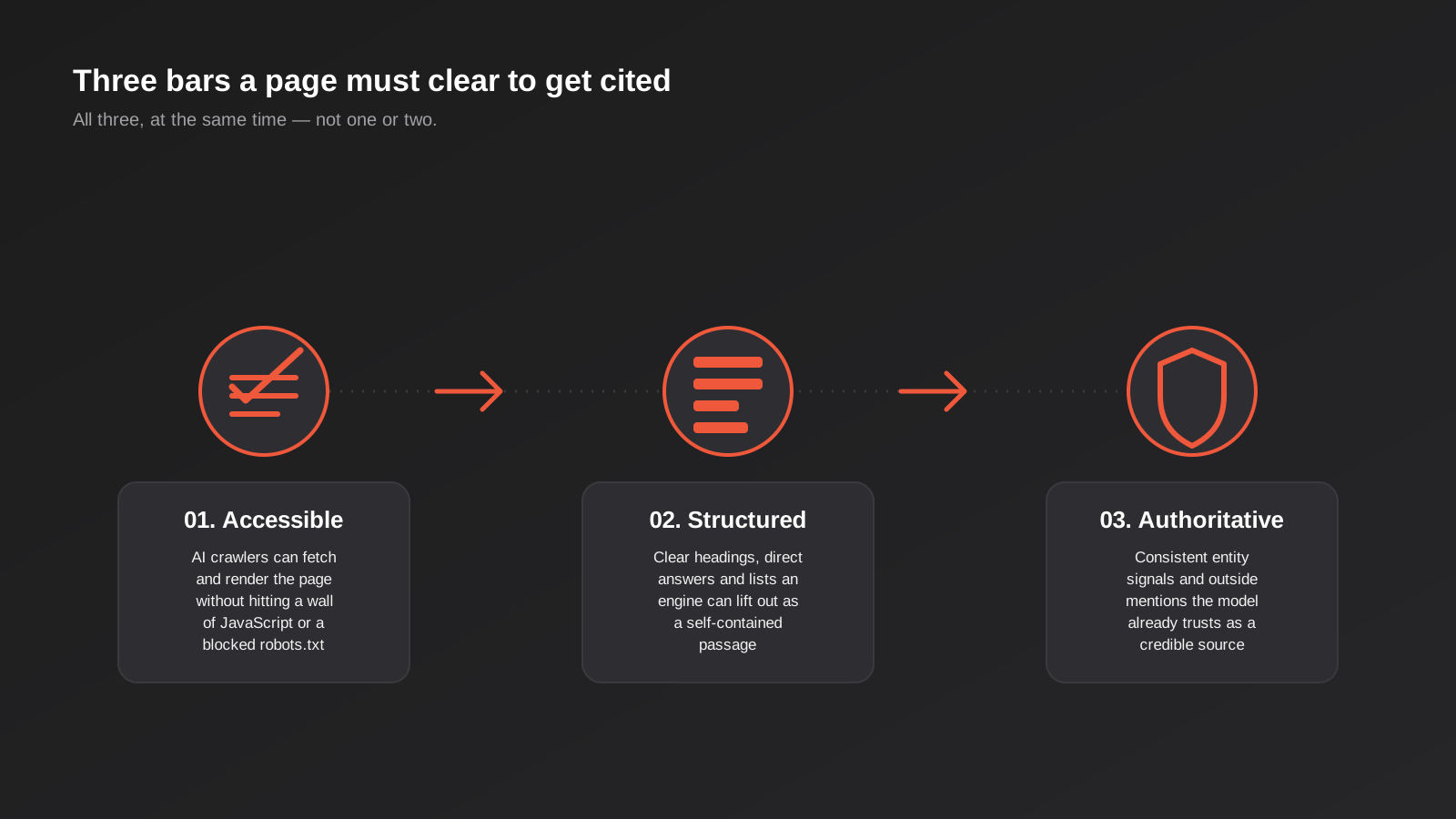
1. Technically accessible
Before an AI engine can consider citing your page, its crawler needs to actually fetch and read it. This sounds basic, and it is, but it’s also where we find the most avoidable failures. Some of the crawlers behind these tools (GPTBot, PerplexityBot, Google-Extended and others) are blocked outright in robots.txt files that were configured years ago by a developer who’d never heard of any of them. Others get stuck because the page’s core content only renders after a chunk of client-side JavaScript runs, and not every crawler executes JavaScript the way a browser does.
The fix is unglamorous: audit robots.txt for AI crawler user-agents specifically, don’t assume a rule that allows Googlebot also covers Google-Extended (it doesn’t — they’re separate directives), and check that your core content is present in the raw HTML response, not just the rendered DOM. If your site went through a recent platform move, this is worth checking as a matter of course — migrations are one of the most common ways a blocking rule gets introduced by accident.
2. Structured for retrieval
AI engines don’t read a page top to bottom the way a person might. They break it into passages and evaluate each one for how cleanly it answers a specific question. A page that spends four paragraphs building up to a point buries that point somewhere a retrieval system may never quite locate; a page that states the answer plainly in the first sentence of a section, then supports it, gets lifted cleanly.
In practice this means a genuine shift in how we structure content, not just cosmetic tweaks:
- Open each section with a direct answer to the question the heading implies, before adding nuance or caveats.
- Use headings that read like actual questions or clearly-scoped topics, not clever wordplay a person would need context to decode.
- Break comparisons and processes into lists or short tables rather than long descriptive paragraphs — a numbered list of steps is far easier for a model to extract cleanly than the same steps described in prose.
- Define terms plainly the first time you use them, especially industry jargon — a glossary-style definition is one of the most commonly cited content types across AI search studies.
- Keep each section focused on one question. A section that tries to answer three related questions at once tends to get extracted poorly or not at all.
None of this is a rewrite of good writing practice — it’s closer to the discipline good technical writing has always demanded. If your content process doesn’t already involve briefing writers this way, our SEO content strategy guide walks through building briefs that force this kind of structure from the first draft.
It’s easier to see the difference with an actual example than to keep describing it abstractly. Here’s a passage written the way most business websites still write, followed by the same information restructured for extraction.
Before: “When it comes to choosing the right approach for your business, there are a number of factors worth considering. Cost is obviously important, but so is the level of ongoing support you’ll receive, and many businesses find that the cheapest option upfront isn’t always the most cost-effective choice over the longer term once you factor in maintenance and support.”
After: “The cheapest option upfront is not always the cheapest overall. Three factors determine total cost: the initial price, ongoing support fees, and maintenance frequency. A lower initial price with high maintenance needs often costs more over two to three years than a higher initial price with a stable, low-maintenance build.”
The second version says less in a stylistic sense — no throat-clearing, no “it’s worth considering” — but it says more in an informational sense. It states the conclusion first, names the specific factors, and gives a concrete comparison a model can lift out whole and attribute cleanly. That’s the shift AI-ready writing actually requires: not more words, fewer words doing more work.
3. Entity authority
The third bar is the one businesses have the least direct control over, and it’s the one that separates a genuinely new discipline from a content formatting exercise. AI models weight sources partly by how confidently they can identify who or what is speaking, and how much they already “know” about that entity from training data and ongoing signals. A business with a consistent name, address and description across its website, Google Business Profile, industry directories and any press or partner mentions builds a coherent entity picture. A business whose name is spelled three different ways across its own footer, its GBP listing and its LinkedIn page is harder for a model to pin down with confidence, even if every individual page is well written.
Practical levers here include consistent NAP (name, address, phone) data everywhere your business appears, a genuinely informative About page with concrete facts rather than marketing copy — founding year, team size, service area, specific credentials — and schema markup (Organization, LocalBusiness, FAQPage, Article) that gives structured signals rather than making a model infer everything from prose. Third-party mentions still matter here too: a mention on an industry association page, a genuine review, a piece of press coverage all feed into the same authority picture, in much the same way backlinks have always fed traditional SEO, just evaluated differently.
The schema types worth prioritising
Structured data doesn’t guarantee a citation, but it removes ambiguity a model would otherwise have to infer from prose, and that makes it one of the higher-leverage technical changes available. If you’re starting from nothing, prioritise in this order:
- Organization or LocalBusiness on your homepage and about page — legal name, address, phone, founding details and social profiles in one machine-readable block.
- FAQPage on any page that genuinely answers distinct questions — not stuffed with keywords, but real questions a customer would actually ask, matching the on-page copy word for word.
- Article or BlogPost on insights content, with author, publish date and modified date filled in accurately — freshness signals matter more to AI retrieval than they historically have to organic ranking.
- Product or Service schema where relevant, particularly for ecommerce or clearly packaged service offerings, since it gives a model a clean, structured price and description to cite rather than one buried in marketing copy.
Not all AI engines work the same way
One of the more common mistakes we see is treating “AI search” as a single target. It isn’t. Each engine sources and weighs content differently, and a page tuned for one won’t automatically perform in another.
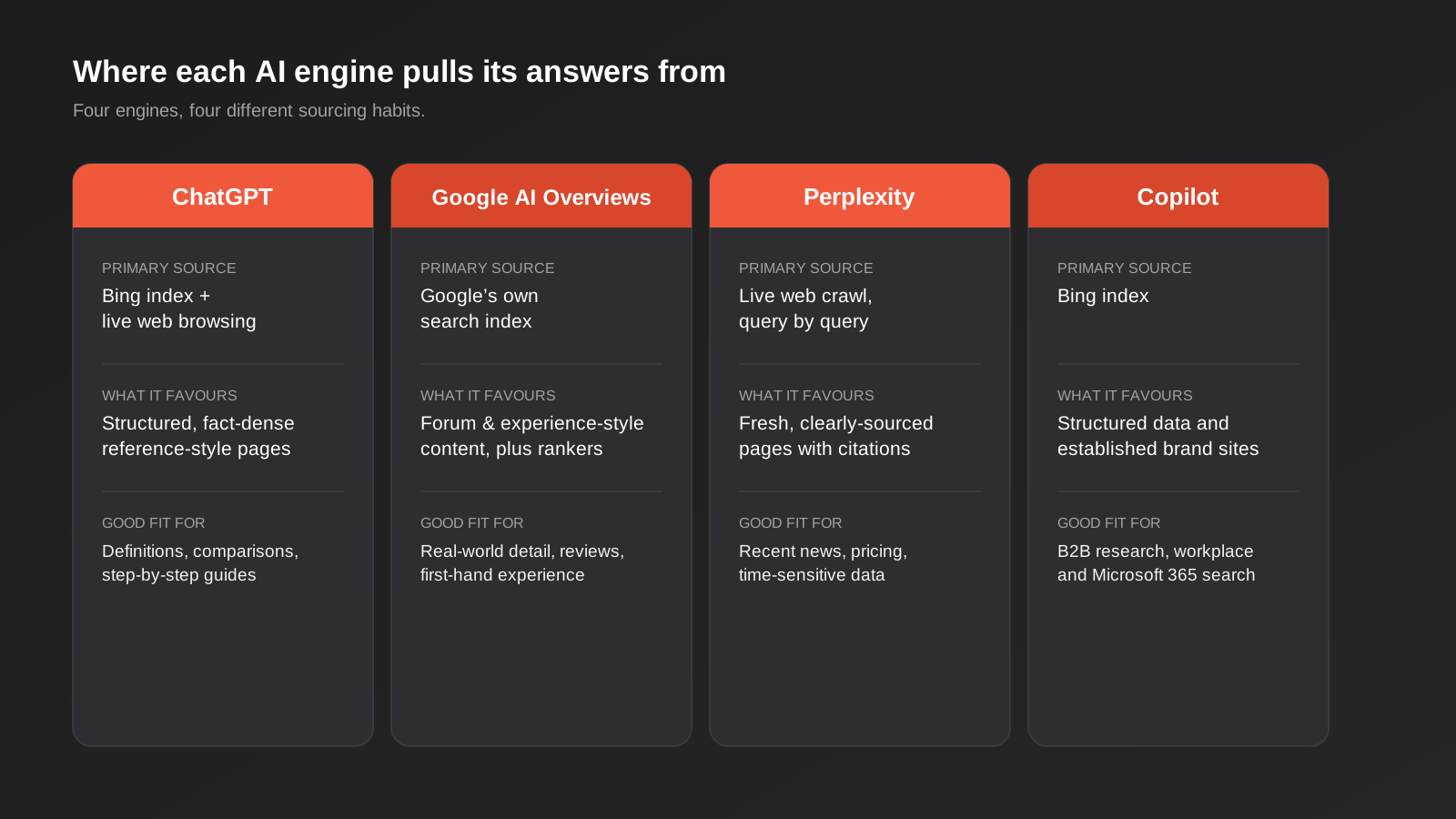
ChatGPT’s search function draws heavily on Bing’s index combined with live browsing, and research into its citation patterns shows a strong lean toward structured, reference-style sources — Wikipedia-type pages come up disproportionately often, which tells you something about the kind of clear, fact-dense, neutral writing that performs well there. Google’s AI Overviews, running on Google’s own index, lean more toward forum-style and lived-experience content in a lot of categories — Reddit threads are cited at a notably higher rate than you’d expect from their organic ranking position, because that kind of content often answers the underlying question more directly than a polished brand page does. Perplexity does something closer to a live retrieval for each query rather than relying purely on a static index, which rewards genuinely fresh content and pages that make their sources and citations easy to follow. Microsoft Copilot, built on Bing, tends to favour structured data and established brand sites, and matters disproportionately for B2B audiences doing research inside Microsoft 365 tools.
Worth separating out too: Google’s AI Overviews (the summary that appears inside ordinary search results) and Google’s AI Mode (a dedicated, fully conversational search experience) aren’t quite the same product, even though they share underlying technology. AI Overviews still sit above a page of familiar organic results, so traditional ranking factors keep some influence nearby. AI Mode is a much more open-ended, multi-turn conversation, closer in behaviour to ChatGPT, and it’s where we’d expect citation patterns to drift further from classic SEO signals as it gets wider use in Australia.
What this means practically: don’t chase a single “AI SEO score.” Think about which engines your actual customers are likely to use for your category, and weight your effort accordingly. A B2B software company selling into enterprise accounts probably cares more about Copilot and ChatGPT than Perplexity. A consumer brand competing on comparisons and reviews probably can’t ignore how Google’s AI Overviews treat community content.
A practical framework for getting started
We’re not going to pretend there’s a magic checklist that guarantees citations — nobody selling you one is being straight with you. But there is a sensible order of operations that gets the highest-leverage work done first.
Start with technical accessibility
Check robots.txt for every AI crawler you care about (GPTBot, ChatGPT-User, PerplexityBot, Google-Extended, ClaudeBot, and Bingbot for Copilot), confirm your core content renders in raw HTML, and make sure your XML sitemap is current. This is a half-day audit, not a project, and it’s worth doing even if you suspect everything’s fine — we consistently find at least one blocked crawler on sites that assumed they were covered.
Pick a handful of pages to rebuild for extraction, not a whole site rewrite
Choose the five to ten pages most likely to answer a genuine buyer question — comparison pages, “how much does X cost” pages, definition-style content, process explainers. Restructure those specifically: direct answers up front, clear headings, lists where a list genuinely helps. Trying to reformat an entire site at once usually produces shallow changes everywhere instead of real improvement anywhere. Pricing pages are consistently worth prioritising in this batch — they answer one of the most commonly asked buyer questions, they’re usually already fact-dense rather than promotional, and a vague or missing pricing page is one of the easier gaps for a competitor’s clearer page to win the citation instead.
Tighten your entity signals
Audit your business name, address and description for consistency across your website, Google Business Profile, and any directories or partner sites you appear on. Add or update Organization and FAQPage schema on key pages. This is slower, less visible work than content, which is exactly why most competitors skip it — and exactly why it’s worth doing properly rather than rushing through it in an afternoon. A single inconsistent listing picked up during an old directory sign-up, or a legacy trading name still sitting on a partner site, is enough to muddy the entity picture a model builds of your business.
Build a small set of genuinely citable reference content
One or two deep, well-sourced pieces that plainly define your category, back claims with specific numbers and dates rather than vague statements, and read as neutral and informative rather than promotional, tend to outperform a larger volume of shallow content for citation purposes. This is the same instinct behind good pillar content in traditional SEO, just written with extraction in mind rather than dwell time. Good candidates are usually the questions your sales team answers on almost every discovery call — pricing ranges, timeframes, what’s included versus what costs extra, how your approach differs from the obvious alternative. Those are exactly the questions people are now typing into an AI chat instead of asking a salesperson directly, which makes them the highest-value content you’re not yet fully capturing.
Treat it as ongoing, not a one-off project
AI models retrain, search indexes update, and citation patterns shift as these products iterate quickly. What gets cited today may not in six months, and vice versa. Build a light recurring check into your existing content process rather than treating this as a single sprint.
Measuring AI search visibility (the honest version)
This is the part nobody has fully solved yet, and we’d rather tell you that plainly than sell you a dashboard that overstates what it actually knows. Google Search Console doesn’t report AI Overview citations as a distinct metric. There’s no equivalent of rank tracking that reliably tells you “you were cited for this query on this date.” A few paid tools attempt to simulate prompts and log whether your brand appears, and they’re a reasonable directional signal, but treat the numbers as indicative rather than precise.
What you can measure directly:
- Referral traffic from AI platforms — chatgpt.com, perplexity.ai and similar sources show up as distinct referrers in GA4 if you know to look for them, and the segment is growing from a low base for most Australian SMBs.
- Branded search volume — if AI answers are naming your business, you’d expect a corresponding uptick in people searching your business name directly afterward.
- Manual prompt testing — periodically asking the actual questions your customers would ask, across ChatGPT, Google and Perplexity, and simply noting whether and how you appear. Unscientific, but genuinely useful as a sense check.
If you’ve already got a reporting setup tracking channel performance, extending it to flag AI referral sources as their own line item doesn’t take much extra work — it’s the kind of addition we typically fold into the same dashboards covered under reporting and data automation rather than treating as a separate tool.
Common mistakes we see
- Treating AI SEO as a bolt-on to existing SEO with no distinct work. Repurposing the same keyword-targeted content without restructuring for extraction rarely moves the needle — the content that ranks well and the content that gets cited well are optimised for genuinely different behaviours, even when they live on the same page.
- Blocking AI crawlers by accident. A robots.txt rule written years ago to manage server load, or copied wholesale from an old template or another site, often blocks AI user-agents nobody thought to check for. This is the single most common issue we find, and the easiest to fix once someone actually looks.
- Chasing every platform equally. Spreading effort evenly across ChatGPT, Google AI Overviews, Perplexity and Copilot when your actual customers mostly use one or two of them wastes effort that could go deeper on the ones that matter to your specific audience.
- Writing promotional copy where a neutral explanation would get cited more. Models tend to favour matter-of-fact, informative language over sales language when selecting what to quote, so a page written entirely in marketing voice often gets passed over for a competitor’s plainer, more direct one.
- Ignoring entity consistency because it feels like a minor detail. A mismatched business name or address across your website footer, Google Business Profile and directory listings is invisible to a human visitor but genuinely confusing to a model trying to establish who’s actually speaking.
- Expecting fast, measurable results. Citation behaviour shifts with model updates outside your control, and the measurement tools available today are still immature. This is a longer game than a paid campaign, closer in the patience it demands to organic SEO than to Google Ads.
- Abandoning local SEO fundamentals to chase AI Overviews. For local-intent queries, the map pack and local pack still carry real weight in Australia. Don’t drop the basics to chase a channel that’s currently less dominant for exactly that query type — the two should run in parallel, not compete for the same budget.
Frequently Asked Questions
Is AI SEO the same thing as GEO or AEO?
Largely yes — generative engine optimisation (GEO) and answer engine optimisation (AEO) are the more technical terms for what’s commonly shortened to “AI SEO” in everyday conversation. They all refer to optimising content so it gets surfaced and cited inside AI-generated answers, as distinct from ranking in a traditional list of search results.
Do I need to choose between traditional SEO and AI SEO?
No, and we wouldn’t recommend it. The two overlap enough — particularly around technical health and genuine content quality — that solid traditional SEO remains the foundation. AI search optimisation is additional, more specific work layered on top for the pages where extraction and citation genuinely matter to your business.
Will adding an llms.txt file get my site cited by AI search engines?
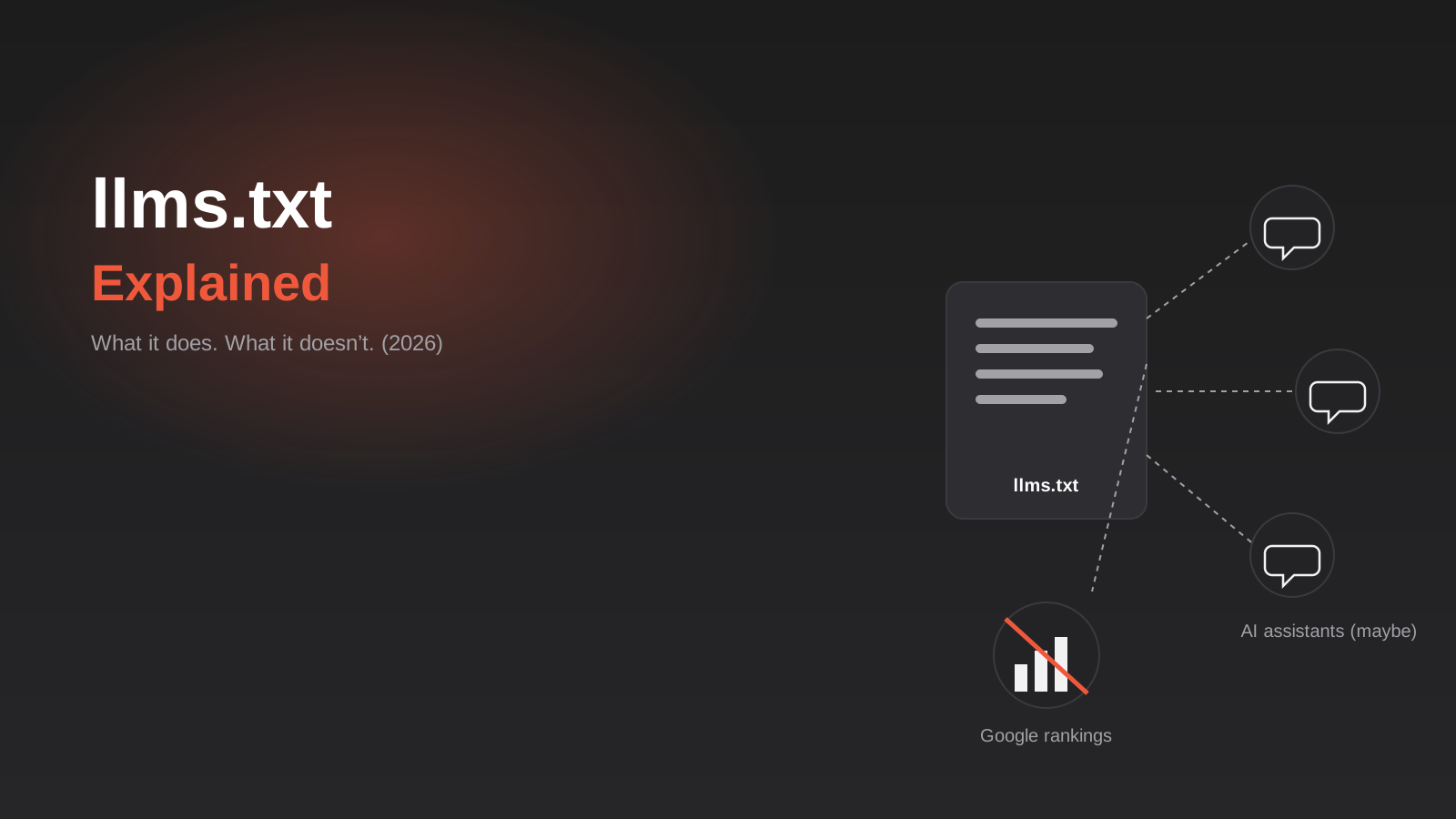
Not by itself. An llms.txt file is a proposed standard for signposting AI-friendly content, and it’s reasonable infrastructure to have, but there’s no solid evidence it meaningfully increases citation rates on its own. Treat it as one small piece of technical housekeeping, not a strategy.
How long does it take to see results from AI search optimisation?
Longer than most businesses would like, and the timeline is genuinely less predictable than traditional SEO because the underlying models and indexes change on a schedule you don’t control. We’d budget in similar terms to organic SEO — months, not weeks — while accepting that measurement is still catching up to the channel.
Does this matter for a small local business, or only larger brands?
It matters less for hard local-intent searches right now, since Google still leans on its local pack for those queries. It matters more the moment a potential customer asks a broader question your business could plausibly answer — “what should I look for in a [service]” or “how much does [service] typically cost” — where an AI answer, not a map listing, is doing the work.
Which AI platform should I prioritise first?
Whichever one your actual customers are most likely to use for research in your category. B2B and technical categories skew toward ChatGPT and Copilot; consumer categories with a lot of comparison shopping and reviews skew toward Google’s AI Overviews. If you’re unsure, manual prompt testing across two or three platforms for your own common customer questions is a quick way to see where you already show up, or don’t.
Where to start
If you take one thing from this, make it the crawler audit — it’s the fastest thing to check and the easiest to get wrong by accident. From there, pick a small set of pages that answer genuine buyer questions and rebuild them properly rather than trying to retrofit an entire site in one go.
This is genuinely new territory, and honest answers are still thinner on the ground than confident-sounding ones. If you’d rather talk through where your own site actually stands before committing budget to it, that’s exactly the kind of conversation our AI SEO team has most days — happy to have a look and tell you plainly what we’d prioritise first.
Keep reading
Related posts
Got a project you'd like to talk through?
Tell us what you're working on — we'll come back with a plan.
