
Keyword Research for SEO: A Practical, Step-by-Step Guide (2026)
 Jignesh Vagadiya
19/08/2026
22 min read
Jignesh Vagadiya
19/08/2026
22 min read
Most SEO content covers keyword research as a single bullet point: “find keywords with high volume and low competition.” That advice was thin a decade ago and it’s actively misleading now. Search volume is an estimate, not a fact. Difficulty scores measure a proxy, not a probability. And a growing share of the queries you’re trying to rank for are being typed — or spoken — into an AI Overview or a chatbot rather than a search box at all.
This guide is the step-by-step version we wish existed when we started doing this properly: how to build a seed list, which tools actually earn their subscription fee, how to read volume and difficulty data without being misled by it, how to cluster keywords into something a content calendar can use, how to find the gaps your competitors have left open, and how the rise of AI-driven search is changing what “a keyword” even means. If you want the broader context — how keyword research fits into an overall SEO strategy, or how it feeds into content planning — we’ve covered that in our SEO guide for Australian businesses and our content strategy guide. This piece is about the mechanics of the research itself.
Why Keyword Research Still Matters (And Why It’s Harder Than It Looks)
There’s a temptation, especially with AI writing tools now able to generate a thousand blog topics in ten seconds, to treat keyword research as a formality — something you do quickly before the “real” work of writing starts. We’d argue it’s the opposite. Keyword research is the part of SEO where you find out, with actual evidence, what people are typing and asking, in what volume, with what intent, and how hard it will be to compete for that attention. Skip it or do it lazily and everything downstream — content briefs, internal linking, page structure, even your paid search targeting — is built on a guess.
The difficulty isn’t finding keywords. Any tool will spit out thousands of them in seconds. The difficulty is knowing which of those thousands are worth building a page around, which ones can be grouped into a single asset, which ones are commercially valuable versus just high-traffic vanity metrics, and which ones you’re realistically going to rank for in the next twelve months given your site’s current authority. That’s a research and judgement exercise, not a data export.
Building Your Seed Keyword List
Every keyword research process starts with a seed list — a starting set of terms and phrases that describe what your business does, in the language your customers actually use (which is often not the language you use internally). Get this step wrong and every tool you plug it into afterwards will hand you back the wrong universe of keywords.
Mining Your Own Site, Sales Team and Competitors
Start internally before you open any tool. Your sales or customer service team hears the exact phrases prospects use — often quite different from your website’s own terminology. A plumber might call it “hot water system replacement” on their site while customers search “hot water tank not working.” Pull transcripts, support tickets, live chat logs, or just ask the team what questions come up most. This is free, high-quality seed data that no keyword tool can generate for you because it doesn’t live in search data at all — it lives in your own customer conversations.
Next, look at three or four direct competitors’ sites. Note their service page titles, their blog category structure, and the headings on their higher-ranking pages. You’re not copying their keywords — you’re using their existing content as a map of the topic territory, which you’ll then verify and expand with actual search data.
Search Console: The Free Data Source Most Businesses Ignore
If your site has any organic traffic history at all, Google Search Console is arguably the single best keyword research source available to you, and it’s the one most businesses barely open. Unlike every third-party tool, Search Console shows you queries Google has already decided your pages are relevant for — including impressions for terms you’re not actively targeting and may not even be aware of.
Go to Performance > Search Results, filter by page for your key landing pages, and sort by impressions. You’ll typically find three categories worth acting on: queries with high impressions but low click-through rate (a title tag or meta description problem, or a ranking position problem); queries sitting on page two (positions 11–20) with reasonable impressions, which are often the fastest wins in all of SEO because a moderate content or internal linking push can push them onto page one; and queries you had no idea you were being found for at all, which is free seed keyword data straight from Google, not an estimate from a third-party crawler.
The catch is that Search Console only shows you what you’re already visible for. It’s a fantastic tool for expansion and optimisation of existing content, but it can’t tell you about competitor territory you haven’t touched yet — that’s where paid tools come in.
Choosing and Using Keyword Research Tools
There is no single “best” keyword tool — there’s a best tool for the specific question you’re asking, and most serious SEO work ends up using two or three of them in combination.
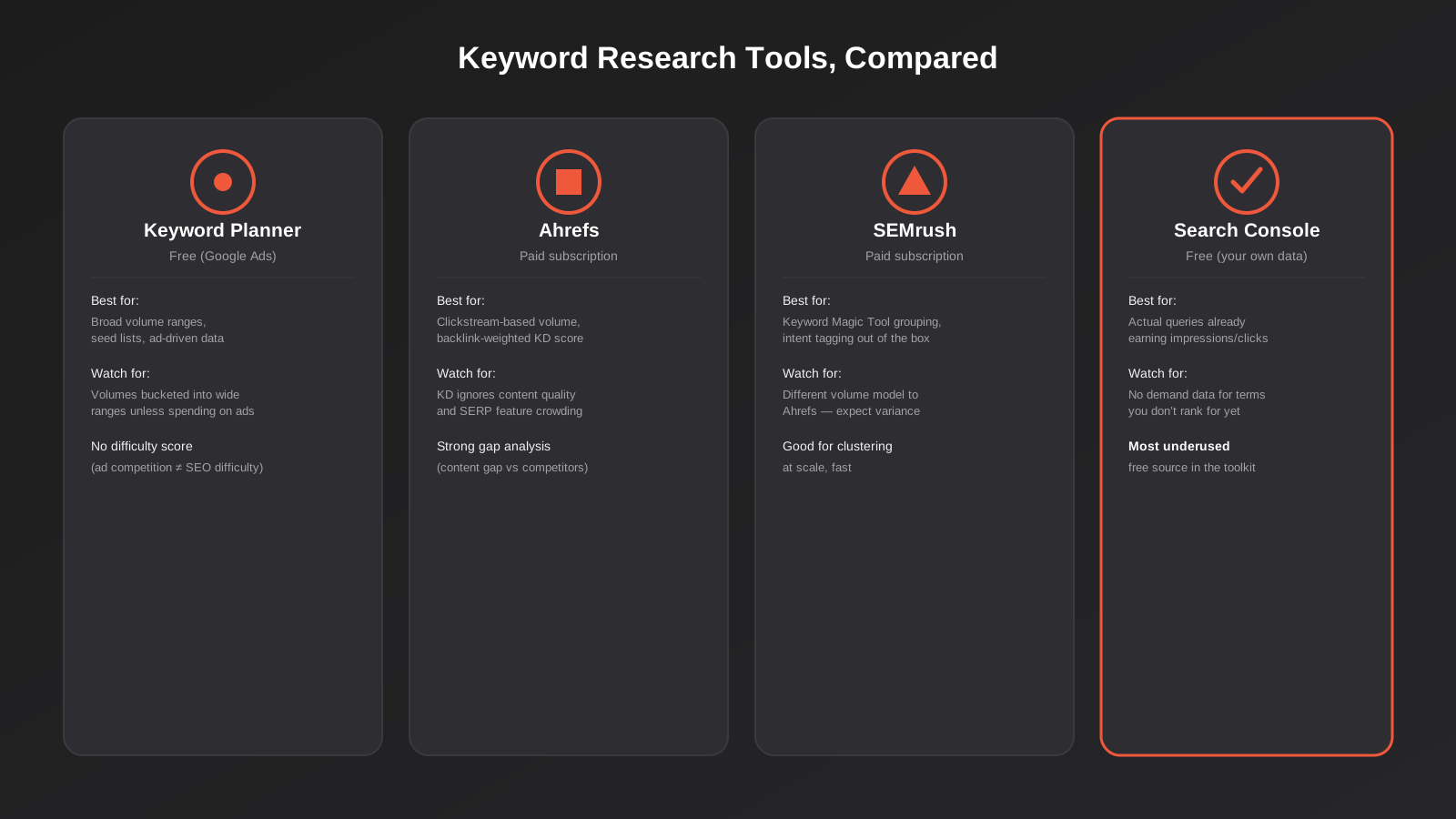
Google Keyword Planner
Keyword Planner is free (with a Google Ads account, even an unfunded one) and its volume data comes straight from Google, which sounds like it should make it the gold standard. In practice, its biggest limitation is that it buckets low-volume keywords into wide ranges — you’ll frequently see “10–100” or “100–1K” for exactly the long-tail, high-intent terms that matter most for a mid-sized business. It’s also built for advertisers, not SEOs, so it’s tuned towards commercial volume and can under-represent informational queries. Use it as a directional cross-check and for genuinely high-volume head terms, not as your primary keyword database.
Ahrefs and SEMrush
Ahrefs and SEMrush are the two paid platforms doing the heavy lifting in most professional keyword research, and they’re closer in capability than either vendor’s marketing suggests. Both crawl the web independently and model volume from clickstream data rather than relying solely on Google’s own numbers, which is why their estimates for the same keyword often differ from Keyword Planner’s — and from each other’s.
Ahrefs tends to have the edge for backlink-adjacent research and its Keywords Explorer’s “Also rank for” and “Also talk about” reports are genuinely useful for finding related terms you wouldn’t think to search for manually. SEMrush’s Keyword Magic Tool is stronger for grouping large keyword sets by topic automatically, and its Position Tracking is a bit more configurable for local and multi-location tracking, which matters a lot for Australian businesses competing across states or metro areas. Neither is a bad choice for a business budgeting for one tool; the honest answer is that if your budget allows for both, use Ahrefs for competitive and backlink-informed research and SEMrush for volume grouping and tracking, and treat any disagreement between them as a sign to widen your estimate rather than trust one over the other.
Free and Secondary Tools Worth Knowing
Beyond the big three, a handful of free tools earn a place in the process. AnswerThePublic and AlsoAsked are useful for surfacing question-format keywords, which matters more every year as AI Overviews and voice search favour full-sentence queries. Google’s own autocomplete and “People also ask” boxes, checked manually in an incognito window, are a five-minute reality check on what real searchers in Australia are currently being shown — and they update faster than any third-party database. None of these replace a proper research platform, but they’re excellent for filling in gaps and sanity-checking what the bigger tools report.
How to Actually Read Search Volume Data
This is the section most keyword research guides skip, and it’s the one that causes the most wasted content budget when it’s ignored.
Volume Is Directional, Not Gospel
Every volume figure you see — from Keyword Planner, Ahrefs, SEMrush, anywhere — is a modelled estimate, not a direct count of searches. These tools sample clickstream and panel data, apply statistical models, and average across a rolling 12-month window. That means two tools can report meaningfully different numbers for the identical keyword, and both can be “right” within their own methodology. Treat volume as an indication of relative scale — this keyword is roughly ten times bigger than that one — rather than a number you can multiply by an expected click-through rate to forecast traffic with any precision. We’ve seen businesses build entire content roadmaps around chasing a keyword reported at 2,400 monthly searches that, once ranked for, delivered a fraction of that in actual Search Console impressions. The estimate wasn’t fraudulent; it was just an estimate.
Seasonality and Regional Distortion in the Australian Market
Most tools default to a 12-month average, which flattens seasonal keywords into a misleading middle figure. “Pool fencing,” “air conditioner repair” and “tax return accountant” all swing dramatically by month in Australia, and a flat annual average will either undersell or oversell the opportunity depending on when you’re planning to publish. Always check the monthly trend graph, not just the headline number, before deciding a keyword is or isn’t worth targeting.
Regional distortion is the other trap specific to Australia. National volume figures blend Sydney and Melbourne’s population weight into terms that a Perth or Adelaide-based business is targeting locally, which can make a keyword look bigger — and more competitive — than it actually is in your service area. Where your tool allows it, filter volume by state or set up a custom location; where it doesn’t, treat national figures as a rough multiple of your likely local volume rather than a direct read.
Keyword Difficulty Scoring — What It Measures and What It Misses
How Difficulty Scores Are Actually Calculated
Keyword difficulty (KD) scores — whether from Ahrefs, SEMrush, Moz or elsewhere — are built almost entirely from backlink data on the pages currently ranking. In simplified terms, the tool looks at the number and quality of referring domains pointing at the top-ranking URLs for that query, and produces a 0–100 score estimating how many backlinks a new page would plausibly need to compete. That’s a genuinely useful signal — link authority is still one of the strongest ranking factors we have — but it is only one input into what Google actually weighs.
What Difficulty Scores Systematically Miss
A low KD score doesn’t account for content quality, page experience, topical authority, or search intent match — a keyword can show as “easy” purely because the current top-ranking pages happen to be thin or outdated, while still being genuinely hard to unseat if those same competitors have strong domain-wide topical relevance. Conversely, a keyword can show as “hard” because of a handful of extremely high-authority pages ranking for it incidentally — a Wikipedia page or a major publisher — that don’t actually represent the realistic competitive set once you filter for commercial intent. We’ve also seen KD scores badly mislead on local and Australian-specific terms, where the tool’s backlink index simply has less data to work with and defaults to a misleadingly low number.
The practical fix is to never treat a KD score as a final answer. Look at the actual top ten results for the query. Are they big-brand domains, aggregator sites, or businesses roughly your size? Do the ranking pages actually answer the query well, or are they thin and outdated? Is search intent obviously commercial, informational, or mixed? A manual SERP scan takes five minutes and will correct more bad keyword decisions than any difficulty score on its own.
Keyword Clustering and Grouping Techniques
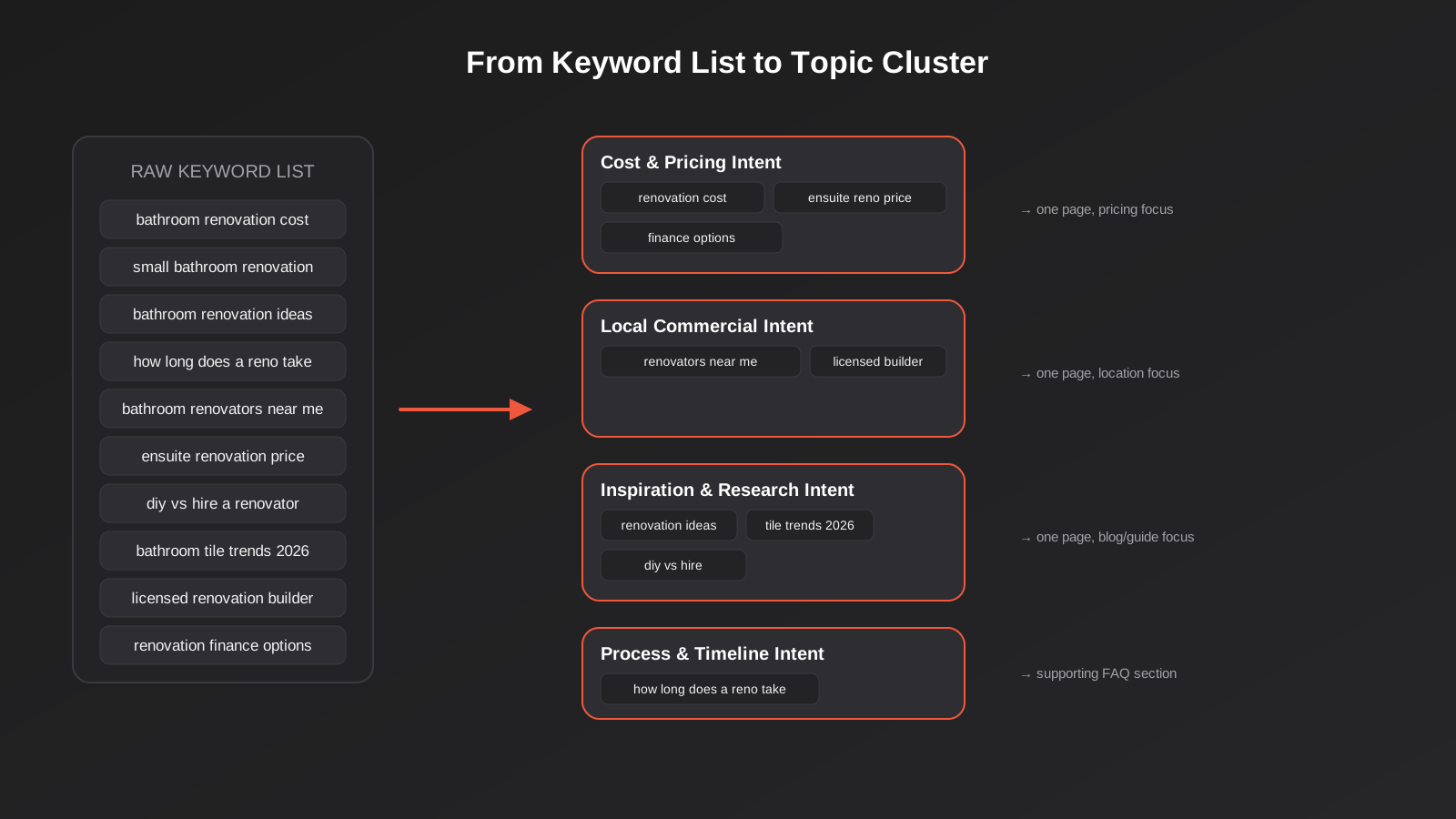
Raw keyword lists from any tool are unusable at scale — a mid-sized business researching one service area can easily surface two or three thousand keyword variants. Clustering is the process of grouping those variants into a manageable number of topics, each of which becomes one page rather than one keyword becoming one page. Done well, this is what stops you from building fifteen near-duplicate pages that cannibalise each other in the rankings.
Manual Clustering by SERP Overlap
The most reliable clustering method, and the one we default to for anything commercially important, is SERP overlap: search each keyword individually and check how much the top ten results overlap with another keyword’s top ten. If seven or more of the same URLs rank for both “keyword research tools” and “best tools for keyword research,” Google has effectively already told you those are the same search intent and belong on the same page. If the overlap is only two or three URLs, they’re related but distinct intents and probably warrant separate pages or at least separate sections. This is slower than automated clustering but it’s grounded in what Google is actually doing right now, rather than a linguistic similarity model guessing at intent.
Tool-Assisted Clustering
For larger keyword sets, SEMrush’s Keyword Magic Tool and Ahrefs’ Keywords Explorer both offer automated grouping based on shared terms and, in Ahrefs’ case, an option to cluster by actual SERP overlap similar to the manual method above but run at scale. These are a good starting point for a keyword set in the thousands, but they still need a human pass afterwards — automated clustering reliably lumps together keywords that share words but not intent (for example, grouping “keyword research for beginners” with “keyword research tools pricing” purely because both contain “keyword research”), so treat the tool’s first pass as a draft, not a final structure.
Competitor Keyword Gap Analysis
Running the Gap Report
A keyword gap analysis compares your site’s ranking keyword set against two or three competitors’ and surfaces the terms they rank for that you don’t. Every major tool has a version of this — Ahrefs’ Content Gap, SEMrush’s Keyword Gap — and the mechanics are simple: enter your domain and up to four or five competitor domains, and the tool returns keywords where at least one competitor ranks in a usable position and you rank nowhere, or well behind.
The value of this exercise isn’t the raw list, which is often enormous and full of noise. It’s in the pattern that emerges once you scan it: a competitor with a dedicated pricing page ranking for a cluster of “cost” and “pricing” keywords you’ve never targeted, or a competitor whose blog covers a sub-topic your content has never touched. Those patterns point to structural content gaps, not just individual missing keywords.
Prioritising What You Find
Not every gap is worth closing. We prioritise by cross-referencing three things: commercial relevance (does this keyword actually relate to something you sell, not just something adjacent), realistic competitiveness (using the SERP-scan method above, not the raw KD score), and existing site strength (a gap keyword closely related to a page you already rank reasonably for is usually a faster win than one requiring a brand-new page with no supporting internal links). A gap analysis that produces four hundred keywords and no prioritisation framework just becomes another spreadsheet nobody acts on.
Long-Tail vs Head-Term Strategy
When Head Terms Are Worth Chasing
Head terms — short, high-volume, broad keywords like “digital marketing agency” or “keyword research” — carry the most search volume and the most competition, usually by a wide margin. They’re worth targeting directly once a site has built enough topical authority and backlink strength to realistically compete, and once the supporting long-tail content around that topic is already in place. Chasing a head term as the first piece of content on a brand-new site is close to the least efficient use of a content budget in SEO; you’re competing against domains with years of accumulated authority for a query with commercial value high enough that everyone else is competing for it too.
Building Authority With Long-Tail First
Long-tail keywords — longer, more specific phrases like “keyword research for a plumbing business in Perth” — individually carry far less volume, but they’re where most sites should start, for two compounding reasons. First, they’re easier to rank for because fewer sites are competing for that exact specific phrasing. Second, and more importantly, a well-built cluster of long-tail content around a topic is what actually earns a site the topical authority needed to eventually rank for the head term above it. This is the practical logic behind pillar-and-cluster content models: the long-tail pages aren’t just traffic in their own right, they’re the evidence Google uses to decide whether your site deserves to rank for the harder, broader query. Treating long-tail as a lesser strategy rather than the foundation is one of the more common strategic mistakes we see in keyword planning.
How AI and LLM Search Are Changing What a Keyword Even Means
From Keywords to Full Questions
The traditional model of keyword research assumes people type short, fragmented phrases into a search box — “best keyword research tools,” not “what’s the best keyword research tool for a small business on a budget.” That assumption is breaking down. AI Overviews, ChatGPT, Perplexity and similar tools have trained a meaningful and growing share of searchers to type — or speak — full, natural questions, because the interface is designed for conversation rather than fragment-matching. A user who would once have searched “SEO keyword research” is increasingly likely to ask “how do I do keyword research for my small business’s SEO in Australia” instead, and to expect a synthesised answer rather than a list of blue links to click through.
This doesn’t mean traditional keyword volume data becomes useless — it’s still the best proxy we have for topic demand. But it means the unit of optimisation is shifting from “rank for this exact phrase” to “be the source an AI system pulls from and cites when answering this class of question.” Those are related goals but not identical ones, and treating them as identical is a mistake that’s already starting to cost visibility for businesses that haven’t adjusted.
What This Means for How You Research Keywords Now
Practically, this shifts a few things in the research process itself. Question-format tools like AlsoAsked and AnswerThePublic, and the “People also ask” boxes in regular search, become more important relative to pure volume tools, because they surface the actual phrasing of the questions AI systems are being asked to answer. It’s worth grouping your keyword clusters not just by topic but by the underlying question each one represents, and making sure your content directly and clearly answers that question near the top of the page — AI Overviews and LLM-based answer engines tend to favour content that states the answer plainly before elaborating, which is a different structure to the SEO-optimised, keyword-dense writing style that worked well for classic organic ranking a few years ago.
It also means monitoring is changing. Search Console still shows you traditional query data, but it doesn’t yet show you what’s happening inside AI Overviews or chatbot citations with anything like the same granularity, which means some genuine visibility is currently invisible in your existing reporting. Our position is not to abandon traditional keyword research — the fundamentals in this guide are still exactly what drives organic visibility — but to treat “what question is this keyword really representing” as a standing part of the process rather than an afterthought.
Turning Research Into a Working Keyword Map
From Spreadsheet to Content Calendar
Once you’ve built a seed list, pulled volume and difficulty data, clustered by intent, and run a gap analysis against competitors, the temptation is to hand the whole spreadsheet to whoever writes your content and let them work through it top to bottom. That’s how keyword research ends up gathering dust after the first month. A working keyword map needs a priority order, and the order should be based on a combination of commercial value, realistic winnability, and how much supporting content already exists around that topic on your site — not just which row happens to have the highest volume figure.
We generally split the final map into three tiers: quick wins (existing pages ranking on page two for a cluster, where a content and internal linking refresh can realistically move the needle within a few months), foundation content (long-tail clusters with clear commercial or informational intent and low competition, which build the topical base for later head-term pushes), and stretch targets (head terms and competitive gap keywords that are worth planning for now but will take sustained content and link building to actually rank for). Mapping every keyword cluster into one of these three tiers, rather than treating the list as flat, is what turns a research exercise into something a content calendar can actually run on for the next six to twelve months.
Tracking Performance After You Publish
Keyword research doesn’t end when a page goes live. Set up rank tracking for your priority clusters in whichever tool you’re using — Ahrefs and SEMrush both handle this well, and it’s worth tracking the whole cluster rather than just the single primary keyword, since a page can quietly pick up rankings for related long-tail variants well before it moves on the primary term. Cross-reference tracked positions against actual Search Console impressions and clicks every month or two; a keyword climbing in a third-party tracker that isn’t showing corresponding impressions in Search Console is worth investigating before you assume the research was right and move on to the next cluster.
Common Keyword Research Mistakes
- Chasing volume without checking intent, and ending up with a page ranking for a keyword that never converts because searchers wanted something else entirely.
- Treating a single tool’s data as definitive instead of cross-referencing volume and difficulty across at least two sources.
- Building one page per keyword instead of clustering by intent, which creates internal competition between your own pages.
- Ignoring Search Console’s existing query data in favour of paid tools, and missing free, already-proven opportunities sitting in your own account.
- Targeting head terms first on a new or low-authority site instead of building topical authority with long-tail content.
- Never re-running research after a campaign, so keyword targeting goes stale as search behaviour and AI-driven query formats shift.
- Ignoring regional and seasonal volume distortion, particularly relevant for Australian businesses competing across states with very different search populations.
- Treating keyword difficulty scores as a hard yes/no filter instead of doing a manual SERP scan to check who’s actually ranking and why.
Frequently Asked Questions
How many keywords should I target per page?
There’s no fixed number, because it depends on how tightly the keywords cluster by intent rather than how many you can find. A well-clustered page might target one primary keyword and eight to fifteen closely related variants that share the same search intent and SERP overlap. If you’re finding keywords that genuinely require different content structures or answer different questions, that’s a signal they belong on separate pages, not a signal to force them onto one.
Is Google Keyword Planner accurate enough on its own?
It’s a reasonable starting point, particularly for high-volume commercial terms, but its bucketed volume ranges make it unreliable for long-tail keyword decisions, which is where a lot of the real opportunity for small and mid-sized businesses actually sits. We’d recommend cross-checking Keyword Planner data against Ahrefs, SEMrush or your own Search Console figures before making a targeting decision based on volume alone.
What’s a good keyword difficulty score to target as a smaller business?
There’s no universal number, because difficulty scores aren’t calibrated against your specific site’s current authority. A KD of 30 might be genuinely achievable for an established site with strong backlinks and out of reach for a brand-new domain. Rather than picking a threshold, do a manual SERP scan for each candidate keyword and compare the ranking pages’ apparent authority and content quality against your own site’s current standing.
How often should keyword research be redone?
For an active content programme, we’d revisit core keyword clusters at least every six months, and sooner if you notice ranking or traffic movement that doesn’t match your existing targeting. Search behaviour, competitor content, and now AI-driven query formats are all shifting fast enough that keyword research done more than a year ago should be treated as a starting point to verify, not a plan to keep executing unchanged.
Should I still bother with long-tail keywords if they have low search volume?
Yes, and for most sites they should be the priority rather than an afterthought. Individually low-volume long-tail keywords add up across a well-built content cluster, they’re generally easier to rank for, and the topical authority they build is often what makes ranking for the bigger head term above them possible in the first place.
Do AI Overviews mean keyword research matters less now?
It changes the practice more than it reduces its importance. Traditional keyword and volume data is still the best available signal for topic demand, but it’s worth pairing that with question-format research — tools like AlsoAsked, “People also ask,” and direct testing in AI search tools — to understand how a topic is being asked about conversationally, and making sure your content answers that question clearly and directly.
Where to Start
If you’re doing this for the first time, don’t try to run every technique in this guide at once. Start with your Search Console data — it’s free, it’s specific to your site, and it will surface real opportunities within an hour of looking. Layer in one paid tool for competitor gap analysis and volume cross-checking once you know roughly which topics matter. Cluster before you brief a single page of content, and check the actual SERP rather than trusting a difficulty score in isolation. Keyword research done properly is genuinely one of the highest-leverage hours you can spend on a website — it’s just rarely done properly. If you’re scoping this as part of a broader SEO engagement, our SEO pricing page outlines what’s typically included.
If you’d rather have this handled for you — from research through to a prioritised, clustered content plan — get in touch with our team and we’ll walk you through how we’d approach it for your site.
Keep reading
Related posts
Psychology Practice Marketing in Australia: Local SEO, Compliant Copy and the Waitlist Problem (2026)
How Australian psychology practices handle local SEO, AHPRA-compliant copy and waitlist triage when they're already at capacity (2026).

Physiotherapy Marketing in Australia: Local SEO, Website Design and Booking (2026)
How Australian physiotherapy clinics win new patients through Google Business Profile, local SEO, website design and real-time booking in 2026.
Local SEO for Veterinary Clinics in Australia: Google Business Profile, Reviews and the Emergency Search (2026)
Veterinary clinic SEO explained: Google Business Profile, review generation and the emergency search most vet websites get wrong.
Got a project you'd like to talk through?
Tell us what you're working on — we'll come back with a plan.
