
How to Compare Agency Quotes in Australia: Why Prices Differ So Much (2026)
 Jignesh Vagadiya
12/11/2026
21 min read
Ask three agencies to quote the same job and you might get back $4,000, $11,000 and $26,000. Nobody is lying to you, and nobody is necessarily ripping you off either. That spread is normal, and it is the single most common reason people stall at the quoting stage, pick the middle one out of nervousness, or go with the cheapest and find out later what it left out.
We write quotes for a living, so we know how they get built. The pattern repeats. The numbers on the bottom line are rarely comparable, because the documents above them describe different projects. One quote assumes you will write your own copy. Another includes a month of post-launch support. A third quietly prices a bigger scope than you asked for. This guide explains where the gaps come from, what typical Australian market ranges look like, and how to line quotes up so you are comparing like with like.
A note on numbers before we start. The ranges below come from published Australian pricing guides and agency rate cards we reviewed this month. Most are written by agencies, so treat them as indicative rather than gospel, and every figure here is exclusive of GST unless we say otherwise. Where we could not find a defensible range, we have given the cost drivers and the questions to ask instead of inventing a number.
What Australian agency quotes actually cost
Start with the market picture, because it tells you whether a quote is even in the right neighbourhood. These are the ranges we see repeated across Australian agency and freelancer pricing pages for the services small and mid-sized businesses buy most often.
Websites
Published guides put a professionally built small-business website from an agency at roughly $3,000 to $8,000, with premium custom builds running from about $8,000 up into the tens of thousands. Online stores sit higher again, commonly $10,000 to $50,000 depending on catalogue size, integrations and custom functionality. Freelancers tend to quote lower, and some guides put small-business sites at $2,000 to $6,000 for that kind of work. We go into the detail in our guide to what a website costs in Australia, so we will not repeat every tier here.
SEO
Monthly SEO retainers for small businesses most often land between about $1,500 and $3,500 a month, according to the Australian guides we checked, with wider ranges of $1,500 to $10,000 or more quoted for competitive industries and larger sites. One audit of published agency entry prices found the average starting retainer sat close to $1,500 a month. Hourly SEO consulting is usually quoted somewhere between $150 and $300.
Paid media management
Google Ads and Meta Ads management is normally priced as a monthly fee, either flat or as a percentage of ad spend, on top of the ad budget itself. That second part trips people up: a quote that says $2,000 a month might mean $2,000 of management plus your ad spend, or $2,000 all in. Always ask which.
Hourly rates, which sit underneath nearly everything
Even fixed quotes are built from hourly rates somewhere in the spreadsheet. Published Australian figures for agency design and development time cluster around $100 to $200 an hour, with specialist marketing time often quoted higher. Freelancers are commonly quoted at $50 to $150 for design and somewhat more for senior developers. One published guide puts Melbourne agencies at the upper end of the agency band. None of these come from a formal industry survey, which is worth remembering whenever someone quotes you “the market rate” with great confidence.
The point of those ranges is not to find the “right” price. It is to spot quotes that are far outside them and ask why. A $900 website quote can be legitimate for a five-page template site with your own content. It cannot be legitimate for a custom store with ERP integration, and if someone quotes it, the missing scope will turn up later as change requests.
Why quotes for the same brief differ so much
When we line up a prospect’s three quotes side by side, the difference almost always traces back to a handful of causes. Understanding them is most of the job.
The briefs are not actually the same
“We need a new website” is not a brief. It is a category. One agency reads it as a refresh of the existing five pages; another reads it as a rebuild with a new information architecture, a blog, and a quote calculator. If you did not give all three a written scope with page counts and functions, you got three guesses, and the price differences are the differences between the guesses.
Different assumptions about who does what
Content is the classic example. Who writes the copy? Who sources and edits images? Who loads the content into the site? If Quote A assumes you supply everything and Quote C includes professional copywriting for twelve pages, a large part of the price gap is simply a content budget that Quote A pushed back onto you.
The same applies to approvals and revisions. A quote with two rounds of revisions and a quote with unlimited revisions are different products, and the second one often comes with a quiet clause about what “unlimited” means once the agency decides the project has run over.
Who is actually doing the work
Agency prices carry overhead: account managers, project managers, office space, tools, insurance, sales. A larger team can bring more specialists and more process, which suits some projects. A smaller specialist team has less overhead to recover, which can bring the price down, but it also means fewer people to cover for each other. A freelancer sits at the low-overhead end and carries the most single-person risk. There is no universally correct choice. What matters is knowing which of these you are buying and whether it fits the stakes of the project.
Platform and licence choices
Quotes can differ simply because one agency builds on WordPress, one on Shopify and one on a proprietary system. The build cost, the ongoing licence cost and your ability to leave later are all different. A cheap build on a closed platform can become the expensive option if you cannot take your site elsewhere.
What is excluded
This is where the biggest swings hide. The cheapest quote is often the one with the most items quietly left off: hosting, domain, SSL, plugin or app licences, stock imagery, analytics set-up, redirects from the old site, training, and a support window after launch. None of these is exotic. Each of them costs money eventually, and if the quote does not list it, you will either pay for it separately or go without.
Margin, positioning and appetite
Some price differences are just business models. An agency with a full pipeline can afford to price high and pick its projects. One that is hungry for work might discount to win. A premium brand with a brand-heavy portfolio will charge for the brand. You cannot see this from the outside, which is one more reason to compare scope rather than totals.
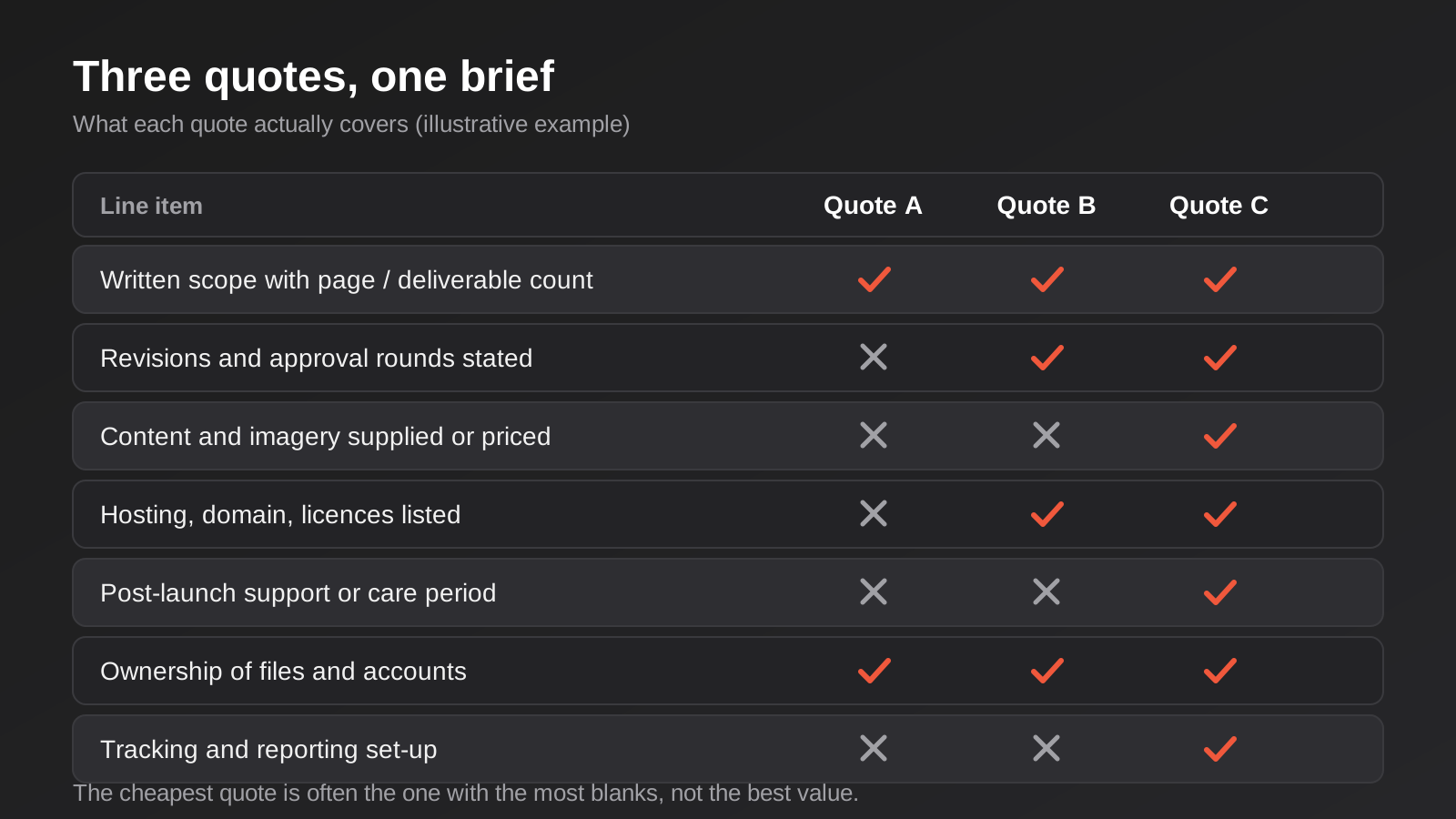
One more thing worth saying about the table above. Averages hide the shape of the market. Prices cluster at a few levels because projects cluster: a template-based small site, a custom brochure site, a store, a store with integrations. When a quote lands between clusters, ask which one it belongs to. That question alone usually reveals whether you are being quoted the project you described.
Pricing models explained
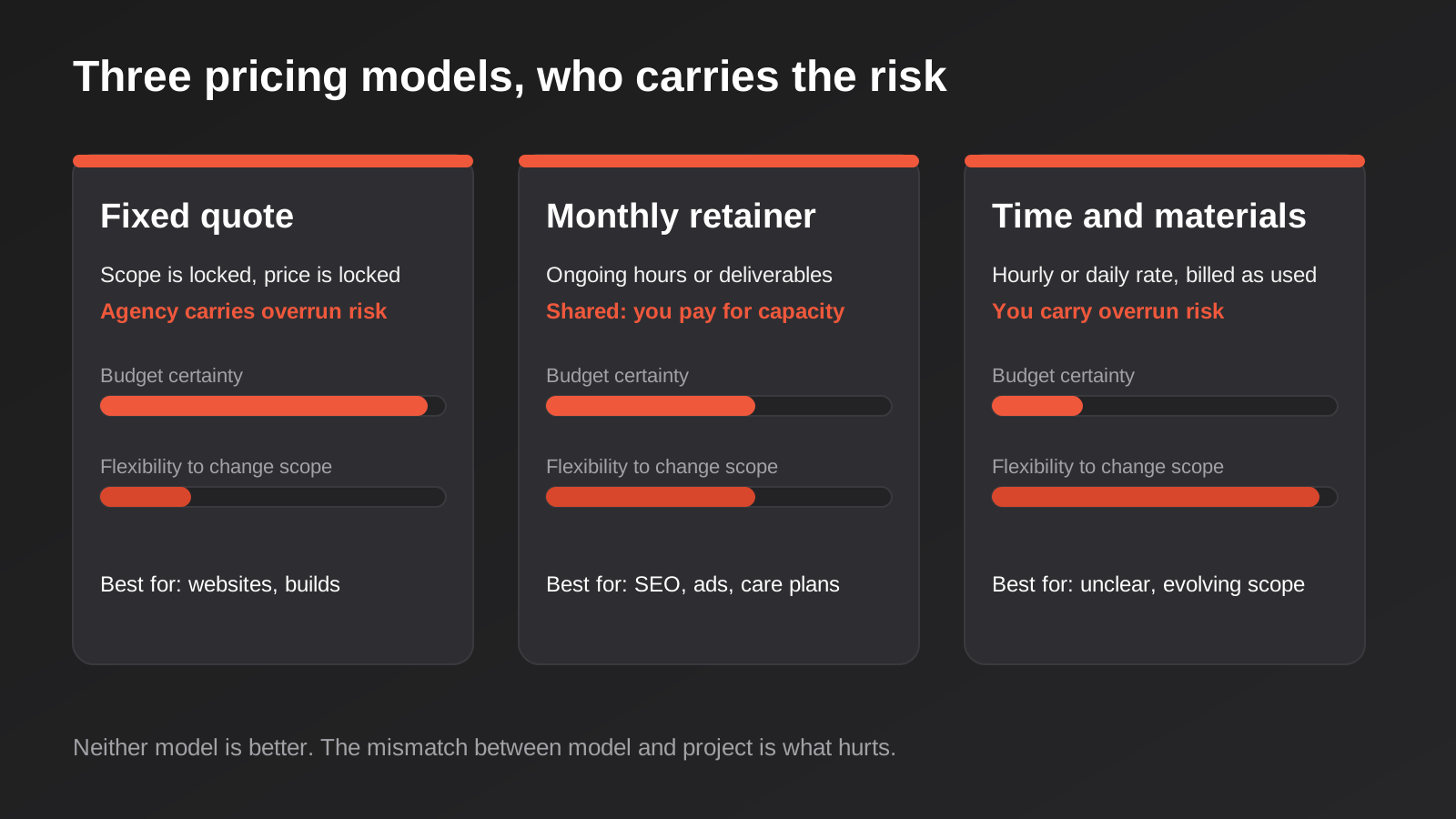
The way a quote is structured tells you who carries the risk if the project goes sideways. You will see three main models, sometimes blended.
Fixed quote
A fixed quote names a scope and a price. If the work takes longer than the agency estimated, that is their problem rather than yours, provided the scope has not changed. It is the easiest model to budget around and the one most small businesses prefer for websites and defined builds. The trade-off is that the agency has to price in some contingency for the unknown, and a rigid scope can make small changes feel like formal variations. We cover the trade-offs in more depth in our piece on fixed price versus time and materials for software projects, and most of it applies to websites and automation work too.
Monthly retainer
A retainer buys ongoing capacity or deliverables for a monthly fee. It suits work that does not have an end date: SEO, paid media management, content, website care. The key questions are what is actually included each month (hours, deliverables, reporting), whether unused time rolls over, and what the exit terms are. Retainers with long lock-in contracts deserve extra scrutiny, because if the work is good you do not need the lock-in, and if it is not, you want to be able to leave.
Time and materials
Here you pay for hours worked at an agreed rate, usually with an estimate attached. It is the right model when scope is genuinely unclear or will evolve as you learn, as in early product work. It puts the overrun risk on you, so it needs a cap, regular reporting and a clear way to stop.
Blended arrangements
Many real quotes mix models: a fixed build fee followed by a monthly care plan, or a fixed discovery phase followed by time-and-materials delivery. That is perfectly reasonable, as long as each part is labelled and you can see where one stops and the next starts.
What a good quote should include
Whatever the model, a quote you can rely on has a recognisable shape. If any of the following is missing, ask for it in writing before you compare prices.
- A written scope. Pages, features, integrations, devices supported, and what is explicitly out of scope. “Up to 10 pages” is better than “a professional website.”
- Deliverables and milestones. What you receive and when, with payment tied to milestones rather than a single large deposit.
- Who does what. Content, images, approvals, data migration and testing, assigned to you or to them.
- Revision and approval process. How many rounds are included, how feedback is collected, and what happens beyond that.
- Ongoing costs. Hosting, domain, licences, app subscriptions, maintenance. Website maintenance is the line most quotes omit.
- Ownership. Who owns the files, the design, the code and the accounts (Google Analytics, Search Console, ad accounts, hosting) when the work ends. You should own them.
- GST treatment. Whether prices include or exclude GST. Retainers advertised ex GST look 10% cheaper than they are if you cannot claim it back.
- Timeline and dependencies. When work starts, how long it takes, and what could delay it.
- Reporting and success measures. For marketing work, what is reported, how often, and what counts as progress. A promise of “page one rankings” is not a measure.
- Exit terms. Notice periods, what you walk away with, and whether any handover assistance is included.
How to compare three quotes side by side
Here is the method we would use if you handed us three PDFs.
Step 1: Rewrite your brief
Before comparing anything, write one page that says what you need, in plain language, with measurable bits: number of pages, functions, integrations, how many products, which locations. Send the same page to everyone. If you have already received quotes, send the page back to each agency and ask them to confirm their quote against it.
Step 2: Build a simple comparison table
One column per quote, one row per item from the list above. Fill in what each includes. Mark blanks as blanks rather than guessing. The picture usually changes immediately: the cheapest quote has the most blanks, and the most expensive one often includes things you might have wanted anyway.
Step 3: Price the blanks
For every blank, ask the agency what it would cost to add it. Add those figures to the base price. A $6,000 quote that needs $3,500 of additions is a $9,500 quote, and it is the $9,500 you should compare against the competition.
Step 4: Compare the people, not just the paper
Ask who will actually do the work, how many projects of this type they have done, and whether you can speak to a past client. Look at live work they have built. You are buying judgment as much as hours, and a good portfolio piece tells you more than a polished proposal.
Step 5: Look for the weird outlier
If one quote is less than half the others, find out why before you get excited. There are legitimate reasons: a smaller scope, a template-based approach, a freelancer with low overhead. There are also less comfortable ones: offshore subcontracting without disclosure, a bait-and-switch intention, or a misunderstanding of the brief. The same applies at the top. If one quote is double the others, ask what it includes that the rest do not.
Step 6: Check how the money moves
Look at the payment schedule. A large deposit upfront and a small final payment pushes risk towards you. Payments tied to milestones keep both sides honest. For retainers, check the notice period and whether you are billed in advance.
What a cheap quote usually leaves out
We are not against cheap, and a low price from a small, capable team can be the right choice. But when a number is well below what other quotes suggest, these are the places the difference usually lives.
- Discovery and planning. The thinking that stops a project drifting. Skipping it saves time at the start and costs more in the middle.
- Content. Copywriting, image selection, product data entry.
- Testing. Cross-browser and mobile testing, form testing, checkout testing for stores.
- Technical SEO basics. Redirect mapping, metadata, sitemaps and schema, particularly on a rebuild. Rebuilds commonly lose organic traffic when redirect mapping was never on the quote.
- Analytics and tracking. Setting up GA4, conversion events and ad tracking properly.
- Training and documentation. How you update the site without calling the agency every time.
- Post-launch support. A bug-fix window after go-live, so you are not paying hourly for mistakes in the original build.
- Performance and security. Speed work, backups, security hardening and updates.
None of this is necessarily dishonest. Quotes have to stop somewhere. The problem is when the missing items are not flagged, and you only discover them on the first invoice for “additional work.”
Questions worth asking every agency
A quote answers the questions the agency chose to answer. These are the ones you ask yourself, ideally by email so the answers are in writing.
- What assumptions is this price based on? Every quote has them. Good agencies list them without being asked, and the list tells you where a variation could appear.
- What would make this price go up? You are looking for a specific answer, such as extra page templates, more than a stated number of products, or a third-party integration that behaves differently to its documentation.
- What do you need from us, and by when? Late content and slow feedback are the top causes of delay, and some agencies charge for the delay.
- Who owns the accounts and the files at the end? The answer should be you, and it should be in the agreement.
- What happens if we want to stop part-way? For fixed builds this means what you are owed for the work done. For retainers it means notice periods and handover.
- What is not included that clients commonly ask for later? An honest agency has a ready answer. A defensive one tells you something too.
- How will you report progress, and on what? For marketing, ask for the metrics up front: leads, enquiries, revenue, cost per lead. Rankings and impressions are inputs, not outcomes.
- Who will I actually speak to week to week? Sales conversations and delivery conversations are sometimes with different people.
Keep the replies. Several months in, when someone says “that was never in scope,” the email chain is cheaper than a dispute.
Red flags in a proposal
Most red flags are not dramatic. They are small signs that the scope or the relationship is looser than it should be.
- A price with no breakdown at all, only a single total.
- Guaranteed rankings, guaranteed traffic or guaranteed leads. Nobody controls Google, and honest agencies do not promise outcomes they cannot control.
- Pressure to sign quickly or to pay a large percentage before any work begins.
- A rate for ongoing work that is vague about hours or deliverables, such as “full digital marketing support.”
- A refusal to show previous work or to put you in touch with a past client.
- A requirement that the agency host or hold your accounts, with no clear way to transfer them.
- Long lock-in contracts for work that is meant to prove itself over time.
- Surprise sub-contracting. Using specialists is fine. Not telling you is not.
Spotting one of these does not mean walk away. It means ask the next question and see how it is answered.
Negotiating without damaging the work
Asking for a better price is reasonable, and agencies expect it. The way to do it is to trade scope or terms rather than simply asking for a lower number. You can often get a meaningful reduction by phasing the project, supplying your own content, accepting a template-based design for secondary pages, or committing to a longer relationship on a retainer. What rarely works is asking for the same scope at 30% less, because the work does not shrink and the corners get cut somewhere you cannot see.
It also helps to be clear about what you are optimising for. If speed matters, say so and expect to pay for it, because compressing a timeline usually means more people on the project at once. If long-term cost matters more, say that instead, and ask each agency what the second and third years look like, not just the launch.
The reverse applies too. If the lowest bidder reduces their price a second time after you push back, ask what has changed in the scope. A price that drops without the scope changing means the original number had more padding than you assumed, or the new one has less work in it than you think.
What you should expect to pay at each business stage
Rather than quote prices as though everyone buys the same thing, it helps to think about what each stage of a business realistically needs.
Just starting out
You need credibility and a way to be found. A lean, well-built site with clear messaging, a Google Business Profile and basic tracking usually does more than an elaborate build. Budget for the essentials, and plan to grow it. Be wary of any quote that sells you a large custom build before you have a single customer telling you what they care about.
Established, growing steadily
Here the question becomes return on spend. A proper website, ongoing SEO or paid media, and reporting that connects the spend to leads or sales. Retainers become relevant. This is the stage where the quality of the agency matters most, because you are no longer paying for a project, you are paying for ongoing judgment.
Scaling, with systems and integrations
Now quotes involve more moving parts: ecommerce platforms, accounting and ERP integrations, automation, custom features. Prices are harder to benchmark because every project differs, which is why serious agencies scope these individually rather than publishing a number. If you are comparing quotes at this level, the written scope matters even more than at the lower stages.
Common mistakes when comparing quotes
- Choosing the middle quote by default. The middle number is not necessarily the right one. It can simply be the compromise between a cheap quote with missing scope and an expensive one with a bigger brief.
- Comparing totals instead of scope. The one we see most often. A total is the output of a scope, and if the scope differs, the total is meaningless.
- Not giving a budget range. Withholding your budget feels like negotiating strength, but it usually means agencies guess high or build to the wrong size. Giving a range gets better-fitted proposals.
- Ignoring ongoing costs. Build cost is the visible part. Hosting, maintenance, licences, and marketing to drive traffic are what you live with for years.
- Accepting vague deliverables. “SEO optimisation” or “digital strategy” without detail is a line item that cannot be audited.
- Paying most of the fee upfront. A deposit is normal. Paying nearly everything before work has been delivered removes your leverage.
- Overlooking ownership. If the agency owns your hosting, ad accounts or source files, leaving them gets difficult and expensive.
- Treating unlimited as a feature. Unlimited revisions and unlimited support always have a practical limit buried in the terms.
- Rushing the decision because of a deadline offer. “This price is only valid until Friday” is a sales tactic. A good quote can survive a week of consideration.
- Skipping the conversation. The call with the people you will work with is data. If they are vague, defensive or dismissive when you ask what a line means, you have learned something that no PDF shows.
Frequently Asked Questions
How many quotes should I get?
Three is a sensible number for most projects. Fewer than three gives you no sense of spread, and more than four tends to produce quote fatigue without adding information. For larger, more complex work, it is worth speaking to a couple of agencies in depth rather than collecting a long list of prices.
Is the cheapest quote always the worst?
No. A low price can reflect a smaller scope, a leaner team or a template-based approach, all of which can be legitimate. The risk is not the price, it is not knowing what was left out. If you can line the scope up and the cheapest quote still covers what you need, it may well be the best value.
Should I tell agencies my budget?
Yes, as a range. It helps them propose something sized to your situation instead of guessing, and it makes the proposals easier to compare. If an agency uses your stated budget as the price regardless of scope, that is a signal about how they work.
Are retainers better value than fixed quotes?
They suit different work. Fixed quotes suit defined projects with a start and an end, such as a website build. Retainers suit ongoing work, such as SEO or ad management, where the job is continual improvement. Using a retainer for a one-off project, or a fixed quote for an open-ended one, is where people usually get frustrated.
Do these prices include GST?
Many Australian agencies quote exclusive of GST, and some guides do not say either way. If you are registered for GST you can generally claim it back, so the difference is mostly about cash flow. Confirm the basis in writing before comparing quotes, because a 10% gap is large enough to flip a decision.
What if I have already signed with an agency and think I overpaid?
Start with the documents. Check what you were promised against what has been delivered, and raise gaps in writing. If you want a second opinion, a reputable agency will review a contract and tell you honestly where it sits against the market. Be careful about leaving in the middle of a project without getting your files and accounts handed over first.
Where to Start
If you only do one thing, write down your scope in a page and send it to every agency you are considering, ours included. The quality of the questions that come back tells you almost as much as the price.
If you want to see how we price before you ask for anything, our published rates are on the pricing page, and the most commonly compared services have their own pages for SEO and websites. Larger or more custom projects are scoped individually, and we give one fixed quote before any work starts.
Worth putting a number on it: our SEO retainers start from $550 a month and our website builds from $1,500, both excluding GST. That is below the $1,500–$3,500 a month and $3,000–$8,000 ranges most Australian businesses see quoted for comparable scope, though bigger or more complex projects will cost more than a starting price. If you’ve already got a written quote from another agency for comparable scope, send it through and we’ll do our best to beat it.
Keep reading
Related posts
How Much Does AI SEO Cost in Australia? A 2026 Price Guide
What AI SEO (GEO/AEO) costs in Australia in 2026: real monthly ranges by tier, what drives quotes up or down, and how…
How Much Does an MVP Cost in Australia? A 2026 Price Guide
What an MVP costs in Australia in 2026: real price bands, what drives quotes up or down, and how to compare three…
How Much Does SEO Cost in Brisbane? A 2026 Price Guide
What SEO costs in Brisbane in 2026: real monthly ranges by scope, what drives quotes up or down, and how to compare…
Got a project you'd like to talk through?
Tell us what you're working on — we'll come back with a plan.
