
How Much Does SEO Cost in Brisbane? A 2026 Price Guide
 Jignesh Vagadiya
04/11/2026
22 min read
Ask five Brisbane agencies what SEO costs and you’ll get five answers that barely overlap. One says $600 a month. Another says $3,500. A third wants a discovery call before it will name a figure, and the fourth sends a PDF with a price on page nine and a twelve-month term on page ten. None of them is necessarily wrong. “SEO” covers everything from fixing a Google Business Profile to running a content and outreach programme across a hundred pages, and the invoice follows the work.
This guide puts 2026 numbers on it for Brisbane businesses. The ranges come from what Brisbane and Australian agencies publish on their own pricing pages, and we’ve been upfront about what that data can and can’t tell you. You’ll also get a plain account of what moves a quote up or down, what the first ninety days of a sensible engagement look like, and a way to read three proposals side by side without being swayed by whichever one has the nicest layout.
If you’re comparing cities, we’ve covered what SEO costs in Melbourne separately, and the national picture sits in our SEO pricing guide for Australia. This one is written for businesses selling into south-east Queensland, where the real pricing question is usually geography: which part of the region you need to win, and how far your customers will travel to find you.
How Much Does SEO Cost in Brisbane in 2026?
Here are the headline ranges, then the detail. These are monthly retainer figures, mostly ex GST, drawn from Brisbane agency pricing pages and Australian cost guides published in 2026.
- Single-suburb or single-location local campaign: roughly $800 to $1,500 a month. One location, a defined list of services, and a Google Business Profile doing a lot of the heavy lifting.
- Standard small-business campaign across Brisbane: roughly $1,500 to $3,500 a month. Several service pages, multiple suburbs, ongoing content and some genuine link work. Most guides we reviewed cluster here for the typical small business.
- Competitive or high-volume sectors: roughly $3,000 to $6,000 a month, with some agencies quoting well beyond that. Legal, finance, health groups, large ecommerce catalogues, anything where page one is crowded with businesses that have been investing for years.
- Entry packages: some agencies advertise from about $500 to $1,000 a month. A few are honest about being light-touch. One Brisbane agency we read argues that anything under about $1,000 a month buys reporting rather than rankings. That’s one vendor’s opinion, not a law, but it’s worth knowing the argument exists.
- AI search visibility: published figures run from about $500 to $1,500 a month as an add-on to an existing retainer, and a few thousand a month for a standalone programme.
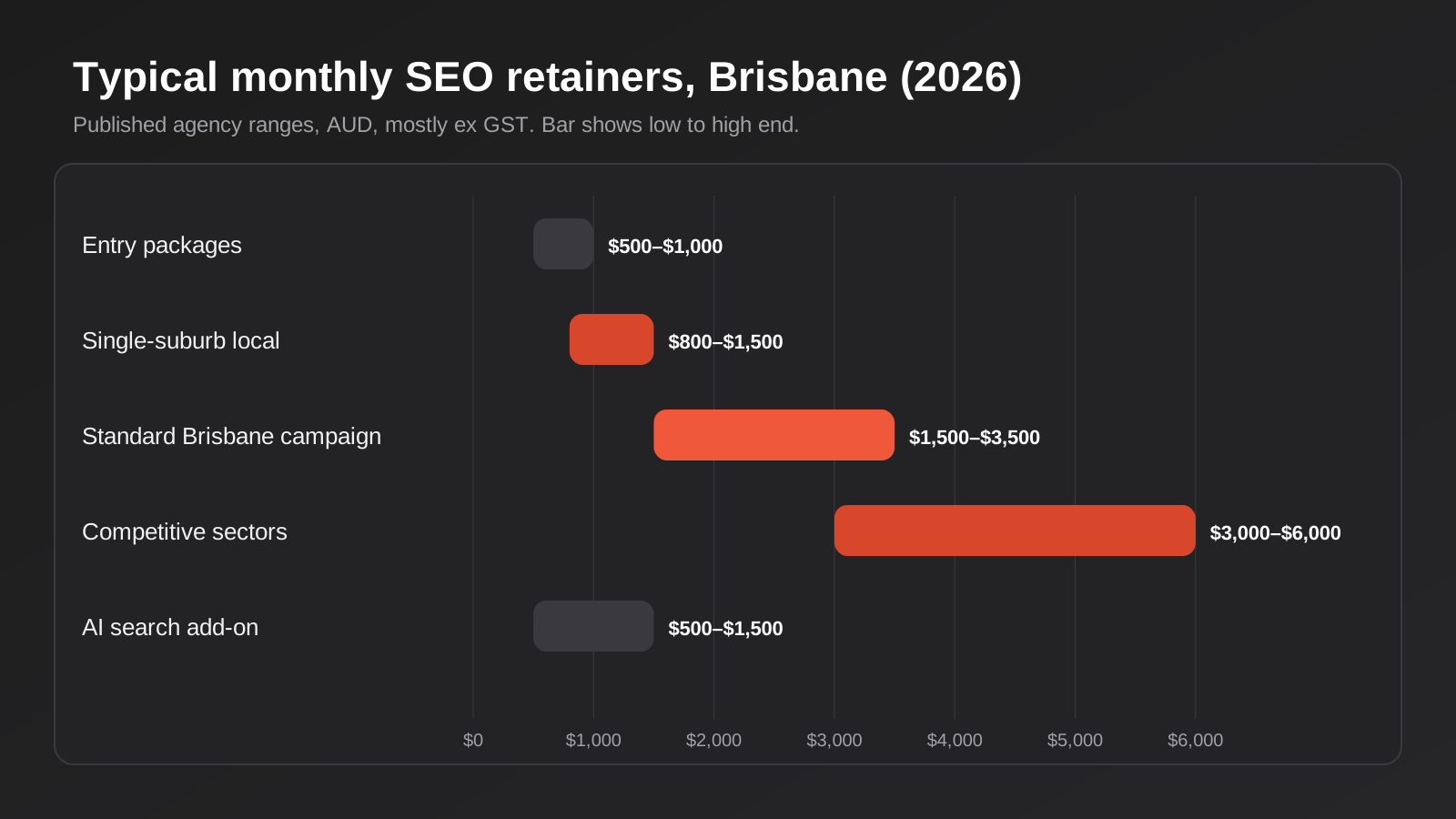
A caution before you build a budget on these. Almost every public source for SEO pricing is an agency or a lead-generation site with something to sell, so the numbers reflect what the market will bear more than what the work strictly costs. One Brisbane agency publishes an average of just under $4,700 a month from its own client base, which is a reminder that averages depend heavily on who is being averaged. Treat the ranges as a map of the market. The width of each band is the interesting part, and the sections below explain what sits inside it.
Retainers, audits and hourly work
Not all SEO is a monthly commitment. Published figures for a one-off audit of a typical small business site sit around $1,500 to $4,000, and larger or more technical sites cost more. Hourly consulting rates are quoted from roughly $75 for a freelancer to $200 or more at an agency, with some specialists above that.
An audit is a sensible purchase when you have a developer or an in-house marketer who will act on it. If nobody is going to implement the findings, you’ve bought a document. Most small businesses get more from a retainer where the person who finds the problems also fixes them.
Check the GST line first
Most agencies quote SEO ex GST. A “$1,200 a month” package is $1,320 on the invoice. Before you compare anything else across three quotes, confirm they’re all stated on the same basis. It’s the most common reason two quotes look further apart than they are.
What “Brisbane” Means for Your Quote
The underlying work in Brisbane isn’t much different from anywhere else. Google ranks pages on relevance, quality and trust whichever city you’re in. What differs is the shape of the market you’re trying to win, and in south-east Queensland that shape is unusual.
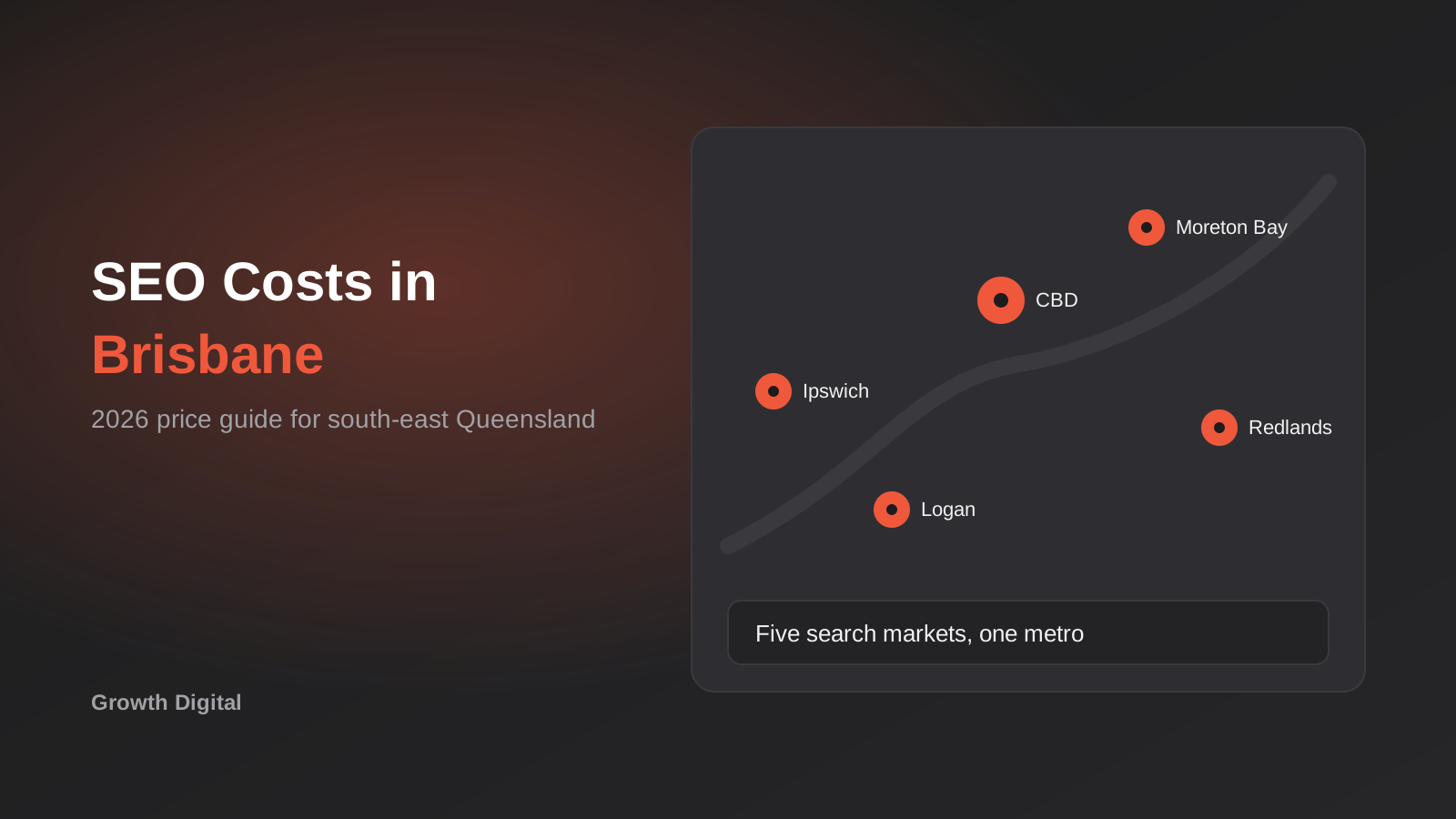
The region is one big metro with several distinct search markets. Brisbane city, Moreton Bay to the north, Logan and Ipswich to the south and west, and the Redlands to the east are all part of one continuous urban area, but people search for them differently. Someone in Springfield Lakes searching for a plumber may type “plumber Ipswich” or “plumber Springfield” long before they type “plumber Brisbane”. A business that serves a corridor needs pages and Google Business Profile coverage for the places customers actually name, not just the capital city. The price rises with every distinct market you want to win.
The Gold Coast and Sunshine Coast are not Brisbane suburbs for SEO purposes. They’re separate search markets with their own competitors, even though they’re an hour from the CBD. A business that services Brisbane and the Gold Coast is running two campaigns, and a quote that treats them as one should explain how. If an agency says “south-east Queensland” without showing which towns it will target, that’s a scope gap.
Trades and home services dominate local demand. A large share of local-intent searching in any big metro is for tradies, health practices, cafes and professional services. That means a lot of competition for map pack positions and a lot of businesses with similar websites. In that environment, the profile, reviews and a clean site with a real page per service matter more than a long monthly content calendar. If you’re in that world, our Google Business Profile guide is worth reading before you talk to anyone, because a good chunk of your result will come from that work.
Big-project sectors behave differently. Brisbane’s pipeline of infrastructure, construction and hospitality work, including the build-up to the 2032 Games, means plenty of businesses sell to other businesses or to government. Their buyers search for specific capabilities and compare suppliers carefully. That’s a content and authority project, closer to a national campaign than a suburb one, and it prices accordingly.
Selling online? Your competitors aren’t local. A Brisbane-based online store ranks against stores in Sydney and Melbourne, and the price of competing is set by their spend, not by Brisbane rates. Ecommerce SEO is quoted by catalogue size and category competitiveness, not by postcode.
So before anything else, answer one question: where do my best customers actually come from? It decides which row of the chart above you’re in.
What Drives the Price Up or Down
When two Brisbane agencies quote $900 and $2,900 for the same brief, the gap is almost always some mix of the factors below. Use them as a question list.
1. How hard your searches are to win
This is the largest driver and the one you control least. If the businesses on page one have spent years publishing, earning links and refining their sites, catching them takes more work per month for longer. If page one is mostly thin directory listings and old sites, a modest programme can move you in a few months.
A decent agency checks this before quoting. Ask them to show you who ranks today for your three most valuable searches and why. A proposal with no competitor analysis is pricing by guesswork.
2. The number of places and services you want to cover
Each suburb or service worth ranking for usually needs its own genuinely useful page. Covering one suburb is small. Covering twenty is a content and quality-control project, and Google has been clear for years that near-duplicate location pages with the place name swapped don’t help. The cost of doing it properly scales with the count.
3. The state of your current website
A slow site, broken pages, duplicate content or crawl problems need repair before content will perform. Some of that is a one-off cost at the start, which is why many agencies charge a setup fee or load the first month. A clean, fast, well-structured site is cheaper to rank than a neglected one. If a rebuild is planned, bring the SEO conversation in before the build, because restructuring afterwards costs more and can lose rankings you already have.
4. Monthly content volume and who writes it
Content is where much of the labour sits. Four researched, properly written pages a month cost far more to produce than a monthly report and some tweaks to existing pages. If a quote doesn’t say how many pieces are included, how long they are and who writes them, you can’t compare it with anything.
5. What “link building” means in practice
Earning links from credible sites is slow and often the most expensive part of a campaign. The cheap version is submitting your business to dozens of directories, which helps with basic consistency and little else. The real version involves outreach, relationships, local sponsorships and press, or content other sites want to cite. If one quote is $1,000 a month higher than another and mentions links in a single line, ask what a typical month’s output looks like, with examples.
6. Reporting and account management
Some agencies keep margins low by sending an automated report and nothing else. Others include a monthly call with someone who understands your business and will tell you what isn’t working. Neither is wrong, but they’re different products, and the person-hours show up in the price. The most useful reports tie rankings to phone calls and enquiries rather than listing keyword positions alone.
The Pricing Models, Explained
SEO in Brisbane is sold in four common ways. Knowing which one a quote uses tells you a lot before you read the detail.
Monthly retainer
The most common by far. You pay a fixed amount each month for a defined set of activities until you stop. It suits SEO because results compound over months, and a retainer funds the steady effort that builds them. The risk is paying for activity rather than progress, so ask what is delivered each month and what you should see at three, six and twelve months.
Fixed-scope project
A set price for a defined job such as an audit, a site restructure or a batch of landing pages. Good when the work has a clear end. Poor as a substitute for ongoing effort, because a delivered project doesn’t maintain rankings on its own.
Hourly or day rate
Charged by time, typically for consulting, audits or specialist technical work. Useful for a second opinion or a short engagement. A weak fit for a whole programme, because you can’t forecast the bill and the incentive is to spend hours rather than finish things.
Performance-based pricing
Pay only if you rank, or pay per lead. It’s rarer than the pitch suggests and carries traps. Keywords chosen to guarantee a “result” are often so easy that ranking for them produces no customers, and per-lead models invite disputes about what counts as a lead. Anyone guaranteeing position one is either gaming easy terms or being optimistic on your behalf, because nobody outside Google controls rankings.
Contract length
Separate from the model is the term. Some agencies require six or twelve months, which is understandable given SEO’s slow start but gives you little leverage if the work disappoints. Others run month-to-month. Know which you’re signing, and what notice you must give to leave.
What the First Ninety Days Should Look Like
A lot of confusion about price comes from not knowing what you’re buying in the early months. A sensible engagement front-loads work that doesn’t show up as traffic yet. Here’s the shape we’d expect, and what you can reasonably ask to see.
Month one is diagnosis and setup. A technical review, a look at your Google Business Profile, keyword research tied to the services that make you money, competitor analysis, and tracking for phone calls and form submissions. If call tracking and conversion tracking aren’t in place by the end of this month, you can’t judge anything that follows. This is also when quick wins land: fixing indexing problems, correcting profile details, tidying page titles.
Month two is building the foundations. Service and location pages get written or rewritten, internal linking is sorted, and the profile gets the attention it needs: categories, services, photos, a plan for collecting reviews. Technical fixes continue. You should see a list of what’s been changed, not a vague note saying “on-page optimisation completed”.
Month three is where movement starts to show. In low-competition niches, local searches may begin to improve. In tougher ones, you’ll mostly see impressions and early ranking shifts for secondary terms. Content and outreach are underway, and the report should show which pages are gaining ground and which aren’t. An honest agency says so when something isn’t working.
None of this is dramatic, which is the point. Be suspicious of a proposal promising traffic in week two. If the early months are all deliverables you can inspect, you’re paying for a proper foundation. If they’re all “ongoing optimisation” with nothing named, you’re paying for time.
What a Good Quote Should Include
A quote that’s easy to compare tells you what you’re paying for. Before accepting anything, check it covers each of these.
- A starting audit or review. Technical health, current rankings, your Google Business Profile and a competitor comparison. Without it, the agency is working blind.
- The keywords or services being targeted. Named, not “up to 20 keywords”. You should be able to judge whether they’re searches that bring customers.
- Specific monthly deliverables. Number of pages optimised or written, hours of technical work, and link activity described in plain terms.
- Who does the work. In-house team, a freelancer or an offshore subcontractor. Any can be fine, but you should know.
- How results are measured. Rankings, organic traffic, calls and enquiries. Ask whether call and form tracking is set up.
- Reporting frequency and format. Monthly at minimum, with a human explanation of what changed.
- Contract terms. Length, notice period, and what happens to your content and accounts if you leave. You should own your website, your Google Business Profile and your analytics. Always.
- GST stated clearly. Ex or inc.
Reading three quotes side by side
Lay the quotes out in one table with identical rows: monthly price ex GST, named target searches, content pieces per month, link activity, technical work, reporting, contract length. Blank cells are your most useful finding. The diagram below shows the idea with made-up quotes, so you can see how a cheap one reveals itself.
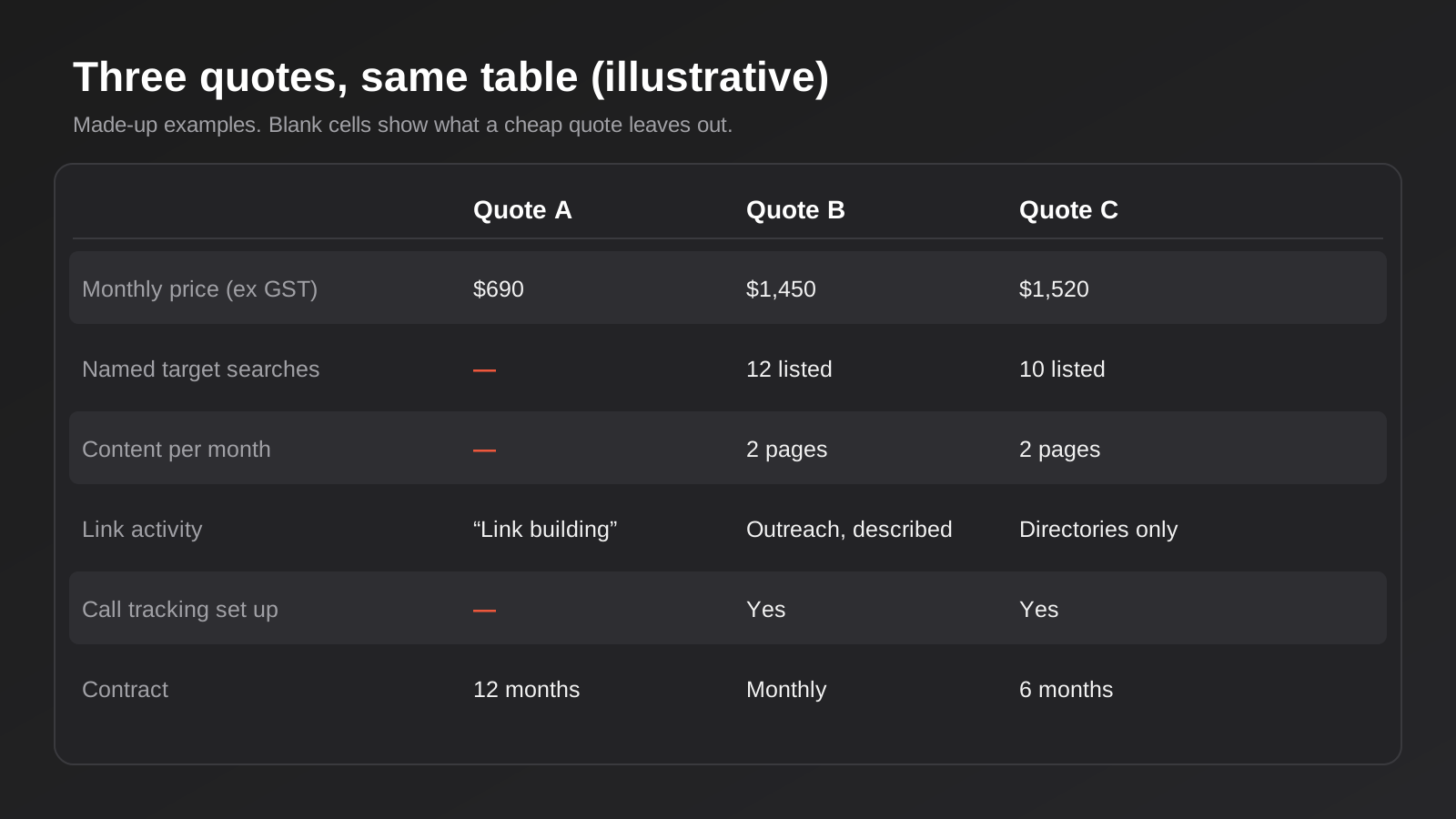
If one quote is $700 cheaper and has four blank cells, you now know why. If two quotes are within $150 of each other but one has far more detail, favour the detailed one. Vague proposals tend to lead to vague delivery. We go into proposal red flags in more depth in our guide to choosing an SEO agency in Australia.
Why Cheap SEO Often Costs More in the End
There are good low-cost options, especially for a small site in a quiet niche. But a quote well below the bands above usually means one of a few things.
The scope is thinner than it looks. A $499 package may deliver a basic on-page tidy-up and an automated report. That’s a fair thing to sell if it’s honestly described. It won’t compete for a contested search.
The work is templated. The same suburb page generated forty times with different place names, or the same blog post lightly reworded for every client. Google is increasingly good at ignoring that content, and sometimes at demoting it.
The links are the risky kind. Bought links and private blog networks can produce a short-term bump followed by a slow loss of rankings or a penalty. Cleaning that up later costs more than the original saving.
The account is under-resourced. One person managing too many clients can’t give your site much attention in a month, and you may not find out for half a year.
The reverse holds too: the most expensive quote isn’t automatically the best. Larger agencies carry sales teams and account layers, and some of what you pay for is their structure rather than your results. The right price is the one where you can see what each dollar buys.
Four Brisbane Budgets, Worked Through
To make the ranges concrete, here are four hypothetical businesses and the part of the market we’d expect them to sit in. These are illustrations, not client stories, and not Growth Digital prices.
A plumber based in Logan. Services the Logan and Ipswich corridors, wants more calls, has a basic website and a half-finished Google Business Profile. This is a single-area to small multi-suburb campaign. The profile, reviews, a page per service and a page per major suburb will do most of the work. Expect the lower to middle part of the single-suburb band, with the main cost being the pages for each area served. The trap is paying for a long-term content calendar when the real gains are in the profile and the service pages.
A dental or physio practice in the inner suburbs. One location, high customer value, heavy competition for the same handful of searches, and advertising rules that limit what the copy can say. That’s a mid-band campaign, probably the lower half of the standard Brisbane range, with a bigger share going to content quality and reviews than to links. Compliance-aware writing costs more than generic copy, and it’s worth it.
A Shopify store with a few hundred products, based in Brisbane. Local pricing is irrelevant here; the competitors are national. The cost comes from category structure, technical clean-up, product and collection copy, and link work. This sits in the standard-to-competitive range, and a good quote will break out the technical work separately from the monthly content.
A B2B manufacturer or contractor selling across Queensland. Buyers research suppliers carefully, so depth beats volume. Think capability pages, case-study style content from real jobs, and links from industry bodies. Budget for the upper-middle of the range and a longer timeline. A suburb-page package would be the wrong product entirely.
What About AI Search?
A growing number of Brisbane agencies now sell “AI SEO” or generative engine optimisation, aimed at appearing in answers from ChatGPT, Google’s AI Overviews and similar tools. Published pricing runs from a few hundred dollars a month as an add-on to a few thousand for a standalone programme.
Our honest view: the foundation of AI visibility is the same as for traditional SEO. Clear, accurate, well-structured content, topical authority and credible mentions elsewhere get you most of the way. What’s different is extra effort on structured data, direct answers to common questions and building brand mentions in places AI systems draw from. That’s real work, and worth paying for if your customers research with AI tools, but it extends the foundation rather than replacing it. If you’re weighing it up, our AI SEO pricing page shows how we scope it. Treat any promise of guaranteed citations with the same scepticism you’d apply to guaranteed rankings.
Common Mistakes When Buying SEO in Brisbane
- Choosing on price alone. The cheapest quote and the best-value quote are rarely the same one. Compare scope first, then price.
- Treating south-east Queensland as one place. Brisbane, the Gold Coast, the Sunshine Coast, Ipswich and Moreton Bay are different search markets. Pick the ones that make you money and win them in order.
- Skipping call and enquiry tracking. If nobody can say how many calls and form submissions came from organic search, you can’t judge the retainer.
- Ignoring the Google Business Profile. For many local businesses it drives more enquiries than the website. A campaign that never touches it is missing the main event.
- Accepting a lock-in with no exit. Twelve months is a long time to be tied to work you can’t evaluate. At minimum, know what you keep if you leave.
- Believing guarantees. A promised ranking by a promised date means easy keywords or optimism.
- Expecting SEO to fix a weak offer. SEO brings people to your site. If your pages don’t say what you do, where, and how to get in touch, the traffic won’t convert at any price.
- Stopping too soon. Cancelling after three months because results are modest ends the investment just before it starts to compound. If the work is sound and the reporting honest, give it a fair run, and judge on leads rather than rankings alone.
- Paying for a rebuild and SEO separately without coordinating. A new site launched without redirects or a content plan can undo a year of ranking progress overnight.
A Rough Budget Guide by Business Stage
Putting it together, this is how we’d think about a starting budget.
New or very small local business, one location. Start with the Google Business Profile, a clean website with a page per core service, and basic tracking. The lower part of the single-suburb band is reasonable if the quote is specific. Don’t pay for a big programme before the basics exist.
Established local business wanting more enquiries. The single-suburb to multi-suburb range. You need a proper audit, service and location pages that read well, reviews and steady content. Expect the middle of the published ranges and a review at six months.
A business competing across Brisbane or beyond. The standard band and up. Insist on competitor analysis in the proposal and on named priority searches.
Ecommerce or a crowded sector. Treat it as a larger investment. Catalogue size, structure and technical complexity set the price, and the upper bands are realistic. Budget for technical work and ongoing content, and expect a longer timeline.
Frequently Asked Questions
How much does SEO cost in Brisbane per month?
Published 2026 figures put a single-suburb local campaign at roughly $800 to $1,500 a month, a standard small-business campaign across Brisbane at roughly $1,500 to $3,500, and competitive sectors at $3,000 to $6,000 or more, mostly quoted ex GST. Entry packages from around $500 to $1,000 exist but usually carry a lighter scope. Your competition, the area you cover and the amount of content and link work included decide where you land.
Is SEO worth it for a small Brisbane business?
It can be, if people search for what you sell and you can turn a visit into an enquiry. It suits businesses with a reasonable value per customer and the patience to wait several months. If you need leads within weeks, pair it with paid search while organic builds. Ask any agency how they will measure calls and enquiries, not just rankings.
Do I need to sign a twelve-month contract?
No. Some Brisbane agencies require six or twelve months, others work month-to-month. Longer terms are defended on the grounds that SEO starts slowly, but they cut your leverage if the work disappoints. Whatever you choose, make sure you own your website, analytics and Google Business Profile, and know the notice period.
How long does SEO take to work?
Profile improvements and technical fixes can move local results within weeks in low-competition niches. Content-driven gains and competitive searches take several months, often longer. Plan for at least a quarter of groundwork before judging, and review against leads rather than ranking positions alone.
Do I need separate SEO for the Gold Coast or Sunshine Coast?
If you want to win customers there, usually yes. They are separate search markets with their own competitors, so ranking in Brisbane doesn’t carry over automatically. A good proposal says which towns will get dedicated pages and profile work, and prices them as distinct scope rather than folding them into one line.
Why do Brisbane agencies quote such different prices for the same job?
Mostly scope. One quote may include new content, real outreach and a monthly call, while another is an automated report and some on-page changes. Differences in competitor analysis, who does the work and how much account management is included also matter. Put the quotes in one table and the gaps usually explain themselves.
Where to Start
Write a short, honest brief you can send to every agency you speak to. Include your business type, the suburbs and towns you serve, the services that make you the most money, your website address and a rough monthly budget. Ask each agency to answer the same questions: what would you fix first, which searches would you target, what do I get each month, and how will you report on calls and enquiries. Identical briefs produce comparable answers, and the agencies that engage with your specifics are usually the ones worth a second call.
Then run a ten-minute test of your own. On your phone, search for your three most valuable services the way a customer would, and note who appears in the map block and on the first page. That tells you more about the competition, and whether a quote is realistic, than most proposals will.
If you’d like to see how we structure this, our SEO pricing page lays out what’s included at each level, which makes a useful reference point when you assess other proposals.
Worth putting a number on it: our own SEO packages start from $550 a month (ex GST), below the $800–$1,500 a month published Brisbane pricing suggests for a single-suburb local campaign, and well below the $1,500–$3,500 most Brisbane small businesses are quoted for a broader scope. Packages scale with the number of keywords and pages covered, so a bigger or more competitive scope costs more than that starting figure. If you’ve already got a written quote from another agency for comparable scope, send it through and we’ll do our best to beat it.
Keep reading
Related posts
How Much Does a Website Redesign Cost in Australia? A 2026 Price Guide
What a website redesign costs in Australia in 2026: real price ranges by scope, what drives quotes up or down, and how…
How Much Does SEO Cost in Adelaide? A 2026 Price Guide
What SEO costs in Adelaide in 2026: real monthly ranges by scope, what drives quotes up or down, and how to compare…
How Much Does SEO Cost for a Small Business in Australia? A 2026 Guide
What SEO costs a small business in Australia in 2026: real monthly ranges by budget, what each level buys, and how to…
Got a project you'd like to talk through?
Tell us what you're working on — we'll come back with a plan.
