
How Much Does an MVP Cost in Australia? A 2026 Price Guide
 Jignesh Vagadiya
07/11/2026
22 min read
Ask five Australian software agencies what a minimum viable product costs and you’ll get five numbers that don’t look like they describe the same thing. One says $20,000. Another says $90,000. A third declines to give a figure until you’ve paid for a discovery workshop. All three can be honest, and that’s the problem: “MVP” isn’t a product category with a going rate, it’s a scoping decision, and the price follows the scope.
This guide is for founders and operations leads who have decided to build something and need a defensible budget before they talk to anyone. We’ll lay out the ranges Australian agencies publish, explain why they’re so wide, go through what actually moves the price, and show you how to put three quotes next to each other so you’re comparing the same build. We haven’t padded it with a single “average cost” figure, because there isn’t a meaningful one.
A note on numbers. The ranges below come from published Australian agency guides and pricing pages in 2026. They’re marketing content written to attract enquiries, they disagree with each other, and they assume different feature sets, so treat them as the shape of the market rather than a quote. Where we couldn’t find a defensible number, we’ve given you the cost driver and the question to ask instead.
What an MVP Actually Costs in Australia
Here’s the honest shape of it. Published Australian guides cluster into three bands, and most of the confusion comes from people quoting one band while describing a project that belongs in another.
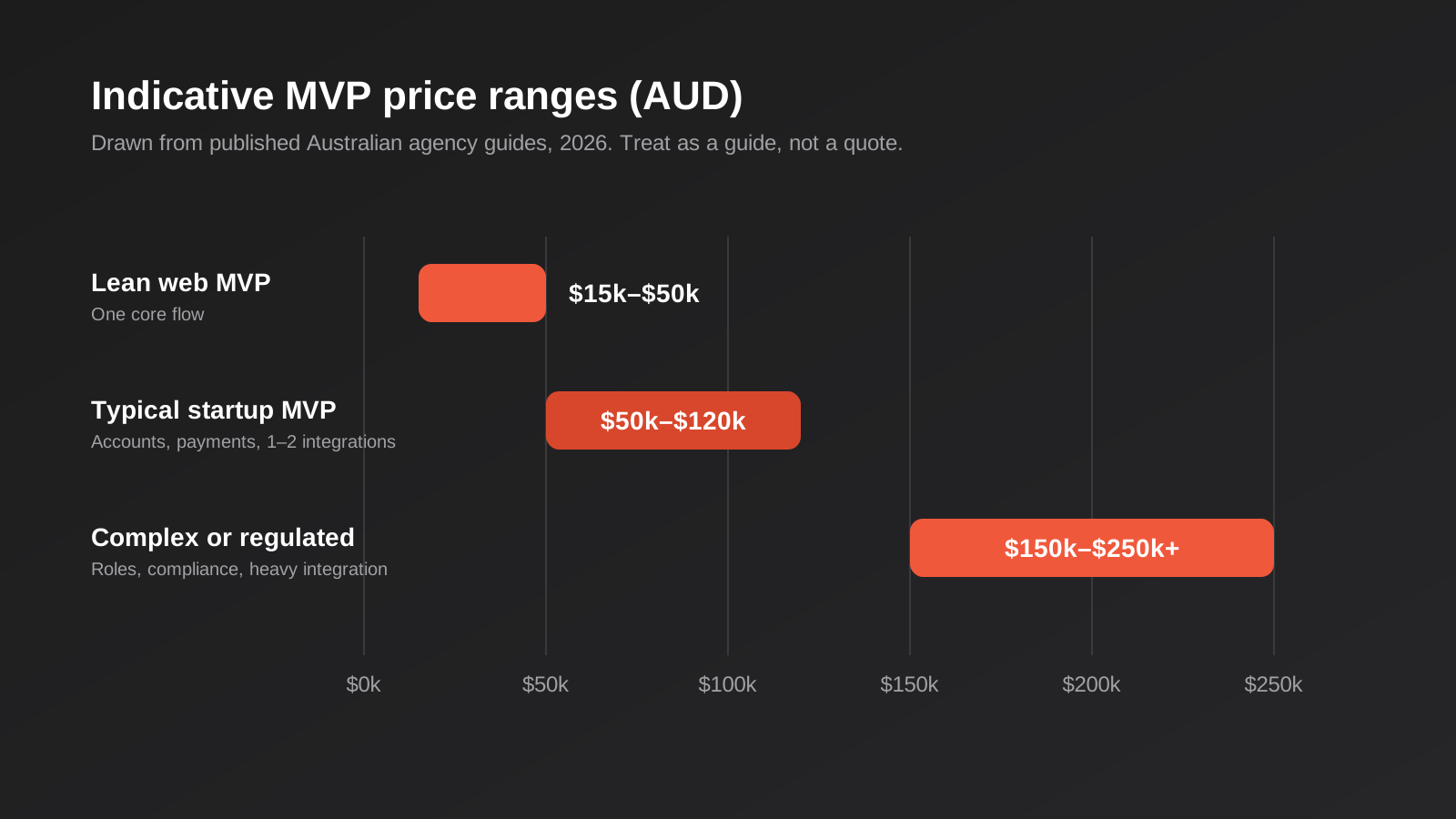
- A lean web MVP, roughly $15,000–$50,000. One core workflow, one type of user, a simple database, a basic admin view or none at all, and few or no integrations. This is the band where a small team validates a single assumption in somewhere around six to ten weeks. It’s also where most of the sub-$30,000 quotes live, and it’s where you need to read the exclusions most carefully.
- A typical startup MVP, roughly $50,000–$120,000. User accounts, payments, a proper admin interface, one or two integrations (a CRM, an accounting package, a mapping or messaging service) and a reasonable amount of testing. Several mobile-focused guides put a basic app MVP at the lower half of this band, around $50,000–$95,000 over two to four months.
- A complex or regulated MVP, roughly $150,000 and up. Multiple user roles with different permissions, compliance obligations such as health data or financial services, heavy integration with legacy systems, or custom logic that is itself the product. Some guides run this band to $200,000 or more. At this level it’s fair to ask whether you’re still building an MVP or a first production release with a smaller name.
Those bands overlap on purpose. A $45,000 build and a $60,000 build can be the same product delivered with a different amount of testing, documentation and handover, which is why the next few sections matter more than the headline number.
Hourly rates give you a sanity check. Published guides put Australian agency developer rates somewhere between about $90 and $170 an hour depending on seniority and the size of the shop, with mid-level developers commonly landing between $110 and $150. A $30,000 quote at those rates buys somewhere in the region of 200 to 270 hours of work in total, including design, testing and project management. That’s enough for a narrow build and not enough for a broad one, and it’s a quick way to test whether a quote’s scope is realistic.
One more thing before the detail. Offshore teams will quote well below all of this, sometimes by half or more. Cheaper hourly rates are real, but so are the costs that come with distance: time zones, requirements lost in translation, and the effort of managing a team you can’t walk down the hall to. We’re not telling you offshore is a mistake. We’re telling you the comparison only works if the scope, the testing and the ownership terms are identical, and they rarely are.
Why the Ranges Are So Wide
Three quotes can differ by a factor of four and all be defensible, because what’s being priced differs more than the quote documents let on. A few things account for most of the gap.
Different definitions of “minimum”
For one agency an MVP is a clickable prototype with a working form behind it. For another it’s a production-grade first release with automated tests and a staging environment. Neither is wrong, but a quote for the first is not a cheaper version of the second. If the brief just says “build an MVP”, every agency will fill in the blanks differently, and the cheapest quote will usually be the one that filled them in most narrowly.
What the build has to prove
An MVP that tests whether people will pay is a different build from one that tests whether an operational process can run without a spreadsheet. The first needs a real payment step and not much else. The second might need integration with your existing systems from day one. We cover the thinking behind that in our guide to how MVP development works in practice, and it’s worth reading before you write a brief, because a sharper assumption produces a smaller, cheaper build.
Team shape and seniority
A senior developer working alone can build a lean MVP quickly, and they’ll charge accordingly. A team with a designer, a developer, a tester and a project manager costs more per week and carries less risk of a single point of failure. Neither is the wrong choice. The question is which risks you’re paying to avoid.
Location and overheads
Capital-city agencies carry higher overheads than regional ones, and boutique agencies carry less account-management weight than large ones. That shows up in the rate, and it’s a legitimate reason for variance. It’s not a reason to assume that more expensive means better or that cheaper means corner-cutting. Ask to see work, and ask who will actually do it.
What Drives an MVP’s Price Up or Down
If you want to bring a quote down without gutting the build, you need to know which levers are heavy. In our experience these are the ones that move the number.
Number of screens and user flows
Every distinct screen needs designing, building, testing and fixing. A product with five screens and one main flow is a very different job from one with twenty screens and several branching flows, even if both are described as “a simple app”. When you’re trimming scope, cut flows before you cut polish, because a flow you don’t build costs nothing and a rough flow costs you users.
User roles and permissions
One login for everyone is cheap. Admins, managers, customers and suppliers each seeing different data is not. Permissions touch almost every screen and every database query, and they’re one of the most reliably underestimated parts of any custom build. If you can launch with a single role and handle the rest manually, you’ve just removed a meaningful chunk of cost. If you can’t, our note on role-based access control for client portals explains why it’s harder than it looks.
Integrations
Connecting to Xero, a CRM, a payment gateway or an ERP is rarely a one-day job, because every system has its own quirks, rate limits and failure modes. Each integration is its own small project: authentication, mapping, error handling, and a plan for what happens when the other system is down. A good quote lists each integration separately. A bad quote says “integrations included” and leaves you to find out later what that meant. If your build touches a legacy ERP, that is a specialist job in its own right.
Platform: web, PWA or native
A web app that works well on a phone is the cheapest way to reach every device. A progressive web app adds installability and some offline behaviour for a modest premium, and our PWA development service covers when that’s worth it. A native iOS and Android build costs materially more because you’re building and testing for two platforms and passing app store review, and it only earns that premium when the product genuinely needs something a browser can’t do, like background location or deep hardware access. If you’re unsure, start on the web.
Design depth
A designer producing a clean, conventional interface using an established component library costs far less than one producing a bespoke brand-led experience with custom animation. For an MVP, conventional is usually the right call. You’re testing the idea, not winning design awards, and you can invest in the visual layer once you know the idea works.
Data and compliance
A product holding customer names and emails is one thing. A product holding health records, financial data or anything covered by sector-specific rules is another, and the architecture, logging and testing work to do that responsibly adds real cost. Australian privacy obligations apply to most businesses handling personal information, and if your product touches regulated data you should budget for specialist advice in addition to the build.
Quality assurance
Testing is the line item most often missing from the cheapest quote, because it’s invisible until something breaks. A build with proper testing takes longer and costs more than one without, and the difference tends to show up in the first month of real use. Ask what testing is included and who does it.
Speed
Compressing a ten-week build into six means more people working in parallel and less room to absorb surprises. Rush work costs more, and it’s worth asking whether you need it. A build that takes twice as long but costs less may be fine if you’re not racing a competitor or a funding deadline.
What an MVP Costs After Launch
The build quote is rarely the whole budget, and founders who plan only for the build are often caught out at month three. Plan for these separately.
- Hosting and infrastructure. For a small MVP this is typically modest, often tens to a few hundred dollars a month, rising with traffic, storage and data residency requirements. Ask where the data will live. If you need it hosted in Australia, say so up front, because it can change the infrastructure choice.
- Third-party services. Payment gateways, email and SMS providers, mapping, search, authentication and analytics each charge their own fees, usually by usage. None is large alone, but they add up, and they should be in your forecast.
- App store fees, if you go native. Apple and Google each charge developer account fees, and both take a share of in-app purchases under their respective rules. Check current terms, because they change.
- Maintenance. Frameworks and dependencies need updating, security patches need applying, and things break when browsers and operating systems change. Plan for ongoing care rather than treating launch as the finish line. Published guides often suggest budgeting an ongoing amount each year as a fraction of the original build cost, but the right figure depends on how fast you’re changing the product.
- Iteration. The whole point of an MVP is to learn and change course. If you’ve spent the entire budget on the first version, you can’t act on what you learn. Hold something back.
If you’re weighing a monthly retainer against a fixed project fee for the later stage, our guide to fixed price versus time and materials walks through how each contract model splits risk.
How Agencies Price an MVP
Pricing models change how risk is shared, and the cheapest-looking model isn’t always the cheapest in practice.
Fixed price
You agree a scope and a price up front. This gives you budget certainty and puts delivery risk on the agency, which is why fixed-price quotes tend to include a contingency buffer and why they come with change-request processes when scope shifts. It works well when the requirements are clear and the scope is genuinely bounded. It works badly when you’re still discovering what the product should do, because every change becomes a negotiation.
Time and materials
You pay for the hours worked, usually against an estimate. It’s flexible and transparent, and it suits situations where the scope will evolve, but it puts budget risk on you. Insist on a cap, regular reporting and a clear definition of what happens if the estimate is exceeded.
Phased or staged pricing
A small paid discovery phase, followed by a build quoted against the scope that discovery produces. For an MVP this is often the sensible middle path, because it spends a little to avoid spending a lot on the wrong thing. Be wary of discovery phases that are really sales pitches, though. You should come out holding a written scope, wireframes or a technical plan that you own and could take to another agency.
Retainer or dedicated team
A monthly fee for a set amount of capacity. Better suited to ongoing development than to a first MVP, but worth knowing about if you expect to iterate rapidly after launch.
Equity or revenue share
Some agencies offer reduced fees in exchange for equity or revenue share. It can work, but it deserves proper legal advice, because you’re giving up a share of the business to fund a build. We’d treat it as a financing decision, not a pricing discount.
What a Very Cheap Quote Usually Leaves Out
We’re not against cheap. Plenty of narrow builds genuinely cost little, and a founder with a tight scope and a patient timeline can get good value from a small team. But when a quote lands at half the price of the others for what looks like the same brief, the gap is almost always hiding in one of a handful of places.
Testing is the first. Without it, the cost doesn’t disappear. It moves to you, in the form of bugs your first users find. Second is the production set-up: a build that works on the developer’s laptop and a build that’s deployed, monitored and backed up are different deliverables, and the second takes real hours. Third is documentation and handover, which nobody enjoys writing and which determines whether another developer can ever pick the project up. Fourth is project management and communication time, which a lean quote often assumes will be zero.
The last one is the most expensive: a scope that quietly assumes you’ll accept the cheapest possible version of everything. Admin tools that don’t exist, error messages that don’t help, forms that break on certain phones, a database designed for the demo rather than for real data. None of these show up in a one-line quote, and all of them show up in week three of real use.
If you find a cheap quote appealing, ask for a call with whoever would build it, walk through the scope together, and ask them to tell you plainly what they’ve assumed. A good small team will be happy to. A team that gets defensive is telling you something.
A Worked Example: Pricing the Same MVP Three Ways
Here’s an illustration, not a real client. Say you run a trades business and want customers to request and pay a deposit for a callout through a web form, with you accepting jobs from a simple dashboard. One user type for customers, one for you, one payment gateway, and an email notification when a job is accepted.
Scoped tightly, that’s close to the lean band. A small team could build the form, a payment step, a basic dashboard and email notifications, test them properly, and deploy them in the order of weeks, not months. The price sits toward the lower half of the lean range if you accept conventional design and no integrations.
Now add real-world requirements one at a time. You want jobs to appear in Xero as draft invoices: that’s an integration, and it needs mapping and error handling. You want your staff to log in separately and see only their own jobs: that’s roles and permissions. You want customers to reschedule and see job history: that’s another set of screens and flows. You want an iPhone and Android app for your technicians: that’s a different platform. Each addition is reasonable, and each moves the price up, which is exactly how an MVP at $35,000 becomes a product at $110,000 without anyone deciding that was the plan.
The useful move here is to ask each agency to price the tight version and then price each addition separately. You’ll see what each feature costs, you can decide which ones the first version genuinely needs, and you’ll have a clear picture of the roadmap beyond it.
What a Good MVP Quote Should Include
A quote that’s a single number on a single page is a warning sign. A useful one lets you see what you’re buying, and it gives you something to compare against other quotes line by line.
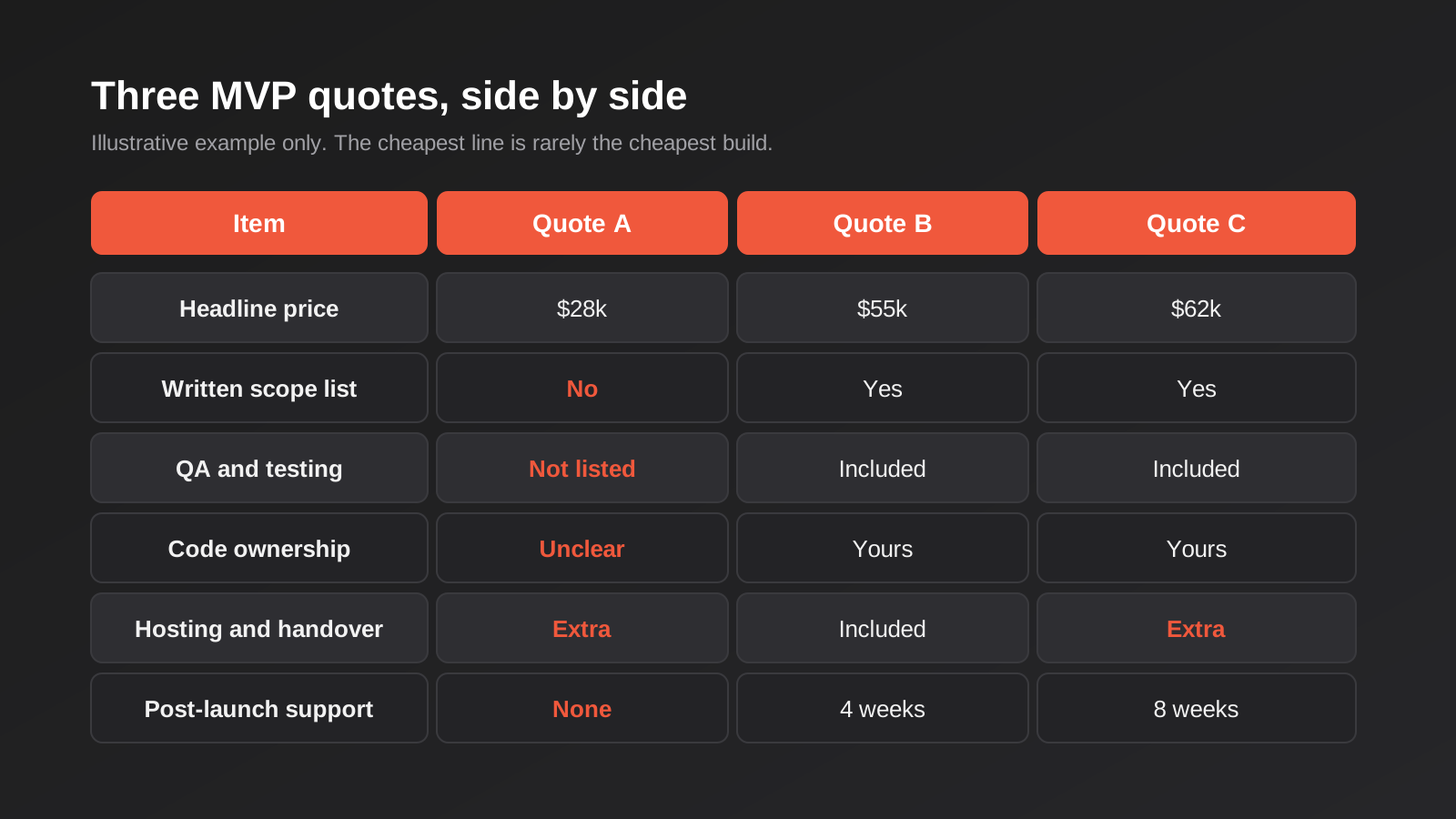
Look for these things in writing:
- A written scope. A list of screens, features and user flows included, and an explicit list of what’s out of scope. The out-of-scope list is often more telling than the in-scope one.
- The assumption being tested. A good agency will ask what the MVP is meant to prove and reflect that in the quote. If nobody asks, nobody is scoping to your goal.
- Itemised integrations. Each external system named, with what data moves in which direction.
- Testing and QA. What’s tested, by whom, and on which devices and browsers.
- Design. Whether design is included, how many rounds of revision, and who owns the design files.
- Hosting, deployment and handover. Who sets up the production environment, where it’s hosted, whose account it sits in, and whether you receive documentation.
- Ownership. The code, the database and the design assets should be yours. Our piece on who owns your custom software covers the contract language that matters here.
- Timeline and milestones. Dates tied to deliverables, and payments tied to milestones rather than calendar dates.
- Post-launch support. A defined period of bug fixing after launch, and what happens after it ends.
- Change process. How scope changes are priced and approved, so a small request doesn’t turn into a surprise invoice.
- GST. Whether the price includes GST. Some agencies quote ex-GST by default, and a $50,000 quote and a $50,000 quote plus GST are not the same number. If your business is registered for GST you can generally claim it back, but your cash flow still has to carry it until you do.
If a quote is missing most of these, you haven’t received a quote. You’ve received a number.
How to Compare Three Quotes Fairly
Getting three quotes is good practice. Comparing them properly is where most people go wrong, because the totals are the least informative part.
Start by giving every agency the same written brief. If you brief them verbally, you’ll get three different interpretations, and you won’t be able to tell whether a price difference reflects a difference in cost or a difference in understanding. A one- or two-page brief that states the problem, the user, the core flow and the must-haves is enough.
Then build a simple table like the one above. Down the side, list the line items from the previous section. Across the top, put the agencies. Fill in what each quote says, and write “not stated” where a quote is silent. Silence is information.
Next, normalise. If one quote includes testing and hosting and another doesn’t, estimate what the missing items would add and compare on that basis, or ask the agency to price them. If one is ex-GST and another inc-GST, convert them. If one covers eight weeks of post-launch support and another covers none, put a value on the difference.
Finally, ask each agency the same three questions. What would you cut if we needed to reduce the price by twenty per cent? What are the most likely reasons this will cost more than quoted? Who will actually do the work? The answers tell you more about an agency than their portfolio does. An agency that can tell you precisely what it would cut understands your scope. One that says “nothing, it’s all essential” either hasn’t thought about it or isn’t being straight with you.
The cheapest quote and the best-value quote are often different. So are the most expensive and the best. You’re looking for the quote where you understand exactly what you’re getting, the price is defensible against the hours, and the people involved give you confidence.
Common Mistakes We See
- Budgeting for the build and nothing else. Hosting, third-party fees, maintenance and iteration all need money, and the iteration budget is the one that decides whether the MVP teaches you anything.
- Writing a feature list instead of an assumption. If you can’t say in one sentence what the MVP needs to prove, you’ll build too much of it.
- Choosing on price alone. The lowest quote is often the one that left things out. Compare scope first, then price.
- Skipping discovery to save money. A small, well-run discovery phase is usually cheaper than rebuilding the wrong thing. If the agency won’t write down what it’s going to build before it builds it, be careful.
- Treating fixed price as risk-free. Fixed price transfers delivery risk, but it doesn’t remove change-request costs. Read what happens when scope moves.
- Leaving ownership vague. Agree in writing that you own the code, the data and the design files, and that you’ll receive full access and documentation at handover.
- Building native when the web would do. Two app store builds cost far more than one web app, and most MVPs don’t need one.
- Building for scale that doesn’t exist. Infrastructure sized for ten thousand users and a permissions model for five roles are solutions to problems you don’t have yet.
- Ignoring GST and cash flow. A $60,000 build plus GST needs more cash on hand than the headline suggests, and milestone payments rarely line up neatly with your funding.
- Not asking who does the work. A senior-led pitch followed by a junior-led build is common. Ask who is actually writing the code.
- Forgetting about incentives and tax treatment. Some businesses building new software may be eligible for the Research and Development Tax Incentive or state-level grants. Eligibility is narrow and the paperwork is real, so speak to your accountant before you start, not after.
Frequently Asked Questions
How much does an MVP cost in Australia?
Published Australian guides put a lean web MVP at roughly $15,000–$50,000, a typical startup MVP with accounts, payments and a couple of integrations at $50,000–$120,000, and a complex or regulated build at $150,000 or more. The spread is wide because the scope is. Get quotes against a written brief and compare line by line rather than by total.
Why do MVP quotes vary so much between agencies?
Because they’re usually pricing different things. Agencies define “minimum” differently, include different amounts of testing, design and handover, and make different assumptions about integrations and roles. Team seniority, location and overheads add further variation. A written scope and a shared brief remove most of the mystery.
Is a cheaper MVP quote a red flag?
Not automatically, but it deserves questions. Ask what’s excluded. Common gaps in low quotes are testing, hosting set-up, post-launch support and clear ownership terms. If the scope is genuinely narrower, a lower price is legitimate. If the scope is the same and the price is half, something has been left out or the work is going to someone less experienced.
Should I pay for a discovery phase?
Often yes, if it produces something you own. A short, paid discovery phase that ends in a written scope, wireframes and a technical plan reduces the risk of building the wrong thing and gives you material you can take to another agency. Be cautious if discovery is free but the quote that follows is vague, or if it’s expensive and produces only a slide deck.
Can I build an MVP for less using no-code tools?
Sometimes, and for testing demand or a process it can be the cheapest honest route. No-code works until you need custom logic, your own data model or an experience a form can’t fake. If the thing you’re testing is the software itself, a lean custom build is usually the more reliable test.
How much should I keep aside after launch?
Plan for hosting, third-party fees and maintenance as ongoing costs, and keep a separate iteration budget so you can act on what you learn. There’s no universal figure, because it depends on how fast you’re changing the product. A useful rule is to avoid spending the entire budget on the first version.
Where to Start
Before you ask anyone for a quote, write down the one assumption your MVP needs to prove, list the screens and flows you can’t launch without, and decide what you can handle manually for the first group of users. That one page will do more to control your cost than any negotiation, and it gives every agency the same brief to price.
If you’d like to see how we think about pricing custom builds, our web app development pricing page explains what we scope against and how we quote. And if you’re at the stage of deciding what to build first, our MVP development service is set up for exactly that kind of lean, scoped-to-learn engagement.
Because we run lean as a specialist agency rather than carrying a large account-management layer, our fixed quotes typically come in below the Australian averages covered in this guide. If you’ve already got a written quote from another agency for comparable scope, send it through and we’ll do our best to beat it.
Keep reading
Related posts
How Much Does SEO Cost in Adelaide? A 2026 Price Guide
What SEO costs in Adelaide in 2026: real monthly ranges by scope, what drives quotes up or down, and how to compare…
How Much Does SEO Cost for a Small Business in Australia? A 2026 Guide
What SEO costs a small business in Australia in 2026: real monthly ranges by budget, what each level buys, and how to…
How to Compare Agency Quotes in Australia: Why Prices Differ So Much (2026)
Why three agency quotes for the same job differ so much in Australia, what a good quote includes, and a step-by-step way…
Got a project you'd like to talk through?
Tell us what you're working on — we'll come back with a plan.
