
MVP Development: How to Build and Validate a Lean First Product
 Jignesh Vagadiya
04/09/2026
22 min read

Most MVPs we get asked to fix aren’t too small. They’re too big. A founder or ops lead comes to us with a spec that already includes multi-tenant permissions, a custom admin dashboard, three integrations and a mobile app — before a single customer has confirmed they want the thing at all. Six months and a chunk of the budget later, the product launches to a market that was never actually tested, and now there’s a pile of code to maintain whether or not anyone uses it.
An MVP is supposed to prevent that. Not by being smaller for its own sake, but by being the cheapest, fastest way to find out if you’re right before you commit real money to being wrong. That’s a different design brief to “version one of the full product,” and most teams build the wrong thing because nobody separates the two.
The instinct to build everything up front usually comes from a good place. Founders and product owners can see the whole finished thing clearly in their head, and it feels risky to launch something that’s visibly missing pieces. But that instinct gets the risk backwards. The real risk isn’t launching something incomplete — it’s spending months building toward a version of the product that turns out to be solving the wrong problem, priced wrong, or aimed at users who don’t behave the way you assumed.
This guide is about how MVP development actually works in practice — not the theory of lean startups, but the practical decisions: what to cut, which build approach fits your situation, what it realistically costs in Australia right now, and how to tell the difference between an MVP that’s working and one that’s just quiet. If you’re still weighing custom software against buying something off the shelf, that’s an earlier decision to this one — this guide picks up from the point you’ve decided to build, and now need to build the right first version.
What an MVP Actually Is (and Isn’t)
A minimum viable product is the smallest version of a product that lets real users complete the core thing it’s meant to do, in a way that generates evidence about whether it’s worth building further. Both halves of that sentence matter. “Minimum” means you’ve cut everything that isn’t load-bearing. “Viable” means what’s left still has to actually work for someone, end to end, not just exist as a demo.
That second part is where a lot of MVPs quietly fail before they even launch. Teams cut so aggressively that what’s left can’t be used for anything real — a booking flow with no payment step, a dashboard with no way to act on what it shows, a chatbot that can answer questions but can’t actually do the task the user came for. That’s not an MVP, it’s a mockup with extra steps, and it will tell you nothing useful because nobody can complete the thing you’re trying to validate.
MVP vs prototype vs beta
These three get used interchangeably and shouldn’t be. A prototype is for testing whether an idea is understandable and usable — clickable mockups, a rough flow, something you put in front of five people to watch them get confused or not. Nothing behind it needs to work. An MVP is a real, working product used by real customers doing the real task, even if the backend is held together with manual steps and a spreadsheet nobody sees. A beta is a near-complete product being tested for bugs and polish before a wider release — the core value proposition is already proven, you’re now derisking the execution.
Confusing these leads to two common failures. Some teams build a prototype, get positive reactions to a demo, and treat that as validation — then discover people who said “I’d use that” don’t actually change behaviour when it’s real and costs money or effort. Others build what is really a beta — full-featured, polished, production-grade — and call it an MVP, spending beta-level money to answer a question a much smaller build could have answered.
The “minimum” that still needs to be viable
A useful test: could a stranger, with no context and no favours from you, use this to actually get the outcome they came for? If the answer requires you to manually intervene, fudge the data, or explain what they’re seeing, it’s not viable yet, no matter how minimal it is. The manual intervention itself is fine — plenty of early MVPs run on a founder doing things by hand behind the scenes that will later be automated. What’s not fine is a user-facing experience that breaks without that hidden help.
Deciding What Belongs in Your First Build
Scope is the actual skill here. Everything else — the tech stack, the timeline, the budget — falls out of how well you’ve scoped the first release. Get the scope wrong and no build approach saves you.
Start from the one assumption you’re testing
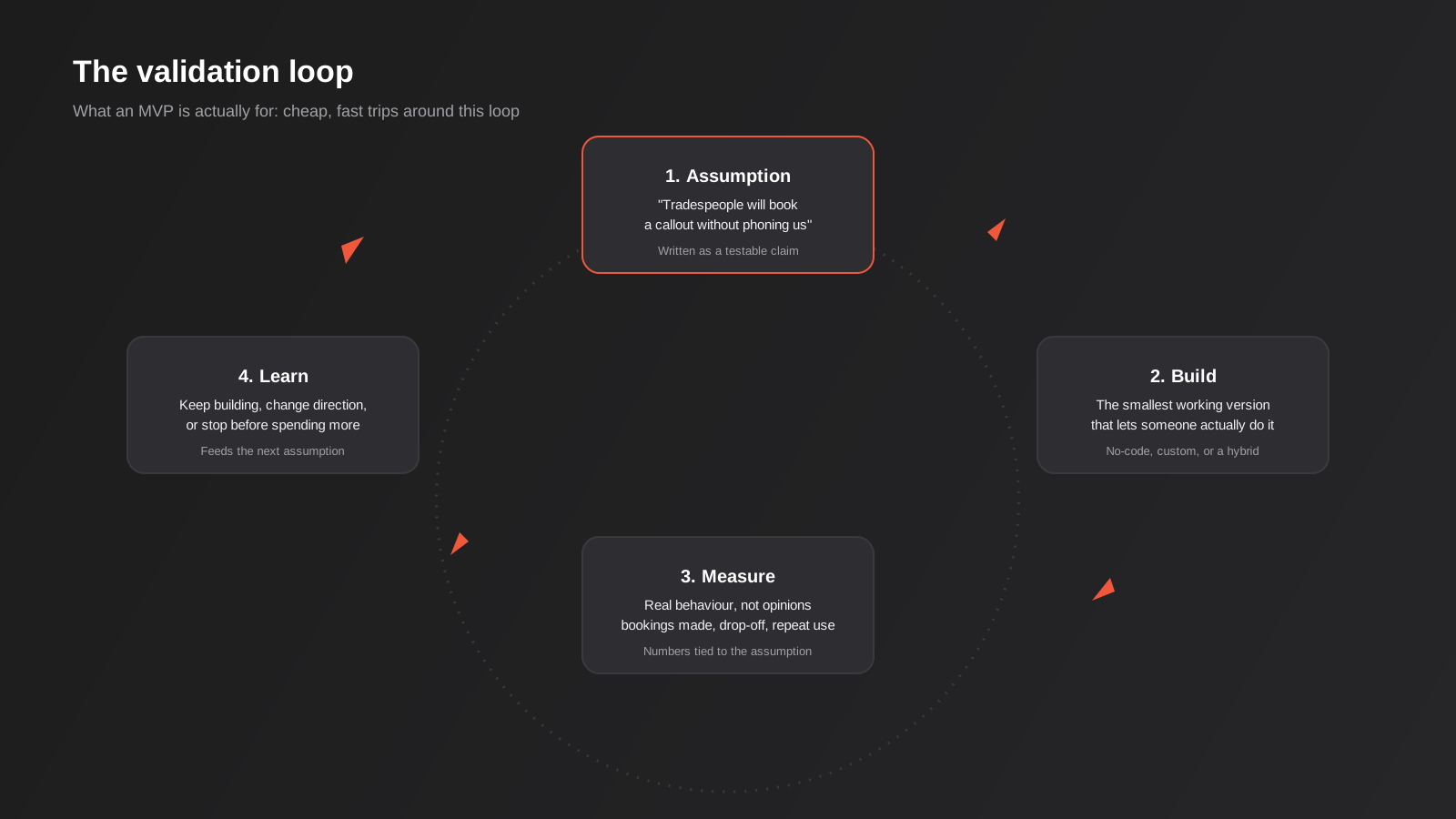
Before any feature list, write down the specific belief the MVP needs to test, as a claim that could turn out to be false. Not “we think tradespeople want an easier way to manage callouts” — that’s too vague to be wrong about. Something closer to “tradespeople will book and pay for a callout through a web form without phoning us first, at least 30% of the time.” That’s specific enough that you’ll know, from real numbers, whether it held up.
Everything in the first build should exist because it’s needed to run that specific test. If a feature doesn’t change what you’ll learn from the test, it doesn’t belong in v1 — even if it’s obviously going to be needed eventually. “Eventually” is the whole trap. Almost every feature in a full product spec is eventually needed. The MVP question is never “will we need this,” it’s “do we need this to learn what we’re trying to learn right now.”
Cutting features without cutting the point
A few cuts we make on almost every MVP scoping session:
- Replace admin tooling with a spreadsheet or a shared inbox for the first cohort of users, and build the admin interface once you know what admins actually need to do.
- Support one payment method and one currency, even if the eventual market needs more.
- Handle edge cases manually rather than in code — refunds, disputes, unusual account states — until volume makes that unsustainable.
- Ship with a single user role. Multi-role permissions are one of the most expensive things to build and one of the easiest to defer.
- Skip the onboarding flow you’d design for scale, and personally walk your first users through it instead.
None of these are permanent decisions. They’re sequencing decisions. The line we hold with clients is that a cut feature should be genuinely absent, not half-built badly — a spreadsheet standing in for an admin panel is honest and fast; a broken, half-finished admin panel is neither.
Take the tradesperson callout example from earlier. The full product vision might eventually include job history, invoicing, route optimisation for multiple jobs a day, and a customer-facing app. None of that belongs in the first build. What belongs is exactly enough to answer the assumption: a form that captures the job details, a way to see and accept it on the business side, and a payment step, because “will they book and pay without phoning” is only answered if payment is real. Job history can be a note in a spreadsheet for the first twenty customers. Route optimisation is irrelevant until there’s enough volume for routes to need optimising.
Choosing the Right Tech Approach
Once scope is set, the build approach is a separate decision, and it’s where a lot of budget gets wasted in the wrong direction — either overbuilding when a lighter approach would have answered the question, or trying to duct-tape together something that genuinely needed custom logic from day one.
No-code and workflow tools for the earliest test
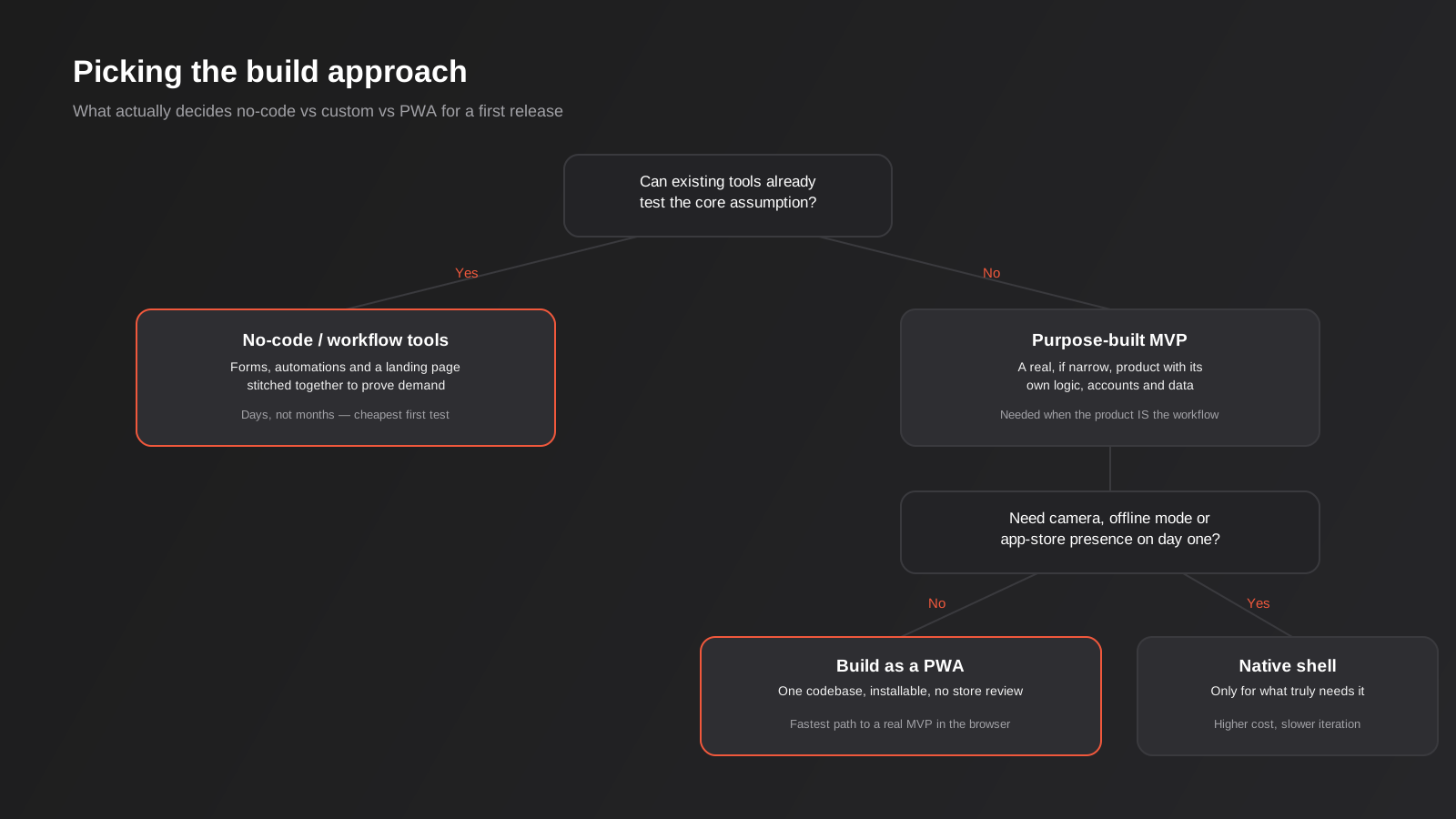
If the core assumption can be tested without a purpose-built product, test it that way first. A landing page, a form, and a handful of connected automations can validate demand, pricing sensitivity and even parts of the operational flow before a single line of custom code gets written. We cover the practical differences between the main workflow platforms in our Zapier vs Make vs n8n comparison, and our workflow automation service covers how these get stitched together properly rather than as a pile of brittle one-off connections.
This approach has a ceiling. It works well when the MVP’s job is proving demand or testing a process, and it works badly once the product itself needs custom logic, its own data model, or an experience that can’t be faked with a form and a spreadsheet behind it. Knowing which side of that line you’re on is worth an honest hour of thinking before you commit to either path.
When custom development is worth it from day one
Some MVPs are custom software from the first line, because the thing being tested is the software. If your product’s value is a scheduling algorithm, a pricing engine, a matching system, or any workflow where the logic is the differentiator, no amount of no-code stitching will let you test it honestly — you need the real thing, scoped down, not a workaround standing in for it. In that case the discipline isn’t avoiding custom development, it’s keeping the custom build ruthlessly narrow. Our MVP development service exists specifically for this middle ground: real software, built properly, scoped to answer a question rather than to be a finished product.
PWA vs native for an MVP’s first release
If the MVP needs to live on a phone, the PWA-versus-native decision matters more at this stage than almost any other, because it directly controls both cost and how fast you can ship changes based on what you’re learning. A progressive web app runs from one codebase, installs from the browser, and skips app store review entirely — which means the gap between “we learned something” and “the fix is live” can be hours instead of days. Our PWA development service covers the build itself, and the same underlying tradeoffs — installability, offline support, hardware access — apply whether the product is an MVP or already validated. Native only earns its cost at MVP stage when the product genuinely depends on something a browser can’t do — background location tracking, deep hardware integration, or a distribution channel that specifically requires an app store listing.
Who Should Actually Build It
This decision gets less attention than the tech stack, but it shapes the outcome just as much. There are three realistic paths for an MVP build, and each suits a different situation.
In-house, if you already have the right person
If there’s a developer already on staff who can own the build end to end, this is often the cheapest and fastest option, because there’s no ramp-up time spent explaining the business context. The catch is that most businesses reaching for an MVP don’t have this person sitting idle, and pulling a developer off other work to build a speculative product has a real opportunity cost that’s easy to underweight when it doesn’t show up as an invoice.
Freelancers, for a narrow, well-defined build
A single experienced freelancer can be a good fit when the scope is genuinely small, the requirements are clear, and you don’t need design, QA and project coordination as separate functions. It gets riskier as scope grows, because a single person is a single point of failure — if they get sick, get pulled onto another client, or simply turn out to be weaker on one part of the stack than another, there’s no team around them to absorb it.
An agency, when the build needs more than one skill
Most MVPs that involve a real user interface, a payment flow, and any integration with an existing system benefit from having more than one discipline involved — someone thinking about the product decisions, someone building it, and someone testing it before it reaches a real customer. That doesn’t have to mean a large team or a large invoice; a lean MVP engagement with an agency should still look and feel lean, scoped to the same “minimum that’s viable” principle as the product itself. What it buys you is continuity if a builder is unavailable, and a second set of eyes on scope before money gets spent building the wrong thing. It’s worth being direct here: this is the kind of engagement our MVP development work is built around, and we’d rather scope a client down to a smaller, cheaper build that answers their question than sell a bigger one that doesn’t.
What MVP Development Actually Costs and How Long It Takes
Cost ranges for MVP development get thrown around a lot, and most of them are meaningless without knowing what’s actually included. As a rough shape of the market in Australia: a genuinely lean MVP — one core flow, one user type, minimal integrations — tends to sit in the low tens of thousands, built over roughly four to eight weeks. A standard MVP with a handful of features, basic user accounts and one or two real integrations moves into the mid tens of thousands and eight to twelve weeks. Anything with multiple user roles, non-trivial integrations or meaningful custom logic from day one climbs from there, and at that point it’s worth asking honestly whether it’s still an MVP or has become a first production release under a different name.
The number that matters more than the total is the cost per week of learning. A build that costs less but takes twice as long to reach real users isn’t actually cheaper — it’s slower to tell you anything. We’d rather scope a client into a build that answers their question in six weeks than one that’s marginally cheaper but takes four months, because four months of runway spent before you know if the product works is the expensive part, not the invoice.
One pattern worth naming directly: if a quote for an MVP comes in dramatically below the range above, ask what got cut to get there. Sometimes it’s legitimately a narrower scope. Often it’s corners — no real testing, no thought given to what happens after launch, or a scope so thin the build can’t actually answer the assumption you set out to test. An MVP that’s cheap but can’t be trusted is worse than no MVP, because it produces a false negative or false positive that then drives a bigger, wrong decision.
Validating: What to Measure Before You Build More
Launching the MVP isn’t the finish line, it’s the point where the actual test starts. Most of the value gets lost here, not in the build, because teams either don’t measure the right thing or don’t give the result an honest hearing.
Turning assumptions into testable hypotheses
Go back to the assumption you wrote down before building anything, and attach numbers to it before launch, not after. What result would count as the assumption holding up? What result would count as it failing? Deciding this in advance matters because it’s far too easy, after the fact, to look at any set of numbers and talk yourself into the story you wanted to hear. If you said 30% of visitors would complete a booking and you get 8%, that’s a result, not a disappointment to explain away.
Tie the measurement to behaviour, not sentiment. Survey answers and verbal enthusiasm are the least reliable signal available to you — people are polite, and they’re bad at predicting their own future actions. What someone actually does with real money, real time or real switching cost on the line tells you far more than what they say they’d do.
Signals that mean build more, pivot, or stop
Three broad outcomes, and each one should change what you do next:
- The assumption held up. Usage matches or beats what you defined as success, and the behaviour is repeating, not a one-off novelty spike. This is the signal to invest further — move from MVP toward a production build.
- Partial or mixed signal. People engage but don’t convert, or one segment loves it and another ignores it entirely. This usually means a narrower pivot: the core idea has something in it, but the specific version you tested wasn’t quite it. Go back to the assumption, not the code, and figure out what changed.
- The assumption failed. Low engagement, no repeat use, no willingness to pay or switch. This is the outcome founders resist accepting the most, because it feels like the build was wasted. It wasn’t — a cheap, fast MVP that returns a clear no has done exactly its job, and done it for a fraction of what building the full product and finding out the same thing later would have cost.
Talking to users while the test runs
Quantitative behaviour tells you what happened; it doesn’t always tell you why. Running a handful of short conversations with early users alongside the numbers — five or six is usually enough to spot a pattern — fills in the gap between “this metric is low” and “this is the specific reason it’s low.” That distinction changes what you do next. Low completion on a booking flow could mean the price surprised people at the last step, the form was confusing, or they never actually had the problem you assumed — three completely different fixes, and only a conversation will tell you which one you’re dealing with.
Keep these conversations close to the actual usage, not months later. Someone who used the product yesterday remembers what confused them; someone who used it six weeks ago is reconstructing a story after the fact, and that story tends to smooth over the friction points that matter most.
From MVP to Production Product
Once validation is genuinely positive, the build changes character. This is usually where the shortcuts taken deliberately at MVP stage get revisited one by one, not all at once and not by accident.
What changes technically once you’ve validated
The manual processes standing in for features get automated in the order they’re actually costing you time or breaking. The single user role becomes proper role-based permissions once there’s a real second type of user to support. The spreadsheet-as-admin-panel becomes a real interface once someone’s spending hours a week wrestling with it. None of this needs to happen in one big rebuild — the healthiest path is usually evolving the MVP’s codebase incrementally rather than throwing it away and starting again, provided the MVP was built on reasonably solid foundations rather than the fastest possible hack. This is also the point where it’s worth revisiting the build-vs-buy question properly with the fuller picture you now have; our custom software vs off-the-shelf framework is written for exactly this stage, not just the initial decision.
Systems and data you’ll need to bring in later
MVPs typically run disconnected from the rest of the business on purpose — no accounting sync, no CRM handoff, minimal reporting. Once the product is real, those connections stop being optional. Order or booking data needs to reach accounting. Leads need to land in a CRM instead of an inbox. Someone needs a dashboard that doesn’t require exporting a spreadsheet every Monday morning. That’s a different scoping exercise to the MVP itself, and it’s worth treating it as one rather than bolting integrations on ad hoc as each one becomes urgent.
Common Mistakes We See
- Skipping the written assumption. Teams jump straight to a feature list without ever writing down, in testable terms, what the MVP is meant to prove. Without that, no result from launch will be conclusive either way.
- Treating polish as validation. A beautiful, well-designed MVP that nobody uses is still a failed test. Visual quality and product-market fit are different questions, and good design can accidentally mask a weak core idea for a few extra weeks.
- Building for a scale that doesn’t exist yet. Multi-tenant architecture, elaborate permission systems and infrastructure sized for ten thousand users, built for a product with zero validated customers, is money spent on a problem you don’t have.
- Ignoring a negative result. Reinterpreting clear failure signals as “we just need more marketing” or “the messaging was off,” when the underlying data says the core assumption didn’t hold.
- No plan for what validation actually triggers. Launching without deciding in advance what a good result versus a bad result means for the next decision, so a clear signal arrives and nobody acts on it either way.
- Choosing the tech approach before the assumption is written down. Committing to custom development, or to a no-code stack, before it’s clear what specifically needs to be tested and whether that approach can actually test it.
- Letting the build drag on until it’s no longer minimal. Scope creep during the build itself is as damaging as a bloated spec from the start — every “while we’re in there, let’s also add” conversation pushes the launch date out and delays the point where real learning starts.
Frequently Asked Questions
How long should an MVP take to build?
Most genuinely lean MVPs land somewhere between four and twelve weeks, depending on scope and how much custom logic the core assumption actually requires. If a build is stretching well past three months, that’s usually a sign the scope has drifted toward a full product rather than a focused test — worth pausing to re-cut the feature list rather than pushing through.
Do I need a technical co-founder or in-house developer to build an MVP?
No, though it helps to have someone on your side, even part-time, who can translate business goals into scope decisions and sanity-check what an agency or contractor proposes. Plenty of validated products started as an agency-built MVP with a non-technical founder driving the product direction. What matters more than who writes the code is that someone owns the assumption being tested and resists scope creep on your behalf.
Should an MVP be built to be thrown away, or built to last?
Built to last, within reason. “Throwaway” MVPs sound appealing but rarely get thrown away in practice — if validation succeeds, the pressure to keep shipping on the existing codebase is immediate, and a genuinely disposable build becomes technical debt fast. The better target is a codebase that’s honestly scoped down rather than deliberately hacked together, so it can evolve into the production product instead of being rebuilt from zero.
What’s the difference between an MVP and a pilot program?
A pilot usually assumes the product already works and is testing rollout, operations or a specific customer relationship at limited scale. An MVP is testing whether the product idea itself holds up at all. In practice they overlap — an MVP launched with one or two committed customers is functioning as both a validation test and a pilot — but the mindset differs: a pilot expects success and is managing risk around it, an MVP genuinely doesn’t yet know the answer.
How many users do I need before an MVP result means anything?
There’s no universal number, and chasing statistical significance at MVP stage is usually the wrong instinct — you’re looking for a clear directional signal, not a rigorous study. A small number of real users who repeatedly use the product and would be upset if it disappeared is a stronger result than a large number who tried it once. Weight repeat, unprompted usage far more heavily than raw sign-up counts.
Can an MVP be built on top of our existing systems instead of standalone?
Sometimes, and it can be the faster path if the core assumption depends on data or workflow you already have — extending an existing CRM or internal tool rather than building fresh. The tradeoff is that you inherit the constraints of that existing system, which can slow the build down if it wasn’t designed for what you’re now trying to do with it. Worth a genuine scoping conversation before assuming either standalone or bolt-on is the default answer.
Where to Start
If you’ve got a product idea and you’re not sure yet whether it needs a no-code test, a lean custom build, or something in between, that’s the right stage to have a conversation before committing to either. We’d rather spend an hour helping you scope the actual assumption you’re testing than watch a build head toward a spec that answers a question nobody asked. Get in touch and we can talk through what your first version actually needs to prove, and what the smallest honest way to prove it looks like.
Keep reading
Related posts
Who Owns Your Custom Software? Source Code, IP and Handover for Australian Businesses (2026)
Paying for custom software doesn't mean you own it. What Australian contracts must say about code ownership, licences, handover and escrow.
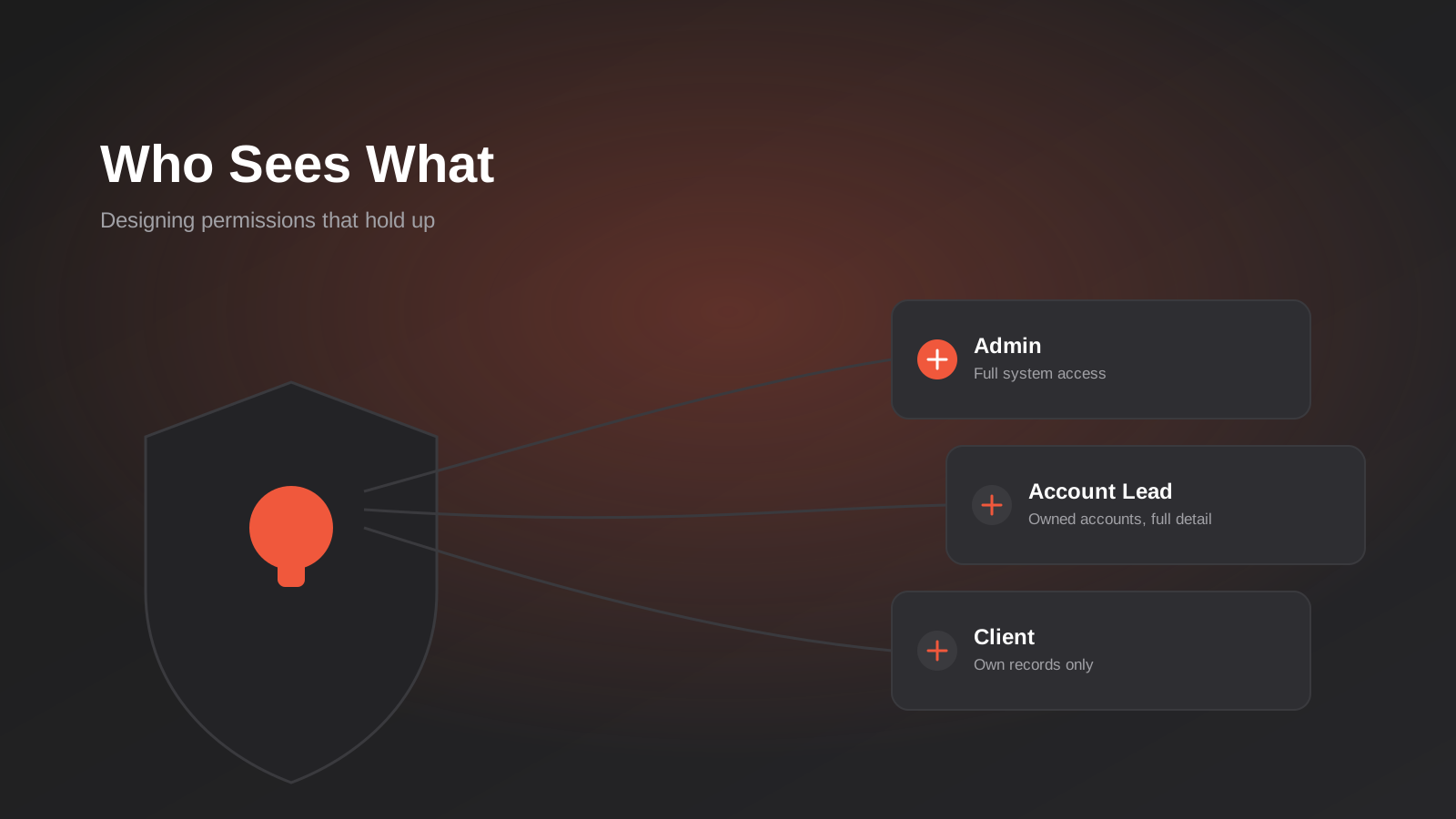
Role-Based Access Control for Client Portals and Internal Tools: A Practical Guide
RBAC for client portals and internal tools: roles, record-level isolation and audit logs explained — a practical guide for growing Australian businesses.
Single Sign-On for Australian Businesses: When SSO Is Worth the Setup
SSO for growing Australian businesses: SAML vs OAuth vs OIDC explained, how to pick an identity provider, costs, and rollout mistakes to…
Got a project you'd like to talk through?
Tell us what you're working on — we'll come back with a plan.
