
Local SEO for Veterinary Clinics in Australia: Google Business Profile, Reviews and the Emergency Search (2026)
 Jignesh Vagadiya
16/10/2026
21 min read
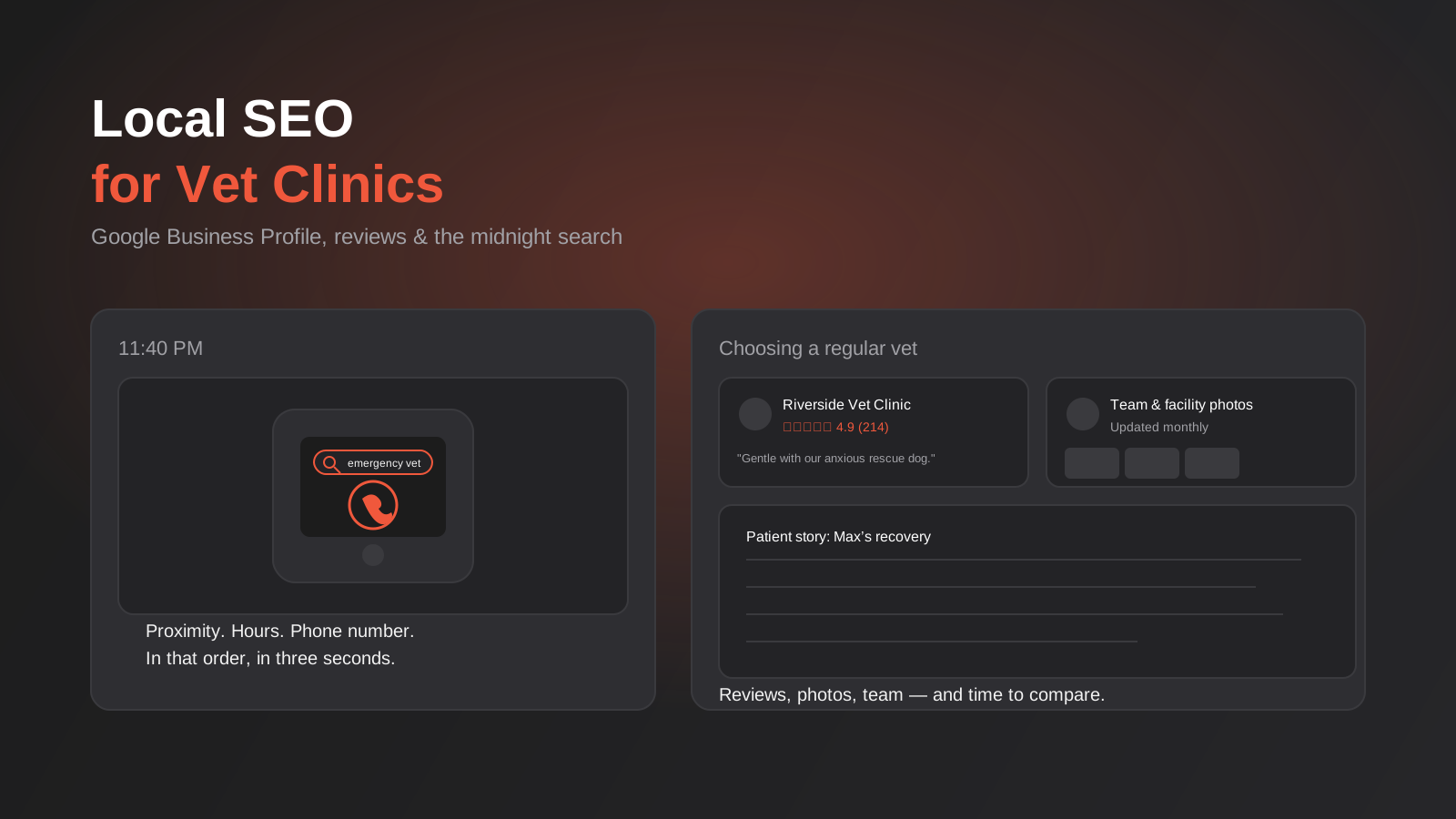
It’s 11:40pm and someone’s dog has eaten something it shouldn’t have. They’re not comparing clinics, reading your about page or checking whether you use Vetro or RxWorks. They’re typing “emergency vet near me” into a phone with shaking hands, and they will call whichever result answers that question fastest — a phone number, an open-now signal, an address. Twelve hours earlier, someone else searched “vet Brisbane” because they’ve just moved suburbs and want a regular clinic for a new puppy. They have time. They’re reading reviews, looking at the team page, comparing fees. Same search box, same intent category in Google Ads terms, completely different person.
Most veterinary clinic websites are built for the second person and hope the first one finds the phone number anyway. That’s backwards, because the emergency search is the one with the least patience for a slow page, a buried contact number or a Google Business Profile with outdated hours. It’s also the one most clinics have never deliberately designed for, because when the homepage was built, nobody was thinking about a panicked owner on a 4-inch screen at midnight.
This guide is about the part of veterinary marketing that sits upstream of all of it: getting found, in both of those moments, by the people searching for a vet right now. We work on veterinary marketing and website design for Australian clinics, and the SEO side keeps turning out to be genuinely different from other local service businesses — not harder or easier, just structured around a different set of rules. Part of that is the emotional range involved: nowhere else in local SEO does the same search box have to serve someone in genuine crisis and someone calmly comparison-shopping, often within the same hour. Part of it is a regulatory quirk that happens to work in veterinary’s favour, which we’ll get to. Here’s what we’ve learned about making all of it work together on one website rather than fighting itself.
Why Veterinary SEO Isn’t Like Other Local SEO
Local SEO for a plumber or a cafe is mostly one problem: rank in the map pack, look credible, convert the click. Veterinary SEO carries two extra complications that change how you should actually build the thing. The first is the split intent described above. The second is a regulatory quirk that works in your favour, if you know to use it.
Two Searches, One Website
Emergency search behaviour is well understood across healthcare generally, and vets are no exception: someone in distress wants proximity, availability and a phone number, in that order, and they will not read a paragraph to find any of them. Google’s own local pack reflects this — for “emergency vet near me” style queries, the businesses surfaced are judged heavily on proximity and the completeness of basic information (hours, phone, whether you’re open now) rather than content depth. If your Google Business Profile hours are wrong, or your after-hours arrangement isn’t stated anywhere a panicked person will see it in the first three seconds, you lose that search regardless of how good your actual website is.
The calm search behaves completely differently. Someone choosing a regular vet is doing something closer to choosing a school or a hairdresser: they’ll read a handful of reviews, look at photos of the clinic and the team, check what species and services you cover, and compare two or three options before calling anyone. Content, trust signals and a properly built site matter here in a way they simply don’t for the emergency searcher.
The practical implication is that a single generic “Contact Us” page serving both audiences will under-serve one of them, almost always the emergency one, because it’s built by people thinking about the calmer, more common case. The fix isn’t a separate website — it’s making sure emergency information (after-hours number, is-this-urgent guidance, directions) is genuinely impossible to miss on mobile, independent of whatever else is happening on the homepage, while the comparison-shopping content (team, reviews, facilities) lives where the calmer searcher expects to find it.
The Testimonial Advantage Most Clinics Waste
Here’s the quirk that’s easy to miss if you’re used to thinking about healthcare marketing generally. Human health practitioners in Australia — GPs, dentists, physiotherapists, psychologists, chiropractors — are bound by AHPRA’s advertising guidelines under the National Law, which specifically restrict the use of testimonials about clinical care. We’ve written about what that means in detail in our guide to healthcare SEO and AHPRA compliance, and it genuinely constrains what those practices can put on a website or a Google Business Profile response.
Veterinary practice sits outside AHPRA entirely. Vets are registered through state-based veterinary practice boards, not the national scheme that covers human health professions, and those boards don’t carry the same blanket restriction on testimonials. That means client reviews, written patient stories, and before-and-after photos of a recovery are all fair game in a way they simply aren’t for a dentist or a physio down the street. Ordinary consumer law on misleading claims still applies — you can’t fabricate outcomes or make unsubstantiated medical claims — but the core lever of “show people what actually happened for a client like them” is open to you.
Most clinics don’t use this. They publish a generic services page and leave reviews sitting passively on Google rather than actively collecting and featuring them. Given how heavily the calm-search audience weighs reviews and third-party proof when choosing a vet, this is close to the single highest-leverage gap we see on clinic websites.

Getting Google Business Profile Right for a Vet Clinic
For most local searches, Google Business Profile (GBP) is doing more work than the website itself — it’s what shows up in the map pack, what populates the knowledge panel, and often the first thing a mobile searcher sees before they ever click through. We cover the general mechanics of GBP properly in our complete Google Business Profile guide; what follows is specific to what changes for a veterinary listing.
Category and Attributes
Primary category matters more than most clinics realise. “Veterinarian” is the obvious default, but Google also supports more specific categories like “Animal hospital” and “Emergency veterinarian service,” and the right choice depends on what you actually are. A general practice that also handles after-hours emergencies shouldn’t necessarily use the emergency category as primary if that’s not the bulk of what you do — but it’s worth adding as a secondary category if it’s genuinely part of your service, since it affects which queries you’re eligible to surface for.
Attributes are the smaller fields people skip and shouldn’t: species treated, whether you offer online booking, whether you’re wheelchair accessible, whether you accept walk-ins. These feed directly into the filtered results Google shows for more specific searches (“exotic vet near me,” “24 hour vet Melbourne”) and cost nothing to fill in properly. Google’s own guidance on choosing a business category is worth reading once if you’ve never gone through it deliberately — it explains how primary and additional categories actually work and why a specific category beats a broad one.
Photos, Services and Q&A
The services section of a GBP listing should mirror the actual structure of your practice — general consults, vaccinations, desexing, dental, imaging, specific species streams if you run them — rather than one line reading “veterinary services.” It’s both a ranking signal for specific service queries and genuinely useful information for someone deciding whether to call.
Photos deserve more attention than they usually get. Team photos and facility shots do real work for the calm-search audience sizing up whether a clinic feels right for their animal, and clinics that post consistently tend to out-perform ones that upload five photos once and never return. The Q&A feature is worth monitoring actively too — anyone can ask or answer a question on your listing, and an unanswered or incorrectly answered question about parking, pricing or whether you treat a particular species sits there publicly until someone from the clinic steps in.
Multiple Locations Without Clinics Competing for the Same Suburb
Clinic groups running more than one site hit a specific problem: each location needs its own GBP listing to rank in its own suburb, but a shared website, shared phone number or duplicated page content across locations can trigger Google to treat the listings as a single diluted entity, or have them cannibalising each other in search results. Each location needs a genuinely distinct, unique page on the website — its own address, its own photos, its own local content — sitting behind one coherent site and one set of client records rather than separate micro-sites. We go into the broader version of this problem, which applies well beyond veterinary, in our guide to multi-location SEO for Australian franchises.
Building a Review Engine, Not Just Asking for Reviews
Review volume and recency both function as live trust and ranking signals, and veterinary clinics tend to generate strong reviews naturally because the emotional stakes of the interaction are high — people are grateful in a way that’s harder to manufacture for, say, a tyre shop. The problem is almost never quality. It’s that most clinics rely on clients remembering to leave one unprompted, which produces a trickle rather than a steady flow.
When and How to Ask
The best moment to ask is immediately after a positive outcome, while the relief is still fresh — a follow-up call or text the day after a successful procedure, a discharge message with a direct review link, or a prompt built into the appointment-reminder sequence a day or two after a routine visit. Timing beats scripting here. A simple SMS with a direct link to your Google review page, sent at the right moment, consistently outperforms a nicely worded email sent to everyone on the books once a quarter.
What doesn’t work, and can breach Google’s policies, is offering incentives for reviews or gating which clients get asked based on how the appointment went. The process needs to be systematic and applied to everyone, which is usually the first thing we help a clinic automate — it’s a natural extension of the same reminder workflows that handle vaccination and parasite-prevention prompts.
Responding to Negative Reviews
Every clinic gets one eventually, often from someone grieving a pet that didn’t survive treatment, which is a genuinely different situation to a plumber getting a one-star review over a late arrival. The response needs to be calm, brief, and never defensive or clinically specific in public — acknowledge the loss, invite them to continue the conversation privately, and resist the urge to litigate the case in a public reply. Prospective clients read how a clinic handles its worst reviews far more carefully than they read the five-star ones, and a measured response to a difficult review often does more for trust than another generic five-star one would have.
Using Patient Stories Properly
Because the AHPRA testimonial restriction doesn’t apply here, a written recovery story — with the owner’s permission, genuine photos, and an honest account rather than a polished case study — is one of the most persuasive pieces of content a vet clinic can publish. It does double duty: it’s genuinely useful content for the calm-search audience doing their comparison, and it’s exactly the kind of specific, detailed page that tends to earn long-tail search visibility for breed- or condition-specific queries over time.

On-Site SEO: Structuring the Site Around Two Journeys
Once the Google Business Profile and review engine are working, the website itself needs to actually hold up both ends of the split intent described earlier, and support the broader on-page and technical fundamentals we’d apply to any SEO engagement.
The Emergency Path
A dedicated emergency or after-hours page, linked from the main navigation and reachable within one tap from the homepage on mobile, should carry exactly four things above any scroll: the after-hours phone number as a tap-to-call link, current hours or an open-now indicator, your emergency referral arrangement if you don’t run 24-hour care yourself, and brief, honest guidance on what counts as urgent versus what can wait for a normal appointment. Nothing else needs to compete for space on this page. It is not the place for brand storytelling.
Page speed matters more here than almost anywhere else on the site, because the person loading this page is often on a patchy mobile connection, in a dark car park, with their hands shaking. A heavy hero image, an embedded video autoplaying in the background, or a cookie banner that has to be dismissed before the phone number is visible are all small design decisions elsewhere on the site that become genuinely harmful on this specific page. The same Core Web Vitals work we’d recommend for any local business website — fast loading, minimal layout shift, immediate interactivity — matters disproportionately on the one page where someone is in a hurry and distressed at the same time.
Condition and Species Pages Without Thin Content
It’s tempting to build a page for every species and every common condition — dog dental, cat dental, exotic dental, and so on — because it looks like good keyword coverage. Done carelessly, this produces a stack of near-identical thin pages that compete with each other and dilute rather than build authority, which is the same trap that affects ecommerce category pages with faceted navigation. The better approach is to only split a page when the content genuinely differs — a dental page for cats actually does need different information to one for dogs — and to consolidate everything else into fewer, more substantial pages that actually answer the questions a searcher has, rather than existing purely to catch a keyword variant. A good test before publishing a new species or condition page is to ask whether a vet on staff could point to at least three paragraphs that wouldn’t apply, word for word, to the equivalent page for a different species. If the honest answer is no, it should be a section on an existing page rather than a new URL competing for the same searcher’s attention.
Schema Markup for Veterinary Services
Structured data doesn’t change what a page says, but it changes how clearly Google and AI-driven search surfaces can parse what you offer. A veterinary clinic should be marking up as a VeterinaryCare or LocalBusiness entity with accurate opening hours, address and service listings, and individual service or condition pages benefit from FAQ schema where there’s genuine Q&A content on the page, not just a decorative accordion. We go through the mechanics of this properly, including which schema types actually earn visible rich results rather than sitting unused, elsewhere on the blog. The short version for a clinic building this for the first time: get the business entity and opening hours markup correct before worrying about anything more advanced, since that foundational layer is what most local-search features actually draw from, and incorrect schema can do more harm than no schema at all if it contradicts what’s visibly on the page.
Local Citations and Directories
Consistent business name, address and phone number (NAP) across directories still functions as a trust signal, and it matters slightly more for veterinary practice because there’s a dedicated ecosystem of vet-specific directories alongside the general local ones. Worth prioritising: your core Google Business Profile and Bing Places listings, the general Australian directories (True Local, Yellow Pages, Local Search), and veterinary-specific directories where clients genuinely browse, such as state veterinary association “find a vet” tools and pet-insurance partner directories if you’re a preferred provider for any insurer. The return on each individual listing is small, but inconsistency — an old address on one directory, a disconnected phone number on another — actively works against you, so an audit and clean-up is worth doing before adding new listings.
A practical way to run this audit is to search your own clinic name plus suburb and work through every result on the first two pages, noting the name, address and phone number exactly as listed on each. Clinics that have rebranded, changed phone systems or moved premises in the last few years are the ones most likely to have stale citations sitting out there quietly contradicting the current website, and it’s worth checking this again whenever any of those details change rather than assuming directories update themselves.
Showing Up in AI Overviews and AI Search
Google’s AI Overviews and similar AI-generated answers are increasingly the first thing a searcher sees for informational queries — “is chocolate toxic to dogs,” “how often does a cat need vaccinations” — even when the eventual booking still goes to whichever local clinic shows up in the map pack underneath. Clinics that publish genuinely useful, specific answers to the questions their own clients actually ask on the phone are the ones most likely to get pulled into those summaries, and clear FAQ-formatted content with proper schema markup is one of the more reliable ways to be eligible for that placement. This is a narrower slice of the broader shift we cover in our guide to AI SEO, and for a vet clinic specifically it means writing the condition and care pages as if answering a real question a worried owner typed in, rather than as a generic services blurb.
Multi-Location and Franchise Vet Groups
Groups running several clinics under one brand face a sharper version of every problem above. Reviews need to be tracked and responded to per location, not pooled into one aggregate number that hides a struggling site behind strong ones elsewhere. Google Business Profiles need distinct, accurate information per clinic rather than a templated copy-paste. And the website architecture needs each location to have a real, substantial page that can rank in its own area, while shared systems — booking, client records, the retail store if you run one — sit behind the scenes as one coherent operation. Getting this balance wrong in either direction, either totally separate sites that fragment authority or one generic site that can’t rank locally anywhere, is the most common structural mistake we see in multi-site healthcare groups generally.
There’s also an internal coordination problem that’s easy to underestimate: if marketing sits centrally but reviews and local content need input from each clinic, someone has to own the loop between them. The groups that handle this well tend to give each clinic manager a simple, repeatable task — flag any negative review within a day, supply two or three new photos a month, confirm hours before public holidays — rather than expecting head office to manufacture local authenticity it doesn’t have direct access to.
Measuring What’s Actually Working
It’s easy to pour effort into SEO and have no real sense of whether it’s converting into booked appointments rather than just impressions. A few measurements are worth setting up early, before you’ve spent months on content and reviews without knowing which parts are pulling their weight. Google Business Profile’s own insights panel shows calls, direction requests and website clicks generated directly from the listing, which is often the single clearest signal you have for emergency-style search performance, since that’s frequently where the call happens without the person ever landing on your website at all.
Call tracking, even a simple dedicated number on the GBP listing versus the one printed on signage, tells you how much of your phone volume is actually coming from search rather than word of mouth or repeat clients, which matters when you’re deciding how much time to keep investing in this. And a basic monthly check of review count and average rating, tracked over time rather than glanced at once, shows you whether the review engine described earlier is actually running or has quietly stalled after the first month of enthusiasm. None of this needs to be elaborate. It needs to exist, and someone needs to actually look at it.
Common Mistakes We See in Veterinary Clinic SEO
- Outdated or inconsistent hours across the website, Google Business Profile and directory listings — the first thing an emergency searcher checks and the fastest way to lose that search entirely.
- Burying the after-hours number and emergency guidance behind homepage carousels, service menus or a contact form instead of a tap-to-call link near the top of a dedicated page.
- Treating reviews as something that happens passively rather than a process with a defined moment to ask, a template to follow and someone responsible for responding.
- Publishing a near-identical page for every species and condition combination, producing thin content that competes with itself instead of a smaller number of substantial, genuinely differentiated pages.
- Never using patient stories or recovery photos, despite veterinary practice sitting outside the AHPRA testimonial restrictions that genuinely limit human healthcare marketing.
- Running multiple locations on templated, near-duplicate pages that dilute each other in search instead of giving every clinic its own substantial, locally distinct page.
- Ignoring the Google Business Profile Q&A section, leaving incorrect or outdated public answers about pricing, parking or species treated unchallenged.
Frequently Asked Questions
How long does veterinary clinic SEO take to show results?
Google Business Profile changes (categories, attributes, photos, review responses) tend to show movement within a few weeks because they affect map pack visibility directly. On-site changes and new content typically take longer, often several months, to earn ranking for competitive terms, since they rely on Google re-crawling and reassessing the whole site over time rather than a single update.
Should a vet clinic run Google Ads alongside SEO, or is SEO enough?
For a new clinic or one entering a competitive suburb, paid search fills the gap while organic rankings and review volume build up, since SEO takes months to compound and a new business can’t wait that long for visibility. Once local rankings and reviews are established, many clinics scale ads back to cover just the highest-intent emergency terms, where immediate visibility matters more than cost per click.
Can we respond to a negative review that includes incorrect medical information?
Yes, but carefully. You can correct a factual inaccuracy briefly and without defensiveness, while still avoiding specific clinical detail about the animal or treatment in a public reply, both for professional judgement reasons and because detailed back-and-forth in public rarely reads well to anyone else reading it. Invite the reviewer to continue the conversation by phone or email, and keep the public reply short.
Do we need a separate website for emergency or after-hours services?
No — a separate site usually fragments your search authority rather than helping it. What you need is a single, clearly signposted emergency page on your existing website, linked prominently from the main navigation and homepage, built specifically for someone who needs the phone number and your hours in the first few seconds on a mobile screen.
How many Google reviews does a veterinary clinic actually need?
There’s no fixed number, and chasing a specific count is the wrong goal. What matters more is a steady flow of recent reviews rather than a large historical total that’s gone quiet, since Google and prospective clients both weight recency, and a clinic with fifty reviews arriving steadily tends to out-perform one with three hundred reviews that stopped two years ago.
What’s the single highest-priority fix for a clinic just starting on this?
Audit and correct your Google Business Profile and directory listings for accurate hours, phone number and category first — it’s the fastest thing to fix, it directly affects whether an emergency searcher finds you at all, and everything else on this list compounds on top of a profile that’s already accurate.
Where to Start
If you’re running a single clinic, start with the Google Business Profile audit and a genuine process for collecting reviews — those two things alone move the needle faster than almost anything else on this list, and neither requires touching the website. If you’re running several locations, the website architecture question (one coherent site, distinct pages per clinic) usually needs solving before the rest of this is worth investing in, since no amount of review generation fixes a site structure that’s working against you in search.
We’d be glad to look at what’s actually happening with your clinic’s search visibility right now — where you’re showing up, where you’re not, and what’s realistic to fix first. No pressure, just a conversation about what we’re seeing.
Keep reading
Related posts
Psychology Practice Marketing in Australia: Local SEO, Compliant Copy and the Waitlist Problem (2026)
How Australian psychology practices handle local SEO, AHPRA-compliant copy and waitlist triage when they're already at capacity (2026).

Physiotherapy Marketing in Australia: Local SEO, Website Design and Booking (2026)
How Australian physiotherapy clinics win new patients through Google Business Profile, local SEO, website design and real-time booking in 2026.
Marketing for NDIS Providers in Australia: How Participants, Families and Support Coordinators Actually Find You (2026)
How NDIS providers get found by participants, families, support coordinators and plan managers — SEO, compliance and the 2026 registration shift.
Got a project you'd like to talk through?
Tell us what you're working on — we'll come back with a plan.
