
Psychology Practice Marketing in Australia: Local SEO, Compliant Copy and the Waitlist Problem (2026)
 Jignesh Vagadiya
19/10/2026
21 min read
A physiotherapy clinic that can’t fill its appointment book has a marketing problem in the usual sense: not enough people know it exists, or not enough of the people who find it actually book. A lot of psychology practices in Australia have the opposite problem. Their books are closed, their waitlist runs six months to a year, and the enquiries keep coming anyway — through a contact form nobody’s checked in three days, or a phone number that rings out because the receptionist is also the practice manager and the bookkeeper.
That changes what psychology practice marketing is actually for. Most advice aimed at allied health businesses assumes the job is to generate more leads. For a lot of psychology practices, the job is closer to triage: get the right people to the right place quickly, say no to the wrong fit without wasting anyone’s week, and do all of it inside advertising rules that are genuinely stricter than almost any other industry we work with.
We put this guide together because we kept seeing the same mismatch — practices running Google Ads to a waitlist that’s already full, or publishing generic “we care about your wellbeing” copy that says nothing a prospective client actually needs to know before they call. What follows is how we’d approach a psychology practice’s website, local search presence and enquiry handling in 2026, written for practice owners and practice managers rather than clinicians, and grounded in the actual rules that apply to AHPRA-registered psychologists, not the version of those rules that gets repeated secondhand on marketing blogs.
The capacity problem nobody else’s marketing advice accounts for
Start with the honest version of where the industry sits. The Australian Association of Psychologists has reported waitlists running anywhere from several months to close to a year at many practices, and it’s common enough now for a practice to simply close its books to new clients for a stretch rather than take on people it can’t see for months. If that’s your practice, the standard SEO playbook — rank higher, get more clicks, convert more enquiries — doesn’t just stop helping. It actively makes things worse. More enquiries into a system with no capacity means more people left waiting on a reply, more frustrated callers, and worse Google reviews from people who never even got an appointment.
The practices that handle this well aren’t necessarily the ones generating the most traffic. They’re the ones whose website and intake process do three things clearly: tell a prospective client quickly whether there’s realistic capacity to see them, filter for genuine fit (modality, presenting issue, Medicare versus private, telehealth versus in-person) before a clinician’s time gets spent on a phone call, and give the people who aren’t a fit somewhere useful to go instead of silence.
Medicare’s 10-session cap shapes the conversation before it starts
Under the Better Access initiative, Medicare currently funds up to 10 individual psychological therapy sessions per calendar year with a General Practitioner referral and Mental Health Treatment Plan, after the cap was reverted from a temporary 20 back down to 10. That single number drives a huge amount of search behaviour and a huge amount of confusion. People search for “how many Medicare sessions psychologist,” “psychologist near me bulk bill,” and “do I need a referral to see a psychologist” far more than they search for anything resembling a marketing keyword, and most practice websites answer none of it clearly.
Individual telehealth sessions are now a permanent part of Better Access regardless of where the client is located, which matters because it means a Sydney-based psychologist can genuinely build a client base across the country rather than just their suburb — a different growth lever than almost any other local service business we work with. Group telehealth sessions are treated differently and are tied to the Modified Monash Model classification of the client’s location, which is a detail worth getting right on your website rather than leaving as a footnote, because getting it wrong is the kind of thing that generates a frustrated phone call rather than a booking.
What you’re actually allowed to say
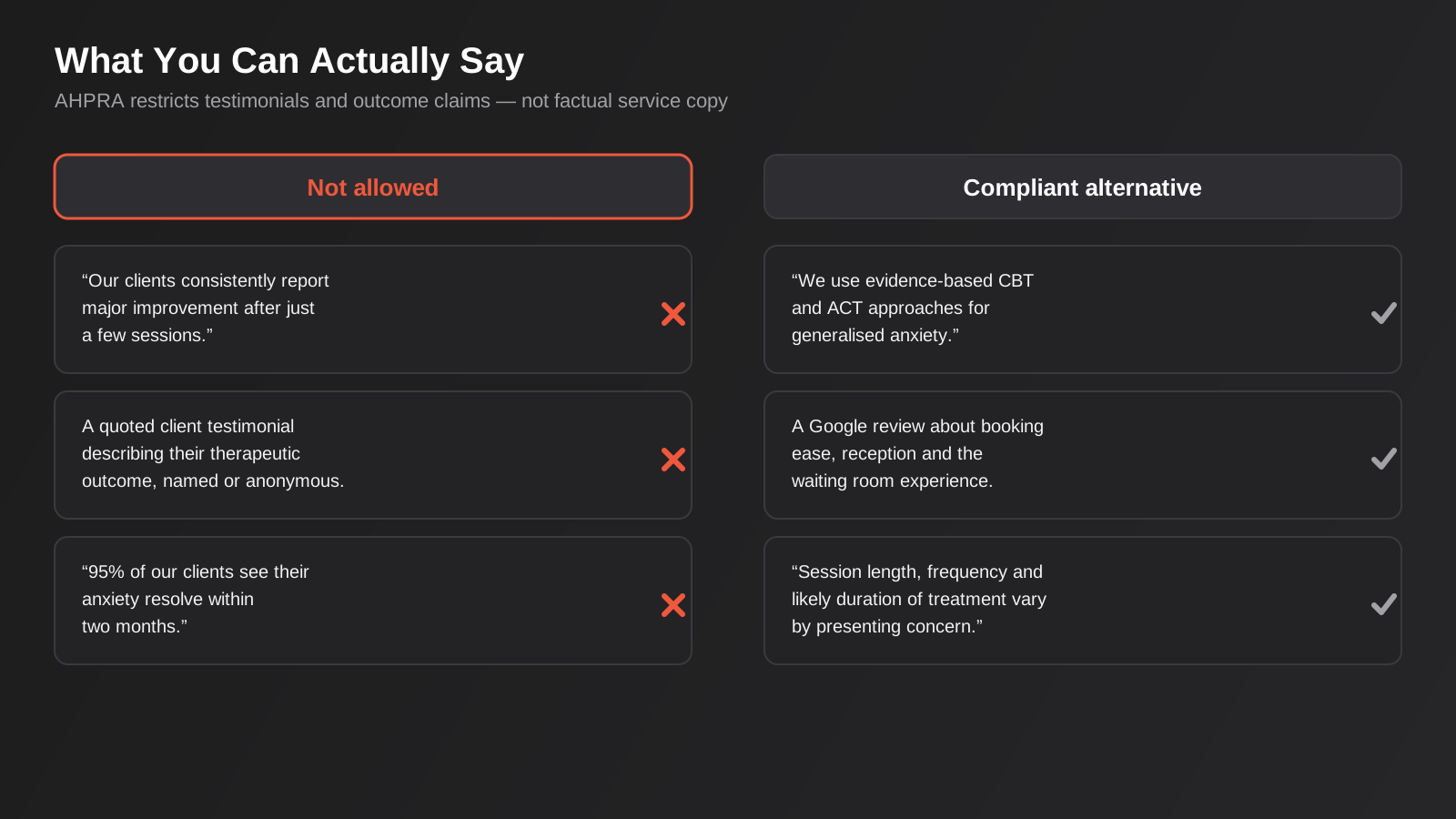
This is the part most generic marketing advice gets wrong for psychology specifically, and it’s worth being precise about because the consequences of getting it wrong aren’t hypothetical — AHPRA runs compliance audits against practitioners’ own renewal declarations. Psychologists are regulated under the National Law, and section 133(1) of that Law prohibits advertising a regulated health service in a way that uses testimonials. The Psychology Board of Australia’s advertising guidelines spell this out directly: advertising must not use testimonials or purported testimonials about the clinical aspects of a psychological service. That’s a flat prohibition, not a disclosure requirement you can work around with a disclaimer.
It catches more than people expect. A quote from a client about how much a program “changed their life,” a “before and after” style case description, a LinkedIn recommendation reposted to your website — all of these sit squarely inside the definition AHPRA uses for a testimonial about clinical aspects of care. It doesn’t matter whether the client offered it unprompted or whether it’s glowing and genuine. If it speaks to the clinical outcome of treatment, it can’t go on your marketing.
What you can still use: reviews are not the same thing as testimonials
The distinction that actually matters in practice is between a testimonial about clinical care and a review or rating about the service experience. Star ratings, comments about how easy it was to book, how friendly the reception staff were, how comfortable the waiting room felt — that’s service-level feedback, and it isn’t caught by the same prohibition the way a comment about therapeutic outcomes is. This is why you’ll see reputable psychology practices actively encouraging Google reviews about the booking experience and accessibility, while being careful never to showcase anything that reads as “my anxiety improved after seeing Dr. X.” If you’re building out your Google Business Profile strategy, this distinction is worth briefing into any review-request templates you send, because a well-meaning admin team will otherwise ask for exactly the wrong kind of feedback.
Writing about what you do without implying a guarantee
The safer version of outcome-adjacent content is describing your approach and your training, not your results. “We use evidence-based approaches including CBT and ACT for generalised anxiety” is a factual description of service and qualification. “Our clients consistently report significant anxiety reduction within weeks” edges into an outcome claim that a regulator would reasonably query, even without a testimonial attached to it. The APS Code of Ethics and the advertising guidelines both push practitioners toward claims that can be backed by the actual evidence base for a modality, not claims about what happened for a specific, unnamed person. If your copywriter isn’t across this distinction, it’s worth a short compliance pass before anything goes live, because the fix after publication (a client complaint, a competitor reporting you, an AHPRA audit flag) is far more disruptive than catching it at the draft stage.
Local SEO for a psychology practice
The search behaviour behind “psychologist near me,” “anxiety therapist [suburb]” and “child psychologist [suburb]” is overwhelmingly local-intent, and it resolves through the Google Map Pack before it resolves through organic blue links for most practices. That means your Google Business Profile carries more weight for new client acquisition than almost any page on your actual website, and it’s worth treating it as the asset it is rather than a directory listing you set up once and ignored. We’ve written a full guide to Google Business Profile setup and optimisation that covers category selection, services configuration and posting cadence in more depth than makes sense to repeat here — the mechanics are largely the same across industries. What’s specific to psychology is what goes into the fields once you’re set up.
Category and attributes that actually match the search
“Psychologist” is a distinct Google Business category from “Counsellor,” “Psychotherapist” and “Mental Health Service,” and a surprising number of practices pick the wrong one or leave it generic. If you have psychologists, counsellors and social workers under one roof, you’re often better served by a primary category that matches your most searched-for practitioner type, with the others reflected clearly in your services list and on individual practitioner pages rather than buried in a single “our team” page. The telehealth attribute matters too — flag it if you offer it, because “psychologist telehealth [suburb]” and simply “online psychologist Australia” are both real, growing search patterns, particularly from regional clients who know the service exists but can’t find a local practitioner with capacity.
Service pages beat one generic services page
The same Google Business Profile fundamentals we outlined for physiotherapy clinics apply here, and so does the same website structure lesson: a single “our services” page trying to cover anxiety, depression, trauma, couples counselling, child psychology and workplace EAP work will rank for almost none of those terms specifically. Separate, genuinely substantive pages for your core presenting issues or specialty areas — each answering what the approach looks like, what a first session involves, and what Medicare and fee arrangements apply — give Google something specific to match against a specific search, and give a prospective client something that actually answers their question instead of a paragraph that could describe any psychology practice in the country.
This is also where the AHPRA restrictions interact with SEO in a way that’s easy to miss. A lot of the content that would normally make a service page compelling — client stories, specific outcome statistics, “95% of our clients report improvement” style proof points — is exactly the content you can’t publish. That pushes the differentiation onto things you can say honestly: practitioner qualifications and areas of focus, session structure, wait time transparency, and how referrals and rebates actually work. Done well, that’s still genuinely useful content; it’s just a different kind of useful than most service-page templates assume.
The website content that actually reduces wasted enquiries
If you only fix one thing on a psychology practice website, fix the rebate and referral explanation. “Can I get a Medicare rebate without a referral,” “what’s the gap payment,” “do I need a GP mental health plan first” — these are the questions that generate the most confused phone calls to reception, and almost every practice website we’ve reviewed leaves them to a vague FAQ or skips them entirely. A clear page (not a buried paragraph) explaining that Medicare rebates require a referral and Mental Health Treatment Plan from a GP, what the current session cap is, what the typical gap payment range looks like, and what private (non-Medicare) options exist for people who don’t have or want a referral, will do more for your admin team’s sanity than almost any other single change.
Telehealth deserves its own clear page, not a sidebar mention
Because individual telehealth is now a permanent, location-independent part of Better Access, it’s one of the few genuine growth levers available to a practice that’s at physical capacity. A practitioner who’s fully booked for in-person sessions in their suburb can still take on telehealth clients from anywhere in the country, provided it’s clinically appropriate. That’s worth a dedicated page explaining how telehealth sessions work, what’s needed on the client’s end, and which presenting issues or client ages you consider suitable for telehealth versus requiring in-person — partly for SEO (telehealth-specific searches are a different intent to local searches), and partly because it genuinely helps a prospective client self-select before they book a session that turns out not to suit them.
Marketing as triage: handling demand you can’t fully serve
If your practice has a genuine waitlist, the most valuable piece of “marketing” infrastructure isn’t a campaign, it’s a structured intake process that sorts enquiries before they reach a clinician’s time. A basic form asking presenting concern, urgency, Medicare versus private preference, and in-person versus telehealth preference lets you route people appropriately instead of treating every enquiry identically. An intake chatbot or structured triage assistant on the website can handle the first layer of this conversationally — flagging anything that reads as a safety concern for an immediate human response, and giving everyone else an honest estimate of current wait times and a clear next step, rather than silence while an admin team works through a backlog.
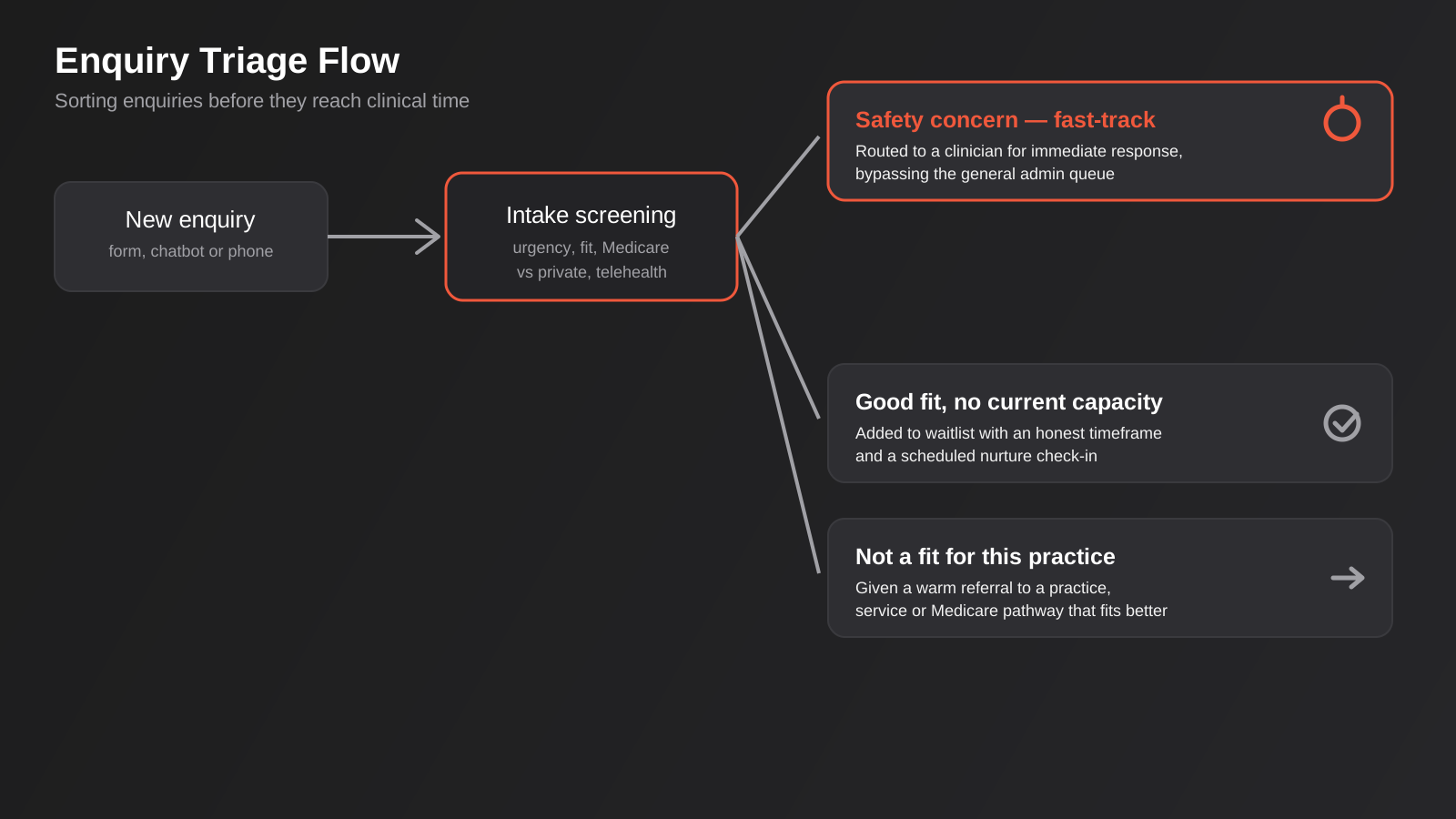
This matters for reputation as much as efficiency. A prospective client who gets an immediate, honest “we have a three-month wait for new clients, here’s what to expect and here’s two practices nearby who may have capacity sooner” leaves with a reasonable impression of your practice, even if they go elsewhere. A prospective client who sends an enquiry into a void and never hears back leaves a one-star Google review about unresponsiveness — the kind of review that genuinely damages your Map Pack visibility, because response rate and responsiveness are factors Google’s local algorithm does weigh.
Referral partnerships do work that consumer SEO can’t
A meaningful share of psychology referrals come through GPs, other allied health practitioners, schools, and workplace Employee Assistance Programs rather than a cold Google search. That’s a different marketing motion to local SEO — it’s closer to B2B relationship building, and it’s worth investing in deliberately if you’re not already: a simple one-page referrer information sheet (what you treat, current wait times, how to refer, Medicare versus private pathways) sent to local GP clinics and allied health practices on a quarterly basis costs very little and tends to produce better-matched clients than broad consumer advertising, because a GP who knows your current capacity and specialty areas will only send appropriate referrals in the first place.
Employee Assistance Program providers work a little differently again — they typically hold a panel of approved practices and route employees to whichever has capacity, so getting onto a few reputable EAP panels can supply a steady stream of referrals without any consumer-facing marketing spend at all. It’s a slower process to set up, since EAP providers tend to run their own onboarding and credentialing steps, but once you’re on a panel the referral relationship tends to be durable, and it’s a channel most solo practitioners and small clinics never pursue simply because it isn’t as visible as SEO or paid ads.
Content marketing that builds authority without crossing the line
With testimonials and outcome claims off the table, psychoeducational content becomes one of the few remaining ways to demonstrate expertise publicly. Articles explaining how a particular modality works, what to expect in a first session, how to tell the difference between normal stress and something worth seeking support for, or how a Mental Health Treatment Plan actually gets set up with a GP — this is content that’s genuinely useful to a reader researching whether to seek help, it carries real SEO value because it answers specific, high-intent questions, and none of it runs into the testimonial or outcome-claim restrictions because it’s describing general clinical knowledge rather than a specific client’s results.
This kind of content also compounds in a way paid advertising doesn’t. An article on, say, “what to expect in your first session with a psychologist” keeps attracting search traffic for years with no ongoing spend, and it tends to rank well precisely because so few practice websites bother writing it — most default to a thin “about us” paragraph instead. The trade-off is that it takes longer to show results than a campaign does, which is worth being upfront about internally before you commit a practitioner’s limited writing time to it.
Awareness periods are a legitimate, low-risk content calendar
Mental health awareness periods — R U OK? Day, Perinatal Anxiety & Depression Awareness Week, World Mental Health Day and similar — give you a predictable, low-effort content calendar that search volume genuinely spikes around each year. Timing a short, factual article or an updated service page to coincide with the relevant week is a reasonable use of a practitioner’s limited content time, and because the content is educational rather than promotional in tone, it sits comfortably within the advertising guidelines without needing a compliance review each time.
Regional access and the telehealth equity gap
Worth a specific mention because it’s an under-served angle most practice marketing ignores: regional and rural clients often face the longest waits and the thinnest local supply of psychologists, which is exactly the gap telehealth is best positioned to close. If your practice has any spare telehealth capacity, targeting content and, where appropriate, advertising toward regional areas classified under the Modified Monash Model can connect you with clients who genuinely have no comparable local option, rather than competing for the same metro clients every other practice in your suburb is chasing. It’s a smaller, more specific audience than a broad “psychologist near me” campaign, but it tends to convert at a higher rate because the alternative for that client is often no local psychologist at all, not a competing practice two suburbs over.
Where paid advertising fits, if it fits at all
Paid search for psychology practices is genuinely harder to get right than most industries we run campaigns for, for two reasons that compound each other. First, the AHPRA advertising restrictions apply to paid ads exactly as they apply to your website — no testimonials, no outcome claims, which rules out a lot of the ad copy that performs well in other service categories. Second, and more fundamentally: if you’re already at or near capacity, running ads to generate more enquiries just accelerates the problem this whole guide is about. We’d rarely recommend broad Google Ads for a psychology practice with a waitlist longer than a few weeks. Where paid search does make sense is narrower: a newly opened practice or a newly added practitioner building their caseload from zero, a specific underserved modality or age group (child psychology, couples counselling, a specific language) where local supply genuinely doesn’t meet demand, or telehealth campaigns targeting regions with thin local psychologist availability.
If any of those apply, the compliant version of a Google Ads campaign leans on factual service description and credentials — qualifications, modalities offered, Medicare rebate eligibility, telehealth availability — rather than the emotional or outcome-driven copy that typically wins in other healthcare verticals. It’s a narrower lane to write within, but it’s workable, and it keeps you well clear of a compliance problem that costs far more to fix than a slightly less punchy ad.
Common mistakes we see in psychology practice marketing
Most of these come down to the same root cause: treating a psychology practice website like any other local service business, without adjusting for the compliance restrictions or the capacity realities that make this industry genuinely different.
- Publishing client testimonials or “success story” case studies that describe clinical outcomes, which sits directly inside the National Law’s testimonial prohibition regardless of how genuine or well-intentioned the content is.
- Running Google Ads or boosted social posts to generate new enquiries while the practice already has a multi-month waitlist, which wastes budget and damages reputation when enquiries go unanswered.
- Leaving Medicare rebate, referral and gap payment information vague or absent, which generates the single largest category of confused calls and messages to reception.
- Using one generic “our services” page to cover every presenting issue and modality, instead of specific pages that actually match how people search.
- Treating telehealth as a footnote rather than a genuine growth channel, despite it being one of the few ways a geographically capacity-constrained practice can still grow.
- Requesting Google reviews with language that invites clinical outcome commentary (“tell us how therapy changed your life”) instead of service-experience feedback, which risks collecting review content that shouldn’t be displayed.
- No structured intake or triage process, so every enquiry — urgent or not, good fit or not — lands in the same queue and gets the same (often slow) response.
Frequently Asked Questions
Can psychologists use client testimonials in their marketing at all?
No. Section 133(1) of the National Law, which governs AHPRA-registered practitioners, prohibits advertising a regulated health service using testimonials about the clinical aspects of care, and the Psychology Board of Australia’s advertising guidelines state this explicitly. This applies regardless of whether the testimonial is solicited, unsolicited, glowing, or offered voluntarily by a happy client — the content itself is what’s restricted, not how it was obtained. Service-level reviews about booking ease, reception experience or accessibility sit outside this restriction, but anything describing therapeutic outcome does not.
Should I keep marketing my practice if I already have a long waitlist?
Generally, scale back active demand generation (paid ads, broad social promotion) and redirect effort into clearly communicating current wait times, improving your intake and triage process, and maintaining your Google Business Profile so you stay visible for when capacity opens up. Switching marketing off entirely usually isn’t right either, since practices lose a portion of their client base every year to relocation, changing needs or discharge, and visibility takes time to rebuild. The goal is matching the volume and type of enquiry to actual capacity, not maximising enquiry volume.
Do I need separate website pages for telehealth and in-person sessions?
It’s worth it in most cases. Individual telehealth is now a permanent part of Medicare’s Better Access initiative regardless of client location, which means a practice that’s physically full in its own suburb can still grow through telehealth clients elsewhere in Australia. A dedicated telehealth page lets you explain what’s required, which presenting issues or ages you consider suitable for telehealth, and target the distinct search intent behind “online psychologist Australia” style queries, separately from local in-person searches.
How does the Medicare 10-session cap affect how I should market my practice?
It drives a large volume of confused search and phone traffic from people trying to understand rebates, referrals and gap payments before they’ve decided whether to book, so clear, specific content answering those questions directly reduces wasted calls and sets realistic expectations. It’s also worth being upfront that Medicare-rebated sessions are capped per calendar year and require a referral and Mental Health Treatment Plan from a GP, so people needing ongoing support understand private-pay or other pathway options rather than assuming unlimited rebated sessions are available.
Should psychology practices run Google Ads given the advertising restrictions?
Sometimes, but it’s a narrower fit than for most healthcare businesses. It tends to make sense for a newly opened practice or practitioner building a caseload from zero, a specific underserved modality or client group, or telehealth campaigns aimed at regions with thin local psychologist supply. It’s rarely worth running broad consumer ads if your practice already has a waitlist of more than a few weeks, since you’d be spending to generate enquiries you can’t act on for months.
What’s different about SEO for a solo psychologist versus a multi-practitioner clinic?
A solo psychologist generally benefits from building authority and search visibility around their specific name, qualifications and specialty areas, since that’s what clients are often searching for directly once referred. A multi-practitioner clinic benefits more from a practice-wide Google Business Profile and service-area pages structured around presenting issues and modalities, with individual practitioner pages supporting rather than replacing that structure, since prospective clients are usually searching for a type of help before they’re searching for a specific clinician.
Where to start
If you’re setting up or rebuilding a psychology practice’s online presence, the practical order we’d work through is: get the Google Business Profile category, services and telehealth attributes right first, since that’s doing most of the heavy lifting for local visibility; fix the Medicare rebate and referral content on the website next, since that’s the highest-friction gap for most practices; then look at whether your intake process actually matches your current capacity, because no amount of SEO polish fixes a bottleneck at the phone or inbox. We’ve also covered the broader AHPRA advertising framework for medical and dental practices if you’re weighing this against other parts of a multi-disciplinary clinic.
We work with psychology and allied health practices across Australia on exactly this mix of local SEO, compliant content and practical intake automation, and we’re happy to have an honest conversation about whether your practice actually needs more enquiries right now, or needs a better system for handling the ones you’re already getting. Get in touch and we’ll tell you which one it looks like from the outside.
Keep reading
Related posts

Physiotherapy Marketing in Australia: Local SEO, Website Design and Booking (2026)
How Australian physiotherapy clinics win new patients through Google Business Profile, local SEO, website design and real-time booking in 2026.
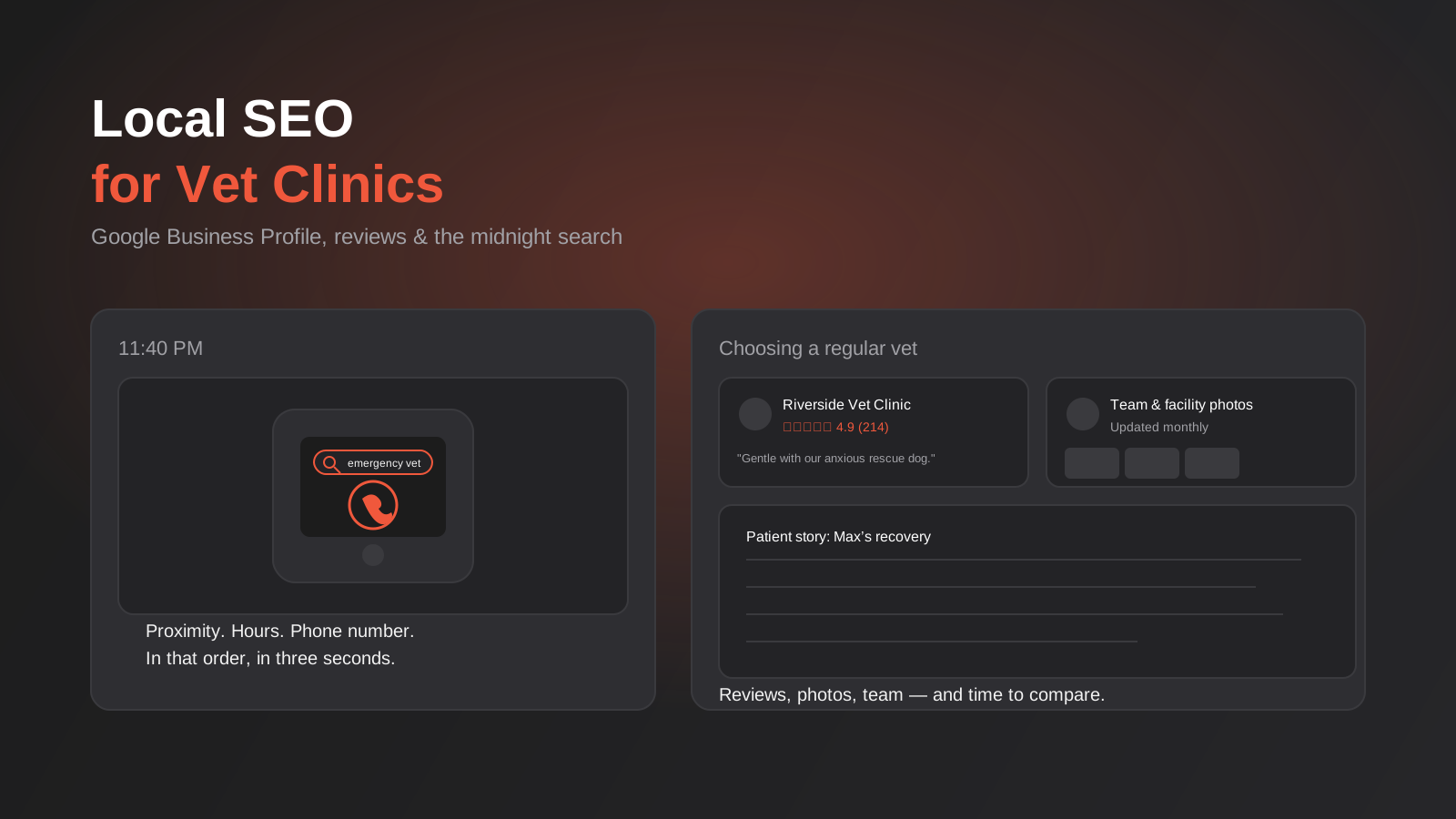
Local SEO for Veterinary Clinics in Australia: Google Business Profile, Reviews and the Emergency Search (2026)
Veterinary clinic SEO explained: Google Business Profile, review generation and the emergency search most vet websites get wrong.
Marketing for NDIS Providers in Australia: How Participants, Families and Support Coordinators Actually Find You (2026)
How NDIS providers get found by participants, families, support coordinators and plan managers — SEO, compliance and the 2026 registration shift.
Got a project you'd like to talk through?
Tell us what you're working on — we'll come back with a plan.
