
Meta Ads Cost and Targeting in Australia: A 2026 Deep Dive
 Jignesh Vagadiya
23/09/2026
21 min read
Meta ads got more expensive this year, and if you’ve been running the same campaign structure since 2023, you’ve probably noticed your cost per lead creeping up without an obvious reason. Part of it is genuine auction inflation. Part of it is that the mechanics of Meta targeting changed under your account without much warning, and the tactics that used to protect your cost per click stopped working the way they used to.
We manage Meta accounts for Australian clients ranging from ecommerce stores spending a few thousand dollars a month to service businesses running lead generation at scale, and the pattern we see across almost every account is the same: detailed targeting doesn’t behave like it used to, Advantage+ is now the default for a reason, and the placements that used to be an afterthought — Reels, Threads — are quietly where the cheapest volume is sitting. None of that is obvious unless you’re in the platform every week.
This is a cost and targeting deep dive, not a full campaign build guide. If you want the complete process for structuring a Facebook ad account from scratch — campaign objectives, creative testing, budget allocation — we’ve covered that in our complete guide to running a high-performing Facebook ad campaign. If you’re running an online store and want the catalog, product feed and cart retargeting setup, that’s in our Facebook Ads for ecommerce stores guide. What follows here is specifically what things cost in Australia right now, why, and how to target an audience under the current rules rather than the rules that applied two years ago.
What Meta Ads Actually Cost in Australia Right Now
Every “average cost” benchmark you’ll find online is a blend of industries, account maturity and campaign objectives, so treat these as a starting reference point rather than a target to hit. Your own numbers will move around them based on your niche, your creative quality and how much conversion data Meta has to work with.
CPC and CPM by placement
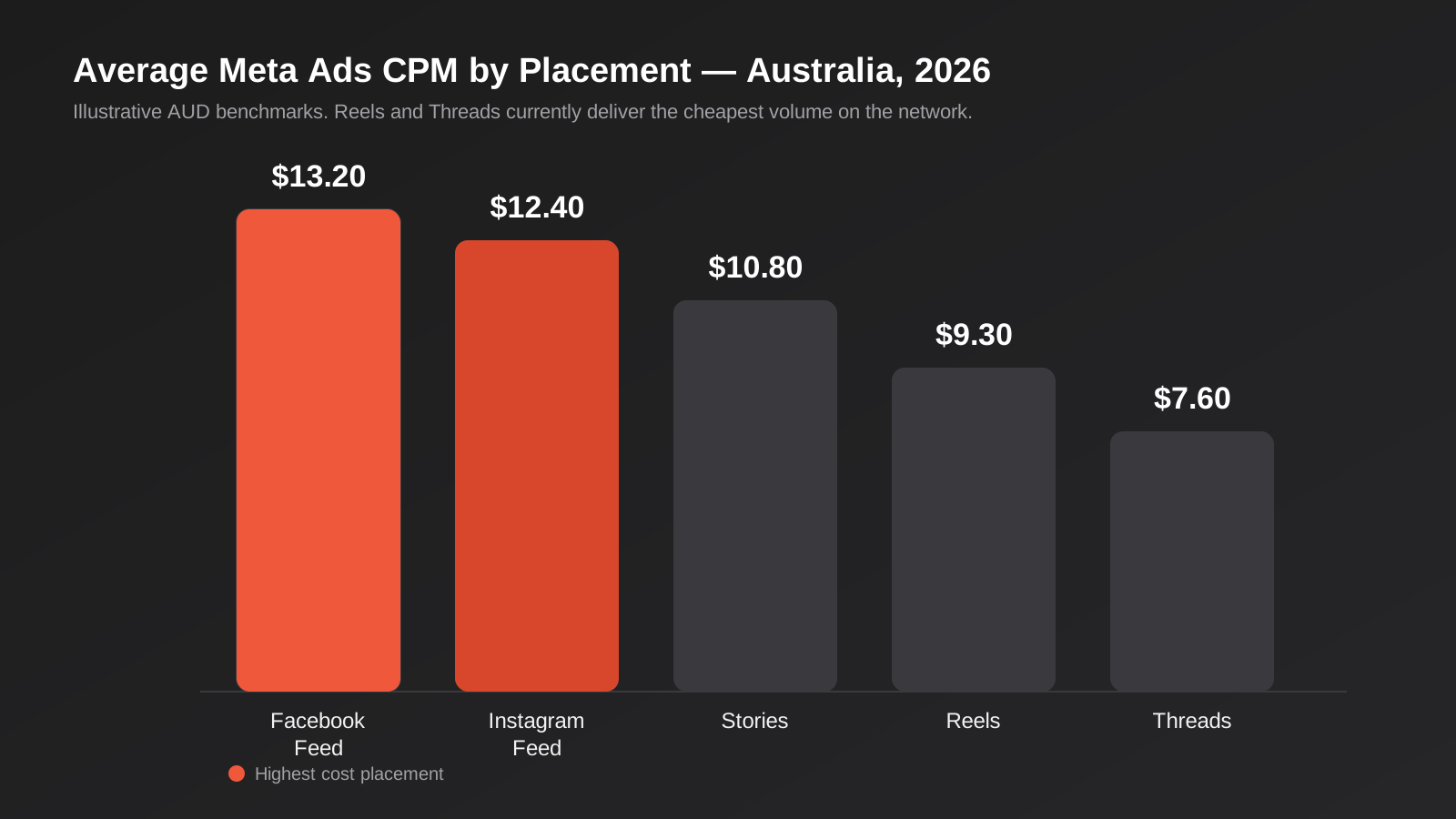
Average cost per click across Meta placements in Australia is sitting around $1.40–$1.70 for Facebook Feed, with Instagram Feed running similar or slightly higher depending on the vertical. Facebook CPM in Australia is averaging roughly $11 in 2026, which is meaningfully cheaper than markets like the US, where CPM sits closer to $20. Australia is still a Tier 1 market by global standards, so costs here are higher than Southeast Asia or Latin America, but the auction is nowhere near as saturated as the US.
The placement breakdown is where it gets more useful. Instagram Reels is currently running roughly 25–30% cheaper per click than Facebook Feed, and it’s also the single largest placement by delivered impressions on the entire Meta network in 2026. That combination — biggest volume, lowest cost — is exactly why we tell clients not to exclude Reels from their placement mix, even if the creative feels like more effort to produce. Stories placements sit somewhere in between, with click-through rates in the 0.4–0.8% range compared to 0.9–1.5% for feed placements.
Threads Ads rolled out globally through Ads Manager in early 2026 as a standalone Feed placement, and CPMs there are currently running 15–40% below Instagram Feed. That’s an early-market discount that won’t last — forecasts point to CPMs rising 15–25% over the next six to twelve months as more advertisers pile in. If you’ve got creative that works in a text-heavy, caption-forward feed, this is worth testing now while it’s still cheap inventory.
Cost per lead by business type
Cost per click tells you what the auction costs, but cost per lead or cost per acquisition is what actually matters to a business owner. As a rough Australian benchmark, ecommerce and home services accounts with decent conversion tracking are landing leads somewhere between $40 and $80. Real estate and professional services — higher-value, longer-consideration purchases — typically land in the $80 to $150 range. If your account is well outside those bands in either direction, it’s worth asking why: either your targeting is too broad for a high-intent product, or your landing page and offer aren’t converting the traffic you’re already paying for.
It’s also worth noting that a rising CPC doesn’t automatically mean a worse account. If your CPC is up 15% year on year but your conversion rate improved because Advantage+ found you a better-matched audience, your actual cost per lead can still be flat or falling. Judge the account on the number that pays the bills, not the auction metric that’s easiest to screenshot.
Industry matters more than most benchmark tables let on. Hospitality and food and beverage tend to sit at the cheap end, often under $40 per lead, because the products are impulse-driven and the audience is broad. Health, beauty and fitness services land in a similar range to home services. Anything involving a considered purchase — finance, insurance, B2B software, legal services — pushes toward the top of the range or beyond it, because the auction reflects how valuable that click is to every other advertiser bidding on the same audience, not just to you. If you’re in one of those higher-cost categories and comparing your numbers to a generic “average CPC in Australia” figure, you’ll consistently think your account is underperforming when it’s actually in line with the category.
Why Costs Moved: What Actually Changed in the Auction
If your CPC crept up over the past year and you haven’t changed anything about your campaigns, there are three structural shifts worth understanding, because they explain most of what you’re seeing.
Advantage+ became the default, and it changed the competition
Meta has spent the past two years pushing every advertiser toward Advantage+ campaigns — broader targeting, automated placements, algorithmic budget allocation. It’s now the default suggestion for most campaign objectives when you set up a new ad set. The practical effect is that far more advertisers are now bidding into the same broad pool of eligible users rather than narrow, hand-picked segments, which pushes up competition in the parts of the auction Advantage+ favours. For accounts with strong conversion history and a daily budget above roughly $50, Meta’s own reporting suggests Advantage+ audiences can cut CPA by up to 32% in ecommerce, because the algorithm is genuinely better than most manual targeting at finding people who convert. But it got there by making the auction more competitive for everyone, which is part of why baseline CPCs sit higher than they did two years ago.
Detailed targeting still exists, but it doesn’t work like it used to
This is the change that trips up the most experienced media buyers. Detailed targeting interests are still selectable in Ads Manager, but as of early 2026 they function as an audience suggestion rather than a hard constraint. Select “small business owners” as an interest and Meta will start there, then expand delivery to anyone else it predicts is likely to convert, whether or not they match that interest. Through 2025, Meta also consolidated thousands of narrow interest categories into broader groupings, so interests that used to isolate a specific niche audience now often mean something much broader than they did when you first set the campaign up.
The bigger change is that detailed targeting exclusions were removed entirely. You used to be able to layer an interest and then exclude a competing interest to sharpen the audience — that lever is gone. The only exclusion tool left is building a Custom Audience from your own data (existing customers, website visitors, CRM lists) and excluding that. If your account still relies on exclusion-based targeting logic from a few years ago, that part of the strategy simply doesn’t function any more.
iOS privacy changes are now a baseline cost, not a shock
App Tracking Transparency reshaped Meta’s targeting and measurement starting back in 2021, and by now most accounts have adapted with server-side tracking and the Conversions API. But it’s still worth stating plainly: some of the CPC inflation you’re seeing is the permanent cost of a smaller, noisier signal pool compared to the pre-privacy-reform era. This isn’t something that will reverse. If your conversion tracking still relies solely on the browser pixel without a server-side Conversions API connection, you’re feeding Meta’s algorithm less data than your competitors are, and it will bid worse on your behalf as a result. We’ve written about the mechanics of this in more depth in our guide to conversion tracking accuracy, Consent Mode and Australia’s privacy reform, which applies to Google Ads and Meta alike.
How Meta Targeting Actually Works in 2026
Given the changes above, the practical targeting decision for most accounts isn’t “which interests should I pick” any more — it’s “how much first-party data do I have, and how should that determine my targeting structure.”
When Advantage+ Audience genuinely outperforms manual targeting
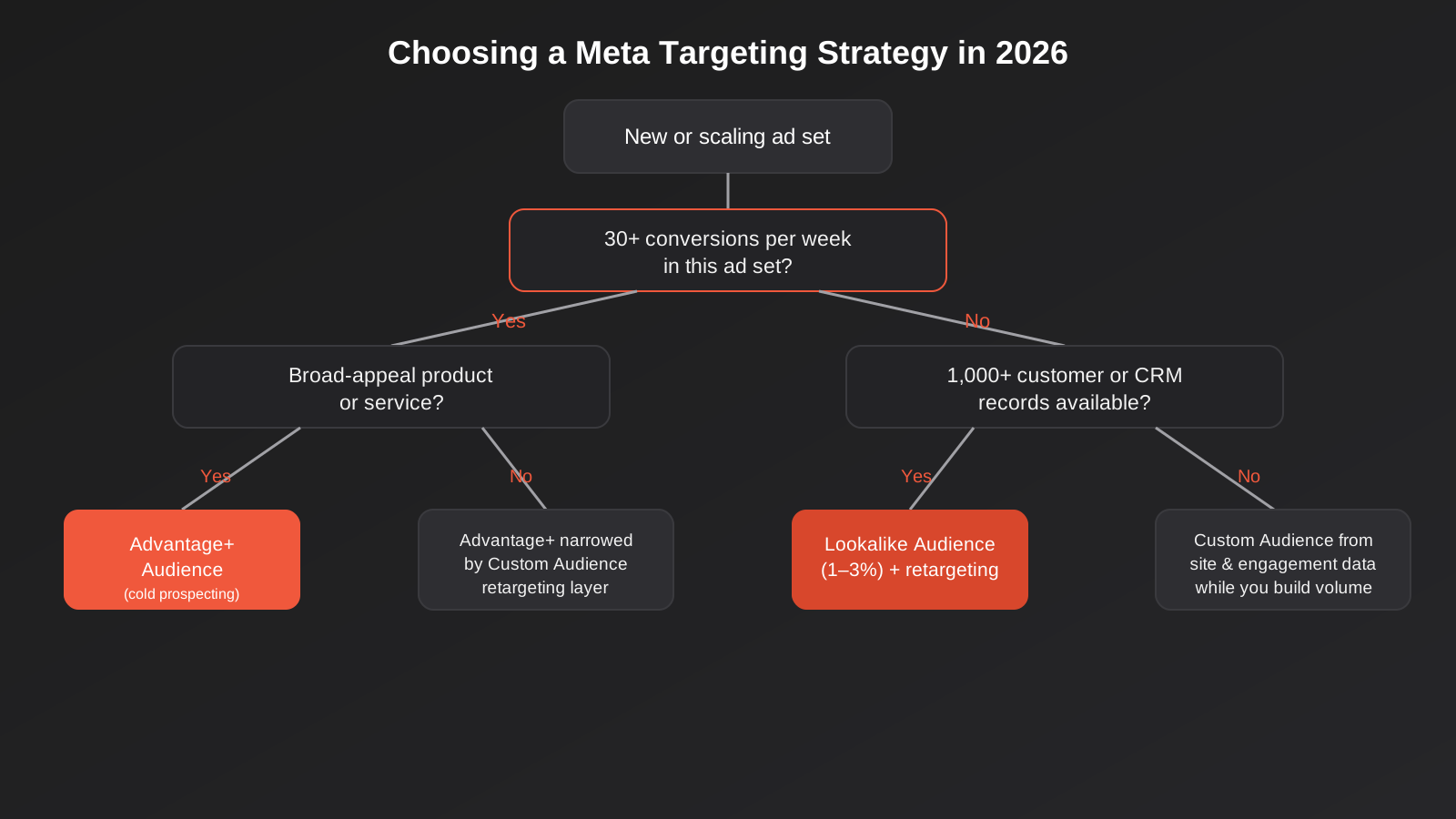
Advantage+ Audience tends to win when three conditions are met: you have enough historical conversion volume for Meta’s algorithm to learn from (generally 30-plus conversions in the ad set’s optimisation event over a recent 7-day window is a reasonable rule of thumb), your product or service has broad enough appeal that a wide net makes sense, and your daily budget can sustain the learning phase without getting throttled. Under those conditions, letting Meta find the audience usually beats a hand-picked interest stack, because the algorithm is weighing thousands of signals you don’t have visibility into.
When manual and Custom Audience targeting still earns its place
Advantage+ struggles in a few specific situations: brand-new accounts with no conversion history yet, low-volume high-value B2B offers where 30 conversions a week simply isn’t realistic, and niche products where “broad appeal” targeting genuinely wastes spend on people who were never going to buy. In those cases, building from your own data works better than fighting the algorithm. Layer a Custom Audience from your customer list or CRM export, build a Lookalike Audience from your best existing customers (1% Lookalikes still perform the most tightly matched, 2–5% widens reach at some cost to match quality), and use retargeting Custom Audiences from website visitors and video viewers as a warm layer sitting underneath cold prospecting.
The practical structure we build for most clients now is a simple three-tier account: a cold Advantage+ prospecting campaign, a warm retargeting campaign built from website and engagement Custom Audiences, and — where the customer list is large enough to be useful — a Lookalike layer sitting between the two. That’s a meaningful simplification from the interest-stacking structures that were standard three or four years ago, and it reflects how much of the targeting work Meta’s algorithm now does on its own.
Placement Strategy: Where Your Budget Should Actually Go
Automatic Placements is Meta’s default recommendation, and for most accounts it’s the right call — the algorithm reallocates spend toward whichever placement is delivering the best result per dollar in real time, and manually restricting placements almost always increases your average cost by shrinking the pool the algorithm can optimise across. But “trust automatic placements” doesn’t mean “ignore your creative for each placement,” and that’s where most accounts lose efficiency.
Reels is currently the largest and cheapest placement on the network, but it only performs if your creative is built for it — vertical 9:16 video, native-feeling pacing, sound-on. Repurposing a horizontal product video into a Reels slot with black bars either side will still deliver impressions, but at a materially worse click-through rate than something shot for the format. The same logic applies to Threads: it’s a text-native feed, so copy carries more weight than the image, in-image text should stay minimal, and a caption written for Instagram will read as out of place there. Instagram Explore was removed as a standalone placement in January 2026, so if your account historically leaned on it, that budget has already been auto-reallocated to Feed, Stories and Reels, which is worth knowing so a placement-level performance drop doesn’t look like a mystery.
A practical minimum for most accounts: have at least one asset genuinely built for vertical video (Reels/Stories) and one static or carousel asset built for feed, rather than a single 1:1 image stretched across every placement. That alone recovers a meaningful chunk of the performance gap between accounts that treat placements as one undifferentiated pool and accounts that don’t.
Campaign Structure That Works Under the Current Rules
Account structure has genuinely simplified. A few years ago, best practice was often a sprawling account with dozens of narrow ad sets testing interest combinations against each other. Under Advantage+ and Campaign Budget Optimisation, that structure now actively hurts performance, because it splits your conversion data across too many ad sets for any of them to exit the learning phase cleanly.
What works better in 2026 is fewer, broader ad sets with more budget and more creative variety inside each one. A single Advantage+ Shopping or Sales campaign with 3–5 ad creatives and a healthy daily budget will generally outperform five narrow ad sets each running one ad and fighting each other in the same auction — a phenomenon called audience overlap, where your own ad sets compete against each other and drive your own costs up. If you’re still running a legacy interest-stacked structure, consolidating it is usually the single highest-leverage change you can make before touching creative or budget at all.
If you’re nervous about restructuring an account that’s currently working, don’t rebuild the whole thing in place. Duplicate the working campaign, apply the new structure to the copy, and split a modest slice of daily budget toward it — enough to gather a meaningful sample within a week or two, but not so much that a bad test damages your main lead flow. Let it run undisturbed for at least seven days before comparing cost per result against the original, since anything shorter than that will still be inside the learning phase and won’t reflect steady-state performance. Once the test structure proves itself, shift budget across gradually rather than switching everything over in one move, so a change in results is easy to trace back to the structural change rather than to a sudden budget shock hitting the auction at the same time.
Creative Volume and Format: What Advantage+ Actually Needs From You
Advantage+ shifted a lot of the optimisation work from the media buyer to the algorithm, but it also shifted more of the performance burden onto creative. When targeting is broader and more automated, the ad itself is doing more of the work of qualifying who actually stops scrolling, and accounts that treat creative as an afterthought tend to plateau quickly under Advantage+ even with a technically sound account structure.
Volume and variety beat a single polished ad
Meta’s own guidance, and what we see in practice, is that Advantage+ campaigns need genuine creative variety to find their audience efficiently — ideally three to five distinct creative concepts per ad set, not five colour variations of the same static image. Dynamic Creative, where Meta automatically tests combinations of headlines, images and copy against each other, works best when you feed it real variety: a UGC-style video, a static product shot, a carousel, and a short-form vertical clip, rather than near-duplicates. The algorithm needs meaningfully different options to learn which format resonates with which micro-segment of your broader Advantage+ audience.
Hook rate matters more than production value
For video, what happens in the first two to three seconds determines most of your outcome, because that’s the window before someone decides to keep scrolling. Ads that open with a static logo screen or a slow brand intro consistently underperform ads that open on the product, the result, or a direct statement of the problem being solved. This is a big part of why lower-production, UGC-style video often outperforms polished brand video on Meta specifically — it doesn’t look like an ad in the first frame, so it survives the scroll long enough to make its point. That doesn’t mean production quality doesn’t matter at all, but on Meta, a strong hook filmed on a phone will usually beat a beautifully lit ad with a slow build.
Refresh creative before fatigue shows up in the numbers
Creative fatigue — where frequency climbs and CPC rises because the same audience has seen the same ad too many times — happens faster in a broad Advantage+ audience than it used to in a narrow interest-targeted one, simply because Meta is reaching a smaller effective pool of genuinely high-intent people within that broader audience. As a rough guide, plan to introduce new creative concepts every two to four weeks for always-on campaigns, and watch frequency as your early warning signal rather than waiting for CPC to visibly climb before reacting.
Attribution Windows and Measuring What Actually Worked
Cost benchmarks only mean something if you’re measuring results the same way Meta is reporting them, and this is where a lot of Australian accounts quietly mislead themselves. Meta’s default attribution window is 7-day click and 1-day view, meaning a conversion gets credited to an ad if someone clicked it within the past 7 days or viewed it (without clicking) within the past 1 day. That’s a generous window compared to how most business owners intuitively think about attribution, and it’s a big part of why Meta-reported conversions rarely match Google Analytics or your actual sales ledger one-to-one.
Since iOS privacy changes reduced the signal available from Apple devices specifically, Meta increasingly relies on modelled conversions to fill gaps in what it can directly observe, particularly for app-based and some website conversion events. Modelled data isn’t fabricated, but it is an estimate, and it tends to be less reliable at low volumes. This is the practical reason we push every client toward connecting the Conversions API server-side rather than relying on the browser pixel alone: it gives Meta a second, more durable signal path that doesn’t depend on a device’s ad-tracking permission state, and accounts with CAPI connected consistently show tighter alignment between reported and actual conversions than pixel-only accounts.
The practical takeaway is to treat Meta’s in-platform reporting as directionally useful for optimisation but to reconcile it against your actual CRM or sales data on a regular cadence, weekly at minimum for an active account. If the gap between reported and real conversions is large and growing, that’s usually a tracking problem rather than a genuine performance change, and it’s worth fixing before making any bidding or budget decisions based on the numbers in Ads Manager.
Bidding and Budgeting Basics That Still Matter
Most accounts should run on the default Highest Volume bid strategy while an ad set is new, then consider a Cost Cap or Bid Cap once you have enough data to know what a sustainable cost per result actually looks like. Setting a cost cap too early, before Meta has learned your audience, tends to choke delivery rather than protect spend.
On budget, the learning phase needs roughly 50 optimisation events (typically conversions) within a 7-day window to exit cleanly. If your daily budget can’t realistically produce that volume, either widen the optimisation event (optimise for a higher-funnel action like Add to Cart instead of Purchase, temporarily), increase budget, or accept that the ad set will stay in a permanently unstable learning state, with costs swinging noticeably day to day. Every time you edit an ad set significantly — audience, creative, budget by a large margin — it re-enters learning, which is why accounts that make small daily tweaks tend to underperform accounts that let campaigns run for a full week before judging them.
Common Mistakes We See in Australian Meta Accounts
- Still building exclusion-based targeting logic that assumes detailed targeting exclusions work the way they did before March 2025 — that lever is gone, and Custom Audience exclusions are now the only option.
- Judging Reels and Threads performance against Facebook Feed benchmarks, when their cost structure and audience behaviour are genuinely different and shouldn’t be held to the same CPC target.
- Setting a Cost Cap or Bid Cap on a brand-new ad set before it has any conversion history, which throttles delivery and stalls the learning phase before it can start.
- Running narrow, overlapping ad sets that compete against each other in the same auction, quietly inflating cost per result across the whole account.
- Relying only on the browser pixel for conversion tracking, without a server-side Conversions API connection, and then wondering why reported conversions don’t match actual sales.
- Uploading a single square creative across every placement instead of building at least one asset specifically for vertical video placements.
- Editing live ad sets frequently — changing budget, audience or creative daily — and resetting the learning phase each time, which makes performance look unstable when the real problem is account management, not the audience.
Frequently Asked Questions
What’s a realistic Meta Ads budget for a small Australian business?
Most small businesses need a minimum daily budget in the $30–$50 range per active campaign to give Meta’s algorithm enough signal to exit the learning phase within a reasonable timeframe. Below that, campaigns tend to stay perpetually unstable, with cost per result swinging widely week to week because there simply isn’t enough data for the system to optimise properly. If your total monthly budget is under roughly $1,000, it’s usually better to run one focused, well-funded campaign than to split that spend across several thin ones.
Is Advantage+ always better than manual targeting now?
No. Advantage+ tends to win for accounts with solid conversion history and broad-appeal products, but it performs poorly for brand-new accounts with no data yet, and for niche or high-value B2B offers where the buyer pool is genuinely narrow. In those cases, a Custom Audience or Lookalike built from your own customer data typically outperforms letting the algorithm search cold.
Should I be running ads on Threads yet?
If you have creative that genuinely fits a text-native, caption-forward feed, it’s worth testing now while CPMs are still running well below Instagram Feed. That discount is a function of low advertiser competition in a newly opened placement and is expected to close over the next six to twelve months as more advertisers move in, so the cost advantage is likely to shrink over time rather than stay where it is.
Why did my cost per click go up even though I haven’t changed anything?
The most common causes are broader industry-wide auction competition as more advertisers shift to Advantage+, the practical effects of detailed targeting behaving as a suggestion rather than a constraint (which changes who actually sees your ads), and the ongoing baseline cost of reduced tracking signal since Apple’s App Tracking Transparency changes. None of these are things you did wrong; they’re structural shifts in how the platform allocates the auction.
Should I use Meta Ads or Google Ads for my business?
They generally serve different points in the buying journey. Meta is strongest for discovery and demand generation — reaching people who aren’t actively searching yet — while Google Ads captures people already searching with clear intent. Most businesses with a reasonable budget run both, with Meta building awareness and retargeting warming up the audience that Google Ads then converts. If your budget only stretches to one, a business with a visual product or service and a broad target market usually does better starting with Meta; a business selling something people actively search for (a plumber, a lawyer, a specific product) usually does better starting with Google Ads.
What if my business is B2B rather than consumer-facing?
Meta can still work for B2B, particularly for retargeting website visitors and building brand awareness among a defined audience, but the buyer pool is usually smaller and the sales cycle longer, which makes Advantage+’s reliance on high conversion volume harder to satisfy. For most B2B lead generation, LinkedIn’s professional targeting data is more precise out of the box. We’ve covered the cost and targeting mechanics for that channel specifically in our LinkedIn Ads cost and targeting deep dive.
Where to Start
If you’re managing your own Meta account, the highest-leverage first step is usually an honest audit: check whether your conversion tracking includes a server-side Conversions API connection, look at whether your ad set structure is still fighting itself with overlapping narrow audiences, and check whether you actually have creative built for vertical placements or whether everything is a repurposed square image. Those three things alone explain a large share of the underperforming accounts we get asked to review.
If you’d rather have a second set of eyes on it, we run Meta Ads for Australian businesses across ecommerce, home services and lead generation, and our Meta Ads service page outlines how we structure and price engagements, with more detail on packages on our pricing page. Happy to look at an existing account and tell you honestly whether the problem is targeting, creative, tracking or something else entirely — get in touch and we’ll talk it through.
Keep reading
Related posts
Facebook Ads for Ecommerce Stores: Catalog Ads, Retargeting and ROAS That Works (2026)
How ecommerce stores use Facebook catalog ads, product feeds and cart retargeting to hit real ROAS — on Shopify and WooCommerce.
How to Run a High-Performing Facebook Ad Campaign: A Complete Guide (2026)
A complete guide to Facebook ads for Australian businesses in 2026 — campaign structure, creative, targeting, budget and measuring ROAS properly.
Got a project you'd like to talk through?
Tell us what you're working on — we'll come back with a plan.
