
Why Your Conversion Tracking Data Is Wrong: Consent Mode, Server-Side Tracking and Australia’s 2026 Privacy Reform
 Jignesh Vagadiya
19/09/2026
21 min read
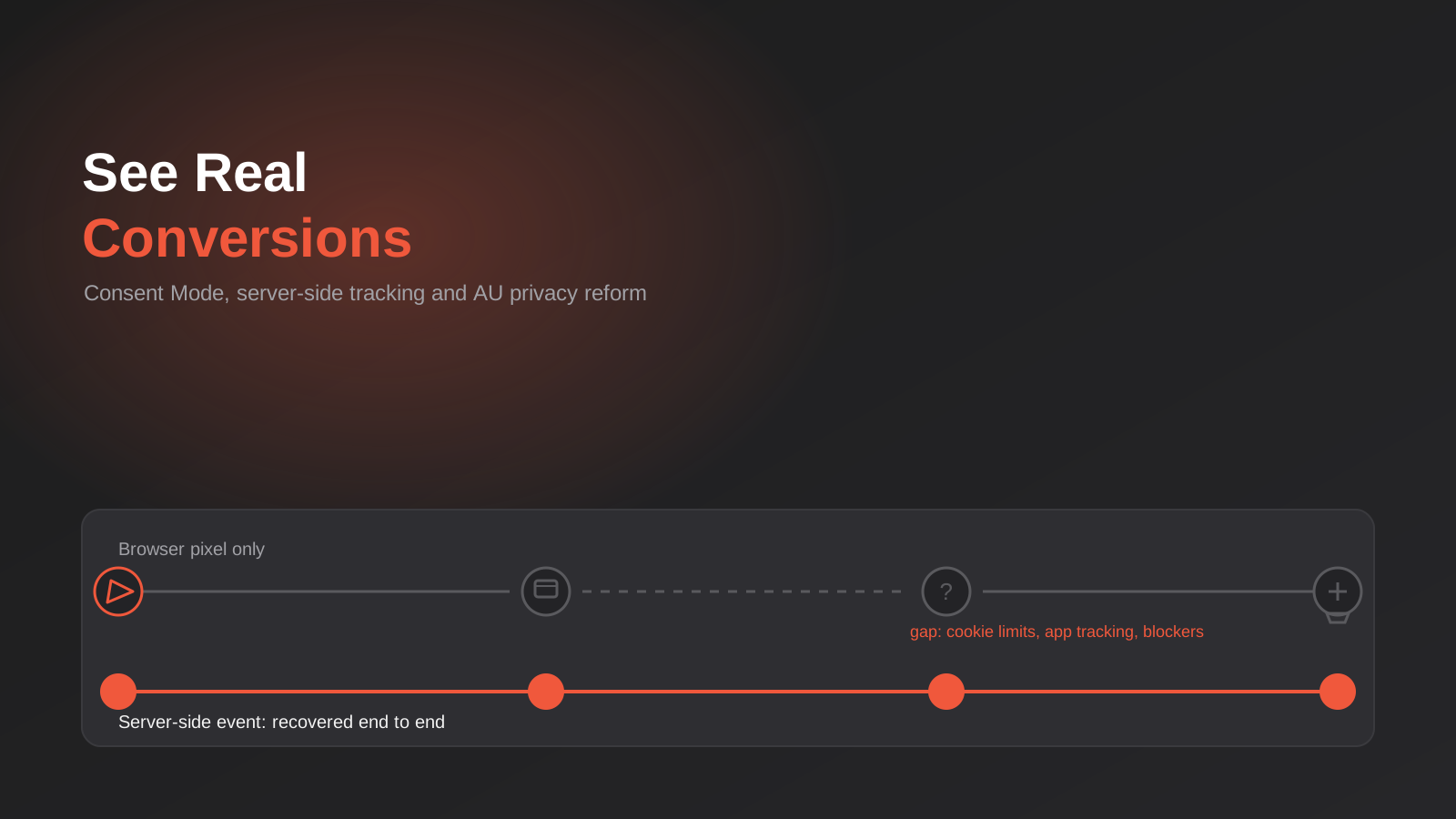
Somewhere around the middle of 2026, a lot of Australian marketers started noticing the same thing: the conversion numbers in Google Ads and Meta Ads stopped matching the sales numbers in Xero or Shopify. Not by a rounding error either — ad platforms reporting twenty, thirty, sometimes fifty fewer conversions a month than the business actually closed. Budgets got cut on campaigns that were secretly working. Bidding algorithms, starved of the data they need to optimise, drifted toward the wrong audiences.
This isn’t one bug with one fix. It’s three separate things arriving at once: browsers and operating systems that increasingly block the tracking methods ad platforms were built on, Google’s own Consent Mode framework tightening what happens when a visitor hasn’t explicitly agreed to be tracked, and — specific to Australia — a Privacy Act reform that, as of September 2026, is sitting in exposure draft form and looks set to bring a real consent requirement to cookies and pixels for the first time.
None of this means tracking is dead or that you should give up on measuring what your marketing does. It means the old approach — drop a pixel, trust the dashboard — no longer captures the full picture, and the businesses that fix it first will spend the next few years making decisions on better data than their competitors. This guide walks through why conversion data is breaking, what Consent Mode and server-side tracking actually do, what’s proposed in the Australian privacy reforms, and a practical order of operations for fixing your own setup.
Why conversion tracking is quietly breaking
Conversion tracking has always relied on a fairly fragile chain of events: a user clicks an ad, a cookie or identifier gets attached to that click, the user later converts on your site, and the ad platform matches the conversion back to the original click using that cookie. Every part of that chain is now under pressure from browser vendors, device makers and regulators who’ve decided that chain is exactly the problem — it’s how people get tracked across the web without meaningfully agreeing to it.
Safari’s Intelligent Tracking Prevention and the seven-day cookie problem
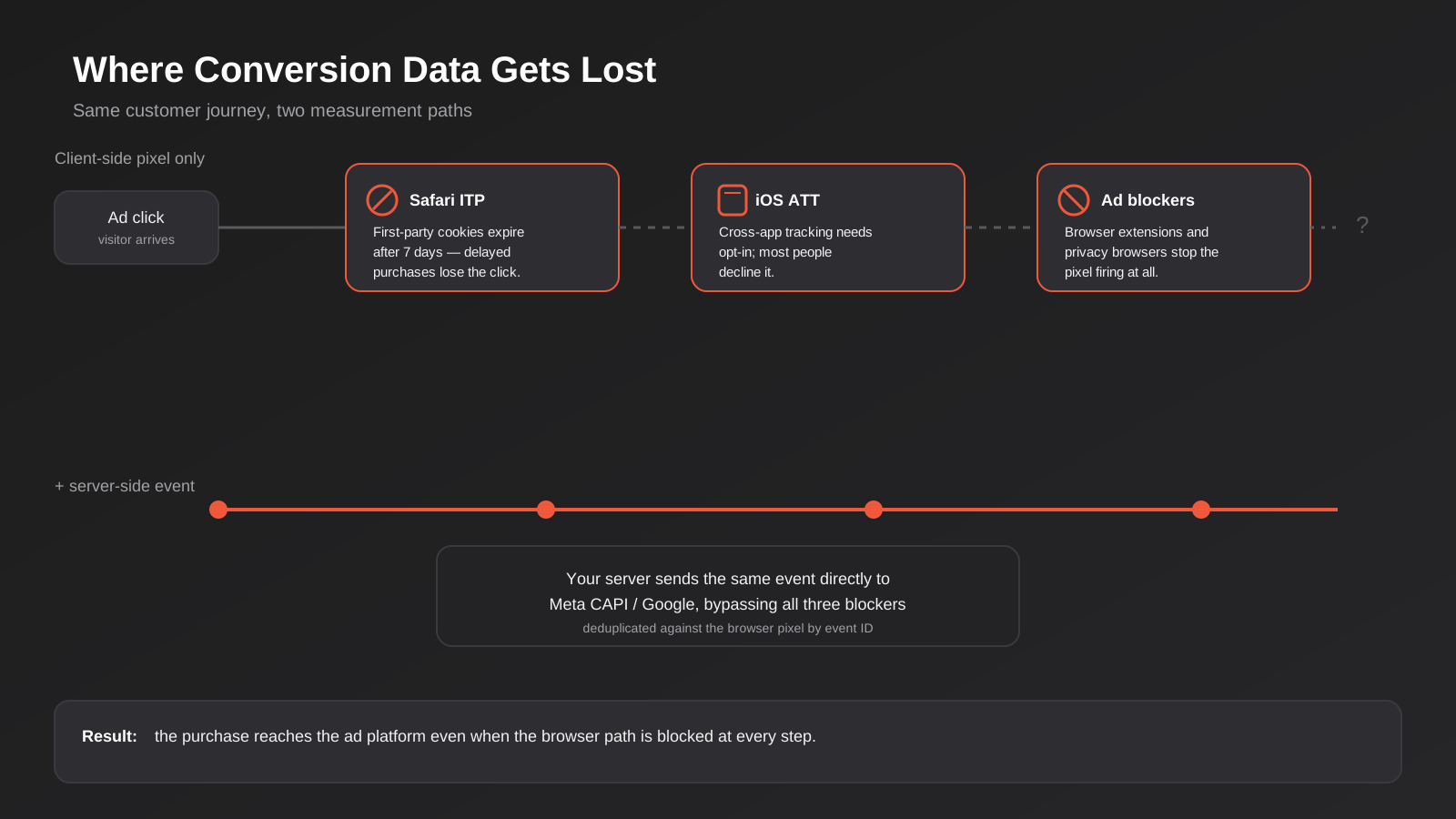
Safari’s Intelligent Tracking Prevention (ITP) has been chipping away at cookie-based tracking for years, and the current behaviour caps the lifespan of first-party cookies set via JavaScript at seven days. In practice that means if someone clicks your ad on a Wednesday, thinks about it, and buys the following Wednesday, the click and the purchase are no longer connected in the browser’s eyes — the cookie that would have linked them has already expired. For anything with even a short consideration window (which is most B2B, most higher-ticket ecommerce and pretty much all services businesses), that seven-day window quietly erases a meaningful slice of your real conversion path.
iOS App Tracking Transparency and cross-app measurement
On mobile, Apple’s App Tracking Transparency (ATT) framework requires apps to ask permission before tracking users across other apps and websites, and most people decline. That hits Meta, TikTok, Snapchat and Pinterest hardest, since their ad models lean heavily on being able to see what someone does after they leave the app. If a good chunk of your audience is on iPhone — and in Australia that’s roughly half the smartphone market — a meaningful share of your paid social conversions are happening in a black box the platform can no longer see into directly.
Ad blockers and privacy-focused browsers
Layer on ad blockers, privacy extensions and browsers like Brave and Firefox that block third-party trackers by default, and you’ve got a fairly large slice of any Australian audience where the standard client-side pixel simply never fires. None of these users are hiding from you maliciously — they’ve just installed the tools that are now bundled into half the browsers on the market, or they’re on a phone where privacy is the default setting, not an opt-in.
The result, if you’re only relying on a client-side pixel, is that your dashboards systematically under-report. Not randomly — systematically, and worse for exactly the customers who take longer to decide or who care about privacy, which tends to correlate with higher-value segments. That’s a specific, fixable problem, and it’s the main thing server-side tracking (covered further down) exists to solve. But before we get to the fix, there’s a second, separate force reshaping tracking in 2026: consent.
Google Consent Mode v2: what it is and why it now matters in Australia
Consent Mode is Google’s framework for telling its own tags (Google Ads, GA4, Floodlight) whether a given visitor has consented to analytics and advertising cookies. It was introduced for the European Economic Area first, tied to the Digital Markets Act, and it became mandatory there in March 2024. Version 2 tightened the requirements further. Australia doesn’t currently have an equivalent legal mandate forcing Consent Mode specifically — but that’s shifting, for reasons covered in the next section, and in the meantime Google has been steadily expanding where Consent Mode’s behaviour applies and rewarding advertisers who’ve implemented it with better modelling.
The four consent signals, explained plainly
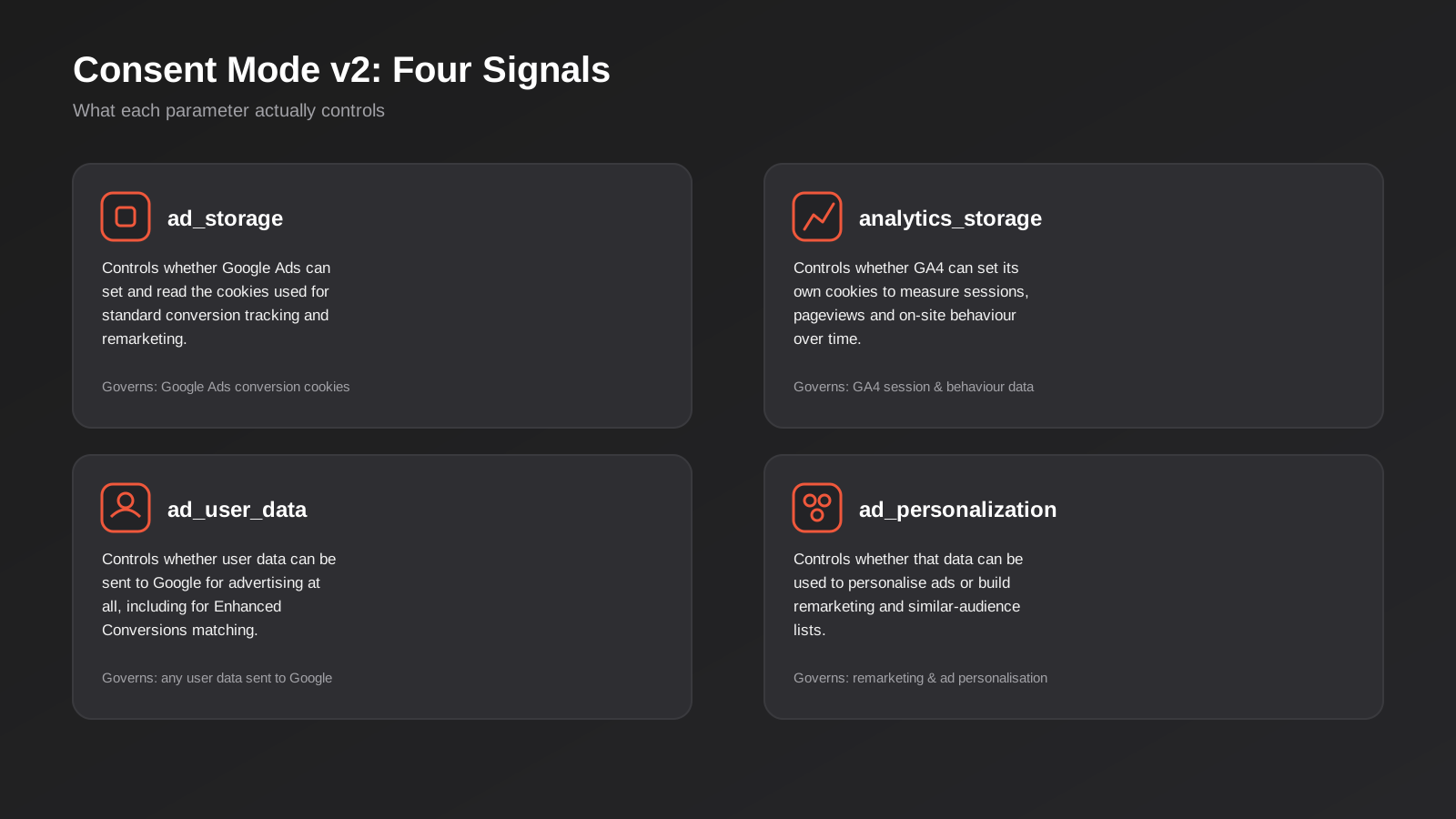
Consent Mode works on four parameters that your site passes to Google’s tags, each one either granted or denied based on what the visitor actually chose in your cookie banner:
- ad_storage — controls whether Google Ads can set and read the cookies used for standard conversion tracking and remarketing.
- analytics_storage — controls whether GA4 can set its own cookies to measure sessions and behaviour.
- ad_user_data — controls whether data about the user can be sent to Google for advertising purposes at all, including for Enhanced Conversions.
- ad_personalization — controls whether that data can be used to personalise ads or build remarketing audiences.
A visitor can grant some and deny others — someone might be fine with analytics but not with personalised ads, for instance — and your tags need to respect that combination rather than treating consent as one on/off switch.
Basic versus advanced implementation
Basic Consent Mode blocks Google’s tags entirely until consent is given, which is simple to implement but means you get zero signal from anyone who hasn’t yet interacted with your cookie banner — including the substantial number of people who never click anything on a cookie banner at all. Advanced Consent Mode still fires the tags, but with consent-aware pings that carry no personal identifiers when consent is denied. Google then uses those anonymous pings, combined with data from users who did consent, to statistically model the conversions it can’t directly observe. Advanced mode is more work to set up properly (it usually means using a proper consent management platform integrated with Google Tag Manager, not a bare-bones cookie notice), but it’s the version that actually preserves useful data.
What happens to your data without it
If you don’t implement Consent Mode at all and a visitor’s browser or extensions block Google’s cookies anyway, that conversion simply disappears from your reporting with no explanation and no way to recover it after the fact. With Consent Mode in place — even just the basic version — Google can fill some of that gap with modelled conversions, which are statistical estimates rather than directly observed events, but are still far more useful for bidding and reporting than a silent gap. It’s not a perfect substitute for real data, but it’s meaningfully better than pretending the gap doesn’t exist.
Australia’s Privacy Act reform: what’s actually being proposed
This is the part that makes conversion tracking a live compliance question for Australian businesses, not just a technical optimisation. On 31 August 2026 the federal government released a Privacy Reform consultation paper alongside an exposure draft of the Privacy Amendment (Personal Data Protection) Bill, with the public consultation period closing on 18 September 2026. It’s described by several law firms tracking the space as the most significant overhaul of Australian privacy law in more than a decade, and it directly targets the mechanics of digital advertising.
A broad, technology-neutral direct marketing framework
The draft defines direct marketing broadly: any advertising or marketing material directed at an individual where personal information is used to select, identify or target that person. Critically, the framework is written to be technology-neutral and explicitly captures targeted and online behavioural advertising based on personal information, including browsing history. That’s a direct reference to how programmatic advertising, remarketing pixels and audience-matching actually work.
What “consent before sharing pixels” means in practice
The proposed reform makes clear that disclosing personal information “for the purposes of direct marketing” is meant to be read broadly enough to cover disclosure via cookies or pixels in programmatic advertising processes. In plain terms: if your site fires a Meta pixel, a Google Ads remarketing tag, or shares customer lists with an ad platform for audience matching, that’s being framed as a disclosure of personal information for direct marketing purposes — and under the draft, businesses that share or monetise that data through advertising partnerships or programmatic pixels would need the individual’s consent first. The draft also proposes a mandatory, simple opt-out mechanism, with extra obligations for services that are ad-supported (meaning the ads themselves are part of the revenue model, which covers a lot of Australian publisher and content sites).
Where this leaves you right now
It’s an exposure draft, not law. The consultation closes 18 September 2026, and from there it still needs to go through drafting, introduction to Parliament and debate before anything is enforceable, which realistically puts binding obligations at least months away and possibly longer if the bill is contested (and reforms of this size usually are, from both privacy advocates who think it doesn’t go far enough and industry groups who think it goes too far). That said, three things are worth doing now rather than waiting: get your consent banner and Consent Mode set up properly if you haven’t already, since it’s the same infrastructure the reform will likely require; document what personal data you’re actually sharing with ad platforms and why, because you’ll need that audit trail regardless of the final wording; and treat pixel and cookie disclosures as something that needs a genuine legal basis, not just a checkbox in a cookie plugin. We’d treat this the same way we’ve treated the run-up to any major compliance deadline — the businesses that start early aren’t scrambling when the deadline actually lands.
Server-side tracking: the practical fix for the data you’re already losing
Server-side tracking flips where the conversion event gets sent from. Instead of relying purely on the visitor’s browser to fire a pixel back to Meta or Google — a request that ad blockers, ITP and consent settings can all interfere with — your own server sends the event directly, in a server-to-server API call that none of those browser-based restrictions can touch. It doesn’t replace consent requirements (you still need a valid basis to send the data), but it does recover the conversions that are currently disappearing purely because of technical blocking rather than a genuine consent decision.
How it actually works, without the jargon
When someone completes a purchase or submits a form on your site, your backend already knows about it — that’s how the order confirmation email gets sent or the CRM record gets created. Server-side tracking means that same backend event also gets forwarded, via API, straight to Meta’s Conversions API (CAPI) or Google’s server-side tagging endpoint, tagged with whatever identifiers you’re allowed to send (hashed email, hashed phone, click ID if you have one). Because both the browser pixel and the server event can fire for the same action, the platforms use event deduplication — matching on a shared event ID — so you don’t end up double-counting a single conversion.
Three implementation paths, and roughly what they cost
There isn’t one right way to set this up — the right path depends on your platform, your team’s technical depth and how many ad platforms you actually need to feed data to:
- Platform-native integrations. Shopify, for example, has a built-in Meta CAPI connection that requires almost no setup beyond connecting the accounts. If your stack has a native option, start there — it’s the cheapest and lowest-maintenance path, even if it’s Meta-specific.
- Server-side Google Tag Manager. You run a server container (hosted on Google Cloud or similar) that receives events and fans them out to Meta, Google Ads, GA4, TikTok and others from one place. It’s more flexible than platform-native options and works across multiple ad platforms, but it needs someone who can configure GTM server-side properly. Expect cloud hosting costs in the order of tens of dollars a month, plus the setup time.
- Custom API integration. Your developers build the integration directly against each platform’s conversions API. This gives you the most control over exactly what data goes where and when, but it’s genuine engineering work with ongoing maintenance as the platforms’ APIs change — realistically only worth it if you’ve got specific data or timing requirements the other two options can’t meet.
Meta doesn’t charge for using the Conversions API itself; whatever you pay is for the infrastructure or agency time to implement and maintain it, not a platform fee. The same is broadly true on the Google side.
First-party data is the piece that survives all of this
Every fix covered in this section — server-side tracking, Enhanced Conversions, CAPI matching — ultimately runs on the same fuel: first-party data you actually own, like the email and phone number a customer gives you at checkout or in a form. Third-party cookies keep getting restricted, browser identifiers keep getting blocked, but a hashed email address you collected directly, with proper consent, keeps working regardless of what Safari, Apple or a future Privacy Act amendment does to the rest of the tracking landscape. This is the practical reason we push clients toward capturing email and phone at every meaningful touchpoint (checkout, lead forms, account creation) rather than treating it as a marketing nice-to-have — it’s becoming the actual infrastructure that measurement depends on. A CRM or ecommerce platform that captures this data cleanly and makes it available to your marketing automation is worth more to your tracking accuracy in 2026 than almost any pixel configuration.
Enhanced Conversions: Google’s equivalent for Google Ads
Google’s version of this is called Enhanced Conversions, and as of Google’s mid-2026 update it’s consolidated into a single toggle covering both web and lead-form conversions. It works by supplementing your existing conversion tag with hashed first-party data — email, phone, address — which Google matches against signed-in Google accounts to confirm conversions that the cookie-based method alone would have missed. Setup runs through your Google Ads account under Conversions, and it requires your GA4 property linked to Google Ads if you’re importing GA4 key events rather than tagging conversions directly. Google has published case studies showing meaningful uplifts in measured conversions once Enhanced Conversions is properly configured, with larger gains typically reported for ecommerce accounts than for lead-gen. We’d treat the exact percentage as directional rather than a guarantee — your own uplift depends heavily on how much of your traffic was being missed in the first place.
Building a conversion tracking stack that survives 2026
If you’re starting from a standard pixel-only setup, here’s the order we’d actually work through it in, rather than trying to do everything simultaneously.
Step 1: Audit what you’ve actually got
Before changing anything, pull up Google Tag Manager (or whatever’s firing your tags) and list every pixel, tag and cookie currently live on the site. Check whether you’ve got a real consent banner or just a notice that doesn’t actually gate anything. Compare your ad platform conversion counts against your source-of-truth numbers — Shopify orders, CRM deals closed, form submissions in your inbox — over the same date range, so you know the actual size of the gap you’re dealing with. If our own guide to the PPC formulas that matter is useful anywhere, it’s here: knowing your true conversion rate and CAC from your own systems is the baseline you’re checking ad platform data against.
Step 2: Fix consent infrastructure first
Get a proper consent management platform in place if you don’t have one, wired through to Consent Mode (advanced, not basic, if you can manage it) rather than a cookie notice that just displays a message without controlling anything. This is the foundation everything else sits on, and it’s also the piece most likely to be required outright once Australia’s privacy reforms land, so there’s no scenario where doing it now is wasted effort.
Step 3: Layer in server-side tracking and Enhanced Conversions
Once consent is properly wired up, add the server-side layer for the platforms carrying real ad spend — usually Meta and Google first, since that’s where most Australian budgets sit. Turn on Enhanced Conversions in Google Ads. If you’re running Shopify and haven’t connected the native Meta CAPI integration, that’s usually a same-day fix with an outsized return for the effort involved.
Step 4: Expect your numbers to change, not necessarily improve
This is worth saying plainly because it trips people up: fixing your tracking usually means your reported conversions go up, sometimes noticeably, because you’re now capturing events that were always happening but weren’t being measured. That’s not the campaign suddenly performing better — it’s the same performance becoming visible. Don’t be surprised if cost-per-acquisition figures shift and bidding strategies that looked underwater start looking healthy once the algorithm can see what it was actually doing all along. Give it a full learning cycle — typically a couple of weeks for Google’s Smart Bidding or Meta’s delivery system to re-optimise against the corrected data — before you judge whether a campaign’s true performance has actually changed. Reacting to the first few days of a bigger number is how businesses end up chasing noise instead of signal. If you’re building out reporting dashboards on top of this data, our guide to reporting and data automation covers how to pull it together without rebuilding a spreadsheet by hand every week, and our broader guide to maximising Google Ads ROI covers what to do with cleaner conversion data once you’ve got it.
Who actually owns this: marketing, dev, or both?
One reason conversion tracking fixes stall inside Australian businesses is that they fall into a gap between teams. Consent banners and cookie policies often sit with whoever manages the website or a compliance-minded operations person; Consent Mode configuration and Enhanced Conversions sit inside the Google Ads or GA4 account, usually with a marketer or agency; server-side tracking touches the actual backend and needs a developer who can safely handle customer data and API credentials. None of these people are wrong to think it’s not entirely their job, which is exactly why it tends not to get done unless someone is explicitly accountable for the whole chain end to end. If you’re scoping this internally, name one owner for the full stack — even if they’re delegating pieces of the implementation — rather than assuming it’ll get picked up because it touches three different roles.
Common mistakes we see with conversion tracking fixes
- Treating Consent Mode as a one-off code snippet. Pasting in Google’s default Consent Mode script without connecting it to a real, functioning consent banner does almost nothing — the tags still need an actual consent decision to react to.
- Adding server-side tracking without fixing deduplication. Running both a browser pixel and a server event without a shared event ID between them inflates conversion counts rather than recovering missed ones, which is arguably worse than under-counting because it hides the problem instead of fixing it.
- Sending more personal data than you actually need. Enhanced Conversions and CAPI both work off hashed identifiers, not raw personal data flying around in plain text — if your implementation isn’t hashing before it sends, that’s a real data handling problem, not just a technical detail.
- Assuming the Privacy Act reform doesn’t apply because it’s “not law yet”. The exposure draft signals clear regulatory direction. Building consent infrastructure now, while it’s optional, is considerably cheaper than retrofitting it under a compliance deadline later.
- Panicking about a sudden jump in conversions post-fix. A 20–30% increase in reported conversions after implementing server-side tracking properly is a sign the fix worked, not a sign something’s broken or that you’re now over-reporting.
- Setting it up once and never checking it again. Ad platforms change their APIs, consent management platforms update their defaults, and browsers keep tightening restrictions. A tracking stack that was correct in January can quietly drift by the middle of the year without anyone noticing until the numbers stop making sense.
Frequently Asked Questions
Is Google Consent Mode legally required in Australia right now?
Not as a specific legal mandate the way it is in the European Economic Area. But Google increasingly expects it for accurate modelling on any traffic where consent banners are present, and Australia’s proposed Privacy Act reform — currently in exposure draft form with consultation closing 18 September 2026 — points toward a genuine consent requirement for cookies and pixels used in targeted advertising. Treating Consent Mode as optional in 2026 is a short-term view.
Do I need server-side tracking if my ad spend is small?
It depends on how reliant your business is on paid platforms making good automated bidding decisions. If you’re spending a few hundred dollars a month and not using automated bidding strategies heavily, the impact is smaller. If you’re running Smart Bidding on Google Ads or Advantage+ campaigns on Meta, both of which rely on conversion data to optimise, missing conversions directly degrades performance — the algorithm is bidding blind on the gaps.
Will fixing conversion tracking increase my Google Ads or Meta Ads costs?
Not directly — Meta doesn’t charge for the Conversions API, and Google’s Enhanced Conversions is a free feature within your existing account. Your actual cost is implementation time or agency/developer fees, plus modest hosting costs if you go the server-side Google Tag Manager route. What often changes is your effective cost-per-acquisition, which typically improves once the platform can see conversions it was previously missing.
What’s the difference between Consent Mode and server-side tracking?
They solve different problems. Consent Mode is about respecting a visitor’s actual consent decision and still getting useful modelled data when consent is denied. Server-side tracking is about making sure conversions that a consenting visitor legitimately generated actually reach the ad platform, despite browser or device restrictions that would otherwise block the request. You need both — one handles consent, the other handles technical reliability.
How do I know if my current tracking is actually broken?
Compare conversion counts from your ad platforms against your actual source-of-truth numbers — completed orders in Shopify or WooCommerce, deals marked won in your CRM, form submissions landing in your inbox — over an identical date range. A gap of more than about 10–15% between what the ad platform reports and what actually happened is a reasonable signal that tracking, not performance, is the problem.
Does this affect GA4 as well as ad platform conversion tracking?
Yes. GA4’s own session and conversion data is subject to the same analytics_storage consent signal and the same browser-level blocking as ad platform pixels, since it relies on similar client-side measurement by default. If you’re using GA4 as your source of truth for marketing reporting, it’s worth applying the same audit — consent-aware tagging and, where relevant, server-side collection — rather than assuming it’s immune because it’s “just analytics”.
Where to start
If you’ve read this far because your own numbers haven’t quite added up for a while, the first useful step is the audit in Step 1 above — a straight comparison between what your ad platforms report and what your own systems say actually happened. That single comparison tells you whether you’re dealing with a measurement problem, a performance problem, or both, and it changes what you should actually fix first.
We work through this audit and the Consent Mode, server-side tracking and Enhanced Conversions implementation as part of our analytics and CRO work, alongside the broader Google Ads management we run for clients who need the resulting data to actually be trustworthy before they act on it. If your reporting has felt off and you’re not sure whether it’s the campaigns or the measurement, we’re happy to have a look and tell you honestly which one it is — get in touch and we’ll walk through what we’d check first.
Keep reading
Related posts
Best Analytics and Reporting Tools After GA4 for Australian Businesses (2026): 6 Compared
Six analytics and reporting tools to use alongside or instead of GA4, compared for Australian businesses on cost, privacy, data location and…
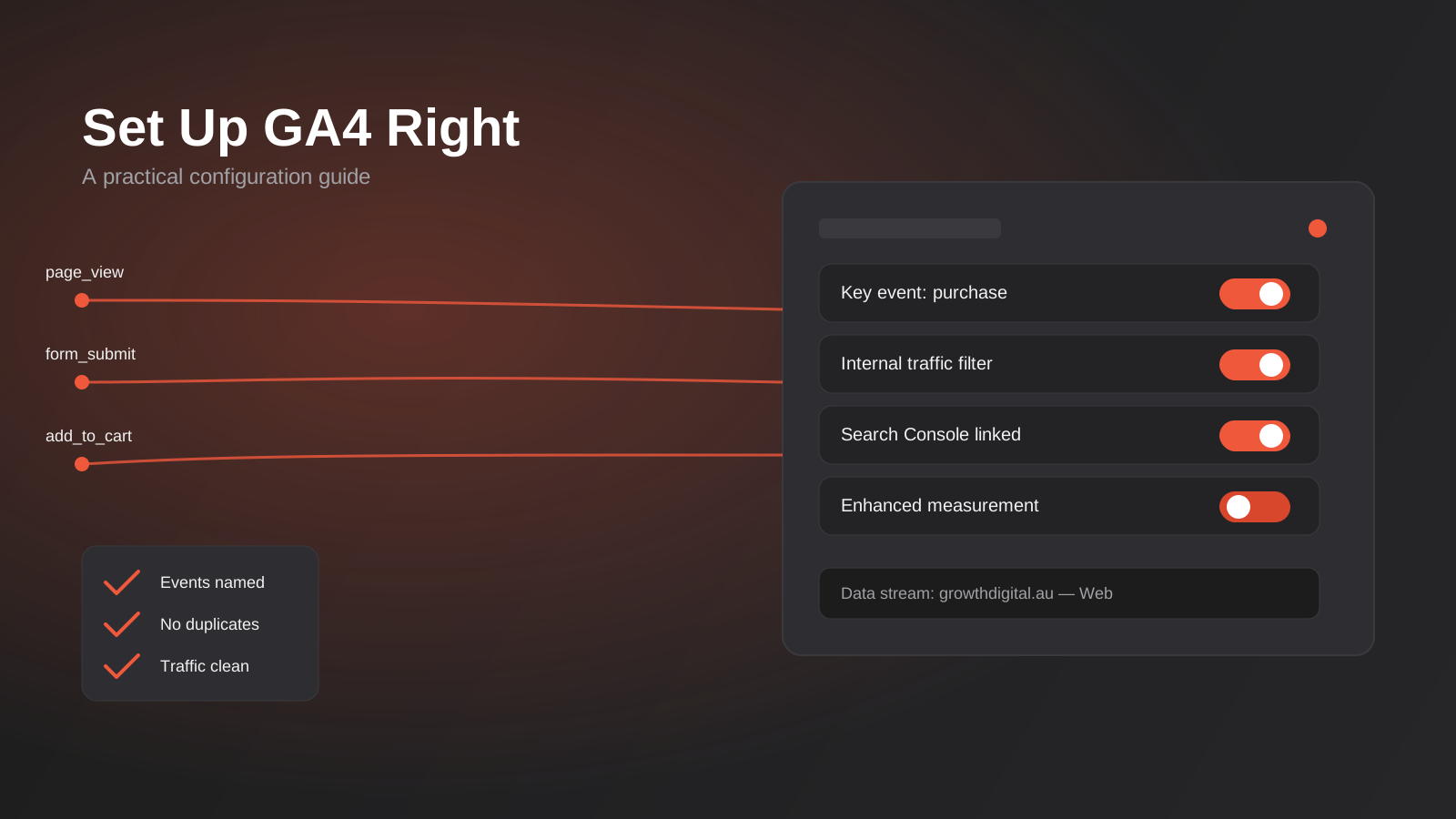
Google Analytics 4 Setup: A Practical Configuration Guide for Australian Businesses (2026)
A practical GA4 setup guide for Australian businesses: events, key events, filters and the mistakes that quietly corrupt your data.
A/B Testing for Australian Websites: How to Run Tests That Actually Tell You Something (2026)
How to run A/B tests that hold up: sample size, avoiding peeking, low-traffic alternatives and building a real testing programme in Australia.
Got a project you'd like to talk through?
Tell us what you're working on — we'll come back with a plan.
