
Social Media Marketing Strategy for Australian Businesses: Platforms, Content Pillars and What Actually Works (2026)
 Jignesh Vagadiya
18/09/2026
21 min read
Most businesses we talk to have a social media problem that has nothing to do with algorithms. They are on four or five platforms, posting whatever seems easiest that week, and the results have gone nowhere for months. When we ask what the strategy is, the honest answer is usually “post consistently and see what happens.” That is not a strategy. It is a hope.
A social media marketing strategy works when it’s built around three decisions made in order: which platform actually reaches your buyers, what you are going to say to them across weeks and months (not just today’s post), and how much of that you can sustain without it eating the business. Skip any one of those and you end up exactly where most small businesses are — a scattered, inconsistent feed that nobody outside the business is really watching.
This guide covers organic social media strategy specifically: choosing platforms, building content that holds together over time, and running it in a way a real business can keep up. We run paid social campaigns for clients too, and we cover those platforms in dedicated guides elsewhere — but paid social works far better once the organic foundation (the right platform, a clear content approach, a page that doesn’t look abandoned) is actually in place. This is that foundation.
Why “Just Post More” Isn’t a Strategy
The single biggest mistake we see is businesses trying to be everywhere at once. Facebook, Instagram, LinkedIn, TikTok, sometimes Pinterest for good measure — all run by one person squeezing it in between everything else they do. Spread across five platforms, nobody does any of them well. Posts go out inconsistently, engagement stays flat, and eventually the whole thing gets quietly abandoned until someone remembers three months later that the Instagram hasn’t been touched since June.
The businesses that actually get something out of social media do the opposite. They pick one platform, sometimes two, and treat it properly: a consistent posting rhythm, content that’s actually useful or interesting to the specific people they want as customers, and enough patience to let it compound. Two decent posts a week on the right platform will outperform daily posting spread thin across four platforms that don’t fit the business.
That’s the core idea this whole guide is built around. Not “how do I post more content” but “what’s the smallest, most sustainable version of this that actually reaches the people I want as customers.”
Choosing the Right Platform for Your Business
Platform choice isn’t about which one is “best” — it’s about where your specific customers already spend time, and what kind of content your business can realistically produce. A tradie with a phone camera and fifteen minutes a day is not going to out-produce a fashion brand’s Reels team, and doesn’t need to. Here’s how we think through it with clients.
Facebook: still the reach channel for local and older audiences
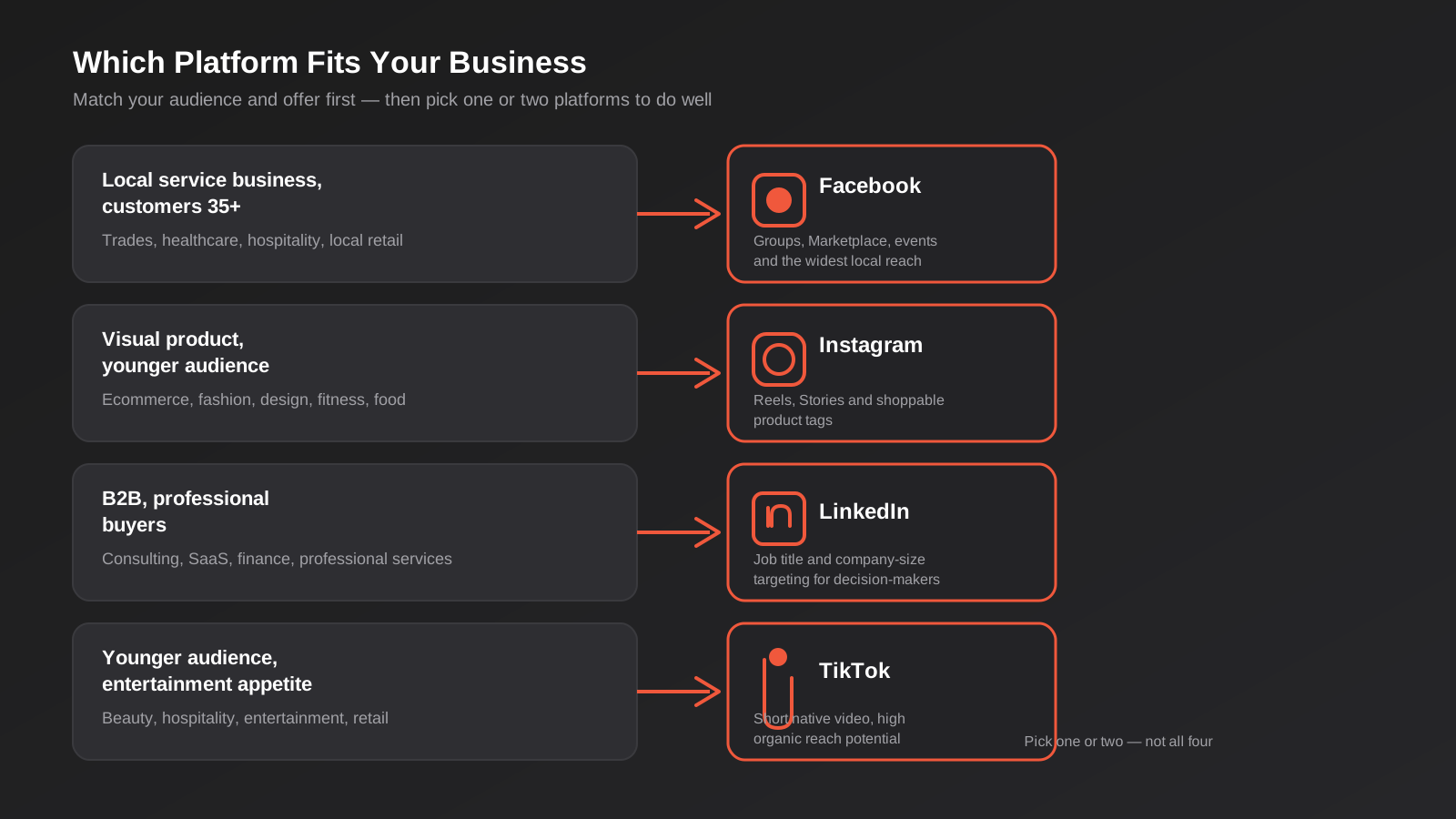
Facebook gets written off as “dead” by people who mostly mean it’s not exciting to them personally. For a huge slice of Australian small business customers — homeowners, parents, tradie clients, anyone over about 35 — it’s still where they are. Local Facebook groups, Marketplace and Events are genuinely useful distribution that other platforms don’t replicate well. If your customers are local and your business is a service (plumbing, dental, allied health, local retail, hospitality), Facebook is close to non-negotiable, even if it’s not the platform you personally enjoy using.
The format that works on Facebook is straightforward and doesn’t need production value: job photos, before-and-afters, customer questions answered publicly, local news and events your business is genuinely part of. It rewards being a real, present local business more than it rewards clever content.
Instagram: visual products and a younger, design-literate audience
Instagram earns its keep when you have something worth looking at — a physical product, a finished space, a visual transformation, food, fashion, fitness, design work. Reels and Stories are where the reach actually happens now; the static grid post is a much smaller part of the platform’s algorithm than it was a few years ago. If your business is ecommerce, Instagram’s shoppable tags also mean it can double as a sales channel, not just an awareness one, particularly alongside a Shopify storefront.
Instagram is a harder platform to fake. If you don’t have visually interesting content to show, forcing it tends to look exactly like what it is — stock imagery and generic quote graphics that get scrolled past without a second glance.
LinkedIn: B2B and professional services, almost by default
If you sell to other businesses — consulting, SaaS, finance, professional services, B2B suppliers — LinkedIn is where the decision-makers actually are, and it’s the one platform where job title and company size targeting genuinely work for both organic reach and paid. We’ve written a full LinkedIn Ads cost and targeting guide for when you’re ready to put budget behind it, but organically, LinkedIn rewards a specific kind of content: genuine expertise, opinions on your industry, case studies, and employees posting as people rather than the company page posting as a brand. A founder or salesperson with 2,000 connections posting three times a week will usually out-reach the company page with 500 followers posting the same content.
TikTok: younger audiences, native video, real organic reach
TikTok is the platform most business owners are most nervous about, usually because it feels like it demands a completely different skill set. It does reward native, unpolished video more than any other platform — a phone-shot clip that feels authentic will beat a polished ad-style video almost every time. Beauty, hospitality, food, retail and anything with visual appeal or entertainment value can still get genuine organic reach here in a way that’s become much harder on older platforms.
The honest caveat: TikTok requires more comfort with being on camera and a faster content pace than the other platforms. It’s not the right starting point for a business that’s still building basic consistency elsewhere.
Pick one or two platforms, not four
Here’s the practical exercise: write down your actual customer — their age bracket, whether they’re buying as an individual or a business, and what kind of content you could realistically produce about your work every week without it becoming a second job. That combination almost always points to one obvious primary platform and, at most, one secondary one worth testing later. Everything else can wait.
Getting the Fundamentals Right Before You Post
Before a single piece of content goes out, the profile itself needs to actually work. This is the part that gets skipped because it’s not as interesting as content ideas, but it’s usually the first thing a new potential customer checks before they message or book — and an inconsistent or half-finished profile undoes a lot of the trust good content builds.
A bio that actually says what you do
Most business bios are either vague (“passionate about excellence”) or so packed with keywords they read like a business card, not a sentence. The better version answers one question in plain language: what do you do, and for whom. “Residential electricians serving Brisbane’s northern suburbs” beats “Powering your future” every time, because someone landing on the page for the first time knows within a second whether you’re relevant to them.
Consistent contact details and a working link
It sounds basic, but it’s one of the most common things we find broken during an audit: a phone number that’s out of date, a website link that points to an old domain, or business hours that don’t match what’s on Google. If you’re promoting more than one thing at a time — a booking page, a product page, a phone number — a simple link-in-bio tool (Linktree and similar free options work fine) solves the “Instagram only allows one link” problem without needing a developer.
Matching branding and a pinned trust post
Profile photo, cover image and colour choices should look like they belong to the same business as your website, not a separate, unrelated account. If your platform supports pinning a post to the top of the profile, use it for your strongest piece of trust content — a great review, a standout result, or your best before-and-after — since that’s often the first content a new visitor actually sees, ahead of whatever you posted most recently.
Checking comments and messages daily
This one has nothing to do with content and everything to do with basic responsiveness, and it’s where a lot of businesses quietly lose the exact people social media was meant to attract. A comment or a DM asking “how much for a standard install” or “do you have this in a size 12” is about as high-intent as a customer gets before they’ve actually paid, and a slow or missing reply reads as “nobody’s home.” A same-day reply doesn’t need to be a full sales pitch — even a quick acknowledgement and a link to book or enquire keeps the person moving forward instead of drifting to a competitor who answered faster.
Building Content Pillars That Actually Work
Once the platform is settled, the next failure point is content. Businesses that post reactively — whatever comes to mind that morning — end up with a feed that has no shape to it. Content pillars fix this. They’re a small number of recurring themes (usually three to five) that every post falls under, so the feed builds a consistent picture of the business over time instead of feeling random.
What content pillars actually are
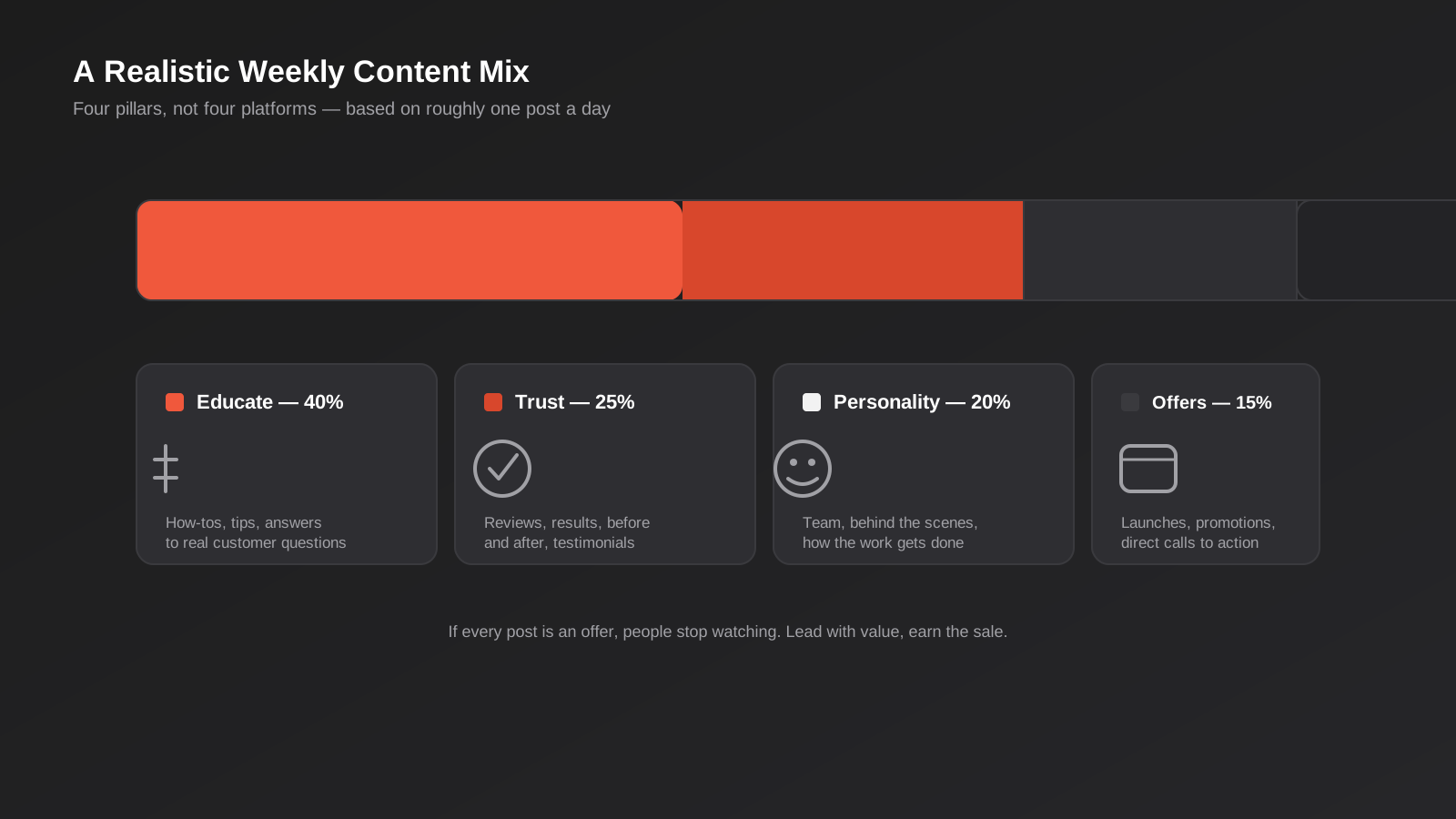
A content pillar is not a content calendar and it’s not a list of hashtags. It’s a category of value you consistently deliver. For most small and mid-sized Australian businesses, four pillars cover almost everything worth posting:
- Educate — answers to real questions your customers ask, how-tos, tips specific to your industry.
- Trust — reviews, results, before-and-afters, testimonials, proof that you do what you say.
- Personality — the team, behind the scenes, how the work actually gets done, the human side of the business.
- Offers — launches, promotions, direct calls to action to buy or book.
The mix matters more than the pillars themselves. A feed that’s mostly Offers reads like an ad account, and people mute or unfollow it fast. A rough working ratio that holds up across most industries is 40% educate, 25% trust, 20% personality, 15% offers — lead with value, and let the sale follow rather than lead.
Pillars by business type
The pillars stay the same in structure but the actual content underneath them looks very different depending on the business:
- Trades and construction — educate with common problems and what causes them, trust with completed job photos and reviews, personality with the crew on site, offers with seasonal service reminders.
- Professional services and B2B — educate with genuine industry insight and opinions, trust with case studies and client outcomes, personality with the people behind the advice, offers used sparingly and usually framed as an invitation to talk rather than a hard sell.
- Ecommerce and retail — educate with how to use or style the product, trust with customer photos and reviews, personality with sourcing or making-of content, offers with genuine promotions and new arrivals.
- Healthcare and allied health — educate carefully, given advertising rules for regulated professions under AHPRA, trust with (permission-based) patient outcomes, personality with the practice and staff.
Where content ideas actually come from
The businesses that run out of things to post are usually trying to invent content from nothing. The better source is what’s already happening: the questions customers ask on the phone every week, the objections your sales team hears before someone buys, the small wins your team already talks about internally, the reviews that come in. A running list of customer questions is, on its own, months of “educate” content without inventing a single idea.
Setting Goals and Measuring What Actually Matters
Follower count is the easiest metric to obsess over and the least useful one to act on. A page with 400 engaged local followers who occasionally message about a quote is worth more than one with 4,000 followers bought or accumulated from unrelated giveaways. Before posting anything, decide what the platform is actually meant to do for the business, because that determines what “working” looks like.
Vanity metrics vs metrics that connect to revenue
Likes and follower growth tell you whether content is landing with an existing audience, which is useful as a diagnostic but says nothing about whether the business is actually getting new customers from it. The metrics worth checking monthly are the ones with a line back to the business:
- Profile visits and website clicks — are people moving from the platform toward you, not just watching passively.
- Direct messages and comments asking about price, availability or booking — the clearest buying-intent signal social media gives you.
- Reach on your best-performing pillar — which content type is actually being shown to new people, not just liked by existing followers.
- Referral traffic from social in Google Analytics — whether social is contributing to the wider mix of channels bringing people to the site (our guide to increasing website traffic covers how social fits alongside SEO, email and paid channels).
Tagging links so you can actually see what social is doing
A link posted plainly in a bio or a caption shows up in Google Analytics as vague “referral” or, worse, “direct” traffic, which makes it look like social isn’t contributing anything even when it is. Adding UTM parameters — short tags appended to the end of a URL, like ?utm_source=instagram&utm_medium=social&utm_campaign=spring-offer — fixes this by labelling exactly where a click came from and which specific post or campaign sent it. Google’s free Campaign URL Builder generates these in a couple of clicks, and most link shorteners will wrap the result into something tidier for a bio link. It’s a small habit that turns “we think social helps” into an actual number you can point to.
A realistic timeline
Organic social builds slowly and compounds. Expect the first six to eight weeks to look flat — that’s normal and not a sign the strategy is wrong. Momentum tends to show up around the three-month mark, once there’s enough consistent content that the platform’s algorithm and your own audience have a pattern to recognise. Businesses that quit at week four because “nothing’s happening” are quitting right before the point where it usually starts to move.
Organic vs Paid: When to Add Ad Spend
Organic and paid social aren’t competing strategies — paid works best when it’s amplifying content and a page that already prove themselves organically. Boosting a post that’s already getting genuine engagement, or retargeting people who’ve watched a video or visited your website, tends to outperform building an ad campaign from a page with no content history and no proof of concept.
The signal that it’s time to add budget is usually one of these: organic reach has plateaued despite consistent posting, you have a specific offer or product launch that needs guaranteed reach in a short window, or you want to target a segment (a certain suburb, a certain job title, a certain interest) that organic reach can’t reliably hit. At that point it’s worth looking at platform-specific guides — our Facebook Ads campaign guide covers broad local and ecommerce reach, and our TikTok Ads guide covers younger, video-first audiences — because the campaign structure, targeting and cost benchmarks differ meaningfully between platforms.
Building a Realistic Content Workflow
The strategy on paper always looks achievable. The failure point is almost always execution — a business owner or one team member trying to write, shoot, edit and post content on top of an already full job, with no system, so it happens in bursts and then stops.
The 20-minute rule
If daily execution of your social strategy takes more than about 20 minutes, it’s not a sustainable strategy for a business owner running the business at the same time — it’s a second, unpaid job that will eventually get dropped. The fix isn’t posting less ambitiously; it’s batching. Set aside two to three hours every fortnight to shoot and write a batch of content, then schedule it out using a native scheduler or a tool like Meta Business Suite, Buffer or Later. The daily “work” becomes checking messages and replying to comments, not creating from scratch every morning.
In-house vs outsourcing
Whether to keep this in-house or hand it to an agency comes down to two honest questions: does anyone on the team actually enjoy and have time for this, and is the business at a size where the marginal hours are better spent elsewhere. Early-stage and very small businesses are often better off doing it themselves, because nobody understands the day-to-day of the business, the customer questions and the small wins worth sharing better than the people living it. It becomes worth outsourcing once posting has stopped happening consistently for a few months running, or once the business is large enough that marketing time is genuinely better spent elsewhere and the budget exists to fund it properly rather than as an afterthought.
Getting more out of one piece of raw content
The batching approach gets a lot easier once you stop thinking in single posts and start thinking in raw material. One job, one customer conversation, or one product shoot can usually be split across several pillars and several weeks rather than a single post that’s used once and forgotten. A tradie finishing a bathroom renovation, for instance, might get a trust post from the finished before-and-after photos, a personality post from a short clip of the team on site, and an educate post a few weeks later pulled from a question the customer asked during the job. Shooting with this in mind — grabbing a few extra photos or a short video clip while you’re already there — costs almost nothing extra at the time and quietly solves most of the “what do I post this week” problem later.
A simple weekly cadence
For a single-platform strategy, three to four posts a week is a sustainable, effective baseline for most small businesses — more than that starts to strain a batching workflow, less than that struggles to build momentum. A workable weekly shape looks like: one educational post, one trust/proof post, one personality post, and an offer only when there’s an actual offer worth making, rather than manufacturing one to fill the slot.
Common Mistakes We See
- Being on every platform at once. Spreading effort across four or five platforms means none of them get done well, and inconsistency is the fastest way to kill any algorithm’s willingness to show your content to new people.
- Posting only offers. A feed that’s constantly selling reads like an ad account people tune out or unfollow. Value has to come first.
- Copying competitors’ content style without their audience or resources. A big, well-funded competitor’s polished video strategy usually isn’t replicable or even appropriate for a much smaller local business with a completely different customer base.
- Quitting after four to six weeks. Organic social genuinely takes two to three months of consistency before it shows real momentum. Most businesses stop right before that point.
- No system for content ideas. Trying to invent a post from nothing every single day burns people out fast. A running list of real customer questions solves this.
- Ignoring comments and messages. A page that posts but never replies signals nobody’s actually home, and it wastes the highest-intent interactions — the people asking about price or availability.
- Boosting posts with no underlying strategy. Throwing ad spend at content that isn’t performing organically, or that isn’t part of any pillar, rarely produces a return worth the spend.
- Buying followers or engagement. It inflates a vanity number while actively damaging reach, because platforms show content less to accounts with unengaged, low-quality followings.
- Never reviewing what actually performed. Most platforms show which posts got the most reach and engagement without any extra tools. Spend ten minutes a month checking which pillar and format is genuinely working, and do more of that, rather than guessing indefinitely.
Frequently Asked Questions
How many social media platforms should a small business actually be on?
One properly, or two at most, if you have the resourcing to genuinely commit to both. Most small businesses do better concentrating all their effort on the single platform where their actual customers spend time, rather than spreading thin coverage across several. It’s far better to post three times a week on one platform consistently than once a week each across four.
How often should we be posting on social media?
Three to four times a week on your primary platform is a sustainable, effective baseline for most small and mid-sized businesses. Consistency matters more than volume — a business that reliably posts three times a week for six months will outperform one that posts daily for three weeks and then goes quiet.
What’s the difference between organic social media and paid social ads?
Organic social is unpaid content posted to your own page or profile, reaching your existing followers and whoever the platform’s algorithm chooses to show it to. Paid social is money spent to guarantee reach to a specific, targeted audience regardless of whether they already follow you. They work best together — paid social tends to perform better when it’s amplifying content and a page that already have some organic proof of concept, rather than starting completely cold.
How long does it take to see results from organic social media?
Expect the first six to eight weeks to look relatively flat even with consistent posting — that’s normal, not a sign the strategy has failed. Real momentum, in the form of steadily growing reach and engagement, typically starts to show around the three-month mark once there’s enough content history for both the algorithm and your own audience to recognise a pattern.
Should we hire someone in-house or use an agency for social media?
It depends on whether anyone on the team has both the time and the genuine interest to do it consistently, and whether the business is at a size where that time is better spent elsewhere. Early on, in-house often works better because nobody knows the day-to-day of the business as well as the people living it. It’s usually worth outsourcing once consistency has broken down for a few months running, or once the business has outgrown ad hoc content and needs a properly resourced content engine.
Do content pillars need to be the same for every platform we’re on?
The pillars — the underlying themes of educate, trust, personality and offers — usually stay consistent across platforms because they reflect what your business is and does. What changes is the format: the same “educate” idea might be a short video on TikTok, a carousel on Instagram, and a longer written post with a photo on Facebook. Don’t post the exact same asset unedited across every platform; adapt the format to how each one is actually used.
Where to Start
If you’re starting from scratch, the order matters more than the amount of effort you throw at it. Pick the one platform your actual customers are already on. Fix the basics on the profile itself — a clear bio, correct contact details, branding that matches the rest of the business. Write down four or five real, recurring customer questions and turn them into your first month of educational content. Batch a fortnight’s worth of posts in one sitting rather than creating daily. Then give it a genuine three months before judging whether it’s working, using the metrics that actually connect to the business rather than follower count alone.
If you’d rather talk it through — which platform actually fits your business, what a realistic content plan looks like, or where paid social might genuinely add to what you’re already doing organically — our social media marketing team is happy to have that conversation. No pressure, just a practical look at what would actually move the needle for your business.
Keep reading
Related posts
Digital Marketing for Car Dealerships and Workshops in Australia (2026)
Digital marketing for Australian car dealerships and workshops: local SEO, Google Ads, booking flows, and the price-advertising rule every dealer must follow.
Digital Marketing for Australian Manufacturers: Turning Visitors Into RFQs (2026)
How Australian manufacturers turn website visits into RFQs: capability pages, product SEO, LinkedIn Ads for procurement buyers, and quote automation.
Marketing for Recruitment Agencies in Australia: Winning Both Clients and Candidates
Recruitment agencies sell to two audiences at once. How SEO, LinkedIn Ads, job board strategy and compliance need to split between employers…
Got a project you'd like to talk through?
Tell us what you're working on — we'll come back with a plan.
