
Link Building for Australian Businesses: What Actually Earns Backlinks (2026)
 Jignesh Vagadiya
25/09/2026
21 min read
A client asked us last year why their new cornerstone guide — genuinely well-researched, properly structured, sitting on a technically clean site — had barely moved after four months. The content checklist was ticked. Keyword research was solid. Internal linking was tidy. What was missing wasn’t on the page at all: nobody outside their own website had ever linked to it. Google had no external signal telling it the page was worth trusting, so it sat at the bottom of page two, next to a dozen thinner competitors that happened to have a handful of real links pointing at them.
Link building has an image problem in Australia. Ask ten business owners what it means and you’ll get two very different answers. Half will describe something faintly disreputable — buying links off a marketplace, submitting a site to two hundred directories overnight, the sort of thing that got someone’s mate’s business penalised back in 2015. The other half will tell you links don’t matter any more, that good content and technical SEO are enough on their own. Both are wrong, and both leave real rankings sitting on the table.
This guide is about what link building actually looks like done properly in 2026 — not the spammy version, not the theoretical version nobody has time for, but the practical, repeatable process an Australian business of almost any size can run without a six-figure digital PR retainer. We’ll cover why it still matters, where most businesses go wrong, and the specific tactics — from citation building through to digital PR and mention reclamation — that actually produce links worth having.
What Link Building Actually Does for Rankings
Search engines still use links as a trust signal, and there’s a reasonably intuitive logic behind why. Anyone can write anything about themselves on their own website. A backlink is different — it’s a third party, on their own site, choosing to point at yours. Multiply that across a domain and you get something close to a reputation score: how many independent sources vouch for this page being worth sending someone to.
That doesn’t mean every link counts equally, and it doesn’t mean links are the only thing that matters. A technically broken site with brilliant backlinks will still struggle, and a beautifully built site with zero external validation will plateau well below where its content quality deserves. Links and everything else — technical health, on-page relevance, user experience, content depth — work together. Where businesses go wrong is treating link building as either the whole game or an afterthought, when it’s genuinely one input among several that all have to be present.
What’s changed since the early days of SEO is the bar for what counts as a valuable link. A page full of exact-match anchor text pointing in from forty low-quality directories used to move rankings. It doesn’t any more, and hasn’t for a long time — Google’s algorithm updates over the past decade have specifically targeted manipulative link patterns, and a domain caught in one can see rankings collapse across the board, not just for the pages the links pointed at. The links that move the needle now are the ones that would exist whether or not SEO was the reason you went looking for them: a supplier mentioning you as a case study, a journalist referencing your data in a story, an industry association listing you as a member.
Why Most Australian Businesses Get Link Building Wrong
Buying links from marketplaces
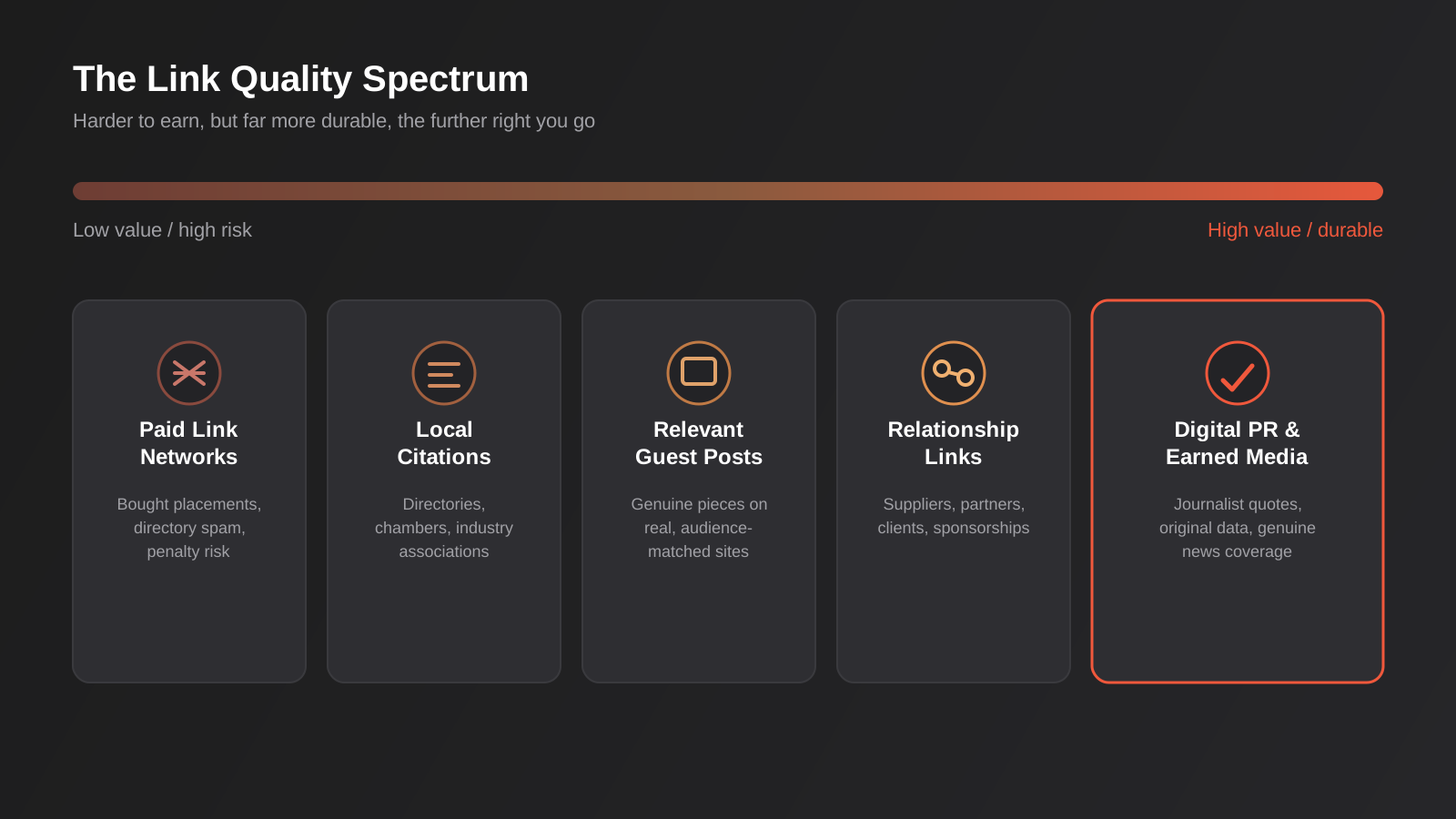
There’s an entire industry of link marketplaces selling “guaranteed” placements on sites with reasonable-looking metrics, often for a flat monthly fee per link. Almost none of these are worth the money. The sites are frequently built purely to sell links, the content wrapped around your link is thin and irrelevant to your business, and Google’s own link spam guidelines explicitly treat paid links passing ranking value as a violation. We’ve inherited more than one account where a previous agency built hundreds of these links, and unwinding the damage — auditing the profile, disavowing the worst of it, waiting for trust to rebuild — has taken longer than the original campaign that caused it.
Mass directory submissions
Submitting a business to two hundred generic directories overnight was standard practice a decade ago. Most of that volume is worthless now. A handful of genuinely relevant, well-maintained directories — industry associations, local chambers of commerce, sector-specific listing sites — still carry real value, mostly for local SEO and citation consistency rather than direct ranking power. Beyond that core set, chasing volume for its own sake wastes time that would be better spent on almost anything else on this list.
Ignoring it entirely because “content is enough”
This is the mistake we see most often from businesses that have otherwise done their SEO homework. They’ve invested properly in content strategy, built out service pages, done real keyword research, and assumed the content itself would attract links naturally. Occasionally it does — a genuinely exceptional, widely shared piece can earn links without any outreach at all. For most businesses, in most industries, that’s the exception rather than the rule. Good content is the raw material link building works with, not a substitute for the outreach and relationship-building that actually gets it noticed and linked to.
Treating it as a one-off project instead of an ongoing discipline
A burst of link building activity around a site launch, followed by nothing for the next eighteen months, produces a visible spike-and-plateau pattern that’s both less effective than sustained effort and, in extreme cases, a pattern algorithms have learned to view with some suspicion. Competitors who are earning links steadily — even a handful a month — tend to out-compound businesses running occasional bursts, for the same reason compound interest beats a single lump-sum deposit over time.
The Foundation: What Actually Makes Content Linkable
Before any outreach happens, it’s worth being honest about what gets linked to and what doesn’t. Nobody links to a generic service page describing what your business does — that’s not their job to promote, and there’s no reason for a journalist, blogger or fellow business owner to reference it. What gets linked to is something that does a job for the linker: gives them a data point to cite, a tool their audience will find useful, or an answer specific enough that pointing to it is easier than writing the explanation themselves.
Original data and research
If your business has access to data nobody else has — aggregated, anonymised trends from your own client base, a survey you’ve run, results from work you’ve actually delivered — that’s genuinely linkable in a way generic advice never will be. A regional real estate agency that publishes an annual analysis of local price movement by suburb, sourced from data it already has access to, gives local journalists and other sites a reason to cite it every year the report runs. This doesn’t need to be a major research operation. Even a modest, honestly-reported data set beats another rehashed “ultimate guide” with no original information in it.
Genuinely useful tools and calculators
A simple, well-built calculator relevant to your industry — a cost estimator, a comparison tool, a quiz that gives a genuinely useful result — tends to earn links steadily over time because it solves a specific problem better than an article can. These don’t need to be complex builds; a straightforward interactive tool that saves someone five minutes of manual working-out is often enough.
Depth that genuinely exceeds what’s already ranking
The “find something popular, make something better, then reach out to whoever linked to the original” approach still works when done honestly. The catch is that “better” has to mean genuinely more useful — more current, more specific to an Australian audience, more practically actionable — not just longer for the sake of it. A thin piece padded to ten thousand words with repetition isn’t more linkable than a tight two-thousand-word piece that actually answers the question better. If you want the groundwork for this kind of content, proper keyword and topic research is where it starts, because you need to know what’s already ranking and where the genuine gaps are before you can credibly claim to have improved on it.
The Easiest Wins: Local Citations and Relationship-Based Links
Before any ambitious digital PR campaign, most Australian businesses — especially local and service-area ones — have a set of easier, lower-effort links sitting right in front of them that get skipped in favour of chasing something flashier.
Citations done properly, not in bulk
A citation is a mention of your business name, address and phone number on another site, with or without a clickable link. For local SEO, consistency across these matters more than sheer volume — the same business name, the same address format, the same phone number, everywhere it appears. Start with the handful that genuinely matter: your Google Business Profile, a small number of relevant, well-regarded Australian directories for your industry, your local chamber of commerce if you’re a member, and any industry-specific associations you belong to. A tidy set of twenty accurate, relevant citations beats two hundred inconsistent, irrelevant ones every time.
Suppliers, partners and clients you already work with
This is the most underused link source we see, because it doesn’t feel like “SEO work” — it feels like asking a favour. If you’re a reseller, installer or certified partner for a product or platform, most manufacturers and platforms maintain a partner or “find a provider” directory. Ask to be listed. If you’ve done genuinely good work for a client who’s happy to say so, ask if they’ll let you add a short case study to your site and, where it’s a natural fit, whether they’d link to it from their own “who we work with” or news page. These links are slow to accumulate but almost impossible for an algorithm to discount, because they come from a real, verifiable business relationship rather than a transaction built purely to move a ranking.
Sponsorships and genuine community involvement
Local sporting clubs, school fetes, community events and charity fundraisers almost always list their sponsors online, usually with a link back to the sponsor’s site. If your business already sponsors or supports local organisations — and plenty do, without ever thinking of it as a link-building activity — check whether that support is reflected online, and ask if it isn’t. This is one of the few tactics where the SEO value is genuinely secondary to the actual reason you’d do it, which is exactly why it holds up so well over time.
Digital PR: The Highest-Leverage Tactic Most Businesses Skip
Digital PR, in practical terms, means getting your business, your data or your expertise mentioned in genuine media coverage — news sites, industry publications, trade press — in a way that includes a link back to your site. It’s consistently rated by SEO practitioners as one of the highest-value link tactics available, because a link from a genuine news or industry publication carries authority that’s extremely difficult to replicate any other way, and it tends to arrive alongside real brand exposure rather than just the link itself.
What this looks like for a business that isn’t a PR agency’s client
Digital PR doesn’t require a retainer with a national PR firm. For most small-to-medium Australian businesses, it looks like: monitoring journalist request platforms and relevant subreddits or industry forums for questions your business is genuinely qualified to answer, and responding with a specific, useful, on-the-record quote rather than a generic sales pitch. Journalists writing under deadline are looking for a real expert with a real, quotable answer — not a link request. Position yourself as the source, and the link tends to follow as a natural byproduct of being quoted, not as something you have to ask for separately.
Timely commentary on industry news
When something changes in your industry — a regulatory update, a new ATO ruling that affects small business, a shift in a platform’s algorithm — being one of the first to publish a clear, useful explanation gives other sites and journalists something to link to while the topic is still being actively searched and written about. This is a genuinely repeatable tactic: watch your industry’s news cycle, and be fast and specific rather than slow and generic when something relevant happens.
Data-driven pitches
If you’ve built an original data asset as described above, pitching it directly to relevant journalists — not a mass blast, a short, specific email to a handful of writers who actually cover your topic — is a genuinely effective way to earn coverage. The pitch should lead with the single most interesting or surprising finding, not a description of your business. Journalists don’t cover companies; they cover stories, and your business happening to be the source is incidental to whether the story itself is worth their time.
Unlinked Mention Reclamation and Broken Link Building
These two tactics share a common thread: they find links that should already exist, or used to exist, rather than starting from nothing.
Unlinked mention reclamation
Businesses get mentioned online more often than they realise — in articles, forum threads, roundup posts, local news stories — without a link attached. Someone types your business name as plain text instead of linking to your site, often not out of any deliberate choice but because it simply didn’t occur to them. A quick search for your business name, filtered to exclude your own domain and social profiles, will usually turn up a handful of these. A short, polite email asking whether they’d be willing to turn the existing mention into a link is one of the easiest asks in link building, because you’re not requesting new content or a new decision — you’re asking them to complete something they’ve effectively already agreed to by mentioning you in the first place.
Broken link building
Every website accumulates dead links over time — pages that got deleted, businesses that closed, resources that moved without a redirect. If you find a broken link on a relevant site that used to point to a resource similar to something you have (or could build), you can let the site owner know their link is broken and suggest your own page as a replacement. This works best combined with the content depth tactic above — having something genuinely comparable or better ready before you reach out, rather than pitching a thin page that happens to be on the same topic.
Guest Posting Done Properly
Guest posting earned a bad reputation for good reason — a decade of mass, low-quality guest post networks trained Google, and most experienced marketers, to be sceptical of it. That doesn’t mean the tactic is dead; it means the low-effort version of it stopped working years ago. The version that still holds value looks close to genuine journalism: pitching a specific, well-researched, genuinely useful piece to a publication whose audience actually overlaps with your target customers, written to that publication’s actual editorial standard rather than a templated article stuffed with keyword-rich anchor text.
A useful test before pursuing any guest post opportunity: would this piece exist, in this form, even if it contained no link back to you at all? If the honest answer is no — if the only reason the article exists is to house a link — it’s very likely the kind of guest post that carries little value and, on a site built primarily to sell placements, real risk. If the answer is yes, because the piece genuinely adds something useful to that publication’s readers, a link within it (ideally contextual, within the body, rather than jammed into an author bio) is a legitimate and durable way to earn authority.
How Many Links Do You Actually Need?
There’s no universal number, and any agency quoting one without having looked at your specific market is guessing. What actually matters is relative, not absolute: how does your link profile compare to the sites currently outranking you for the terms you care about? A local trades business competing for a single-suburb term might only need a modest handful of genuinely relevant local links to be competitive. A national ecommerce brand chasing a head term against well-funded competitors will need a considerably deeper, more sustained programme just to hold parity, let alone gain ground.
A rough competitive check is more useful than any generic target: look at the two or three sites currently ranking above you for a keyword that matters, and get a sense of where their links are coming from — are they genuinely earned from relevant, authoritative sources, or thin and directory-heavy? If it’s the latter, you may need fewer, better links than you’d assume to compete. If it’s the former, that’s a realistic signal of the level of sustained effort actually required, and a fair basis for setting expectations before you start.
Building a Repeatable Process
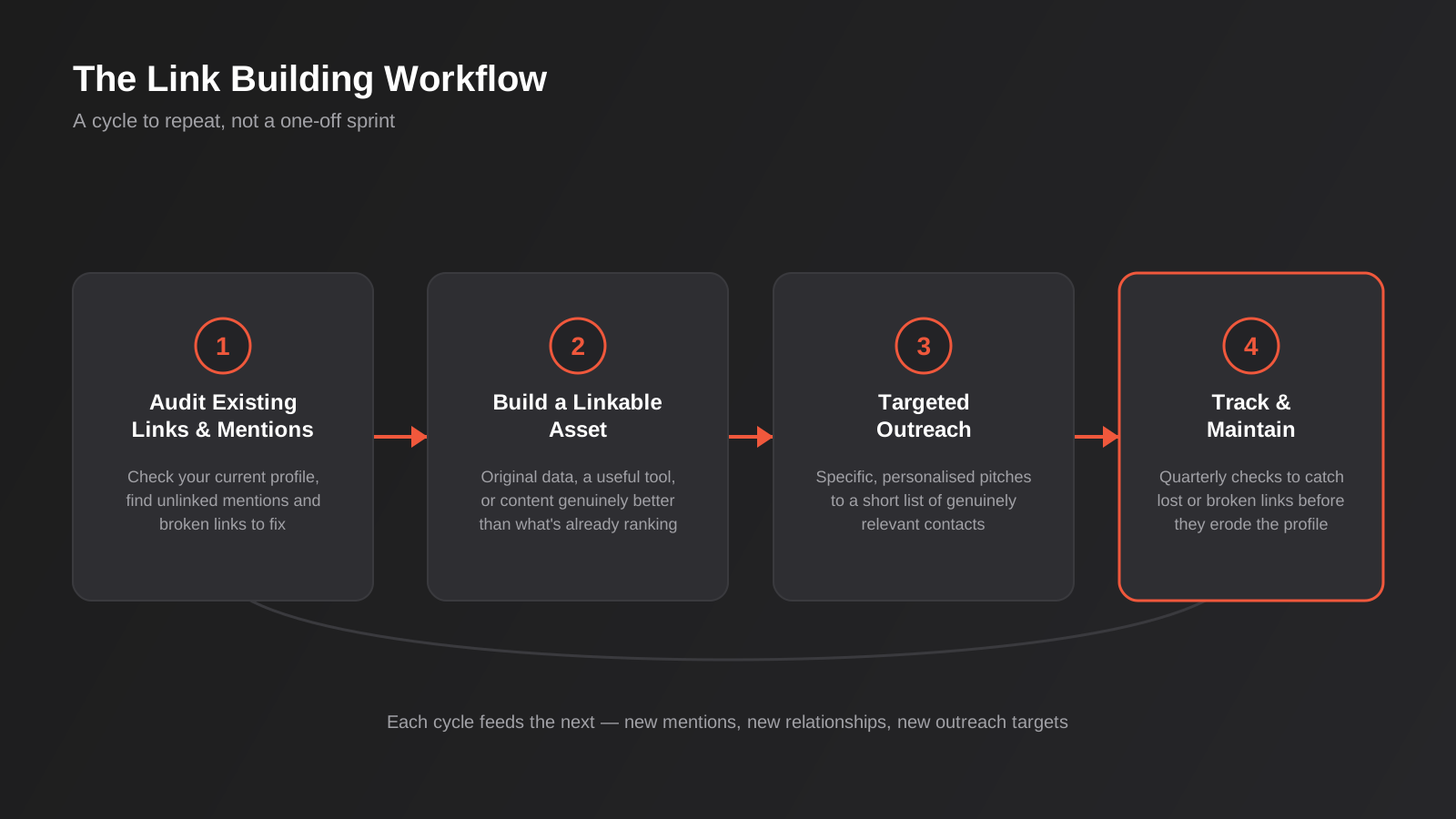
Start with an audit
Before building anything new, know what you already have. A basic backlink audit — using a tool like Ahrefs, Semrush or Google Search Console’s own link report — shows what’s already pointing at your site, including anything genuinely harmful left behind by a previous agency’s shortcuts. This is also where you’ll find your existing unlinked mentions and any broken links worth fixing.
Build one genuinely linkable asset before you start outreach
Outreach without something worth linking to is just asking for a favour. Pick one of the approaches above — an original data piece, a practical tool, a genuinely improved version of something already ranking — and get it built and published before you start reaching out about it.
Run targeted, specific outreach — not mass email
A short list of genuinely relevant targets, each pitched individually with something specific about why this resource suits their audience, will consistently outperform a mail-merge blast to five hundred generic contacts. Response rates on relevant, personalised outreach are meaningfully higher than on generic pitches, and the sites you do land will be more relevant to begin with.
Track what you’ve earned and keep it healthy
Links break, sites shut down, and pages you were linked from occasionally get restructured in ways that drop your link entirely. A periodic check — quarterly is reasonable for most businesses — catches this before it quietly erodes a profile you spent months building.
How Link Building Fits Into the Rest of Your SEO Strategy
Link building doesn’t work in isolation, and treating it as a separate workstream from the rest of SEO tends to produce disjointed results. The content you’re trying to get links to needs to be worth linking to in the first place, which loops back to genuine content strategy rather than content produced purely to have something to promote. The technical foundation of your site needs to be solid enough that earned authority actually flows through to the pages that need it, rather than getting trapped behind broken internal linking or indexing issues. And realistic expectations matter here as much as anywhere else in SEO — a sustainable link building programme compounds over months, not weeks, the same way the rest of organic search does.
If you’re evaluating whether an existing SEO provider’s approach to link building is sound, one of the more revealing questions you can ask is simply how they build links and whether they can show you examples. A vague answer, or one that mentions a “network” they can plug you into, is usually shorthand for exactly the manipulative tactics this guide has been steering away from — something worth digging into further if you’re currently choosing or evaluating an SEO agency.
Common Mistakes to Avoid
- Chasing a link count instead of relevance. Fifty irrelevant links do less for a specific keyword than five genuinely relevant ones from sites your actual customers would recognise.
- Over-optimised anchor text. Links that all use the exact same keyword-stuffed anchor text look manufactured, because they usually are — natural link profiles have varied, often branded or generic anchor text.
- Buying links from marketplaces or “guaranteed placement” services. Nearly always low-quality, frequently against Google’s guidelines, and a genuine risk to the whole domain if the pattern is picked up.
- Ignoring your own existing relationships. Suppliers, partners, clients and industry associations are consistently overlooked in favour of colder, harder outreach that converts far less often.
- Running outreach with nothing genuinely link-worthy to point to. A generic service page or a thin blog post rarely earns a link no matter how well the outreach email is written.
- Treating it as a one-off sprint. A burst of activity followed by eighteen months of silence produces weaker, less durable results than the same total effort spread steadily over time.
- Never auditing the existing link profile. Businesses that inherited a manipulative link profile from a previous agency, and never checked, are sometimes fighting their own backlinks without realising it.
Frequently Asked Questions
Is link building still worth doing in 2026?
Yes. Links remain one of the clearest external trust signals search engines use, and while their relative weight in the overall algorithm has shifted over the years, a genuinely earned link profile still separates sites that rank from sites that plateau, particularly in competitive markets where content and technical SEO alone aren’t enough to differentiate one strong site from another.
How long does link building take to show results?
Individual links can be earned within weeks once a genuinely linkable asset and a proper outreach process are in place, but the ranking impact of a growing link profile tends to compound over three to six months and beyond, in line with the same general timeline as the rest of organic SEO. Businesses expecting a single month of outreach to shift rankings are setting an unrealistic bar for a channel that’s fundamentally about building durable authority over time.
Can I do link building myself without an agency?
Yes, particularly the relationship-based and citation tactics covered above, which rely more on knowing your own industry and existing contacts than on specialist tools. Digital PR and content-led outreach at scale generally benefit from dedicated time and experience, since response rates and relevance matter more than volume, but a business owner willing to spend a few focused hours a month on outreach to genuinely relevant contacts can build a respectable link profile without outside help.
How do I know if my existing backlink profile has been damaged by a previous agency?
Run a backlink audit through Google Search Console or a tool like Ahrefs or Semrush and look for patterns — a large volume of links from irrelevant, low-quality or clearly link-farm-style sites, especially if they arrived in an unnatural burst rather than gradually over time, is a reasonable sign of manipulative link building in your history. If you find this, disavowing the worst offenders through Google Search Console is the standard remediation step, though it’s worth approaching carefully rather than disavowing broadly, since removing signal indiscriminately can do more harm than the original problem.
What’s the difference between link building and digital PR?
Digital PR is one tactic within the broader discipline of link building — specifically, earning links through genuine media coverage, journalist relationships and newsworthy content. Link building more broadly also includes citation building, relationship-based links, guest posting, broken link building and mention reclamation. Digital PR tends to produce the highest-authority individual links, but a sustainable programme usually draws on several of these tactics rather than relying on just one.
Do internal links matter as much as external backlinks?
They serve a different purpose. External backlinks bring outside authority into your site; internal links distribute that authority around it, helping search engines understand which pages matter most and helping visitors find related content. A site that earns strong external links but never links to them internally from other relevant pages is leaving some of that authority stranded on a single page instead of letting it support the rest of the site.
Where to Start
Link building rewards businesses that start small and stay consistent over ones that wait for the perfect campaign before doing anything at all. If you’re starting from nothing, the realistic first month looks like this: audit what you already have, claim and tidy up the citations that are missing or inconsistent, ask three suppliers or partners you already work with for a listing or a mention, and pick one piece of content worth building properly before you start reaching out about anything bigger.
If you’d rather talk through what a link building programme would actually look like for your specific market — what your competitors’ link profiles suggest about how much work is genuinely needed, and where the easiest wins sit for your business — we’re happy to have that conversation. No guaranteed placements, no link networks, just a practical look at what would move the needle for your site.
Keep reading
Related posts
Psychology Practice Marketing in Australia: Local SEO, Compliant Copy and the Waitlist Problem (2026)
How Australian psychology practices handle local SEO, AHPRA-compliant copy and waitlist triage when they're already at capacity (2026).

Physiotherapy Marketing in Australia: Local SEO, Website Design and Booking (2026)
How Australian physiotherapy clinics win new patients through Google Business Profile, local SEO, website design and real-time booking in 2026.
Local SEO for Veterinary Clinics in Australia: Google Business Profile, Reviews and the Emergency Search (2026)
Veterinary clinic SEO explained: Google Business Profile, review generation and the emergency search most vet websites get wrong.
Got a project you'd like to talk through?
Tell us what you're working on — we'll come back with a plan.
