
SMS Marketing Compliance in Australia: The Spam Act, the ACMA Sender ID Register and the Fines That Prove It’s Enforced (2026)
 Jignesh Vagadiya
03/11/2026
21 min read
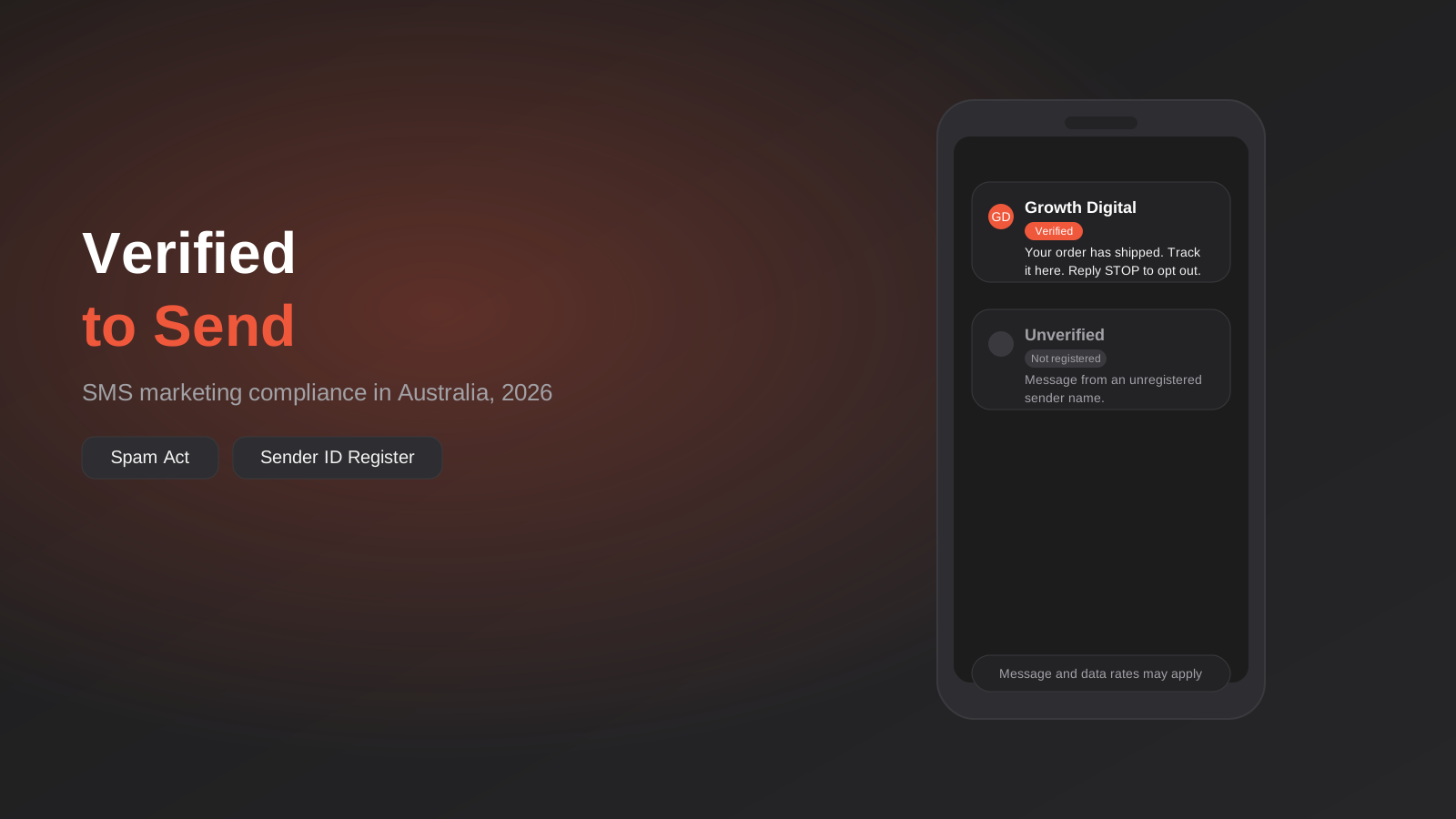
Telstra paid $626,000 for sending close to 10.5 million non-compliant text messages. Lululemon paid $702,900 for emails with no unsubscribe link. TAB has now paid more than $2.7 million across two separate enforcement actions for the same basic mistake: messaging people who hadn’t agreed to it, or who’d asked to stop. None of these businesses are small, and none of them thought they were breaking the law.
That’s the part worth sitting with before you send your next SMS campaign. The Spam Act 2003 isn’t new, but the Australian Communications and Media Authority has clearly decided SMS and email marketing is worth actively policing, and 2026 added a second layer on top of it: a mandatory Sender ID Register that changes what your branded texts look like on a customer’s phone the moment you get registration wrong. If you run any kind of SMS program — order updates, abandoned cart texts, appointment reminders, promotional blasts — both of these now apply to you directly, not just to the telcos and casino operators making headlines.
This guide covers SMS marketing compliance in Australia end to end: what the Spam Act actually requires for SMS specifically, what the new Sender ID Register changes and how to register for it, where the Do Not Call Register does and doesn’t come into it, and how to build a program that would survive someone actually checking your records. If you’re still deciding whether SMS is the right channel at all, our guide to email vs SMS marketing covers that decision in more depth; this one assumes you’ve made the call and need to do it properly.
Why SMS Marketing Compliance in Australia Suddenly Matters More in 2026
Businesses have been sending non-compliant texts and emails for two decades without much consequence beyond the occasional complaint. What’s changed isn’t the law — it’s the enforcement budget and appetite behind it. ACMA’s own published enforcement record shows a steady run of six and seven-figure penalties through 2025 and into 2026, and the regulator has said publicly that spam and telemarketing compliance is an ongoing priority, not a one-off crackdown.
The Fines That Prove It Isn’t Theoretical
A handful of recent, publicly confirmed ACMA actions give a sense of scale and pattern:
- Telstra paid $626,000 after sending roughly 10.5 million text messages that didn’t comply with the Spam Act.
- Lululemon paid a $702,900 infringement penalty and entered a two-year court-enforceable undertaking after sending over 370,000 marketing emails with no working unsubscribe option.
- TAB (Tabcorp) has paid more than $2.7 million in 2026 penalties on top of an earlier $4 million-plus action, both tied to messaging customers who had opted out or never consented.
- Betfair paid $871,660 after an investigation found it sent marketing messages to VIP customers who either hadn’t consented or had explicitly withdrawn consent.
- PointsBet was fined $500,800 for breaches including emails misclassified as non-commercial so they could skip the unsubscribe requirement.
The pattern across every one of these is the same two or three mistakes: sending to people who hadn’t agreed, ignoring opt-out requests, or not making opt-out easy to find and act on in the first place. None of it involves anything technically clever. It’s basic process failure at scale, and ACMA has shown it will pursue household names for it, which should tell you something about appetite for pursuing smaller businesses that make the same mistakes with less legal and compliance support behind them.
What’s Actually Changed in 2026
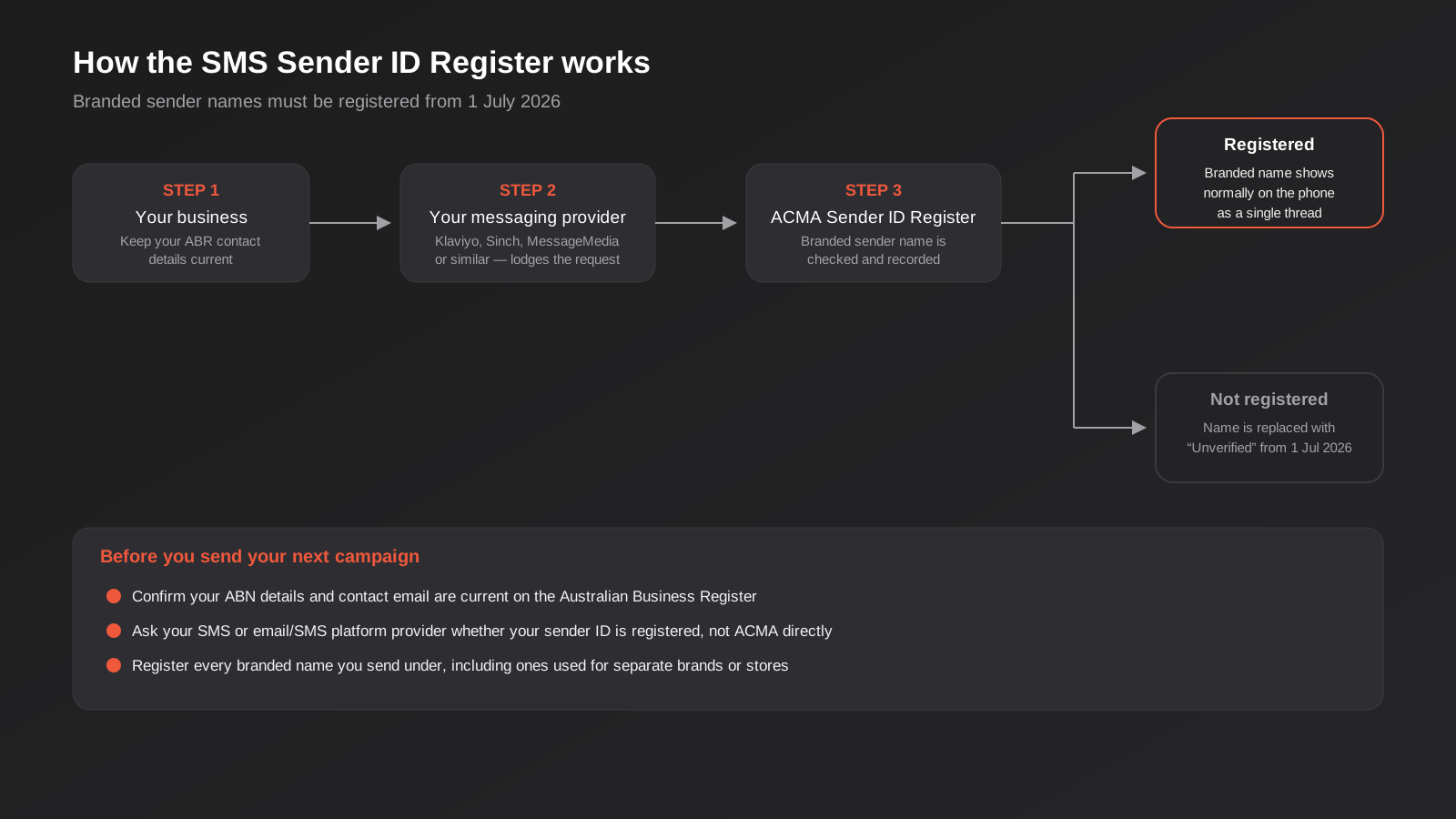
Alongside that enforcement pattern, ACMA has introduced the SMS Sender ID Register, a genuinely new requirement that didn’t exist before this year. From 1 July 2026, any business sending texts under a branded sender name — your business name appearing at the top of the message instead of a phone number — needs that name registered. We’ll walk through exactly how that works further down, but the short version is this: it’s not a Spam Act consent issue, it’s a separate telecommunications rule under the Telecommunications (SMS Sender ID Register) Industry Standard 2025, and getting it wrong doesn’t result in a fine so much as your business name quietly turning into the word “Unverified” on every customer’s phone.
The Spam Act: What It Actually Requires for SMS
The Spam Act 2003 covers commercial electronic messages generally, which includes SMS alongside email and MMS. For a marketing text to be legal, three things need to be true at the same time: you need consent, you need to identify yourself clearly, and you need to provide a functional way to unsubscribe. Miss any one of the three and the message is non-compliant, even if the other two are handled perfectly.
Consent: Express vs Inferred
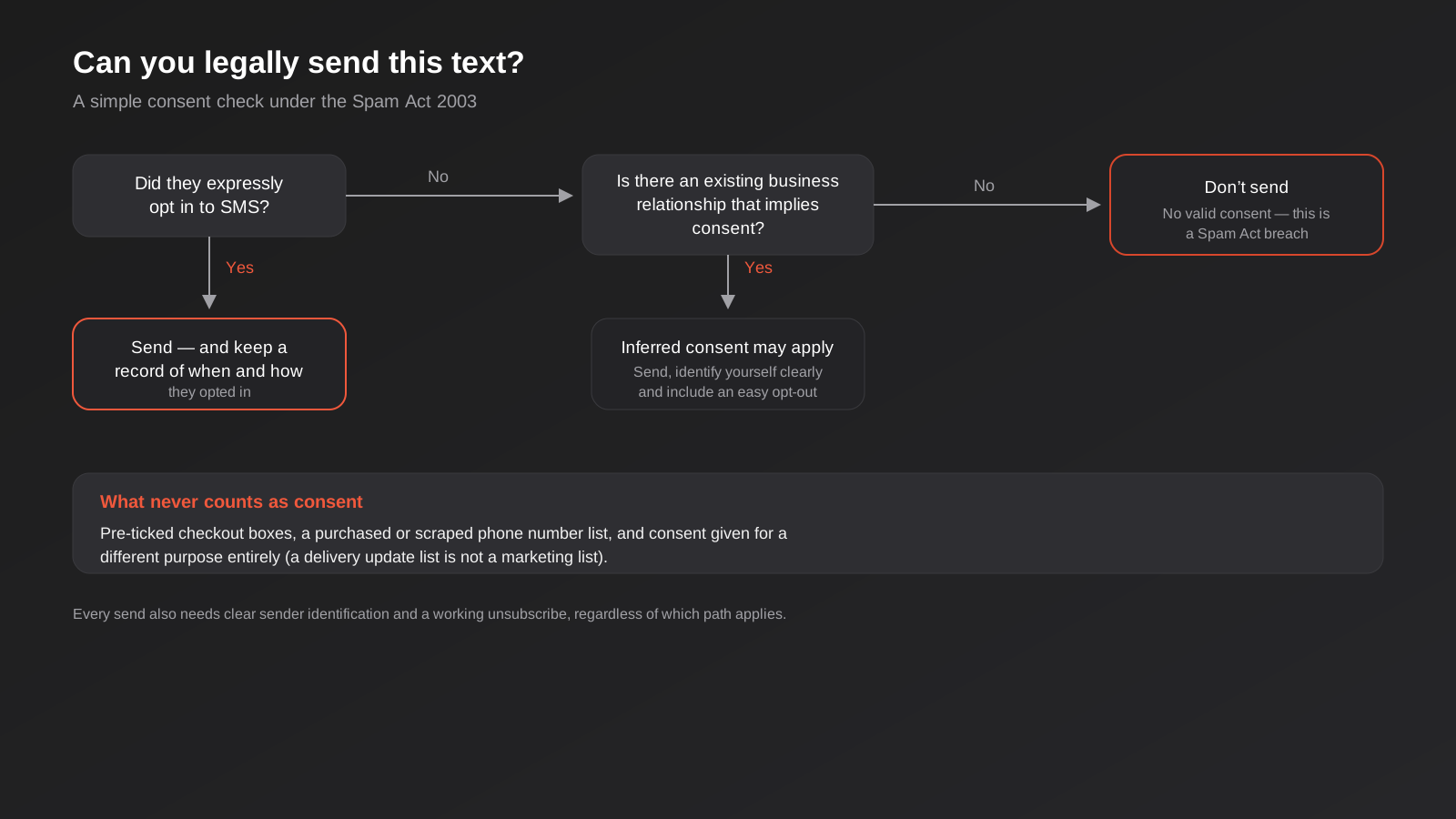
Consent under the Spam Act comes in two forms, and the distinction matters because it changes what you can prove later. Express consent is the clean case — someone actively opted in, usually by ticking an unticked box, texting a keyword, or submitting a form that clearly states they’ll receive marketing texts. Inferred consent is messier: it relies on an existing business relationship making it reasonable to assume someone expects to hear from you, such as a customer who’s made a recent purchase and would plausibly expect a follow-up offer.
Inferred consent is real, but it’s also the weaker position to defend if ACMA ever asks you to justify a send, so it’s worth treating as a fallback rather than a strategy. A few things never establish consent of either kind, and it’s worth being blunt about this because we still see businesses get it wrong: a pre-ticked checkout box doesn’t count, a purchased or scraped phone number list doesn’t count, and consent collected for one purpose — say, delivery notifications — doesn’t transfer to a different purpose like promotional offers.
Identify Yourself Clearly
Every marketing text needs to make it obvious who it’s from and how to contact that business. In practice this usually means your business name appearing in the message itself or as the sender name, plus some way to get in touch — a phone number, a reply-to address, or a link to your site. A text that just says “20% off today only, shop now” with a short link and nothing identifying the sender fails this test even if the recipient technically consented to receiving texts from you.
A Working, Easy Unsubscribe
This is where most of the fines above actually originated. The unsubscribe mechanism needs to be functional, easy to find, and processed within a reasonable timeframe — not buried behind a login, not requiring a phone call during business hours, and not something that technically exists but quietly fails. For SMS specifically, that almost always means a reply keyword like STOP that actually removes the number from future sends, tested periodically rather than assumed to be working. PointsBet’s fine partly came from reclassifying marketing messages as something else specifically to dodge this requirement, which is the kind of workaround that makes a bad situation worse once a regulator starts looking.
The ACMA SMS Sender ID Register: What It Means for Your Business
This is the genuinely new piece, and it catches a lot of businesses off guard because it has nothing to do with consent at all. It’s a telecommunications registration requirement that sits on top of everything the Spam Act already demands.
Branded Sender IDs vs Numeric Senders
When a text arrives with a business name at the top of the thread instead of a phone number — “Growth Digital” rather than a ten-digit number — that’s a branded, or alphanumeric, sender ID. From 1 July 2026, every branded sender ID used to message Australian mobiles needs to be registered under the Telecommunications (SMS Sender ID Register) Industry Standard 2025. This covers both SMS and MMS. Numeric senders and genuine two-way conversational numbers sit outside this specific requirement, but almost every marketing and transactional SMS program we see for Australian businesses sends under a branded name, because it converts better and looks more legitimate than a random number.
How Registration Actually Works
You don’t register directly with ACMA. Registration happens through whichever platform or telco actually sends your messages — Klaviyo, Sinch, MessageMedia, Twilio, or whoever you’re using for SMS — and ACMA’s own guidance is explicit that businesses should contact their messaging provider rather than trying to deal with the register directly. If your business has an ABN, the contact details recorded against it in the Australian Business Register need to be current, because that’s what gets checked during registration. This is worth checking now if you haven’t touched your ABR listing in a while; an outdated authorised contact email is a surprisingly common reason registration stalls.
What Happens If You Don’t Register
According to ACMA’s own published guidance, an unregistered branded sender name gets replaced with the word “Unverified” on the recipient’s phone from 1 July 2026 onward, shown as a single message thread rather than your actual business name. That’s a genuinely bad outcome for a marketing message — a customer who sees “Unverified” at the top of a promotional text is far less likely to open it, and more likely to assume it’s a scam, which ironically undermines the exact trust-and-safety goal the register is meant to achieve. Treat the 1 July 2026 deadline as already behind you if you haven’t acted; the fix is still straightforward, it just needs doing now rather than later.
If you’re running SMS through a platform that’s also handling your email marketing — which is increasingly common now that tools like Klaviyo treat both channels as one lifecycle program — this is also a good trigger to review your email marketing setup at the same time, since consent, authentication and sender reputation all sit on the same underlying infrastructure.
What If You Send Under More Than One Brand?
Multi-brand retailers, franchise groups and businesses running separate storefronts under one ABN need to treat each branded sender name as its own registration, not a single blanket approval for the parent entity. We see this trip up groups that run, say, a main retail brand plus a separate outlet or clearance store under a different name — both sender IDs need registering independently through the provider, even if they share the same underlying Klaviyo or Sinch account and the same ABN sits behind both. The same logic applies to franchise head offices sending on behalf of individual locations: if each location texts under its own branded name rather than a shared head-office name, each of those names needs its own registration, which is worth mapping out before half your sender names end up covered and half quietly showing as “Unverified”.
Choosing a Platform That Makes This Easier, Not Harder
Not every SMS or email/SMS platform handles Australian compliance the same way, and it’s worth factoring into a platform decision rather than treating it as an afterthought once you’re already locked in. Klaviyo, Sinch, MessageMedia and similar established providers with a genuine Australian presence generally have a defined process for lodging Sender ID registrations and tend to flag consent-related fields clearly in their list-building tools. Smaller or purely overseas platforms sometimes don’t, which leaves the registration step and the compliant-consent-field setup entirely on you to build manually. None of this makes a platform wrong to use, but it does change how much manual record-keeping you’ll need to build around it, and that’s a fair question to ask a provider directly before committing a list of several thousand numbers to it.
Where the Do Not Call Register Fits (It Mostly Doesn’t)
We get asked about this often enough that it’s worth a dedicated section: the Do Not Call Register has nothing to do with SMS marketing. The DNC Register covers voice telemarketing calls and faxes. It does not cover text messages, and registering a number on the DNC Register does not stop marketing SMS from being legal to send, provided you have consent under the Spam Act. The confusion is understandable — both regulators sit under similar consumer-protection logic, and both involve a phone number — but they’re separate regimes with separate rules, and SMS is governed exclusively by the Spam Act and, now, the Sender ID Register standard. If a customer tells you they’re on the Do Not Call Register and asks you to stop texting them, honour that request anyway (it’s good practice and likely what they actually mean), but understand that legally, it’s the Spam Act opt-out that applies, not the DNC listing itself.
Building an SMS Program That Actually Holds Up
Knowing the rules is one thing; building a program that would survive someone actually auditing it is another. A few practical habits make the difference between a business that could demonstrate compliance in an afternoon and one that would need weeks to even work out what it has.
Capture Consent Separately From Email
Email and SMS consent are not interchangeable, even though they often get treated as one checkbox. Someone agreeing to receive your newsletter hasn’t agreed to receive texts, and the two need separate, clearly labelled opt-ins — typically a mobile number field with its own explicit consent statement, not a shared tickbox that assumes agreement to both. Double opt-in, where someone confirms their number with a reply code before marketing texts start, is stronger evidence of genuine consent than a single web form submission, and worth the small amount of list friction it adds for anything beyond transactional messaging.
Where SMS Fits Next to Email
Most businesses that get SMS compliance right are running it as one channel inside a broader lifecycle marketing program rather than a bolt-on side project. That matters for compliance specifically because the record-keeping, segmentation and opt-out logic should live in one system rather than being scattered across a separate SMS tool that nobody checks for conflicting preferences. If you’re weighing up which messages deserve to be SMS versus email in the first place — cost per message, open rates, and the kind of content each channel actually suits — that’s covered in detail in our email vs SMS comparison, and the authentication side of deliverability (which overlaps meaningfully with the trust signals behind Sender ID registration) is covered in our email deliverability guide.
Businesses running this through a dedicated marketing automation platform tend to have an easier time here, simply because consent status, send history and opt-out records are all visible against the one customer profile rather than needing to be cross-checked across tools.
Record-Keeping That Would Survive an Audit
If ACMA or a customer ever asks why you sent a particular message to a particular number, you want a clean answer within minutes, not a week of digging through export files. That means logging, for every subscriber: when they opted in, how (which form, which keyword, which checkout flow), and when, if ever, they opted out. It also means not deleting opted-out numbers from your system entirely — suppress them from future sends, but keep the record that they opted out and when, because “we don’t know, we deleted that data” is not a defence ACMA has ever accepted.
Sending Times and Frequency
The Spam Act doesn’t specify exact sending hours, but ACMA’s broader guidance and plain common sense both point the same way: sending promotional texts at 6am or 11pm invites complaints even from people who did consent, and a pattern of complaints is often what triggers a closer look at a business’s practices in the first place. Treat consent as the floor, not the whole standard — a legally compliant message sent at a thoughtless time still damages trust in the channel.
What This Actually Costs
SMS pricing in Australia is usually quoted per message rather than as a flat subscription, and the range is wide depending on volume and provider. Pay-as-you-go rates typically sit somewhere between 2 and 10 cents per message excluding GST, with high-volume senders able to negotiate toward the bottom of that range and smaller senders on entry-level plans often paying closer to the top. Some providers layer a monthly platform fee on top of per-message pricing; others run genuinely pay-as-you-go with no setup or monthly cost at all, so it’s worth checking which model you’re actually being quoted before comparing two providers’ headline rates directly.
None of that includes the work of actually building and managing a compliant program — consent capture, segmentation, campaign and flow design, and keeping registration and records current. For most Australian businesses, that work gets folded into a broader email and SMS lifecycle marketing retainer rather than priced as a standalone SMS service, since the strategy, platform and compliance obligations overlap so heavily with email that running them separately usually creates more admin than it saves.
It’s also worth separating one-off campaign costs from the cost of automated flows, because the economics work differently. A promotional blast to a list of 10,000 numbers at, say, 4 cents a message costs roughly $400 in raw sending fees before any agency time, and that’s a cost you pay every time you send it. An automated flow — a shipping update, an abandoned cart nudge, an appointment reminder — gets built once and then runs on its own triggers indefinitely, so the build cost is front-loaded and the ongoing cost is just the per-message sending fee as it fires. Businesses that treat SMS purely as a campaign channel tend to underestimate how much of the real value sits in flows they haven’t built yet, which is as much a strategy gap as a compliance one.
Common Mistakes We See
- Treating email consent as SMS consent. A shared opt-in checkbox at signup does not give you permission for both channels unless it explicitly says so.
- Buying or scraping phone number lists. There is no form of purchased list that satisfies express or inferred consent under the Spam Act, regardless of what the list vendor claims.
- Assuming the STOP keyword works without testing it. Platform misconfigurations happen, and an unsubscribe that silently fails is functionally the same as never having one.
- Registering only one sender name when the business sends under several. Separate brands, store fronts or regional divisions each need their own registered sender ID if they send under different names.
- Deleting opted-out contacts instead of suppressing them. This destroys the exact record you’d need to prove you honoured the opt-out.
- Reclassifying marketing messages as “service” or “transactional” to dodge unsubscribe requirements. This is precisely the kind of workaround that has drawn some of ACMA’s largest recent penalties.
- Not checking ABR contact details before registering a Sender ID. An outdated authorised contact is one of the most common reasons registration stalls or fails.
Frequently Asked Questions
Do I need to register my SMS Sender ID if I only send transactional texts, like order confirmations?
The Sender ID Register applies to branded sender names generally, not only marketing messages, so a transactional branded name can still need registration. The clearest path is to ask your messaging or ecommerce platform provider directly whether the specific sender name you use is covered, since they’re the ones who actually lodge the registration on your behalf.
Is inferred consent enough, or should I always get express opt-in?
Inferred consent is legally valid, but it’s a weaker position if you ever need to justify a send, because it relies on a judgement call about what a reasonable person would expect rather than a documented yes. Where you can realistically get express opt-in — a clearly labelled SMS consent field at signup or checkout — it’s worth the extra step for the stronger record it creates.
Does the Do Not Call Register stop me from sending marketing SMS to someone on it?
No. The Do Not Call Register covers telemarketing calls and faxes, not text messages. SMS marketing is governed by the Spam Act’s consent rules regardless of whether a number also appears on the DNC Register. If someone on the DNC Register hasn’t separately opted out of your SMS list, sending to them with valid consent is legal, though honouring an opt-out request either way is good practice.
How quickly do I need to process an SMS opt-out request?
The Spam Act requires unsubscribe requests to be honoured within a reasonable time, which in practice means a working STOP keyword should remove someone immediately or within the same day, not days later. Several of ACMA’s largest recent penalties involved unsubscribe mechanisms that technically existed but didn’t actually work, so testing the mechanism periodically matters as much as having one.
What’s the penalty if I get this wrong?
Spam Act breaches can attract infringement notices and civil penalties that scale with the size and nature of the breach; ACMA’s recent published enforcement actions against Australian businesses have ranged from the low hundreds of thousands of dollars to several million for repeated or large-scale breaches. Separately, failing to register a Sender ID doesn’t carry a direct fine under current ACMA guidance, but results in your branded name being replaced with “Unverified” on recipients’ phones from 1 July 2026, which carries its own real cost in open rates and customer trust.
Can my SMS platform handle Sender ID registration for me?
Yes — registration is designed to run through your messaging provider rather than directly with ACMA, so platforms like Klaviyo, Sinch and MessageMedia have their own process for lodging it on your behalf. What they can’t do for you is keep your Australian Business Register contact details current, which is a step worth checking yourself before registration, since it’s a common reason the process stalls.
Do these rules apply if I use an overseas SMS platform to send to Australian customers?
Yes. Both the Spam Act and the Sender ID Register apply based on where the recipient is, not where your platform or provider is based, so sending to Australian mobile numbers triggers Australian obligations regardless of which country your SMS tool operates out of. The practical catch is that a genuinely overseas-only platform may not have a built-in process for lodging an ACMA Sender ID registration at all, which is worth confirming directly with the provider rather than assuming it’s handled.
Where to Start
If you’re running SMS campaigns right now and can’t immediately answer how a given subscriber opted in, or whether your branded sender name is registered, that’s the honest starting point — not a rewrite of your whole program, just an audit of what you’ve actually got against what the Spam Act and the Sender ID Register require. Most businesses find the gaps are fixable in days once they know exactly where they are, which is usually a consent record that was never properly logged, or a sender name registration that was never actioned because nobody realised it applied to them.
We build and manage SMS as part of broader email marketing and lifecycle programs for Australian businesses, with consent capture, segmentation and compliance built in from the start rather than patched on afterward. If you want a straight read on where your current SMS setup stands, tell us what you’re sending and how people got onto your list, and we’ll tell you honestly what needs fixing. You can see how our pricing works across services on our pricing and packages page.
Worth being upfront about cost too: email and SMS lifecycle marketing doesn’t have a single fixed price on our site because the scope depends on your list size and how many flows and campaigns you need, so we quote it against your actual situation rather than a generic package. What we can say honestly is that because we run lean as a specialist agency rather than carrying a large account-management layer, our fixed quotes typically come in below the Australian averages covered in this guide. If you’ve already got a written quote from another agency for comparable scope, send it through and we’ll do our best to beat it.
Keep reading
Related posts
Best SMS Marketing Platforms for Australian Businesses (2026): 6 Compared
Six SMS platforms for Australian businesses compared: sender ID, GST, real per-message costs, Shopify fit and the drawbacks vendors skip.

Best Email Marketing Platforms for Australian Businesses (2026): 6 Compared
Six email marketing platforms compared for Australian businesses — real pricing, ecommerce depth and AU data hosting, from Mailchimp to Vision6.
Email Deliverability in Australia: The SPF, DKIM, DMARC and Spam Act Guide for 2026
A practical 2026 guide to SPF, DKIM and DMARC, Gmail and Yahoo's bulk sender rules, and the Spam Act 2003 obligations Australian…
Got a project you'd like to talk through?
Tell us what you're working on — we'll come back with a plan.
