
Email vs SMS Marketing: Which Channel Should Your Australian Business Use? (2026)
 Jignesh Vagadiya
15/09/2026
21 min read
A retail client asked us a fair question last month: they’d just spent eighteen months building an email list of around 14,000 subscribers, open rates were sitting in the high teens, and someone on their team had suggested adding SMS into the mix. Was it worth the extra cost and the extra channel to manage, or would it just be the same message sent twice?
That’s the question this article answers properly, because most of what gets written about email vs SMS marketing either oversells SMS on the strength of its open rate or dismisses it as spammy and expensive without looking at what it’s actually good for. Both channels have a job. The mistake almost every business makes is picking one, or running both with the same message and the same list, instead of understanding what each channel does that the other genuinely can’t.
We’ll go through what each channel is actually better at, what they cost in Australia right now, the compliance rules that changed for SMS this year, and a practical framework for deciding which message goes down which channel. If you’ve already got email flows running and you’re wondering whether it’s SMS’s turn, or you’re starting from nothing and trying to work out where to put your budget first, this is written for you.
Why This Isn’t Really an Either/Or Decision
Most of the debate around email versus SMS treats it as a competition, and that framing causes bad decisions. The two channels sit in different places in a customer’s attention and behave differently under pressure. Email is a low-pressure, browsable format that people check on their own schedule and skim for what’s relevant. SMS is a high-pressure, immediate format that interrupts whatever someone’s doing, which is exactly why it works for time-sensitive messages and exactly why it backfires when it’s used for anything that isn’t genuinely time-sensitive.
If you already run email marketing automation with welcome flows, abandoned cart sequences and segmented campaigns, this article isn’t about replacing that. It’s about knowing which specific messages inside that customer journey are worth pulling out and sending by SMS instead, or alongside. That’s a narrower, more practical question than “which channel is better,” and it’s the one that actually changes what you do on Monday morning.
The businesses that get the most out of both channels aren’t the ones running the biggest SMS list. They’re the ones who’ve mapped their customer communications by urgency and content depth, then assigned each message type to the channel that suits it. We’ll build that framework properly later in this piece, but first it’s worth being honest about what each channel does well, because the strengths are genuinely different, not just a matter of speed.
It also helps to separate the question into two decisions that get conflated constantly: which channel should carry a given message, and how big should each list actually be. A business can run a modest, highly selective SMS list of a few hundred high-intent customers alongside a broad email list of tens of thousands, and that’s not a failure to “commit” to SMS — it’s usually the right shape. SMS doesn’t need to reach everyone to be worth running. It needs to reach the right handful of people at the moment a text message is genuinely more useful to them than an email would be.
What Email Does Better
Content depth and storytelling
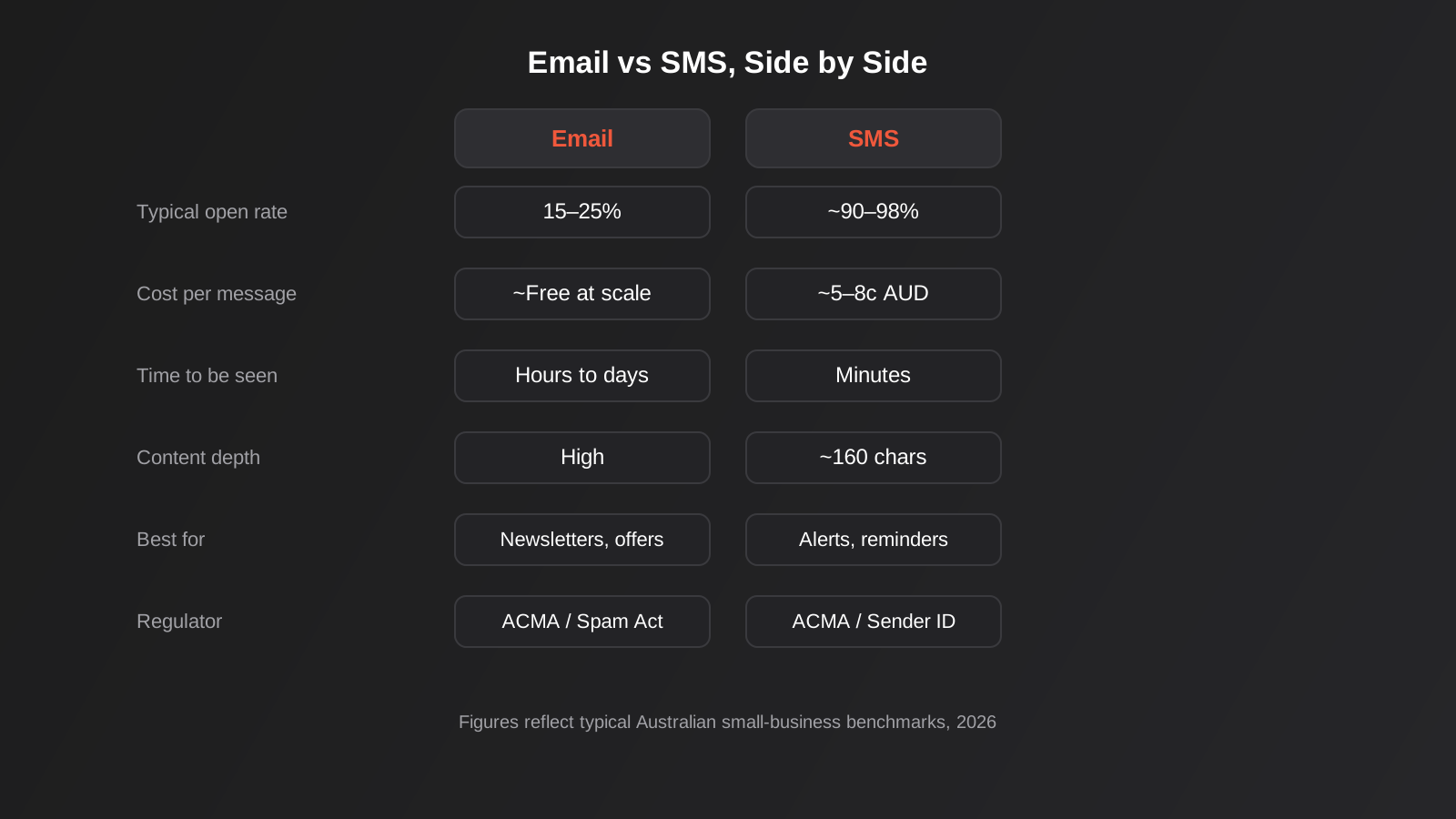
Email can carry a real message. You’ve got room for a subject line, preview text, a hero image, several paragraphs of copy, product recommendations, a footer, and a call to action that isn’t the only thing on the page. That matters for anything that needs context: explaining a new product line, walking through why a price changed, building a case for a service upgrade, or telling a brand story that builds trust over several sends rather than one. SMS physically cannot do this. You get roughly 160 characters before a message splits into multiple parts, and even a two-part message reads as terse and transactional no matter how you write it.
This is why newsletters, product education, loyalty programs and anything with a “read more” component belongs in email. It’s also why email remains the better channel for building a relationship over time rather than just prompting an action right now.
Cost per contact
Email is close to free at scale. Most Australian small businesses run on platforms priced by subscriber count rather than message volume, so you can send a campaign to your entire list as often as your strategy calls for without a per-message cost showing up on the invoice. SMS, by contrast, carries a per-message carrier fee in Australia — typically somewhere in the order of five to eight cents per message depending on your provider and volume, sometimes more for messages that need to split across multiple SMS segments. Send that to a list of 10,000 people every week and the maths starts to matter. Email doesn’t have that ceiling, which is part of why it stays the default channel for regular, high-frequency contact.
The data you get back
Email gives you opens, clicks, which links got clicked, how far someone scrolled in some platforms, device type, and a much richer picture of intent than a delivered-or-not SMS report. That data feeds segmentation: you can build a flow that only fires for someone who clicked a specific product link, or suppress a send to anyone who hasn’t opened in ninety days. SMS platforms are improving here, and click tracking on shortened links is now standard, but you’re still working with a fraction of the signal email gives you. If your email marketing strategy leans on behavioural segmentation, that’s a capability SMS doesn’t replace — it’s a capability you extend into SMS for a narrower set of triggers.
What SMS Does Better
Open rates and speed
This is the number everyone quotes and it’s real: SMS open rates commonly sit above 90%, often cited around 98%, and most of those opens happen within a few minutes of delivery. Compare that to email, where a well-performing Australian campaign might land somewhere in the 15–25% open rate range depending on industry and list health. If a message genuinely needs to be seen today, SMS is the only channel that reliably delivers that outcome. This isn’t a reason to move everything to SMS — it’s the reason SMS exists as a channel at all, and it’s wasted the moment you use it for something that didn’t need same-day visibility.
Timing-sensitive messages
Appointment reminders, delivery updates, “your table’s ready,” flash sales with a same-day cutoff, order confirmations, two-factor codes, a booking about to lapse — these are the message types SMS was built for, and they’re the ones where the format’s bluntness is a feature rather than a limitation. Nobody wants a beautifully designed HTML email telling them their tradesperson is fifteen minutes away. They want one short, clear line, and they want it now.
Reaching people who don’t check email
Plenty of customers, particularly in trades, hospitality, healthcare and services businesses, don’t check a personal inbox often, or use an email address that’s effectively abandoned outside of receipts and password resets. Their phone number is the more reliable contact point. If your customer base is heavy on tradies, older demographics, or anyone with a genuinely mobile-first daily routine, SMS often has better real-world deliverability of attention, even if the technical deliverability of email is fine.
The Real Cost Comparison
Numbers help more than generalisations here, so here’s roughly where things sit for an Australian small to mid-sized business running both channels through 2026.
Email marketing software for a list in the low thousands typically runs somewhere between $70 and $800 a month depending on platform, list size and how much automation you’re using. That’s a flat cost regardless of how many campaigns you send within reason — Klaviyo, Mailchimp, ActiveCampaign and similar platforms price on contacts, not sends. If you’re paying an agency to manage strategy, copywriting, design and flow-building on top of the software, full-service packages generally land somewhere between $600 and $3,500+ a month depending on scope, which is roughly the same range you’ll see across most digital marketing services priced in Australia at this tier.
SMS adds a carrier fee on top of whatever platform fee you’re paying, usually five to eight cents per message in Australia, sometimes cheaper at high volume through a business messaging provider, sometimes more if a message runs long enough to split into multiple segments. Do the arithmetic before you commit to a cadence: a weekly SMS to a list of 5,000 people at six cents a message is $300 a month just in carrier costs, before software and management fees. That’s not a reason to avoid SMS, but it is a reason to be deliberate about who’s on the list and how often you message them, rather than treating it like a free add-on to your email calendar.
The practical upshot: email is the channel you can afford to use often and broadly. SMS is the channel you use sparingly and for a smaller, more qualified list, because both compliance and cost push you toward restraint.
Compliance: The Spam Act, ACMA and the New SMS Sender ID Register
Both channels sit under Australia’s Spam Act 2003, enforced by the Australian Communications and Media Authority. The core rules are the same for email and SMS: you need consent before sending, you need to clearly identify who’s sending the message, and every message needs a functional, free way to opt out. Where the two channels differ is in how strictly those rules get applied in practice, and in what’s changed recently.
Consent rules for email vs SMS marketing
The Spam Act recognises both express consent (someone actively opted in — ticked a box, submitted a form, texted a keyword) and inferred consent (an existing business relationship where a reasonable person would expect to receive marketing, such as a recent purchase). Both apply to email and SMS. In practice, regulators and platforms both treat SMS consent more strictly because the channel is more intrusive — a text message arrives on a device people carry everywhere and often can’t silence as easily as an inbox. If you’re building an SMS list, get express opt-in specifically for SMS rather than assuming an email subscriber has also consented to texts. Bundling the two into one checkbox is a common shortcut that creates real compliance risk, and it’s one of the mistakes we cover below.
What changed on 1 July 2026
This is the development most Australian businesses running SMS campaigns need to know about if they haven’t already dealt with it. ACMA’s SMS Sender ID Register became mandatory from 1 July 2026. Any business or organisation sending branded text messages — meaning your business name appears as the sender instead of a number — now has to register that sender ID through an ACMA-approved telco or messaging provider. Registration opened in November 2025, and ACMA has flagged that applications can take several weeks to process, which has already caught out a number of businesses that assumed it was a same-day formality.
Messages sent from an unregistered sender ID are now labelled “Unverified” on the recipient’s phone and grouped into a separate thread, which is a fast way to tank your open rates even if the message itself is perfectly compliant otherwise. The scheme exists to cut down on impersonation scams that spoof business names, and if you’re using a business messaging platform, check with them directly on whether your sender ID is registered — don’t assume it carried over automatically from before the scheme existed. If you have an ABN, your authorised contact details on the Australian Business Register also need to be current, because that’s part of what your provider checks during registration.
Penalties for genuine Spam Act breaches, separate from the sender ID scheme, are not small — ACMA can pursue fines up to $2.22 million for companies and $444,000 for individuals for serious or repeated non-compliance. Most businesses never get near that because they’re not deliberately spamming, but it’s worth knowing the ceiling exists, because it should inform how carefully you handle consent records and unsubscribe requests on both channels.
If you’re not sure where your business stands on any of this, the practical checklist is short: confirm your SMS sender ID is registered with your telco or messaging platform, make sure your ABN’s authorised contact details on the Australian Business Register are current, keep a dated record of how and when each contact gave consent for each channel, and test your unsubscribe mechanism yourself on both email and SMS at least once a quarter. None of that is difficult, but all four get skipped by businesses that set SMS up once and never revisit it.
Where Each Channel Actually Wins
Ecommerce
Order confirmations, shipping updates and delivery-day notifications are strong SMS candidates because the customer wants to know right now, not whenever they next open their inbox. Abandoned cart recovery is more interesting: the first reminder usually performs well as email because it can show the product image, price and a persuasive nudge with room to breathe. A second reminder a few hours later, for a genuinely high-intent cart, can work as a short SMS precisely because it interrupts — but only if the customer opted into SMS specifically and the cart value justifies the carrier cost. Flash sales and limited-time promotions with a same-day deadline are one of the few genuinely good broadcast use cases for SMS, because the urgency in the message matches the urgency of the channel. If you’re running an online store, this is worth mapping against your existing ecommerce conversion strategy rather than bolting SMS on as an afterthought.
Service businesses and bookings
This is where SMS earns its keep most reliably. Appointment reminders 24 hours out cut no-shows in a way email reminders generally don’t, simply because they get seen. Booking confirmations, “your technician is on the way,” and rebooking prompts after a service all suit SMS. The email side of a service business relationship handles the heavier lifting: educational content, seasonal offers, loyalty and referral programs, and the kind of relationship-building content that doesn’t need to be read in the next five minutes.
B2B
B2B is the one context where SMS usage should stay genuinely minimal. Business buyers expect email for anything substantive — a proposal follow-up, a webinar invite, a case study, a nurture sequence — and an unsolicited text to a business contact reads as overly familiar or, worse, spammy in a way that damages the relationship. The exception is operational: appointment or demo call reminders, or a time-critical update during an active project, where the same logic that applies to service businesses still holds. Whatever channel generates the lead in the first place, keep the nurture almost entirely on email once that lead is in your system.
Building a Combined Email + SMS Strategy
Segmentation across channels
Treat SMS opt-in as its own list, not a subset that’s automatically implied by an email signup. Ask for it separately, explain what they’ll get (“order and delivery updates only” is a very different promise to “occasional offers”), and let people be on email without being on SMS. This single decision prevents most of the complaints and unsubscribes that give SMS campaigns a bad name. From there, segment by behaviour and value rather than blasting the full SMS list every time: reserve SMS sends for your highest-intent segments — recent purchasers, cart abandoners with high-value carts, loyalty members who’ve asked for early access — and let everyone else stay on the email cadence.
Frequency and fatigue
Email fatigue shows up as declining open rates over weeks or months. SMS fatigue shows up faster and harder, often as an immediate unsubscribe or a spam complaint, because the channel is more intrusive to begin with. A reasonable starting cadence is two to four SMS sends a month outside of transactional messages like order and appointment updates, versus one to several email sends a week depending on your content depth and list expectations. If you’re not sure where your current cadence sits, look at unsubscribe rate by channel over the last quarter — a climbing SMS opt-out rate is usually the first honest signal that frequency has crept past what the list agreed to.
A simple channel-mapping framework
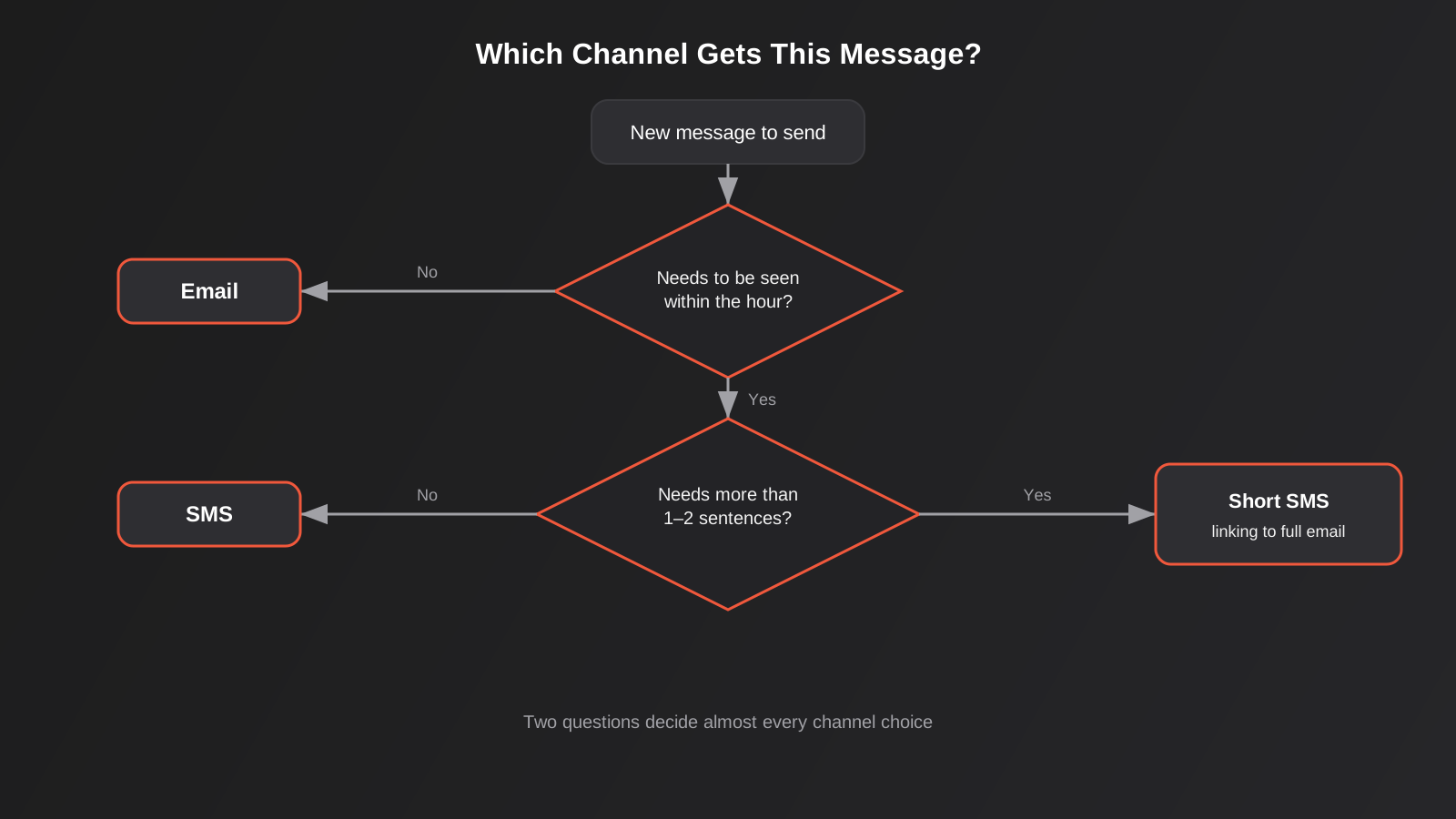
Before adding a message type to either channel, ask two questions: does this need to be seen within the hour, and does it need more than one or two sentences to make sense? Time-sensitive and short goes to SMS. Not time-sensitive, or needs room to explain, goes to email. Time-sensitive and complex — a service outage that needs both urgency and detail, say — often works best as a short SMS with a link through to a fuller email or landing page, using each channel for what it’s actually good at rather than picking one and stretching it to cover both jobs.
One platform or two
Some email platforms, Klaviyo among them, now handle SMS natively inside the same tool, sharing one customer profile, one set of flows and one view of engagement across both channels. Others require a separate SMS-specific platform that talks to your email tool through an integration or a shared CRM. There’s a real trade-off either way. A combined platform is simpler to manage and makes cross-channel logic easy to build — suppress the SMS send if the email already converted, for instance — but you’re locked into one vendor’s SMS pricing and deliverability, which isn’t always competitive. Separate best-of-breed tools usually give you better SMS deliverability and lower per-message cost, at the price of more setup work to keep the two systems in sync. For a business just starting to test SMS, a combined platform is usually the lower-friction choice; once volume justifies it, splitting the two out is worth revisiting.
Measuring what matters on each channel
Don’t judge SMS by email benchmarks or vice versa — the numbers that matter shift by channel. For email, open rate, click-through rate and unsubscribe rate over time tell you most of what you need. For SMS, delivery rate, click-through rate on the link, opt-out rate and, critically, reply volume (a spike in replies asking “who is this?” is an early warning that your sender ID or message content isn’t landing as expected) matter more than open rate, since open rate on SMS is high almost by default and doesn’t discriminate between a good campaign and a mediocre one. Track revenue or conversions attributed to each channel separately rather than as a combined total, because a campaign that looks strong on blended numbers can be masking a channel that’s actually losing money once carrier fees are factored in.
Common Mistakes
- Sending the exact same message and cadence to both channels, which wastes SMS’s urgency on content that didn’t need it and wastes money on carrier fees for a message email would have handled fine.
- Assuming email opt-in covers SMS consent, which creates a compliance gap and usually produces a spike in opt-outs the first time a text lands unexpectedly.
- Not registering a sender ID with ACMA’s SMS Sender ID Register, which now gets branded messages flagged “Unverified” and buried in a separate thread on the recipient’s phone.
- Over-mailing the SMS list because it’s a smaller, more engaged group — that engagement erodes fast under high frequency, faster than it does on email.
- Ignoring time zones and sending SMS outside acceptable hours; a text landing at 6am or 10pm does more brand damage than a badly timed email ever will, because it physically interrupts someone.
- Using SMS for content that has no urgency — general newsletters, brand updates, “here’s what’s new this month” — which trains recipients to opt out because every message starts to feel like noise.
- Skipping a clear, one-tap unsubscribe on SMS, or making someone reply “STOP” without telling them that’s the mechanism, which is both a compliance risk and a basic usability failure.
- Not tracking cost per contact by channel, so SMS spend creeps up on a list that isn’t segmented by value, and nobody notices until the invoice does.
Frequently Asked Questions
Is SMS marketing worth it for a small Australian business?
Usually yes, but only for a defined set of message types rather than as a full replacement for email. If you take bookings, ship physical products, or run any kind of appointment-based service, transactional SMS (reminders, confirmations, delivery updates) tends to pay for itself quickly through reduced no-shows and fewer support enquiries. Promotional SMS is worth testing on a small, opted-in segment before rolling it out broadly, because the cost per contact and the compliance requirements are both higher than email.
Do I need separate consent for email and SMS marketing?
Yes, and this is one of the most common compliance gaps we see. The Spam Act 2003 requires consent for each type of commercial electronic message, and while email consent and SMS consent can technically overlap under an existing business relationship, the safest and clearest approach is to ask for them separately with distinct opt-in language, so people know exactly what they’re agreeing to receive on which channel.
What is the ACMA SMS Sender ID Register and does my business need to register?
It’s a mandatory register, in effect since 1 July 2026, that requires any business sending branded text messages (where your business name shows as the sender rather than a phone number) to register that sender ID through an ACMA-approved telco or messaging provider. If you send any marketing or transactional SMS under your business name, you need to register or your messages will show as “Unverified” to recipients. Contact your SMS platform or telco directly to confirm your registration status — don’t assume it happened automatically.
How much does SMS marketing cost compared to email in Australia?
Email is largely a flat monthly platform cost regardless of send volume, typically $70–$800 a month for a small to mid-sized list depending on the platform and automation you’re using. SMS adds a per-message carrier fee on top of platform costs, generally five to eight cents per message in Australia, which means SMS costs scale directly with list size and send frequency in a way email doesn’t. That’s the main reason SMS lists tend to stay smaller and more selectively used than email lists.
Should ecommerce stores use SMS for abandoned cart recovery?
It can work well as a second or third touchpoint after an initial email, particularly for higher-value carts where the urgency of SMS justifies the cost. It shouldn’t be the first touch, because email gives you room to show the product, the price and a persuasive reason to come back, which a 160-character text can’t do. Reserve SMS cart recovery for customers who’ve specifically opted into SMS and for cart values that make the carrier fee worthwhile.
How often should I send marketing SMS without annoying my list?
As a starting point, two to four promotional SMS sends a month is a reasonable ceiling for most businesses, separate from transactional messages like order updates or appointment reminders, which customers generally expect and don’t count as marketing fatigue. Watch your opt-out rate closely in the first few months — a rising SMS unsubscribe rate is the clearest signal that frequency has outpaced what your list actually agreed to.
Where to Start
If you’re running email already and wondering whether SMS is worth adding, start narrow: pick one or two genuinely time-sensitive message types — order updates, appointment reminders, a cart recovery step — build a proper opt-in for SMS specifically, and check your sender ID registration before you send a single message. Measure it against a clear cost-per-contact number before expanding into broader promotional sends. If you’re not running structured email marketing yet, that’s usually the higher-leverage place to start before SMS enters the conversation at all, and it’s worth looking at what a properly built-out social media marketing presence adds to the mix too, since the three channels tend to reinforce each other rather than compete for the same budget.
Either way, it’s worth mapping your actual customer communications — every touchpoint from first contact through to repeat purchase or rebooking — against the framework above before committing budget to a new channel. We do this kind of channel audit regularly for clients who are trying to work out where email stops being enough and where SMS, done properly, starts paying for itself. If you want a second opinion on where your business sits, get in touch and we’ll talk through it.
Keep reading
Related posts
Best Email Marketing Platforms for Australian Businesses (2026): 6 Compared
Six email marketing platforms compared for Australian businesses — real pricing, ecommerce depth and AU data hosting, from Mailchimp to Vision6.
Email Deliverability in Australia: The SPF, DKIM, DMARC and Spam Act Guide for 2026
A practical 2026 guide to SPF, DKIM and DMARC, Gmail and Yahoo's bulk sender rules, and the Spam Act 2003 obligations Australian…
Email Marketing Automation That Actually Makes Money: Welcome Flows, Abandoned Cart and Segmentation for Australian Businesses (2026)
A practical guide to email marketing automation for Australian businesses: welcome flows, abandoned cart recovery, segmentation, compliance and what to measure.
Got a project you'd like to talk through?
Tell us what you're working on — we'll come back with a plan.
