
Email Marketing Automation That Actually Makes Money: Welcome Flows, Abandoned Cart and Segmentation for Australian Businesses (2026)
 Jignesh Vagadiya
28/08/2026
21 min read
Jignesh Vagadiya
28/08/2026
21 min read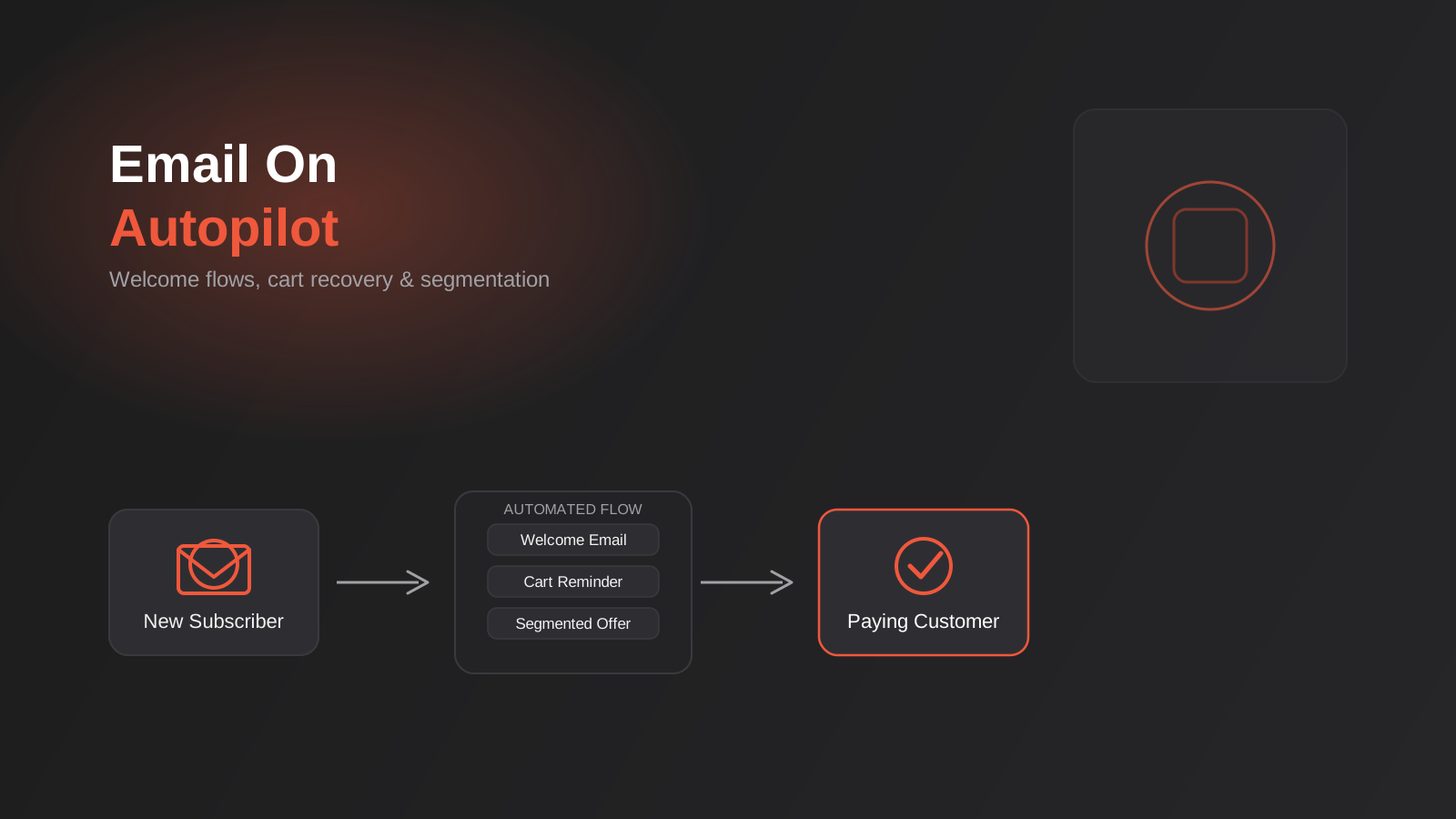
Most businesses treat email like a newsletter. Someone writes a promotion once a month, sends it to the whole list, watches the open rate for a day, then forgets about it until next month. Meanwhile the automated emails that actually make money — the ones that fire the moment someone joins the list, abandons a cart, or goes quiet for three months — simply don’t exist. Or worse, they were set up once in 2022 and never touched again.
That gap matters because automated flows are the highest-leverage part of email marketing by a wide margin. They’re built once, they run in the background, and because they trigger on behaviour rather than a calendar date, they reach people at the exact moment they’re most likely to act. A new subscriber who just downloaded a guide is warmer than they’ll ever be again. Someone who put a product in their cart and left is closer to buying than someone browsing your homepage cold. Automation is what lets you actually respond to that moment instead of hoping they come back on their own.
This guide covers the three automations that do most of the work — welcome flows, abandoned cart recovery and segmentation — plus the tooling, compliance and reporting decisions that determine whether any of it actually holds together. If you’re running an online store, a service business with a lead magnet, or anything in between, the same logic applies: build the flows once, get the timing and messaging right, and let them keep converting long after you’ve stopped thinking about them.
Why automated flows outperform broadcast email
A broadcast email goes to everyone on your list at the same time, regardless of where they are in their relationship with your business. A brand-new subscriber gets the same email as someone who’s bought from you four times. That’s the fundamental limitation: broadcasts are timed to your calendar, not to the recipient’s behaviour.
Automated flows flip that. They’re triggered by an action — a signup, a cart abandonment, a purchase, a period of inactivity — and because the trigger is behavioural, the email arrives when it’s actually relevant. That relevance is why flows consistently outperform broadcasts on open rate, click rate and revenue per email sent, even though they take a fraction of the ongoing effort. You write them once, test them a handful of times, then leave them running.
There’s also a compounding effect that broadcast-only senders miss entirely. Every new subscriber automatically gets the welcome flow. Every abandoned cart automatically gets the recovery sequence. As your traffic grows, the automated revenue grows with it, without anyone having to remember to write another campaign. It’s one of the closest things in digital marketing to a set-and-forget revenue channel — not because it requires no work, but because the work is front-loaded into the setup rather than repeated every week.
What counts as a “flow”
A flow is any sequence of emails triggered by a specific event and sent automatically, without a human clicking send. The event might be joining your list, abandoning a cart, completing a purchase, viewing a product repeatedly without buying, or going quiet for 90 days. Each of these deserves its own flow with its own timing and message, because the intent behind each action is different. Someone who just subscribed wants to know who you are. Someone who abandoned a cart wants a reason to finish the job. Someone who’s gone quiet needs a different kind of nudge entirely, if they need one at all.
It’s worth being clear about what a flow is not, too. It isn’t a drip campaign in the old sense of a fixed schedule sent to everyone regardless of behaviour, and it isn’t a single automated email fired once with no follow-up. The value comes from the combination of a specific trigger, a short sequence rather than one message, and conditions that can change what someone sees partway through based on what they do next — opening an email, clicking a link, or completing the purchase the flow was trying to recover. Build the trigger and the first email, then treat the rest of the sequence as something to refine once you can see how people are actually responding to it.
The welcome flow: your highest-converting email, every time
If you only build one automation, build this one. A welcome flow triggers the moment someone joins your list, and it reaches them at the single highest point of interest they’ll ever have in your brand. They just signed up. They’re curious. They haven’t been trained yet to ignore your emails. Every day that passes after signup, that attention decays a little further — which is exactly why the first message needs to go out within minutes, not the next time someone remembers to check the list.
What to actually send
A three-to-five email sequence covers most businesses well. The exact content depends on whether you’re an ecommerce store, a service business or a B2B operation, but the shape is consistent:
- Email 1 — immediate: confirm the signup, deliver whatever was promised (a discount code, a guide, access to something), and set expectations for what they’ll hear from you and how often.
- Email 2 — one to two days later: tell them who you are. This is where a short brand story, a founder note, or a “why we started this” angle earns more trust than another product pitch would at this stage.
- Email 3 — three to four days later: show your best-known product, service or piece of content. Social proof works well here — reviews, case studies, or simply what other customers are buying.
- Email 4 (optional) — around day seven: address the most common objection or question new customers have, and make a clear, direct offer.
The mistake most businesses make here is leading with the hardest sell in email one. If someone just met you, an aggressive discount-and-buy-now message can feel like a bait-and-switch on the thing they actually signed up for — the guide, the discount code, the content. Deliver on that first, build a small amount of trust, then make the ask.
Timing and triggers
Speed matters more than most people assume. The first welcome email should send within minutes of signup, not hours. After that, spacing emails two to four days apart avoids overwhelming a new subscriber while keeping momentum. Watch your unsubscribe rate on this flow specifically — if it climbs above what you see on regular campaigns, the cadence is probably too aggressive or the content too sales-heavy too early.
If your business collects leads through a form rather than a storefront — common for trades, professional services and B2B — the same principle holds, but the content shifts toward proving expertise and reducing perceived risk rather than pushing a first purchase. A tradesperson’s welcome flow might walk through recent jobs and what to expect from a quote. A B2B software business might use it to onboard someone into a trial. The trigger and cadence logic is identical; only the content changes.
Abandoned cart recovery: recovering revenue that’s already half-won
For any business selling products online, cart abandonment is the single highest-value automation to get right after the welcome flow. Most visitors who add something to a cart never complete the purchase — they get distracted, compare prices elsewhere, hit an unexpected shipping cost, or simply run out of time. A cart abandonment sequence isn’t trying to convince a stranger to buy something they’ve never considered. It’s reminding someone who already decided they wanted the product to go back and finish.
Timing windows that actually work
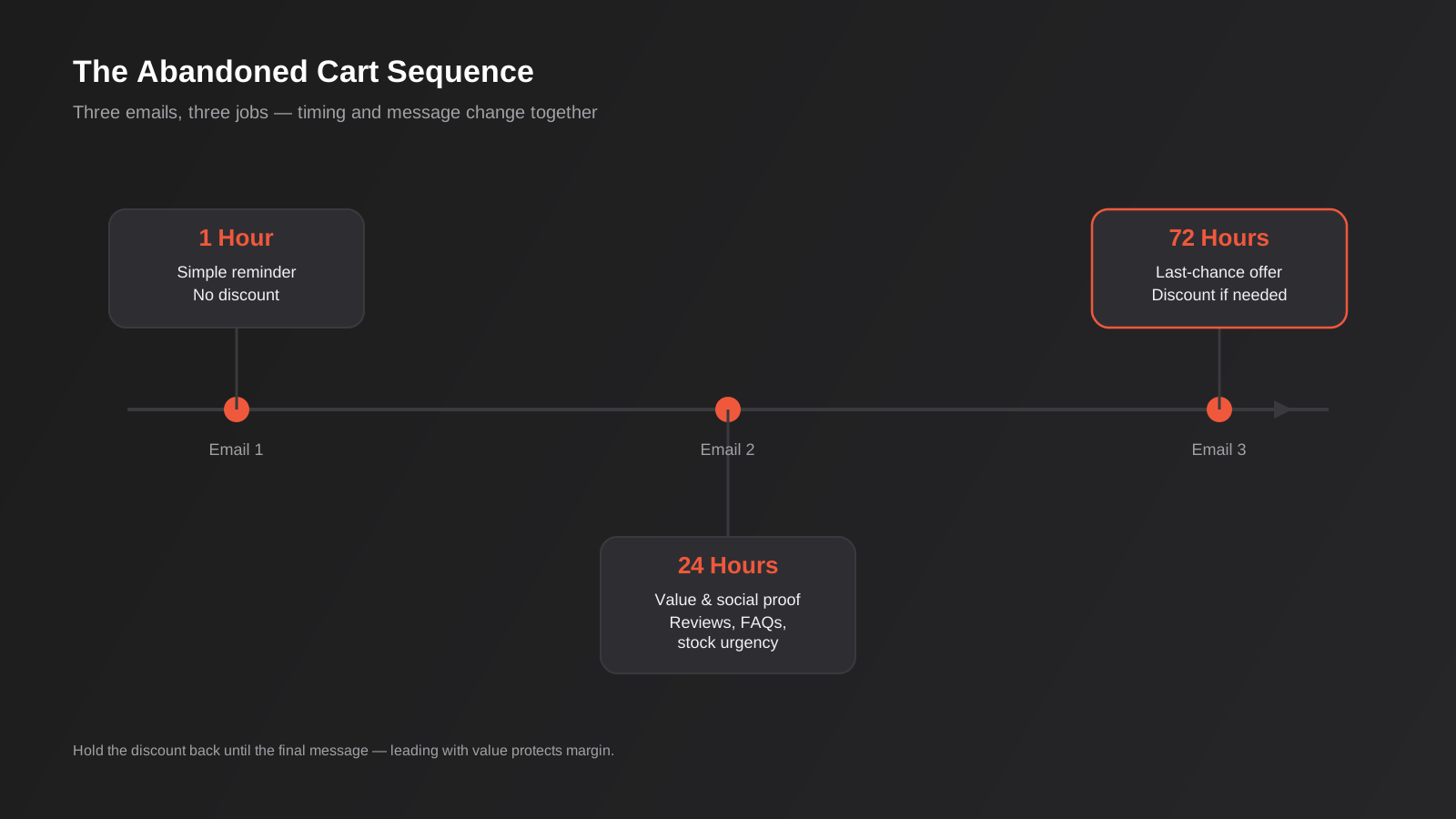
The first message matters more than the second and third combined. Sending within the first hour of abandonment consistently outperforms a next-day send, because intent is still fresh and the person may not have even closed the browser tab. A practical three-email structure looks like this:
- Email 1, around one hour: a simple, friendly reminder. “You left something in your cart” with a clear image and a direct link back. No discount yet.
- Email 2, around 24 hours: add value — reviews, answers to common questions, delivery information, or stock urgency if it’s genuinely limited.
- Email 3, around 48–72 hours: the last-chance message. If a discount is going to be offered, this is where it belongs.
Why the discount shouldn’t come first
This is the mistake we see most often, and it’s an easy one to fall into because it feels like the safest way to win the sale back. Lead every abandoned cart email with a discount code and you train your customer base to abandon carts on purpose, knowing a coupon is coming. Over time that erodes margin on sales you would have gotten anyway at full price. Reserve the discount for the final email in the sequence, and even then, consider limiting it to customers who haven’t purchased at full price before — a loyal repeat buyer often doesn’t need one to come back.
Beyond the cart: browse and checkout abandonment
Cart abandonment gets the attention because it’s the easiest to set up in most ecommerce platforms, but two related flows are worth adding once the core sequence is working. Browse abandonment targets someone who viewed a product repeatedly without ever adding it to a cart — lower intent than a cart abandoner, so the messaging should be softer and more informational. Checkout abandonment targets someone who started entering payment or shipping details and stopped — higher intent than a simple cart abandoner, often stalling on an unexpected cost or a technical hiccup, so the first message here should address friction directly rather than just reminding them the product exists. If you’re running this on Shopify or a similar platform, our guide to running a Shopify store in Australia covers the platform side of getting checkout and cart data flowing cleanly into these flows.
Segmentation: sending the right email to the right person
Flows handle behaviour at the individual trigger level. Segmentation is what makes sure the ongoing campaigns you send — and the branches within your flows — go to the right slice of your list instead of everyone at once. A promotion aimed at winning back lapsed customers makes no sense landing in the inbox of someone who ordered yesterday. An early-access email for your best customers loses its value if it goes to someone who has never bought anything.
Segment by behaviour, not just demographics
Demographic data — location, age, industry — has its place, particularly for geographic targeting or industry-specific messaging. But behavioural data is what actually predicts what someone wants to hear from you next: what they’ve bought, how often, how recently, and what they’ve clicked on but not purchased. Five segments cover most businesses well as a starting point.

How segmentation and flows work together
The two aren’t separate systems — the best setups use segmentation inside flows. A welcome flow can branch after email two based on whether someone clicked a link about a specific product category, sending category-relevant content from that point on rather than a generic sequence. An abandoned cart flow can check whether the customer has purchased before and skip the discount entirely for someone who reliably buys at full price. This is where email marketing stops being a series of one-off campaigns and starts behaving more like a genuine lifecycle system — which overlaps significantly with what we cover in marketing automation more broadly, since the logic connecting triggers, conditions and actions is the same regardless of which channel the message goes out on.
Post-purchase and win-back: the lifecycle beyond the first sale
Welcome flows and cart recovery get most of the attention because they’re the easiest to justify on paper — new subscriber revenue and recovered sales are simple to point to. But the emails that go out after someone has already bought are just as valuable, and they’re the part of the lifecycle most businesses skip entirely once the first two flows are running.
Order and post-purchase sequence
A confirmation email is table stakes and usually handled automatically by whatever platform processes the order. What’s worth adding on top is a short sequence in the days after delivery: a check-in asking whether the product arrived and met expectations, a review request timed to when the customer has actually had a chance to use it rather than the moment it ships, and — where relevant — a genuinely useful how-to or care guide. This is also where cross-sell suggestions perform best, because the customer has just demonstrated real purchase intent and trust, which is a very different context to cold traffic seeing the same product for the first time.
Replenishment and repeat-purchase reminders
If you sell anything that gets used up or replaced on a predictable cycle — skincare, supplements, pet food, printer supplies, anything consumable — a replenishment flow timed to that cycle is one of the highest-return automations available and one of the least commonly built. If the average customer reorders every 45 days, a reminder at day 35 to 40 catches them before they run out and before they’ve gone looking at a competitor out of necessity. This data usually already exists in your order history; it just needs to be pulled into a trigger rather than left in a spreadsheet nobody looks at.
Win-back for lapsed customers
Once someone crosses your lapsed threshold, resist the urge to jump straight to a large discount. A short sequence that starts with genuine value — what’s new, what’s changed, a reason to look again — performs better long-term than opening with a steep offer, for the same reason a discount-first cart abandonment email trains bad behaviour. Save the stronger incentive for a final message, and if that gets no response either, it’s usually better to suppress the contact from regular sends than to keep emailing someone who’s clearly disengaged. Continuing to send to unengaged addresses drags down your overall deliverability and can affect inbox placement for the rest of your list.
Testing and improving flows over time
A flow that’s been left untouched since launch is a flow that’s slowly going stale, even if nothing about it is technically broken. Products change, seasons change, and an offer that made sense when the flow was built can easily be running six months after it expired without anyone noticing, because nobody looks at automated emails the way they scrutinise a campaign they just sent.
What to test, in order of impact
Not every element of a flow is worth testing with equal priority. Timing changes — sending the first cart recovery email at 30 minutes instead of an hour, or adding a fourth welcome email — tend to move the needle more than subject line wording, simply because timing affects whether the email is relevant at all. Subject lines and preview text are worth testing next, since they determine whether the email gets opened in the first place. Body copy and layout matter, but usually less than people expect once the timing and subject line are already working. And whether or not to include a discount, and at what threshold, is worth testing directly rather than assuming — a smaller discount offered to everyone often outperforms a larger one offered only after someone doesn’t respond to two prior emails, and the answer differs by business.
A simple review cadence
Most businesses don’t need a complicated testing calendar — they need a recurring reminder to actually look. Reviewing flow performance quarterly is enough for most businesses: check whether the offers referenced are still current, whether performance has drifted from when the flow was first built, and whether a new segment or trigger has emerged worth building a flow around. Growing ecommerce stores in particular tend to outgrow a single generic flow structure within twelve months as their product range and customer base diversify, so treat the first version of any flow as a starting point rather than a finished asset.
Choosing a platform without over-engineering it
The tool matters less than most vendors would like you to believe, but it does need to fit your business model. A few practical distinctions:
- Ecommerce-first platforms (Klaviyo, Omnisend) integrate deeply with Shopify and WooCommerce, pulling in order history, browse behaviour and product catalogues automatically. If you run a store, this category is usually the right starting point.
- General-purpose marketing platforms (Mailchimp, ActiveCampaign) work well for service businesses, content-driven brands and anyone without a transactional storefront driving the data.
- CRM-integrated platforms (HubSpot, and similar tools tied into a sales pipeline) suit B2B businesses where email needs to talk to sales activity — deal stages, lead scoring, sales rep hand-offs — rather than just purchase history.
Whichever you choose, the platform needs clean data flowing in from your website and, if relevant, your CRM. A beautifully built flow sending the wrong product recommendations because your product feed isn’t syncing properly will underperform a simpler flow built on accurate data every time. If your store or CRM data isn’t integrating cleanly with your email platform today, that’s usually a bigger lever than rewriting the emails themselves.
Migrating platforms is worth doing carefully rather than often. Every migration risks losing flow history, segment definitions and, if it’s handled badly, sender reputation built up on the old sending domain. If you’re already mid-way through a broader platform migration — moving your store or website to a new system — it’s worth mapping the email platform dependencies before the migration starts, not after something breaks. A common, avoidable failure is losing suppression lists and unsubscribe history in a switch, which can mean re-sending to people who deliberately opted out under the old system — a compliance problem as well as a trust one.
Compliance: the Spam Act isn’t optional
Australian businesses sending commercial email need to work within the Spam Act 2003 and the guidance the ACMA publishes around it. Three requirements matter most in practice. First, consent — you need express or reasonably inferred consent before sending commercial email, which for most businesses means a clear opt-in on your signup form rather than a pre-checked box or a purchased list. Second, identification — every commercial email needs to clearly identify your business and how to contact it. Third, a functioning unsubscribe — every email needs a working opt-out mechanism, and requests need to be honoured within the timeframe the Act specifies, not just eventually.
None of this is a reason to avoid automation — it’s a reason to get the signup and consent flow right at the start, so every automated email downstream is already compliant by construction rather than something you have to audit later. Most reputable email platforms build the technical side of this in (one-click unsubscribe, sender identification), but the consent piece is on you and your signup forms.
Measuring what actually matters
Open rate is the easiest metric to look at and one of the least useful on its own, particularly since Apple Mail Privacy Protection and similar changes have made open tracking unreliable across a large share of any list. For flows specifically, revenue per recipient and conversion rate per flow tell you far more than open rate ever will. Report at the flow level, not just the account level — a welcome flow and a cart abandonment flow will have completely different benchmarks, and blending them into one average hides which one actually needs attention.
Deliverability deserves its own line of attention too. A flow with great copy and perfect timing is worthless if it’s landing in spam. Watch bounce rate, spam complaint rate and inbox placement, not just clicks. If your conversion rate across email traffic looks worse than your other channels, deliverability and list hygiene are usually the first place to look before touching the creative.
Common mistakes
- Leading with a discount in the first cart abandonment email. It trains customers to abandon on purpose and erodes margin over time.
- Sending the welcome email hours or days after signup. Interest peaks at the moment of signup and decays fast — speed is the whole point of the flow.
- Building flows once and never touching them again. Product ranges change, offers expire, and a flow built two years ago is often still referencing a promotion that ended long ago.
- Treating open rate as the primary success metric. It’s the least reliable number on the dashboard and the easiest to over-index on.
- Segmenting by demographics alone. Behavioural data — what someone has actually done — predicts intent far better than who they are on paper.
- Buying or scraping an email list. It breaches the Spam Act’s consent requirements and tanks deliverability for every other email you send from that domain.
- Ignoring mobile rendering. A large share of any list opens email on a phone; a flow that looks broken on mobile is losing revenue silently.
Frequently Asked Questions
How many emails should a welcome flow have?
Three to five is the practical range for most businesses. Fewer than three usually means missing the chance to build trust before asking for a sale; more than five tends to see diminishing engagement, since attention has already moved on by the second week.
Do service businesses need an abandoned cart flow if they don’t sell products online?
Not in the literal sense, but the same logic applies to abandoned quote requests, incomplete booking forms or unfinished consultation sign-ups. Any point where someone starts an action and doesn’t finish it is worth an automated follow-up, whether or not a shopping cart is involved.
How long should we wait before someone is considered “lapsed”?
It depends heavily on your typical purchase cycle. A business selling consumables people reorder monthly might define lapsed as 60 days of inactivity; a business selling something bought once every two years needs a much longer window. Look at your own repeat purchase data before picking a number rather than copying a generic benchmark.
Is it worth paying for a premium email platform if our list is small?
Usually not yet. The flows and segmentation logic in this guide can be built on most mid-tier platforms once your list has enough volume to make automation worthwhile. The bigger factor is usually how cleanly your website or store data connects to whatever platform you choose, not how many features the platform advertises.
Can we run email automation ourselves, or does it need an agency?
Plenty of businesses build and maintain their own flows successfully, particularly once the initial setup is done. Where it tends to get outsourced is the integration work — connecting a store or CRM cleanly to the email platform — and the ongoing strategy of reviewing performance and refreshing flows as the business changes.
What’s the difference between email marketing and marketing automation?
Email marketing is one channel; marketing automation is the broader system of triggers, conditions and actions that can span email, SMS, CRM updates and more. Everything in this guide is technically a marketing automation concept applied specifically to email — the same logic extends to other channels once the email side is working well.
Where to start
If none of this exists yet, start with the welcome flow and, if you sell products online, abandoned cart recovery straight after. Those two cover the highest-intent moments in any subscriber relationship — the first impression and the near-miss purchase — and they’ll teach you more about what your list responds to than a year of one-off campaigns will. Segmentation and the more advanced lifecycle flows can layer on once those two are running cleanly and you can see what the data is actually telling you.
If you’d rather talk through what this would look like for your business specifically — what data you’ve already got, what platform makes sense, and which flows would move the needle first — we’re happy to have that conversation. You can see how we approach email marketing as part of a broader growth strategy, or get in touch directly and we’ll talk through where the gaps actually are.
Keep reading
Related posts
Best Email Marketing Platforms for Australian Businesses (2026): 6 Compared
Six email marketing platforms compared for Australian businesses — real pricing, ecommerce depth and AU data hosting, from Mailchimp to Vision6.
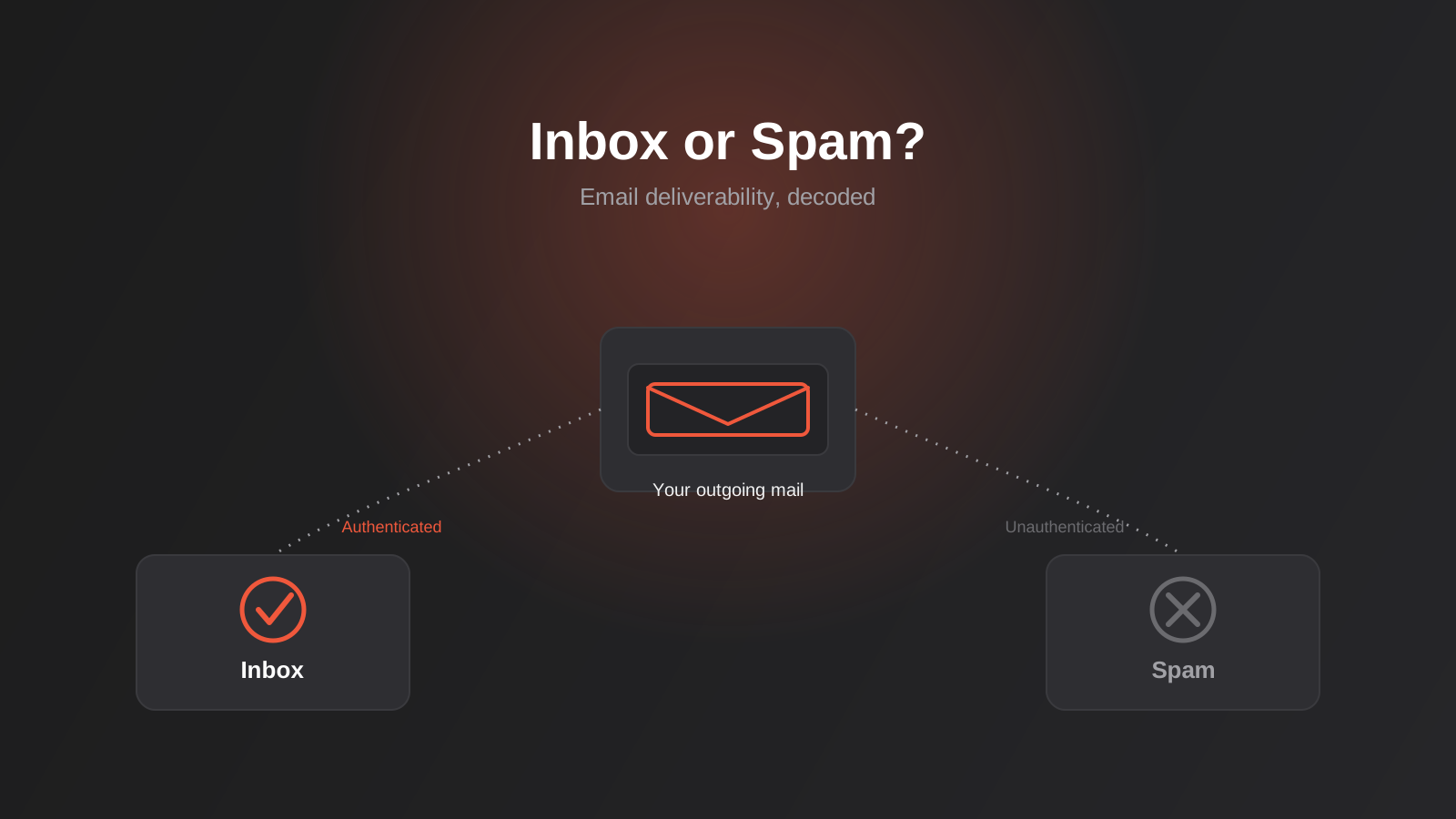
Email Deliverability in Australia: The SPF, DKIM, DMARC and Spam Act Guide for 2026
A practical 2026 guide to SPF, DKIM and DMARC, Gmail and Yahoo's bulk sender rules, and the Spam Act 2003 obligations Australian…
Email vs SMS Marketing: Which Channel Should Your Australian Business Use? (2026)
Email or SMS? Real Australian cost benchmarks, ACMA's new Sender ID Register rules, and a practical framework for which message suits which…
Got a project you'd like to talk through?
Tell us what you're working on — we'll come back with a plan.
