
Best Ecommerce Platforms for Australian Retailers in 2026: Six Options Compared
 Jignesh Vagadiya
23/10/2026
21 min read
Most “best ecommerce platform” lists are written by someone who gets paid when you click a signup link, and it shows. Every platform is “powerful yet easy to use”, every drawback is a polite euphemism, and the pricing is in US dollars with no mention of GST, Afterpay or whether anyone in your timezone will pick up the phone. This one is written by an agency that builds stores for Australian retailers, so we should be upfront about our bias: we work heavily with Shopify, and you will see that in the verdicts. We’ve tried to correct for it by giving every platform a real weakness and saying plainly who should skip it.
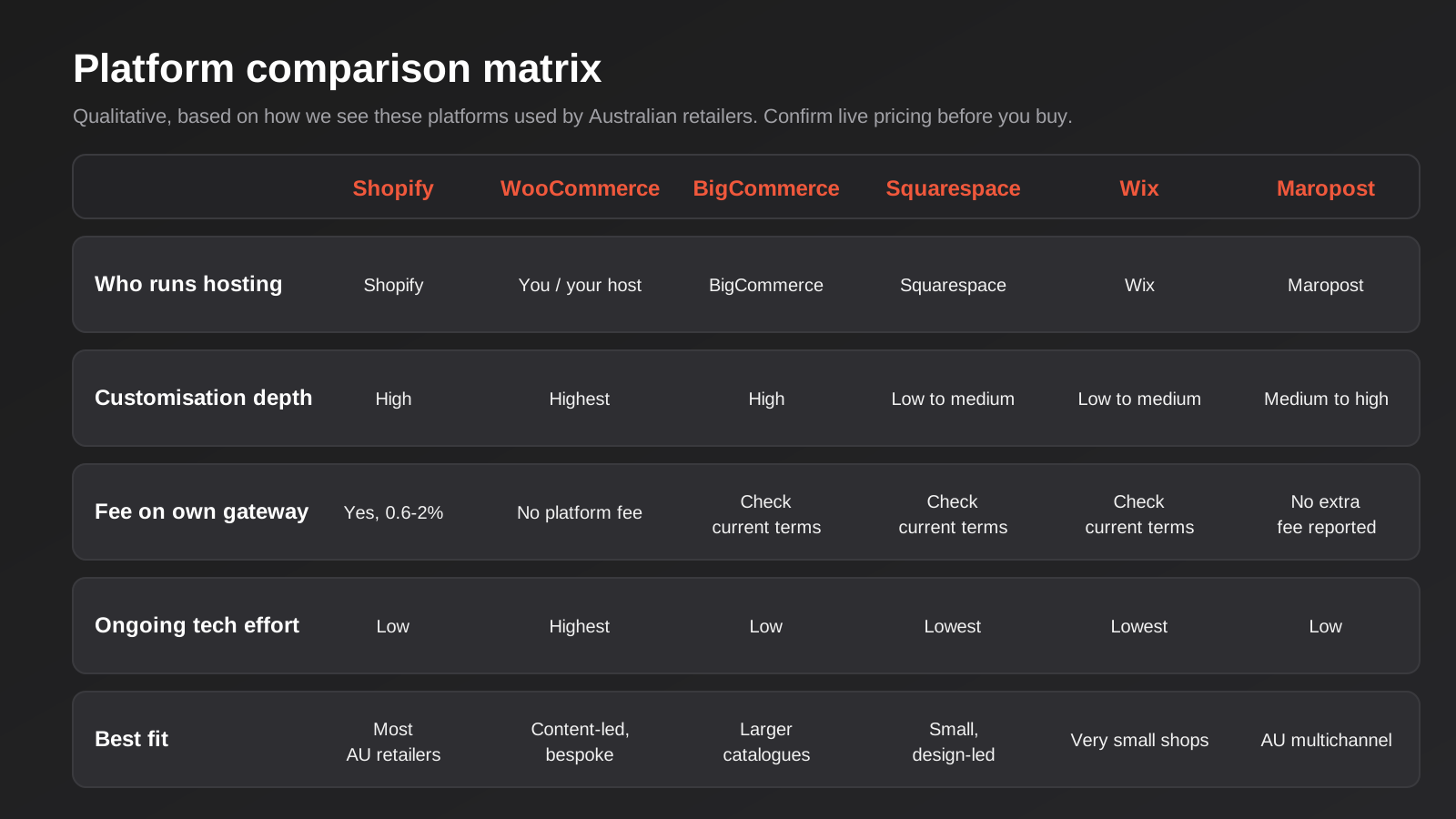
We looked at six of the best ecommerce platforms Australia’s retailers actually choose between: Shopify, WooCommerce, BigCommerce, Squarespace, Wix and Maropost Commerce. We left out enterprise stacks like Adobe Commerce and Salesforce Commerce Cloud, because if you’re shopping for those you’re not reading a round-up, and we left out marketplace-only selling such as eBay or Amazon storefronts, which is a sales channel rather than a platform. For each one we’ve checked current pricing where it’s published and flagged the cases where it isn’t or where sources disagree, because a confident wrong number is worse than an honest “ask for a quote”.
Our criteria were the things that bite Australian merchants specifically: how GST and local payment methods are handled, what the platform charges when you use a gateway it doesn’t own, how much technical upkeep falls on you, how deep the local agency and app ecosystem runs, and what it costs to leave. Design templates and feature checklists matter far less than people think, because most of those gaps close with an app or a day of development. The things that don’t close easily are fee structures, lock-in and maintenance burden, so that’s where we spend our time.
Shopify
What it is. A fully hosted ecommerce platform where Shopify runs the servers, security, checkout and core updates, and you pay a monthly subscription plus payment processing. It’s the default choice for most Australian online retailers for good reason: it’s the platform with the deepest local ecosystem of themes, apps, freelancers and agencies.
What it does well. Launch speed and reliability. A competent store can go live in a few weeks, checkout converts well out of the box, and the platform handles traffic spikes without you thinking about servers. Australian essentials are well covered: GST is handled automatically, Shopify Payments is available to Australian merchants, and Afterpay and Zip work through the checkout. The app store is enormous, which means almost any requirement, from subscriptions to wholesale pricing to inventory sync, already has a tool built for it. For accounting, integrations to Xero and MYOB are mature; we’ve written up how a proper Xero and Shopify integration handles GST mapping and payout reconciliation, because the default connectors leave gaps once volume grows.
Where it falls short. The cost stack. The plan fee is only the start. If you use a payment gateway other than Shopify Payments, Shopify adds its own transaction fee on top of what the gateway charges, and apps quietly accumulate into a second monthly bill. Checkout customisation is restricted on lower plans, so anything unusual at checkout tends to push you toward Plus. Content and blogging are serviceable but thinner than WordPress. And you’re renting: you can export products and customers, but the store itself doesn’t travel.
What it costs. On monthly billing in Australian dollars, the main plans currently sit at roughly $56 for Basic, $149 for Grow and $575 for Advanced, with annual billing bringing each down meaningfully. Online card rates through Shopify Payments run about 1.75% plus 30 cents on Basic, falling to roughly 1.6% on Grow and 1.4% on Advanced. Using an outside gateway adds a platform fee of around 2% on Basic, 1% on Grow and 0.6% on Advanced. Shopify Plus is a negotiated contract that starts around $3,700 a month. Currency conversion fees apply if you settle in a different currency from the one customers pay in. Treat all of that as a snapshot and confirm it on Shopify’s own Australian pricing page before you budget, because plan fees and rates get adjusted.
Who it suits. Most Australian retailers from a first store through to a few million in annual revenue, especially if you want to launch quickly, sell across several channels, or plan to connect accounting and inventory systems. It’s a poorer fit if you need heavy content publishing as your main acquisition channel, or complex bespoke logic that doesn’t fit Shopify’s data model. If you’re weighing it against the main alternative, our deeper comparison of Shopify vs WooCommerce for Australian businesses covers GST, hosting and migration trade-offs in detail.
WooCommerce
What it is. A free, open-source ecommerce plugin for WordPress. You install it on your own hosting and own the entire stack: code, database, design and data. There’s no platform subscription, which is why it looks cheap on a comparison chart and why that chart is misleading.
What it does well. Control and flexibility. If you can imagine a pricing rule, a product type or a checkout flow, someone has probably built a plugin for it, and if not, a developer can build it without asking a platform for permission. Because it sits on WordPress, it’s also the strongest option when content matters as much as the catalogue: guides, a serious blog, landing pages and SEO work all live in one system. There’s no platform transaction fee on your own gateway, so using Stripe, PayPal or Afterpay through plugins doesn’t attract a surcharge from WooCommerce itself.
Where it falls short. Everything Shopify does for you becomes your job. Hosting, security patches, plugin updates, backups, performance tuning and the occasional conflict between two plugins that were never tested together. A WooCommerce store that nobody maintains slowly turns into a liability, and a store that gets hacked at 4pm on a Friday is a bad way to learn that the “free” platform had a cost. Performance at scale takes deliberate engineering. Checkout is also yours to get right, whereas Shopify’s has been tuned across millions of stores.
What it costs. The plugin is free, but you’ll pay for hosting, a theme if you don’t build one, premium extensions and ongoing maintenance. Hosting ranges from budget shared plans that struggle under real traffic to managed WordPress hosting built for stores, and we’d rather you get current quotes than trust a number from us. Payment processing through WooPayments in Australia is listed at 1.75% plus 30 cents for standard card payments, with extra charges for international cards and currency conversion, and GST applies to WooCommerce’s own fees unless you’re GST-registered and supply your details. If you use Stripe or PayPal directly, their own published rates apply instead.
Who it suits. Content-led retailers, businesses with unusual product or pricing logic, and teams with a developer or agency on retainer who will actually look after the site. If you’re on WooCommerce today and finding the upkeep wearing, moving isn’t painful when it’s planned properly; our guide to migrating from WooCommerce to Shopify covers what has to carry across so rankings and customer accounts survive. It’s a poor fit if your honest plan is to set it up once and leave it alone.
BigCommerce
What it is. A hosted platform in the same broad category as Shopify, with a reputation for shipping more features in the core product and relying less on paid apps. It’s more common in mid-market and B2B builds than in first-store setups.
What it does well. Built-in capability. Multi-currency, product options and variants, and a good chunk of B2B functionality come as part of the platform rather than as separate subscriptions, which can make the running cost easier to predict for a catalogue with complicated products. It has a solid API for integrating with ERPs and inventory systems, and it lets you run a headless front end if you ever outgrow standard themes.
Where it falls short. The Australian ecosystem is much smaller. Fewer local agencies know it well, fewer Australian-built apps and integrations exist, and when something unusual breaks you may wait longer for someone who has seen it before. Pricing is published in US dollars, so confirm what you’ll actually be billed and how GST and exchange rates apply. The more important catch is the revenue thresholds: BigCommerce ties plan tiers to annual online sales and moves you up a plan when you cross them, which means your platform cost rises with success rather than with the features you actually use.
What it costs. The commonly published monthly-billing prices are around US$39 for the entry plan, US$105 for the middle plan and US$399 for the upper plan, with cheaper annual billing. Be careful here, because BigCommerce reportedly reworked its plan names and sales thresholds during 2026 and added fees for processing payments through gateways outside an approved list. Several comparison sites still describe the older structure, and we couldn’t verify the new one against BigCommerce’s own pricing page. Get the current figures directly, and ask specifically about your payment gateway.
Who it suits. Retailers with large or complex catalogues, B2B and wholesale models, or an existing development team that wants a clean API and doesn’t need a big local agency pool. It’s a harder sell for a small shop, mainly because Shopify’s ecosystem advantage matters more the smaller your internal team is.
Squarespace
What it is. A design-led website builder with ecommerce bolted into its plans. It started as a place for portfolios and brand sites, and the selling features have grown over time, but its centre of gravity is still the website rather than the store.
What it does well. Appearance and simplicity. The templates are polished, the editor is genuinely easy, and a small brand with a handful of products and strong imagery can look better here than on a lot of heavily customised stores. Hosting, security and updates are handled for you, and one login covers the whole site, blog included.
Where it falls short. Depth. Once you need complex variants, sophisticated discounting, deep inventory management, wholesale pricing or serious integrations, you hit ceilings that Shopify and WooCommerce don’t have. Customisation beyond the template system is limited. And payments need a close look: Squarespace’s own payments product is only available in certain countries, so Australian merchants typically rely on Stripe or PayPal, and you should confirm the current position and the transaction fee on your plan before committing. Sources disagree on current Australian pricing, which is itself a reason to check.
What it costs. Squarespace restructured its plans in 2025 and 2026 into Basic, Core, Plus and Advanced tiers, and the published prices we found were either in US dollars or from older plan structures, so we won’t quote a figure we can’t stand behind. Expect a monthly plan fee in the tens of dollars rather than hundreds, add card processing from your gateway, and check whether your tier carries an extra commerce fee on top of it.
Who it suits. Small, design-conscious brands selling a limited range, creators selling a few products, and service businesses with a small shop attached. If you expect to double your catalogue, add wholesale or connect an inventory system within a year, start on something with more headroom rather than paying twice.
Wix
What it is. A drag-and-drop website builder that offers ecommerce through its Business plans. It’s the most beginner-friendly option on this list and has a large template library and a lot of built-in marketing tools.
What it does well. Getting started. A non-technical owner can build a working shop in a weekend without hiring anyone, and the all-in-one setup means hosting, domain, store and basic marketing live under one roof. For a very small catalogue or a side business testing demand, the low barrier is a real advantage.
Where it falls short. Portability and growth. A Wix site’s design and structure can’t be exported to another platform in any usable way, so leaving means rebuilding rather than moving. Page speed and SEO control are more constrained than on WordPress or Shopify, and heavier ecommerce needs such as large catalogues, complicated shipping rules or accounting integrations tend to need workarounds. We see businesses outgrow it more often than any other platform on this list, and the rebuild is the expensive part.
What it costs. Wix reorganised its plans in 2025. One 2026 source lists the paid tiers from the high teens to just under US$160 a month on annual billing, with ecommerce available on the Business tiers, but that’s US currency and we couldn’t find a current Australian price list. Check the Australian pricing page, and ask what the transaction and payment fees are on the plan you’d actually need.
Who it suits. Very small shops, hobby businesses and first experiments where speed and a low starting cost matter more than scale. It isn’t what we’d pick for anyone who already knows the business will need integrations, a big catalogue or serious organic search.
Maropost Commerce
What it is. The platform many Australians still call Neto. It’s a hosted ecommerce platform with an Australian history, built around retailers who sell across several channels at once and need inventory, orders and fulfilment managed from one place.
What it does well. Multichannel operations. Where Shopify tends to rely on apps for marketplace listings and inventory control, Maropost builds more of that into the core, which suits retailers juggling a website, eBay, marketplaces and wholesale from a single catalogue. Its local roots show up in Australian shipping and payment integrations, and Maropost’s own material says it doesn’t add platform transaction fees on top of what your gateway charges.
Where it falls short. The ecosystem and the polish. There are far fewer themes, apps and agencies than around Shopify, so you depend more on Maropost’s own team and a small pool of specialists. Storefront design flexibility is tighter, and reviews on Australian software sites are mixed, with some customers praising the value and others criticising support. That’s a signal to talk to a current customer in your category before you commit rather than a reason to rule it out.
What it costs. Published tiers have historically been structured around the number of sales channels and order volume, with a custom-priced enterprise level. A third-party listing showed entry pricing in the low-to-mid hundreds a month, but it didn’t state the currency and we couldn’t confirm a current Australian price. Ask Maropost for a written quote against your actual channels and order volumes.
Who it suits. Established Australian retailers whose real complexity is stock and channels rather than storefront design, particularly those already on it who are deciding whether to stay. For a first online store, you’ll usually get a smoother start and a larger talent pool elsewhere.
Payments, GST and Other Australian Details That Change the Maths
Payment fees deserve more attention than they usually get, because they scale with your sales while the plan fee doesn’t. A store turning over $20,000 a month and paying an extra percentage point to a gateway the platform doesn’t own is giving up $2,400 a year for nothing. That’s why the fee on an outside gateway is the number we check first on any hosted platform, and why Shopify Payments, WooPayments and a direct Stripe account each deserve a proper side-by-side before you pick.
Buy now, pay later is the second thing. Australian shoppers expect Afterpay or Zip at checkout in categories like fashion, homewares and electronics, and the way each platform supports them differs. On a hosted platform it’s usually a settings change. On WooCommerce it’s a plugin that has to be kept current. Either way, the BNPL provider charges the merchant a higher rate than a normal card, so model it into your margins rather than treating it as a free conversion boost.
GST sounds trivial and isn’t. Check that prices display the way your customers expect, that tax-exempt and international orders are handled correctly, and that what the platform records ends up in your accounts in a form your bookkeeper can reconcile. Platform subscription fees themselves attract GST, which matters when you compare a price quoted ex-GST against one quoted inclusive. Most of the money lost to this isn’t lost to errors in the platform but to the gap between the platform and the accounting package, which is a reason to test the integration early.
Shipping is the third. Australia Post, Sendle and the big carriers all have integrations, but the quality varies by platform, and rural delivery pricing, parcel lockers and click-and-collect each add setup work. If shipping is a significant part of your margin, make carrier-calculated rates a requirement during selection rather than a task for after launch.
Last, there’s support. A platform with a 24-hour support queue in another timezone is a different proposition from one with a local team or a local agency pool when your store breaks the afternoon before a sale. That doesn’t decide the choice by itself, but it’s worth asking every vendor and agency what happens, and how fast, when something critical fails outside US business hours.
How to Choose
Start with who will look after the store in two years, not who will build it this quarter. If the honest answer is “nobody in particular”, that rules out self-hosted WooCommerce and points you toward a hosted platform where maintenance isn’t your problem. If you have a developer or an agency on call and the business needs something the hosted platforms can’t do, WooCommerce comes back into play.
Then look at where the money goes after launch. Plan fees are the visible part. What changes the picture is payment fees, the apps you’ll need to replace missing features, thresholds that move you up a tier as you grow, and the cost of getting out if it stops fitting. Run the numbers for the store you expect to have in twelve to eighteen months, because a platform that is cheapest at ten products can be the most expensive at a thousand.
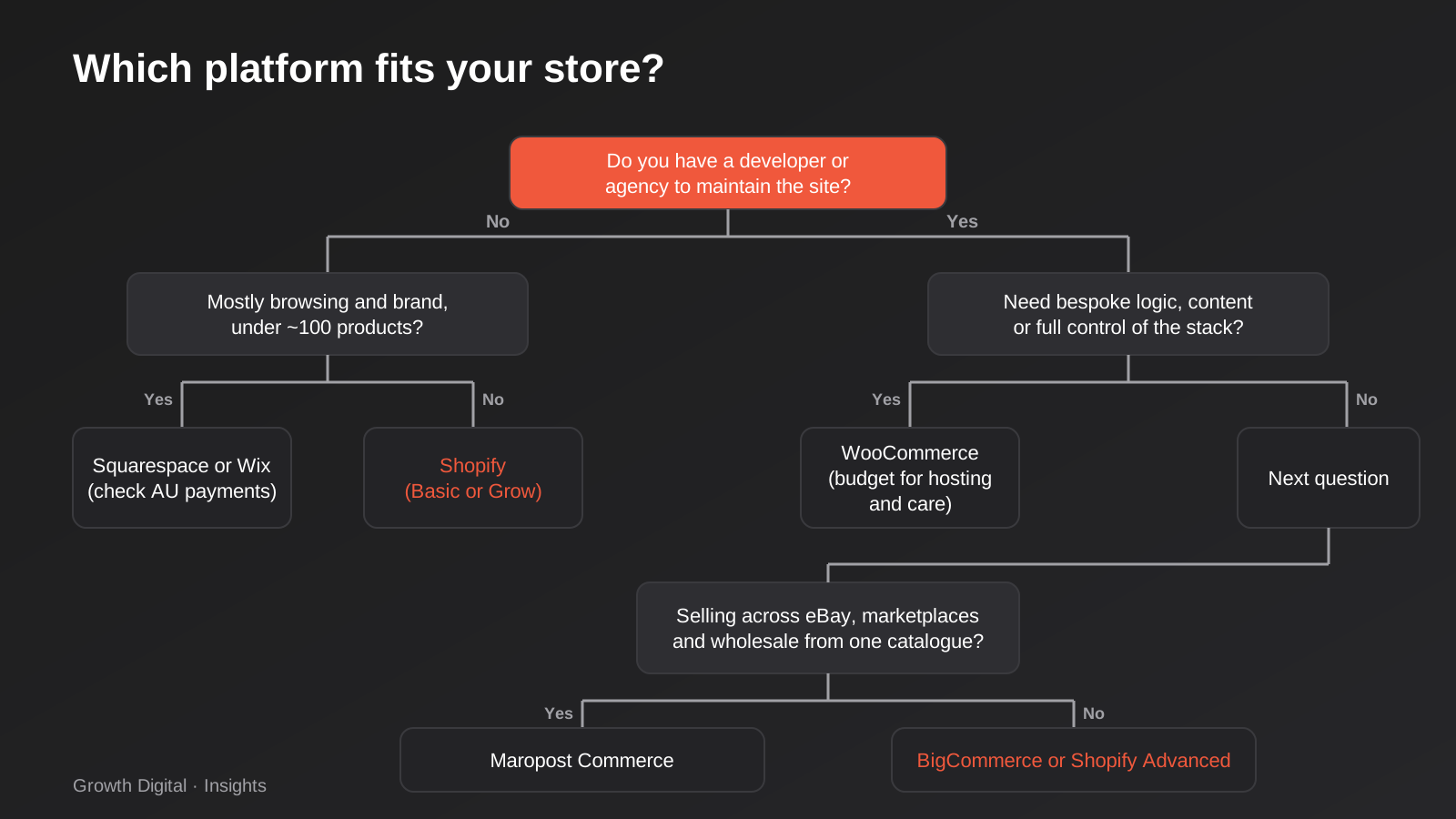
A few shortcuts we use in practice. If you want a store live quickly, expect to grow, and will connect accounting or inventory systems, Shopify is the safe default. If content and search are your main acquisition engine and you have technical support, WooCommerce deserves a proper look. If your catalogue is small and your brand carries the sale, Squarespace or Wix can be perfectly reasonable starting points, as long as you accept that growth may mean a rebuild. If your difficulty is channel and stock complexity rather than the storefront, put Maropost and BigCommerce on the shortlist and push both for written quotes.
The platform subscription is only half the cost of getting a store online. Building it is the other half, and that’s where quotes diverge most. As a rough guide, Australian agencies typically charge around $2,000–$8,000 to configure a premium theme store with a modest catalogue, $10,000–$30,000 for a custom-designed theme with real functionality, and $30,000 and well beyond for Shopify Plus or complex integration work. If you want the full breakdown, we’ve covered it in our guide to what a Shopify store costs in Australia, including the questions that make two quotes comparable.
Common Mistakes When Choosing a Platform
- Choosing on the headline monthly fee. A $30 plan with a 2% transaction fee and four paid add-ons can cost more than a $150 plan that includes what you need.
- Treating WooCommerce as free. The software is free. Hosting, security, updates and developer time are not, and they don’t stop after launch.
- Ignoring the exit. Ask how you’d get your products, customers, order history and URLs out before you commit. Some platforms make that easy and some make it a rebuild.
- Buying for the business you hope to be in five years. Enterprise functionality you won’t use for years is expensive insurance. Pick for the next eighteen months, with a credible upgrade path.
- Forgetting Australian specifics. Check GST handling, Afterpay or Zip support, Australia Post and carrier integrations, local support hours and whether your accounting package connects cleanly.
- Letting a template decide. A beautiful demo store tells you nothing about checkout behaviour, fees or maintenance. Judge the platform and treat the theme as a skin.
- Skipping the integration conversation. If stock, orders or invoices have to flow into Xero, MYOB or an ERP, test that connection first. It’s usually where the surprises are.
- Migrating without an SEO plan. Changing platforms resets URLs, redirects and templates. Done carelessly it costs you rankings you spent years earning.
Frequently Asked Questions
What is the best ecommerce platform for a small Australian business?
For most small retailers it’s Shopify, because it’s quick to launch, handles GST and local payment options well, and doesn’t leave you maintaining a server. Squarespace or Wix can work if you sell a handful of products and care more about design than operations. WooCommerce makes sense mainly when content is central and someone technical will look after the site.
Is Shopify or WooCommerce cheaper in Australia?
WooCommerce usually looks cheaper at the start because the software is free, but you pay for hosting, maintenance and developer time instead. Shopify’s cost is more visible: a monthly plan, card processing fees and any paid apps. Over a couple of years the totals are often closer than people expect, and the right choice depends more on who maintains the store than on the sticker price.
Do I pay GST on ecommerce platform subscriptions?
Generally yes, platform subscriptions and fees are treated like other software services, and some vendors show prices excluding GST. If you’re registered for GST you can usually claim it back as a business expense. Check whether any price you’re comparing includes or excludes GST, and speak to your accountant about your own situation.
Can I switch ecommerce platforms later without losing my SEO?
Yes, but it has to be planned. You need to map old URLs to new ones with redirects, carry across titles and descriptions, keep structured data intact and monitor rankings in the weeks after launch. Most traffic losses come from skipped redirects and changed page structure rather than the platform itself.
Which platform is best for selling on eBay and marketplaces as well?
Maropost Commerce was built around multichannel selling and handles it natively, while Shopify and BigCommerce cover it through integrations and apps. If you run a single catalogue across your website, eBay and wholesale, test the stock-sync behaviour with real products before you commit, because that is where multichannel setups usually fail.
How long does it take to launch an online store?
A template-based Shopify build with a modest catalogue typically takes a few weeks with an agency. Custom designs and integrations stretch that to a couple of months or more. The usual cause of delay is content: product photography, descriptions and pricing that isn’t ready when the build is.
Where to Start
Before comparing anything, write down four things: how many products you’ll have in a year, which channels you’ll sell through, which systems the store needs to talk to, and who will look after it after launch. Those four answers usually knock the shortlist down to two platforms, and the comparison gets much easier from there.
If Shopify is one of the two, our Shopify pricing page lays out what a build costs with us, kept separate from Shopify’s own subscription so you can see both numbers clearly. If you’d rather talk through the choice before committing to a platform, send us the four answers above and we’ll tell you which way we’d lean, including when the honest answer isn’t Shopify.
Worth putting a number on it: our own Shopify builds start from $3,000 excluding GST, which sits toward the lower end of the $2,000–$8,000 most Australian agencies charge for a template-based store of comparable scope. If you’ve already got a written quote from another agency for comparable scope, send it through and we’ll do our best to beat it.
Keep reading
Related posts
How to Bulk Update Shopify Prices From a Supplier Price List (Without Breaking Your Catalogue) (2026)
How to update Shopify prices in bulk from a supplier spreadsheet: SKU matching, cost vs sell price, GST, compare-at prices, and a…
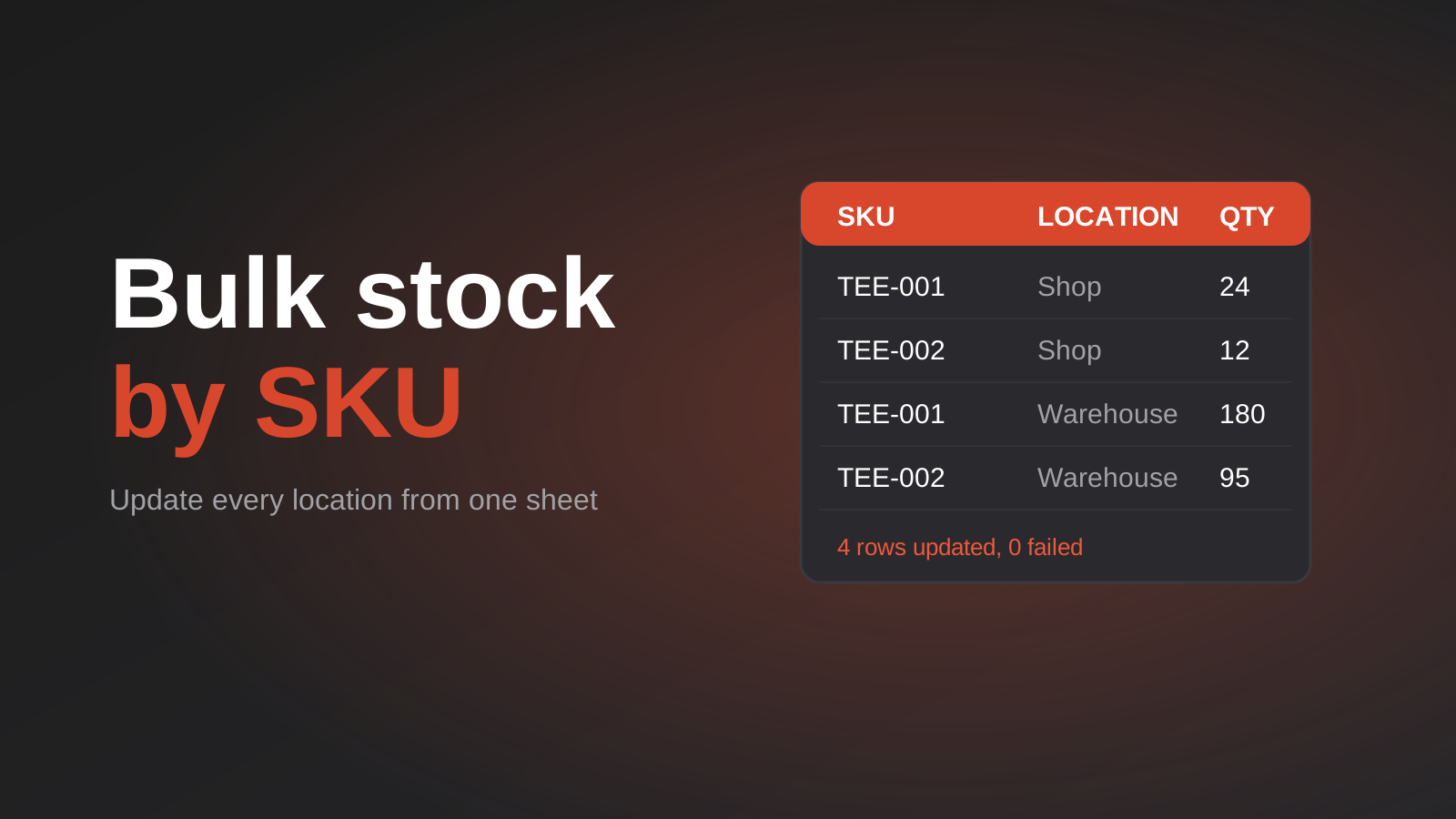
How to Update Shopify Inventory in Bulk by SKU: A Spreadsheet Workflow for Multiple Locations (2026)
A practical spreadsheet workflow for updating Shopify stock in bulk by SKU across multiple locations, with the traps that corrupt inventory and…
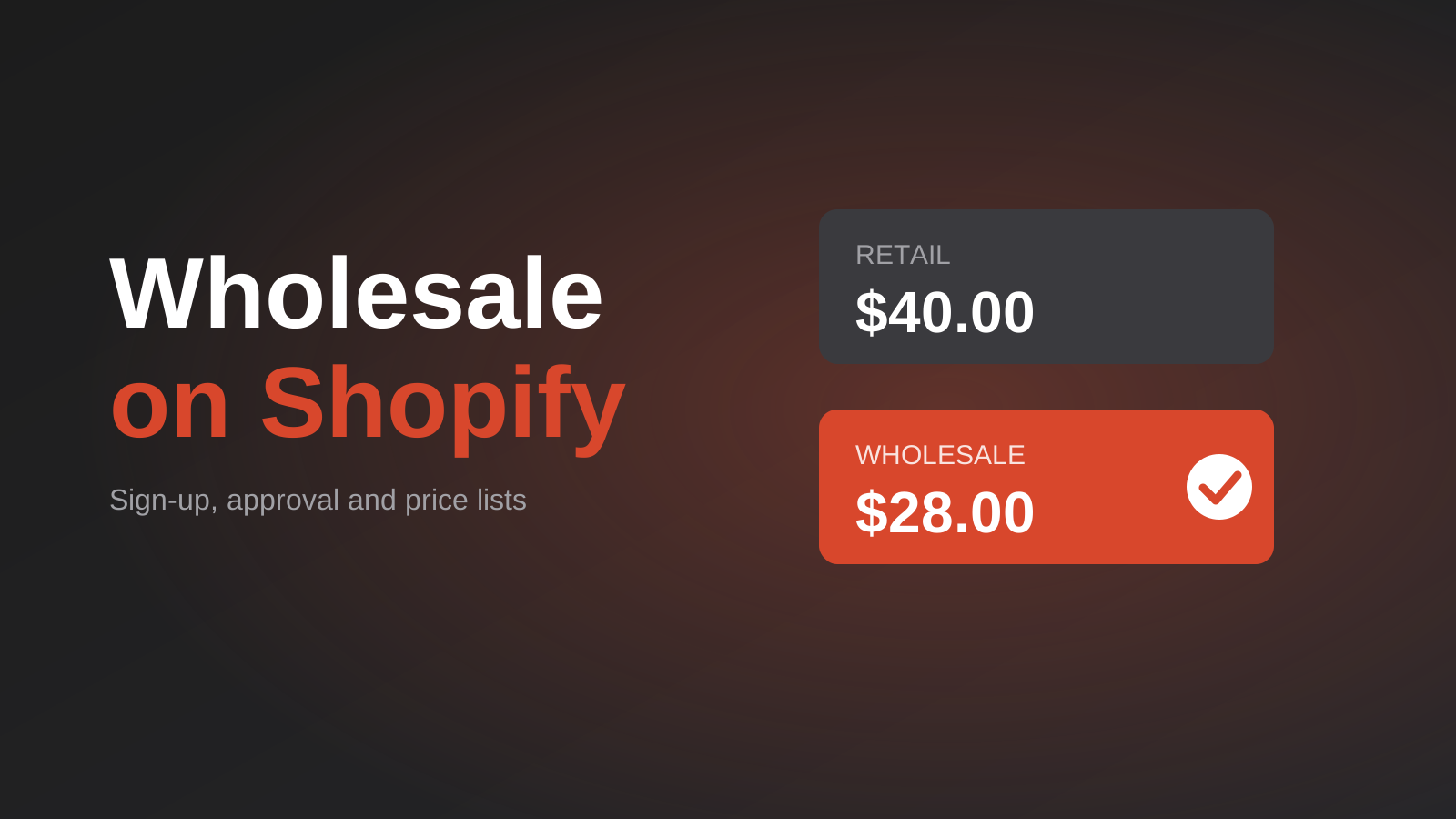
How to Set Up Wholesale Pricing on Shopify: Sign-Up, Approval and Price Lists (2026)
How to add wholesale pricing to a Shopify store: the options, how to decide who qualifies, structure price lists and tiers, handle…
Got a project you'd like to talk through?
Tell us what you're working on — we'll come back with a plan.
