
Retail Media Networks in Australia: Cartology, Coles 360 and Whether Your Brand Should Buy In (2026)
 Jignesh Vagadiya
15/11/2026
21 min read
Walk into a Woolworths and look up at the shelf-edge screens near the deli, or open the app and notice the “sponsored” tag sitting quietly under a product you didn’t search for. That’s not a glitch in the recommendation engine. It’s media, bought and sold the same way a banner ad on a news site is bought and sold — except the publisher here is the supermarket, and the audience data behind it is your loyalty card.
Retail media networks in Australia are now a genuine line item in marketing budgets, not a curiosity agencies mention in passing. Cartology, Woolworths’ media arm, and Coles 360 between them are estimated to bring in close to a billion dollars a year, and Bunnings, Myer, Chemist Warehouse and a handful of others are actively building their own versions of the same model. IAB Australia’s 2026 State of the Nation research found the large majority of active buyers increased spend here over the past year, which is the kind of number that gets a channel onto a CMO’s agenda whether or not anyone fully understands how it works yet.
We get asked about this a lot more than we did eighteen months ago, almost always by a brand that already sells through an ecommerce platform or a marketplace and has started hearing the term “retail media” from a supplier rep, a trade partner or a competitor’s LinkedIn post. This guide is for that brand: what retail media networks actually are, who can buy into them, what they cost, and the honest answer to whether your business should be spending time on this before you’ve got Google, Meta and your own site working properly first.
What retail media actually is, and why it’s not Amazon Ads or Google Ads
Retail media is advertising sold by a retailer, using the retailer’s own first-party shopper data, placed somewhere that data makes the ad genuinely targeted — on the retailer’s website or app, in its physical stores, or increasingly on other publishers’ sites where the retailer’s data is used to target the buy. The thing that makes it different from a normal display or search ad is who owns the targeting signal. Google knows what someone searched. Meta knows who someone is and what they engage with. A retailer with a loyalty program knows what that exact person actually bought, how often, and at what price point — which is a different, often more valuable, kind of truth.
If you’ve read our guide to Amazon Ads for Australian sellers, some of this will sound familiar, and it’s worth being precise about the overlap. Amazon Ads is retail media too, by the strict definition — Amazon is a retailer selling ads against its own shopper data. What sets the Australian grocery and category networks apart is that most of them aren’t open marketplaces the way Amazon is. You can’t just sign up and start bidding on Woolworths search terms the way you’d bid on Amazon or Google. Cartology and Coles 360 are built, first and foremost, to sell media to the brands that already supply stock to those retailers. That single structural difference changes almost everything about who this channel is actually for.
It also explains why retail media has grown so fast without most small and mid-sized Australian businesses noticing. The growth is concentrated among FMCG and grocery suppliers — the Nestlés, Unilevers and local challenger brands that already have a trading relationship with Woolworths or Coles and a dedicated person managing that account. If you don’t supply a major retailer, the conversation is different, and we’ll get to exactly where you fit further down.
Australia’s retail media landscape in 2026
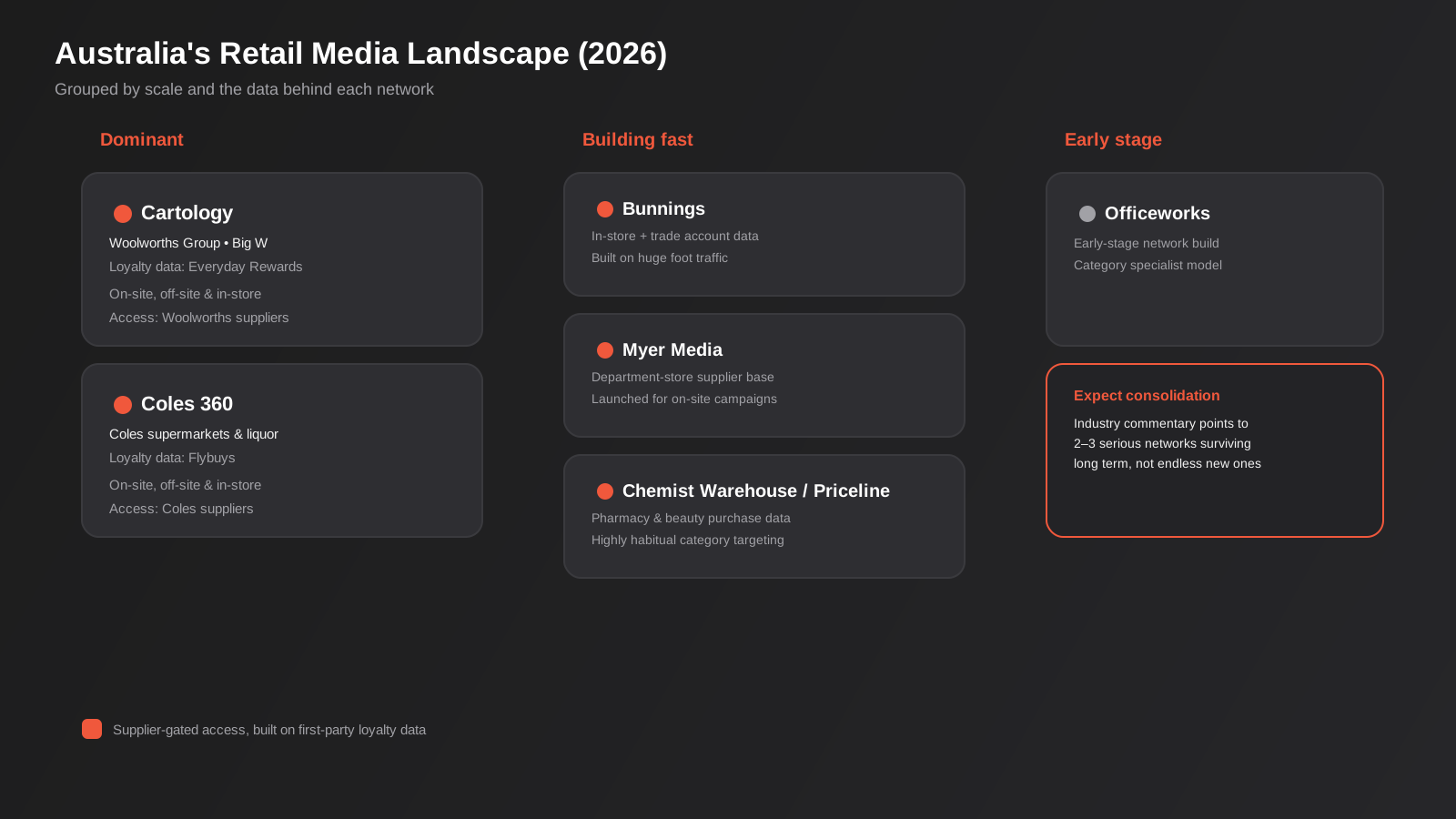
Two networks dominate, a handful of others are building fast, and the rest of the market is mostly noise and vendor decks. Here’s what’s actually operating right now.
Cartology (Woolworths Group)
Cartology is Woolworths’ retail media business, built on top of the Everyday Rewards loyalty program and spanning Woolworths supermarkets, Big W, and the group’s liquor and health brands. It sells on-site placements — sponsored products in search and category pages, display banners on the website and app — plus off-site programmatic buys that use Woolworths’ shopper data to target ads on other publishers’ inventory, and in-store media through shelf-edge screens and other physical placements. Access is overwhelmingly through Woolworths suppliers, sold either directly or through Cartology’s own platform and managed service teams.
Coles 360
Coles 360 runs the same basic model against the Flybuys loyalty base: on-site sponsored placements and display across Coles’ digital properties, in-store screens and sampling, and off-site audience activation built from Flybuys purchase data. Coles reported double-digit growth in Coles 360’s retail media income in its most recent financial year, in line with Cartology’s trajectory, and both businesses are explicitly positioned by their parent companies as profit centres in their own right, not a marketing add-on.
The challengers: Bunnings, Myer, Chemist Warehouse, Priceline, Officeworks
Outside the two grocery giants, the pattern repeats with any retailer that has enough transaction volume and loyalty data to make the maths work. Bunnings has been building its own in-store and digital advertising capability off the back of its enormous foot traffic and trade account data. Myer launched a retail media network aimed at its department-store supplier base. Chemist Warehouse and Priceline both sit on pharmacy and beauty purchase data that’s arguably more targetable than almost anything in grocery, given how specific health and beauty buying patterns are. Officeworks and a growing list of category specialists are at earlier stages of the same build.
None of these challenger networks comes close to Cartology or Coles 360 in scale yet, and most industry commentary — including a widely discussed Mumbrella column from Mark Ritson — expects consolidation rather than an endless proliferation of networks, with Australian media buyers settling on two or three serious platforms within a few years. That’s useful context if you’re being pitched on a smaller network: ask how long it’s been running, what its measurement actually shows, and whether it’s likely to still exist in its current form in two years.
How Australia compares to the US and UK
Australia is running a smaller, earlier version of a model that’s already mature overseas, which is useful context for working out where this is heading. In the US, Amazon’s advertising business is enormous in its own right, and Walmart Connect and Kroger Precision Marketing have both built retail media arms large enough to be reported as standalone revenue lines in quarterly results, with Walmart Connect alone generating billions of dollars a year. In the UK, Tesco’s Clubcard data underpins a retail media business run jointly with dunnhumby, and Sainsbury’s and Boots run comparable programs off their own loyalty data.
The pattern in both markets is the same one playing out here: a dominant grocery player or two establishes the model first, loyalty data turns out to be a genuinely different asset to intent data from search, and smaller specialty retailers follow once the economics are proven. Australia is roughly where the UK was a few years into Clubcard’s media business — real revenue, real supplier demand, and measurement standards still catching up to the money flowing through the channel. If you’re trying to judge how fast this will mature here, the overseas trajectory suggests consolidation among networks and tightening measurement standards are more likely than the current spread of smaller players all surviving independently.
On-site, off-site and in-store: the three layers of retail media
It helps to stop thinking of retail media as one product and start thinking of it as three genuinely different buys stacked under one brand name, because the economics and the targeting logic differ for each.
On-site
This is the part that looks most like Amazon: sponsored product placements in search results and category pages, display banners on the homepage or product pages, all served to someone who is actively shopping on the retailer’s website or app right now. It’s the highest-intent inventory in the stack, which is why it’s usually sold first and priced at a premium, and it behaves a lot like Sponsored Products on Amazon — you’re competing for a sale that’s already in motion, not creating demand from nothing.
Off-site
Off-site retail media takes the retailer’s first-party purchase data and uses it to target ads on other publishers’ inventory — a video ad on a BVOD platform, a display ad on a news site, shown to someone the retailer’s data says buys a lot of a particular category, regardless of whether that person is on the retailer’s own site at the time. This is where retail media starts competing directly with the kind of audience targeting Google and Meta sell, and it’s the layer most affected by the measurement complaints that keep showing up in IAB Australia’s research — it’s harder to prove a BVOD ad shown off-platform actually drove a specific sale than it is to prove a sponsored search result did.
In-store
Shelf-edge screens, digital signage near the entrance, audio and sampling activations — in-store retail media sells the thing that online advertising fundamentally can’t: a moment right next to the physical product, often seconds before the purchase decision. It’s the hardest layer to measure cleanly with digital attribution tools, which is exactly why Woolworths and Coles lean on loyalty card data at checkout to tie an in-store ad exposure back to a basket, something a brand running its own retargeting campaign could never replicate without that loyalty relationship.
The reason this three-layer split matters commercially is that most networks don’t let you buy them à la carte in a simple self-serve way, the way you’d toggle placements in a Google Ads account. Packages are often bundled, minimum spends differ by layer, and a brand new to the channel will usually be steered toward on-site first because it’s the easiest to measure and the easiest for the retailer’s sales team to sell confidently.
What it actually costs, and how buying in actually works
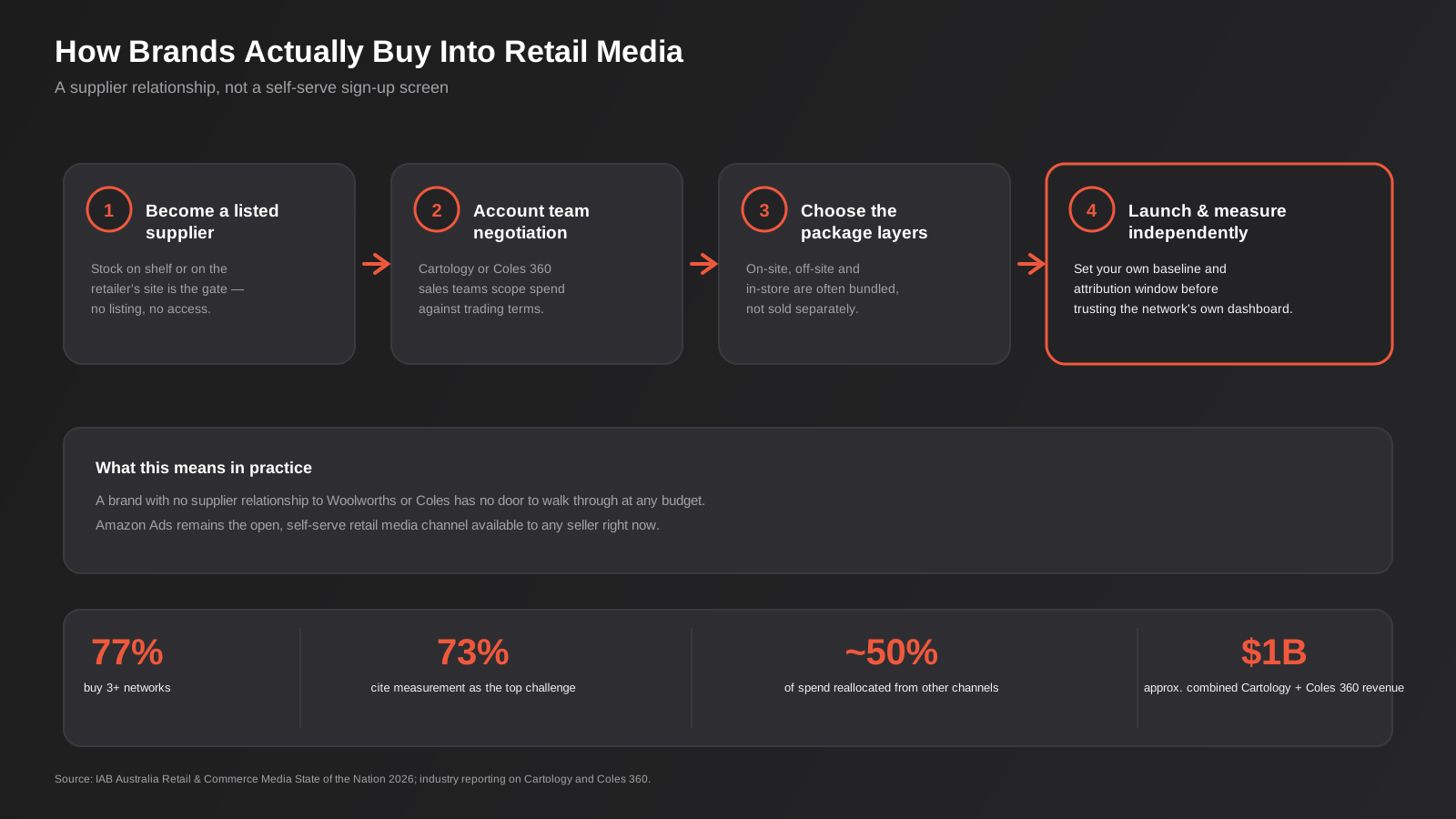
There’s no public rate card for Cartology or Coles 360 the way there is for Google Ads’ auction-based CPC ranges, and that’s not an oversight — it reflects how the access model works. Both networks are sold overwhelmingly to their own supplier base through dedicated account teams, not through open self-serve sign-up. If you don’t already supply stock to Woolworths or Coles, there generally isn’t a door to walk through to buy search placements against their shopper searches, in the way there is with Amazon. Industry reporting on the category notes that 77% of Australian buyers now work with three or more retail media networks at once, which tells you the brands actually spending here are typically national or near-national suppliers running media across every major retailer they’re stocked in, as one coordinated program rather than a single-network test.
Where cost figures do surface, they come from trade press and agency commentary rather than published pricing, and they point to this being a channel for brands with real trade marketing budgets rather than a few hundred dollars a month. Minimum commitments, when they exist, tend to be set at a level that makes sense against a national listing’s total revenue with that retailer, not against a single product’s margin. If a number you’re being quoted feels close to what you’d pay for a modest Google Ads test, it’s worth asking exactly what’s included, because retail media packages frequently bundle in-store elements, content production and account management in a way a pure media buy wouldn’t.
The bigger cost question for most brands isn’t the media spend itself — it’s measurement. IAB Australia’s 2026 research found inconsistent metrics and reporting standards are the single biggest challenge cited by active retail media buyers, and close to half of retail media investment is reportedly money reallocated from other channels rather than genuinely incremental budget. That second point matters more than it sounds: if your retail media spend is just Google or Meta budget moved sideways, you need the retail media number to actually beat what that budget was doing before, not just look respectable on its own. Ask any network, before committing spend, exactly how it attributes a sale to an ad — what window it uses, whether it’s first-click, last-click or some blended model, and whether its numbers can be independently verified rather than taken on the network’s own dashboard.
Is retail media worth it for your brand? A decision framework
Run through these four questions honestly before a sales deck from a retail media team talks you into a bigger commitment than makes sense.
Do you already supply stock to the retailer whose network you’re considering? This is the gating question for Cartology and Coles 360 specifically. If you sell direct-to-consumer only, or through a marketplace rather than as a listed supplier, the honest answer right now is that this channel mostly isn’t open to you yet, however compelling the loyalty data story sounds. Spend your attention on channels you can actually access — Amazon Ads and your own site’s paid search and social are the equivalent high-intent inventory you can buy today.
Is your category one where loyalty data materially changes targeting quality? Grocery, health, beauty and pharmacy categories benefit enormously from purchase-history targeting because buying patterns are habitual and frequent — knowing someone buys a competitor’s shampoo every six weeks is genuinely actionable. A category with infrequent, highly considered purchases gets much less lift from this kind of data, because there isn’t a repeating pattern to target against.
Can you measure this independently, or are you relying entirely on the network’s own numbers? Given how consistently measurement comes up as the industry’s biggest complaint, walking in with your own view of baseline sales and a plan to track incrementality, not just attributed sales inside the platform, is the difference between a channel you can defend in a budget review and one you’ll quietly drop after a quarter when someone asks what it actually added.
Is this genuinely incremental budget, or are you just moving spend sideways from a channel that was working? Given how much retail media investment is reportedly reallocated rather than new, be deliberate about this. Moving budget from a Google Ads campaign you can measure cleanly into a retail media line you can’t yet measure as well is a real trade-off, not a neutral channel diversification move, and it should be made consciously rather than by default because a trade rep asked for it.
A quick worked example of how this plays out: a mid-sized Australian snack brand already supplying both Woolworths and Coles, spending steadily on Meta and a modest amount on Google Shopping, is a strong candidate — habitual purchase category, existing supplier relationships with both major networks, and enough baseline data from other channels to judge whether a Cartology or Coles 360 test actually lifts sales rather than just reshuffling where credit lands. A single-SKU supplements brand selling only direct-to-consumer through its own site, with no grocery listing at all, isn’t a candidate yet at any budget, no matter how well-targeted the loyalty data sounds in a sales deck — there’s no door open to walk through.
If you’re a listed national or near-national FMCG supplier in a habitual-purchase category with the internal capability to measure incrementality, retail media is very likely worth a properly resourced test. If you’re a smaller direct-to-consumer brand without a supplier relationship to a major grocery chain, the realistic move is to build strength in the channels that are actually open to you first, and revisit retail media once you’ve got the distribution relationship that makes it relevant.
How retail media fits with your other channels
Retail media doesn’t replace Google, Meta or Amazon — it sits at a different point in the funnel, closer to the final purchase decision, and the overlap in intent is usually smaller than marketers assume. Someone searching Google for a category term is further from a specific purchase than someone already browsing a retailer’s app, and someone standing in the aisle with the product in hand is closer still. A sensible media plan treats these as a sequence rather than competing budgets fighting for the same credit.
If you’re running Google Shopping or Performance Max for the same products, expect genuine but limited overlap with on-site retail media — a shopper already inside a retailer’s app has effectively chosen where to buy, which is a different intent signal to someone comparing options across the open web. The two budgets are worth managing and reporting separately rather than blending them into one blended ROAS number, for the same reason we recommend separate tracking for Amazon versus Google Shopping: credit for the same eventual sale can get claimed by more than one channel if attribution windows overlap, and you’ll make worse decisions reading a blended number than two honest, separate ones.
Where retail media genuinely adds something the other channels can’t is the in-store layer and the loyalty-data-driven off-site targeting — neither Google nor Meta can put a message in front of someone standing next to the actual shelf, and neither has purchase-history data as granular as a supermarket loyalty program’s. If your brand is already spending well across search and social and the incremental return there is flattening, that’s the point at which testing retail media — assuming you can access it — starts to make more sense than squeezing another 5% out of a Meta campaign that’s already efficient.
Getting your foundations right before you buy in
A retail media campaign is only as good as the product data and digital shelf presence behind it, and this is the step brands skip most often because it isn’t the exciting part of the pitch. Before any retail media budget is well spent, a few things need to already be true.
Your product listings on the retailer’s own site need to be complete and accurate — correct imagery, full nutritional or ingredient data where relevant, and consistent naming across every SKU variant. A sponsored placement pointing at a thin or outdated product page wastes the same way a Google Ads click pointing at a weak landing page does; the ad can only amplify what’s already converting reasonably well on its own.
Your own ecommerce operation also needs to be solid enough to handle whatever lift the campaign generates, particularly if you’re running a direct-to-consumer channel alongside your retail presence. If your own site is still running on a platform that can’t keep stock levels and pricing synchronised with what’s showing in-store, a successful retail media push can create exactly the kind of fulfilment headache that undoes the value of the campaign. We’ve written separately about choosing an ecommerce platform for Australian retailers, and for brands running meaningful volume across multiple channels, a Shopify Plus setup with proper inventory sync tends to handle that multi-channel complexity better than a smaller platform stretched past what it was built for.
Finally, get your internal measurement house in order before you spend a dollar with a retail media account team. Agree internally on what counts as a baseline, what attribution window you’ll accept, and who owns reconciling the network’s reported numbers against your own sales data. Doing this after the campaign has launched means you’re negotiating definitions with a vendor who has every incentive to use the most flattering measurement available, rather than the one that tells you the truth.
Common mistakes
- Assuming retail media is open to any brand, when Cartology and Coles 360 are built primarily around existing supplier relationships rather than open self-serve access.
- Judging a retail media campaign purely on the network’s own attributed sales figure, without an independent view of baseline and incrementality.
- Moving budget out of a well-measured channel like Google or Meta into retail media without being honest that the new channel is currently harder to measure, not easier.
- Funding sponsored on-site placements against a product listing with weak images, missing data or inconsistent naming across the retailer’s catalogue.
- Treating every retail media pitch as equally credible, rather than asking how long the network has been running and how its measurement has held up against independent scrutiny.
- Ignoring the in-store and off-site layers entirely because on-site is easier to understand, and missing the parts of the inventory that genuinely can’t be replicated on Google or Meta.
- Letting a trade marketing relationship drive the retail media decision instead of running it through the same ROI discipline applied to every other paid channel.
Frequently Asked Questions
Can a small Australian brand buy ads on Cartology or Coles 360 without being a supplier?
Generally no, not in any straightforward self-serve sense. Both networks are built primarily around existing Woolworths and Coles supplier relationships, sold through dedicated account teams rather than an open sign-up portal. If you’re not already listed with the retailer, the realistic starting point is building the supplier relationship itself, not the ad campaign.
Is retail media the same thing as Amazon Ads?
They’re the same category of advertising — a retailer selling ads against its own first-party shopper data — but they work differently in practice. Amazon Ads is open to any seller with an active listing through a genuinely self-serve auction. Cartology and Coles 360 are sold mainly to existing suppliers through managed account relationships. If you’re comparing the two as channels, read our separate guide on Amazon Ads costs and campaign types for the marketplace side of this.
How much does retail media cost in Australia?
There’s no published rate card from Cartology or Coles 360, and pricing is negotiated through account teams rather than quoted publicly. Trade press coverage suggests minimum commitments are generally set at a level suited to national or near-national suppliers with meaningful trade marketing budgets, not a few hundred dollars a month, and packages often bundle on-site, off-site and in-store elements together rather than being priced as separate line items.
Why do brands struggle to measure retail media performance?
IAB Australia’s 2026 research found inconsistent measurement standards are the single biggest challenge cited by active buyers in this category. Different networks use different attribution windows and models, in-store exposure is inherently harder to tie to a specific sale than a digital click, and a brand relying purely on a network’s own dashboard has no independent check on whether the reported lift is genuinely incremental or just budget that would have converted anyway.
What’s the difference between on-site, off-site and in-store retail media?
On-site means sponsored placements and display ads shown to someone actively browsing the retailer’s own website or app. Off-site uses the retailer’s shopper data to target ads on other publishers’ inventory, such as video or display elsewhere on the web. In-store means physical media — shelf-edge screens, signage and sampling — placed near the actual product. Each layer has different pricing, access requirements and measurement challenges.
Should a direct-to-consumer brand bother with retail media at all?
Usually not yet, unless you also supply stock to a major retailer. The bigger-scale Australian networks are built around existing supplier relationships, so a pure DTC brand’s time is generally better spent on channels that are actually open to it — its own site, Google, Meta and, where relevant, Amazon — before pursuing a retail media relationship that depends on first becoming a listed supplier.
Where to start
If you’re already a listed supplier to Woolworths or Coles and retail media keeps coming up in trade conversations, the sensible first move is a small, properly scoped test on the on-site layer alone, with your own baseline and attribution tracking set up before the campaign launches, not after. If you’re earlier than that — still building out your own ecommerce presence or weighing up which channels are actually worth your attention this year — it’s worth getting that foundation solid before a retail media conversation is even relevant to your business.
We help Australian ecommerce and FMCG brands work out where a channel like this genuinely fits against the budget they’re already spending on search, social and marketplaces, rather than taking a trade rep’s pitch at face value. Because we run lean as a specialist agency rather than carrying a large account-management layer, our fixed quotes for the ecommerce and paid media work that underpins this typically come in below the Australian averages agencies with heavier overheads tend to quote. If you’ve already got a written quote from another agency for comparable scope, send it through and we’ll do our best to beat it.
Get in touch and we’ll have a straight conversation about whether retail media is worth pursuing for your category specifically, or whether your budget is better spent sharpening the channels you can already access.
Keep reading
Related posts
Black Friday & Cyber Monday Marketing for Australian Ecommerce Stores (2026)
A practical guide to Black Friday and Cyber Monday 2026 for Australian stores: email flows, site readiness, ad budgets and ACCC pricing…
Best Payment Gateways for Australian Businesses (2026): 6 Compared
Six payment gateways compared for Australian businesses after the surcharge ban: Stripe, PayPal, Square, Tyro, Airwallex and eWAY, with fees and drawbacks.
Best Ecommerce Platforms for Australian Retailers in 2026: Six Options Compared
Six ecommerce platforms for Australian retailers compared honestly: real fees, GST and payments, drawbacks and who each one actually suits.
Got a project you'd like to talk through?
Tell us what you're working on — we'll come back with a plan.
