
How Much Does a Shopify Store Cost in Australia? A 2026 Price Guide
 Jignesh Vagadiya
16/10/2026
22 min read
A client forwarded us a quote recently for a Shopify store that read, almost word for word, like a brief we’d just scoped ourselves — same product count, same rough feature list, same “nothing too complicated.” Their number was $2,400. Ours, for what we judged to be the same actual job once we asked a few more questions, was closer to $7,500. Neither of us was gouging them. We were pricing two different things that both happened to be called “a Shopify store.”
That gap is the whole story with Shopify pricing in Australia right now. Shopify itself is refreshingly transparent about what its platform costs — the plan tiers are published, the transaction fees are published, nothing is hidden behind a “call us” button. The build cost sitting on top of that platform fee is where things get murky, because “build me a Shopify store” can mean anything from installing a free theme and uploading ten products yourself, to a fully custom-themed storefront with wholesale pricing, an ERP feed and a product configurator. Both are real projects. Only one of them costs $7,500.
This guide splits the two costs apart deliberately: what Shopify’s own platform actually costs you each month, separately from what it costs in Australia in 2026 to have someone design and build the store that sits on top of it. We’ll give you real ranges for both, the specific things that push a build quote up or down, how agencies typically structure the pricing, and the questions that turn a confusing quote into one you can actually compare against another. If you want our own current figures rather than a market average, our Shopify pricing page has them laid out plainly. Everything below is the broader market, so you can sanity-check any quote you’re holding against it — including ours.
How Much Does a Shopify Store Cost in Australia?
Start with the build cost, because that’s the number most people are actually trying to find when they type this question into Google. The range is wide because the thing being built varies enormously, but four tiers cover almost every real Shopify project we see or quote against in Australia.
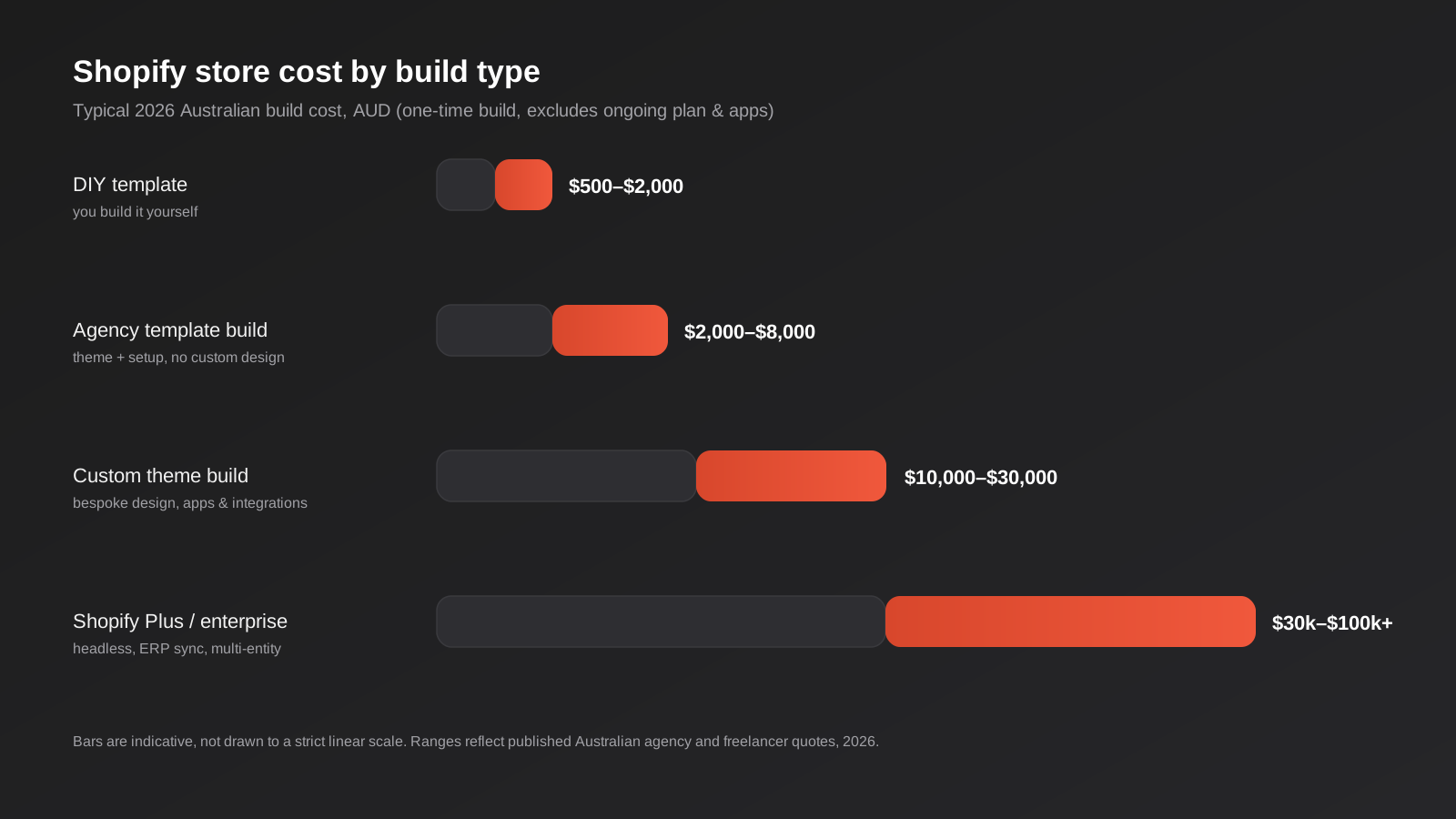
- DIY template build: roughly $500–$2,000 if you’re doing it yourself with a free or low-cost theme, installing a handful of apps and uploading products on your own time. You’re paying almost entirely for your own hours here, maybe with a freelancer brought in for a few specific fixes.
- Agency template build: roughly $2,000–$8,000. An agency installs and configures a premium theme, sets up collections, navigation, Shopify Payments, shipping zones and a handful of apps, and uploads an agreed number of products for you. This is the tier most small Australian retailers actually land in for a first store.
- Custom theme build: roughly $10,000–$30,000. Bespoke design built specifically for your brand rather than adapted from a theme, plus real customisation — product configurators, wholesale pricing tiers, multi-currency, loyalty integration, accounting or inventory sync.
- Shopify Plus or enterprise build: $30,000 and climbing well past $100,000 for the largest projects — headless storefronts, ERP and 3PL integration, multi-entity or multi-currency operations, custom checkout extensions. These are closer to software projects than website builds, and they’re scoped and staffed accordingly.
Freelancers tend to sit a little under agency pricing for comparable scope — a competent freelancer might build a solid template store for $1,500–$4,000 where an agency quotes $2,000–$8,000 for a similar brief — but the gap narrows once you factor in project management, QA and the fact that an agency is still standing behind the work in six months. Neither option is automatically the smarter choice; it depends on how much hand-holding you need during and after the build.
None of these build-cost figures include what Shopify itself charges you to run the store once it’s live, which is a separate, ongoing cost most “how much does Shopify cost” guides blur together with the build price. We’ve kept them apart deliberately, because conflating a one-time build fee with an ongoing platform subscription is exactly the kind of thing that makes two quotes look impossible to compare. More on that in the next section.
Which tier is realistic for you comes down to what the store actually needs to do, not how big your ambitions are. A new candle brand with twelve SKUs and no wholesale channel doesn’t need a $20,000 custom build — that money is better spent on photography, paid ads or inventory. A business already doing six figures in wholesale through spreadsheets and email, on the other hand, will find a template build simply can’t support the pricing tiers and purchase order workflow the wholesale side actually needs, however well it’s built. Work backwards from what the store has to do in its first year, not from a number a competitor mentioned at an industry event.
What Drives the Price Up
Every Shopify quote is assembled from the same handful of variables. Knowing them is the fastest way to understand why your quote landed where it did, and where there’s genuine room to trim it if the number came in higher than you budgeted.
Theme choice: off-the-shelf versus custom
A premium Shopify theme with your logo, colours and fonts swapped in is a job measured in days. A visual identity designed specifically for your brand, laid out in Figma and then built section-by-section to match pixel-for-pixel, is a job measured in weeks. Both are legitimate Shopify stores. Only one of them looks like nobody else’s store in your category, and that differentiation is the main thing you’re paying for when a quote jumps from the template tier into custom theme territory.
Product and collection count
Uploading ten products with a title, three images, a price and a description is quick. Uploading four hundred products with variants, size charts, custom metafields and SEO-optimised descriptions for each one is a project in its own right, and most agency quotes cap the number of products included before charging per-item for the rest. If your catalogue is large, ask explicitly how upload is priced beyond the included count — this is one of the most common places a “final” quote grows after the fact.
Apps and the functionality they replace
Shopify’s app ecosystem is the platform’s biggest strength and one of its sneakiest cost drivers. Each app usually carries its own monthly subscription on top of your Shopify plan, and configuring an app properly — wiring up a subscriptions app, a loyalty programme, a review platform, a size-chart tool — is billable setup time even though the app itself might be $20 a month. Three or four well-chosen apps, properly configured, is normal. Fifteen apps nobody fully understands is how a $149-a-month Grow plan turns into a $400-a-month running cost nobody budgeted for.
Payments, shipping and tax complexity
A standard setup using Shopify Payments, a flat domestic shipping rate and GST handled automatically is close to the simplest configuration the platform supports. Multiple payment methods, Buy Now Pay Later options, carrier-calculated shipping tied to Australia Post or a 3PL, international shipping zones, and B2B tax exemptions for wholesale customers each add real setup time, because each one is effectively a small integration sitting inside checkout.
Integrations with your other business systems
Connecting Shopify to Xero or MYOB for accounting, to a warehouse management system for fulfilment, or to an ERP for inventory and pricing is routine for a growing retailer and genuinely complex to get right. A single clean integration, well scoped, might add $800–$3,000. Several integrations that all need to stay in sync — accounting, inventory, fulfilment — start to look like a project of their own, which is why we usually scope ERP and systems integration work separately from the storefront build rather than folding it into the same line item.
Migration from an existing platform
If you’re not starting from scratch, moving an existing store’s products, customer accounts, order history and URL structure onto Shopify without breaking your SEO rankings or losing historical data is specialist work in its own right. We cover this in detail in our guide to migrating from WooCommerce to Shopify, but the short version is that a migration typically adds $2,000–$10,000 on top of the build itself, scaling with catalogue size and how much custom functionality the old site had that needs to be rebuilt rather than simply copied across.
Copywriting, photography and brand assets
Design and build costs get the attention, but a store with generic manufacturer product descriptions and stock photography converts at a fraction of one with original copy and real product photography. Many quotes assume you’re supplying usable content; if you’re not, ask whether copywriting and photography are in scope or billed as an add-on, because this is consistently where a cheap quote turns out to leave the most unfinished work for you.
Selling in multiple currencies or markets
Shopify Markets makes selling internationally far easier than it used to be, but “far easier” still isn’t “free.” Localised pricing, duty and tax calculation at checkout for different countries, translated storefronts and region-specific shipping rules each need to be configured and tested properly rather than switched on and forgotten. If Australia is your only real market for the next year, it’s usually cheaper to launch domestic-only and add international selling as a defined phase two once there’s actual demand to justify it, rather than paying to build and test markets you’re not yet selling into.
Timeline pressure
A compressed launch date — ahead of a product drop, a seasonal peak or a trade show — doesn’t reduce how much work the build needs, only how quickly it has to happen. Expect a rush premium, typically 15%–30% on top of the base quote, if you need a build turned around well inside its normal timeline. Say so upfront if the date is fixed for a real business reason; it changes how the project gets staffed, not just what it costs.
What Brings the Price Down
If budget is the binding constraint, these are the genuine, honest ways to bring a Shopify quote down, roughly in order of how much difference each one makes.
- Start from a proven premium theme instead of a fully custom design. You trade some differentiation for a professional result at a fraction of the custom-build cost, and a good theme with the right colours and fonts still looks considered.
- Launch with a smaller catalogue and expand later. Twenty well-presented products beat two hundred rushed ones, and uploading the rest in a second phase once the store is live and selling costs the same either way — it just spreads the cash outlay over time.
- Use Shopify Payments rather than a third-party gateway where you can. It avoids the extra 0.5%–2% transaction fee Shopify charges on non-Shopify-Payments processors, and it removes a setup step from the build.
- Pick apps deliberately, not speculatively. Every app you install “just in case” is a monthly cost and a setup line item. Start with the two or three your launch genuinely needs and add more once you know what the store is missing.
- Supply your own product content, properly organised in a spreadsheet with images named and sized correctly, rather than asking the agency to assemble it from scratch. This only saves money if the content is actually ready, not “mostly there.”
- Fix the scope before requesting quotes. A written brief with product count, must-have apps and any integrations named upfront is the single biggest lever against a budget blowing out, because scope creep after a quote is accepted is the most common cause of a final invoice exceeding the original number.
None of these are shortcuts that compromise the result. They’re genuine trade-offs between cost and scope, and a competent agency will tell you plainly which ones make sense for your situation rather than upselling you into apps and customisation the business doesn’t need yet.
Shopify’s Own Platform Costs: What You Pay Shopify Directly
Separate from any build fee, Shopify charges its own monthly subscription directly to you, billed by Shopify, not by whoever builds your store. As of 2026, the core plans on monthly billing are Basic at around $56 a month, Grow (formerly “Shopify”) at around $149 a month, and Advanced at around $575 a month, with a cheaper Starter plan around $7 a month for a link-in-bio style store with no full theme. Paying annually rather than monthly brings the effective cost down meaningfully across all three tiers. Shopify Plus, aimed at high-volume and enterprise merchants, starts at roughly $3,700 a month and is negotiated based on sales volume above a certain threshold.
On top of the plan fee, Shopify Payments charges a processing rate per transaction — around 1.75% plus 30¢ on Basic, dropping slightly on Grow and Advanced as the plan fee rises. If you use a different payment gateway instead of Shopify Payments, Shopify adds its own additional transaction fee on top of whatever that gateway already charges, which is why almost every Australian merchant we work with ends up on Shopify Payments rather than a third-party processor. Budget for apps on top of this — a typical store running three to six well-chosen apps spends somewhere between $40 and $300 a month on subscriptions, before any custom app development.
Put together, a realistic all-in monthly running cost for a modest Australian Shopify store — plan, a handful of apps, no custom development — usually sits somewhere between $100 and $450 a month, separate from the one-time build fee covered above and separate from marketing spend. None of this is negotiable the way a build quote is; it’s Shopify’s own published pricing, which is exactly why it’s worth knowing before you compare agency quotes — a lower build quote that quietly assumes a cheaper Shopify plan than your catalogue actually needs isn’t really a lower quote at all.
A couple of Australia-specific details worth knowing before you budget. Shopify’s own subscription and app fees generally attract GST the same way any other software subscription does, so check whether the figure you’ve been quoted is GST-inclusive before you compare it against another provider’s number. If you sell in currencies other than AUD, or your Shopify Payments account settles in a different currency to the one customers pay in, Shopify applies a currency conversion fee on the gross order amount on top of its standard processing rate — worth factoring in if a meaningful share of your sales will come from overseas customers rather than domestic ones.
Pricing Models Explained
How an agency or freelancer charges for the build matters almost as much as the number itself. Three models cover most of the Australian Shopify market.
Fixed-quote pricing
One number for a defined scope — this theme, this many products uploaded, these apps configured, delivered by this date. It’s the dominant model for template and custom theme builds because the scope is knowable upfront, and it’s the model most of our own Shopify packages use. The risk of the job running long sits with whoever quoted it, which is exactly why a fixed quote should come with a tightly defined scope document and a clear change-request process for anything outside it.
Hourly or day-rate pricing
You pay for time rather than outcome, typically somewhere between $90 and $200 an hour for Australian Shopify development depending on seniority and whether you’re working with a freelancer or an agency. This suits work where scope genuinely can’t be pinned down upfront — a complex ERP integration where the real complexity only surfaces once someone is inside your existing systems, or an evolving custom build with features still being decided. The risk here sits with you as the client, so ask for a not-to-exceed estimate and regular time reporting rather than agreeing to open-ended hourly billing with no ceiling at all.
Revenue-share or percentage-of-sales models
Less common for the build itself but worth knowing about, since it occasionally appears bundled with ongoing management: a lower or even waived build fee in exchange for a percentage of ongoing sales or a recurring management fee tied to revenue. This can suit a cash-constrained new brand, but read the exit terms carefully — some of these arrangements make it expensive or awkward to take the store in-house later, and you should know exactly what happens if you want to leave before you sign anything structured this way.
Whichever model you’re offered, ask how payment is staged. A common, fair structure is a deposit to start, a milestone payment at design sign-off, and a final payment at launch. Be cautious of a request for full payment upfront on a large fixed-quote project; it removes the agency’s financial incentive to finish on the timeline they promised.
What a Proper Shopify Quote Should Include
A quote that’s just a dollar figure and “a Shopify store” tells you almost nothing. Before comparing two quotes, make sure both actually answer the same questions — this is where most of the “why is one triple the other” confusion resolves once you line them up properly.
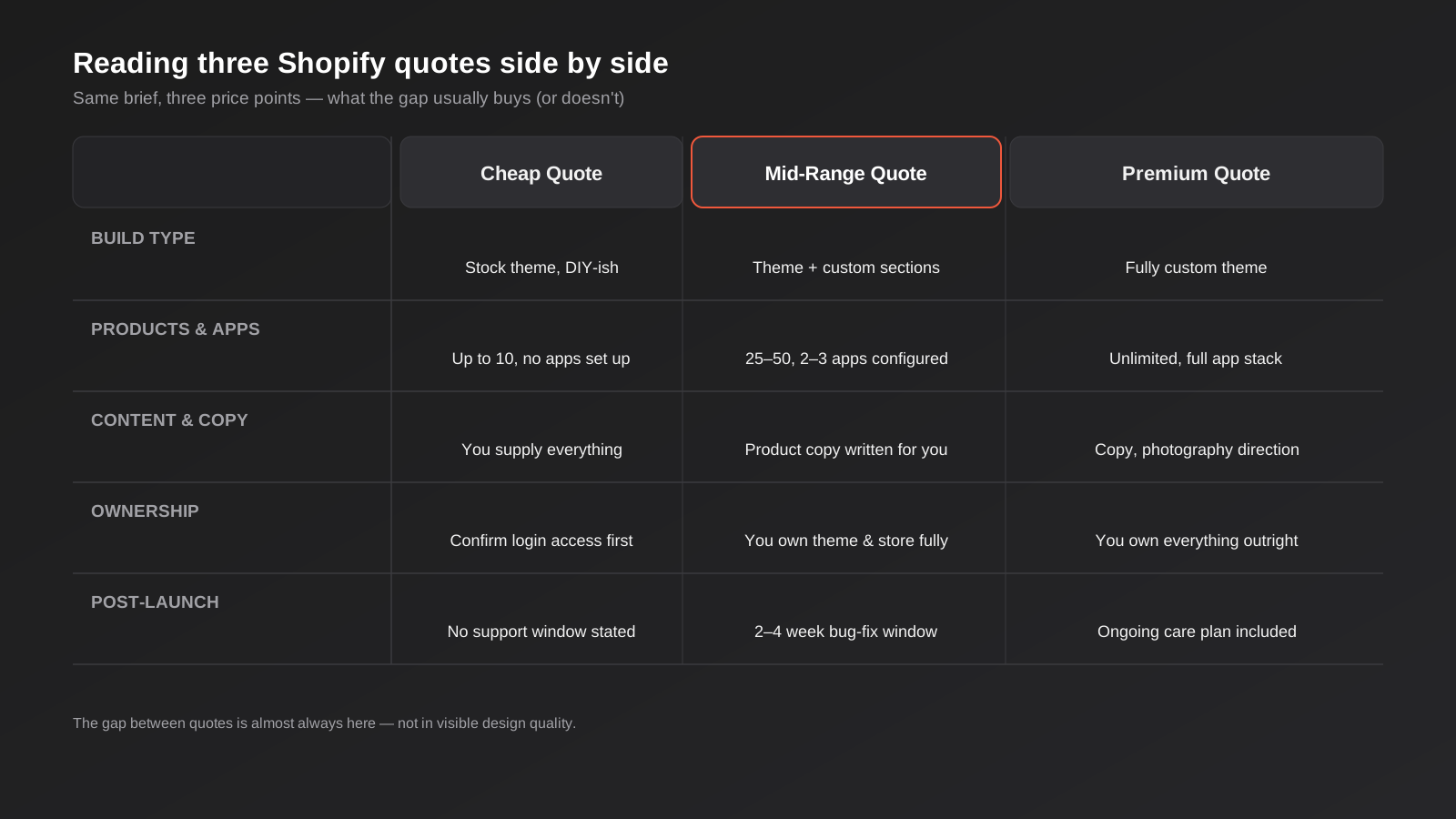
- Exactly how many products and collections are included, and what it costs per item beyond that count.
- Which apps are included and configured versus which ones you’ll need to add and pay for separately.
- Who owns the theme, the store and the Shopify account afterwards. You should hold the Shopify account yourself; be cautious of any arrangement where an agency owns the account and you’re effectively a guest on your own store.
- What’s explicitly excluded — product copywriting, photography, migration from an existing platform, third-party app subscription costs, ongoing SEO.
- The number of design revision rounds included before further rounds are billed as extra work.
- The post-launch support window, and what counts as a free bug fix versus a billable change request.
- A realistic timeline naming your side’s dependencies — if the quote assumes you’ll supply final product content within a week and that’s not realistic for your team, say so before signing, not in week five.
One pattern worth naming specifically: the quote that’s dramatically cheaper than every other one you’ve received for what reads like the same brief. Sometimes that’s a genuinely efficient operator with low overheads. More often it’s a template being sold at custom-build prices without saying so, a scope that quietly excludes half of what you asked for, or production happening offshore with no local project management layer translating between you and the person doing the work. None of those are automatically disqualifying, but you should know which one you’re getting before you compare the number to anyone else’s.
Common Mistakes When Budgeting for a Shopify Store
- Comparing the build quote without checking the ongoing Shopify plan it assumes. A quote that looks cheaper because it was priced against the Basic plan isn’t actually cheaper if your product count or staff accounts require Grow.
- Treating the build fee as the total first-year cost. Plan fees, transaction fees, app subscriptions and marketing spend are real, ongoing costs that a one-off build price never covers.
- Picking the cheapest quote without asking what it leaves out. The gap is almost always in product content, app configuration, revision rounds or post-launch support — not in visible design quality, which is why it’s easy to miss until after you’ve paid.
- Not confirming who holds the Shopify account. Some cheap builds are cheap partly because the agency keeps admin control, which becomes expensive leverage later if you want to switch providers or bring work in-house.
- Letting app count grow without reviewing the running cost. Each “just install this one too” request feels small individually and adds up to a materially higher monthly bill than the one you budgeted for.
- Skipping a written product and feature brief. Verbal alignment on “we’ll need wholesale pricing eventually” turns into a costly change order once the build is underway and that feature wasn’t actually scoped.
- Assuming a higher price always buys a better result. It usually buys more scope, not more skill. A well-scoped $5,000 template build executed properly beats a poorly managed $20,000 custom project in most practical comparisons.
- Underestimating migration complexity if you’re moving from another platform. Treating it as “just importing a CSV” is how URL structures, SEO rankings and customer accounts quietly break during launch week.
Most of these trace back to treating the quote as the end of the conversation rather than the start of one. The merchants who end up happy with what they paid are almost always the ones who asked more questions before signing, not the ones who found the lowest headline number.
Frequently Asked Questions
How much does a basic Shopify store cost in Australia?
A basic Shopify store built by an agency using a premium theme, with standard setup and a modest product catalogue, typically costs $2,000–$8,000 in Australia in 2026. A DIY build using a free theme can be done for $500–$2,000 if you’re doing the setup and product upload yourself. Neither figure includes Shopify’s own monthly plan fee, which is separate and billed directly by Shopify.
Is the Shopify monthly plan included in a build quote?
No, almost never. The build quote covers design and setup as a one-time fee; Shopify’s own subscription — Basic, Grow, Advanced or Plus — is billed separately and directly by Shopify to you, and you choose the plan based on your sales volume, staff accounts and feature needs. If a build quote seems to include “Shopify fees,” ask exactly what that means, since it’s not how Shopify’s own billing works.
Why do Shopify quotes vary so much for what sounds like the same brief?
Because “a Shopify store” isn’t one product. One quote might include custom theme design, product copywriting and app configuration; another might cover only installing a theme and uploading the products you supply. Product count, app complexity, integrations and migration from an existing platform all move the number independently, which is why two quotes for what sounds like the same brief can differ by a factor of five without either being dishonest.
How much do Shopify apps cost on top of the plan?
Most stores run somewhere between three and six apps, totalling roughly $40–$300 a month on top of the Shopify plan fee itself, depending on what the apps do. Reviews, size charts and basic email capture tools tend to be cheap or free at low volume; subscriptions, loyalty programmes and advanced personalisation apps cost more and often scale their price with your order volume or customer list size.
Should I build on Shopify or WooCommerce?
It depends on how much control you want versus how much you want handled for you. Shopify is generally faster to launch and requires less ongoing technical maintenance since hosting and core updates are managed for you; WooCommerce offers more flexibility and no mandatory transaction fee on your own payment gateway but needs separate hosting and maintenance. We’ve compared the two in detail, including GST and migration considerations, in our guide to Shopify vs WooCommerce for Australian businesses.
How long does it take to build a Shopify store in Australia?
A template-based build typically takes four to six weeks from kickoff to launch; a custom theme build runs eight to twelve weeks depending on how much customisation and how many integrations are involved. The most common cause of delay in practice isn’t development capacity, it’s how quickly the client side can supply final product content, images and copy — a store with ready-to-go content launches noticeably faster than one where content is still being written during the build.
Where to Start
If you came here asking how much a Shopify store costs in Australia, the honest answer is still “it depends on what you’re actually building” — but you now know exactly what it depends on: theme choice, product count, app complexity, integrations and whether you’re migrating from somewhere else. The number that matters isn’t a market average from a blog post, including this one. It’s the number that comes back once your actual catalogue, features and integration needs have been properly scoped.
If you’d like to see where you’d land with a real scope rather than a market range, our Shopify pricing page walks through our own current packages, and our main pricing page covers the rest of what we do if a new site is only part of what you’re planning. If you’re weighing Shopify against building a custom web app instead because your catalogue needs genuinely bespoke logic, it’s worth reading about when headless commerce is actually worth the cost before you commit to either path, since the two solve different problems at different price points.
Whichever tier you land in, the same principle holds across every price point in this guide: a vague brief gets a vague quote, and scope that grows after you’ve signed is the single biggest reason a Shopify project ends up costing more than the number you were first given. Get the product list, the must-have apps and any integrations written down before you send the brief to anyone, and the quotes that come back will actually be comparable.
Worth putting a number on it: our own Shopify packages start from $3,000 one-time — toward the affordable end of the agency template band covered above for comparable scope, because we keep our overheads lean as a specialist agency. If you’ve already got a written quote from another agency for a comparable build, send it through and we’ll do our best to beat it.
Keep reading
Related posts
How Much Does a WooCommerce to Shopify Migration Cost in Australia? A 2026 Price Guide
What a WooCommerce to Shopify migration costs in Australia in 2026: real price ranges by store complexity, hidden costs and how to…
How Much Does an AI Chatbot Cost in Australia? A 2026 Pricing Guide
What an AI chatbot costs in Australia in 2026: three pricing tiers, the running costs people miss, and how to compare quotes…
How Much Does Custom Software Development Cost in Australia? Build Cost vs Five Years of Licences (2026)
What custom software development costs in Australia in 2026: ranges by project type, integration costs, running costs, and how the build compares…
Got a project you'd like to talk through?
Tell us what you're working on — we'll come back with a plan.
