
How Much Does Marketing Automation Cost in Australia? A 2026 Price Guide
 Jignesh Vagadiya
02/11/2026
22 min read

Marketing automation has one of the strangest price tags in digital. The software can cost less than a Netflix subscription, or more than a small car lease. The setup can be an afternoon of your own time, or a $15,000 project with three suppliers. And almost nobody publishes what it costs to have someone build it for you, which is why the first quote you get tends to feel arbitrary.
We build automation for Australian businesses, so this guide comes from the delivery side. It covers what the three cost layers are (the platform, the build, and the care afterwards), the ranges Australian businesses are actually seeing in 2026, what pushes a quote up or down, and what a written quote should contain before you compare it with anything. Our own prices stay out of the body of the article, because automation is scoped project by project and a number printed here would be stale or wrong within a quarter. The place to see how we quote is our automation pricing page.
A caution on sources. Almost every public price for this work comes from vendors, partners and agencies that sell it, and the figures disagree with each other. We have used ranges that several Australian sources roughly agree on, flagged where the evidence was thin, and given you drivers and questions instead of a number wherever we could not defend one. Platform prices are quoted by most vendors in US dollars, so treat any platform figure here as a starting point to check against the live pricing page, then add GST and allow for the exchange rate.
How Much Does Marketing Automation Cost in Australia?
The honest answer is that “marketing automation cost” is three separate costs that get blurred together. Quotes go wrong when you compare one supplier’s build fee with another supplier’s all-in monthly price.
- The platform licence. The tool that sends the emails and runs the flows: Klaviyo, ActiveCampaign, HubSpot, Brevo, Mailchimp and so on. Paid monthly or annually, usually scaling with how many contacts you hold. This goes to the vendor, not your agency.
- The build. Someone maps your customer journey, configures the platform, connects it to your website, CRM or store, writes the templates and tests everything. A one-off fee, sometimes with a mandatory vendor onboarding fee on top.
- The ongoing care. Monitoring, fixing what breaks, improving what underperforms, and keeping the list clean. Monthly, and the line most often missing from a first quote.
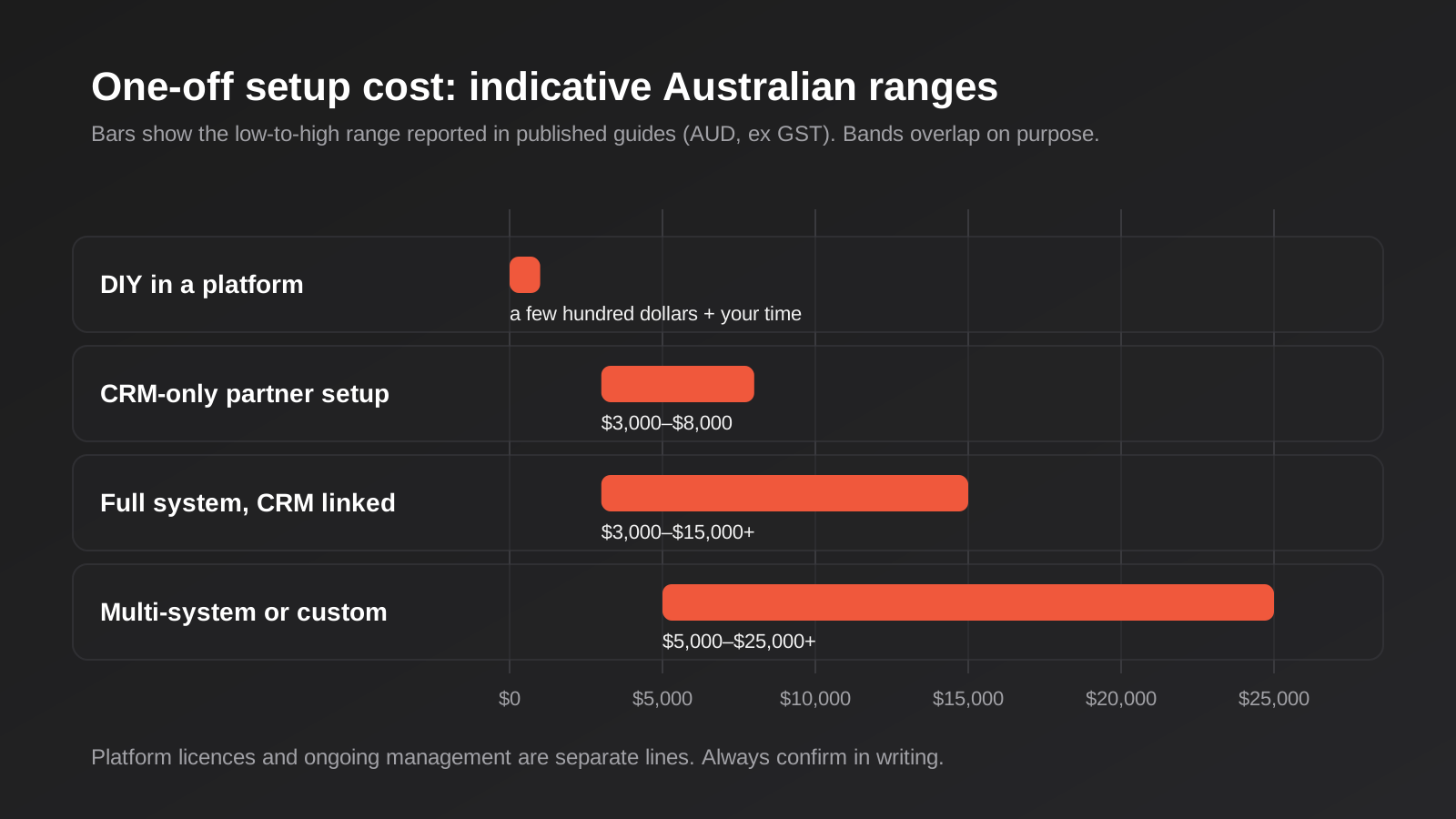
For the one-off build, the published Australian ranges cluster like this:
- DIY inside a single platform: a few hundred dollars in licence and template costs, plus a lot of your own time. Realistic for a welcome series, an abandoned-cart flow and a simple newsletter, if you have the patience to learn the tool.
- Partner-led setup of one platform with a CRM: roughly $3,000–$8,000. One Australian HubSpot partner puts a CRM-only setup (portal configuration, pipeline, basic workflows) in this band.
- Full agency-configured system linked to your CRM or store: roughly $3,000–$15,000 or more, according to an Australian guide aimed at small and medium businesses.
- Multi-system or custom automation: roughly $5,000–$25,000, with some sources stretching the outer range much wider. A Melbourne consultancy estimates most small business automation projects land in the $5,000–$25,000 range, and a separate Australian source gives $2,000–$50,000 depending on complexity.
Those bands overlap because the jobs overlap. A “full system” for a ten-person service business and a “full system” for a multi-brand retailer are not the same project, even when both are described that way on a proposal.
What we could not find, despite looking, is a defensible monthly figure for managing automation flows. Sources simply do not agree, and many agencies fold it into a wider retainer. So rather than invent a number, we cover what drives that line further down and the questions to ask about it.
Why the quote is rarely one number
Ask for “marketing automation” and you will hear back about a project, a retainer, a platform and sometimes a training day. A decent quote separates them. If everything is rolled into a single monthly fee, you cannot tell how much of it is a build you will own forever and how much is rent.
The question that cuts through it is simple: “If I stop paying you in month seven, what do I still have?” A one-off build leaves you with working flows, documentation and accounts in your name. A bundled retainer can leave you with nothing but a log-in you do not control.
The Platform Cost Most Quotes Skip
Agencies rarely include the licence in a build quote, and buyers often forget it. Yet the licence can dwarf the build fee over two or three years. The pricing logic differs by platform, and understanding it matters more than any single figure.
- Klaviyo prices on active profiles, and its entry price moves with your list size. Different third-party comparisons give very different figures for a list of 5,000, which tells you to use the vendor’s own calculator. SMS is priced separately.
- ActiveCampaign also scales with contacts, with comparison tables putting a 5,000-contact starter plan at roughly US$99 a month. Its automation features are strong for the price, but some of the more useful ones sit on higher tiers.
- Brevo bills on emails sent rather than contacts stored, with paid plans starting very low and Australian dollar pricing published. That makes it unusually cheap for a large list that you email infrequently.
- Mailchimp remains common among small businesses. Comparison tables put its Essentials plan at roughly US$27 for 1,000 contacts and US$75 for 5,000, though its pricing has changed often.
- HubSpot is the one where the licence changes the whole budget. Third-party sources report Marketing Hub Professional at around US$800–$890 a month with a mandatory one-time onboarding fee of about US$3,000 in the first year, which would put the first-year licence alone near US$10,000 before extra seats or contacts. Sources disagree on whether a partner can reduce the fee. Check HubSpot’s own page before building a budget around any of this.
Note that most of these are US-dollar prices from comparison sites rather than the vendors themselves, which is exactly why we would not hand you one of them as a firm figure. For a side-by-side look at the tools themselves, with an Australian lens on GST, support hours and data location, see our comparison of email marketing platforms for Australian businesses.
Contacts, seats and the add-ons that bite later
Three things reliably surprise buyers about licence costs. First, contact counts include people who never open anything, so a list that has quietly grown to 20,000 can cost far more than the 5,000 you actually email. Second, extra seats, SMS credits, landing pages, sandbox environments and advanced reporting are frequently separate add-ons. Third, the cheap tier you start on often lacks the one feature you needed, so the upgrade arrives within a year. Ask the vendor for the cost at your current list size and at double it.
What Drives a Marketing Automation Quote Up or Down
When a quote sits well above or below the ranges, one of the following is usually responsible. Knowing which one lets you decide whether the extra cost is buying something you need.
How many flows you want built
A welcome sequence is cheap. An abandoned-cart flow is a bit more. A full lifecycle programme with post-purchase, win-back, replenishment, lead nurturing, re-engagement and birthday messages is a different order of work, because each flow needs its own logic, copy, design and testing. Quotes that say “up to ten automations” without describing them are leaving the most important variable undefined.
The number of systems you connect
Each connection adds mapping, authentication, error handling and testing. A newsletter tool by itself is simple. Connecting it to your website forms, CRM, ecommerce platform, booking system and accounting package turns it into an integration project. If the connections are heavy, you may be buying system integration with an email platform on top, and our guide to what system integration costs in Australia is a useful reference point for that part of the quote.
The condition of your data
This is the hidden cost. Duplicate contacts, inconsistent field names, missing consent records and old lists of dubious origin all have to be sorted before automation can run on them. Skipping the cleanup does not remove the cost, it moves it to the day your first flow emails the wrong person. We cover that work in our guide to cleaning your data before you automate, and any quote that does not mention it deserves a question.
Segmentation and personalisation depth
Sending the same message to everyone who joins a list is cheap to build. Branching flows by purchase history, product interest, lead score or lifecycle stage is where the hours go, because every branch has to be designed, written, built and tested. Personalisation is also where the best returns tend to come from, so the extra cost is not automatically waste. It does need to be tied to something you will actually use.
Copy, design and template work
Some quotes include writing and design for every email. Others assume you will supply copy and branding and only configure the platform. The gap between those two is often thousands of dollars, and it is the single most common reason two quotes for “the same” job differ. Ask who writes, who designs, how many rounds of revision are included and whether you own the templates afterwards.
Compliance and consent
Australian businesses sending commercial email and SMS have to deal with the Spam Act: consent, clear sender identification and a working unsubscribe. If your list was built informally, there may be consent gaps to resolve, and a sensible build includes consent capture and suppression handling. It adds modest cost and avoids a much larger problem. Deliverability setup, such as authenticating your sending domain, is part of the same conversation.
Testing and rollout
Testing a flow properly means seeing it from the inside: a test contact moving through every branch, edge cases like someone who buys mid-sequence, and what happens when a field is empty. Cheap builds often skip this and discover problems on live customers. A staged rollout, where a flow is switched on for a small segment first, costs a little more and prevents public mistakes.
Training and documentation
If your team will run the system, you need training and a written record of what was built and why. If the agency runs it forever, documentation matters less to you, but it matters a great deal if you ever want to leave. Pay for it at the start; it is far more expensive to reconstruct later.
Where the Money Actually Goes in Year One
A useful way to compare options is to separate what you pay once from what you pay every month. A quote that looks cheap on the build can be expensive to run, and a pricey build on a cheap platform can be the lowest total.
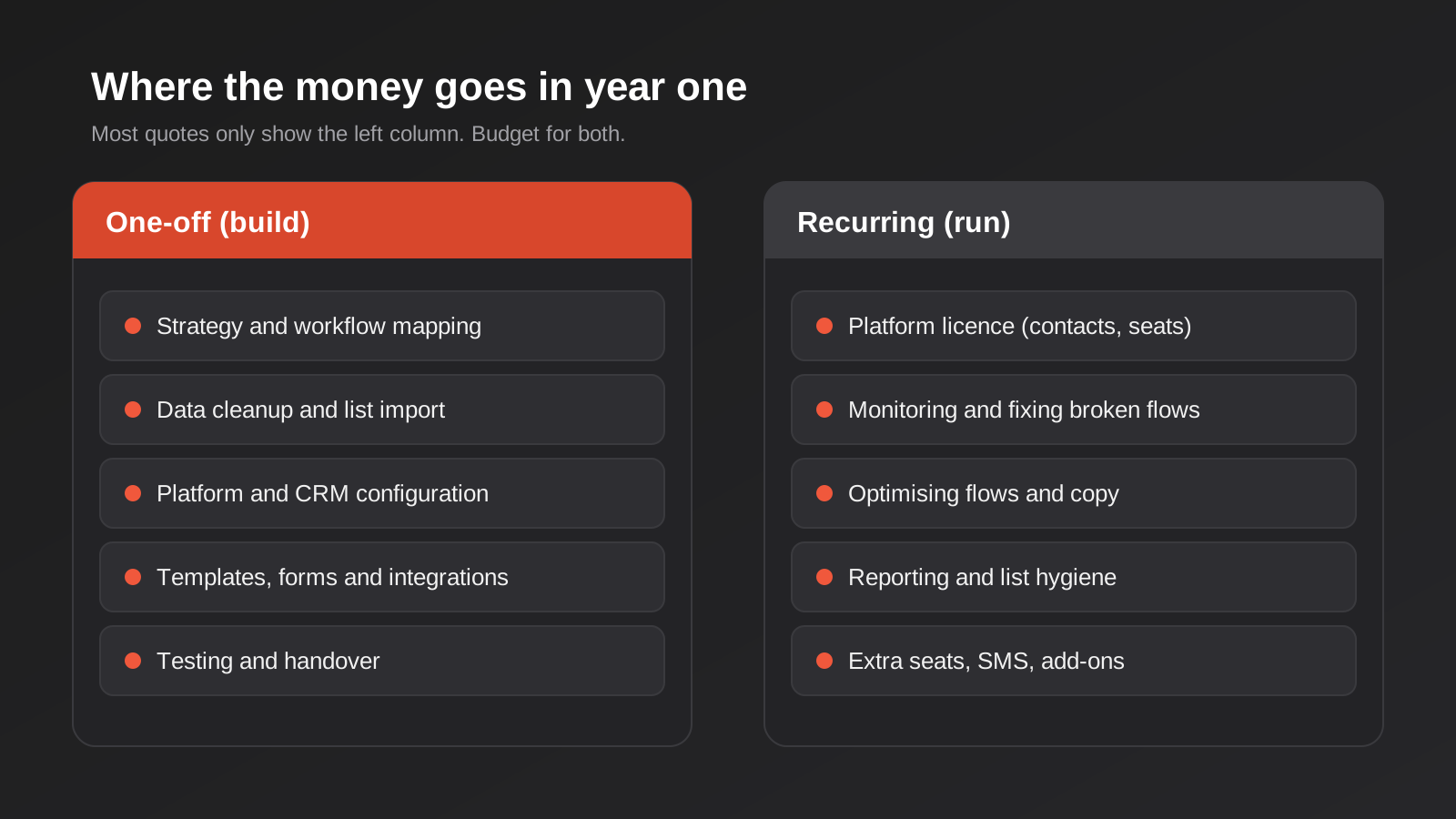
To compare properly, add up year one for each option: the licence for twelve months, any vendor onboarding fee, the build, and the ongoing care you expect to need. Then add a second row for year two without the one-off items. The ranking of options often flips between those two rows.
Pricing Models for Marketing Automation
The same work can be priced in four ways, and each moves risk between you and the supplier.
Fixed-price project
You agree a defined scope and a single price. It suits builds with a clear start and finish, such as “set up these six flows and connect them to the CRM”. The risk on your side is paying for a scope that is described loosely, so insist on a list of flows, triggers and integrations in writing. The risk on the agency’s side is underquoting, which tends to show up as a pushback on every change request. A well-scoped fixed price is usually the easiest to compare and the least stressful to manage.
Time and materials
You pay for hours at an agreed rate. It is honest about the work involved and suits exploratory projects where the scope will change, but it hands the budget risk to you. If you go this way, ask for an estimate range, a cap and a regular time report.
Monthly retainer
A fixed monthly fee for a block of work: building new flows, optimising existing ones, monitoring and reporting. It works well after the initial build, when the job becomes continuous improvement. It works badly when it is used to hide a build cost inside a monthly fee with a long minimum term. Read the term and the exit conditions closely.
Platform-partner packages
Some vendors sell implementation through their own partner networks at set prices. These can be good value and well matched to the platform, but they bind you to that vendor, and the package covers what the vendor wants to sell, not necessarily what your business needs. Ask what happens if you outgrow the platform.
What a Proper Quote Should Include
A good quote reads like a scope of work. Someone who was not in the meeting should be able to read it and know what will exist when the project finishes. Look for these items.
- A named list of automations. Each with its trigger, the audience, what it sends and when it stops. “Lead nurture sequence” is a title, not a deliverable.
- The systems being connected. Which ones, in which direction, and what data moves between them.
- Who supplies the content. Copywriting, design, images and approvals, with the number of revision rounds.
- Data work. Cleanup, deduplication, list import, consent handling and suppression lists.
- Testing and launch approach. Staging, test contacts, a soft launch and who signs off.
- Platform costs. A clear statement of whether the licence is included or separate, who holds the account, and what the platform will cost at your list size.
- Ownership. The account, templates, flows and documentation should be yours if you leave.
- Training and handover. What your team will learn and what is written down.
- Ongoing care. Whether it is included, what it covers, how issues are reported and fixed, and the response times.
- Exclusions and change process. What is not covered and how extra work is priced.
- GST, payment terms and term. Ex or inc GST, the payment schedule, minimum term and notice period.
If you are still deciding what to put on the list in the first place, start by choosing what to automate first, so you are not paying to build something that will not move the needle.
How to compare three quotes side by side
Build a simple table with the same rows for every supplier: build fee, platform assumed, licence cost at your list size, number of flows, systems connected, content included, data cleanup, testing, training, ongoing care, term and GST. Fill in what each quote says and write “not stated” where it does not. The blanks are the most useful part, because they show exactly where you will be asking questions, and they usually cluster in the cheapest quote.
Then work out the year-one total for each. The headline build fee is rarely the deciding number once licences and care are included.
Why Two Quotes for the Same Brief Differ So Much
If you collect more than two quotes you will see a spread of three or four times for what you thought was the same request. The suppliers are almost never quoting the same job, because several assumptions sit behind a short brief.
The first is ambition. “We want to automate our follow-up” can mean a three-email sequence or an entire lead lifecycle programme with scoring. The second is baseline: one supplier assumes your data and tools are in good order, another has looked and priced the cleanup. The third is who does the creative work. The fourth is the platform choice, because a build on a free or cheap tool and a build on an enterprise one are different projects. The fifth is the supplier’s own cost structure, where a lean specialist and a larger firm with layered account management will price the same hours differently.
What a cheap quote usually leaves out
A low price is not always a bad one, and some small operators do excellent work at modest rates. When a quote sits far below the others, these are the usual places the saving was made.
- Data cleanup. Your list is imported as it stands, duplicates and all.
- Testing. Flows go live without a full run through every branch.
- Content. Placeholder templates, with the real writing left to you.
- Documentation. Nothing written down, so only the builder understands the system.
- Error handling. No alerts when a connection fails, so problems surface through customer complaints.
- Ownership. The build lives inside the supplier’s account.
- Aftercare. No time allocated for fixes in the first weeks, which is when most of them are needed.
Ask “what happens in week three if a flow breaks?” and listen to the answer. Concrete and specific is good. A brochure answer tells you plenty.
What to Expect to Pay at Each Business Stage
Price expectations make more sense when tied to where the business is. These are rules of thumb built on the ranges above, not prescriptions.
Sole trader or very small business
Start with a single platform, a welcome flow, an enquiry follow-up and a regular newsletter. Doing it yourself in a low-cost tool is reasonable here, and paying someone for a short setup session is often better value than a full build. Spending enterprise money at this stage is usually premature.
Established small business with a CRM
This is where the $3,000–$15,000 band applies. You have customers, a CRM, a website and a handful of repeatable journeys worth automating: enquiry follow-up, quote reminders, review requests, reactivation. The best return usually comes from two or three well-built flows, not twenty mediocre ones. If the CRM itself is the open question, compare CRMs for Australian small businesses before you commission any flows.
Ecommerce retailer
Catalogue size, order volume and number of channels scale the work. Abandoned cart, browse abandonment, post-purchase, replenishment and win-back flows are standard, and each depends on clean product and customer data. Platform choice matters a lot here, because ecommerce-focused tools price differently from general ones. Quotes are normally scoped individually.
B2B or multi-system business
Longer sales cycles, lead scoring, sales handover rules and several connected systems push the work into custom territory, with the wider $5,000–$25,000-plus bands in play. Reporting also matters more, since you need to see which marketing activity produced pipeline, not just opens and clicks.
The Running Costs Nobody Puts in the Proposal
Automation is not a cabinet you install and forget. Things change around it: a form gets redesigned, a field is renamed in the CRM, an API connection expires, a product range is retired. Each change can silently break a flow, and the first sign is often a customer receiving the wrong email, or no email at all.
Budget for four recurring jobs. Monitoring, so failures raise an alert instead of waiting to be noticed. Maintenance, to keep connections working as the tools around them change. Optimisation, because flows should be improved from results, not left to run for years. List hygiene, so you are not paying for dead contacts and damaging your sender reputation. Together these are the difference between automation that earns money in year two and automation that quietly decays.
Whether this is a monthly retainer, a bank of hours or an on-call arrangement is something to settle before the build, because it affects how the build is documented. Our marketing automation service page sets out what we build and support.
How Long Before Marketing Automation Pays Back
Payback depends on what the flows are doing. A welcome series or abandoned-cart flow can produce measurable revenue within weeks of going live, because it acts on people who are already interested. Lead nurture programmes take longer, since they work on the sales cycle of your business, which may be months. We would be wary of any supplier who gives a firm payback period before looking at your numbers.
A practical test is to work from the value of one outcome. If a recovered order is worth $90 in margin and a good abandoned-cart flow recovers a handful of orders a month, you can estimate fairly quickly whether the build pays for itself within a year. If you cannot say what a customer or a repeat order is worth, establish that first. Decide in advance which two or three numbers you will watch, such as recovered revenue, enquiry-to-quote rate and unsubscribe rate, and make sure tracking is in place from the first day.
Common Mistakes When Buying Marketing Automation
- Choosing the platform before the plan. Pick the tool after you know which journeys you need, not because a partner sells it.
- Comparing build fees without licences. A cheap build on an expensive platform can cost more over two years than a pricier build on a modest one.
- Ignoring the data. Automating over a messy list multiplies the mess faster than any manual process could.
- Automating everything at once. Two flows built well and measured beat ten flows launched together and never reviewed.
- Not owning the account. If the platform is registered to the agency, leaving them becomes a project of its own.
- Skipping consent. Commercial messages without proper consent and unsubscribe handling create legal and reputational risk.
- Forgetting the people. Staff need to know what the automation sends, so they can answer replies and spot mistakes.
- No plan for changes. If a form or field changes and nobody tells whoever maintains the flows, things break silently.
- Measuring opens instead of outcomes. Open rates are distorted by privacy features in mail apps. Track clicks, enquiries and revenue.
- Accepting a long lock-in. A twelve-month term with a cancellation fee for an unproven supplier is a lot of risk to take on in one go.
None of this means automation is not worth the money. For a business with repeatable customer journeys it frequently is. It does mean the price on page one of a proposal is rarely the price you will pay.
Frequently Asked Questions
How much does marketing automation cost per month in Australia?
It depends which layer you mean. Platform licences range from the low tens of dollars a month for small lists on budget tools to several hundred or more for professional tiers of the larger platforms, usually priced in US dollars. Ongoing management by an agency is quoted so differently that we could not find a defensible typical figure, so ask each supplier what is included and compare on that basis. Check whether prices include GST.
Is it worth paying an agency, or can I set it up myself?
If your needs are a welcome email, an abandoned-cart flow and a newsletter, doing it yourself in a mainstream platform is realistic and costs mostly your time. An agency earns its fee when you need several systems connected, your data needs sorting, the logic branches, or the cost of mistakes is high. A middle path is paying for a strategy and setup session, then running the flows yourself.
Why do platforms charge by contacts, and how can I keep the bill down?
Contact-based pricing is how most vendors scale their fees with your usage. You can keep it under control by removing unengaged contacts regularly, suppressing people who have unsubscribed or bounced, avoiding duplicate records and checking whether the platform counts a person once or per list. Some tools, such as Brevo, price on emails sent instead, which can suit large, quiet lists.
Do I need a CRM before I automate marketing?
Not always. A retailer can run well on an ecommerce platform and an email tool. A service business with sales conversations usually benefits from a CRM because the automation can respond to what happened with the lead, not only whether they opened an email. If you are unsure, start with the journey you want to improve and work back to the tools.
Will the quote change after the project starts?
Fixed-price quotes should not move unless you change the scope, which is why a written list of flows, systems and exclusions matters so much. Time-and-materials work can move, so ask for a cap. Whichever model you choose, agree in advance how extra requests are priced.
What should I ask an agency before signing?
Ask which flows will exist at the end and who owns them, who holds the platform account, what happens to the data and consent records, how testing is done, who fixes things when they break and how fast, what the total first-year cost is including the licence, and what you walk away with if you cancel. Clear, specific answers are a good sign regardless of the price.
Where to Start
Begin with one journey, not a platform. Write down the single process where a missed or late follow-up costs you most, estimate what one recovered customer is worth, and take that to two or three suppliers with the same written brief. Use the comparison table above to line up the answers. If you want to see how we scope and quote this kind of work, the details are on our automation pricing page.
Because we run lean as a specialist agency rather than carrying a large account-management layer, our fixed quotes typically come in below the Australian averages covered in this guide. If you’ve already got a written quote from another agency for comparable scope, send it through and we’ll do our best to beat it.
Keep reading
Related posts
How to Compare Agency Quotes in Australia: Why Prices Differ So Much (2026)
Why three agency quotes for the same job differ so much in Australia, what a good quote includes, and a step-by-step way…
How Much Does AI SEO Cost in Australia? A 2026 Price Guide
What AI SEO (GEO/AEO) costs in Australia in 2026: real monthly ranges by tier, what drives quotes up or down, and how…
How Much Does an MVP Cost in Australia? A 2026 Price Guide
What an MVP costs in Australia in 2026: real price bands, what drives quotes up or down, and how to compare three…
Got a project you'd like to talk through?
Tell us what you're working on — we'll come back with a plan.
