
EDI Integration for Australian Suppliers: What It Takes to Trade With Woolworths, Coles and Bunnings (2026)
 Jignesh Vagadiya
22/09/2026
21 min read
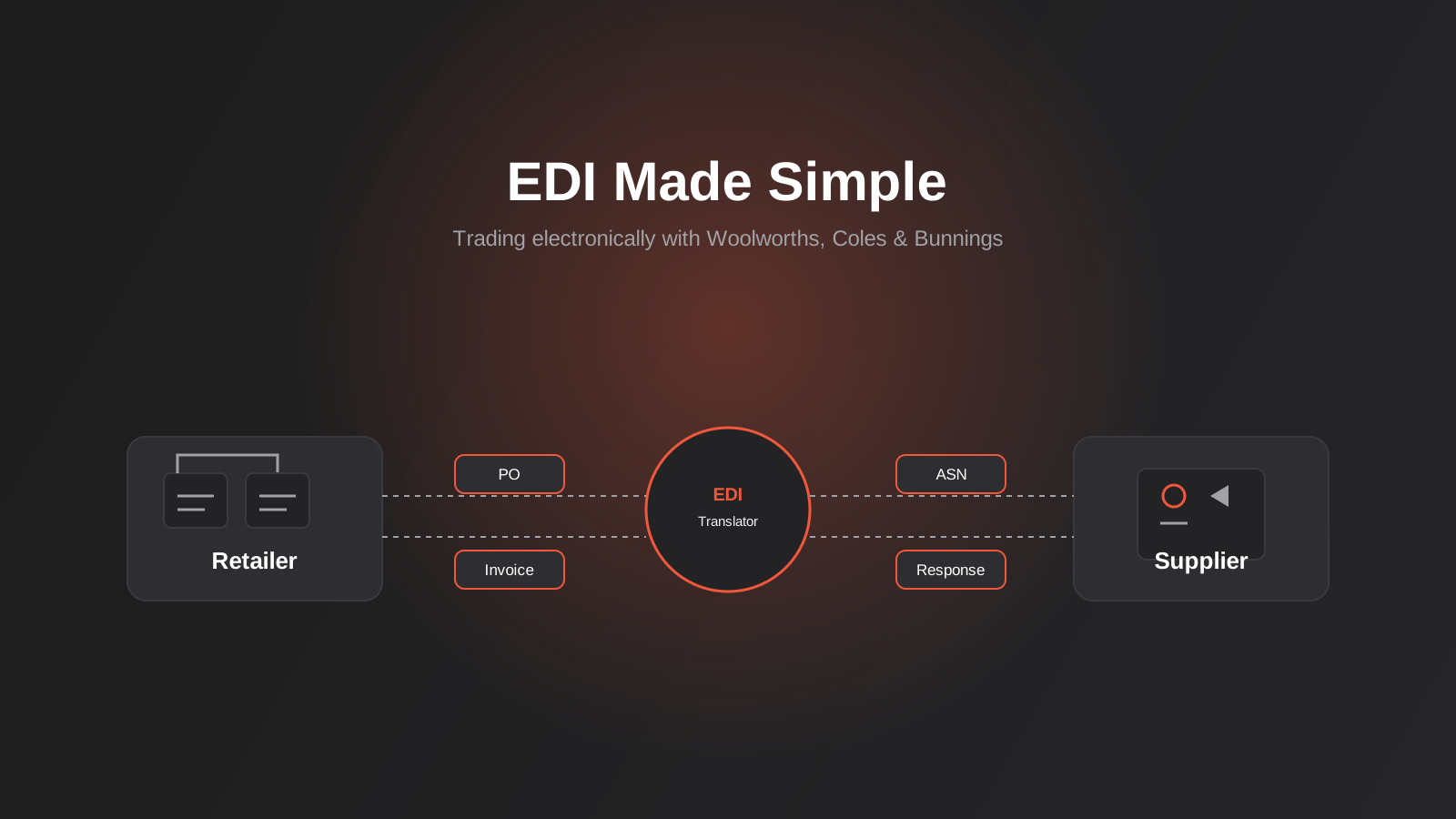
A supplier onboarding email from Woolworths or Coles usually contains one line that stops a small business dead: “EDI compliance is mandatory before your first purchase order can be raised.” No explanation of what that means practically, no recommended provider, just a deadline and a link to a technical specification written for someone else’s IT department. We’ve sat across the table from enough Australian manufacturers, distributors and FMCG brands hitting this exact wall to know it’s rarely about capability. It’s about nobody having translated “EDI compliance” into what actually has to happen inside your business.
This isn’t the same problem as connecting to a B2B procurement portal like Ariba or Coupa — we’ve covered that punchout world separately in our guide to cXML and OCI punchout integration. Retail trading partner EDI is a different beast: older protocols, stricter formatting rules, and a retailer on the other end who will simply stop paying your invoices, or worse, delist you, if you get it wrong. It’s also a genuinely under-written topic in Australia. Most of what’s published either comes from EDI vendors selling their own platform, or from generic global content that never mentions Woolworths’ own EDI connectivity guide, Coles’ EDIFACT specification, or Bunnings’ vendor compliance portal by name.
So this is the practical version of EDI integration for Australian suppliers: what EDI actually is, which documents you’ll really exchange, the three realistic ways to get connected, what changes inside your business once you’re live, and what it costs in 2026. If you’re staring down a retailer onboarding deadline, or trying to work out whether to build this yourself or hand it to a managed provider, this is the guide we wish existed before we started doing this work for clients.
What EDI Actually Is (And Why a PDF Invoice Doesn’t Cut It)
Electronic Data Interchange is the direct, computer-to-computer exchange of structured business documents in a fixed format that both sides’ systems can parse without a human reading anything. That’s the whole idea: no PDFs, no emailed spreadsheets, no person retyping a purchase order into your accounting system. The retailer’s system generates an order, sends it as a structured file, and your system receives it, validates it against a specification, and imports it directly into your ERP, WMS or accounting platform.
The distinction that trips people up is between “sending files electronically” and EDI proper. Emailing a PDF invoice is electronic. It is not EDI, because a PDF has no fixed, machine-readable structure a retailer’s accounts payable system can ingest automatically. Neither is a CSV export unless it maps precisely to the retailer’s field-by-field specification, in the exact segment order they require, with the exact delimiters, code lists and mandatory fields they’ve defined. Retailers mandate EDI specifically because it removes the manual data entry step on their side entirely — a purchase order that lands as structured EDI can flow straight into their systems, get matched automatically, and get paid without anyone in their AP team touching it.
EDIFACT, X12 and Why the Alphabet Soup Matters
There are two dominant EDI standards in play globally, and which one you need depends entirely on who you’re trading with. EDIFACT (UN/EDIFACT) is the international standard and the one Australian retailers overwhelmingly use — Woolworths and Coles both specify EDIFACT message types for local trading. X12 is the American standard, used heavily if you’re supplying into US retailers or dealing with a global brand’s US-based EDI infrastructure. If you only trade domestically you’ll mostly deal with EDIFACT; if you also supply into the US or a multinational, you may need to support both, and your EDI translator software or provider needs to handle each format’s segment structure, not just swap a few field names.
Within EDIFACT, each document type has a message code — ORDERS for a purchase order, DESADV for a dispatch advice, INVOIC for an invoice. Within X12 the same document types are numbered — 850, 856, 810. Retailers publish their own “implementation guide” on top of the base standard, specifying which segments are mandatory, which codes they use for store locations, and how they want quantities and dates formatted. Two retailers both claiming to use “EDIFACT ORDERS” can still require meaningfully different files, which is exactly why a generic EDI setup built for one partner often needs real rework before it’s accepted by the next.
Why Woolworths, Coles, Bunnings and Aldi Mandate It
From a retailer’s side, EDI isn’t a bureaucratic hurdle for its own sake — it’s how they run supply chains with thousands of suppliers and hundreds of thousands of SKUs without an army of data entry staff. Every major Australian retailer — Woolworths, Coles, Bunnings, Aldi, and increasingly mid-tier chains and buying groups — requires EDI-capable suppliers as a condition of trade, and it typically sits in the supplier agreement alongside GS1 barcode compliance, not as an optional nice-to-have.
GS1 Numbering, Barcodes and SSCC Labels
EDI compliance and GS1 compliance are bundled together in practice, even though they’re technically separate systems. Every product needs a GTIN (the barcode number), every pallet or carton needs an SSCC (Serial Shipping Container Code) printed as a GS1-128 barcode label, and your Advance Shipping Notice has to reference those same SSCC numbers so the retailer’s warehouse can scan a pallet as it arrives and reconcile it instantly against what you told them electronically was coming. If your SSCC labels don’t match your ASN data, or your labels aren’t scannable at the retailer’s dock, goods get held or rejected regardless of how correct your EDI files are. GS1 Australia runs the numbering and label standards side of this, separately from the EDI document exchange itself, and getting both right at the same time is where a lot of first-time suppliers underestimate the work.
The upside worth mentioning: GTINs and SSCC structures are standardised globally through GS1, so a barcode numbering scheme you set up correctly for Woolworths carries across to Coles, Bunnings, Aldi or an overseas retailer without starting from scratch. The work that doesn’t carry across as cleanly is each retailer’s specific EDI implementation guide and their store or distribution centre coding, which is exactly why onboarding a second retail partner is usually faster than the first, but rarely instant.
What Happens If You Don’t Comply
Non-compliance doesn’t usually mean an outright ban on day one. It means chargebacks — deductions from your payment for late, missing or incorrectly formatted ASNs, mislabelled cartons, or invoices that don’t match the original purchase order within the retailer’s tolerance. Persistent non-compliance escalates to held payments, and ultimately to a supplier being deprioritised or delisted in favour of one that trades cleanly. For a small or mid-sized supplier, chargebacks alone can quietly erode margin on every single order, which is the real financial argument for getting the integration right the first time rather than patching it order by order.
The Core Documents You’ll Actually Exchange
Strip away the acronyms and every retail EDI relationship boils down to the same four-document cycle, repeated for every order, every day, at whatever volume you trade.
Purchase Order — ORDERS (EDIFACT) / 850 (X12)
The retailer tells you what they want, in what quantity, delivered to which distribution centre or store, by when. This lands in your system as a structured file your ERP or order management system needs to pick up automatically — not as a PDF someone in your warehouse prints out and keys in by hand.
Order Response — ORDRSP (EDIFACT) / 855 (X12)
You confirm back what you can actually supply, which matters more than it sounds. If you can’t fulfil the full quantity or the requested date, this is where you tell the retailer’s system that upfront, rather than them finding out when the shipment doesn’t arrive.
Advance Ship Notice — DESADV (EDIFACT) / 856 (X12)
Sent before the goods physically arrive, this tells the retailer exactly what’s on the truck — down to carton and pallet level, referencing the SSCC labels physically attached to the freight. It’s the document that lets a distribution centre scan a pallet on arrival and match it instantly to what was promised, and it’s also the single most common source of chargebacks when the data doesn’t match the physical goods.
Invoice — INVOIC (EDIFACT) / 810 (X12)
Your invoice, sent as structured data that matches the original purchase order line by line, quantity by quantity, price by price. Retailers run automated three-way matching — PO, ASN, invoice — and any mismatch outside their tolerance either gets kicked back for manual review or triggers a chargeback rather than getting paid.
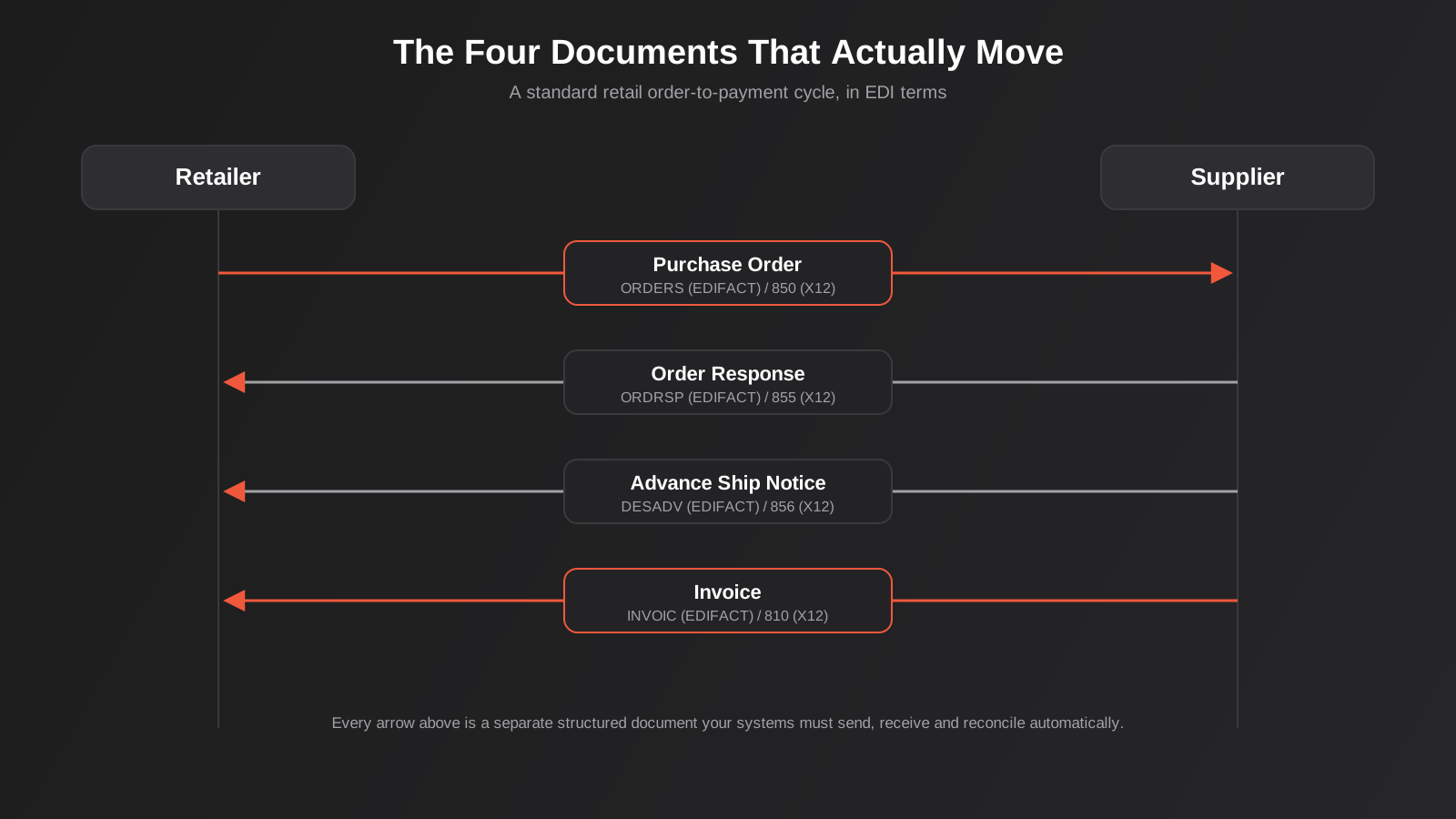
Larger or more mature retail relationships add documents on top of this core four — remittance advice, product catalogue updates, price change notifications, returns — but if your systems can reliably handle these four in both directions, you’re compliant with the vast majority of what an Australian major retailer requires from a standard supplier.
Three Ways to Actually Get Connected
There isn’t one “correct” way to become EDI-capable. There are three realistic paths, and which one fits depends on your order volume, how many retail partners you’re trading with, whether you already run an ERP, and how much you want this to be your team’s problem versus someone else’s. We tend to walk clients through this as a genuine cost-versus-control decision rather than a technology preference — the “best” option on paper for a business trading with five retail partners at high volume is often the wrong option for a business onboarding its first one, and vice versa.
Managed EDI Provider (VAN)
A Value Added Network provider — in Australia this includes names like Crossfire, SPS Commerce, Pacific Commerce, TrueCommerce and Cogential IT — already has a live connection into Woolworths, Coles, Bunnings and most other major AU trading partners. You connect to them once; they handle translating between your format and each retailer’s specification, and they maintain the connection when a retailer changes their spec (which happens more often than anyone expects). This is the lowest-effort path technically, and the fastest to get compliant if you have no in-house development capacity. The trade-off is ongoing cost that scales with document volume and a level of dependency on the provider’s own uptime and support responsiveness.
Self-Managed EDI Software (AS2)
You run your own EDI translator software and connect directly to each retailer via AS2 (the secure transport protocol most Australian retailers use for direct EDI connections), managing the mapping and certificate exchange yourself. This gives you full technical control and, at high enough volume, lower per-document cost than a managed provider — but it means someone on your team (or a technical partner) owns every mapping change, every certificate renewal, and every retailer-specific quirk indefinitely. It suits businesses trading with many partners over a long horizon, where the fixed cost of building this capability pays for itself against per-transaction VAN fees.
API-to-EDI Middleware
This is where most growing Australian suppliers actually land, and it’s the option that gets the least airtime in generic EDI content. Rather than your ERP or inventory system talking EDIFACT directly, a middleware layer exposes a normal REST API or a pre-built connector to your ERP, and handles the EDI translation and retailer connection behind that layer. Your team and your ERP integrator work in APIs and webhooks — the world we already cover in our guide to ERP integration for Australian businesses — while the middleware quietly does the EDIFACT/X12 heavy lifting on the retailer-facing side. It’s a genuinely practical middle ground if you’re already running a reasonably modern ERP or accounting platform and don’t want two completely separate integration skillsets living in your business.

What Has to Change Inside Your Business
Whichever connection path you choose, EDI compliance isn’t a one-time integration project that ends once the connection is live. It changes how a handful of operational processes actually run, day to day.
Your ERP or Inventory System Becomes the Source of Truth
EDI works because it’s automated end to end. If your stock levels, product master data and pricing live in a spreadsheet that someone updates when they remember to, your automated Order Response and Invoice will be automated confirmations of wrong information. The businesses that get the most value from EDI are ones where the underlying system of record is accurate and current enough that automating the document exchange on top of it is actually safe to do. This is the same groundwork we describe in our guide to ERP integration — EDI compliance is very often the forcing function that finally justifies fixing data quality issues that had been tolerated for years.
Barcode and Label Printing Becomes an Operational Workflow, Not an Afterthought
Someone in your warehouse needs to print GS1-128 SSCC labels, attach them to the correct pallets and cartons, and make sure the numbers on those physical labels are the exact numbers referenced in the ASN you’re about to send. In practice this usually means your warehouse or fulfilment software needs a label printing module that talks to the same order data as your EDI system, so the physical label and the electronic message are generated from one source rather than two people doing two separate manual steps that can drift out of sync.
Invoice Matching Discipline
Because retailers automatically three-way match PO, ASN and invoice, your invoicing process needs to reference the retailer’s original PO number exactly, quantity and pricing needs to match what was confirmed in your Order Response, and any short-shipment or substitution needs to be reflected consistently across all three documents. This is less a technology problem than a process discipline problem — the technology will happily automate a mismatch straight into a chargeback if the underlying process lets one through.
What EDI Integration Actually Costs and How Long Onboarding Takes in 2026
Real numbers, because “it depends” isn’t useful when you’re staring down a retailer deadline.
Managed Provider Pricing
Traditional VAN-based EDI pricing in 2026 typically combines a monthly network fee, commonly somewhere in the AU$50–$500 range depending on the provider and the number of trading partners, with per-document transaction charges that can run from roughly $0.10 to $1.00 per message depending on document type and volume tier. A supplier sending a few hundred documents a month across two or three retail partners will sit at the lower end of that range; a business processing thousands of ASNs and invoices monthly will negotiate volume pricing that changes the economics meaningfully.
Build-It-Yourself Costs
Running your own EDI translator and AS2 connections removes the per-document fee but adds software licensing, the AS2 certificate and connectivity setup for each retailer, and ongoing developer or integrator time whenever a retailer updates their specification. For a business trading with two or three major partners, the annual cost of ownership can land close to a managed provider’s fees once support time is counted honestly — the case for self-managing strengthens mainly at higher partner counts and document volumes.
The Costs Nobody Quotes Upfront
Beyond the headline monthly fee or per-document rate, budget for the setup work a provider or software vendor rarely puts on the first quote: mapping fees when a retailer changes their implementation guide (which happens periodically and isn’t optional to ignore), a sandbox or test environment fee for the certification cycle with each new retailer, and AS2 certificate renewals if you’re managing that layer yourself. None of these are large individually, but they’re the reason a “should be around $X a month” estimate from a sales call often understates the real first-year cost by a meaningful margin. Ask any provider directly what a retailer specification change costs to implement on their side before you sign, because that’s the ongoing cost that actually varies most between vendors.
Realistic Onboarding Timelines
Bunnings’ own supplier onboarding process typically runs four to eight weeks from first contact to a live, tested EDI connection, and that’s a reasonable benchmark across the major Australian retailers generally. The timeline is rarely the technical connection itself — it’s testing cycles with the retailer’s own EDI team, correcting mapping issues that only show up once real test documents are exchanged, and getting GS1 labelling sorted in parallel. Businesses that start the GS1 barcode and SSCC labelling work at the same time as the EDI connection, rather than treating them as sequential, generally hit go-live dates faster.
EDI vs API: Which One Do You Actually Need
It’s worth being direct about this because the terms get used loosely: if a major retailer’s supplier agreement says EDI is mandatory, that’s not a preference you get to override by offering them a nicer API. EDI is what they’ve built their receiving, warehouse and accounts payable systems around, and asking a retailer the size of Woolworths or Coles to accept a bespoke API integration instead is not a realistic conversation for a small or mid-sized supplier. Where the EDI-vs-API question genuinely opens up is on your side of the connection — the interface between the EDI layer (however you’ve implemented it) and your own ERP, inventory or accounting system, which is exactly the API and integrations work we cover in our guide to API integrations for growing Australian businesses.
It’s also worth distinguishing this from punchout catalog integration, which solves a related but different problem. Punchout (cXML/OCI) is what lets a B2B buyer shop your catalogue from inside their own procurement system like Ariba or Coupa before an order even exists. EDI is what happens after that order is placed, moving it, confirming it, shipping against it and getting paid for it. A supplier selling into large enterprise procurement teams may eventually need both; a supplier trading purely with Woolworths, Coles, Bunnings or Aldi as a retail partner will almost always need EDI first.
Don’t Confuse This With Peppol E-Invoicing
This is a genuinely common mix-up, and worth clearing up directly. Australia has been pushing Peppol e-invoicing hard through the ATO and the Business Council’s e-invoicing initiative — it’s a separate international framework for sending structured invoices directly between accounting systems (Xero, MYOB, and most mid-market ERPs support it natively), and it’s mainly aimed at business-to-business and business-to-government invoicing generally, not retail supply chain trading specifically.
Peppol and retail EDI solve overlapping but distinct problems. Peppol is genuinely simpler to set up — if your accounting platform already supports it, turning it on can be close to a configuration task rather than an integration project — but it only covers the invoice itself. It has no equivalent for a retailer’s purchase order, no Advance Ship Notice, no SSCC label reconciliation at a distribution centre. A retailer like Woolworths or Coles isn’t going to restructure its warehouse receiving process around Peppol; they need the full EDI document cycle we’ve described above, because the invoice is only the last of four documents in that cycle.
Where this gets genuinely useful is if you’re already sending Peppol e-invoices to some trading partners (government clients, for instance) and separately building EDI compliance for retail partners — in that case it’s worth checking whether your EDI middleware or ERP integration can handle both invoice formats from the same underlying invoice data, rather than maintaining two parallel invoicing processes that both need to stay in sync with your actual sales records.
Common Mistakes
- Treating EDI compliance as a one-off IT project instead of an ongoing operational commitment — specifications change, and someone needs to own updates permanently, not just at go-live.
- Building or buying an EDI connection before fixing inventory and pricing data accuracy, which just automates the delivery of wrong information faster.
- Underestimating GS1 labelling as a side task, when SSCC label errors are one of the most common causes of ASN-related chargebacks.
- Assuming one retailer’s EDIFACT implementation will work unchanged for the next retailer, without checking their specific implementation guide.
- Choosing a managed provider purely on price without confirming they have an existing, tested connection to your specific retail partners.
- Skipping proper testing cycles with the retailer’s EDI team before go-live, then discovering mapping errors on the first real live order.
- Leaving invoice matching logic disconnected from the ASN and PO data, so mismatches surface as chargebacks rather than being caught before the invoice is sent.
Frequently Asked Questions
Do I need EDI if I only supply one small retailer?
If that retailer’s supplier agreement mandates EDI, yes — the requirement doesn’t scale down with your size, though your onboarding volume and therefore your costs will. For a single retail partner at modest volume, a managed EDI provider is usually the more sensible starting point than building your own AS2 connection, since the fixed cost of self-managing rarely pays off against one trading partner.
Can I use Zapier, Make or n8n instead of proper EDI?
Not for the retailer-facing connection itself — those tools don’t speak native EDIFACT or X12, and retailers require a certified, tested connection through AS2 or an approved VAN, not a generic automation platform. Where tools like these genuinely help is on your internal side, moving data between your EDI middleware and your accounting, inventory or CRM systems once the compliant connection exists.
How long does EDI onboarding with Woolworths or Coles actually take?
Budget four to eight weeks as a realistic range, similar to Bunnings’ published onboarding timeline, though it varies with how quickly your test documents pass the retailer’s validation and how much rework your GS1 labelling needs. Businesses that run GS1 barcode and label setup in parallel with the EDI connection, rather than after it, tend to land closer to the shorter end.
What’s the real difference between EDIFACT and X12?
They’re two separate international EDI standards using different message structures and codes for the same underlying document types. Australian retailers overwhelmingly specify EDIFACT for domestic trading; X12 mostly comes up if you’re also supplying into US retailers or a multinational’s US-based systems. Your EDI translator or provider needs to support whichever standard(s) your actual trading partners require — it’s not something you get to choose independently.
What causes most EDI-related chargebacks in practice?
Advance Ship Notice mismatches are the single biggest culprit — sending an ASN that doesn’t match the physical carton and pallet contents, or SSCC labels that don’t scan cleanly at the retailer’s dock. Invoice-to-PO mismatches from pricing or quantity discrepancies are the next most common source, which is why tight integration between your order, inventory and invoicing data matters as much as the EDI connection itself.
Should a growing business build its own EDI capability or use a managed provider?
For most businesses trading with one to three major retailers, a managed provider or an API-to-EDI middleware layer is the more sensible starting point — it gets you compliant faster and doesn’t require your team to become EDI specialists. Self-managed AS2 connections make more sense once you’re trading with enough partners, or at enough volume, that the fixed cost of owning the mapping work directly is clearly cheaper than ongoing per-document fees.
Is EDI compliance the same as GS1 compliance?
No, though retailers usually require both together and it’s easy to conflate them. EDI is the electronic exchange of structured business documents — purchase orders, ASNs, invoices. GS1 compliance is the barcode numbering and labelling system (GTINs on products, SSCCs on pallets and cartons) that those documents reference. You need working GS1 numbers and scannable labels for your ASN data to mean anything at the retailer’s dock, so treat them as two workstreams that need to finish in parallel, not one task with two names.
Where to Start
If a retailer deadline is already on the table, the first useful step isn’t picking a provider — it’s an honest look at what’s actually feeding your order, inventory and invoicing data right now, because that determines whether a fast managed connection will work cleanly or just automate existing data problems. From there, whether the right path is a managed EDI provider, an API-to-EDI middleware layer sitting on top of your existing ERP, or a full self-managed AS2 build depends on how many trading partners you’re dealing with and where you want that ongoing responsibility to sit.
We work through this with Australian suppliers regularly as part of our broader API and integrations work, usually alongside the ERP and ecommerce automation pieces that need to be solid before the EDI layer sits on top cleanly. If you’ve got a retailer onboarding deadline approaching and want a second opinion on which path actually fits your business, we’re happy to have that conversation before you commit to a provider.
Keep reading
Related posts
POS Integration for Australian Retail and Hospitality: Stock, Sales, Settlements and Getting the Books to Agree (2026)
How point-of-sale integration works for Australian retailers and hospitality venues: stock sync, daily sales posting, settlements and fees, and keeping the books…
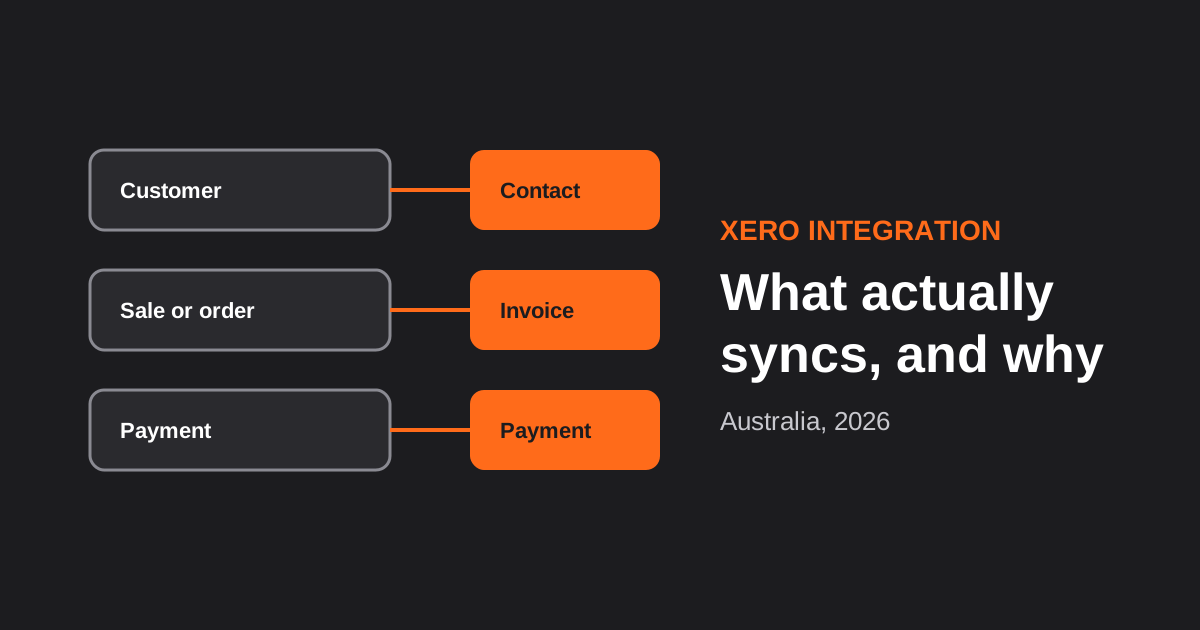
Xero Integration for Australian Businesses: What Actually Syncs, GST Mapping and the Mistakes That Break Reconciliation (2026)
How a Xero integration really works in Australia: what to sync, how to map invoices, payments, refunds and GST, and the mistakes…
CRM Integration for Australian Businesses: What to Connect First and How to Do It Properly (2026)
A practical guide to CRM integration for Australian businesses: what to connect first, which way data should flow, native vs middleware vs…
Got a project you'd like to talk through?
Tell us what you're working on — we'll come back with a plan.
