
When to Rebrand Your Business: Signs, Process and Real Cost in Australia (2026)
 Jignesh Vagadiya
28/10/2026
21 min read
A client rang us a few months back wanting “a few logo tweaks.” Twenty minutes into the call it was clear she actually meant something bigger: the business had grown from a two-person operation doing residential jobs into a twelve-person outfit chasing commercial contracts, and the logo — a hand-drawn mark from the ABN-registration days — was the least of what no longer fit. The website still talked about “we,” the quotes still went out on a template from 2021, and the van signage said something different again. She didn’t need a tweak. She needed to work out when to rebrand her business — whether now was actually the time, and if so, how much of a rebrand she needed.
That’s the actual question behind “when should I rebrand,” and it’s a harder one to answer than most of the content written about it suggests. Plenty of guides will give you a tidy list of warning signs and leave you to work out the rest. Fewer will tell you honestly that a full rebrand and a brand refresh are different projects with different price tags, different timelines, and genuinely different risk profiles — and that picking the wrong one wastes money either way, whether that’s overpaying for a strategic overhaul you didn’t need or underinvesting in a refresh when the actual problem was positioning, not paint.
This guide works through the real signs it’s time to do something, what a rebrand actually involves once you commit to one, what it costs in Australia in 2026, and the mistakes that turn a sensible brand update into an expensive one. If you’re trying to work out what a brand identity even consists of before deciding whether yours needs replacing, our guide to brand identity vs visual identity is worth reading first — this piece assumes you already know roughly what’s in a brand system and picks up at the harder question of whether and how to change it.
Refresh, Reposition or Rebrand? The Difference Actually Matters
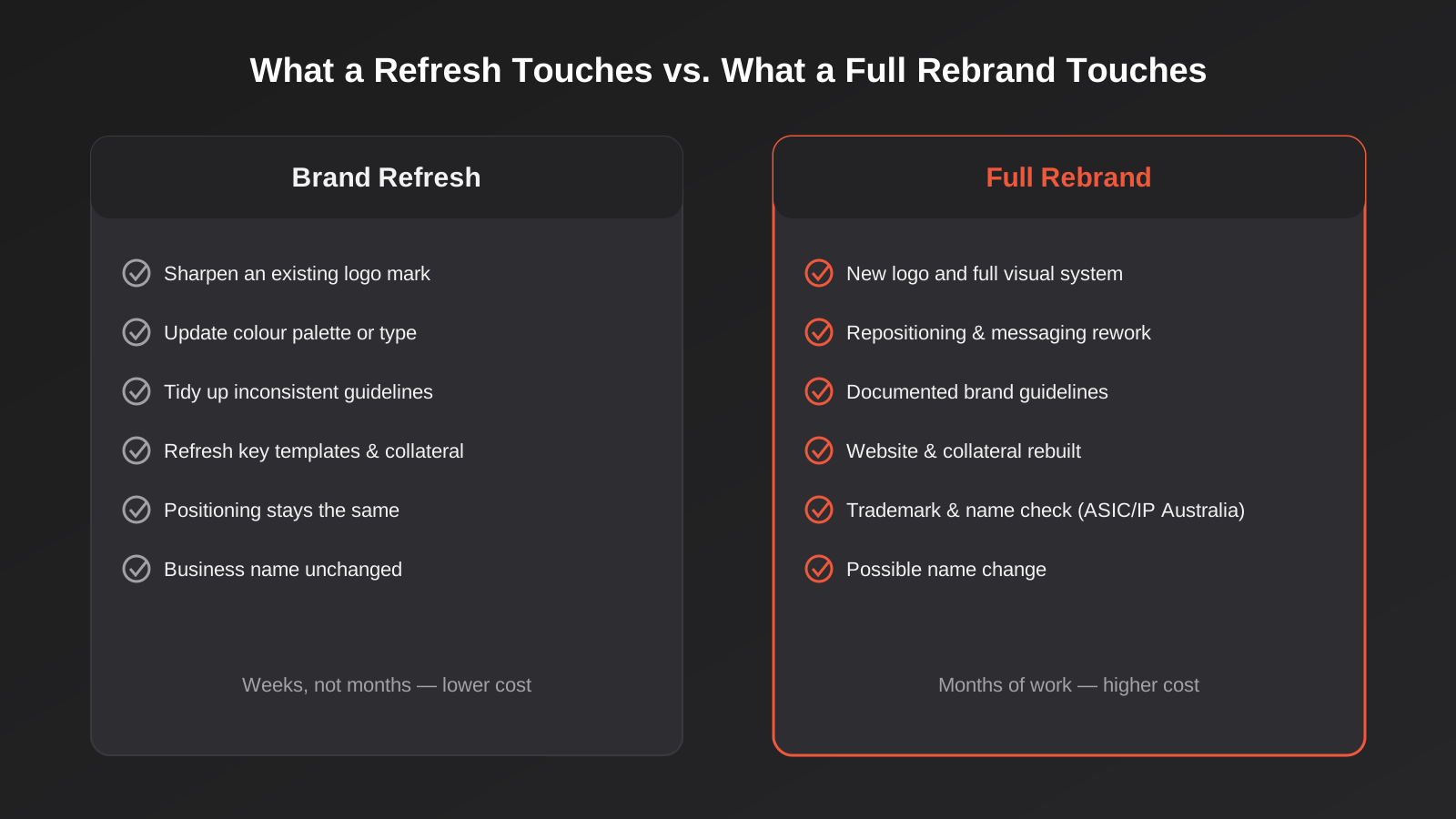
These three words get used interchangeably in casual conversation and that’s exactly where the budgeting problems start. A brand refresh sharpens what’s already there — tightening up a logo, updating a tired colour palette, tidying inconsistent guidelines — without touching what the business stands for or what it’s called. A reposition is a strategy change first: the business is targeting a different customer, competing on a different basis, or has outgrown its original pitch, and the visual work follows from that decision rather than driving it. A full rebrand usually means both at once — new positioning and a new visual system built to express it, sometimes with a new name attached, which adds a whole separate layer of legal and practical work on top of the design.
The reason this distinction is worth labouring is that each one has a completely different cost and timeline, and agencies don’t always volunteer which one they’re actually quoting you for. A refresh can be a few weeks and a few thousand dollars. A full rebrand with a name change is a multi-month project touching your website, signage, legal registrations, social handles and every piece of print collateral you’ve ever ordered. Knowing which one you actually need, before you ask for quotes, is the single biggest lever on what the project ends up costing.
Seven Signs It’s Actually Time to Rebrand
Not every outdated logo justifies a rebrand, and not every rebrand starts with an outdated logo. These are the signs that, in our experience, actually correlate with a brand needing more than a quick tidy-up — as opposed to the ones that just feel like good excuses to spend money on something new.
- The business has genuinely changed what it does or who it serves. If you started doing residential handyman jobs and now run commercial fit-outs, or you launched as a budget option and have quietly become the premium choice in your market, your positioning has moved even if nobody formally decided it should. The brand needs to catch up to where the business actually is, not where it was when the logo was designed.
- You’re embarrassed to hand over your own business card. This sounds flippant but it’s a genuinely reliable signal. If your instinct is to apologise for your own branding before a client even looks at it, that discomfort is usually well-founded, and it’s costing you credibility in moments that matter — a pitch, a tender, a first meeting with a bigger client than you’re used to.
- A merger, acquisition or ownership change has happened. Combining two businesses under one identity, or a change in ownership that comes with a change in direction, is one of the clearest triggers for a full rebrand rather than a refresh, because the thing being represented has actually changed, not just its wrapping.
- Your brand is inconsistent across every touchpoint because nobody’s ever controlled it. Different logo files floating around, three versions of the colour blue depending on who last opened the file, a website that doesn’t match the signage that doesn’t match the invoice template — this is less about the brand being “wrong” and more about there never having been a documented system to keep it right. Sometimes the fix here is lighter than a full rebrand; see the next section on refreshes.
- A legal or trademark conflict has surfaced. If IP Australia or a cease-and-desist letter has told you your name or mark conflicts with an existing registration, this isn’t really a choice — it’s a forced rebrand on a timeline you didn’t pick, and the sooner it’s handled properly the less disruptive it is.
- You’re entering a new market or audience that your current identity actively works against. A brand built for one state government tender audience and a brand built to win over fast-growing retail clients often pull in genuinely opposite directions — formal and risk-averse versus energetic and current. If you’re trying to serve both with one identity, it’s worth asking whether that’s actually possible, or whether you’ve been quietly underperforming with one audience to keep the other comfortable.
- Staff and customers struggle to explain what makes you different. This is the quietest sign and often the truest one. If you ask five people on your team to describe what sets the business apart and get five different, vague answers, no visual refresh fixes that. The brand strategy itself — not the logo — is the actual problem, and visual work without fixing the underlying positioning just puts a nicer coat of paint on a confused message.
Notice that most of these are about the business, not the logo. That’s deliberate. The visual identity is the symptom that gets noticed first because it’s the thing you look at every day, but in most of the genuine rebrand cases we’ve worked through, the trigger was something that had already changed in the business months or years before anyone decided to do anything about how it looked.
What a Rebrand Actually Involves
Once you’ve decided you’re doing a genuine rebrand rather than a lighter refresh, the project itself follows a fairly consistent shape. Skipping a step here is where a lot of rebrands quietly go wrong — usually by jumping straight to logo concepts because that’s the fun, visible part, while skipping the strategy work that should have decided what the logo needs to communicate in the first place.
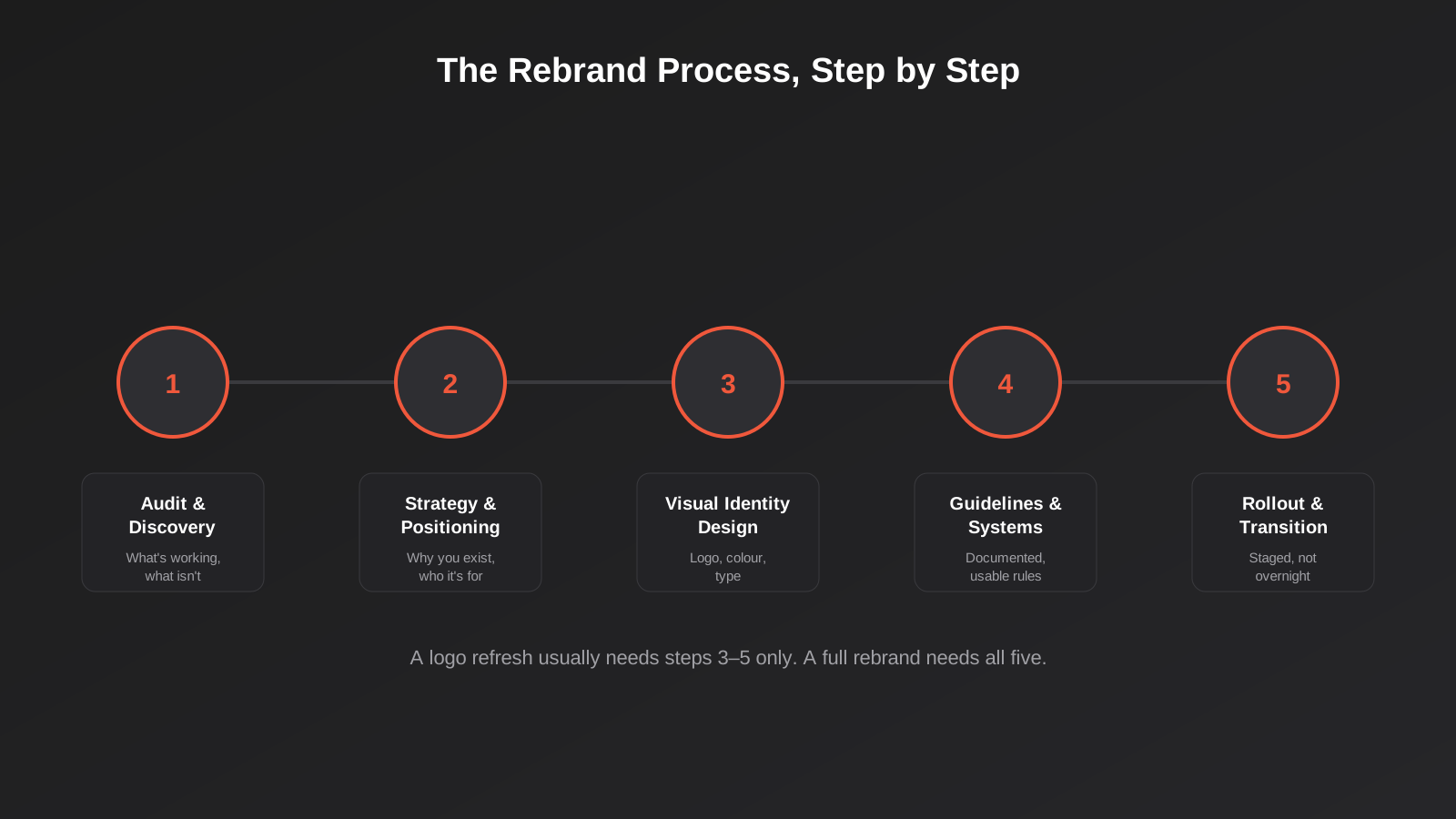
Step 1: Brand Audit & Discovery
This starts with an honest look at what’s actually working and what isn’t, before anyone touches a design tool. A proper audit reviews every place the current brand shows up — website, social profiles, signage, print collateral, staff uniforms, email signatures — and gets specific about which elements have earned genuine recognition worth protecting and which are just inconsistent clutter nobody would miss. It also means talking to actual customers and staff about how they currently perceive the business, not just assuming internally what the problem is. A competitor review at this stage is worth doing properly rather than skimming a few websites; the goal is understanding where your category’s visual language has drifted, so the new identity doesn’t accidentally look like everyone else’s idea of “modern” at the same time.
Step 2: Strategy & Positioning
This is the step that gets skipped most often, and it’s the one that actually determines whether the rebrand solves the real problem. Positioning work answers who you’re actually for, what you’re competing on, and what you want to be known for in three years, not just what feels true today. Tone of voice gets defined here too — whether the business sounds formal or casual, technical or plain-spoken — because that decision shapes copywriting across the website and every piece of marketing long after the logo work is finished. Skipping straight past this step to “just design us a new logo” is how businesses end up with a beautiful new mark that still doesn’t answer the question a confused customer or a confused staff member was actually asking.
Step 3: Visual Identity Design
Only once the strategy is settled does the actual logo, colour and typography work begin — and it should be explored across genuinely different directions before converging on one, not a single concept presented and rubber-stamped. This is also where AI-assisted concept exploration has become a genuinely useful part of the process for most agencies, including ours: it speeds up the early divergent-thinking phase, generating a wider spread of directions to react to faster, while the actual refinement, judgement calls and final craft stay with a human designer who understands the strategy behind the work. If you only need a standalone logo or a set of practical assets without the full strategic engagement, that’s a narrower, less expensive scope — our graphic design service covers exactly that, as distinct from a full branding and visual identity project.
Step 4: Guidelines & Systems
A brand that isn’t documented drifts the moment more than one person touches it, which is exactly how most businesses end up back at “inconsistent branding” within a couple of years of their last rebrand. Proper guidelines cover logo usage and the things you can’t do to it, exact colour codes across every format you’ll actually use, typography rules, and application examples across your most common real-world touchpoints. For a business that’s genuinely scaling — multiple staff producing their own materials, contractors, franchise or multi-location operations — this is also where it’s worth asking whether you need a fuller design system rather than a standalone guidelines PDF: a documented, component-based approach that keeps everything from social templates to proposal documents consistent without someone having to manually check each one against a style guide nobody opens.
Step 5: Rollout & Transition
This is the step that separates a rebrand that lands well from one that confuses existing customers. A staged rollout — announcing the change, running old and new identities in parallel for a defined period where that’s practical, prioritising the highest-visibility touchpoints first — protects the recognition and trust you’ve already built while the transition happens. Legacy asset transition matters here too: old stock, old signage, old business cards don’t need to all disappear on day one, but there should be an actual plan for when they do, rather than an indefinite “we’ll get to it” that means half your sales team is handing out the old card eighteen months later. Build a simple checklist of every touchpoint before launch day — website, Google Business Profile, social profiles, email signatures, signage, invoicing templates, supplier portals, industry directories — because it’s always longer than people expect, and the things left off it are exactly what ends up looking inconsistent six months after everyone assumed the rebrand was finished.
Future-Proofing: Building a Brand That Doesn’t Need Redoing in Three Years
One question worth asking before a single logo concept gets designed: how big do you expect this business to be in three to five years, and does the brand being built now actually have room for that? A brand sized perfectly for a five-person operation can genuinely start working against a fifty-person one — a colour palette too narrow to differentiate departments or product lines, a logo treatment that doesn’t scale cleanly onto a shopfront or a fleet of vehicles, guidelines that never anticipated a second location or a franchise model. None of this means over-engineering a brand system for a business that might never need it; it means having an honest conversation about growth plans as part of the strategy phase, not as an afterthought once the business has already outgrown what was built.
This is also where the difference between a one-off guidelines document and a genuine, component-based system starts to matter in practice rather than in theory. A static PDF works fine for a business where one or two people produce all the marketing material. It starts breaking down the moment multiple staff, contractors or franchisees are all producing their own assets without a shared, structured set of building blocks to work from — templates, defined components, a library that’s actually maintained rather than a folder of files from 2023 that nobody’s updated since. Building that scalability in from the start costs more upfront than a simple guidelines document, but it’s considerably cheaper than discovering the gap exists only once the business has grown past what the original rebrand anticipated and everything needs revisiting anyway.
The flip side is just as real: plenty of small businesses genuinely don’t need this level of system, and paying for one anyway is a waste of a budget that would be better spent elsewhere. If you’re a sole trader or a small team with no immediate plans to franchise, add locations, or bring on contractors who’ll be producing their own materials, a well-documented but straightforward guidelines package is the right-sized answer, not a limitation. The goal isn’t the most sophisticated system available — it’s a system that matches where the business is actually headed, honestly assessed rather than optimistically assumed.
What Rebranding Actually Costs in Australia in 2026
Pricing for rebrand work is reported inconsistently across the industry, partly because “rebrand” covers everything from a solo tradie updating a logo to a listed company repositioning across every market it operates in. Based on current Australian agency pricing and the scope each tier genuinely covers, excluding GST, here’s a realistic breakdown:
- Logo-only refresh, small business: roughly $500–$3,000 for a sharpened logo and light colour or type updates, with no change to positioning or a documented guidelines package.
- Brand refresh with basic guidelines, growing business: typically $3,000–$15,000, covering a refined visual identity, a usable guidelines document, and application across your most common touchpoints — website, social, core print collateral.
- Full visual identity transformation: generally $15,000–$40,000 for genuine strategy and positioning work, a new visual system built from scratch, comprehensive documented guidelines, and application across a wide range of digital and print touchpoints.
- Enterprise or multi-stakeholder rebrand: $50,000–$150,000 or more once you’re covering extensive market research, a board or multi-partner approval process, a name change with legal and trademark work, and rollout across many locations, a large signage estate, or a national footprint.
A few cost drivers push a quote toward the top of whichever tier you’re in: a name change on top of the visual work, since that drags in ASIC business name checks, IP Australia trademark searches and registration, domain and social handle acquisition, and updating every legal document and contract template that references the old name. Signage is its own line item that catches people out — physical signage, vehicle wraps and shopfront changes are quoted and installed separately from the design work, and for a business with several locations or a vehicle fleet this can genuinely rival the design fee itself. Packaging redesign, where it applies, follows the same pattern: design is one cost, and retooling or reprinting packaging at volume is a completely separate one that’s easy to underestimate.
The hidden costs worth budgeting for before you start, rather than discovering partway through: reprinting existing stationery and business cards that still have stock left; updating every third-party listing that references your old name or logo, from Google Business Profile to industry directories to supplier accounts; staff uniforms and vehicle signage if those apply to your business; and the simple cost of staff time spent on the transition itself, which rarely makes it into a rebrand budget but is real labour nonetheless. None of these are reasons to avoid a rebrand that’s genuinely needed — they’re reasons to scope the full picture before you commit to a number that only covers the design studio’s invoice.
Protecting What You’ve Already Built During the Transition
A rebrand that ignores what you’ve already earned — search rankings, customer recognition, supplier relationships built under the old name — can end up costing more in lost momentum than the design work itself. A few things are worth getting right before you launch.
Check the name is actually available before you fall in love with it
If a name change is part of the plan, check the ASIC business name register and search the IP Australia trademark database before the strategy and design work goes too far down a single path. Finding out a preferred name is already trademarked in your category after the visual identity is finished is an expensive way to learn this, and it happens more often than agencies like to admit.
Don’t let the rebrand quietly tank your search rankings
If the rebrand touches your website — a new domain, restructured URLs, a different homepage message — the SEO risk is real and well documented, and it’s worth treating as its own workstream rather than an afterthought of the visual refresh. A proper redirect map from every old URL to its new equivalent, careful handling of any domain change, and keeping your core ranking content intact through the transition all matter here. We’ve written a full guide to redesigning a website without losing rankings or revenue that covers this in more depth if your rebrand includes a site rebuild — the short version is that visual and messaging changes alone don’t usually hurt rankings, but careless URL and content changes absolutely can.
Communicate the change before customers stumble onto it
Existing customers finding out about a rebrand by accident — a different logo on an invoice with no explanation, a Google search that suddenly returns a different business name — creates confusion and, for some customers, genuine distrust about whether they’re still dealing with the same business. A short, direct announcement across the channels you actually use to reach customers, timed to land before the public-facing change rather than after, avoids most of this. It doesn’t need to be a marketing campaign; it needs to exist.
Give legacy assets a real transition window, not an indefinite one
Decide upfront how long old materials can keep circulating and what happens to remaining stock, rather than leaving it open-ended. A defined transition window — say, sixty or ninety days for internal materials, immediate for anything customer-facing like the website and signage — keeps the change feeling deliberate rather than half-finished.
Brief your own team before launch day, not on it
Staff who get blindsided by a rebrand on the same day a customer sees it are in no position to explain it convincingly, and some of the more awkward early moments of a rebrand come from a team member who genuinely didn’t know enough to answer a simple “what happened to your old logo?” from a client. A short internal briefing — what’s changing, why, and a few lines they can use if someone asks — costs almost nothing and prevents a surprising amount of avoidable confusion in the first few weeks. For anyone handling sales or client-facing work specifically, it’s worth also telling them what hasn’t changed: the team, the service, the pricing structure, whatever continuity actually exists, since that’s usually the first thing an existing client wants reassurance about.
Common Mistakes
- Jumping straight to logo concepts without doing the strategy work first. A new mark on top of unresolved positioning just delays the moment you realise the actual problem is what the business says about itself, not how it looks saying it.
- Rebranding because you’re bored of the current logo, not because anything about the business has actually changed. Boredom with your own branding is normal after a few years of looking at it every day; it’s not, by itself, a business reason to spend $20,000. If nothing about positioning or audience has shifted, a lighter refresh usually serves you better.
- Skipping a trademark and name availability check until after the creative work is approved. This is consistently the most expensive mistake on this list, because it means redoing strategic and design work that was otherwise fine.
- Treating guidelines as a formality rather than something your team will actually use. A forty-page brand guidelines PDF that gets opened once at launch and never again defeats its own purpose. Guidelines only work if they’re genuinely usable by whoever’s producing the next asset, months or years from now.
- Launching everything simultaneously with no staged rollout. Flipping every touchpoint overnight without a transition plan increases the chance that something gets missed — an old logo surviving on a supplier portal, an email signature nobody remembered to update — and makes the change feel chaotic rather than considered.
- Letting the budget cover design but not the real-world rollout costs. Signage, printed stock, uniforms and staff time are frequently left out of the initial number, then discovered partway through as unplanned spend.
- Not involving the people who’ll actually use the new brand day to day. A rebrand decided entirely by leadership or ownership, with no input from the staff who’ll be applying guidelines and representing the brand daily, tends to get adopted more slowly and less consistently than one where the people doing the work had a say early on.
Frequently Asked Questions
How do I know if I need a refresh or a full rebrand?
Ask whether what the business actually does, who it serves, or what it’s called has genuinely changed. If the answer is no and the only problem is that the current identity looks dated or inconsistent, a refresh usually solves it for a fraction of the cost. If positioning, audience or the name itself has shifted, a refresh will leave the real problem unaddressed and you’re better off budgeting for the fuller process.
How long does a full rebrand actually take?
For a small to mid-sized business, strategy and visual identity design typically takes six to eight weeks once discovery is complete, with guidelines and initial application adding further time on top. A name change, trademark registration or a large signage and location rollout extends this considerably — several months is realistic once legal and physical rollout work is included.
Can I rebrand without changing my business name?
Yes, and most rebrands work exactly this way. Keeping the name while changing positioning, visual identity and messaging avoids the legal, trademark and third-party listing work a name change drags in, and is usually the better default unless the current name is actively working against you.
Will a rebrand hurt my SEO rankings?
Not inherently. Changing a logo, colours or messaging has little direct effect on search rankings. The risk comes from what often happens alongside a rebrand — a new domain, restructured URLs or a rebuilt website — and that risk is manageable with a proper redirect map and migration plan rather than a reason to avoid rebranding altogether.
Should I tell customers before or after the rebrand launches?
Before, even if only by a few days. A short announcement across the channels you already use to reach customers — email, social, in person if that’s how your business operates — prevents the confusion of someone discovering the change by accident and wondering if they’re still dealing with the same business.
What’s the single most common reason a rebrand doesn’t land well?
Skipping the strategy and positioning work and going straight to a new logo. The visual identity is meant to express a decision about what the business stands for; without that decision actually being made first, the new look ends up just as generic or confused as the old one, only newer.
Where to Start
If you’re genuinely unsure which side of refresh-versus-rebrand your business sits on, that’s a conversation worth having before you brief anyone on design work. Tell us where the business actually is — what’s changed, what hasn’t, what’s bothering you about the current identity versus what’s a symptom of a bigger shift — and we’ll tell you honestly whether that’s a quick tidy-up or a genuine rebrand, through our branding and visual identity service.
Because we run lean as a specialist agency rather than carrying a large account-management layer, our fixed quotes for branding and rebrand work typically come in below the Australian averages covered in this guide for comparable scope. If you’ve already got a written quote from another agency for comparable scope, send it through and we’ll do our best to beat it.
Keep reading
Related posts
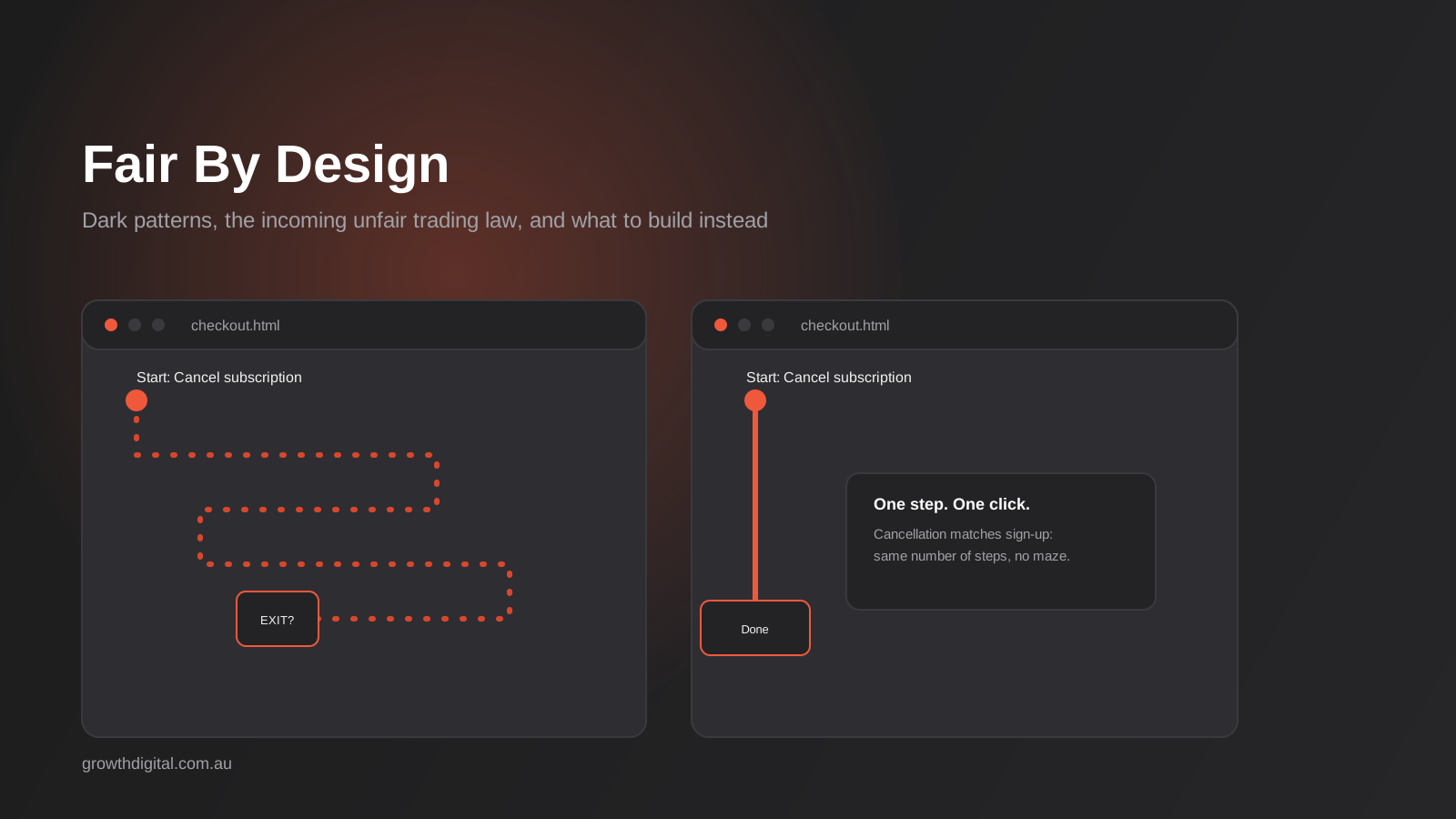
Dark Patterns in Website Design: What Australia’s Unfair Trading Practices Law Means for Your Site
Dark patterns in website design explained: what counts, how Australia’s incoming unfair trading practices law applies, and what to build instead.
Graphic Design for Australian Businesses: What You Actually Need (and When Canva Stops Being Enough)
What graphic design actually covers for Australian businesses, real 2026 pricing, and a practical framework for when DIY tools stop being enough.

Design Systems: Do You Actually Need One? A Practical Guide for Australian Businesses (2026)
Design systems get sold to every business. Here's a practical framework for when you actually need one, real 2026 Australian costs, and…
Got a project you'd like to talk through?
Tell us what you're working on — we'll come back with a plan.
