
Graphic Design for Australian Businesses: What You Actually Need (and When Canva Stops Being Enough)
 Jignesh Vagadiya
14/10/2026
20 min read
Someone on the team is in Canva at 11pm, resizing a flyer for a trade show that starts in nine hours. It happens at almost every business we’ve worked with, and it’s not really a design problem. It’s a sequencing problem — nobody decided, ahead of time, which jobs are fine to do in-house and which ones need a professional. So everything defaults to whoever’s free, and whoever’s free defaults to Canva.
That’s not a knock on Canva. For a lot of what a business needs day to day, it’s genuinely the right tool. The problem is when it’s the only tool, used for everything from a one-off Instagram tile to the logo that goes on every invoice, van, and storefront for the next ten years. Those two jobs don’t belong in the same bucket, and treating them the same is how businesses end up rebranding twice in five years, or handing a printer a JPEG that pixelates the moment it’s blown up to A1 for a trade show banner.
This guide to graphic design for Australian businesses is about where that line actually sits: what it covers beyond the logo, what it costs in Australia right now, when DIY tools are the right call and when they’re quietly costing you more than a designer would, and the handful of mistakes we see most often when a business tries to shortcut the process.
What “Graphic Design” Actually Covers
Most people hear “graphic design” and think logo. That’s one deliverable out of a much longer list, and conflating the two is where a lot of budgeting mistakes start — a business sets aside $800 for “design” assuming that covers everything they’ll need for the next year, when it was only ever enough for the mark itself.
Brand identity assets
This is the foundation layer: the logo (usually in a few lockup variations — horizontal, stacked, icon-only), a defined colour palette with exact hex/CMYK/Pantone values, typography choices for headings and body text, and often a small set of supporting graphic elements (patterns, icons, photographic treatment) that give the brand a consistent texture beyond just the mark. If you want the deeper distinction between brand identity and visual identity — they’re not interchangeable terms, and we cover that properly in our brand identity vs visual identity guide — this is the visual identity half of that equation.
Marketing and sales collateral
Brochures, one-pagers, sell sheets, pitch decks, proposal templates, case study layouts. This is the collateral a sales team actually hands to a prospect or presents in a meeting, and it’s one of the most commonly underinvested categories — businesses will spend thousands on a logo and then send a client-facing proposal built in Word with default fonts.
Digital and social assets
Social media templates, ad creative, email headers and banners, website graphics that aren’t part of the core UI. This overlaps with UX/UI design at the edges but it’s a distinct skill set — a lot of it is about producing variations quickly and consistently rather than solving interaction problems.
Packaging and product design
For retail and ecommerce businesses, this is often the highest-stakes category because the packaging is the product experience for a huge share of customers. Box design, label artwork, inserts, unboxing elements. If you’re building or rebuilding an online store, this ties directly into ecommerce design, where packaging has to work alongside product photography and the storefront itself.
Environmental and print
Signage, vehicle wraps, trade show booths, business cards, letterhead. This category has its own technical requirements — CMYK colour, bleed and trim marks, vector source files, material-specific considerations — that trip up a lot of DIY attempts. A logo that looks fine on a screen in RGB can shift colour badly once it’s printed, and a design built at social-media resolution will pixelate the second it’s scaled up for a banner.
Knowing which of these five categories a job falls into is most of the battle. The next question is who should actually do the work.
DIY vs Hiring: A Practical Framework
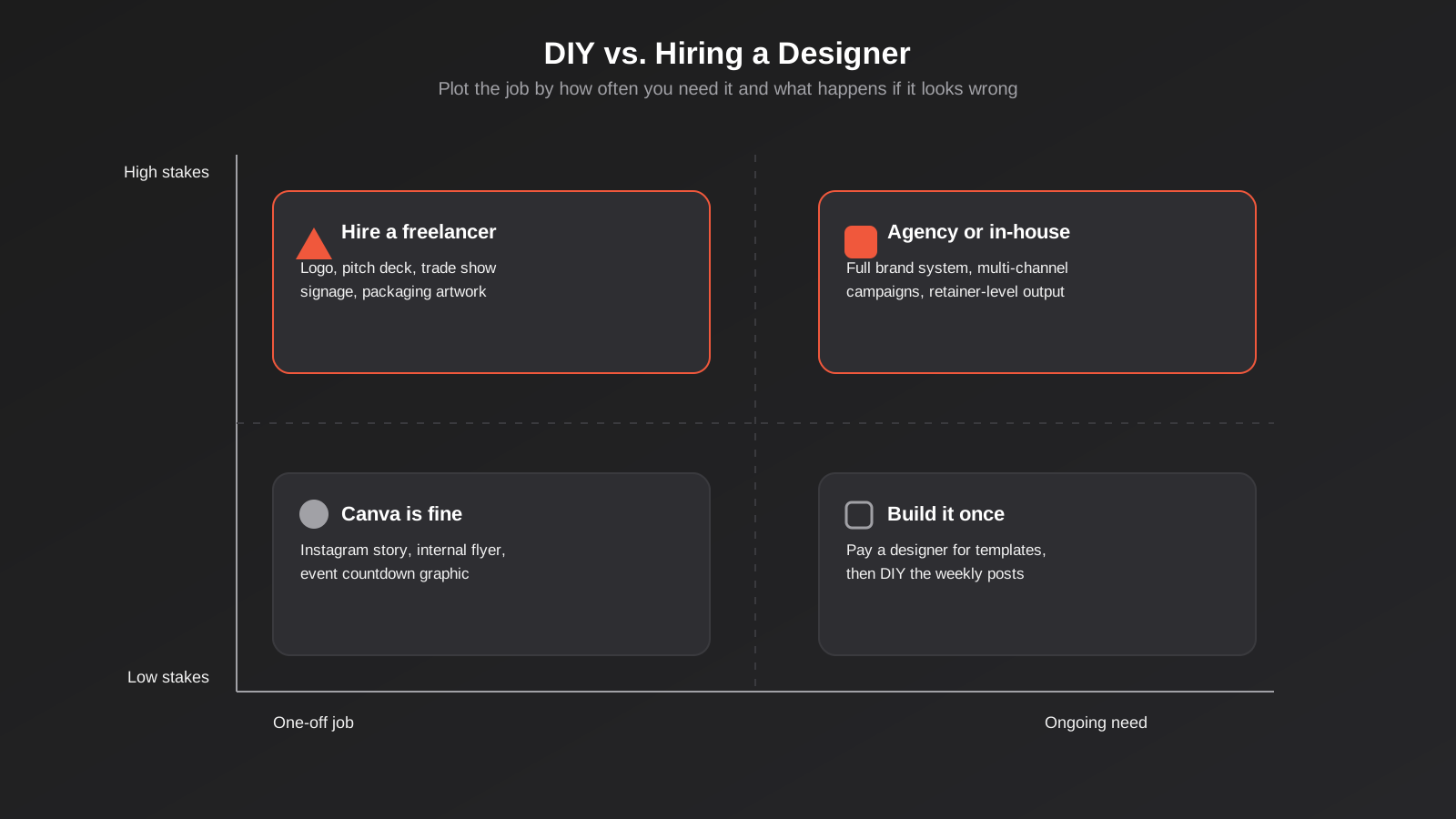
The research on this is fairly consistent, and it lines up with what we see in practice: DIY tools are genuinely fine for low-stakes, quick-turnaround work, and genuinely risky for anything that represents the business long-term or gets reused at scale. The useful question isn’t “can Canva do this?” — it almost always can, visually. The question is what happens if it’s wrong, and how often you’ll need to do it again.
Where DIY genuinely works
- One-off social media tiles and Instagram stories
- Internal documents and templates nobody outside the business sees
- Quick event graphics with a short shelf life (a countdown, a simple announcement)
- Simple email graphics where the brand system is already locked in and you’re just filling a template
Where it stops being fine
- Anything that becomes the permanent face of the business — the logo, the primary brand palette
- Print work with technical requirements (signage, packaging, trade show banners) where colour accuracy and resolution actually matter
- Client-facing sales collateral, where visual quality is doing real work on trust and credibility
- Anything built from a template that’s freely available to competitors — Canva’s own templates are used by thousands of other businesses, which undercuts the “identity” part of brand identity
The split that works for most of the businesses we talk to is a hybrid: pay a designer once to build the brand foundation — logo, palette, type, a basic set of templates — and then let the team use Canva (or whatever tool) within that system for the ongoing, lower-stakes output. That’s a completely different proposition to using DIY tools to define the brand in the first place, which is where the real risk sits.
What Graphic Design Actually Costs in Australia
Pricing here is genuinely wide, and anyone who quotes you a single number without asking what you need is skipping a step. Based on current market data and what we see quoted across the industry, here’s roughly how it breaks down.
Logos and individual pieces
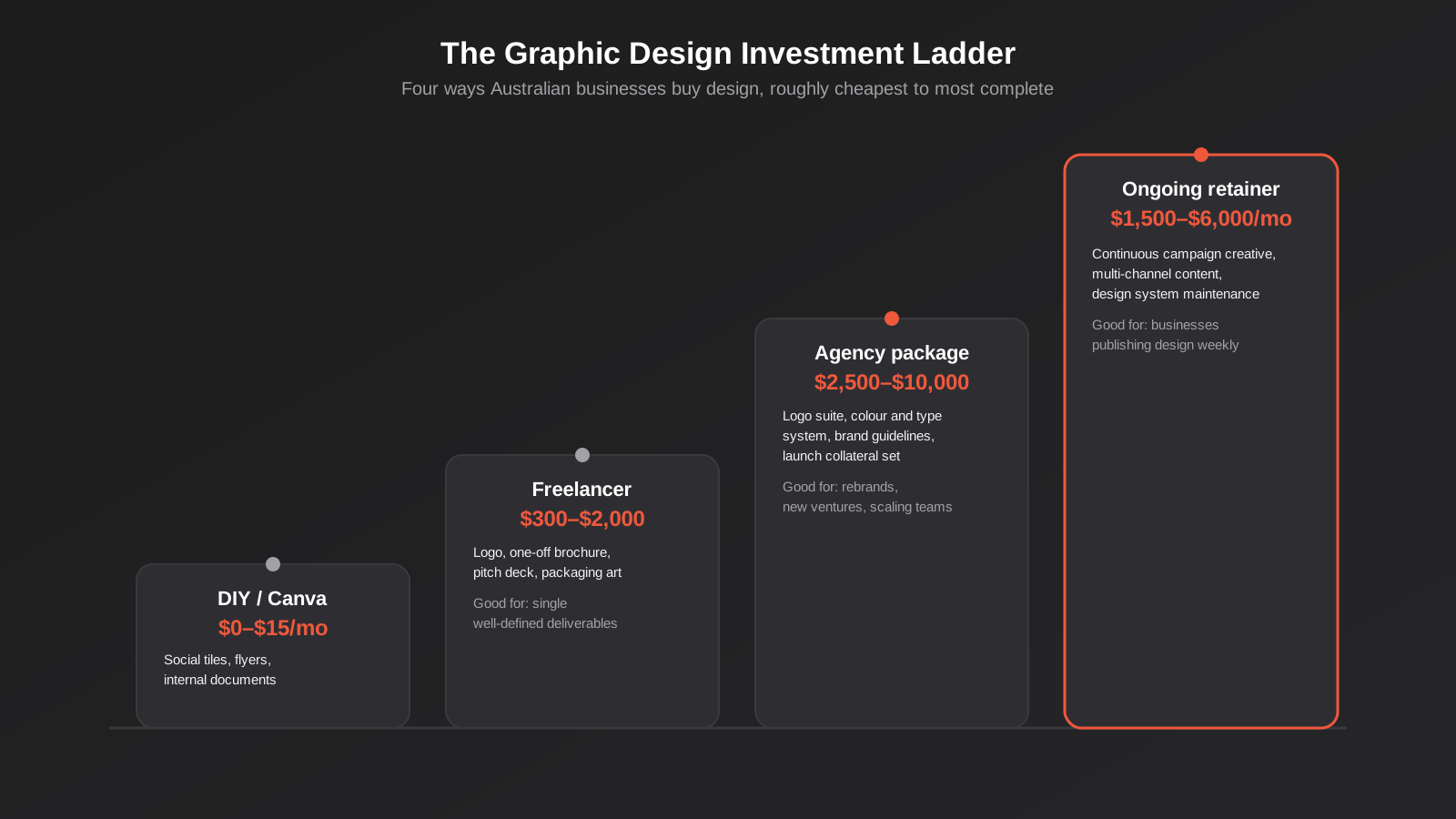
A freelance logo typically runs somewhere in the $300–$800 range, with marketplace platforms sometimes quoting lower and specialist branding studios quoting considerably higher. An agency-produced logo, which usually comes with strategy work and multiple concept directions rather than a single take, tends to sit at $800–$2,500 and up. Individual pieces of collateral — a flyer, a brochure, a social template set — generally land between $50 and $1,000 depending on complexity and how many revisions are built into the quote.
Hourly rates
If you’re hiring a freelancer by the hour rather than per project, junior designers in Australia tend to sit around $22–$38/hr, mid-level designers around $38–$65/hr, and senior or specialist designers $65–$110/hr. Agency rates are usually bundled into a project fee rather than billed hourly, but when they are itemised they sit at the upper end of that range or above it, reflecting the account management, strategy, and quality control layered on top of the design work itself.
Full brand packages and ongoing work
A complete brand identity package — logo suite, colour and type system, guidelines document, and a starter set of collateral — typically runs $2,500–$10,000 through an agency, depending on scope and how many touchpoints need covering. Businesses that need a steady stream of design output (regular campaigns, frequent social content, multi-channel marketing) often move to a retainer instead of one-off projects, which in Australia generally runs $1,500–$6,000 a month depending on volume and turnaround expectations.
Printing, stock licensing, and font licensing are usually quoted separately from the design fee itself, so factor those in before comparing two quotes that look identical on the surface. If you’re weighing this against the cost of a full web project, a website build carries its own separate cost structure entirely, and a fixed-price quote should lay out exactly what’s included rather than a vague “from” figure.
What’s actually in a quote, and what isn’t
Two quotes that look identical on price can be wildly different in scope, and the gap usually hides in three places. First, revisions — a quote might include two rounds of changes or unlimited rounds within a defined period, and “unlimited” without a time box can quietly turn into months of back-and-forth. Second, concepts — some freelancers deliver one direction and refine it, while agencies typically present two or three distinct directions before narrowing to one, which costs more but reduces the risk of ending up with something nobody on the team actually likes. Third, turnaround time — a $400 logo delivered in two days and a $400 logo delivered in three weeks are not really the same product, because rushed concept work tends to show.
A reasonable timeline for a straightforward logo is one to three weeks from brief to final files, and four to eight weeks for a full brand package with guidelines and a starter collateral set. Anything promising a complete brand identity in 48 hours is either reusing a template more heavily than they’ll admit, or skipping the concept and feedback stages that actually make the output fit your business rather than looking generic.
Brand Guidelines: The Deliverable Most Businesses Skip
If there’s one line item businesses cut to save money, it’s the guidelines document — and it’s usually the wrong one to cut. A brand guidelines document is what stops every freelancer, intern, and marketing hire from reinventing the brand slightly differently every time they touch it. Without one, colour values drift (someone picks the “close enough” orange from memory), logo spacing gets inconsistent, and six months in you’ve got three slightly different versions of the same mark floating around different channels.
A genuinely useful guidelines document, even a minimal one, covers:
- Exact colour values in hex, RGB, CMYK and (ideally) Pantone, so print and digital always match
- Logo usage rules — minimum size, clear space, and what you must never do (stretch it, recolour it, put it on a clashing background)
- Typography hierarchy for headings, body copy and any secondary fonts, plus where to source the licensed files
- A handful of real layout examples showing the system in use, not just the assets in isolation
For a lot of small businesses, that lightweight version is genuinely enough. The question of when you need to go further — a full documented design system with component libraries, usage patterns across a growing team, and governance for multiple people producing design work in parallel — is a different decision, and we’ve written a dedicated framework for exactly that in our design systems guide, including real 2026 build costs. If you’re past the point where a one-page guidelines PDF covers it, that’s the next read. Formalising a system is also where design systems as a service becomes relevant — worth a look once your team or your agency roster has grown past the size where a verbal understanding of “the brand” holds together.
Graphic Design for Ecommerce and Retail
Retail and ecommerce businesses carry a design load that service businesses mostly don’t: packaging, product photography direction, and a constant stream of seasonal or promotional creative that has to stay on-brand while still feeling fresh. A few things worth getting right early:
Packaging has to survive the real world
Packaging design isn’t just “apply the logo to a box.” It needs to account for the material it’s printed on, how it photographs for the product listing, how it looks stacked on a shelf or in a shipping satchel next to five competitors, and whether it’s still legible at the size it’ll actually be printed, not the size it looked great at on a 27-inch monitor.
Product imagery needs a consistent direction
Even when photography itself is outsourced separately, a designer should be setting the direction — background colour or texture, cropping ratio, consistent lighting style — so that a product page doesn’t end up looking like five different photographers shot it on five different days. This is closely tied to the storefront design itself, and the two need to be planned together rather than handed to separate people in isolation.
Templates save you at scale
Once a store has more than a handful of SKUs, one-off design per product doesn’t scale. This is where a well-built template system pays for itself — a designer builds the structure once (badge placements, sale banner positions, social tile layouts for new arrivals), and the team fills it in without needing a designer for every single product drop.
Don’t forget the compliance layer
If you’re selling food, cosmetics, supplements, or children’s products, packaging design has to work around mandatory labelling requirements — country of origin labelling, ingredient and allergen statements, warning text, and minimum font sizes for regulated information. A good packaging designer builds the creative layout around that fixed regulatory content from the start, rather than finishing the design and then trying to squeeze compliance text in afterwards, which is how labels end up with an awkward wall of fine print bolted onto an otherwise clean design.
Briefing a Designer So You Get It Right the First Time
The single biggest lever on both cost and turnaround isn’t the designer’s skill — it’s the quality of the brief. A vague brief produces concepts that miss the mark, which burns revision rounds, which is exactly what blows out both the budget and the timeline on a fixed-price project. A few things that consistently speed the process up:
- Bring references, including negative ones. Three competitor or aspirational examples tell a designer more in thirty seconds than a paragraph of adjectives. Just as useful: one or two examples of what you specifically don’t want, and why.
- Define the audience, not just the aesthetic. “Modern and clean” means something different to a tradie business targeting homeowners than it does to a B2B SaaS company targeting procurement managers. Who’s actually looking at this, and what do they need to feel before they trust you?
- List every place the asset needs to work, up front. A logo that only has to work on a website is a different brief to one that also needs to work embossed on leather, printed one colour on a invoice, and legible on a ute door from twenty metres away. Finding this out after concepts are chosen means starting over.
- Decide who signs off, before the brief goes out. Design-by-committee is one of the most common reasons projects blow out in both time and revisions. One decision-maker, with input gathered beforehand rather than argued over live on a shared screen, keeps a project moving.
- Share the non-negotiables early. If a particular colour is locked in for regulatory or franchise reasons, or a previous mark has to be phased out gradually rather than replaced overnight, say so in the first brief, not the second round of feedback.
Freelancer, Agency, or In-House: Making the Call
Once you’ve decided a job genuinely needs a professional rather than DIY, there’s still a decision about who that professional should be.
Freelancers suit a single, well-defined deliverable
A logo, a one-off brochure, a packaging refresh for one product line. You know what you need, you can brief it clearly, and you don’t need ongoing account management or a team producing in parallel. The trade-off is availability and continuity — a freelancer juggling multiple clients may not be available on short notice, and if they move on, someone else has to pick up their files and conventions cold.
Agencies suit anything with moving parts
A rebrand, a new venture launch, anything that spans multiple collateral types and needs to stay consistent across all of them simultaneously. Agencies bring a team rather than one person, which matters when a project needs strategy, design, and production happening in parallel against a deadline, and it means the work doesn’t stall if one person is unavailable.
In-house or retainer suits constant volume
If you’re producing design output every single week — campaign creative, social content, sales enablement material — the per-project model starts working against you. A retainer or an in-house hire means the designer already knows the brand, the audience, and the typical turnaround expectations, which cuts the ramp-up time that eats into every new freelance or one-off agency engagement.
None of these are permanent choices. Plenty of businesses start with a freelancer for the logo, move to an agency package for a full rebrand a few years later, and eventually bring someone in-house once design volume justifies it. The mistake is picking the wrong tier for the job in front of you right now — hiring an agency for a single flyer, or trying to DIY a full rebrand because the freelancer quote for the logo felt expensive in isolation.
Refresh or Rebrand? Knowing Which One You Actually Need
A good chunk of the graphic design enquiries we get aren’t “we need a logo,” they’re “something feels off about how we look, but we’re not sure what to actually ask for.” That uncertainty usually resolves into one of two very different jobs, and getting the distinction wrong wastes real money either way — a full rebrand when a refresh would have done it, or a cosmetic tweak when the underlying identity genuinely isn’t working.
A refresh is the right call when
- The core mark and colours still feel right, but the execution looks dated — a drop shadow and gradient-heavy logo from a decade ago, fonts that have fallen out of use, collateral that doesn’t match across channels
- Customer recognition of the current logo is a genuine asset you don’t want to throw away
- The business itself hasn’t fundamentally changed — same offering, same audience, same positioning
A refresh usually means tightening the logo’s construction, modernising the type and colour application, and rebuilding the collateral templates — without changing what the mark fundamentally is. It’s a fraction of the cost of a full rebrand and carries almost none of the risk that comes with asking existing customers to recognise something new.
A rebrand is the right call when
- The business has outgrown what the name, mark, or positioning originally represented — a trades business that’s expanded into a different service category, or a company that’s moved upmarket and the current identity reads as the wrong price point
- There’s a legal or trademark conflict forcing a change regardless of preference
- A merger, acquisition, or ownership change means the existing identity doesn’t represent the business anymore
- Market research or direct customer feedback shows the current identity is actively working against trust or recall, not just looking a little tired
A genuine rebrand is a bigger, riskier, more expensive undertaking than most businesses expect, because the design work is really the easy half. The hard half is the rollout — signage, vehicles, stationery, every social profile, every piece of packaging in a warehouse, legacy documents customers already have on file. If you’re rebranding alongside a platform or website change, there’s a parallel risk of losing search visibility mid-transition that’s entirely separate from the design work, and it’s a real cost businesses underestimate when they’re focused entirely on how the new identity looks.
Common Mistakes
- Treating the DIY logo as temporary, then never replacing it. “We’ll get a real logo once we’re established” is how businesses end up five years deep with brand recognition built on a mark they were always going to change.
- No brand guidelines, so every new freelancer reinvents the brand slightly. Colour drift and inconsistent logo treatment compound fast once more than one person is producing design work.
- Never receiving the source files. If a designer hands over a flattened PNG or JPG and not the editable vector file (AI, EPS, or SVG) and font files, you don’t actually own a reusable asset — you own a picture of one.
- Designing for screen and printing it anyway. RGB colours and 72dpi images that look fine on a monitor often shift colour or pixelate badly once they hit a printer, especially at large formats like banners and signage.
- Using marketplace freelancers without a written scope or usage rights. Cheap marketplace gigs can be a perfectly good option, but get what’s included (revisions, file formats, commercial usage rights) in writing before the brief goes out, not after the first draft lands.
- Picking a font without checking the licence. A font that looks free because you found it through a quick search may not be licensed for commercial or embedded use, which becomes a real problem the moment it’s baked into a logo or printed at scale.
- Briefing a designer with no reference points. “Make it modern” produces far worse output than three competitor examples and two words you don’t want (even vague negative direction narrows the brief faster than positive adjectives alone).
Frequently Asked Questions
How much does a logo cost in Australia?
A freelance logo typically runs $300–$800, while an agency-produced logo with full strategy and multiple concepts tends to sit at $800–$2,500 or more. Marketplace platforms sometimes advertise lower figures, but treat very cheap quotes as a signal to check exactly what’s included — revisions, source files, and usage rights all vary.
Do I need a graphic designer or a brand strategist?
A graphic designer executes the visual output — logo, collateral, templates. A brand strategist works out what the brand should stand for, who it’s speaking to, and how it should differ from competitors before any visuals get made. For a new business or a genuine rebrand, strategy should come first; for an established brand that just needs new collateral within an identity that already works, you can usually go straight to a designer.
Can I just use Canva templates forever?
For low-stakes, frequently-changing content, yes — plenty of businesses never outgrow it for things like routine social posts. The risk is using Canva templates to define your core identity (the logo, the primary brand look) rather than to produce within a system someone else has already built. Templates are, by definition, available to every other business using the same platform.
What files should I actually get from a designer?
At minimum: editable vector source files (AI, EPS, or SVG) for the logo, not just a flattened PNG or JPG; the exact colour values in hex, RGB and CMYK; licensed font files or clear licensing instructions; and a basic guidelines document explaining how everything fits together. If any of these are missing, ask before the project closes out — it’s far harder to get them later.
How is graphic design different from web design?
Graphic design covers static visual assets — logos, print collateral, social graphics, packaging. Web design (and the closely related discipline of UX/UI design) deals with interactive layouts, user flows, and how a site or app actually functions for a visitor, not just how it looks in a single static frame. The two overlap heavily on a landing page or marketing site, which is why landing page design and landing page development are often confused as the same job when they’re not.
Do I own the rights to a design I pay for?
Usually, but not automatically — it depends on what’s in the agreement. Most professional contracts transfer full ownership once the project is paid in full, but some freelance arrangements only grant a usage licence unless full buyout is specified. Confirm this in writing before the brief goes out, particularly for a logo or anything you expect to use indefinitely.
Where to Start
If you’re not sure which tier you actually need — a single freelance project, a full brand package, or an ongoing retainer — that’s a scoping conversation, not something you need to work out alone from a blog post. We work across the full range, from a single logo and guidelines document through to full graphic design for Australian businesses scaling past the point where DIY tools hold up, including complete brand identity engagements end to end. Happy to have a look at what you’ve got, tell you honestly whether it needs a rebuild or just a tidy-up, and talk through what it would actually cost to fix.
Keep reading
Related posts
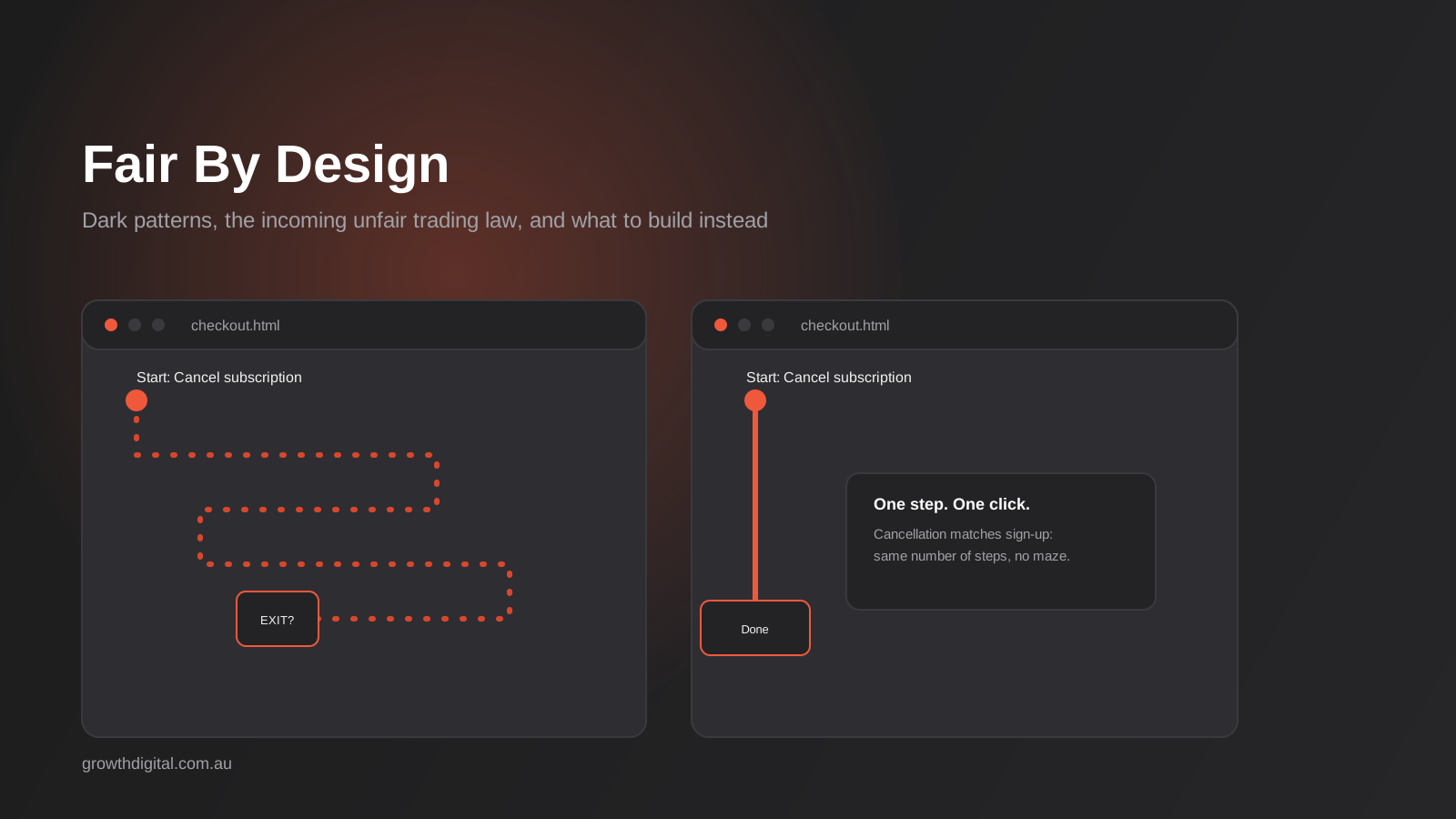
Dark Patterns in Website Design: What Australia’s Unfair Trading Practices Law Means for Your Site
Dark patterns in website design explained: what counts, how Australia’s incoming unfair trading practices law applies, and what to build instead.

Design Systems: Do You Actually Need One? A Practical Guide for Australian Businesses (2026)
Design systems get sold to every business. Here's a practical framework for when you actually need one, real 2026 Australian costs, and…
UX/UI Design Principles That Actually Convert: A 2026 Guide for Australian Websites
A practical guide to the UX and UI design principles that genuinely move conversion — friction, hierarchy, trust signals and a five-point…
Got a project you'd like to talk through?
Tell us what you're working on — we'll come back with a plan.
