
SEO vs Google Ads: Which Should You Start With?
 Jignesh Vagadiya
08/10/2026
21 min read

Almost every discovery call we run starts with some version of the same question: SEO vs Google Ads, and which one should get the first dollar. A business owner has a fixed budget, usually somewhere between two and six thousand dollars a month, and they’re trying to decide between the two. They’ve usually already read a handful of agency blog posts that end with “it depends” and offer nothing beyond that. It does depend, but not on vague factors like “your goals” or “your industry” in the abstract. It depends on a short list of concrete things about your business that you can actually check.
We’ve built both channels for businesses across trades, ecommerce, professional services and B2B software, and the honest pattern is this: the channel that wins the “which first” argument is almost never the one with the better long-term economics. It’s the one that matches how urgently you need revenue and how much runway you’ve got to wait for the slower option to work. Get that match wrong and you’ll either burn budget on ads you can’t sustain, or starve a new site of the early traffic it needs to look credible to Google in the first place.
This isn’t a “both matter, do both eventually” piece, even though both channels usually do matter eventually. It’s a framework for deciding which one gets the first dollar, with the actual cost and timeline math behind that decision, and a sequencing plan for Australian businesses that don’t have unlimited budget to run everything at once.
SEO vs Google Ads: solving the same problem in opposite ways
Both channels put your business in front of someone actively searching for what you sell. That’s where the similarity ends. The mechanics of how each one delivers that visibility, and what happens to your traffic the moment you change your spending, are almost opposites.
Google Ads is a rental, SEO is a build
Google Ads is pay-per-click in the most literal sense. You bid on a keyword, you win an auction, you pay for the click, and you show up at the top of the results for as long as the budget keeps flowing. Turn the campaign off and you disappear from that position within hours. There’s no equity building up anywhere. Every month starts from the same position as the last, which is both the strength and the weakness of the channel: it’s completely controllable, but nothing compounds.
SEO works on an entirely different mechanism. You’re not buying a position, you’re earning one through relevance signals Google trusts: content that actually answers the query, technical health, backlinks, user behaviour, and time. None of that disappears the day you stop actively working on it. A page that ranks in position three for a commercial keyword will keep generating leads for months with minimal upkeep, because the thing that got it there (the content, the links, the domain authority) doesn’t vanish when you stop paying.
The timeline gap is the part most businesses underestimate
A Google Ads campaign can be live and generating clicks within 24 to 48 hours of launch, assuming your account isn’t brand new and under Google’s early learning-phase restrictions. You’ll have enough data to judge whether it’s working within two to four weeks, assuming reasonable spend and conversion volume.
SEO doesn’t work on that clock. A brand-new site, or an established site targeting genuinely new keyword territory, typically needs four to six months before you see meaningful ranking movement on competitive commercial terms, and often six to twelve months before that traffic is reliable enough to plan revenue around. This isn’t an agency trying to buy time. It reflects how Google’s algorithm actually evaluates trust: new content gets a trial period, backlinks take time to be discovered and valued, and user behaviour data (which increasingly factors into rankings) needs volume to be meaningful. If your business can’t survive six months without the revenue a channel produces, that channel cannot be your first move, no matter how much cheaper it looks on paper.

The questions that actually decide this, not “which is better”
Forget asking which channel is objectively stronger. Neither is: they’re tools built for different jobs, and the entire debate collapses once you answer five concrete questions about your own business.
1. How many months of runway do you actually have?
If the business needs new revenue inside the next one to three months to stay healthy, SEO cannot be the first move, full stop. Run Google Ads first, even if you know SEO is the better long-term investment. A channel that works in year two doesn’t help a cash flow problem in month one. This is the single biggest deciding factor and the one businesses most often get wrong, usually because they’ve read that SEO is “free” and assume free means immediate.
2. Does meaningful search volume exist for what you sell?
SEO only works where demand already exists in search. If people are actively typing “emergency plumber Parramatta” or “custom ERP integration Melbourne” into Google, there’s a real market to capture organically. If what you sell is genuinely new (a product category nobody’s searching for by name yet), there’s no search demand to rank for, and SEO content becomes an awareness exercise rather than a lead-generation one. In that situation, paid social or even Google Ads on adjacent problem-aware terms will outperform SEO, because you’re creating demand rather than capturing it. Proper keyword research, checking actual monthly volume rather than guessing, is worth doing before committing budget either way.
3. What’s the actual cost per click for your keywords?
Some industries have Google Ads costs per click that make paid search nearly unworkable for a small budget. Legal services, finance and certain trades regularly see $15 to $50+ per click in Australian capital cities. If your average transaction value is $150, you need an extremely efficient funnel to make that math work, and a thin budget will burn out before you learn anything useful. Lower cost-per-click industries, retail and many local services among them, make Google Ads a far more forgiving place to start, because you can afford to test and iterate without the budget evaporating in a week.
4. Do you already have any domain authority to work with?
A ten-year-old site with a reasonable backlink profile and existing rankings in adjacent terms can often see SEO movement in two to three months rather than six to twelve, because it’s not starting from zero trust. A brand-new domain is starting from nothing, and no amount of content volume shortens that initial trust-building period much. If you’re on a new domain, assume the longer end of the SEO timeline and plan paid spend to bridge that period.
5. Is the buying decision made on Google, or somewhere else?
Both channels only matter if your customer’s decision-making actually happens in a search engine. For a lot of B2B and considered-purchase categories, the real decision happens through referral, LinkedIn, industry reputation or a sales conversation, and Google is just where someone confirms a name they already heard elsewhere. In that case, neither SEO nor Google Ads should be the first budget line at all. Check where your last ten customers actually came from before assuming search is even the right channel to debate.
The cost math worth doing before you commit a budget
Agencies on both sides of this argument like to quote headline numbers that make their channel look better. The only numbers that matter are the ones specific to your business, and they’re not hard to calculate.
Google Ads: work out your break-even cost per lead first
Before spending a dollar, calculate what a lead is actually worth to you. Take your average customer value, multiply by your close rate, and that’s your break-even cost per acquisition. If a customer is worth $2,000 and you close one in five leads, you can afford to spend up to $400 per lead and still break even, which gives you real room to test. Compare that number against the likely cost per click for your keywords (Google’s Keyword Planner gives a rough estimate) and a realistic conversion rate for your landing page (2–5% is a reasonable starting assumption for most service businesses) to see whether the maths holds up before you commit real budget, including true ROAS once cost of goods is factored in rather than just revenue per click.
SEO: estimate payback period, not just eventual value
SEO’s selling point is that organic clicks are “free,” but the investment to get there (content production, technical fixes, link building, and usually an agency retainer or an in-house hire) is very real money spent for months before any of it converts into a lead. The honest way to evaluate SEO isn’t “will this eventually be worth it,” because for most legitimate commercial keywords, yes, eventually it will. The honest question is “can I afford the months of spend before the payback starts,” and that’s a cash flow question, not a value question. A $3,000/month SEO retainer that takes eight months to produce its first reliable lead volume has cost roughly $24,000 before it breaks even. That’s not a reason to avoid SEO. It’s a reason to make sure you can actually fund eight months of it without the business needing that money sooner.
A worked example, because the abstract version never quite lands
Take a mid-sized Melbourne electrical contractor with $4,000 a month to spend and a genuine choice between the two channels. Their average job is worth $850, and roughly one in four qualified enquiries converts into a booked job, which puts their break-even cost per lead at just over $200. A look at Keyword Planner shows “electrician [suburb]” terms running $8–14 per click in their service area, and their landing page, once it’s built properly, should convert somewhere around 4–6% of visitors into an enquiry. Run the maths and $4,000 buys somewhere between 285 and 500 clicks a month, which at a 5% conversion rate produces 14–25 leads, at a cost per lead of roughly $160–$280. That’s workable, sitting close to break-even with room to improve as the account optimises.
Now run the SEO version of the same business. They’re on a four-year-old domain with a handful of existing backlinks and a thin service-page structure. A realistic SEO investment of $2,500–$3,000 a month, spent on proper service and location pages, technical fixes and some digital PR for local citations, would plausibly start producing a handful of organic leads by month four, with meaningful volume by month seven or eight. Multiply that out and they’ll have spent somewhere between $10,000 and $24,000 before the channel is reliably contributing, and during that entire period, if ads aren’t also running, the phone isn’t ringing from search at all.
Neither number is wrong, and neither channel is the villain here. The business with four months of cash runway and an immediate need for jobs should be running the Google Ads numbers, full stop. The business with twelve months of runway and a goal of lowering blended cost per lead over the next two years should be running both, with SEO getting the larger share of new budget once the ads account is validated. The maths doesn’t give you a universal answer. It gives you the inputs to make a decision specific to your own situation, which is the entire point of doing it before committing a budget rather than after.
What AI Overviews are changing about this calculation in 2026
One variable that didn’t exist in this decision a few years ago is how much AI Overviews and AI Mode have changed what happens after someone searches. For a meaningful share of informational queries, Google now answers the question directly on the results page, which means the organic click a business used to earn by ranking well simply doesn’t happen as often as it used to, even from a page-one position. This has real implications for how you weigh the two channels.
Commercial, transactional queries (the “buy,” “hire,” “near me” terms both channels actually compete on) are affected far less than informational ones, because Google still tends to show ads and local results above an AI summary for anything with clear purchase intent. If your SEO strategy was built almost entirely around informational blog content as a traffic play, rather than the commercial pages that actually generate leads, AI Overviews have quietly eroded part of that value, and it’s worth checking your Search Console data for click-through rate drops on your highest-traffic informational pages specifically.
The practical effect on the SEO vs Google Ads decision is that commercial-intent SEO (service pages, location pages, product and category pages) has held up considerably better than broad informational content, and is still a sound long-term investment. Pure top-of-funnel blog traffic as a standalone strategy needs a second look, because some of what it used to deliver now gets absorbed into an AI summary before the click happens at all. Google Ads, for the moment, is largely unaffected by this shift on commercial terms, since paid placements and AI Overviews currently coexist on the same results page rather than competing for the same real estate. We go into this in more depth, including how to actually get cited inside AI Overviews and tools like ChatGPT, in our AI SEO guide.
The sequencing that works for most Australian businesses
The “which one first” framing is useful for deciding where the first dollar goes, but very few businesses that stick with digital marketing for more than a year end up running only one channel. The practical pattern we see work across most client accounts is a deliberate sequence, not a permanent choice.
Start with ads if you need leads now, and mine the data while you’re at it
If Google Ads is your first move because of runway or urgency, don’t treat it as separate from your eventual SEO plan. Every campaign generates exact data on which keywords actually convert into leads or sales, not just which ones get clicks, which is a far more reliable signal than keyword research tools alone. Feed that data straight into your content and SEO priorities: build out the organic content around the search terms your ads have already proven convert, rather than guessing from volume estimates alone.
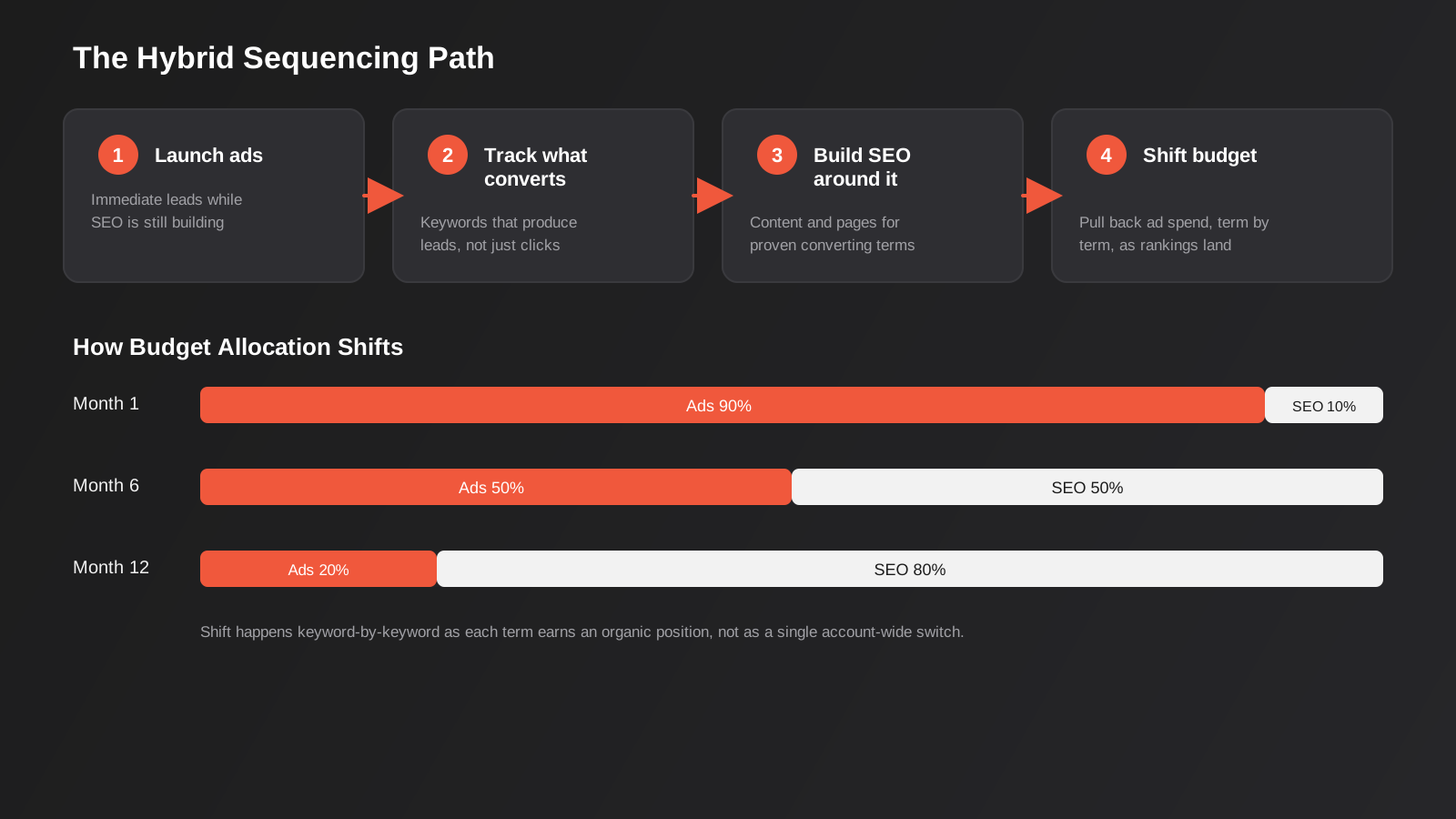
Shift budget as organic rankings mature, not all at once
As specific pages start ranking organically on page one for terms you’re also bidding on, that’s the signal to start pulling back ad spend on those exact keywords specifically, not the whole account. You’re not choosing between the channels broadly; you’re reallocating keyword by keyword, as each one earns its own organic position. A sensible mid-point for a lot of accounts around month six to nine is roughly even budget split, shifting further toward organic as more of the keyword set ranks, while ads stay on brand-defence terms, competitor terms and anything organic still hasn’t cracked.
Keep a floor on both, permanently
Even a business with a dominant organic position usually keeps a small ads floor running on branded terms and high-intent bottom-of-funnel keywords, because organic rankings can and do move (algorithm updates, new competitors, a technical issue you didn’t catch) and a total absence from paid leaves you with zero coverage during that gap. Similarly, a business running primarily on ads benefits from even a modest ongoing SEO investment, because it reduces blended cost per lead over time and provides some insulation against rising CPCs, which in most categories only move in one direction. If you want the fuller view of how this fits into total marketing spend rather than just these two channels, our marketing budget allocation framework walks through the broader split across SEO, paid, email and other channels.
How the decision tends to play out by business type
The framework above applies broadly, but a few patterns show up consistently enough across industries to be worth naming directly.
Local trades and home services
High purchase intent, decent transaction values, and search volume that’s usually there already (people search “[service] [suburb]” when they have an actual problem). Google Ads tends to win the first-move argument here because job urgency on the customer’s side matches the immediacy of paid search, and a well-run Local Services Ads or Google Ads campaign can be profitable from week one. SEO still matters hugely for trades over the medium term, particularly local pack visibility, but it’s rarely the right place for the very first dollar when cash flow is tight.
Ecommerce
This usually ends up a genuine hybrid from day one rather than a sequential choice, because Shopping ads and category-page SEO solve different parts of the funnel (the Shopping feed catches people ready to buy a specific product, while content and category SEO catch people still comparing). Most ecommerce brands we work with run both from the start, but weight new budget toward whichever is currently under-converting relative to traffic volume.
Professional services and B2B
Longer sales cycles and higher transaction values generally favour SEO’s compounding value, and the cost per click on competitive B2B terms (legal, finance, consulting) is often so high that paid search alone struggles to be profitable without a very efficient sales process behind it. If there’s runway to wait out the SEO ramp, this is the segment where starting organic-first tends to pay off best. If there isn’t, LinkedIn Ads targeting by job title and company often outperforms Google Ads for this segment anyway, because the buying intent on Google for B2B terms is murkier than it looks.
New businesses on new domains
No matter the industry, a genuinely new domain needs to assume the long end of the SEO timeline. Google Ads (or paid social, depending on the category) almost always has to carry the first six to twelve months of lead generation while the domain builds enough trust and content depth for organic to start contributing meaningfully.
Common mistakes we see businesses make with this decision
- Choosing SEO first purely because it looks cheaper per click, without checking whether the business has the cash flow to survive the months before it produces leads.
- Choosing Google Ads and then treating it as permanent, rather than using the keyword and conversion data it generates to build an SEO roadmap in parallel.
- Judging an SEO investment as a failure at the three-month mark, when most competitive commercial keywords realistically need double or triple that timeframe to show results.
- Running Google Ads on keywords where the cost per click makes the unit economics impossible from the outset, instead of doing the break-even maths before launch.
- Assuming “both” means splitting a thin budget evenly across both channels, which usually under-funds both to the point that neither performs well enough to judge properly.
- Switching agencies or strategies every few months when results feel slow, which resets the clock on SEO trust-building and wastes the learning period Google Ads campaigns need to optimise.
- Ignoring where customers actually say they found you, and defaulting to whichever channel is currently fashionable in industry commentary rather than what the business’s own data shows.
Frequently Asked Questions
Can I really not do both SEO and Google Ads at the same time on a small budget?
You can, but a genuinely thin budget split across both channels often ends up under-funding each one past the point where either can perform well enough to evaluate. A $1,500/month budget split in half rarely buys a competent SEO programme and a competitive ad account simultaneously. In that situation it’s usually better to fully fund one channel, get it working, and add the second once budget allows, rather than running two half-measures.
How long before I’ll know if my SEO investment is actually working?
Early technical fixes and content published in month one can show initial ranking movement within six to eight weeks for lower-competition long-tail terms, but the competitive, high-value commercial keywords that actually drive revenue typically take four to six months to show meaningful movement, and six to twelve months to become a reliable, forecastable source of leads. Judging an SEO programme at the three-month mark is one of the most common reasons businesses abandon it right before it would have started paying off.
If I start with Google Ads, am I wasting money that could have gone to SEO?
Not if you use it properly. A well-run Google Ads account generates real conversion data on which keywords and ad copy actually produce leads, not just clicks, which is more reliable than keyword research tools alone for prioritising your SEO content plan. Many of our clients’ strongest SEO content calendars started as a list of search terms that were already proven to convert in their ads account.
What if my industry has very expensive Google Ads clicks?
High cost-per-click industries (legal, finance, parts of healthcare and certain trades) make paid search a harder place to test cheaply, since a thin budget can evaporate in days without producing enough data to learn from. In these categories, SEO’s compounding value tends to matter more and the pressure to find paid-search budget efficiency is higher. It’s still worth doing the break-even cost-per-lead maths before dismissing ads outright; some high-CPC categories also have high transaction values that still make the unit economics work.
Does it matter which channel I start with if I’m planning to use both eventually anyway?
Yes, because the sequencing affects how efficiently you spend the budget along the way. Starting with the channel that matches your actual runway and urgency means you’re not funding a slow-building channel while the business needs faster revenue, or overpaying for immediate leads when you had the time to build organic traffic cheaply instead. The end state might be similar, but the path to it, and how much you spend getting there, isn’t.
Should I trust an agency that only offers one of these two services?
Be cautious of advice from any provider that only sells one channel, since it’s rarely in their interest to tell you the other one might actually suit your situation better. It’s worth getting the decision framework and break-even maths from a source that runs both channels and has no reason to steer you toward the one that happens to be their only product.
What should I actually track to tell if I picked the right channel?
Cost per lead and cost per acquisition matter more than clicks, impressions or rankings on their own, since those are the numbers that tell you whether the channel is actually profitable rather than just active. For Google Ads, watch cost per lead weekly for the first two months and be prepared to pause keywords that aren’t converting rather than waiting out the full learning phase on everything. For SEO, track ranking position and organic traffic monthly, but weight your judgement more heavily on leads and enquiries from organic once you’re past month four, since early ranking movement on easier terms can look encouraging without yet producing real revenue.
Where to start
If you’re genuinely unsure which channel suits your business, the fastest way to find out isn’t more research, it’s running the actual numbers on your own business: your runway, your realistic cost per click, your break-even cost per lead, and how much search volume actually exists for what you sell. Most of that takes an hour with real data, not months of guessing.
We run both SEO and Google Ads at Growth Digital, which means we don’t have a reason to push you toward whichever one happens to be our specialty. If you want a second opinion on which channel should get your first dollar, or how to sequence both once budget allows, get in touch and we’ll talk it through honestly, including if the answer is “neither, yet.” You can also see what the market is actually paying for each channel in our digital marketing pricing guide before that conversation.
Keep reading
Related posts
Digital Marketing for Car Dealerships and Workshops in Australia (2026)
Digital marketing for Australian car dealerships and workshops: local SEO, Google Ads, booking flows, and the price-advertising rule every dealer must follow.
Digital Marketing for Australian Manufacturers: Turning Visitors Into RFQs (2026)
How Australian manufacturers turn website visits into RFQs: capability pages, product SEO, LinkedIn Ads for procurement buyers, and quote automation.
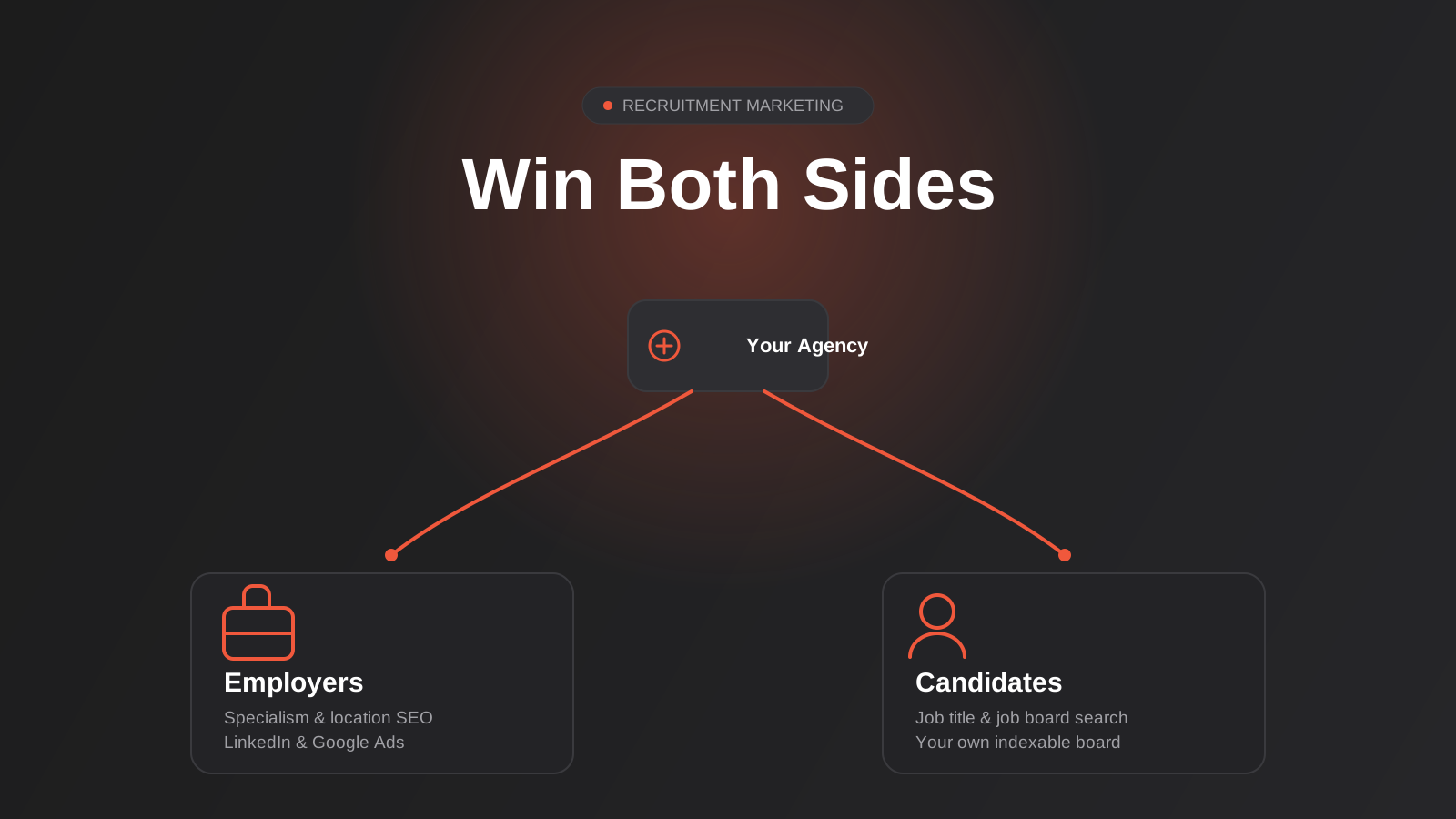
Marketing for Recruitment Agencies in Australia: Winning Both Clients and Candidates
Recruitment agencies sell to two audiences at once. How SEO, LinkedIn Ads, job board strategy and compliance need to split between employers…
Got a project you'd like to talk through?
Tell us what you're working on — we'll come back with a plan.
