
SEO for Accountants and Financial Advisers in Australia: Two Regulators, One Website (2026)
 Jignesh Vagadiya
28/09/2026
23 min read
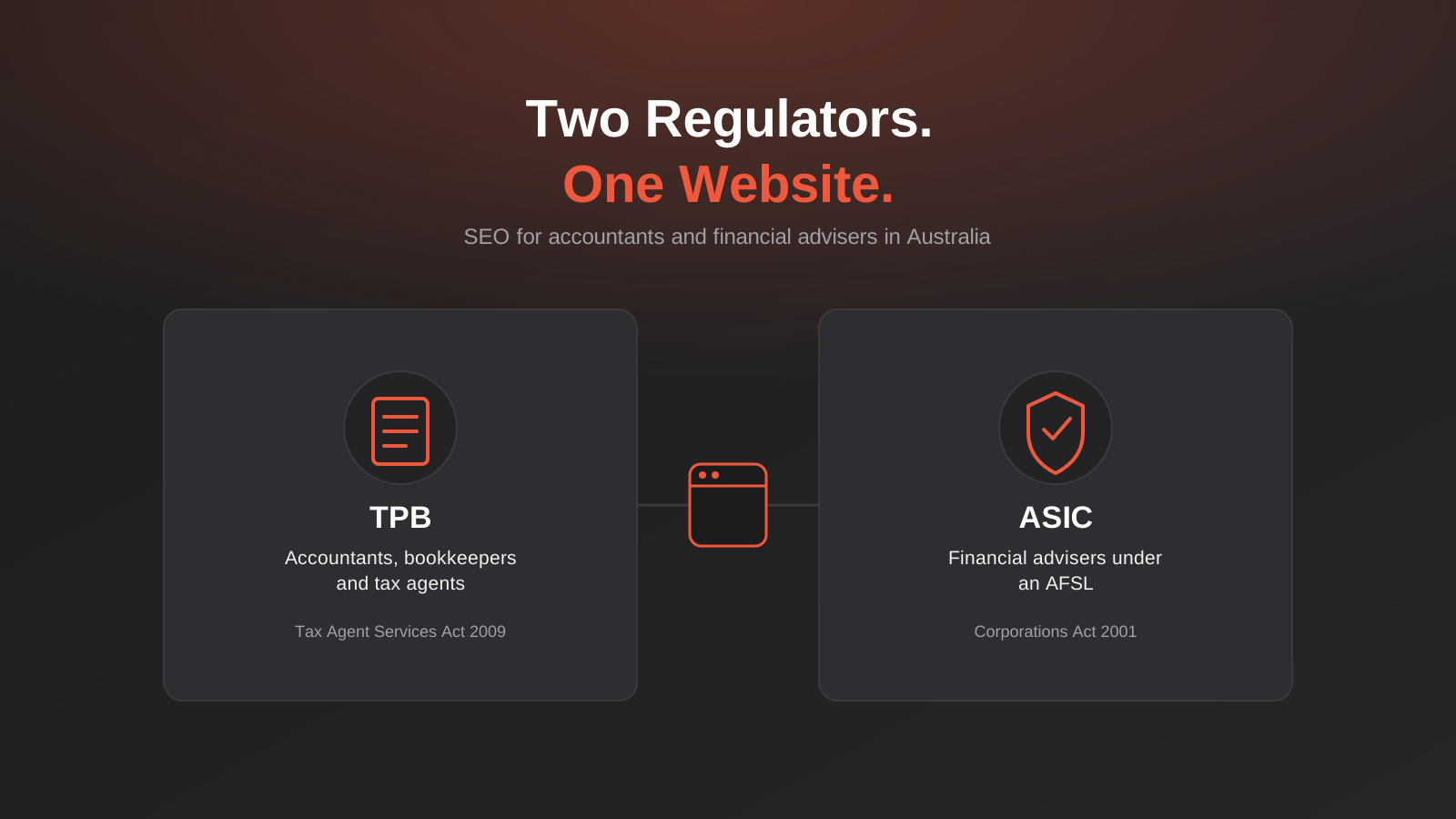
Walk into most accounting firms that also run an in-house financial planning arm and you’ll find one website, one tone of voice, and one marketing person writing all of it. “Our expert team,” “independent advice you can trust,” a testimonials carousel pulled from happy clients on both sides of the business. It reads as one firm, because to the client it is one firm. To a regulator, it’s two completely different pieces of legislation sitting on the same domain, and the marketing team usually has no idea where the line between them falls.
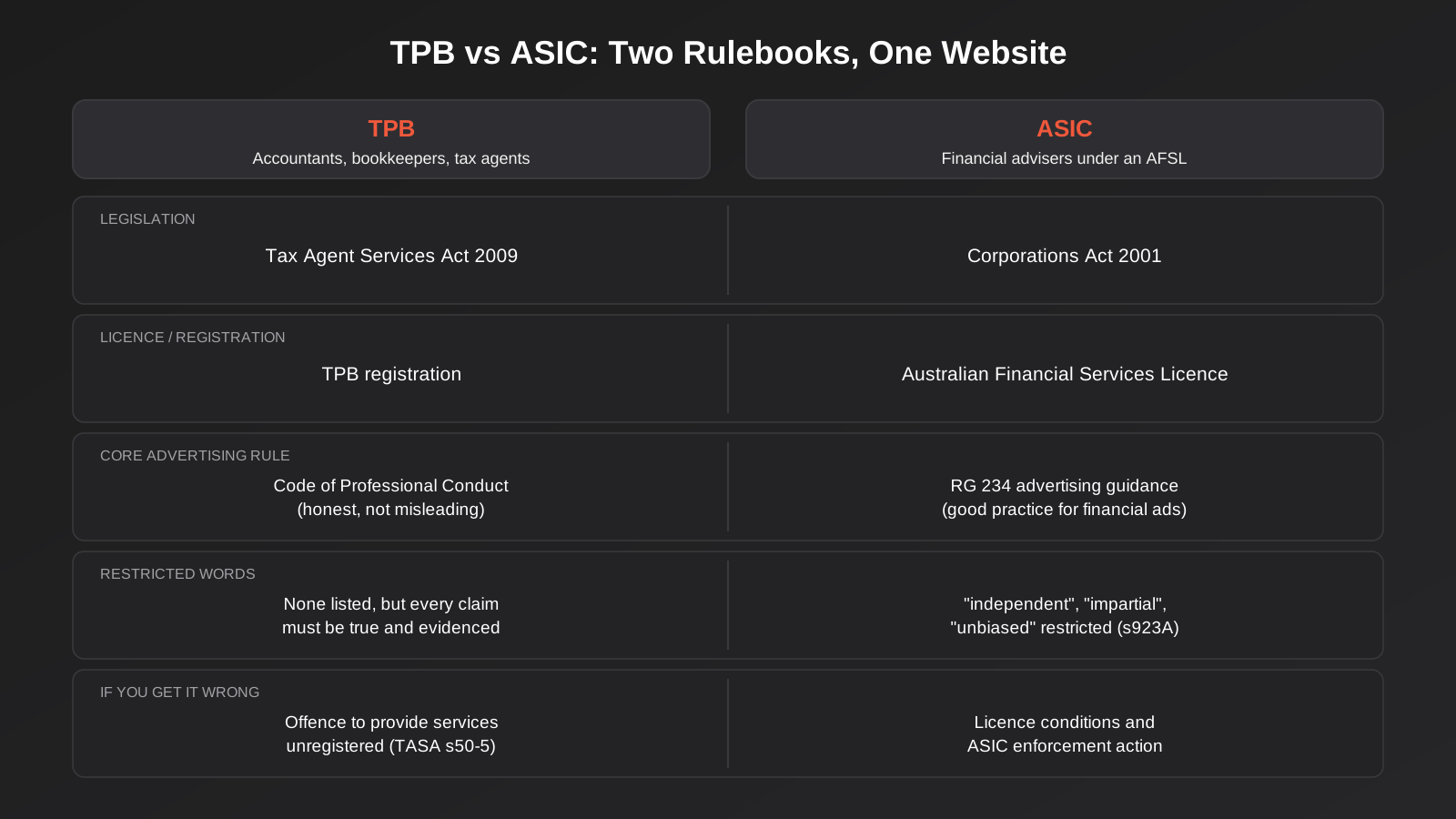
Accountants and tax agents answer to the Tax Practitioners Board under the Tax Agent Services Act. Financial advisers answer to ASIC under the Corporations Act, through an Australian Financial Services Licence. The two regimes don’t overlap much, they don’t use the same restricted words, and they don’t carry the same penalties. A “specialist” claim that’s merely sloppy on the accounting side of a website can sit two paragraphs away from a restricted word that’s a strict liability offence on the advice side, and most SEO advice aimed at “financial services” treats the whole category as one blob with one set of rules.
We’ve written before about the law firm version of this problem, where the Australian Solicitors’ Conduct Rules shape what a firm can claim, and the healthcare version, where AHPRA governs medical and dental advertising. Accounting and financial advice is a harder case than either, because it’s genuinely two regulatory regimes rather than one, and a huge share of the firms we talk to run both under a single brand without a single page on the site that acknowledges the split. This is a guide to SEO for accountants and financial advisers in Australia specifically — what changes once you take that regulatory split seriously, across keyword research, service pages, reviews, local SEO and the technical layer, for accountants, bookkeepers, tax agents and financial advisers alike.
Two Professions, Two Regulators
The starting point that most generic “financial services SEO” content skips is that “accountant” and “financial adviser” aren’t loosely related job titles, they’re separately licensed activities with separate legislation behind them. Getting this distinction right on the website isn’t a legal nicety, it’s the difference between copy that’s merely bland and copy that’s an actual liability.
Accountants, Bookkeepers and Tax Agents Answer to the TPB
Tax agents and BAS agents are registered under the Tax Agent Services Act 2009 (TASA) and regulated by the Tax Practitioners Board. Section 50-5 of TASA makes it an offence to provide a tax agent service for a fee or reward while unregistered — this isn’t a professional-conduct nicety, it’s a statutory prohibition with real penalties attached. Every registered practitioner also operates under the Code of Professional Conduct set out in section 30-10 of TASA, which requires honesty, competence and no false or misleading statements in how services are represented, marketing included. The Tax Agent Services (Code of Professional Conduct) Determination 2024 added eight further obligations from 1 August 2024, tightening things like managing conflicts of interest and keeping clients properly informed, which flows through to how a firm can position itself in content.
For a website, the practical implication is straightforward but frequently ignored: every accountant, tax agent or BAS agent named or pictured on a page offering tax agent services needs to actually be registered to provide them. A “team” page that includes a bookkeeper or junior staff member alongside registered agents, with no distinction drawn, blurs a line the TPB cares about. The TPB’s own registered tax practitioner symbol exists precisely so a firm can signal registration status clearly, and using it correctly (only for practitioners who actually hold it) is one of the more underused trust signals on accounting firm websites.
Financial Advisers Answer to ASIC and the Corporations Act
Financial advice is a different licensing regime entirely. Anyone providing personal financial product advice needs to operate under an Australian Financial Services Licence (AFSL), either their own or as an authorised representative of one, under the Corporations Act 2001. ASIC’s Regulatory Guide 234 sets out what “good practice” advertising looks like for financial products and advice services, and it was substantially updated in mid-2026 to fold in guidance from the old RG 53 on using past performance figures in promotional material, alongside more recent enforcement examples. If a page on your site quotes a return, a growth rate or any kind of historical performance figure to support an advice offering, RG 234’s current guidance is the document to check it against before it goes live.
Then there’s the restricted-word problem, which is where most “independent” positioning on financial advice websites quietly falls over. Section 923A of the Corporations Act restricts use of the words “independent,” “impartial” and “unbiased” — and, per ASIC’s own guidance in Regulatory Guide 175, extends that restriction to “words of like import” including “independently owned,” “non-aligned” and “non-institutionally owned.” You can only use them if the licensee genuinely receives no commissions, no volume-based payments and no other conflicted benefits, and operates free of the ownership ties the section describes. Most advice practices with any product relationships at all — and that’s most of them — simply can’t use these words, however accurate they feel in spirit. Yet “independent financial adviser” is exactly the phrase a meaningful slice of searchers type into Google, which means the SEO temptation and the compliance trap sit right on top of each other.
The Messy Middle: Firms That Run Both
Plenty of mid-sized accounting practices in Australia have grown a financial planning division, either under their own AFSL or as an authorised representative of a licensee, sitting alongside the core tax and compliance work. This is where the two rulebooks actually collide on one website. The tax and BAS pages need to reflect TPB registration and TASA’s Code of Professional Conduct. The financial planning pages need an AFSL number, a general advice warning wherever general advice is given rather than personal advice, and a Financial Services Guide (FSG) linked prominently before any advice-adjacent content. A shared “About Us” page that talks about “our independent, expert advice” across both halves of the business is very likely non-compliant on the advice side and simply loose on the tax side — and the fix for one section isn’t automatically the fix for the other, because they’re not the same regulator.
The practical answer is page-level regulatory tagging in your content workflow, not a single site-wide disclaimer bolted onto the footer. Every page needs one clear owner of which regime it sits under — tax agent services, financial advice, or general business content that isn’t regulated by either — before anyone writes a word of SEO copy for it.
What Google Rewards Here, Regardless of Which Regulator Applies
Financial content sits in Google’s Your Money or Your Life (YMYL) category almost by definition — bad advice about tax obligations or investment decisions has real financial consequences, and Google’s quality rater guidelines call for extra scrutiny on expertise, authoritativeness and trust for exactly this kind of content. The useful news is that the raw material a compliant firm needs to build genuine E-E-A-T signal and the raw material it needs to satisfy its regulator overlap almost entirely. The work is exposing what’s already true, not inventing anything.
Credentials Are an SEO Asset, Not Just a Compliance Line
A one-line “CPA, 15 years experience” under a headshot wastes what should be one of the stronger pages on the site. A practitioner bio that states the actual registration — CPA Australia, Chartered Accountants ANZ, IPA membership, TPB registration number for a tax agent, or the AFSL under which a financial adviser operates and their ASIC-recorded authorisation — gives Google specific, verifiable entity signal instead of a vague claim of expertise. It does the same job for a prospective client doing due diligence before they hand over their tax file number or their super balance. Authoring service page content under a named, credentialed practitioner’s byline, linked to their bio, is one of the more underused moves available to firms in this space, and unlike a lot of SEO advice, it costs nothing beyond attribution discipline.
Registration Numbers as a Trust Element
Stating a TPB registration number or an AFSL number plainly on the relevant page, rather than assuming a visitor already trusts the firm, is a small addition that does real work. It’s checkable — a prospective client (or a competitor, or a journalist) can verify it against the TPB or ASIC public registers in under a minute — and content that invites that kind of verification tends to read as more credible to both a human reader and to the E-E-A-T signals Google is approximating. It sounds like a compliance footnote. On a page where the reader is deciding whether to trust you with their finances, it functions closer to a conversion feature.
Keyword and Search Intent Research for Accounting and Advice Firms
Generic keyword tools will hand you volume, but the intent behind financial services searches splits cleanly into a few patterns worth researching separately, because they need different pages and different content depth.
High-Intent, Location-Qualified Service Terms
The terms that actually convert for accounting and advice firms are specific and location-qualified: “tax accountant Parramatta,” “SMSF accountant Melbourne,” “BAS agent near me,” “small business accountant Brisbane,” “financial planner for retirement Sydney.” These have lower search volume than a generic “accountant” search but dramatically higher conversion rates, because the searcher has already defined their problem, their location and their intent to engage someone. Building a dedicated, substantive service page for each real specialisation — SMSF administration, business activity statements, self-employed tax returns, retirement advice, aged care advice — and matching it to the location terms your actual client base searches from beats a single generic “our services” page trying to rank for all of them at once.
Informational Clusters That Build Authority Without Crossing a Line
Underneath the commercial terms sits a large volume of informational search: “how do I lodge a BAS,” “when is SMSF pension due,” “what’s the difference between general and personal financial advice,” “do I need a tax agent or can I lodge myself.” This content builds topical authority and internal linking depth without needing to make a single claim about the firm itself, which makes it lower-risk from a compliance standpoint while still doing real SEO work. The trap is writing it so generically it could sit on any firm’s site unchanged — genuinely useful informational content that reflects your actual practice areas and client questions (pulled from what your reception staff or client managers actually get asked, not just a keyword tool) outperforms templated explainer content that reads the same everywhere.
Increasingly, people are asking AI tools these same informational questions directly rather than searching Google first — “what’s the tax-free threshold this year,” “do I need an SMSF or is an industry fund enough.” The signals that earn a citation from an AI system draw on largely the same foundation as traditional SEO: clear, well-sourced, plainly-answered content and consistent entity signals. We cover the mechanics of that in more depth in our AI SEO guide, and the compliance angle carries over here too — content written to be quoted out of context by an AI system needs to be just as careful about restricted claims as content written for a human reader, because the answer surfaces the same way either way.
Building Service Pages That Rank Without Crossing a Line
The service page is where commercial intent and regulatory risk meet most directly, and it’s where the tax side and the advice side genuinely need different treatment.
Tax and Accounting Service Pages
A strong tax or accounting service page states plainly what the service covers, who on the team delivers it and their registration status, typical turnaround and process, and a genuine indication of cost structure where the firm is comfortable publishing one (fixed-fee tax returns are increasingly common and increasingly what searchers are looking to compare before they call). What it should avoid is unqualified superlatives — “the best tax accountants in Melbourne,” “guaranteed maximum refund” — which sit uncomfortably close to the honesty and competence standard in TASA’s Code of Professional Conduct even though the Code isn’t a word-by-word blacklist the way some other regimes are. A defensible, specific claim — years registered, number of returns lodged in a given category, genuine memberships — tends to perform just as well for SEO, because specificity is what differentiates a page from ten competitors targeting the same keyword, and it’s also the version that survives scrutiny.
Financial Advice Pages and the General Advice Warning
Any page that discusses financial products or strategies in general terms, without knowing the reader’s personal circumstances, is giving general advice, and it needs a general advice warning stating that the information doesn’t consider the reader’s objectives, financial situation or needs before they act on it. This isn’t a formality to bury in an 8pt footer — ASIC’s guidance expects it to be clear and proximate to the advice itself, not disconnected from the content it qualifies. Personal advice, where the firm has actually considered someone’s specific circumstances, comes with its own disclosure obligations through a Statement of Advice, which is a client-facing document rather than a website content problem, but the two need to stay clearly distinct in how a page talks about “advice” so a reader isn’t left assuming general content applies specifically to them.
The Financial Services Guide (FSG) needs to be easy to find and linked from anywhere advice-adjacent content sits, not buried three clicks deep in a legal page nobody reaches. This is worth treating as an SEO and UX task, not just a compliance checkbox — a clearly signposted FSG link is exactly the kind of transparent, specific content Google’s E-E-A-T signals reward on YMYL pages anyway.
The Words to Avoid Entirely on the Advice Side
“Independent,” “impartial,” “unbiased,” and near-equivalents like “independently owned,” “non-aligned” and “non-institutionally owned” are restricted under section 923A of the Corporations Act to advisers who genuinely receive no commissions, no volume-based payments and no other conflicted benefits. Most licensees with any product relationships at all can’t use them, and using them without meeting the conditions is a real enforcement risk, not a theoretical one — ASIC has pursued this specifically since clarifying its position in 2017. Because “independent financial adviser” is a phrase real searchers type, the fix is the same one that works in every regulated-industry SEO problem we’ve covered: write for the underlying intent honestly instead of reaching for the restricted word. “Fee-for-service advice with no product commissions” (where genuinely true) or “advice tailored to your situation, not a product panel” can do the same persuasive work without tripping the restriction, and it’s usually more specific and more convincing copy anyway.
Reviews, Testimonials and Case Studies Under Two Rulebooks
Reviews are one of the strongest local SEO trust signals available, and they’re also one of the areas where the tax side and the advice side genuinely diverge in how much risk a published testimonial actually carries.
On the accounting and tax side, there’s no equivalent to AHPRA’s blanket testimonial prohibition in healthcare, but the Code of Professional Conduct’s honesty standard still applies — a curated testimonial implying an outcome (“saved me $20,000 in tax”) needs to be genuine, current and not misleading about what’s typical, because an unrepresentative outcome presented as standard practice is exactly the kind of claim that undermines the honesty and competence obligations the Code sets out.
On the advice side, the same care applies but with a sharper edge, because RG 234’s updated guidance folds in the old RG 53 treatment of past performance claims specifically. A testimonial that references investment returns or portfolio performance is functionally a performance claim wearing a client’s name, and needs to meet the same evidentiary and disclosure standard RG 234 sets for any performance figure — which most curated client quotes simply don’t, and shouldn’t try to.
The safer, and in practice more persuasive, approach across both sides of the business is the same one that works for law firms and healthcare practices: make it easy for genuinely satisfied clients to leave an unprompted, unincentivised review on Google, respond to those reviews professionally, and let review volume and recency do the SEO work rather than a hand-picked set of quotes on the homepage. A consistently representative review profile, built without cherry-picking, is more persuasive to a prospective client than a suspiciously perfect curated set regardless of which regulator technically applies.
Local SEO, Google Business Profile and the Google Ads Verification Hurdle
Most of the searches that convert for accounting and advice firms are local — “near me” or suburb-qualified — which puts real weight on the local pack and Google Business Profile.
Google Business Profile Category and Consistency
Category selection genuinely matters here: “Accountant,” “Tax Preparation Service,” “Bookkeeper” and “Financial Planner” are distinct categories that sharpen relevance for the specific service someone’s searching, and picking the closest generic category instead of the accurate one leaves ranking potential on the table. Name, address and phone number need to match exactly across the website, Google Business Profile and every directory the firm appears on — CPA Australia’s find-a-practitioner tool, Chartered Accountants ANZ’s directory, the Financial Advisers Register, industry association listings — and these accumulate faster in this industry than in most, because so many professional bodies run their own directories.
The Google Ads Financial Services Verification Requirement
Anyone planning to run paid search alongside SEO needs to know this before budgeting for it: Google requires financial services advertisers targeting Australia to complete a mandatory verification process, providing proof of the relevant AFSL before financial services ads are approved to run. This isn’t optional and it isn’t fast — building the verification into the campaign timeline rather than discovering it after a launch date has already been promised is worth doing early, particularly for a firm running its first paid campaign for a financial advice offering. Tax and accounting services generally don’t carry the same verification requirement, which is another point where treating “financial services marketing” as one undifferentiated category leads a firm to plan for the wrong compliance timeline on the wrong half of the business.
Schema and Technical SEO for Financial Services Sites
Generic LocalBusiness schema works, but Schema.org has more specific types — AccountingService and FinancialService among them — that give search engines and AI systems parsing the page a clearer signal about what the practice actually offers, alongside Organisation markup carrying the AFSL or TPB registration details where relevant. FAQPage schema is worth using where a page genuinely answers direct questions, but the same caution that applies in every regulated industry applies here: be conservative with aggregateRating markup, and only mark up ratings actually collected through a legitimate, verifiable review platform rather than a hand-picked set of testimonials, since misusing review schema is a Google guideline violation on top of whatever the underlying content risk already is.
Beyond markup, the same technical fundamentals that matter for any YMYL site matter here — crawlability, mobile usability and Core Web Vitals — with one industry-specific wrinkle: accounting and advice sites tend to accumulate heavy third-party tools over time (a client portal login, a booking widget, a live chat script, an embedded calculator), each added by a different person for a good reason, and stacked together they routinely drag down page speed on exactly the service pages carrying the most commercial weight. An occasional audit of what’s actually loading on the highest-traffic pages, with lazy-loading and compression applied where it’s safe to, is worth the hour it takes.
A Compliance Workflow That Doesn’t Slow Down Publishing
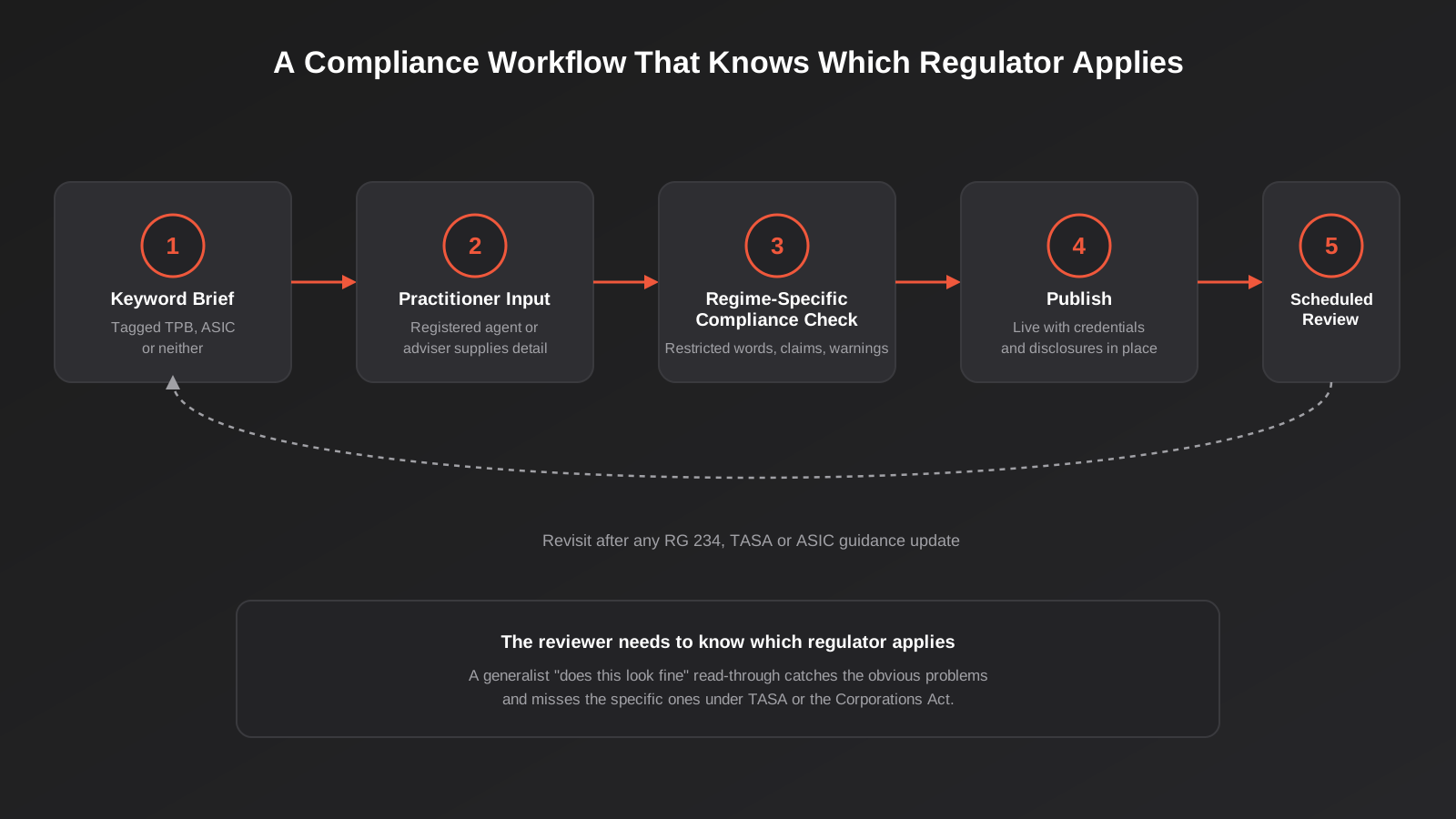
Firms that publish consistently in this space have a workflow, not a rule everyone’s supposed to remember. A version that actually holds up in practice looks like this: a content brief built from real keyword and search-intent research, tagged at the brief stage with which regime the page sits under (TPB, ASIC, or neither); a first draft written with input from the relevant practitioner or adviser, since they’re the source of the actual technical detail even if they’re not the one writing the SEO copy; a compliance pass checked specifically against the rules for that regime — does this page misuse a restricted word, overstate an outcome, quote a performance figure without the RG 234 disclosure it needs, or represent an unregistered person as delivering a tax agent service; then publish.
That compliance pass needs to be a specific, checkable step, not a general “does this look okay” read-through, and it needs someone who actually knows which of the two regimes applies to the page in front of them — a generalist marketing reviewer who doesn’t know the difference between TASA and the Corporations Act will catch obvious problems and miss the specific ones. Content also needs a periodic refresh cycle beyond the initial publish: RG 234 itself was substantially updated in 2026, and TASA’s Code picked up new obligations from the 2024 Determination, which means content written to be compliant eighteen months ago may not be compliant today even if nothing on the page has changed.
Common Mistakes We See
- Treating “financial services” as one category and applying the same review checklist to tax content and advice content, when they sit under entirely different legislation
- Using “independent,” “unbiased” or “independently owned” on an advice page without checking whether the licensee actually meets the section 923A conditions
- Publishing a shared team page that doesn’t distinguish which staff are registered tax agents, authorised representatives, or neither
- Quoting investment returns or portfolio performance in a testimonial without the disclosure RG 234 requires for any performance claim
- Burying the general advice warning or the Financial Services Guide link somewhere a reader is unlikely to see it before acting on the content
- Budgeting a paid search launch for a financial advice offering without accounting for Google’s mandatory AFSL verification timeline
- Leaving compliance-reviewed content unrevisited for years after a regulatory update, like the 2026 RG 234 changes or the 2024 TASA Determination
Frequently Asked Questions
Do accountants need to worry about ASIC at all if they don’t give financial advice?
No. A tax agent or accountant who sticks to tax agent services — returns, BAS, tax planning within a compliance context — is regulated by the Tax Practitioners Board under TASA, not ASIC. ASIC’s rules, including the section 923A restricted words and RG 234’s advertising guidance, only bite once a firm starts giving financial product advice under an AFSL. The confusion usually starts when a firm’s marketing lumps “financial services” together as one category and applies advice-side caution (or, just as often, advice-side laxness) to content that’s actually pure tax and accounting work.
Can we call ourselves a “specialist” tax accountant?
Unlike the legal profession’s protected “accredited specialist” title, there’s no single equivalent formal restriction for accountants, but the same underlying principle applies: a claim needs to be true and not misleading under the Code of Professional Conduct’s honesty standard. If a practitioner has genuinely built deep experience in a niche — SMSF administration, R&D tax incentives, primary producer tax — describing that focus specifically and with evidence (years, matter volume, relevant memberships) is both more defensible and, in our experience, better performing SEO copy than a bare “specialist” claim with nothing behind it.
What’s the actual difference between general advice and personal advice on a website?
General advice is information or recommendations that don’t take into account the reader’s personal objectives, financial situation or needs — most website content sits here, and it needs a general advice warning saying exactly that. Personal advice considers someone’s actual circumstances and comes with a Statement of Advice obligation, which happens in a direct client engagement rather than through published web content. The risk on a website is implying personal-advice-level specificity (“this is the right strategy for you”) in content that’s legally and practically general advice.
How long does SEO take to show results for an accounting or financial advice firm?
Similar to other YMYL categories under extra scrutiny — expect six to twelve months of consistent, compliant publishing before competitive terms move meaningfully, longer in capital cities for generic terms like “accountant Sydney” with no suburb or specialisation qualifier. Suburb-qualified and service-specific terms (SMSF accountant in a specific area, tax agent for a particular client type) tend to show movement faster, which is also usually where the higher-converting search volume actually sits.
Is it worth running Google Ads alongside SEO for a financial advice offering?
Often yes, but budget time for Google’s mandatory financial services verification process before the campaign launch date, since it requires proof of the relevant AFSL and isn’t instant. Ad copy also needs the same general advice warning and restricted-word discipline as website content — a compliant landing page behind a non-compliant ad headline doesn’t fix the underlying problem, it just moves where the breach happens.
Our firm has both a tax practice and an in-house financial planning arm under one brand — should we split the website?
Not necessarily into separate domains, but the content absolutely needs to be split by regime at the page level, with clear distinction on team pages, service pages and anywhere advice-adjacent content sits about which regulatory framework applies. A shared homepage and shared “About” content can work fine; a shared claims vocabulary across both halves of the business is where firms get into trouble, because a line that’s merely loose marketing on the tax side can be a real breach on the advice side.
Where to Start
If your firm’s website talks about tax and financial advice in the same voice with no distinction between them, the practical starting point is an honest content audit split by regulator: which pages are pure tax agent services under the TPB, which are financial advice under an AFSL, and which claims on either side wouldn’t survive a proper compliance read. From there it’s sequencing — fix anything that’s a live regulatory risk first, particularly around restricted words and testimonials, then build out the service-page and local SEO structure properly, then layer in the content that compounds over time.
This sits alongside the other regulated industries we work across, and our finance and banking industry page covers more of how this translates for firms in the sector, alongside our broader SEO service — current SEO pricing is also published if you’d like a sense of investment before talking to anyone. If you’d rather just talk through where your firm’s site actually stands against both rulebooks, we’re happy to have that conversation before any commitment is on the table.
Keep reading
Related posts
Psychology Practice Marketing in Australia: Local SEO, Compliant Copy and the Waitlist Problem (2026)
How Australian psychology practices handle local SEO, AHPRA-compliant copy and waitlist triage when they're already at capacity (2026).

Physiotherapy Marketing in Australia: Local SEO, Website Design and Booking (2026)
How Australian physiotherapy clinics win new patients through Google Business Profile, local SEO, website design and real-time booking in 2026.
Local SEO for Veterinary Clinics in Australia: Google Business Profile, Reviews and the Emergency Search (2026)
Veterinary clinic SEO explained: Google Business Profile, review generation and the emergency search most vet websites get wrong.
Got a project you'd like to talk through?
Tell us what you're working on — we'll come back with a plan.
