
SEO for Law Firms in Australia: Ranking Without Breaching the Solicitors’ Conduct Rules (2026)
 Jignesh Vagadiya
21/09/2026
21 min read
Search a phrase like “personal injury lawyer Melbourne” and you’ll find law firm websites making claims that would not survive a complaint to their state Law Society — “no win, no fee guarantee”, “Australia’s leading family lawyers”, partner bios calling someone a specialist without the accreditation to back it up. Some of that copy still ranks. Most of it is one competitor complaint or one client dispute away from a professional conduct problem, and a page that gets pulled down or rewritten under instruction from a regulator loses whatever ranking it built.
That’s the real difficulty with SEO for law firms in Australia. It isn’t primarily a content or backlink problem — it’s a claims problem sitting on top of an SEO problem. Google already treats legal content as Your Money or Your Life (YMYL), which means it wants exactly the kind of specific, credentialed, evidenced content a compliance-conscious firm should be producing anyway. The tension people assume exists between good SEO and good compliance is mostly a myth. The real tension is between generic marketing copy and the specificity both Google and the Australian Solicitors’ Conduct Rules actually reward.
In our experience running SEO across regulated Australian industries, the mistakes are rarely technical. They’re practice area pages that read like brochures, local SEO built around suburb keyword stuffing instead of a genuine multi-office presence, and content workflows with no compliance checkpoint before anything goes live. We’ve written about this pattern once before — AHPRA governs medical and dental advertising the way the Australian Solicitors’ Conduct Rules govern legal advertising, and if you run a healthcare practice our guide to healthcare SEO and AHPRA compliance covers that version of the same underlying problem. This is the legal industry’s version: what actually ranks, and what gets a firm a please-explain letter instead.
Why Law Firm SEO Plays by Different Rules
Legal advertising in Australia is governed at the state and territory level, mostly through each jurisdiction’s adoption of the Australian Solicitors’ Conduct Rules (ASCR), enforced by the relevant Law Society or Legal Services Commissioner. Rule 36 is the one that matters for marketing. It doesn’t hand you a list of banned words. It’s principles-based: advertising must not be false, misleading or deceptive, must not be offensive, and must not otherwise be prohibited by law. That principles-based structure is actually harder to work with than a blacklist, because it means every claim on a practice area page needs to be defensible on its own merits, not just checked against a list of forbidden phrases.
This matters for SEO specifically because ranking well for competitive legal terms usually means writing more assertive, more specific copy — that’s what differentiates a page from ten competitors targeting the same keyword. The firms that get this right write specific, evidenced, defensible copy. The firms that get it wrong write specific-sounding copy that isn’t actually true, which is worse for both compliance and ranking than being vague, because Google increasingly rewards the same specificity a regulator would ask you to prove.
It also gets more complicated for firms admitted in more than one state, or targeting clients across state lines through a single national-sounding website. A practitioner admitted in New South Wales advising a Victorian client on a Victorian matter can raise its own professional obligations question, separate from advertising rules entirely, and a website that blurs which practitioners are admitted where — deliberately or through generic templated copy — creates both a compliance risk and a confusing, low-trust experience for the reader trying to work out if this firm can actually help them. Stating jurisdiction clearly on every relevant page is a small fix that solves both problems at once.
What Rule 36 Actually Restricts
Rule 36.1 sets the general standard: no false, misleading or deceptive advertising, nothing offensive, nothing that breaches another law (including, relevantly, the Australian Consumer Law’s misleading conduct provisions, which apply to law firms like any other business). In practice this catches the things you’d expect — overstated success rates, implied guarantees, comparative claims about being “the best” or “the top-rated” firm in a region without evidence to support it. It also catches things that feel like harmless marketing filler, like a stock claim of “decades of combined experience” that doesn’t hold up when you actually add up admission dates.
The practical SEO implication is that every page needs an owner who can defend every sentence. That’s not a legal department slowing down marketing — it’s the same content review discipline Google wants from YMYL pages anyway. A practice area page written by someone with no legal training, published without a practitioner reading it, is a compliance risk and a weak E-E-A-T signal at the same time.
The “Specialist” Trap
Rule 36.2 is more specific and it’s the one firms trip over most often. You cannot describe yourself or a practitioner as a “specialist” or “accredited specialist” unless that person actually holds formal specialist accreditation through their state Law Society or Law Institute’s specialist accreditation scheme. Not “specialises in” used loosely, not “our specialist team” as a figure of speech — the formal credential.
This is a genuine SEO headache because “specialist” is exactly the word people search. “Family law specialist Brisbane” gets real search volume. The fix isn’t to avoid the topic, it’s to write for the intent without misusing the word: “family lawyers with X years focused exclusively on family law”, or, where it’s genuinely true, naming the specific accreditation and the body that granted it. Content that explains the difference between a general practitioner and an accredited specialist actually performs well, because it answers a question real searchers have and gives you a legitimate reason to use the keyword throughout the page.
Testimonials, Reviews and Client Outcomes
Testimonials sit in a genuinely tricky spot. They need to be genuine, current, given freely without incentive, and obtained with the client’s informed written consent, and they can’t imply a guaranteed outcome for a future client or identify someone without permission. A five-star Google review a happy client leaves unprompted is treated differently to a testimonial the firm solicits, edits and publishes on its own website — the second carries more responsibility for the firm to get right, because you chose to publish it.
For SEO purposes this means a testimonials or case results page needs a genuine consent and verification process behind it, not a marketer copying a nice email into a template. It’s slower to build, and it’s also more defensible, and defensible content is what survives long enough to accumulate rankings instead of getting pulled down six months in.
“No Win, No Fee” and Cost Claims
“No win, no fee” is one of the highest-intent phrases in personal injury and compensation law searches, and it’s also one of the more heavily scrutinised claims under Rule 36. Used without qualification, it’s likely to be misleading unless the firm genuinely intends to indemnify an unsuccessful client against an adverse costs order and doesn’t require payment of disbursements regardless of outcome. Queensland’s Legal Services Commission has pursued this as a live enforcement issue — a Queensland solicitor was fined $30,000 by QCAT over unlawful no-win-no-fee advertising, in a matter the Queensland Law Society’s own guidance flagged as a “prevalent” problem in personal injury marketing specifically.
For a page targeting this phrase, that means the claim needs its qualifying detail nearby, not buried three pages of terms and conditions away — what counts as a win, which costs (if any) remain payable regardless of outcome, and what happens to disbursements. Google tends to reward this kind of transparent, specific cost content anyway, because it directly answers the next question a searcher has after they land on the page. Building the compliant version and the well-ranking version turns out to be close to the same exercise.
What Google Actually Rewards on a Law Firm Website
Legal content sits firmly in Google’s YMYL bucket, which means the practical translation of E-E-A-T — experience, expertise, authoritativeness, trust — gets scrutinised harder here than it would for, say, a homewares store. The good news is that a compliant law firm already has most of the raw material. The work is exposing it properly rather than inventing it.
Practitioner Bios Are an SEO Asset, Not Just a Trust Page
A thin “Our Team” page with headshots and one-line titles wastes what should be one of the strongest pages on the site. A practitioner bio that includes real admission details — year of admission, jurisdiction, qualifications, genuine accreditations, matter types actually handled, professional memberships — gives Google (and a prospective client doing due diligence) exactly the signal YMYL content needs. Authoring practice area content under a named practitioner’s byline, linked back to their bio, is one of the more underused E-E-A-T moves available to law firms, and it costs nothing beyond attribution discipline.
Case Results Without Breaching Confidentiality or Advertising Rules
Firms often avoid publishing any outcome detail at all because it feels risky, which throws away genuinely persuasive, genuinely rankable content. The safer version is aggregated and anonymised: settlement ranges by matter type over a defined period, described in a way that doesn’t identify any individual client or imply a guaranteed result for the next one. Where a specific matter is used, it needs the client’s written consent and careful language that presents it as an outcome achieved in that matter, not a promise about future ones. This is more work than lifting a quote from an old email, and it’s the version that actually holds up.
Trust Signals That Actually Move the Needle for YMYL
Some of the highest-leverage trust signals for a law firm site are unglamorous: a visible ABN and physical office address, clear statement of the jurisdiction(s) practitioners are admitted in, a genuine complaints and feedback pathway (several state legal services commissioners expect this to be findable, not buried), and real photography of the office and team instead of stock images of a gavel and scales of justice. None of these are ranking factors in a direct, mechanical sense, but they all feed the same trust assessment Google is trying to approximate through hundreds of weaker signals, and they measurably affect whether a visitor who does land on the page picks up the phone.
A current practising certificate and professional indemnity insurance are baseline requirements for any solicitor in Australia, and stating them plainly — rather than assuming a prospective client already trusts that they exist — costs a sentence and closes a small but real trust gap, particularly for clients researching a firm they haven’t been referred to personally. It sounds like a compliance footnote. In a YMYL category where the reader is actively trying to work out whether to trust you with a real legal problem, it’s closer to a conversion feature.
Practice Area Pages That Actually Rank
The practice area page is the workhorse of legal SEO — it’s where commercial intent and Google’s content-quality bar meet. Most law firm sites get the structure wrong before they even get to the writing.
One Page Per Practice Area, Not One Page Per Suburb × Practice Area
The tempting shortcut is to template out a “family lawyer [suburb]” page for every suburb in a firm’s service area, swapping the suburb name and leaving the body copy almost identical. This is the same thin-duplicate-content trap that undermines local SEO in any industry, and it’s worse for a YMYL site because Google has less tolerance for shallow content in categories it scrutinises more heavily. A firm with two or three genuine offices is far better served by one strong page per office (with real local detail — parking, court proximity, the practitioners actually based there) and one strong page per practice area, cross-linked, than by dozens of near-duplicate suburb pages competing with each other for the same ranking.
What a Practice Area Page Actually Needs
A page targeting “family lawyer Brisbane” and a page targeting “how does property settlement work after divorce in Queensland” are answering different search intents — one commercial, one informational — and trying to make a single page rank for both usually means it does neither well. The commercial page should be concise, credential-forward and action-oriented: what the firm does in that area, who handles it, how the process typically works, how to get started. The informational content — the genuine questions people ask before they’re ready to call a lawyer — belongs in supporting guide content that links into the commercial page, using FAQ schema where the content is a genuine, direct answer to a genuine question, not a way to stuff extra keywords into a rich snippet.
Keyword clustering makes this manageable instead of overwhelming. A family law practice area typically clusters into divorce and separation, property settlement, parenting arrangements and consent orders, spousal maintenance, and child support — each with its own commercial and informational intent, and each deserving its own supporting content rather than being crammed as a subheading into one enormous page. The same logic applies to a commercial litigation, conveyancing or wills and estates practice: map the real questions clients ask across the life of a matter, cluster them by sub-topic, and build content depth in the order that reflects where your actual enquiry volume comes from, not where it’s easiest to write.

Local SEO for Multi-Office and Suburb-Level Firms
Most law firms compete on local intent even when they don’t think of themselves as a “local business” — searches like “conveyancing lawyer near me” or “wills lawyer [suburb]” carry real volume and real commercial intent, and Google’s local pack sits above organic results for exactly these queries.
Google Business Profile Setup for Law Firms
Category selection matters more than firms think — “Lawyer” is the safe generic category, but where a more specific category genuinely applies (family lawyer, personal injury attorney, criminal justice attorney) it sharpens relevance for the exact terms clients search. Firms operating from serviced offices or without a genuine walk-in presence at every location need to be honest about service-area versus storefront settings in Google Business Profile — Google actively suppresses listings it suspects are using an address purely for ranking purposes, and getting caught out here can mean losing the listing entirely, not just a ranking penalty.
Reviews Strategy Within the Rules
Review volume and recency are a real local ranking factor, and clients are generally happy to leave one once a matter has closed well. The compliant way to build this is a consistent, unincentivised request sent to every client at matter close (not selectively to the ones you expect to leave a five-star review, which risks looking like a curated sample), with no offer of a discount or gift in exchange. This is both the compliant approach and, in practice, the one that builds a genuinely representative review profile, which is more persuasive to prospective clients than a suspiciously perfect one anyway.
Legal Directories and Citation Consistency
Legal-specific directories — Doyle’s Guide, Best Lawyers, LawTap and the Australian Law List among them — still carry weight for law firm SEO in a way general directories don’t for most other industries, because several of them run genuine peer-review or client-verified ranking processes rather than open self-submission. A profile listed consistently across these, with the same firm name, address and phone number as the website and Google Business Profile, reinforces the entity signals Google uses to confirm a business is legitimate and stable. It’s also a trust asset that sidesteps the testimonial problem entirely — a peer-reviewed directory ranking is a third party’s assessment, not a claim the firm is making about itself, which makes it one of the cleaner credibility signals available under Rule 36.
Building a Content and Compliance Workflow That Doesn’t Slow Down SEO
The firms that publish consistently and stay compliant have a workflow, not a rule they hope everyone remembers. The ones that get burned usually had a marketer or agency publishing directly with no practitioner or principal sign-off step at all.
Where Legal Content Actually Gets Written vs Reviewed
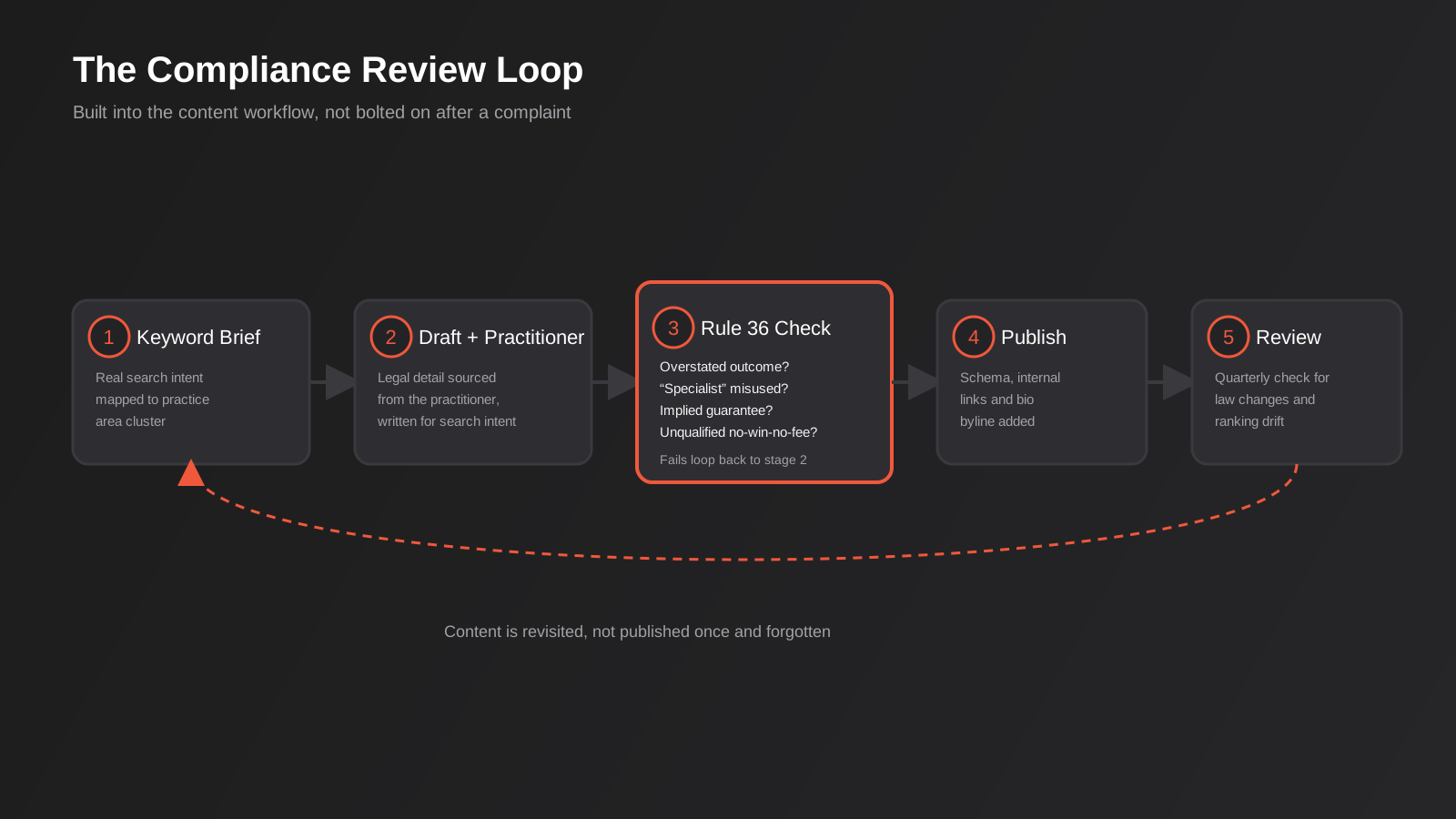
A workable version looks like this: a content brief built from real keyword and search-intent research, a first draft written with the relevant practitioner’s input (not necessarily by them — most practitioners don’t have time to write SEO content from scratch, but they should be the source of the actual legal detail), a compliance pass checked specifically against Rule 36 and any state-specific advertising guidance for that practice area, then publish. The compliance pass is a specific, checkable step — does this page overstate an outcome, misuse “specialist”, imply a guarantee, or make an unqualified no-win-no-fee claim — not a vague “does this look okay” read-through.
Keeping Content Current Without Republishing From Scratch
Legal content decays differently to most content — a page can be well-written and well-optimised and still become wrong the day legislation changes or a relevant case is decided. Family law and employment law content in particular has a habit of going stale after reform. A quarterly review cadence on high-traffic and high-value pages, checking both search performance and legal currency, catches this before a client relies on outdated information or a competitor’s more current page overtakes it in rankings.
Technical SEO Considerations Specific to Legal Websites
None of this replaces the technical fundamentals — crawlability, site speed, mobile usability — but a couple of technical choices are specific enough to legal sites to call out.
Schema Markup for Law Firms
LegalService and Attorney schema help Google understand practice areas, office locations and practitioners as structured entities rather than inferring them from body text. FAQ schema is genuinely useful on pages with real, directly-answered questions, but it’s worth being conservative with aggregateRating markup — only mark up ratings actually collected and verifiable through a legitimate review platform, not a hand-picked set of testimonials, since misuse of review schema is both a Google guideline violation and arguably its own misleading-advertising problem under Rule 36.
Site Architecture for Multi-Practice, Multi-Office Firms
Larger firms often end up with practice area content scattered across old blog posts, PDF flyers and a handful of orphaned pages nobody links to. A clean hub structure — a practice area landing page linking down to its own supporting guides and out to the relevant practitioner bios and office pages — keeps link equity flowing to the pages that actually convert, and makes it obvious to both users and Google which page is the authoritative one for a given practice area.
Site Speed and Core Web Vitals on Legal Sites
Law firm websites accumulate weight quickly — a hero video, stock photography sized far larger than it needs to be, an embedded booking widget, a live chat script and a third-party review carousel, each added by a different person at a different time. Every one of those can be a legitimate trust or conversion feature, but stacked together they routinely tank Core Web Vitals scores, and a slow-loading practice area page loses a meaningful share of mobile visitors before it ever gets the chance to convert them. The fix isn’t removing the trust signals, it’s auditing what’s actually loading on the highest-traffic pages, compressing or lazy-loading imagery, and being deliberate about which third-party scripts genuinely earn their place above the fold.
Common Mistakes We See
Most of the SEO problems we see on law firm sites trace back to one of a handful of recurring habits, usually inherited from a template, a previous agency, or a well-meaning attempt to scale content faster than the compliance process could keep up with.
- Templating suburb-stuffed landing pages instead of building genuine practice area and office depth
- Letting a marketer or agency use “specialist” or “expert” in copy without checking whether the accreditation actually exists
- Publishing case outcomes or testimonials without documented client consent
- Treating Google reviews and website testimonials as if the same rules apply to both
- No compliance sign-off step before content goes live, so problems get caught by a complaint instead of a review process
- Leaving high-value content unreviewed for years after a relevant legislative or case law change
Frequently Asked Questions
Is SEO even worth it for a law firm, or should we just run Google Ads?
Most firms need both, but for different reasons. Google Ads gets you into the auction for high-intent terms immediately, at whatever the current cost per click is for that practice area and city — and legal keywords are consistently among the more expensive categories in Australian search advertising. SEO takes longer to build but keeps producing enquiries without a per-click cost once a page is established, and it compounds across the growing library of practice area and guide content a firm accumulates over time. Firms in competitive practice areas like family law or personal injury generally run both in parallel rather than choosing one.
How long does legal SEO take to show results given the extra YMYL scrutiny?
Slower than most industries, honestly. YMYL content gets held to a higher bar before Google trusts it enough to rank it prominently, particularly for a newer site or one with a thin content and backlink history. A realistic timeline for meaningful movement on competitive practice area terms is six to twelve months of consistent, compliant publishing, not the six-to-eight weeks sometimes promised for less scrutinised industries.
Can we say we’re “the best family lawyers in Melbourne”?
Only if you can substantiate it, and in practice almost no firm can substantiate an unqualified superlative like that. It’s the kind of claim Rule 36 is specifically aimed at. A defensible alternative is a specific, true claim — years in practice, number of matters handled in that area, genuine accreditation where it exists — which usually performs just as well for SEO because it’s more specific, and specific content tends to answer the searcher’s actual question better than a superlative does.
Do we need a separate website page for every suburb we service?
No, and building them is one of the more common ways firms accidentally hurt their own rankings. Build a genuinely substantive page for each real office location and let strong practice area pages, combined with an accurate Google Business Profile, cover the surrounding service area. A handful of deep, well-differentiated location and practice pages consistently outperforms a large set of thin, near-identical suburb pages.
What actually happens if a competitor reports our website to the Law Society?
It varies by state and by how serious the alleged breach is, ranging from an informal request to amend the content through to a formal investigation and, in more serious or repeat cases, disciplinary action and fines — Queensland’s Legal Services Commission has pursued exactly this over unqualified no-win-no-fee advertising. Even a minor complaint usually means the page comes down or gets rewritten while it’s reviewed, which is the ranking cost people don’t think about until it happens to their highest-traffic page.
Should a sole practitioner or barrister approach SEO differently to a larger firm?
The compliance rules apply the same way regardless of firm size, but the practical SEO strategy usually differs. A sole practitioner is better served leaning hard into personal authority — a genuinely detailed bio, authored guide content, a narrow set of practice areas covered in real depth — than trying to compete on the volume of pages a larger firm can produce. Depth on a narrow set of terms tends to beat breadth spread too thin, particularly for a newer or smaller site still building trust with Google.
Where to Start
If you’re running a law firm’s marketing, the practical starting point is usually an honest content audit: which practice area pages actually have the depth and credentials to earn trust, which ones are thin or templated, and which claims on the site wouldn’t survive a Rule 36 read. From there it’s a matter of sequencing — fix the compliance risk first, then build out the practice area and location structure properly, then layer in the content and local SEO work that compounds over time.
We work with firms across several regulated industries, and our legal services industry page covers how that translates specifically to law firm marketing, alongside our broader SEO service. If you’re earlier in the process of choosing who to work with at all, our guide to choosing an SEO agency in Australia covers the vetting questions worth asking before you sign anything, and our SEO pricing page has current fixed pricing rather than a vague quote range. If you’d rather just talk through where your firm’s site actually stands, we’re happy to have that conversation before any commitment is on the table.
Keep reading
Related posts

Psychology Practice Marketing in Australia: Local SEO, Compliant Copy and the Waitlist Problem (2026)
How Australian psychology practices handle local SEO, AHPRA-compliant copy and waitlist triage when they're already at capacity (2026).

Physiotherapy Marketing in Australia: Local SEO, Website Design and Booking (2026)
How Australian physiotherapy clinics win new patients through Google Business Profile, local SEO, website design and real-time booking in 2026.
Local SEO for Veterinary Clinics in Australia: Google Business Profile, Reviews and the Emergency Search (2026)
Veterinary clinic SEO explained: Google Business Profile, review generation and the emergency search most vet websites get wrong.
Got a project you'd like to talk through?
Tell us what you're working on — we'll come back with a plan.
