
How Much Does Custom Software Development Cost in Australia? Build Cost vs Five Years of Licences (2026)
 Jignesh Vagadiya
21/10/2026
11 min read
Most businesses ask about the cost of custom software at the moment a subscription starts to hurt. The CRM wants more per user, the inventory tool doesn’t talk to the accounting package, and someone is rekeying orders from one screen into another every afternoon. At that point the question isn’t really “what does software cost”, it’s “what does this cost compared with carrying on as we are”, and almost nobody prices it that way.
This guide does both. It gives you realistic Australian price ranges for the main kinds of custom software in 2026, shows what pushes a project up or down, and then runs a simple five-year comparison against the subscriptions you’d be paying otherwise. If you’ve already read our guide to what a custom web app costs, this one is the wider view: not one product, but the whole category, including software whose main job is connecting the systems you already run. If you want to talk through a real project, our custom software development service page explains how we scope and build.
How Much Does Custom Software Development Cost in Australia?
“Custom software” isn’t one product, so it doesn’t have one price. The ranges below are grouped by what the software is for, because that predicts the cost better than any feature list. They reflect where Australian agency rate cards and published cost guides converge in 2026, with the bottom of each range lean but usable and the top fully featured.
- Integration or automation layer (software that moves data between systems you already own, such as orders into accounting, or CRM records into a quoting tool): roughly $8,000–$40,000. A single, well-documented integration sits at the bottom. Several systems that must stay in step push you towards the top.
- Internal tool or workflow system (replacing a spreadsheet, a paper process or an email chain with something purpose-built, with a handful of user roles and a simple admin area): roughly $20,000–$60,000.
- Line-of-business system (the software your operation actually runs on: job management, scheduling, quoting, compliance records, with reporting and several integrations): roughly $60,000–$200,000.
- Customer-facing platform or SaaS product (portals, marketplaces, subscription products, anything with public sign-up, payments and support load): roughly $100,000–$400,000 and up, scoped entirely on functionality.
Two things sit outside these numbers. The first is a discovery or scoping phase, which many teams charge for separately and which commonly runs somewhere between a few thousand and ten-plus thousand dollars depending on how many systems and stakeholders are involved. It’s money well spent: it turns a sentence-long brief into something that can be priced honestly. The second is everything after launch, covered below.
If your project sounds like a customer-facing app rather than business software, our guide to what an app costs in Australia covers that side in more detail.
What Moves the Price
How many systems it has to talk to
Integration is the quiet multiplier. Connecting to a system is easy to say and slow to do properly, because the real work is in what happens when the other system is slow, changes its API without notice, or returns something unexpected. A single clean integration might add $3,000–$8,000. Several systems that all hold overlapping data, such as stock in the ERP, stock in the store and prices in both, can easily become the biggest line in the quote. We’ve written separately about the specific cases: CRM integration, point of sale integration and Xero integration each have their own quirks and costs.
How well the process is understood
Software automates a process, and if the process is only half-understood the software inherits the confusion. A business that can walk through every step, every exception and every approval on a whiteboard will get a tighter quote than one saying “it’s complicated, we’ll know it when we see it”. Time spent writing the process down before talking to developers is the cheapest saving available.
Users, roles and permissions
One kind of user is simple. Staff, managers, customers and contractors, each seeing different data and allowed to do different things, multiplies design, build and testing time, because every role has to work correctly and fail safely.
Data you already have
Moving years of records out of a spreadsheet or an ageing system is rarely a quick import. Duplicates, inconsistent formats and missing fields all need decisions, and those decisions take time from people on your side as well as the developers. If you’re replacing an old system rather than wrapping it, read our guide on whether to wrap a legacy system with APIs or replace it before you settle on a budget.
Security, privacy and compliance
Handling payments, health information or other sensitive personal data brings work that never appears as a visible feature: encryption, audit trails, retention rules and a security review before launch. Software that touches the Australian Privacy Principles carries this cost whether or not anyone mentions it in the brief.
Who builds it, and from where
Senior developer rates in 2026 run roughly $180–$250 an hour in Sydney and Canberra and $150–$210 in Melbourne and Brisbane, with lower blended rates where offshore delivery is involved. Scope matters far more than location, but the rate explains part of why two reputable teams can land well apart on the same brief. What matters more than the headline rate is who owns requirements and quality. Locally led teams with experienced specialists behind them tend to deliver fewer surprises than a cheap rate with nobody accountable for the detail.
The Part Most Quotes Skip: Running Costs
Subscriptions have one great virtue: the vendor handles everything after the invoice. Custom software shifts those jobs to you, so they belong in the comparison.
- Maintenance and support: plan on roughly 15–25% of the build cost per year for fixes, dependency and security updates, and small improvements.
- Hosting and infrastructure: typically $50–$500 a month for a business application, depending on traffic, data and background processing.
- Third-party services: email and SMS providers, mapping, payment fees and other usage-based tools that grow with your volume.
- Change: your business will evolve, and the software has to follow. Budget for a steady trickle of changes rather than treating launch as the finish line.
Custom Build vs Five Years of Subscriptions
Here is a deliberately simple example. It’s illustrative, not a prediction, so swap in your own numbers. Imagine a business paying $36,000 a year across the tools that currently run one process (say 30 users at about $100 a month). Over five years that’s $180,000 before any price increases. Now imagine a custom build of that process at $80,000, costing about $19,000 a year to run (maintenance at 20% of the build, plus hosting and services).
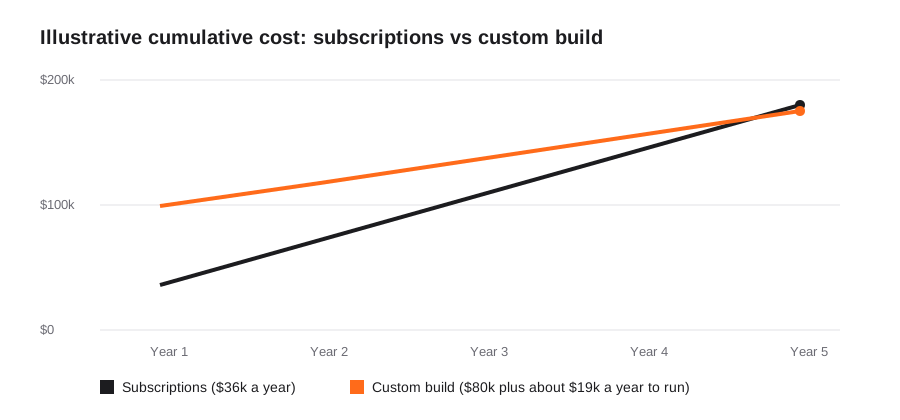
In this example the custom build costs more for roughly the first four and a half years, and the two lines only meet around year five. That is the honest shape of most of these comparisons: custom software rarely wins on cost alone in the short term. Subscriptions are cheaper to start, and a year-one bill that is $60,000 higher is real money.
So why would anyone build? Because cost isn’t the only variable the chart leaves out.
- Licences scale with headcount; custom software mostly doesn’t. Double the team in the example and the subscription line steepens sharply, while the custom line barely moves.
- Price rises are one-way. Subscription pricing tends to move up, and you have limited say over it.
- Workarounds have a cost. If staff spend hours a week rekeying data or maintaining side spreadsheets because the off-the-shelf tool doesn’t quite fit, that time doesn’t appear in the licence bill but it is very much paid for.
- Fit can be worth more than price. Software built around how you actually work can remove steps, errors and delays that no configuration setting can.
- You own it. The code, the data model and the roadmap are yours, with no vendor deciding to retire a feature you rely on.
The reverse holds too. If an off-the-shelf product covers nine-tenths of your need and your team is small, custom development is the expensive way to chase the last tenth. Our custom software vs off-the-shelf decision framework walks through where the break-even usually sits.
Ways to Keep the Cost Sensible
- Automate one process first. Prove the value on the process that hurts most, then extend. Start with business process automation thinking: if a lighter workflow tool solves 80% of the problem, you may not need custom code for it at all.
- Build only what is unique. Sign-in, payments, email and reporting have mature building blocks. Spend the budget on the logic that is specific to your business.
- Phase it. Fund a first release, learn from real use, then scope the next phase with evidence rather than guesses.
- Write down the process and the exceptions. A clear brief keeps quotes comparable and keeps your own mid-build requests from quietly inflating the project.
- Insist on ownership. Source code, hosting accounts and domains should sit in your business’s name, so you’re never locked in.
What a Good Quote Should Tell You
- A defined scope in plain language, including what is deliberately left out.
- Each integration named and priced separately, rather than “we can connect to anything”.
- How data migration is handled and who does the cleaning.
- The testing approach and whether you can try a working version before launch.
- What ownership you get and what leaving would involve.
- A support arrangement after launch, including what counts as a free fix and what counts as new work.
- A change process for anything outside the original scope.
Frequently Asked Questions
How much does custom software development cost in Australia?
It depends on what the software does. In 2026 an integration or automation layer typically runs $8,000–$40,000, an internal workflow tool $20,000–$60,000, a line-of-business system $60,000–$200,000, and a customer-facing platform $100,000–$400,000 or more. The only figure that matters for your project is the one that comes back after your processes, integrations and user roles have been properly scoped.
Is custom software cheaper than paying for subscriptions?
Rarely in the first few years. Subscriptions cost less to start, and a custom build usually takes several years to match the cumulative licence bill. Custom software tends to win when the number of users is large or growing, when licence costs keep climbing, or when the off-the-shelf tool forces expensive workarounds. Run a five-year comparison with your own figures before deciding, and include maintenance and hosting on the custom side.
What does it cost to run custom software after it is built?
Budget roughly 15–25% of the original build cost per year for maintenance and updates, plus hosting that typically runs $50–$500 a month and any usage-based third-party services. A $100,000 system therefore carries something like $15,000–$25,000 a year before new features. Skipping this budget is the most common reason custom software slowly decays.
How long does custom software take to build?
A single integration can be done in a few weeks. An internal tool commonly takes two to four months, and a line-of-business system four to nine months or more depending on scope. Your own availability for decisions and testing is frequently the slowest part, so treat any timeline given before discovery as a rough guide.
Should I pay fixed price or hourly?
Fixed price suits a well-defined scope where requirements are unlikely to move, because it puts overrun risk on the developer. Time and materials suits a product that will evolve once people use it, with regular demos so you can redirect early. Whichever you choose, tie payments to milestones you can see working, and avoid paying most of the fee before any software exists.
Do I own the software and the code?
You should. At the end of a standard project, the source code, hosting accounts and domains should be registered in your business’s name. If a developer keeps any of these by default, ask why and find out what it would cost to move away later.
Where to Start
If you came here asking what custom software would cost for your business, the useful next step is a one-page description of the process you want to improve, the systems involved and the people who use it. That is enough to get quotes you can compare, and enough to run the five-year comparison above with real numbers instead of guesses.
When you’re ready to scope a real project, see how we work on our custom software development page, or if you’re in Sydney, Melbourne or Perth, the local pages for Sydney, Melbourne and Perth cover how we work with businesses there. For a wider view across all our services, the pricing overview is the place to start.
Keep reading
Related posts
How Much Does a WooCommerce to Shopify Migration Cost in Australia? A 2026 Price Guide
What a WooCommerce to Shopify migration costs in Australia in 2026: real price ranges by store complexity, hidden costs and how to…
How Much Does an AI Chatbot Cost in Australia? A 2026 Pricing Guide
What an AI chatbot costs in Australia in 2026: three pricing tiers, the running costs people miss, and how to compare quotes…
How Much Does It Cost to Build an App in Australia? A 2026 Price Guide
What it costs to build a mobile app in Australia in 2026: realistic ranges by complexity, what drives the price, cross-platform vs…
Got a project you'd like to talk through?
Tell us what you're working on — we'll come back with a plan.
